J. L. BELL is a Massachusetts writer who specializes in (among other things) the start of the American Revolution in and around Boston. He is particularly interested in the experiences of children in 1765-75. He has published scholarly papers and popular articles for both children and adults. He was consultant for an episode of History Detectives, and contributed to a display at Minute Man National Historic Park.

Subscribe thru Follow.it


•••••••••••••••••


Showing posts with label John Hancock. Show all posts

Thursday, October 22, 2026

“I had settled it some months ago to accept Hancock”

John Hancock was elected to three important positions in the spring of 1772.

In April, fellow members of the Company of Cadets unanimously chose Hancock to lead that upper-class militia company, which served as the governor’s honor guard.

Though the top officer in ordinary companies was a captain, the Cadets commander had the rank of colonel. Because they were fancy, and rich, and well connected.

Knowing Hancock would like that status, Gov. Thomas Hutchinson approved the company’s choice. 

In May 1772, Boston held a town meeting to choose the town’s four representatives in the lower house of the Massachusetts General Court.

Back in May 1771, the four men elected had been:
(Adams was listed in the town records as “Mr. Samuel Adams” while the other three men were given the honorifics “Honorable” and “Esquire.” All four had been elected to the house before, so those designations must have been based on perceived wealth, not formal rank in government.)

In May 1772, many more voters came to Faneuil Hall for the representatives’ election. This time the results were:
Town clerk William Cooper didn’t list any other candidates, but there probably were some.

Adams won reelection with support from about 70% of the voters, but that was still a marked tumble from previous years. The March meeting highlighting his deficits as a tax collector might have hurt him. It’s also seems likely that the electorate had cooled on Adams’s militancy given that the Crown hadn’t forced any new measures for many months.

Those four representatives went out to Cambridge for the General Court session starting on 27 May. On the first day, Cushing was reelected as speaker of the assembly, Adams as its clerk. Then came the choice of the Council for the new legislative year.

The legislators produced a list of twenty-six men, including Hancock. That choice wasn’t a surprise. He had been named every year since 1768. And every year the royal governors exercised their prerogative to veto his selection.

This spring, however, Gov. Hutchinson had a new idea. He accepted all the proposed Councilors except Jerathmeel Bowers of Swansea. (Privately, Hutchinson wrote that the legislators had nearly chosen Phillips and Adams for the Council, and he would have vetoed them, too.)

As the governor told his predecessor, Sir Francis Bernard, in a letter the next day:
I had settled it some months ago to accept Hancock & have seen the good effects of it not that I can depend upon his being for any time of the same mind but it breaks the connexion & they are all jealous of him and in the greatest part of their measures he forsakes them. . . .

Han. carries Ad. in his chariot but when they come to Court they seldom vote the same way. If the former exerts himself as he promised me will do I think it not improbable that before the end of the year if not before the end of the Session they will apply to me in such a manner as that I may bring [the General Court] to Boston consistent with my Instruction. I wish to do it chiefly that I may have the Members every day at my table and provide an Antidote for the poison of that white liverd fellow that you usd so much to detest.
Convinced that Hancock wished to distance himself from Adams, and felt grateful about his colonelcy and rising onto the Council, Hutchinson was optimistic he could break up the political partnership that had roiled Boston for years.

TOMORROW: Hancock’s choice.
Wednesday, October 21, 2026

“Subscribers towards Mr. Adams’s debt”

In 1860 the New England Historical and Genealogical Register published the text of an undated document headed “Copy of original list of subscribers toward Mr. Adams’s debt.”

The author of the surrounding article, Andrew H. Ward, believed that debt was one Samuel Adams had inherited from his father’s investment in the Massachusetts Land Bank.

The journal’s editor cast doubt on that idea in a footnote, noting that the presence of “Rev Mr Bowen” on the list must mean it dated between 1766, when Penuel Bowen was ordained at the New South Meeting-House, and 1772, when he left the pulpit and opened a provisions store. That period was long after the estate of Adams’s father was settled.

Another subscriber on the list was “A gentleman of distinction,” and Ward’s footnote said someone had inserted “Mr. T——e” above that. That probably meant Customs Commissioner John Temple. He left Boston in late 1770, further narrowing the span of possible dates.

Kay Menand’s Massachusetts Historical Review article “The Things That Were Caesar’s: Tax Collecting in Eighteenth-Century Boston” reports that in March 1768 the appeals court ordered Adams to pay the town £1,463, and that judgement was satisfied. However, as noted yesterday, in 1772 a Boston town committee found that Adams still owed £1,149.10.0.1/4 of uncollected taxes, money that the town was unlikely ever to see.

Putting all the clues together, I think this list probably dates from the late 1760s. We don’t know if all the subscribers paid what they promised, so we can’t make the sums add up. Even so, it’s an interesting snapshot of people willing to help out Adams and/or Boston.

The top subscriber by far, pledging more than four times as much as any other individual, was John Hancock. At this point he was still firmly at Adams’s side.

The next tier of donors (£60+) consisted of John Erving, James Pitts, and James Bowdoin, wealthy merchants who often served on the Council. Erving was close to the royal establishment, but unlike his sons (including George, pledging £12), he stayed in America after the siege.

Likewise, John Gray the ropemaker (£40), Nathaniel Sparhawk the Maine landowner (£40), and Harrison Gray the provincial treasurer (£20) all leaned toward the Crown in the 1760s while maintaining friendships among the Whigs. Moses Gill (£26.13) was a solid Whig.

Among the smaller donors, Dr. Joseph Warren (£13.6) stands out as a young professional among older, established, and wealthier merchants. William Whitwell (£6) is notable because he led the 1772 inquiry into Adams’s outstanding debt with Thomas Dawes (£13) on his committee. Future Loyalist Isaac Royall offered the smallest amount of any name on the list, a mere £1.8.

This list appears to date from a period before the province’s political dividing lines hardened. Men who opposed Samuel Adams’s tactics were nonetheless willing to help bleach a blot on his reputation—with the knowledge that their money wasn’t going to him personally but to their town.

TOMORROW: The elections of 1772.

Tuesday, October 20, 2026

“Remaining unpaid of Mr. Adams Debt to the Town”

A couple of days ago I recounted how in March 1771 the Boston town meeting appointed the merchant William Whitwell and four other men to look into the town’s finances.

That committee finally reported on its inquiry on 9 Mar 1772. Among its conclusions was:
We also find that there still remains to be paid into the Province Treasury on Account of Mr. Samuel Adams the Sum of Fifty Pounds and from the information given us by Mr. Robert Peirpoint it appears that there is no probability of any part of the Sum of £1149 10 0 1/4 remaining unpaid of Mr. Adams Debt to the Town, will ever be received and paid into the Treasury——
Adams had been one of Boston’s tax collectors from 1756 to 1765. He turned over a lot less money than he was supposed to collect. No one believed Adams had kept funds for himself, however. Rather, he hadn’t pressed citizens for everything they legally owed. If the townspeople pressured him for more money, they knew he’d have little choice but to squeeze them back, and no one wanted that.

According to Gov. Thomas Hutchinson, John Hancock had spurred that inquiry while knowing it could harm Adams. The finding that Adams owed more than £1,000 might indeed have been embarrassing except that the town meeting had already voted to sue him for uncollected taxes back in 1767. Hutchinson had presided over an appeal of that suit. Boston had granted Pierpont, one of Adams’s bondsmen, authority to collect back taxes on his behalf. In sum, the outstanding sum was old news.

Whitwell and his committee also found that a couple of more recent tax collectors owed £148 and £432, minus their premiums. The town was in legal negotiations with another former tax collector, Jonathan Payson. Such disputes weren’t uncommon, though Adams’s deficit was much bigger than others.

In addition, the committee found that Thomas Cushing owed £155 and John Ruddock £82 from selling lottery tickets for the town. Both those men were politically active Whigs. Hutchinson suspected Cushing had been another of Hancock’s targets.

Yet later in the same afternoon, the meeting considered the even older debt of “the Linnen Manufacturing Company” that had built the Manufactory building beside the Common. Three “Surviving Members” of that company—Lt. Gov. Andrew Oliver, commissary general Thomas Hubbard, and Dr. Silvester Gardiner—asked the town to write off the remaining amount. The meeting refused. Those gentlemen were on Hutchinson’s side in the political disputes.

One more financial question remained: William Molineux petitioned the town for more money for his spinning enterprise, which provided employment for poor women and children. Or at least to forgive the £300 it had loaned him years before. Molineux was among the Boston Whigs’ most radical leaders.

That question was so involved that the discussion was adjourned to the next day. A “printed Paper” criticizing Molineux was spread around by persons unknown. “After considerable debate,” the meeting heard justice Richard Dana’s judgment that the law wouldn’t let the town forgive Molineux’s debt. So the men at the meeting voted to take no action at all beyond rejecting “unjust Reflections on Mr. Mollineuxs Character” and thanking the man for “his faithful discharge of a Contract.”

Meanwhile, Massachusetts’s royal judges took advantage of how Molineux and his supporters were busy in Faneuil Hall on that 10 March to deliver a royal pardon to convicted murderer Ebenezer Richardson so he could slip out of town unnoticed.

All in all, I see the 1772 inquiry into debts owed the town as fairly ordinary business. I’m sure Hutchinson was pleased that people had to pay attention to Samuel Adams’s “defalcation.” But I doubt the governor was accurate in believing Hancock was secretly, deliberately poking at Adams’s sensitive spot.

TOMORROW: Mr. Adams’s debt.

Monday, October 19, 2026

“An inquiry into the state of the finances of the town”

Even as he served as royal governor of Massachusetts, Thomas Hutchinson was writing the third volume of his history of the colony.

Before he died in 1780, Hutchinson cut down that manuscript. Interestingly, he removed some passages defending his own conduct, though of course what survived presented his view of events.

Hutchinson’s grandson published the edited text in 1828. In 1936 the Harvard College administrator Lawrence Shaw Mayo (shown here) republished all three volumes in a scholarly edition.

In 1947, Mayo married Catherine Barton, a “friend and companion of long standing who shared his scholarly interests,” according to Clifford K. Shipton. Six weeks later, Mayo took his own life, to his friends’ shock.

Meanwhile, Shipton was tracking down a collector who had bought Hutchinson’s earlier manuscript. He asked Catherine Barton Mayo to study it, and she published the excised passages in the American Antiquarian Society Proceedings in 1949.

One of those passages stated about the spring of 1772:
The breach between [Samuel] Adams & [John] Hancock was apparently about this time greater than ever. The latter in a town meeting, a few weeks before, had intimated his design to move for an inquiry into the state of the finances of the town, in which the former had occasioned a great deficiency, and also into the state of monies raised by lottery for the benefit of the town of which lottery Mr. [Thomas] Cushing, the speaker of the House and a kinsman and fast friend of Mr. Adams, was one of the Trustees, and reported to be deficient.
As a town selectman, Hancock had a solid reason to push for an audit of Boston’s finances. The governor hinted that this concern was actually a clever way to distance himself from Adams and Cushing.

I’m not convinced Hutchinson’s presentation of events was accurate. To start with, although Adams and Cushing were personally close, Cushing’s politics were closer to Hancock’s, especially as the 1770s went on. On the question of how much to protest the Massachusetts General Court being convened outside of Boston, the issue that reportedly first divided Adams and Hancock in the spring of 1772, Cushing was on Hancock’s side.

Then there’s a matter of timing. Boston’s town records show that the meeting created its committee to look into financial matters on 27 May 1771. (Those records don’t say who proposed that measure.) The committee chairman was the merchant William Whitwell, and the other members were Thomas Dawes, Melatiah Bourn, Alexander Hill, and Ezekiel Price, political and business insiders.

That committee offered an interim report in June but didn’t deliver its full findings until 9 Mar 1772. Even that was, as Hutchinson’s own account says, “a few weeks before” the disagreement in the General Court led to Hancock’s first noted resentment of Adams.

Now according to Hutchinson’s unnamed sources, all the way back in June 1771 Hancock “wished to be seperated from Mr Adams.” And in December Adams sensed it necessary to assure Hancock that he hadn’t said certain things about him in a conversation about James Otis. So it’s possible that Hancock was chafing under Adams’s influence, set up the financial inquiry in May 1771, and finally openly objected to something Adams said the following April.

If so, Hancock was playing a really long game.

TOMORROW: Following the money, counting the votes.

Saturday, October 17, 2026

“It was one cause of the alienation between them”

Gov. Thomas Hutchinson wasn’t the only chronicler to say Samuel Adams and John Hancock fell out over the question of how adamantly to protest against Hutchinson convening the Massachusetts General Court in Cambridge.

In 1809, the Rev. John Eliot (1754–1813, shown here) published A Biographical Dictionary, Containing a Brief Account of the First Settlers, and Other Eminent Characters among the Magistrates, Ministers, Literary and Worthy Men, in New-England.

Eliot was a son and successor of the Rev. Andrew Eliot (1718–1778), minister at the New North Meeting-House during the Revolution. He had thus met all the leading politicians of pre-Revolutionary Boston before coming of age and had heard plenty of gossip about them.

In his book’s short biography of Samuel Adams, Eliot wrote:
During these [legislative] sessions at Cambridge, a difference of opinion arose, upon some secondary matters, between Adams and Hancock, which cooled their friendship, and was succeeded by an antipathy, that had an effect upon the minds of the people, many of whom took a warm interest in this personal animosity, though they agreed in political sentiments; and acted together in the great affairs which arrested the attention of all the whigs.
Eliot went into more detail in his profile of Hancock:
There was a collision of sentiment among the leading whigs about the removal of the court to Boston. Hutchinson offered this upon certain conditions, which the majority of members saw fit to comply with.

Adams was against the measure, and expressed his sentiments in opposition to his friend and colleague. Mr. Hancock was a man impatient of contradiction, and, upon some occasions, indulged a petulant humour. He could not bear the opposition of Mr. Adams on this question. It was one cause of the alienation between them.

That gentleman [Adams] was cool and determined, hard and unyielding, as well as bold in his argument. He sometimes was sarcastick in his replies; but upon the subject which then divided the house, he observed the utmost delicacy, and seemed to dread the consequence of this political difference.

These gentlemen had different views, though equally zealous in their opposition to the mother country. Or else one looked further than the other. . . . The division of these two leading characters made parties among the whigs, especially in the town of Boston.
The relationship of Hancock and Adams was still sensitive years after both men had died, Eliot told the Rev. William Bentley in 1810, in a letter published in the New England Historic and Genealogical Register.

Eliot listed his entries about Adams, Hancock, and Hutchinson among his “best drawn.” However, “Several Gentlemen in Boston, estimable for Talents & worth, tho’ federalists (which may lower them with you), say they would not have subscribed for the book had they seen what I have said of S.A. & John Hancock.”

Eliot was looking back through years in which Hancock and Adams were much further apart than they were in 1772, so that could have magnified the importance of this moment. Nonetheless, he offers more testimony that Hancock’s response to Adams’s disagreement was the first crack in their partnership.

COMING UP: Town finances.

Friday, October 16, 2026

“The Right of the Governor to carry them to Houssatonick”

John Hancock and Samuel Adams split in early 1772 over a few small issues—at least according to Gov. Thomas Hutchinson.

The first involved where the Massachusetts General Court was meeting.

Under orders from London, Hutchinson had summoned the legislature to meet in Cambridge instead of in Boston. His predecessor, Gov. Francis Bernard, had done the same. The General Court had also gone to Cambridge during a smallpox outbreak.

In the eighteenth-century British Empire it was widely accepted that colonial legislatures would be elected once a year, but then the royal governors could convene those legislatures where and when they chose. This power derived from their being representatives of the monarch in Britain.

According to Hutchinson in June 1771:
Mr [James] Otis in a Speech the first day after the Election gave his opinion to the house that we had a very good Governour and he was sure the People in all parts of the Province thought so, he condemned the proceedings of the House the last year & acknowledged the Right of the Governor to carry them to Houssatonick, the Western extreme part of the Province, was sensible that it would be inconvenient and that he would not do it and hoped he would carry them back to Boston. This gave a shock to the party and the House voted to go on with their business as usual without a division or opposition.
This speech immediately made Otis’s colleagues and constituents worry about which side he was on.

Soon Adams as assembly clerk rallied the legislators to complain bitterly about being summoned to an inconvenient meeting place and refuse to do any business until they were back in Boston. Hutchinson tried to bring up issues that the representatives, especially those from western towns, couldn’t resist acting on.

As the spring of 1772 came around, Hutchinson let it be known that as long as the house petitioned him to convene the General Court in Boston for practical reasons, with no challenge to his chartered power to summon them elsewhere, he would accede to that preference. (After all, as house speaker decades earlier, he had maneuvered to keep the legislative seat in Boston.) 

Adams wanted to stick to the principled, no-compromise confrontation. Hancock, along with speaker Thomas Cushing, was willing to couch their complaint on practical grounds. Ultimately, so did the majority of legislators.

The difference between Adams’s and Hancock’s positions was not that big, and Hancock may have had a better sense of what his fellow lawmakers and voters were up for. Still, this disagreement over wording or tactics was enough to give Hutchinson hope that two of his biggest opponents were splitting.

One of the grievances in the Declaration of Independence would be:
He has called together legislative bodies at places unusual, uncomfortable, and distant from the depository of their public records, for the sole purpose of fatiguing them into compliance with his measures.
That referred to this dispute over where the General Court should gather, which became an even bigger deal in 1774 when Gen. Thomas Gage summoned the legislature to Salem.

The Revolutionary War ended up changing the norm about where and when American legislatures met. The U.S. Constitution gave Congress authority over “the Seat of the Government of the United States” and provided for regular meetings there. Only “on extraordinary Occasions” can the President convene Congress, and only “in Case of Disagreement between” the two houses can the President adjourn them.

TOMORROW: Another chronicler.

Thursday, October 15, 2026

“Told John Hancock Esqr. that he heard me say in a threatning manner”

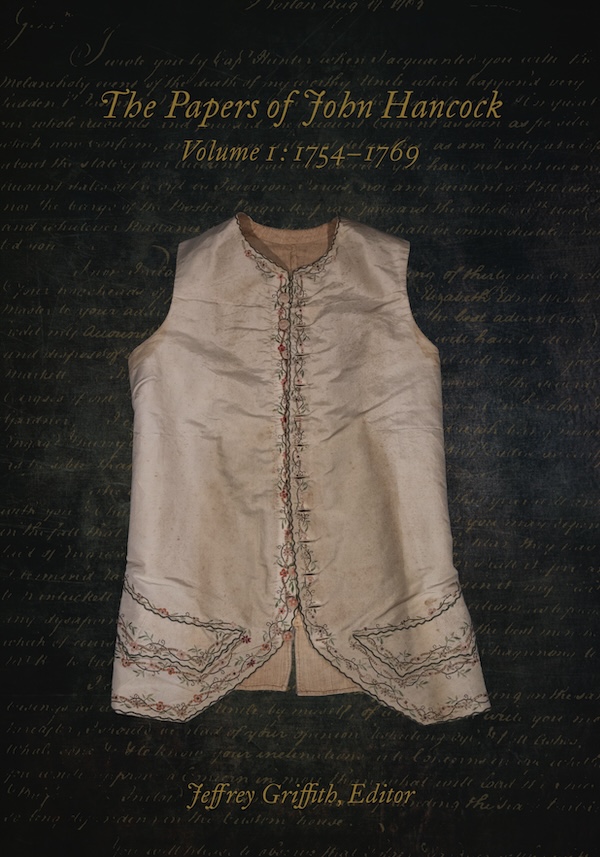
The newly released first volume of The Papers of John Hancock, covering the years 1754–1769, doesn’t even have an index entry for Samuel Adams. Hancock was politically active in that time, as a Boston selectman and representative in the Massachusetts General Court. But he did his politicking in person, not in (preserved) letters or newspaper essays.

In contrast, the first volume of the Writings of Samuel Adams, covering 1764–1769, includes a couple of items defending Hancock from charges of fomenting riots: a 1768 letter written for the signature of House speaker Thomas Cushing and a 1769 newspaper essay signed “Candidus.” Hancock also served on several committees with Adams, but Adams gets the credit (via a descendant’s biography) for creating those committees’ documents.

In those corpuses, the first sign of a rift between Hancock and Adams appears in a 15 Dec 1771 “Memorandum” that Adams wrote for himself after a conversation with the colony’s deputy treasurer:
This day I waited on Mr. Harrison Gray junr. to acquaint him that I had been informd that he had told John Hancock Esqr. that he heard me say in a threatning manner that Mr. Hancock might think as he pleasd, Mr. [James] Otis had friends & his (Mr. Hancocks) treatment of Mr. Otis would prejudice his (Mr. Hancocks) Election.

Mr. Gray declard to me that he did not hear me mention a Word of Mr. Hancocks Election—that a conversation happend between Mr. John Cotton [deputy secretary of Massachusetts] & myself (Mr. Gray being present) relative to Mr. Otis—that Mr. Cotton said Mr. Otis’ Conduct must be the Effect of Distraction or Drunkeness—that I said I did not think so—but that it rather proceeded from Irritation—that he (Mr. Gray) said if Mr. Otis is distracted why should Mr. Hancock pursue him—& that I answerd that Mr. Hancock might be stirred up by others to do it, but I thought he had better not or it was a pity he should.

This Mr. Gray declared was all that I said relative to Mr. Hancock, in answer to his Question as is before mentiond & that it did not appear to him that I discoverd the least Unfriendliness towards Mr. Hancock. He further said he was willing to give his oath to the truth of this his declaration.

Upon which I told Mr. Gray that it was far from my Intention to make Mr. Hancock displeasd with him, that I was satisfied that Mr. Hancock understood him differently & I should let Mr. Hancock know what he now said, & asked him to repeat it which he did precisely as before—& told me he was freely willing that I should repeat it to Mr. Hancock that if Mr. Hancock & myself desired it he would thus explain it in presense of us both.
Here’s the scan of that document from the New York Public Library.

At this time, Boston had reelected James Otis, Jr., to the House after a year off, hoping he would regain his sanity and efficacy as a legislative leader. Instead, Otis became more inclined to support royal policy and then more irrational, as I discussed back here.

In November, acting in his capacity as a probate judge after a request from the Otis family, Gov. Thomas Hutchinson asked the Boston selectmen to assess whether Otis was “a Non Compos Distracted or Lunatick Person.” The selectmen, including Hancock, decided he needed a guardian. On 3 December, Otis was “carried off…in a post chaise, bound hand and foot,” for treatment.

Samuel Adams’s memorandum doesn’t say when he discussed Otis with Cotton and Gray. Adams had tried to gloss over the situation: Otis was acting from “Irritation,” he insisted, not “Distraction or Drunkeness.” As to why Hancock thought otherwise, he “might be stirred up by others.”

This episode belies the common picture, pushed by Loyalists and adopted by many authors since, that Adams was the savvy politician pulling Hancock’s strings. Not only was Hancock breaking from Adams, but the merchant had a better sense of the situation. Otis needed help, and he was losing popular support. In the spring of 1772, the North End Caucus (in my reading) and then the Boston town meeting chose never to vote for him again.

The memorandum does show Adams’s keen judgment about what could annoy Hancock, however. Adams had heard, quite possibly from Hancock himself, that Gray had described him as speaking “in a threatning manner.” And what was Adams supposedly threatening? Hancock’s popularity and prospects for reelection. Adams recorded this evidence to show Hancock that he’d said no such thing.

Without this memorandum in writing, we’d have no evidence of Adams worrying that Hancock thought he’d revealed “Unfriendliness” in the fall of 1771.

TOMORROW: Matters come to a head.

Wednesday, October 14, 2026

“They Assured me he wished to be seperated from Mr Adams”

I dug into the early-1770s rift between John Hancock on Samuel Adams the old-fashioned way: By pulling books about those men off my shelves, looking in their indexes, reading the relevant passages, and tracking down the citations.

The earliest signs of trouble appear in the letters of acting governor Thomas Hutchinson, which the Colonial Society of Massachusetts is publishing in a series edited by John W. Tyler.

On 5 June 1771, Hutchinson wrote to a correspondent in Britain, probably John Pownall in the Colonial Office:
I can mention to you what will appear improper in a publick Letter. I was much pressed by many persons well affected in general to consent to the Election of Mr Hancock [to the Council] his connections being large which are strongly prejudiced against me for the frequent refusal to accept of him in Office. They Assured me he wished to be seperated from Mr Adams another Representative of the Town an Incendiary equal to any at present in London and, if I would admit him to the Council, they had no doubt there would be an end to the Influence he now has, by means of his property, in the Town of Boston.

As there had been no advances on his part I could not think it proper for me to follow their advice. I have now reason to think that before another Election he will alter his conduct so far as to justify my acceptance of him which certainly will take off that sowerness of temper from many People which his negatives occasion and unless you think it a step not advisable I believe I shall accept of him.
Hutchinson didn’t state why he believed Hancock would change his behavior. The merchant hadn’t spoken to the acting governor himself. Some men friendly to the royal government (“persons well affected”) had.

Months later, Hutchinson was more confident. On 1 December, he told Gen. Thomas Gage in New York:
The pretenders to Patriotism [in] this Province have always followed the Example of those who make the like pretences in England. They are now quarrelling among themselves. Hancock has declared he will never again connect himself with Adams. They both have their Partizans & like [John] Wilkes & [Richard] Oliver they both declare they will never give up any part of the Cause of Liberty.
Two days later, Hutchinson told his predecessor, Sir Frances Bernard: “At present H & A are at great variance. Some of my friends blow the coals & I hope to see a good effect.”

He wrote to Bernard again on 29 Jan 1772:
If it was not for the Faction in this Town I think the Province would be easy with one Session in a year & it would be enough for the necessary business. This Faction seems to be breaking. The Doctor [Benjamin] Church who wrote the Times is now a writer on the side of Government. Hancock has not been with their club for two months past & seems to have a new set of acquaintance. By means of [Timothy] Folger there have been some overtures. I remember what passed between him & you & therefore shall act with greater caution. His coming over will be a great loss to them as they support themselves with his money.
And finally Hutchinson ventured to describe the situation in an official letter to the Secretary of State for North America, Lord Hillsborough, on 31 January, albeit in veiled fashion: “A Gentleman who has assisted them much by his money and by the reputation which his fortune gives him among the people seems weary of them and I have reason to think is determined to leave them.”

Meanwhile, Adams had sensed some trouble and tried to mend the relationship.

TOMORROW: All a misunderstanding?

Tuesday, October 13, 2026

Mapping Samuel Adams’s Declining Opinion of John Hancock

Among the intriguing questions posed to the A.I. program on the John Hancock Papers website is: “What did Hancock think about Sam ADams”?

The relationship of John Hancock and Samuel Adams fascinated people during their careers, and it continues to be interesting.

I even consulted on a picture book about the two men: Most Wanted, written by Sarah Jane Marsh and illustrated by Edwin Fotheringham.

When I thought about how I’d answer the question, my mind went to several historical moments:
  • The Rev. William Gordon’s anecdote about how Adams “artfully nominated” Hancock for the Massachusetts General Court ahead of John Rowe.
  • Adams’s 11 May 1770 letter to Hancock when the merchant wanted to resign from that legislature after not receiving a unanimous vote in the town meeting, assuring him he was “a most valueable Member.”
  • Gov. Thomas Hutchinson’s (probably unrealistic) hope in the early 1770s to woo Hancock away from Adams with a seat on the Council, a militia command, and other rewards.
  • The Boston Whigs’ choice of Hancock to deliver the Massacre memorial oration in 1774, cementing his place in the radical camp.
  • Hancock and Adams’s activity on 18–19 Apr 1775, including Gordon’s “glorious morning” anecdote.
  • The disagreement between Hancock and Adams over whether they should let the crowd pull their carriage as they entered New York City—at least as reported later by the Adams family.
  • Adams’s opposition to a ball in honor of Martha Washington which John and Dorothy Hancock planned to attend.
  • The growing divide between Hancock and Adams during the Second Continental Congress, as recalled by John Adams in his autobiography’s comment about March 1776: “Mr. Samuel Adams had become very bitter against Mr. Hancock and spoke of him with great Asperity, in private Circles, and this Alienation between them continued…”
  • The dispute within the Congress over whether it should thank Hancock when he resigned as chair in October 1777.
  • Samuel Adams’s catty comments about politicians susceptible to flattery in letters to James Warren that same month.
All those data points, however, come from Samuel Adams or others. The question posed is what Hancock thought of Adams.

TOMORROW: Ups and downs.

Monday, October 12, 2026

Making Hay with the Hancock Papers

Dr. Jeffrey M. Griffith’s John Hancock Papers website uses generative A.I. in a way I haven’t seen elsewhere: to answer questions about Hancock and his career based on a database of over 4,000 documents.

It looks like it’s not possible to search for particular words or phrases in the Hancock letters, as one can do at Founders Online. That might come later, after publication of the volumes through the Colonial Society of Massachusetts. Or that approach might reflect my traditional thinking.

Instead, the “search” function is designed around topics, as interpreted through large language model A.I. software analyzing the transcribed letters. The website explains:
Dr. JMG’s AI seeks to find connections between letters, individuals, events, and subjects. The technology, however, requires extensive training – and will become more comprehensive as additional letters are uploaded and questions are posed to the platform. As a Private AI system, all responses to prompts are entirely generated from the content of the uploaded letters on this website and are not impacted by external sources.

The responses point the user to the primary source material. Any interpretation provided by Dr. JMG's AI response should not be considered authoritative, but rather as a step for the user to interpret and interact with the primary source material.
The queries and answers appear on the Community Bulletin Board, an archive going back to spring 2025. Early on we can see the program responding then that it doesn’t yet have information to answer questions, later (presumably after more documents have been entered into the archive) providing answers. Presumably, we see evidence of the software being “trained.”

One example caught my eye. On 25 Aug 2025, the system responded to the query “Is rain mentioned?” with this text:
Yes, rain is mentioned in the context provided. Specifically, it is noted: "It has been quite otherwise here, I have not known aHotermore Wet Summer, & We have a prospect of a great Quantity of Hay." This indicates that the summer was particularly wet, implying significant rainfall.
In a keyword search of the letters’ text, looking for “rain” wouldn’t have caught the phrase “Wet Summer.” But, depending on its sensitivity, it could have flagged words like “constraint.” For someone seeking meteorological commentary, therefore, that type of search would produce both false negatives and false positives.

A search method that could interpret “rain” as more than a series of four characters, extend that term to find “Wet Summer”—or “storm,” “dry,” “weather,” and related terms—and summarize the findings accurately could indeed be very useful.

However, that query response doesn’t state the source of the words it presented in quotation marks. And there appears to be some garbling: “aHotermore Wet Summer.” So I tried to trace back that response by querying for the phrase “quantity of hay,” thinking that would take me to the specific text, suitable for quoting and citing.

With and without quotation marks, that “quantity of hay” phrase produced long replies beginning:
  • “50 sources analyzed / In my extensive review of the 3,900+ letters held within the Hancock Archives, there appears to be no specific mention of the ‘quantity of hay’ in any of the documents. . . . ”
  • “50 sources analyzed / After thorough analysis of John Hancock’s correspondence, the term ‘quantity of hay’ does not appear directly in any of the letters in the existing metadata. . . . ”
Likewise, asking about the phrase “wet summer” immediately produced paragraphs of prose on Hancock’s health and business activities, but nothing about summer weather. That response cited a specific letter, dated 14 Nov 1771; it refers a couple of times to “Summer” but says nothing about wetness.

All the responses to my queries came with lists of documents in the database which I could click on, but with no sign of which was most pertinent to the answer. Checking the topmost document, and then random links on the list, showed that some had little connection at all. Several of the documents linked to “quantity of hay” referred to Hancock’s London contacts Hayley & Hopkins—perhaps “hay” producing false positives the same way “rain” did. 

Given large language models’ proclivity for outputting plausible statements that have no basis in reality—what experts call “hallucination”—I now can’t be sure Hancock or his correspondents ever wrote about a “Wet Summer” and a “Quantity of Hay.” If somebody did, I’m no closer to finding that document.

To sum up, I was initially impressed by the potential for an A.I.-assisted approach to searching a large database of documents. After a test, I came away with more dubious questions than solid answers. Will additional training improve the results? According to some experts, “hallucinations” are baked into the system.

TOMORROW: Hancock and Adams.

Sunday, October 11, 2026

Seeking a Look at John Hancock

I asked Jeffrey M. Griffith, editor of the Colonial Society of Massachusetts’s new Papers of John Hancock series, about computerized handwriting transcription in part because his website for that project includes elements created with generative A.I.

At the bottom of the home page, for example, are three “John Hancock Videos.” It looks like these started with period images of Hancock—the well known John Singleton Copley painting and a couple of engravings. I presume the engravings were colorized.

Then all three images were fed through the sort of program that animates portraits so the subject appears to move their head, eyes, and mouth. These Hancocks deliver statements on different topics derived from the man’s actual writings through large-language-model A.I.

Those sorts of moving portraits were all the rage online a few years back. The early models showed us George Washington and the like swiveling their eyes and smiling. I wondered then how the results would look if we fed in a photograph of someone we’ve all seen really moving—a twentieth-century President or movie star. Would the output still be impressive, or would the uncanny valley open?

Just this week I saw a similar animated portrait incorporated into a museum exhibit. Now that the technology exists, it might become a standard way to enliven images for the public. Or it may be remembered as a hallmark of the 2020s. At least with figures as old as Hancock, no one will be fooled into thinking it’s genuine footage.

Dr. Griffith alerted me to another way he found an A.I. program valuable:
With that said, a very recent positive use of AI for research that I have come across is Harvard’s Collection Explorer. The metadata and previous digitalization efforts that they have worked on over the past decade has allowed them to create a tool that digs deep into their holdings.

I had a list of a handful of letters that I needed to find from Houghton Library that I could not previously uncover through their traditional search engine, and I was able to find them through this tool. Additionally, I found letters for Hancock that I have never seen cited before, nor did I know they existed. This nearly blew up Volume 2, but fortunately I was able to slip in a letter before the book design was completed.

To summarize, the actual readily-accessible tools to transcribe are not quite ready for wide use…, but the integration of AI searching has done great things for the discovery and acquisition of the materials for me to transcribe.
That speaks to one of the particular challenges of assembling John Hancock’s papers. While some families had the motivation and wherewithal to preserve a famous ancestor’s files, providing a big home base for a documentary project, others didn’t.

Also, I’m pleased to know other people find the Harvard library catalogue requires advanced technology to navigate.

Saturday, October 10, 2026

Improving Transcriptions of Handwritten Documents

Even as I muse on the value of A.I. programming for transcribing historical handwritten documents, the Fold3 service announces:
We’ve unlocked 2.4 million pages of Revolutionary War Pension Files with a state-of-the-art, patent-pending Transcription Viewer.
For paid subscribers, the service offers multiple ways to see the scanned documents and its transcriptions at the same time—that seems to be the patent-pending part. But beneath that function are the transcriptions themselves.

Fold3 launched “Full-Text Search” of the Revolutionary War Pension Files in March. However, its staff says, “Handwriting recognition technology has really advanced since” that time, so the service now provides “Dramatically improved line-by-line transcription quality.”

The improved transcriptions were produced, says the staff, “primarily with AI with lots of human interaction.” It’s not clear what form that human interaction took—staff hours, volunteers, feedback from users, advanced programming?

Human oversight still seems to be key. When I asked Dr. Jeffrey M. Griffith of the John Hancock Papers about his impression of the latest handwriting-recognition software, he said:
I have not used AI tools to transcribe the manuscripts, as I have found that widely-accessible large scale models like Chat GPT, Claude, and Grok are not as accurate as I desire. What’s even more troubling for my project in particular, is that the same prompt can result in different outputs. Most problematically, in some instances where I have tested the systems, if the system is uncertain, it just creates contents that may not even be relevant to the particular manuscript.

Knowing how specialized AI systems can get, I am sure there are some extremely powerful (and equally expensive to use) models continue to improve reading handwriting from various decades and centuries, but I have not explored those. Admittedly, even if an AI system is to be used for an initial transcription, the content needs to be thoroughly reviewed and compared to the original text.
Griffith judges the basic transcription tools available now as “much better than those very early efforts by Clements Library at University of Michigan.” Transkribus or a similar service might today produce better results from the Gage Papers. Conversely, if “lots of human interaction” is key to continual improvement, that site might benefit from providing a clear channel for user feedback on texts.

Because the profession of documentary editing puts such value on accuracy, people working in the field would naturally be wary of A.I.-produced transcriptions until they’re much more reliable. A text with errors could mislead readers. More likely, in a time of tight budgets, an institution might decide that a text with errors is good enough and not put funds toward professional-quality transcriptions.

All that said, I do use imperfect transcriptions like those on Google Books or the Gage Papers as my starting point when I quote documents. I did that with texts produced through O.C.R. programs, and I’m doing that with texts produced through A.I.

I find those imperfect databases easier to search, read, and quote than online archives without any transcriptions, like the New York Public Library’s scans of the Samuel Adams Papers and Boston Committee of Correspondence Papers.

So for me the bottom line is the more information that’s available in an online archive, the better. Scans better than mere lists of documents. Scans and bad transcriptions better than scans alone. Good, authoritative transcriptions without scans very useful, and good transcriptions with scans the best of all.

TOMORROW: Other ways of using A.I.

Saturday, August 15, 2026

Spreading the News of the Spread of a Fire

We can see the spread of news in the spring of 1775 through articles on the fire in Boston on the night of 17–18 May 1775.

The first printed report appeared in Samuel Hall’s Cambridge-based New-England Chronicle on 18 May, in the middle of other local news:
A terrible Fire broke out in Boston about 9 o’Clock last Evening, and raged a long Time. We hear it began just above the Draw Bridge, and burnt along the Town-Dock. A great Number of Buildings are doubtless consumed; but it is not possible to collect the Particulars for this Paper.
That same dire but vague paragraph was reprinted in Hartford on 22 May, Portsmouth on 26 May, and Philadelphia on 29 May.

Ebenezer Watson’s Connecticut Courant of Hartford confirmed that report in the 22 May issue by also quoting “a Letter from a Gentlemen in Cambridge…dated May 18”:
They had a great Fire in Boston last Night---it appeared to be between King-Street and the Market---it continued all night, and is not yet extinguished. What has really happened, is to us uncertain, as yet.
James Rivington chose to run the latter item in his 25 May New-York Gazetteer.

Meanwhile, on 22 May Solomon Southwick’s Newport Mercury offered an extract from “a manuscript account of the fire which happened in Boston last Wednesday night”:
The fire began in the barracks, under the arch formerly improved by Benjamin Davis, about half after eight o’clock, 17th May.—The soldiers were receiving some cartridges, by which means one took fire, and communicated to many more, which immediately set fire to the room.
That account then listed many property owners starting with John Hancock and including “a cooper’s shop, owned by Eliakim Hutchinson, adjoining the town dock, improved for barracks.” It concluded:
Instead of ringing the bells as usual, the soldiers beat to arms, by which means the people were in great confusion, not being used to such signals in time of fire.

N.B. The inhabitants took particular care to save the goods in Mr. Hancock’s store.
Curiously, in his 26 May New-Hampshire Gazette Daniel Fowle printed a version of that same detailed report on page 1 even as on page 3 he ran the New-England Chronicle’s first story saying it was “not possible to collect the Particulars for this Paper.”

John Holt put the “manuscript account” in his New-York Journal on 1 June with the dateline “CAMBRIDGE, May 12”—an obvious error since the fire hadn’t yet occurred then. Presumably Holt’s shop should have printed 19, 21, or 22 May, getting one digit wrong or transposing them.

No newspaper was published in Cambridge on those dates, suggesting Holt indeed took that text from a manuscript, not from a preceding newspaper. In addition, that text never appeared in the New-England Chronicle, the only newspaper then published out of Cambridge.

That strongly suggests that the Patriot authorities in Cambridge, perhaps Boston town officials in exile, sent their own quasi-official report on the fire out to newspapers in other colonies.

TOMORROW: A more pointed description.

Friday, August 14, 2026

“The 65th lost their Arms, Cloathing, and everything”

Yesterday I quoted the first newspaper account of the fire at the 65th Regiment’s barracks on the Town Dock, rented from the Loyalist merchant Benjamin Davis.

Here are some more accounts from the town, starting with Lt. John Barker’s journal entry for 18 May:
About 9 oclock last night a fire broke out in the Barracks of the 65th Regt. on a Wharf near the Market: every house on the Wharf, amounting to 41, was burnt to the Ground, and most of the things in them; the 65th lost their Arms, Cloathing, and everything; and the 47th has lost 4 Companies cloathing; the loss altogether is considerable as they were all stores on the Wharf and full of Goods. – A chest of Bullets was found in [John] Hancock’s store.

Coll. [James] Abercrombie Adjt. Genl., lately arrived from England, going up Cambridge river this morning in a Man of War’s Boat was fired upon by several of the Rebels from the Banks; several balls went thro’ the boat but nobody was hurt; they made the best of their way back, and I don’t hear that he has been as fond of reconnoitring since.

Detachments from the different Corps were sent to extinguish the fire, which had began to break out again; in 4 or 5 hours they effected it.
Merchant John Rowe put in his journal:
17 May … About Eight of Clock A Terrible Fire Broke Out in the Barracks on Treats Wharff Occupied by the 65th Regiment. it was Occasiond by Accident or rather from Great Carelessness — it destroyd 33 Stores on Dock Square — Mine was in Great Danger I thought it So & therefore removd Great part of my Effects — from thence. it continued untill half past One with Progress — The Officers Behavd Very Well

The Cloathing of 4 Companies belonging to the 47th. Regimt was burnt & Some Fire Arms Lost

18 May Thursday Warm Weather W So. W — The People in General very Busy in Collecting the Effects that were Sav'd Out of the Fire
Rumors were more dire, as usual. From Salem, Nathaniel Appelton wrote: “There has been a very great fire at Boston last night don’t yet learn the particulars but in generall that it broke out near draw-bridge & consumed many buildings; some say 30, some say 100, oh poor Boston!”

In fact, this fire appears to have been confined to a central business district. Although lots of warehouses and stores were destroyed, along with the goods inside them, no private homes were lost—just the 65th Regiment’s quarters.

TOMORROW: Newspaper coverage.

Monday, August 03, 2026

“So disagreeable that one half of the Congress withdraw”

Delving into the newly published John Dickinson letters also led me back into the notes of the Continental Congress during 1775.

The official record that secretary Charles Thomson kept for eventual publication was often anodyne. The delegates made themselves into a committee of the whole to avoid going on the record, and of course Thomson was politic about what he recorded.

But some delegates kept their own notes. In this period Silas Deane kept busy summarizing arguments and then grading the speakers.

Neither Dickinson nor John Adams came off in Deane’s notes as so composed and effective as they would have liked.

In his memoir Adams described himself as “not having ever been remarkable for very long Harrangues.” But on 15 May Deane described the Massachusetts man’s remarks as “lengthy, and argumentative.”

Dickinson felt he was guiding the Congress to a safe middle course. That same day Deane wrote that the Pennsylvanian “argues smoothly but Sophistically on the Subject and gives rather disgust.”

And here’s the delegates’ interactions on 24 May:
Mr. Dickinson in his old Way lengthy, and concludes in his old Way with a Fable

Mr. [Thomas] Mifflin animadvests[?] with spirit on him and exposes his reasoning &c

Mr. [Thomas] Johnson, on a reconciling plan and offers a Motion.

Col. [Richard Henry] Lee for a different mode of expression in ye Motion and is severe on Dickenson

Mr. Jno. Rutledge against any Concession whatever, that Lord North has given Us his Ultimatum with which We cannot agree. Treats Dickinsons plan with the upmmost Contempt. and is so severe that [Samuel] Chase rises to explain himself.

Col. Lee up again

Mr. [Thomas] Stone of Maryland so disagreeable that one half of the Congress withdraw
Deane’s 1775 notes were published in Letters of Delegates to Congress, and they can easily be found online at From the Page and American Founding.

Meanwhile, the Congress’s official record of 24 May 1775 is:
Peyton Randolph, President, returned to Virginia where he was Speaker of the Assembly. John Hancock was unanimously chosen President.

Samuel Ward reported that the committee of the whole had made progress in the business of the state of America, but not having come to a conclusion, requested permission “to sit again.”

Adjourned till to Morrow at 9 o’Clock.
Deane’s notes show what was really behind that “progress.”

Sunday, July 05, 2026

John Hancock’s Enclosures

The Continental Congress approved its edited text of the Declaration of Independence in the middle of the day on 4 July 1776.

The delegates moved on to other business while a clerk—most likely Timothy Matlack—wrote out the final text neatly.

John Hancock signed that document as Congress chairman. Charles Thomson signed as secretary. Then it went to printer John Dunlap.

Years later, a handful of Philadelphians recalled hearing the Declaration, or part of it, read to the crowd outside the Pennsylvania State House that afternoon. This wasn’t the official proclamation, just someone like Matlack sharing news.

Dunlap’s shop set the text in type and printed copies that evening and into the next day. Those broadsheets were to go to the delegates, the army, and the Patriot governments of the new states.

On 5 July, 250 years ago today, Hancock started to fulfill his duty of distributing copies. He wrote to the Pennsylvania Committee of Safety:
I do myself the Honour to enclose, in Obedience to the Commands of Congress, a Copy of the Declaration of Independence; which I am directed to request, you will have proclaimed, in your Colony, in the Way and Manner, you shall judge best.

The American States being now for ever divided from those who wished to destroy them, it has become absolutely necessary for their Security and Happiness to adopt some Government of their own. In this View of the Matter, the important Consequences, flowing from a Declaration of Independence, considered as the Ground & Foundation thereof, will naturally suggest the Propriety of proclaiming it in such a Mode, that the People may be universally informed of it.
On the same day Hancock put two of those three sentences into a letter to the New Jersey Convention that first discussed moving prisoners to York, Pennsylvania.

On 6 July, Hancock signed more letters. These went to the New York Convention, Gov. Jonathan Trumbull of Connecticut, Gov. Nicholas Cooke of Rhode Island, the Massachusetts General Court, and the New Hampshire Assembly:
Altho it is not possible to foresee the Consequences of Human Actions, yet it is nevertheless a Duty we owe ourselves and Posterity in all our public Counsels, to decide in the best Manner we are able, and to trust the Event to that Being who controuls both Causes and Events so as to bring about his own Determinations.

Impressed with this Sentiment, and at the same Time fully convinced that our Affairs may take a more favourable Turn, the Congress have judged it necessary to dissolve all Connection between Great Britain & the American Colonies, and to declare them free and independent States, as you will perceive by the enclosed Declaration, which I am directed by Congress to transmit to you, and to request you will have it proclaimed in your Colony in the Way you shall think most proper.

The important Consequences to the American States from this Declaration of Independence, considered as the Ground & Foundation of a future Government, will naturally suggest the Propriety of proclaiming it in such a Manner, that the People may be universally informed of it.
Hancock finished that task on 8 July, sending the Declaration to states to the south. His letter to Georgia has been sold a couple of times in the last decade.

TOMORROW: Publication.

Thursday, May 14, 2026

Twenty Years of Boston 1775

Twenty years ago today, on 14 May 2006, I posted my first item on this blog.

That post was a link to an article I’d written for the magazine then called New England Ancestors, now American Ancestors, published by the New England Historical and Genealogical Society.

The original link broke. A subsequent link from 2012 broke. But Boston 1775 is still here.

That article described how a message from Dr. John Homans to his mentor, Dr. Joseph Gardner, in the first days of the Revolutionary War was detoured by the duplicitous Dr. Benjamin Church, Jr.

Last August I revealed other messages that Dr. Church diverted into the files of Gen. Thomas Gage, from Boston magistrate Edmund Quincy to his daughter Dorothy and her fiancé, John Hancock.

Tonight I’m speaking in Stoneham about how Dr. Church managed to infiltrate Gen. George Washington’s network for sneaking intelligence out of besieged Boston before the Continentals realized their surgeon-general as a spy.

One way to look at this situation is that after twenty years of daily blogging I’m still working the same ground.

Another is that Dr. Benjamin Church’s treachery is an endless source of revelations and fun.

Saturday, May 09, 2026

Declarations of Independence around Boston—Collect Them All!

To commemorate the 250th anniversary of the Declaration of Independence, multiple institutions in greater Boston have collaborated to lay out a Declarations Trail—exhibits of different significant copies of that document.

The Leventhal Map Center at the Boston Public Library has opened “Declarations: Printing a New Nation” with eight printings from broadsides and newspapers, along with maps showing the spread of that news. It will be up through 13 September. Shown here is the library’s copy of the Declaration as printed by Ezekiel Russell for the newly independent Massachusetts government.

The Boston Athenaeum exhibit “Imagined Nation” displays early printings in the context of such items as George Washington’s copy of Thomas Paine’s Common Sense, maps of the young republic, and World War II–era posters. That runs through November.

The Massachusetts Historical Society’s “1776: Declaring Independence” display, up through December, includes “handwritten copies of the Declaration by John Adams and Thomas Jefferson as well as multiple early printings, including a rare Dunlap broadside.” That was the first official presentation of the text, commissioned from printer John Dunlap by the Continental Congress in July 1776.

In Cambridge, three parts of the Harvard University library system are creating linked displays. The university archives is offering “Harvard and the American Revolution.” Next week the Harvard Map Collection will open “Charting Independence.” And starting on 18 May the Houghton Library will host “War of Words,” a display assembled by curator John Overholt to feature “the posters, pamphlets, newspapers, and images that brought news of the American Revolution to those who lived through it.”

In addition to the sites on the Declarations Trail, the Commonwealth Museum regularly displays Mary Katherine Goddard’s official reprinting of the Declaration signed by John Hancock and sent to the state in 1777.

And the “The Road to Revolution: Massachusetts and the Independence Movement” exhibit in Revolutionary Spaces’s Old State House, drawing on material from the M.H.S., includes a “rare 1776 Boston broadside printing of the Declaration of Independence.”

Most of those exhibits are free to the public. Many have special tours, talks, and workshops scheduled as well.

In a parallel initiative, five Revoloutionary-era institutions with admission fees—the Paul Revere House, Old State House, Old North Church, Old South Meeting-House, and King’s Chapel—have combined to offer visitors the Boston 250 Pass with a 10% on regular adult admission.

Friday, March 20, 2026

“Alarmed in Lexington” in Lexington, 21 Mar.

Evacuation Day over, so it’s time to look ahead to another Patriots Day season. 

On Saturday, 21 March, the Lexington History Museums will host two performances of Alarmed in Lexington, a series of three short plays by Debbie Wiess about events in the Hancock-Clarke House on 19 Apr 1775.

The audience will take in these three vignettes while moving through the house in small groups (including going up and down stairwells).

As the action begins, it’s shortly after midnight and Paul Revere and William Dawes have just left after bringing news of approaching British regulars. The vignettes dramatize the responses of the town minister, the Rev. Jonas Clarke, and his granddaughter Lucy; Massachusetts resistance leaders John Hancock and Samuel Adams; and Hancock’s fiancée, Dorothy Quincy, and his aunt, Lydia Hancock. Those conversations take place in the same rooms where those people were living in 1775.

The performances are scheduled for 4 and 7 P.M. Tickets are limited and cost $40, or $30 for Lexington History Museums members.

Tuesday, August 26, 2025

“Pray the God of Armies to restrain Man”

John Hancock wasn’t the only person Edmund Quincy wrote to on 22 Apr 1775, just after the start of the Revolutionary War, as quoted yesterday.

Justice Quincy couldn’t very well write to Hancock and ignore the man’s fiancée, Dorothy Quincy, could he? After all, she was his daughter.

Thus, we have this second, shorter letter written inside “Boston (a Garison’d town)”:
Dear Dolly—

I’ve an opporty (unexpected) by Doctr. [Benjamin] Church, Just to tell you, that I’m kept from my intended Journey to L[exing]ton & [Lene’y?] by restraint of Princes—endeavors are using to obtain an opening but how soon, none know!

It’s ye. will of Heaven, that it should be thus—!—To His Will, let us learn Submission, thro’ all the Changing Scenes of a Short uncertain Life—I pray God we may all learn this profitable Lesson, that we may be reaping the advantage at all times, especially in a time of Sharp trials, to wch. we are in every State more or less liable

We are generally in good health—but as generally under great sorrow, for the loss of so many humane lives, Wednesday last: pray the God of Armies to restrain Man, from further Attempts of a Similar kind—

Your Bror. & family propose removal—to Providence—if the Gates are opened to us—your Trunk is here—if mine go, yours will also—

I condole with Madm. [Lydia] Hancock, & you, under present & late Circumstances of things—I hope to see you soon, if it please God

Interim recommending you to his protection, with. all your near-Connexions in this devoted Town—I am with my Sincere regards to Madm. H. Mr. [Jonas] Clark & Lady—, Dear Child, Your Affectionate Father & Friend
Edm: Quincy

[Postscript:] Your S[iste]r. [Esther] Sewall distress’d, with ye View she has of things

[Postscript vertical along left margin:] I hope Mr. H. is well on is Journey—you are happy in yo. being out of this town—tho’ ye. Govr. Speaks Fair He is much troubled himself
Esther Sewall was another of Edmund Quincy’s daughters, married to royal attorney general Jonathan Sewall. She evidently had a close-up “View” of the administration of Gen. Thomas Gage and was “distress’d” at what lay ahead.

TOMORROW: The letter carrier.