


J. L. BELL is a Massachusetts writer who specializes in (among other things) the start of the American Revolution in and around Boston. He is particularly interested in the experiences of children in 1765-75. He has published scholarly papers and popular articles for both children and adults. He was consultant for an episode of History Detectives, and contributed to a display at Minute Man National Historic Park.

Subscribe thru Follow.it


•••••••••••••••••


Showing posts with label Thomas Anburey. Show all posts

Monday, August 19, 2024

“Claimed to be Burgoyne in order to get better quarters”?

Sherman Lohnes left a helpful comment on these lines in yesterday’s posting about Elisha Porter:
He later served in the Saratoga campaign as a militia colonel and escorted Gen. John Burgoyne east. According to the Porter family, Burgoyne left his host a dress sword.
Since December 2022 Lohnes has shared a blog on The 1777 March of the Saratoga Convention Army, the prisoners of war in Continental custody after the Saratoga battles.

Using sources and reminiscences of that journey, the blog reexamines a lot of the lore and local traditions about it.

Lohnes commented:
It's highly unlikely that General Burgoyne gave Elisha Porter his sword - or even that Porter accompanied Burgoyne from Saratoga to Cambridge.

Burgoyne offered his sword in surrender to General Horatio Gates on October 17th at Saratoga, who graciously allowed him to keep it. Prior to the surrender, Burgoyne took pains to negotiate terms with Gates that allowed all of his officers to not only keep their swords, but wear them while they were being held in Massachusetts.

Finally, Burgoyne didn't stay with Porter in Hadley. New Hampshire Militia Brigadier-General William Whipple, who did travel with Burgoyne and kept a journal of their trip, indicates that they crossed the Connecticut River south of Hadley, from West Springfield into Springfield, before continuing on through Palmer to Brookfield, and eventually Cambridge…
In this blog post, Lohnes wrote:
Though Porter was a colonel, and commanded the 4th Hampshire County Regiment of the Massachusetts Militia, which marched on September 24, 1777, to reinforce the Northern Army and served until October 17, 1777, Brigadier-General William Whipple’s Journal indicates Burgoyne did not pass through Hadley.

If Burgoyne didn't stop in Hadley (or Northampton), what may have led its residents think that he did? Perhaps the source of these tales is explained by British Ensign (and author) Thomas Anburey. According to Anburey, at some point along the march one of the officers with the British column went on ahead, and claimed to be Burgoyne in order to get better quarters. Being the first to reach "a small village, he personated General Burgoyne, and with such an air of confidence..." that his hosts being "compleatly outwitted, they assigned him the best quarters."
Another possibility is simply that the Porter family’s understanding of what happened grew in the telling from one generation of children to another. Marching out to Saratoga and back again in parallel with some prisoners from Burgoyne’s army could have become escorting the British general himself. A British officer’s dress sword acquired in any sort of way could have become connected to the most famous officer in that army.

Family and local historians writing in the 1890s and 1900s described seeing that sword, and they didn’t use the same language, indicating they observed independently. That strongly suggests the Porter family did own such an artifact. But evidently not an accurate knowledge of where it came from.

Monday, August 15, 2022

The Memory of Gen. Simon Fraser

Brigadier general Simon Fraser had a long career in the British army before dying in the Battle of Saratoga.

Even so, it appears that Gen. John Burgoyne’s description of his funeral, quoted back here, made Fraser into a British icon of sorts.

Burgoyne’s efforts were helped along by another narrative of that event in Lt. Thomas Anburey’s Travels Through the Interior Parts of America, published in 1789. Anburey wrote:
About sun-set, the corpse was carried up the hill; the procession was in view of both armies; as it passed by Generals Burgoyne, [William] Phillips and Riedesel, they were struck at the plain simplicity of the parade, being only attended by the officers of his suite…and urged by a natural wish to pay the last honors to him, in the eyes of the whole army, they joined the procession.

The enemy, with an inhumanity peculiar to Americans, cannonaded the procession as it passed, and during the service over the grave. The account given me by your friend Lieut. [Quin John] Freeman was, that there appeared an expressive mixture of sensibility and indignation upon every countenance—the scene must have been affecting.
Anburey spent years as a prisoner of war with the Convention Army—that was how he traveled through the interior parts of America. He didn’t come away with any fondness for the host nation.

In the same year Anburey’s account was published, a print appeared on the London market titled “View of the West Bank of the Hudson’s River, 3 Miles above Still Water, Upon which is the Army under the Command of Lt. Gen. Burgoyne (Showing General Frazer’s Funeral).”

Follow this link to a digitized image of this print from the Yale University Art Gallery. On the rightmost of the three hills is a line of tiny figures following two coffins. Some experts interpret the second one as representing Burgoyne’s aide-de-camp Sir Francis Clarke, also killed in the battle though not in any account buried with Fraser.

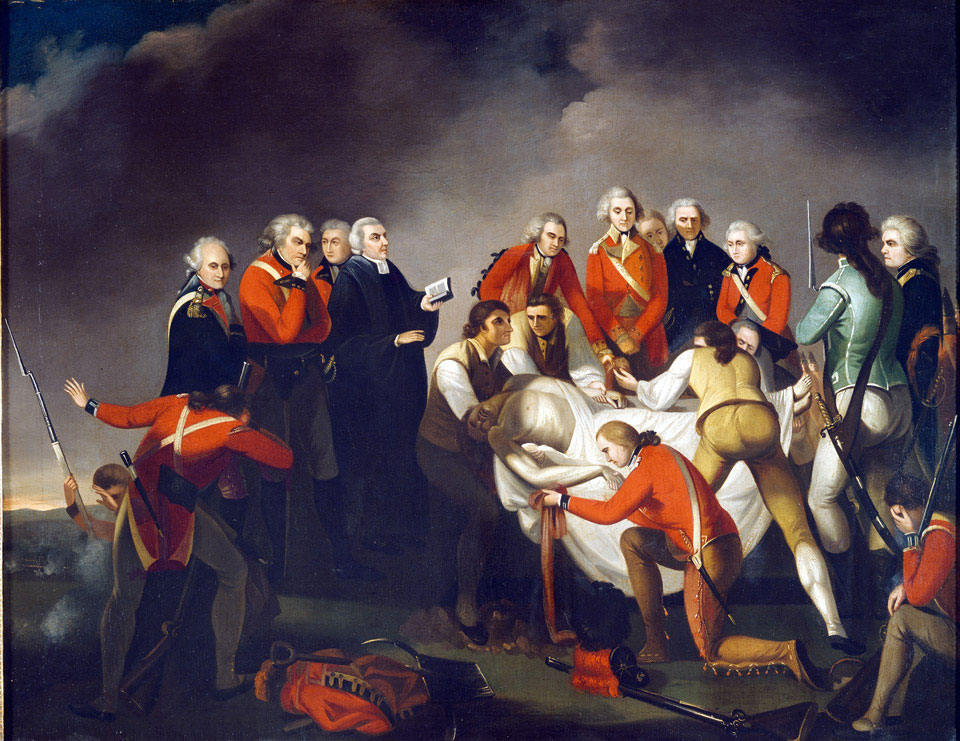
Finally in 1791 the Scottish artist John Graham (1754–1817) exhibited a painting of Fraser’s funeral. Graham was influenced by Benjamin West’s picture of the death of Gen. James Wolfe in 1759. So much so, in fact, that one critic of the time reviewed The Funeral of General Fraser by saying: “We should have been more pleased with the picture if we had not seen The Death of General Wolfe by West.”

As West had done before him (and as other West acolytes like John Singleton Copley and John Trumbull did), Graham sought out the officers who had been at the event he was depicting. He made studies of those men and portrayed them as individuals in his scene. That painting was made into a print in 1794, and the print was issued with a key to the figures.

(I can’t find Graham’s original on the web; the image above shows a copy in the collection of the National Army Museum.)

Burgoyne, Anburey, and Graham thus crafted Fraser’s funeral into an emblem of British fortitude and propriety even in defeat. This stuff-upper-lip behavior could easily, as Don Carleton commented last week, tip into Monty Python–style satire. Still, it was effective.

American chroniclers of the Battle of Saratoga felt a need to quote Riedesel and Burgoyne on Fraser’s death and metal—those sources are just too full of drama to ignore. But the same historians often added a protest that if only the British commanders had told the Americans that the generals were gathering for a funeral there would have been no artillery fire. I’m not entirely convinced.

Tuesday, September 25, 2012

“A very extraordinary method of courtship”

Last week I quoted the Rev. Samuel Peters’s comments about the New England custom of bundling, first published in London in 1781. Six years before, another minister, the Rev. Andrew Burnaby, Vicar of Greenwich, England, had reported on a similar habit in Massachusetts.

In his 1775 book Travels through the Middle Settlements in North-America, in the Years 1759 and 1760, Burnaby wrote:
Singular situations and manners will be productive of singular customs; but frequently such as upon slight examination may appear to be the effects of mere grossness of character, will, upon deeper research, be found to proceed from simplicity and innocence. A very extraordinary method of courtship, which is sometimes practised amongst the lower people of this province, and is called Tarrying, has given occasion to this reflection.

When a man is enamoured of a young woman, and wishes to marry her, he proposes the affair to her parents, (without whose consent no marriage in this colony can take place); if they have no objection, they allow him to tarry with her one night, in order to make his court to her.

At their usual time the old couple retire to bed, leaving the young ones to settle matters as they can; who, after having sate up as long as they think proper, get into bed together also, but without pulling off their undergarments, in order to prevent scandal. If the parties agree, it is all very well; the banns are published, and they are married without delay. If not, they part, and possibly never see each other again; unless, which is an accident that seldom happens, the forsaken fair-one prove pregnant, and then the man is obliged to marry her, under pain of excommunication.
In a footnote Burnaby added:
A gentleman sometime ago travelling upon the frontiers of Virginia, where there are very few settlements, was obliged to take up his quarters one evening at a miserable plantation; where, exclusive of a Negro or two, the family consisted of a man and his wife, and one daughter about sixteen years of age.

Being fatigued, he presently desired them to shew him where he was to sleep; accordingly they pointed to a bed in a corner of the room where they were sitting. The gentleman was a little embarrassed, but being excessively weary, he retired, half-undressed himself, and got into bed. After some time the old gentlewoman came to bed to him, after her the old gentleman, and last of all the young lady.

This, in a country excluded from all civilized society, could only proceed from simplicity and innocence: and indeed it is a general and true observation, that forms and observances become necessary, and are attended to, in proportion as manners become corrupt, and it is found expedient to guard against vice, and that design and duplicity of character, which, from the nature of things, will ever prevail in large and cultivated societies.
Burnaby’s picture of sharing beds was considerably more benign than Peters hinted at. He also emphasized that the practice prevailed “amongst the lowest people” in Massachusetts and along the Virginia frontier, not all classes.

Another British visitor who encountered bundling in Massachusetts was Lt. Thomas Anburey, taken prisoner in 1777. I quoted his recollections, published in London in 1789, back here.

TOMORROW: The observations of a visitor from France?

Friday, October 02, 2009

“I did not go to bundle with her”

In 1777, Thomas Anburey was a young officer in Gen. John Burgoyne’s army thrusting down into the U.S. of A. from Canada. Then Anburey was a prisoner of war, being marched to Boston. Twelve years later, he published his observations on that experience in the form of a series of letters home.

Here’s Anburey writing about a surprising night he spent just outside Boston:

The night before we came to this town, being quartered at a small log-hut, I was convinced in how innocent a view the Americans look upon that indelicate custom they call bundling: though they have remarkable good feather beds, and are extremely neat and clean, still I preferred my hard mattrass, as being accustomed to it;

this evening, however, owing to the badness of the roads, and the weakness of my mare, my servant had not arrived with my baggage, at the time for retiring to rest; there being only two beds in the house, I enquired which I was to sleep in, when the old woman replied, “Mr. Ensign,” here I should observe to you, that the New England people are very inquisitive as to the rank you have in the army: “Mr. Ensign,” says she, “Our Jonathan and I will sleep in this, and our Jemima and you shall sleep in that.”

I was much astonished at such a proposal, and offered to sit up all night, when Jonathan immediately replied, “Oh, la! Mr. Ensign, you won’t be the first man our Jemima has bundled with, will it Jemima?” when little Jemima, who, by the bye, was a very pretty black-eyed girl, of about 16, or 17, archly replied, “No, Father, by many, but it will be with the first Britainer,” (the name they give to Englishmen.)

In this dilemma, what could I do?—the smiling invitation of pretty Jemima—the eye, the lip, the—Lord ha’ mercy, where am I going to?—but wherever I may be going to now, I did not go to bundle with her—in the same room with her father and mother, my kind host and hostess too!—

I thought of that—I thought of more besides—to struggle with the passions of nature; to clasp Jemima in my arms—to—do what? you’ll ask—why, to do—nothing! for if amid all these temptations, the lovely Jemima had melted into kindness, she had been an outcast from the world—treated with contempt, abused by violence, and left perhaps to perish!—

No, Jemima; I could have endured all this to have been blessed with you, but it was too vast a sacrifice, when you was to be victim!—Suppose how great the test of virtue must be, or how cold the American constitution, when this unaccountable custom is in hospitable repute, and perpetual practice.
As social historians have pointed out, in the eighteenth century about a third of all first-time brides in New England gave birth within seven months of marriage. So the American constitution wasn’t really that cold after all.

Tuesday, October 07, 2008

Talk on Andrew Brown’s Newspaper, 14 Oct 2008

On 14 Oct 2008 at 7:30 P.M., the American Antiquarian Society in Worcester will host a talk by David Paul Nord titled “A City and a Newspaper: Citizen Journalism in Philadelphia during the Yellow Fever Epidemic of 1793.” The Federal Gazette was the only paper to publish all during the outbreak. Nord, professor of journalism and adjunct professor of history at Indiana University, will discuss what that newspaper meant to its readers, and how both elites and ordinary people used the press.

The Federal Gazette was edited by Andrew Brown (1744-1797), an intriguing figure. In the nineteenth century people said that he “came to America in 1773 as an officer in the British army, but left that service and settled in Massachusetts. He fought on the patriot side at Lexington and Bunker Hill.”

In fact, Brown came to America as an enlisted man in His Majesty’s 47th regiment. From Steve Gilbert, via Don Hagist, I understand that the regiment’s rolls state that Brown deserted on 2 Feb 1775. Samuel Adams wrote of Brown:

Immediately after the Battle of Lexington he joynd the American Army in which his Zeal & Activity was signalizd—In July 1776 he servd as Major in the Militia of this State at Ticonderoga under Genl [Horatio] Gates—In 1777 he was appointed Depy Muster Master by Col. [Joseph] Ward, and when the Convention Troops arrivd at Cambridge he was employd by Genl [William] Heath as Town Major
As town major in 1778, Brown was in charge of supplies and housing for the large number of prisoners of war captured from the Saratoga campaign. British officers, recognizing Brown as a deserter—and a lower-class Irish one at that—objected to following his instructions and depending on him for supplies. Lt. Thomas Anburey wrote:
The fellow, conscious of his baseness, when he meets an officer of that [47th] regiment, rides hastily away, but you must allow it is rather grating to be in the power and under the command of such a villain.
Gen. Heath obliquely acknowledged that problem in a letter to Gen. William Phillips, ranking British officer:
His former situation and some other Circumstances may have rendered him disagreeable to the officers, and I shall give the matter a proper Consideration.
In turn, Brown was more lenient toward prisoners from Germany than those from England, according to a couple of German sources.

After the war, Brown moved to Pennsylvania, first running a girls’ school and then going into the newspaper business. He was obviously educated and ambitious, and probably found much more opportunity in American society than he would have had in Britain. But his story ended unhappily in Philadelphia. I’ve collected more information about Andrew Brown, but there are still a lot of holes to fill, and I look forward to this lecture.

Tuesday, November 27, 2007

Tempting Away British Musicians in 1778

Gen. John Burgoyne led a British army south from Canada in 1777, but met defeat at the Battles of Bennington and Saratoga. The thousands of prisoners of war became known as the “Convention Army,” after their terms of surrender. For about a year these troops were held in camps outside Boston while the two governments argued over who was breaking that agreement.

That reversed the geographic situation from that of 1774-76, when there were thousands of British soldiers inside Boston. During that earlier stretch, officers struggled to keep enlisted men from deserting to the provincials outside town. In 1777-78, disaffected British soldiers slipped into Boston in order to defect.

Among the officers in Burgoyne’s army was Lt. Thomas Anburey of the 24th Regiment. In 1789 he edited his letters home into a book titled Travels Through the Interior Parts of America, 1776-1781, which spends as much time on natural history as political disputes. He closed his letter dated 20 May 1778 with these anecdotes about deserters from among the Crown’s regimental musicians, who were mostly drummers and fifers:

I am sorry to inform you that the Americans are too successful in enticing our soldiers to desert; a few days since the whole band of the sixty-second regiment, excepting the Master, deserted in a body, and are now playing to an American regiment in Boston. . . .

You will be pleased with a noble and animated saying of a little drum-boy, not ten years old: this boy’s father, who belonged to our regiment, some time since deserted into Boston, and has been as nigh as he could venture with safety to our barracks, to entice or seize his son, and take him with him; but finding it in vain he sent an American to entreat him to go to his father, when the little fellow replied, “No; tell my father, if he is such a rascal as to desert his King and country, his son won’t; he has fed at their expence, and will die in their service.”
If this anecdote is true, this “drum-boy” was the youngest I’ve read about in the British service. Since drums were an eighteenth-century army’s signal corps, commanders wanted reliable men in that job. But of course if this boy was already traveling with his father’s regiment, they’d want to get some good out of feeding him. And he was apparently more loyal to his regiment than to his father.

The rope-tension drum shown above is available from Cooperman.