


J. L. BELL is a Massachusetts writer who specializes in (among other things) the start of the American Revolution in and around Boston. He is particularly interested in the experiences of children in 1765-75. He has published scholarly papers and popular articles for both children and adults. He was consultant for an episode of History Detectives, and contributed to a display at Minute Man National Historic Park.

Subscribe thru Follow.it


•••••••••••••••••


Showing posts with label James Aitken. Show all posts

Saturday, June 06, 2026

“The wider transatlantic workers’ struggle that helped make the American Revolution”?
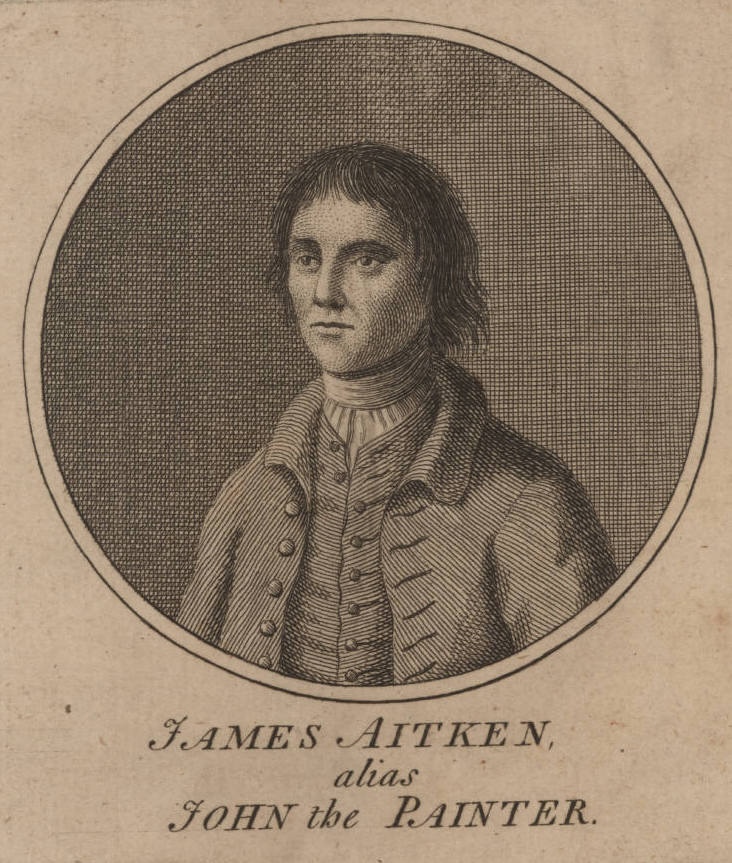
Jacobin just published Tom Cutterham’s essay “Class Struggle Was a Crucial Part of the American Revolution,” reflecting his upcoming book, Empire Ablaze: The American Revolution and the Atlantic Working Class.

The article begins:
Late in 1776, with the War of Independence underway in the American colonies, a twenty-four-year-old housepainter named James Aitken walked into Britain’s most important naval dockyard and set it on fire. The damage was significant: estimates for repairs were twice the value of the tea destroyed at Boston harbor three years earlier.

The sense of threat experienced by Britain’s ruling elite was also profound. Few people today remember Aitken’s acts of sabotage against the British war machine. But they deserve recognition as part of the wider transatlantic workers’ struggle that helped make the American Revolution.
Aitken is the subject of one of my favorite books on the Revolution, Jessica Warner’s The Incendiary. But I’m not convinced he’s good evidence of a transatlantic political movement, even though he did start his life in working-class Scotland, was in Pennsylvania during the first years of the Continental Congress, and then returned to Britain to support the American cause. Aitken didn’t connect with other activists, except for Silas Deane in Paris. He seems to have been socially inept. Aitken was a movement of one.

Likewise, something seems to be missing from the article’s description of the Gordon Riots:
In London too, the long-standing collaboration between laborers, artisans, and the commercial middle class proved a point of fracture as the possibility of revolution grew too close for comfort. When huge crowds took to the streets in the summer of 1780, burning the home of the Lord Chief Justice, throwing open prison gates, and attacking centers of imperial power like the East India Company offices, it seemed as though the “general effort” [Catharine] Macaulay had called for might finally be at hand.
Those riots were spurred by support for a rather mad aristocrat’s protest against a new British law granting more political rights to Catholics. Though the violence threatened the political establishment, was it really for the benefit of the working class?

I expect Cutterham’s longer book addresses the details of these cases. And I don’t disagree that economic friction between the working class and their employers (still called “masters” in many fields) was part of the Revolutionary era. But so were a bunch of other factors that may have driven events more and certainly muddy the waters. Cutterham’s points are worth considering with care.

Sunday, August 28, 2022

Mrs. Macaulay, Dr. Franklin, and Habeas Corpus

In late 1776 the Scottish artisan James Aitken, after receiving some encouragement of American diplomat Silas Deane, left incendiary bombs in the Royal Navy dockyards at Portsmouth and Bristol.

The British authorities tracked down Aitken, who had become known as “John the Painter.” He was tried, convicted, sentenced, and hanged by 10 Mar 1777. (Read the whole story in Jessica Warner’s study The Incendiary.)

Lord George Germain led the national government in another response to Aitken’s attacks: a Treason Act. Like laws that Parliament enacted during previous wars, this allowed the government to hold anyone suspected of treason or piracy without bail or trial—i.e., to suspend the right of habeas corpus—for the rest of the calendar year.

Parliament renewed this law each year until the end of the American war. The Massachusetts General Court passed a similar law to deal with traitors, though it promised more protections for the accused. Eventually the U.S. Constitution would carve out a wartime exception to habeas corpus as well.

Britain’s Treason Act was on Catharine Macaulay’s mind when she visited Paris at the end of 1777. Though her country wasn’t yet at war with France, there were American rebels in the capital—Deane, Arthur Lee, and most famously Benjamin Franklin.

I assume Mrs. Macaulay and Dr. Franklin had met in London during the 1760s when they were both Whig celebrities, but I don’t know if they became more than acquaintances. In late 1777, the two figures were definitely at the same dinner parties. According to Elizabeth Arnold, “Mrs. Macaulay met him several times, among the literati of Paris, at dinners given on her account, but she never received him at her hotel.”

Macaulay made a point of not visiting Franklin or inviting him to visit her. She explained herself to him in a letter dated 8 December:
Sir

I have some affaires which demand my immediat return to England. You are very sensible that the suspenssion of the Habeas Corpus Act subjects me to an immediat imprisonment on any suspicion of my having held a correspondence with your Countrymen on this side the Water. This Sir is the only reason why I did not fix a day to have the honor of seeing you at my own Hotel and why I have not been more forward in availing myself of my present situation to hold converse with my American friends who reside in this Capital.

I am sure Sir that you and every generous American would be exceedingly concerned to hear that my feeble constitution was totaly destroyed by a long imprisonment and to see me fall a sacrifice to the resentment of administration unpitied and unlamented as an impertinent individual who would needs make a bustle where she could not be of the smallest service and especially Sir as I hope the whole tenor of my conduct must have convinced you that I would with pleasure sacrifice my life to be of any real use to the public cause of freedom and that I am now nursing my constitution to enable me to treat largely on our fatal civil wars in the History I am now about.

I am Sir with a profound respect for your great Qualities as a Statesman Patriot and Phylosopher Your Very Obedient Humble Servant.
By “our fatal civil wars,” Macaulay meant the war then taking place in America—the very war that made it dangerous for her to be seen as too close to Franklin. And once again, Macaulay made a point of her delicate health.

COMING UP: Back home in Bath.

Thursday, May 19, 2022

“The most clement measures shall be adopted towards the Americans”

By the fall of 1772, Rhode Island’s investigations of the attack on H.M.S. Gaspee had run aground as surely as the schooner itself had back on 9 June.

As was standard, Gov. Joseph Wanton had quickly issued a proclamation offering a reward for information—£100, in fact. By July, Adm. John Montagu (shown here) had collected testimony from Aaron Briggs or Biggs, who implicated some prominent merchants.

But Gov. Wanton soon had contradictory testimony from four other people.

James Helme, senior justice in Kings County, told his colleagues that at the October court session he
fully intended to give the affair of burning the said schooner and wounding the lieutenant, in charge to the jury; but having been nearly two months on the circuit, it entirely went out of my mind, when the grand jury was empannelled; and there being no business laid before said jury, they were soon dismissed.
Oops.

However, more was happening in London. In August, the secretary of state for the colonies, Lord Hillsborough, sent to Rhode Island the text of Parliament’s new Dockyards Law. Enacted that spring, it established that destroying a ship in a Royal Navy shipyard was tantamount to treason and subject to capital punishment.

Eventually Crown lawyers agreed that the Dockyards Law didn’t apply since the Gaspee hadn’t been in a naval shipyard when the raiders set fire to it. But Hillsborough’s message told Gov. Wanton how harshly the London government wanted to punish the men who attacked the schooner. (The only person ever executed under the Dockyards Law was James Aitken, alias “John the Painter,” who set fires at the Portsmouth Shipyard in 1777 in sympathy with the American cause.)

For unrelated reasons, in August the Earl of Dartmouth replaced Hillsborough as secretary of state. On 4 September the new minister sent a letter to Gov. Wanton detailing the plan for a royal commission to investigate the Gaspee incident and surrounding conflicts.

Rhode Island’s first report of this commission contained some positive details. The 30 November Newport Mercury shared the news under a 25 September London dateline, emphasizing signs of leniency:
His Majesty… [is] offering his pardon to any of the said offenders (excepting the person who wounded Lieutenant [William] Duddington, & excepting two others who assumed to be sheriffs of the colony, and the Captain or leader of the insurgents) who shall discover any of their accomplices, and also offering rewards for such discovery.

A correspondent informs us, that Lord Dartmouth has signified his determined resolution that the most clement measures shall be adopted towards the Americans.
Furthermore, Gov. Wanton was designated to chair the inquiry commission.

But soon, Rhode Islanders were hearing more ominous details.

TOMORROW: A leak from the legislature.

Tuesday, December 18, 2012

What Changed Terrorism Since the 1700s?

What shifted the label of “terrorism” from mob rule, as I described on Friday, to today’s image of it as sneak attacks on civilians by relatively small shadowy groups?

One major factor, I think, was the shift to democratic governance. When America’s Sons of Liberty used mob violence against royal Customs officials, they had little other power over those appointees. Colonists couldn’t vote on those men or their salaries, and they couldn’t vote for the men in London who appointed those men. For all of Boston’s reputation for lawlessness, the pre-Revolutionary period saw no attacks on the town’s elected officials or employees (except by British army officers who resented watchmen’s claims of authority).

In democracies the majority can express its desires through elections and therefore rarely sees a need for violence (with some exceptions, such as the race riots of the 1800s and early 1900s). That has generally left domestic political violence for smaller groups who feel they have no other way to affect the political system. Sometimes those are substantial ethnic or religious minorities who feel oppressed. Sometimes they’re small political minorities who justified in their cause, such as radical abolitionist John Brown in the 1850s or diehard segregationists a century later. Sometimes terrorism is a form of warfare between countries, of course, but even in those cases the terrorists often feel that their targets have oppressed them and occupied their land.

Alongside the change in political structures around the world came change in technology. Scientists like Alfred Nobel invented dynamite and other new explosives. Gunmakers produced machines that shot lots of bullets in a very short time. And we have more control over deadlier poisons, like sarin gas. That means individuals and small groups can produce as much destruction in a short time as an eighteenth-century mob.

When Guy Fawkes and his co-conspirators wanted to blow up King James I and Parliament in 1605, they reportedly assembled thirty-six barrels of gunpowder in a cellar beneath the building. That took months. The first supply of powder decayed and had to be replaced. Eventually people noticed.

It took a Boston crowd all night to ruin Lt. Gov. Thomas Hutchinson’s house in 1765, and the structure remained standing. Destroying the East India Company tea in 1773 required scores of men and boys working for hours and the collusion of hundreds of onlookers.

Similarly, at the Boston Massacre in 1770, seven threatened soldiers killed five people and wounded six. They did so by double-loading their muskets and in most cases firing straight into a densely packed crowd. But after all the soldiers but one had pulled their triggers, they had to reload before another shot. If the crowd hadn’t been too stunned to counterattack, the soldiers’ bayonets would have been their only defenses.

When a sailor named Samuel Dyer tried to shoot two Royal Artillery officers in Boston in October 1774, his pistols misfired, and he ended up chasing them around with one of their swords before running away.

Today’s guns are more efficient at shooting bullets. As last week’s news reminded us, a single person can shoot dozens of people in minutes. We worry that a single individual can conceal enough explosive to kill a bunch of people in a body cavity. Technology has made mass murder, and thus terrorism, much easier.

The eighteenth century provided only one way for an individual or small group to destroy a lot of property at once: arson. Of course, the spread of a fire depended on weather conditions and often wasn’t fast enough to kill people. But it could cause tremendous property damage and disrupt whole communities. Fire was what Americans feared when they traded rumors that rebellious slaves or British troops were “burning the town.”

On 21 Sept 1776 a fire destroyed five hundred buildings in New York City, just captured by the British military. That night, royal authorities arrested Nathan Hale as a rebel agent, and the next day they hanged him. Historians debate whether Hale had helped to set those fires, but the British probably suspected he had.

Fire is how James Aitken, alias John the Painter, attacked British shipyards and other sites as a secret and fairly freelance American agent during the war. Jessica Warner’s study of Aitken is titled The Incendiary: The Misadventures of John the Painter, First Modern Terrorist, but the little damage he produced shows how much more dangerous a small band of modern terrorists can be.

Thursday, December 20, 2007

Tracking The Incendiary

Jessica Warner’s short, thorough, and lively history book The Incendiary was originally published as John the Painter, which was the alias of arsonist James Aitken. That title probably made Aitken sound too much like, well, a painter. What makes him interesting is that during the Revolutionary War he was a terrorist—before that word gained its current meaning or was even coined. And he was a terrorist for the U.S. of A.

Aitken was a poor boy from Edinburgh who received a solid elementary education and training as a house painter but had trouble finding work. He traveled to London, briefly tried his luck as a highwayman, and then sailed for Philadelphia as an indentured servant around 1773. Aitken spent only a short time in America before returning to Europe in mid-1775, reportedly accused of being a Loyalist, but he nevertheless became enamored of the Patriot cause.

In the fall of 1776, Aitken went to Paris and managed to meet with the American diplomat Silas Deane. He presented his grand plan to cripple the Royal Navy by setting fire to the naval shipyards at Portsmouth and Bristol. Deane gave him a little money and a little encouragement, which means that, even though Aitken was entirely self-directed, it’s hard to argue that he wasn’t an American agent. Aitken never forgot that support, though Deane was later embarrassed by it.

Aitken then returned to Britain with his incendiary devices. In December 1776, he left one in a building at the Portsmouth shipyard. Soon the terrible threat of “John the Painter” was all over the British newspapers. The blind London magistrate Sir John Fielding deployed his Bow Street runners and Hue and Cry magazine to hunt Aitken down. Half-panicked, Aitken set more small fires in Bristol.

Warner skillfully narrates Aitken’s life and plan, the authorities’ countermoves, and the documentary history of the case. The result is a consuming narrative that also reveals a lot about life in Britain in the 1770s. You’ll notice I’m not telling you how the story ends; that’s because Warner does such a good job of telling it.

A year ago, History Carnival XLIII at the Axis of Evel Knievel [I’ve been wanting to write that for a long time] quoted Historymike’s take on this book:

I disagree with Warner’s dismissal of Aitkin as some sort of working-class radical. John the Painter, despite his flaws and his over-inflated sense of destiny, rationally flouted English property laws (which at the time were capital crimes) because his attempts at “honest” work led to impoverishment.
I think this analysis may give too much credit to Aitken’s thinking. Clearly he was too intelligent and/or ambitious to be happy as a poor house painter: even while he was on the run, he carried books and pamphlets to read, and he hoped the Americans would make him a “captain” while British society offered no such possibilities.

However, Aitken’s politics seem to be based more on attaching himself to a team than on a coherent philosophy, and as a saboteur he was ineffectual, tripping himself up because he couldn’t work with others. He managed not to find “honest work” even in Pennsylvania, which had a great demand for labor. In fact, at several points in The Incendiary I sensed Aitken having difficulty with social cues: assuming that other people knew what he was up to, becoming overly attached to men like Deane. I began to wonder whether he might have had a pervasive developmental disorder which made life even more frustrating than it was for other men in his social circumstances, and sharpened his anger at Great Britain.