


J. L. BELL is a Massachusetts writer who specializes in (among other things) the start of the American Revolution in and around Boston. He is particularly interested in the experiences of children in 1765-75. He has published scholarly papers and popular articles for both children and adults. He was consultant for an episode of History Detectives, and contributed to a display at Minute Man National Historic Park.

Subscribe thru Follow.it


•••••••••••••••••


Showing posts with label Mary Sanderson. Show all posts

Tuesday, April 21, 2015

Mary Sanderson and the Man in Her Bed
Mary Munroe was born in 1748 in a “part of Lexington called Scotland” for the number of Scottish immigrants who had settled there. She reportedly kept “a little of the Scottish accent…all her life.”

In October 1772, Mary Munroe married Samuel Sanderson, a cabinetmaker who had moved into town from Waltham four years before. A man who knew her later wrote that Sanderson was “reputed an excellent workman, and a man of strong, native, good sense, but of a rather phlegmatic and desponding temperament, with whom the world never wagged so cheerily as with many.”

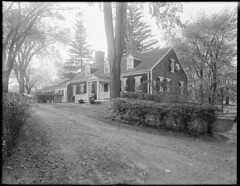
The Sandersons had a boy named Amos in July 1774. Samuel’s brother Elijah also lived and worked with him in his house (shown here, courtesy of the Boston Public Library’s Flickr collection).

In April 1775, Samuel Sanderson was a corporal in the Lexington militia, standing on the common as the British column arrived. Local historian Michael J. Canavan recorded this story about how Mary Sanderson experienced the outbreak of war:
When he heard that the British were coming he piloted his wife over to her father’s carrying his babe, and accompanied by a little girl who was at their house. Over at Scotland they found the mother getting breakfast and the brothers at first did not believe the report.

After the British retreated Mary returned home and found a good many things had been stolen. Her cow (which was a good part of her marriage portion) had been killed; and a wounded British soldier was stowed away in her bed. She cried out “I wont hae him there. Why didn’t you knock him on the head?”

But the town authorities insisted he be taken care of. . . . The soldier begged for Tea but she refused. “what for should I gae him tae for? He shall hae none.”

The wounded man refused to eat or drink unless the food was tasted by some of the family.
Smart man.

Despite crippling arthritis, Mary Sanderson lived to be a centenarian. On 23 Sept 1852 the women of Lexington organized a “levee” in her honor at the town hall, with refreshments and music. It raised $300. She died less than a month later at the age of 104.

Saturday, August 30, 2014

Samuel Adams’s Petition to the Legislature

Yesterday I mentioned a New England Historical and Genealogical Register obituary for Samuel “Rat-trap” Adams after his death in 1855. After giving some details about his parents it said:
At the time of the Revolution he was old enough to perform services in that cause, which he did, on the patriot side. About five years ago he applied to the General Court for remuneration for some losses which he sustained in the service. There were those in that body disposed to slight his application, but the Hon. J. T. Buckingham [a state senator from Suffolk County in 1850-51] effectually brought a majority to sustain it, and a small appropriation (probably more than was asked for) was granted for the relief of the truly deserving old citizen. In sustaining the application, Mr. Buckingham paid a well merited tribute to the honest old gentleman, whose peculiarities in matters of religion and politics, though admitted, were not allowed to debar him from his just rights.
Now that looks like a lead! A statement from Adams about his work “in the service” of the “patriot side” during the Revolution. A written statement in the most formal of circumstances, with potential legal ramifications if it were found to be exaggerated. A document that might still be on file in the state archives.

Alas, that anecdote turned out to be untrue in several respects. Adams did petition the Massachusetts legislature for support in 1850. But his claim was “for compensation for bringing a prisoner from Worcester to Boston jail, during Shays’ rebellion, 68 years ago,” according to the 25 February Daily Atlas. That would have been 1782, though the uprising in western Massachusetts actually happened in 1786-87.

Furthermore, while Buckingham may have been behind the favorable vote in the Massachusetts senate, which approved giving Adams $100, the bill aroused opposition in the Massachusetts house. An acidic letter from Boston published in the Barre Patriot on 15 February said:
If they give him money, why not vote as much more to the lady in Lexington who is now 102 years old, and needs it more than a hale man of only 90, or thereabouts. She succored the wounded in the Revolution.
So I had to look for that lady. She was Mary (Munroe) Sanderson, who died in 1852, less than a month after a private party raised $300 for her.

Back to Samuel Adams’s bill. The lower house discussed it twice before letting it die. Adams renewed his petition the next year. The committee on claims recommended paying him $100—but once again the bill died.

Newspapers in 1852 and 1853 refer to more rejected petitions from Samuel Adams. By that time Buckingham was no longer in the senate. The published journal of the Massachusetts House shows that in January 1854 yet another Adams petition “for compensation for services rendered during ‘Shay’s Rebellion’” was introduced, given leave to be withdrawn (i.e., rejected) the next month, reconsidered, and rejected again.

The Massachusetts State Library has just launched what it calls DSpace, offering digital copies of many public documents, including the Acts and Resolves for each year showing what bills did pass. And a search through those files shows that Samuel Adams never got special compensation for his work in 1782. Or 1787. Or whenever.

TOMORROW: Samuel Adams and the Sons of Liberty.