J. L. BELL is a Massachusetts writer who specializes in (among other things) the start of the American Revolution in and around Boston. He is particularly interested in the experiences of children in 1765-75. He has published scholarly papers and popular articles for both children and adults. He was consultant for an episode of History Detectives, and contributed to a display at Minute Man National Historic Park.

Subscribe thru Follow.it


•••••••••••••••••


Showing posts with label George III. Show all posts

Tuesday, September 29, 2026

“To be a liege subject of the State of Massachusetts Bay”
In May 1778, the Massachusetts General Court began a new legislative year.

On 17 September, Council member John Pitts brought the lower house “a Petition of Hopestill Capen, a Prisoner in Boston Goal, praying that he may not any longer be confined.”

This was a breakthrough. For the first time, Capen was addressing the General Court as a legitimate government. Previously he had insisted that doing so would violate his religious scruples.

Once again, the legislators formed a joint committee to consider Capen’s petition, along with a similar plea for release from the shorthand expert John Hodgson.

On 19 September, the Council approved a resolution “liberting them on certain Conditions.” This time, the House fully concurred. The official resolve stated:
that the prayer of Hopestill Capen’s petition be so far granted, that he be liberated from his confinement upon his giving bond to the Treasurer of this State for the sum of Two thousand pounds, with sufficient sureties that he will subscribe and closely adhere to the following declaration by him proposed in his petition, vizt. “I, the subscriber, acknowledge myself to be a liege subject of the State of Massachusetts Bay, and hold myself obliged to assist in supporting peace and good order in this State and when called on by lawfull authority I am ready so to do.”
Back in February 1778, the legislature had stipulated this oath of allegiance:
I, A.B., do swear (or affirm as the case may be) that I will bear faith and allegance to the state of Massachusetts Bay, and will faithfully support and maintain and defend the same against George the Third, king of Great Britain, his abettors and all other enemies and opposers whatsoever, and will discover all plots and conspiraces that shall come to knowledge, against said state or any other of the United States of America. So help me God.
Hodgson was ready to take that oath, but Capen still shied from explicitly renouncing his loyalty to George III. After all, what if the tide of war turned, and the Crown prevailed? According to his faith, he would have to be a Loyalist again. But for now, Capen would acknowledge the state of Massachusetts as his sovereign. (It’s notable he used the term “subject,” not “citizen.”)

In the fall of 1778, after twenty-five months of confinement, Hopestill Capen got out of jail.

TOMORROW: The last years.

Sunday, August 02, 2026

“Dependant upon the Imperial Crown of Great Britain”?

In 1775, John Adams and John Dickinson held the same basic position about the best course for the British Empire and its large North American colonies:
  • There must be a new understanding of the relationship between those colonies and the central government in London.
  • But those colonies need not become independent.
The problem was that the two men defined “independent” differently.

On 15 May, Silas Deane made these notes on the Continental Congress’s debate:
Mr. Jno Ruttlidge…insists it previously some that points must be settled, such as do We aim at independancy, or do we only ask for a Restoration of Rights & putting of Us on Our old footing. speaks long & well

Mr. Robt. R Livingston Succeeds him in the same way. short

Mr. Jno. Adams lengthy, and argumentative. independance on Parliamant is absolutely to be avowd. in the Americans, but a dependance on the Crown is what We own
Adams thus declared himself in favor of “independance” only from Parliament, not the entire British system (“the Crown”). How exactly that would work he didn’t say.

Two months later, in his letter to James Warren that fell into British hands, Adams went into more detail:
We ought to have had in our Hands a Month ago, the whole Legislative, Executive and Judicial of the whole Continent, and have compleatly moddelled a Constitution, to have raised a Naval Power and opened all our Ports wide, to have arrested every Friend to Government on the Continent and held them as Hostages for the poor Victims in Boston. And then opened the Door as wide as possible for Peace and Reconcilliation
Adams still didn’t use the term “independance.” He still held out the prospect of “Reconcilliation.”

To Dickinson, however, Adams’s wish list amounted to “a total Independence, & the Establishment of a Commonwealth.” The term “commonwealth” recalled the English protectorate of the mid-1600s, which Adams’s Puritan ancestors had applauded but most British subjects remembered with distrust.

Adams never saw the material that Dickinson sent to David Barclay in Britain in August 1775. In fact, hardly anyone in the history of the world saw those documents until they were just published in the William & Mary Quarterly. With his letter Dickinson included draft legislation he hoped would calm the crisis by resetting the imperial relationship to how it had been back before Parliament started raising tariffs in 1763.

But Dickinson prefaced part of that legal repeal with this language:
Whereas it is essential to the good Government & Prosperity of every Sosciety [sic] or State, that an undisputed Supreme superintending Power & Authority should exist within it; And whereas this Power & Authority hath always been vested in & exercised by Parliament; and whereas the respective local legislatures of distinct Colonies are in many Instances incompetent; be it therefore further enacted by the Authority aforesaid, that when any of the said Colonies shall by an Act of Assembly acknowledge & recognize & declare the said Colony to be dependant upon the Imperial Crown of Great Britain, and that the Kings most excellent Majesty by & with the Advice & Consent of the Lords Spiritual & temporal & Commons in Parliament assembled had hath & of Right ought to have full Power & Authority to make Statutes to bind the People of the said Colonies, where the general Wellfare of the Whole Empire shall require the Exercise of such a Supreme superintending Power & Authority, as especially to make Statutes for regulating the Trade & Navigation of the Whole Dominion of the Imperial Crown of Great Britain…
To Adams, Dickinson’s concession would have amounted to accepting dependence on Parliament.

Ironically, both men claimed that the disclosure of Adams’s letter was useful because it showed how far he wanted to go. Dickinson felt those words should make politicians in Britain realize that some Americans sought de facto independence. Adams felt the same words emboldened more Americans to adopt his position.

In fact, none of the documents I’ve been discussing—Adams’s intercepted letter, Dickinson’s two letters to Barclay and his draft legislation—made any difference in London. On 23 August, before those papers could cross the Atlantic, King George III issued a proclamation written by Lord Dartmouth that the North American colonies were in “open and avowed rebellion” and his forces should “use their utmost endeavours to withstand and suppress such rebellion.”

Wednesday, July 29, 2026

Dickinson Seeking “a happy & permanent Reconciliation”

The William & Mary Quarterly had a big Sestercentennial scoop in its July 2026 issue—so big that it made those newly discovered documents available online for a limited time ahead of publication. 

The documents are two long 1775 letters and an enclosure from Pennsylvania politician John Dickinson to David Barclay, a British merchant and banker (shown here).

In 1775 the Continental Congress assigned Dickinson the task of drafting the Olive Branch Petition. He also reworked Thomas Jefferson’s prose in the Declaration of the Causes and Necessity of Taking Up Arms. The first text sought a reconciliation with the Crown in traditional fashion, the second explained publicly why the young war was justified.

Together those texts show the balancing act Dickinson was trying to pull off. He believed in the American resistance to Parliament’s new measures, in which he had played a leading role, and he also believed in the danger of splitting completely from Britain.

Dickinson dated the first of the newly surfaced letters on 5 Aug 1775. It shared his (not always accurate) description of the war so far, emphasizing how the Crown was unlikely to prevail without both sides suffering great harm. Then came his draft bill for reworking the constitutional relationship between Britain and its colonies and calming people’s “Fears & Jealousies.”

Those two documents were written out by a secretary for Dickinson’s edits and signature. The second letter, finished 28 October, is in Dickinson’s own messy, reconsidered writing. By then, though he didn’t know it, George III and the government had dismissed the Olive Branch Petition without looking at it, declared all the colonies at the Congress to be in rebellion, and promised a forceful response. Dickinson’s proposal had arrived too late to do any good.

According to the New York Times, these letters remained in the Barclay family, coming into the hands of his great-great-great-great-great-nephew, Humphrey Barclay. In 2024 he showed them to book and manuscript specialist Donovan Rees, who realized their importance. Dickinson’s initiative isn’t mentioned in any other source—both he and Barclay were working backchannels, so they kept their correspondence quiet. Dickinson even put a postscript on the first letter asking Barclay not to print it or give anyone a copy.

On behalf of the Barclay family, Rees offered to sell the three documents to the U.S. Library of Congress, but it didn’t meet the asking price. (It’s unclear when that discussion took place, but the Library of Congress has been under dire pressure at times in the last couple of years. There’s an ongoing legal dispute over whether the President’s criminal-defense lawyer and current acting U.S. Attorney General is also the acting Librarian of Congress.)

The documents were then purchased by Harvard professor Eric Nelson, author of The Royalist Revolution: Monarchy and the American Founding among other books. Nelson generously makes manuscripts in his collection available to researchers.

Prof. Jonathan Gienapp of Stanford and Dr. Jane E. Calvert of the John Dickinson Writings Project prepared transcripts of the documents for analysis and publication. The William & Mary Quarterly organized a forum of scholars to discuss their implications in short essays appearing in that July issue.

For a good primer on these Dickinson letters, see Calvert and Gienapp’s article “The Secret Effort to Prevent the Revolution.”

TOMORROW: Hurt feelings.

Saturday, November 15, 2025

The Coroners of Suffolk County, 1747–1774

Early this month I started to discuss the office of coroner in pre-Revolutionary Boston. Then came Pope Night, followed by postings about the espionage of Dr. Benjamin Church, Jr. Now I’m going back to pick up the coroners’ thread.

Coroners were royal appointees: chosen by the governor, who was chosen by the ministry in London, who was chosen with the approval and authority of the king.

As such, their commissions lapsed six months after the death of the king in whose name they were appointed. The new monarch could remove them before that date or authorize new appointments.

The same rule applied to many other legal documents issued in the king’s name, such as the writs of assistance that granted Customs officials the power to search buildings for smuggled goods.

The death of King George II on 25 October 1760 started that clock ticking. In January 1761 sixty-three Boston merchants with James Otis, Jr., as their attorney sued to challenge the validity of new writs of assistance under Massachusetts law. Customs official Charles Paxton responded with his own filing, and the case was argued before Massachusetts judges in February and November 1761.

The merchants lost. But John Adams’s memory of the case (and his wish to put Massachusetts ahead of Virginia in challenging Crown policies) made the Writs of Assistance Case a milestone on the way to independence and eventually the Fourth Amendment.

When it came to the coroners, there was much less trouble. With the advice and consent of the Council, Gov. Francis Bernard simply issued new appointments in the name of King George III for what appear to have been all the existing coroners, and perhaps some new ones, on 5 Nov 1761.

In 1870, William H. Whitmore went through government records, compiled a list of every man elected or appointed to Massachusetts offices before independence, and published The Massachusetts Civil List for the Colonial and Provincial Periods, 1630-1774. You can read it here, though it’s not that sort of book.

Here are scraps of The Massachusetts Civil List’s section on Suffolk County coroners. Recall that Suffolk County then included all of today’s Norfolk County, so this list includes men who examined unexpected deaths in rural towns well outside Boston.

That list doesn’t say when a coroner left office, usually by becoming a potential subject for a coroner’s inquiry. But it should include the names of the Boston coroners in 1770, the year of the Massacre, and 1774, the year of William Molineux’s death.

That’s why I started to worry I’d tripped into a Boston 1775 emergency.

TOMORROW: A chill of doubt.

Thursday, October 23, 2025

The “Doctrine of Projectiles” and Other Doctrines

On 10 Aug 1775, the Newburyport schoolmaster John Vinal wrote out the text of a new advertisement to appear in the next day’s Essex Journal and succeeding issues.

That was nearly four months into the war, and Vinal’s ad reflected that situation:
AT a Time when our Enemies are endeavouring our Ruin it is highly proper to qualify ourselves in the best Manner we can to defend our injured Country:

And as the Doctrine of Projectiles, or Art of GUNNERY is of such Importance that no Person should undertake the Direction of any Piece of Ordnance without a competent Knowledge of it, the Want of which has proved fatal to many:

The Subscriber therefore proposes to instruct those who may incline to attend four Afternoons in a Week, from five to seven o’Clock, or from eleven to one A.M. [sic] in the above Art at a very moderate Price

JOHN VINAL.

N.B. The Subscriber received his Knowledge of the above Art from a Gentleman who was an Engineer in the British Army the whole of the last War.

Newbury Port, August 10th, 1775.
In April and October 1776 Vinal went back to advertising private lessons for the “youth of both sexes” in the standard school subjects, not gunnery.

Vinal was also a warden of St. Paul’s, the town’s Anglican church, founded in 1711. On 16 July 1776 he, fellow warden Joseph Cutler, and eight vestrymen gave this letter to their minister, the Rev. Edward Bass (1726–1803):
Rev’d Sir;—

The Representatives of the United Colonies in America, having in Congress declared s’d colonies free and Independent States, and disavowed all Allegiance to the King of Britain and the service of the Church to which we belong, prescribing certain prayers, &c., to be used for s’d King, his Family & Government, We find ourselves under the necessity of requesting you to omit in your use of the Service all Prayers, Collects, or Suffrages which relate to the King, Royal Family, or Government of Great Britain, both as we would avoid great Inconsistency and as we value the welfare of the church, being assured that without such omission the Existence thereof would immediately cease.
Most of Boston’s Anglican clergymen had left with the British military, and others in Massachusetts were keeping a low profile. Bass had to worry about local opinion, his congregation, his sacred oaths—and his salary.

TOMORROW: A special collection.

Friday, October 17, 2025

“Never made the least attempt to shake off the authority of Great-Britain”

Last month I profiled the Rev. Samuel Madden, the Irish minister who in 1733 was the first person to write fiction based on time travel—a book he suppressed immediately after printing.

Madden wasn’t the only eighteenth-century author to imagine a future George VI, however.

In 1763 the London printer William Nicoll published The Reign of George VI, its author anonymous. It’s scanned here.

This book discusses the years 1900–1925. It praises the future fictional George VI (not the real one who took the throne in 1936) based on ideas in The Patriot King (1749) by Viscount Bolingbroke and thoughts of where the British Empire might go after victory over the French.

The Reign of George VI says interesting things about the British territories across the Atlantic Ocean:
But the immense region of country which the English possessed in North America, was what most extended and forwarded the British manufactures; the King was there Sovereign of a tract of much greater extent than all Europe:

the constitution of the several divisions of that vast monarchy, was admirably designed to keep the whole in continual dependance on the mother country: there were eleven millions of souls in the British American dominions in the year 1920: they were in possession of, perhaps the finest country in the world, and yet had never made the least attempt to shake off the authority of Great-Britain:

indeed, the multiplicity of governments which prevailed over the whole country —— the various constitutions of them, rendered the execution of such a scheme absolutely impossible.

This wide extended region which increased its people so surprisingly fast, was far from being forgot by the King; many noble harbours were surrounded with towns, and made naval magazines; a prodigious number of ships were built by order, from Great-Britain; and the royal navy itself boasted many very fine ships that were built in America.
On the one hand, the author contemplated the chance that American colonists would “shake off the authority of Great-Britain.” On the other, he or she quickly dismissed the possibility that the American colonies could unite to do that or feel “forgot by the King”—a lesson for George III.

In 1899 the Oxford military historian Charles Oman edited and published a second edition of The Reign of George VI, and that in turn was reprinted in 1972. However, Oman’s text included “omissions, rearrangements of sentence order, repunctuation, and other silent variations from the original,” Fred Anderson wrote in his essay about the 1763 Treaty of Paris in The Making of Peace.

The original text of The Reign of George VI has since been printed in the first volume of British Future Fiction, 1700-1914. It occasionally gets mixed up with Madden’s earlier book, or he gets credited for this one.

In Invasions: Fears and Fantasies of Imagined Wars in Britain, 1871–1918, Christian K. Melby suggested that Oman’s republication of The Reign of George VI fed the craze for invasion literature that swept Britain in the early twentieth century. However, since that trend was already under way when the book resurfaced, the influence may have gone the other way—the Oxford scholar tripping across an old title that seemed to fit surprisingly well with modern concerns.

Friday, July 04, 2025

“Two hundred and forty-nine years later…”

Mother Jones just shared David Corn and Tim Murphy’s article “Here are the Declaration of Independence’s Grievances Against King George III. Many Apply to Trump.”

It begins:
When Thomas Jefferson was writing the Declaration of Independence in the weeks leading up July 4, 1776, he wanted to not only rely on just high-falutin enlightenment ideals to justify the case for separation from Great Britain. His aim was also to present a slam-dunk indictment of King George III—to prove that the royal was a “tyrant” and that he and Parliament had forfeited their right to rule the Americans by breaking their own laws and trampling on the rights of their people. This is why about half of the Declaration is a list of 27 specific grievances lodged against the King and his regime.

Two hundred and forty-nine years later, many of these grievances apply to the reign of Donald Trump. Here’s a look at how Trump stacks up against the Mad King.

He has refused his Assent to Laws, the most wholesome and necessary for the public good.

This grievance refers to the King refusing to approve laws passed by the colonies. Trump used his veto power a few times during his first presidency and has not had to do so this year. But he’s shown his disregard for Congress by simply ignoring existing laws. The Elon Musk-led DOGE attack on the government violated numerous laws—including those governing privacy and data. Trump paid no heed to the War Powers Resolution when he launched a military attack on Iran. He illegally impounded funds approved by Congress. He has misinterpreted the International Emergency Economic Powers Act and the Alien Enemies Act of 1798 to claim powers not afforded the president. Legal experts have said that Trump’s firing of inspectors general and commissioners of independent government commissions is illegal—though some of these cases are still being litigated in the courts. He has also issued an executive order to end birthright citizenship, which is enshrined in the Constitution.
On the Mother Jones site, that last paragraph includes lots of links for reports on the violations. And it goes on, all the way down to “He has excited domestic insurrections amongst us…”

This record is all the more remarkable for two reasons. First, several of the Congress’s complaints about George III referred to things the royal government did while it was openly waging war against the people of America for over a year. And secondly, Britain didn’t have a written Constitution to render the violations so clear.

Thursday, December 26, 2024

Grand Union Flag Raising Commemoration in Somerville, 1 Jan.

On Wednesday, 1 Jan 2025, the city of Somerville will observe its annual Grand Union Flag Raising, 249 years after Gen. George Washington had a new flag flown in the fortifications atop Prospect Hill.

The program will begin at 11:30 A.M. with a procession from the City Hall to Prospect Hill. The public is invited to participate in this walk along with city officials and guests.

From noon to 1:00 P.M. there will be a ceremony on the hill in the shadow of the present monument. It will feature:
  • A reenactment of George III’s message to the rebellious colonies delivered by gentlemen from His Majesty’s 10th Regiment of Foot. This will presumably be part of the king’s speech to Parliament in the fall of 1775, which arrived in Massachusetts around the same time as the flag-raising.
  • Remarks from people interpreting Martha Washington, wife of the Continental commander-in-chief, and the poet Phillis Wheatley, who several weeks before had sent Washington a complimentary poem.
  • Members of the Ancient and Honorable Artillery Company.
  • A portrayal of Gen. Washington leading the ceremony to raise the new flag, usually interpreted to be the new Continental Navy flag: thirteen red and white stripes for the thirteen colonies at the Continental Congress with the Union Jack in the canton.
Attendees should be prepared for cold weather; this event takes place on a hill during the New England winter. Hot drinks will be available. Participants will also have a choice between small Grand Union flags to wave or blank flags to decorate.

If the weather cooperates, the tower on Prospect Hill will be open to the public following the ceremony. The Somerville Museum will be on hand with souvenirs representing the city’s historic assets.

Sunday, November 03, 2024

“A sotish, stupid, stubborn, worthless, brutish man”

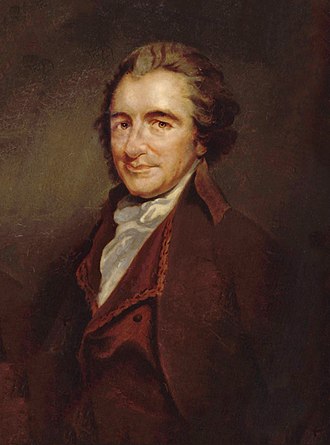
Having whole-heartedly adopted the American cause, Thomas Paine embedded himself with the Continental Army in the fall of 1776.

That was not a good time for the Continental Army.

Returning to Philadelphia, Paine started to publish The Crisis, urging Americans not to let themselves fall back under the control of a tyrant:
Let them call me rebel, and welcome, I feel no concern from it; but I should suffer the misery of devils, were I to make a whore of my soul by swearing allegiance to one whose character is that of a sotish, stupid, stubborn, worthless, brutish man.

I conceive likewise a horrid idea in receiving mercy from a being, who at the last day shall be shrieking to the rocks and mountains to cover him, and fleeing with terror from the orphan, the widow and the slain of America.

There are cases which cannot be overdone by language, and this is one. There are persons, too, who see not the full extent of the evil which threatens them; they solace themselves with hopes that the enemy, if he succeed, will be merciful.

It is the madness of folly, to expect mercy from those who have refused to do justice; and even mercy, where conquest is the object, is only a trick of war: The cunning of the fox is as murderous as the violence of the wolfe, and we ought to guard equally against both.
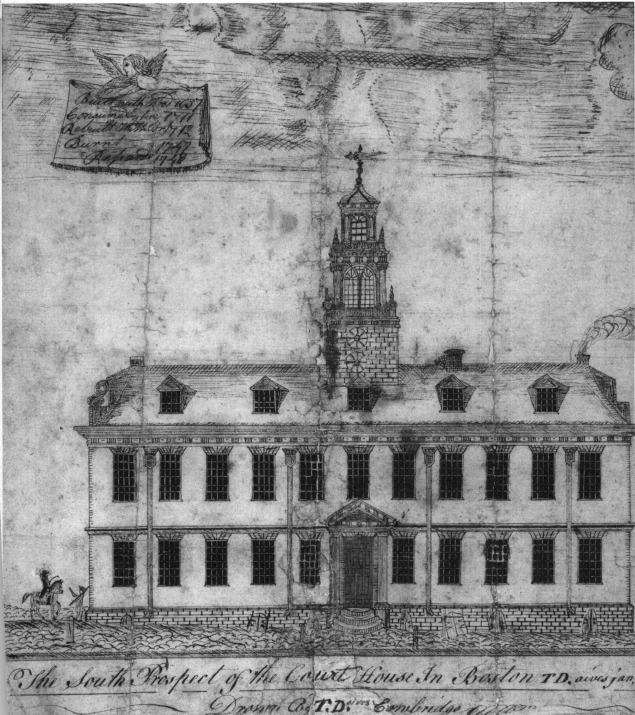
In that quotation I followed the spelling and punctuation of the broadside issued “opposite the Court-House, Queen Street,” in Boston. That was how Edward Eveleth Powars and Nathaniel Willis, publishers of the Independent Chronicle, described their print shop, in a space originally used by James Franklin. The town hadn’t yet gotten around to giving the street a new, non-monarchical name.

Thursday, October 17, 2024

“Selwyn, whose constant flow of exquisite wit made him generally acceptable”

As described yesterday, on Christmas Eve in 1769 the brothers Patrick and Matthew Kennedy got drunk and stomped around the neighborhood of Westminter Bridge in London, clubbing people.

One of those people died: watchman George Bigby.

Within weeks, the Kennedys were tried, convicted, and sentenced to death. Matthew was about to step on the cart that would take him to the gallows when a reprieve arrived.

The brothers had a sister, Catherine or Kitty, who was one of London’s leading courtesans. (Many discussions of this case amalgamate Kitty Kennedy with another courtesan named Polly Kennedy, née Jones. There are some nice pictures of that woman, but I’m convinced by the historian Horace Bleackley that I shouldn’t use them because they show a different person.)

Kitty Kennedy’s closest gentleman friends were Lord Robert Spencer, brother of the Duke of Marlborough, and the Hon. John St. John, brother of Viscount Bolingbroke. Both men were members of Parliament. St. John, a barrister, actually testified at the brothers’ trial, claiming a prosecution witness had offered not to testify in exchange for £10; by implication, all the witnesses were dubious.

But Kitty had some prominent ex-lovers as well. And even more men who were won over by entreaties from her and her admirers. Among the aristocrats who publicly supported leniency for the Kennedys were the Duke of Manchester, until recently lord of the bedchamber to George III; the Earl of Carlisle; Viscount Palmerston; the Earl of Fife, who was in the British House of Commons because his peerage was Irish; and Sir George Savile, M.P.

But the Kennedy family’s most active champion was George Selwyn (1719–1791, shown above), yet another member of Parliament. Not because Selwyn was enamoured of Kitty Kennedy—he was gay. And not because he was against hanging—Selwyn was notorious for his fetish for watching people die. Rather, Kitty Kennedy’s admirers seem to have convinced Selwyn that her brothers were not the sort of young men who should be hanged.

There was an obvious class prejudice behind the campaign to keep the Kennedys from being executed. They weren’t street thugs, people said; they worked in an auction house, and had a sister who was a social celebrity. And hadn’t Matthew suffered enough in thinking he was about to be hanged?

Of course, other people thought the Kennedys had been drunk, cruel, and violent, and under the law of the day deserved their death sentence, even if only one could have struck the fatal blow.

Horace Walpole was among those who helped push for leniency while reveling in the insider nature of the campaign. For instance, sometime in 1770 Walpole wrote to Selwyn:
After you was gone last night, I heard it whispered about the room that a bad representation had been made at the Queen’s house against the unhappy young man. Do not mention this, as it might do hurt; but try privately, without talking of it, if you cannot get some of the ladies to mention the cruelty of the case; or what do you think of a hint by the German women [i.e., certain ladies in waiting], if you can get at them?
In his memoirs Walpole later described the case this way:
Two Kennedys, young Irishmen, had been charged with, and one of them had been condemned for, the murder of a watchman in a drunken riot. They had a handsome sister, who was kept by two young men of quality.

Out of friendship to them, Mr. George Selwyn had prevailed on six or seven of the jury to make an affidavit that, if some circumstances, which had really been neglected by the counsel for the prisoners, had appeared on the trial, they would not have brought in their verdict murder.

Mr. Selwyn applied for mercy, and the young convict was reprieved; but when the report was made in Council, Lord Mansfield prevailed to have him ordered for execution.

Mr. Selwyn, whose constant flow of exquisite wit made him generally acceptable, applied in person to the King, and represented that Lord Rochford, the Secretary of State, had under his hand assured the pardon; that such an act had always been deemed pardon, and that the prisoner had been made acquainted with it. The King immediately renewed his promise, the criminal was ordered for transportation…
That commutation was made on 17 April. Matthew Kennedy was put on a ship bound for America.

TOMORROW: Shipboard conditions.

Tuesday, October 15, 2024

“Not the only Instances of the unexampled Goodness”

As I quoted yesterday, on 24 May 1773 the Boston Gazette ran a delightfully bitter attack on Commissioner Charles Paxton for finding a job for Ebenezer Richardson in the Philadelphia Customs office.

A couple of paragraphs below that invective, Edes and Gill printed:
Some Time last Week Ebenezer Richardson, Esq; who lately had such a fortunate and surprizing Escape from the Gallows for the Murder of young SEIDER; through the extraordinary Clemency of our pious and gracious Monarch, set out for the City of Philadelphia, being appointed an Officer in the Customs, for this notable Exertions in Behalf of Government———

Balf, McQuirk & Kennedys are not the only Instances of the unexampled Goodness of George the Third.
This writer obviously expected readers to recognize those names, but I didn’t.

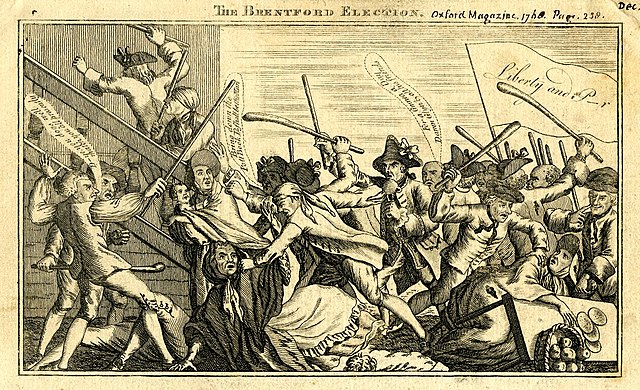
Laurence Balfe and Edward McQuirk (or Quirk or Kirk) were accused of hitting George Clarke on the head during a riot sparked by a by-election at Brentford in West London on 8 Dec 1768, as shown above.

The rival candidates in that election were Sir William Beauchamp-Proctor, a Rockingham Whig, and John Glynn, lawyer for the radical John Wilkes. (Glynn won and served in Parliament till his death in 1779.)

A “gentleman of very considerable fortune” testified that he had seen McQuirk and Balfe among Proctor’s supporters on the first day of voting. The two men were carrying clubs, and McQuirk was “very active in the fray.”

That night, the wealthy gentleman spoke to McQuirk and Balfe, letting them believe he was on their side. McQuirk admitted to having been in the brawl and hinted he might have to flee the country. Balfe said he’d been paid “a guinea for going down to Brentford.”

The gentleman took his information to a “parson Horne,” no doubt the political radical John Horne, then still a Wilkes ally. That man arranged for McQuirk and Balfe to be arrested by Sir John Fielding, the London magistrate. Clarke died on 14 December, elevating the charge to murder.

In January 1769 McQuirk and Balfe were convicted of murder at the Old Bailey, with the jury deliberating only twenty minutes. Proctor immediately launched a public campaign for royal clemency, calling this verdict unjust.

Advocates for mercy pointed out that the prosecutors never accused either defendant of hitting Clarke. Indeed, there was no evidence Balfe hit anyone, just that he was in the crowd. The Earl of Rochford also reported there was “some doubt whether Clarke’s death happened in consequence of the blow he received.”

On 10 March, the Crown pardoned McQuirk and Balfe.

Proctor was a supporter of the Marquess of Rockingham, and Rockingham had been mostly supportive of America during this first term as prime minister in 1765–1766. Furthermore, the case against McQuirk and Balfe really was flimsy, and they were obviously pawns in a much bigger game. We might therefore expect colonials to support clemency for them.

However, American Whigs were enamored of John Wilkes. They suspected any attack on his party as oppression by the establishment. Thus, Edes and Gill could present “Balf [and] McQuirk” as an example of George III or the ministers around him abusing the royal pardon power to benefit political supporters, just like Ebenezer Richardson.

TOMORROW: The case of the Kennedys.

Sunday, July 21, 2024

“What government policy towards the colonies was supposed to be”

The History of Parliament site shared Dr. Robin Eagles‘s profile of Lord North, prime minister from 1770 to nearly the end of the Revolutionary War.

The length of that term would have marked North as an unusually successful prime minister—except for one thing.

Eagles writes:

North was able to draw on a lengthy political apprenticeship. He had been returned to the Commons in his early twenties in 1754, and had become a predictably fast friend of the king, continuing the family tradition of loyal dependability. He accepted his first post in government in 1759 and from 1767 had served as chancellor of the exchequer. All of this ought, on the face of it, to have made him well prepared for the task ahead.

All of North’s good qualities – and there were plenty of them – were insufficient for a crisis of the proportions that was about to assail his administration from America. Some were out of North’s control; others stemmed from policies to which he had contributed in previous administrations.

Perhaps the biggest problem was that no one ever seemed entirely sure quite what government policy towards the colonies was supposed to be, though there should have been little doubt given the king’s own very clear determination to keep America as a British possession. North’s own response left everyone mildly confused. On one occasion, he was asked what the government plan was, only for him to reply that no one had come up with one.
Keeping the American colonies was not a plan but a goal, of course. Neither George III nor Lord North nor the other administrators contemplated what concessions they might make to achieve that goal until it was too late for compromise.

Thursday, July 04, 2024

“In free countries the Law ought to be the King”

For Independence Day I’m going back before the Declaration to a text published at the end of 1775 which paved the way for blaming everything on King George III.

These passages are from Thomas Paine’s Common Sense, advocating both independence from Britain and a republican form of government—meaning he set out to convince people who had lived under a monarch their whole lives that that figure wasn’t necessary.
The powers of governing still remaining in the hands of the king, he will have a negative [i.e., veto] over the whole legislation of this continent. And as he hath shewn himself such an inveterate enemy to liberty, and discovered such a thirst for arbitrary power; is he, or is he not, a proper man to say to these colonies, You shall make no laws but what I please?

And is there any inhabitant in America so ignorant, as not to know, that according to what is called the present constitution, that this continent can make no laws, but what the king gives leave to: and is there any man so unwise, as not to see, that (considering what has happened) he will suffer no law to be made here, but such as suits his purpose? . . .

BUT where, say some, is the King of America? I will tell you, friend, he reigns above, and does not make havock of mankind like the Royal Brute of Great Britain. Yet that we may not appear to be defective even in earthly honours, let a day be solemnly set apart for proclaiming the charter; let it be brought forth, placed on the divine law, the word of God; let a crown be placed thereon, by which the world may know, that so far we approve of monarchy, that in America, THE LAW IS KING.

For as in absolute governments the King is Law, so in free countries the Law ought to be the King; and there ought to be no other. But left any ill use should afterwards arise, let the crown, at the conclusion of the ceremony, be demolished, and scattered among the people, whose right it is.

A GOVERNMENT of our own is our natural right; and when a man seriously reflects on the precariousness of human affairs, he will become convinced, that it is infinitely wiser and safer, to form a constitution of our own in a cool deliberate manner, while we have it in our power, than to trust such an interesting event to time and chance. If we omit it now, some Massanello may hereafter arise, who, laying hold of popular disquietudes, may collect together the desperate and the discontented, and by assuming to themselves the powers of government, may sweep away the liberties of the continent like a deluge.
When Paine republished Common Sense in London in 1791, some lines in these passages still constitutied lese-majeste. The printer left blank spaces at those spots instead. In the copy scanned for Google Books, someone has gone through and inserted the original text by hand.

Sunday, April 21, 2024

The Death of Daniel Thompson

Yesterday I quoted Maj. Loammi Baldwin’s diary noting the death of Woburn militiaman Daniel Thompson on 19 Apr 1775.

The published Woburn vital records say Daniel Thompson was born on 9 Mar 1734, making him forty-one years old at the Battle of Lexington and Concord (unless that’s an unlabeled Old Style date). He and his wife Phebe had three children, born 1761–1765.

According to a family history, The Memorial of James Thompson, of Charlestown, Mass., 1630-1642, and Woburn (1887), this was the story of Thompson’s death:
He was a man of ardent temperament, full of activity and enterprise. Previous to the Revolutionary war he was one of the guards of the royal governor [most likely the horse guard], and yet, in the troubles which preceded that event, he ever zealously espoused the cause of his native country.

On the morning of the 19th of April, 1775, hearing of the march of the British toward Concord, he mounted his horse and hurried to the north village, a mile distant, for the purpose of rousing his friends to oppose the march of the enemy. There is a tradition that of all the men he met only one hesitated, and when that one asked him if he were not too hasty and likely to expose himself to great danger, he instantly replied, “No! I tell you our tyrants are on their march to destroy our stores, and if no one else opposes them to-day, I will!” Immediately hurrying away to the scene of action, he boldly took his position and poured his fire into the ranks of the British.

On the retreat of the enemy, he took a station near the road. Stepping behind a barn to load, and then advancing round the corner of the building, he fired diagonally through the platoons of the enemy, so as to make every shot effectual.

A grenadier, who watched his movements, was so enraged that he ran around the corner of the barn and shot him dead on the spot, while he was in the act of reloading his gun. Tradition says that a well directed ball from another Woburn gun prevented the grenadier from ever rejoining his comrades.
I’m skeptical about that quotation, though the aggressive attitude seems to fit with going too close to the road and being cut down by a flanker. Abram English Brown’s Beneath Old Roof Trees (1896) added the comforting claim that one of Daniel Thompson’s own brothers killed that grenadier and brought his firelock back home to Woburn.

More certainly, we know that Thompson died within the borders of Lincoln. His body was brought back to Woburn. On 21 April there was a joint funeral with Asahel Porter, detained by the regulars in the early hours of the 19th and killed in the shooting on Lexington common.

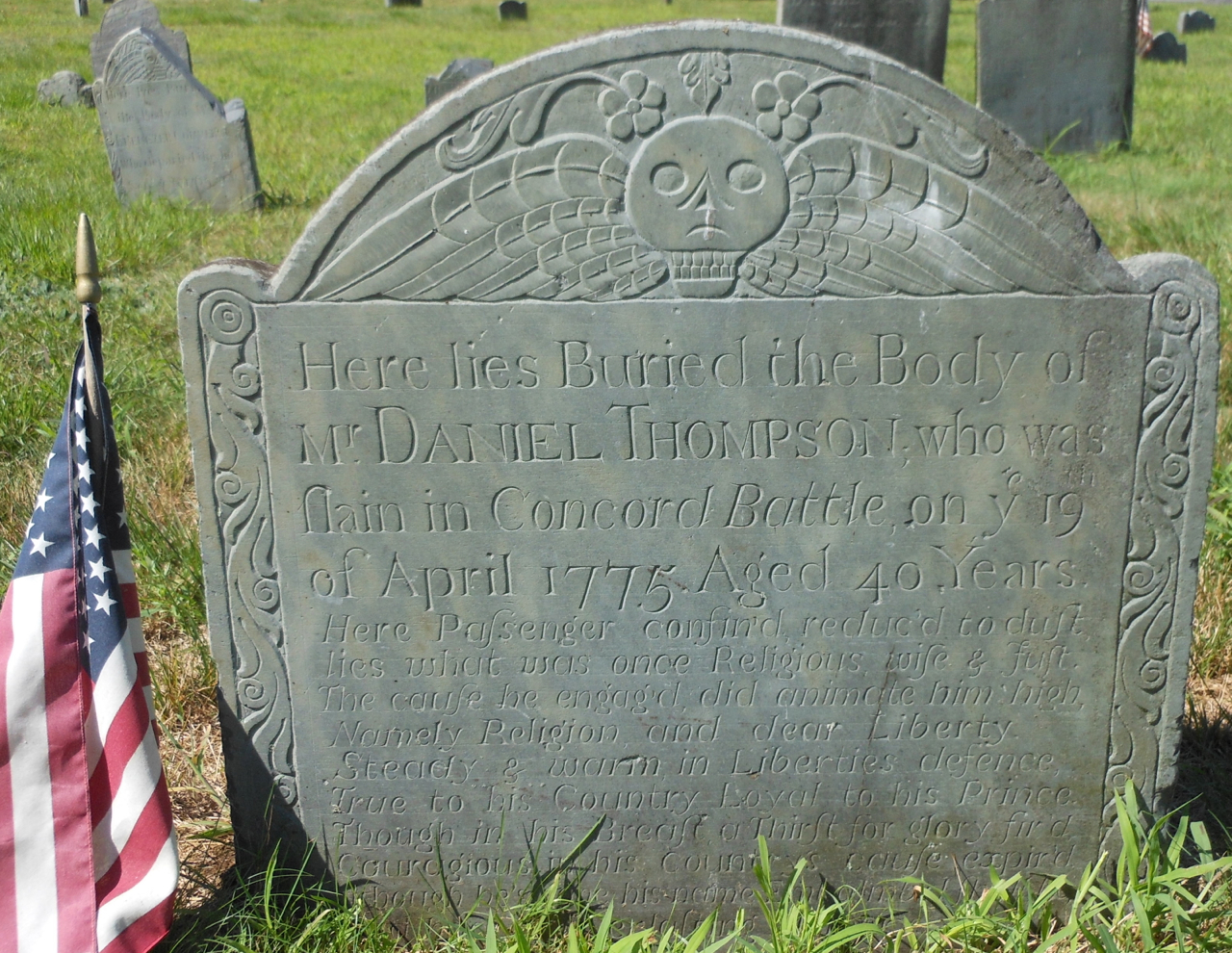
Thompson’s gravestone appears above, courtesy of Find a Grave. It says:
Here lies Buried the Body of
Mr. DANIEL THOMPSON who was
slain in Concord Battle on ye. 19th.
of April 1775. Aged 40 Years.

Here Passenger confin’d reduc’d to dust,
lies what was once Religious wise & Just.
The cause he engaged did animate him high,
Namely Religion and dear Liberty.
Steady and warm in Liberties defence,
True to his Country, Loyal to his Prince.
Though in his Breast a Thirst for glory fir’d,
Courageous in his country’s cause expired.
Although he’s gone his name Embalmed shall be,
and had in Everlasting Memory.
The phrase about “Loyal to his Prince” suggests the Thompson family erected this stone in 1775 when most Americans still professed allegiance to King George III and saw themselves as fighting corrupt British ministers rather than the whole British constitutional system. If the Thompson family had had to wait another year for the stonecarving, the elegy would surely have praised Thompson’s loyalty to his country but not to his “Prince.”

Daniel and Phebe Thompson’s daughter, born in 1762 and also named Phebe, married Josiah Pierce in 1787 and settled in Maine. Josiah was a younger half-brother of Benjamin Thompson, who by then had moved from Woburn to Europe on his way to becoming Count Rumford.

Saturday, April 13, 2024

James Warren: “News we have”

On 6 Apr 1775, James Warren was in Concord, representing Plymouth in the Massachusetts Provincial Congress.

He started writing home to his wife, Mercy, that day. That letter contains a passage I’ve quoted many times in my Road to Concord talks, but there’s a lot more going on, too.

So over the next few days I’ll analyze of Warren’s whole letter.
My Dear Mercy,—

Four days ago I had full Confidence that I should have had the pleasure of being with you this day, we were then near closeing the Session. Last Saturday we came near to an Adjournment, were almost equally divided on that question, the principle argument that seemd to preponderate, and turn in favour of sitting into this week was the prospect of News and News we have.

Last week things wore rather a favourable aspect, but alas how uncertain are our prospects. Sunday Evening brought us accounts of a Vessel at Marblehead from Falmouth, and the English Papers etc by her. I have no need to recite perticulars. you will have the whole in the Papers, and wont wonder at my forgoeing the pleasure of being with you. I dare say you would not desire to see me till I could tell you that I had done all in my power to secure and defend us and our Country.

We are no longer at a loss what is Intended us by our dear Mother. We have Ask’d for Bread and she gives us a Stone, and a serpent for a Fish.
That last line is an allusion to Matthew 7:9–11.

The British news that Warren alluded was printed in the Essex Journal of Newburyport before spreading to other papers. “Capts. Barker and Andrews” had sailed from England on 17 February, bringing the latest.

The Essex Journal reprinted a long report on debate in Parliament on 5 April and an even longer one on 12 April. Those two articles don’t agree in all the details, but they’re clear on the basic developments.

For years the Massachusetts Whigs had hoped that their pleas, protests, and persistence would prompt a change in British government policy. Instead, the Lords refused to hear the latest petitions from America.

The Earl of Chatham, formerly William Pitt and still America’s favorite, moved that Parliament repeal the Coercive Acts and remove troops from Boston. Other peers argued for “compelling the Americans to the immediate obedience of the legislature of the mother country.” Ultimately the House of Lords rejected all of Chatham’s proposals by margins like 77 to 18.

Furthermore, on 9 February both houses of Parliament had signed off on an address to the king that declared in part:
…we find that a part of your majesty’s subjects in the province of Massachusetts Bay have proceeded so far to resist the authority of the supreme legislature; that a rebellion at this time actually exists within the said province. . . .

we consider it as our indispensible duty, humbly to beseech your majesty that you will take the most effectual measures to enforce due obedience to the laws and authority of the supreme legislature; and we assure your majesty that it is our fixed resolution, at the hazard of our lives and properties, to stand by your majesty against all rebellious attempts…
The king’s official response was to promise “the most speedy and effectual measure for enforcing due obedience to the laws, and the authority of the supreme legislature.”

And that was just the official record. The London newspapers also threw in comments like “Lord N—h is determined that the Americans shall wear chains.”

TOMORROW: Keeping up spirits, keeping up defenses.

Saturday, January 27, 2024

“The Custom house would drench us with this Poison”

Within a week after he was attacked by a mob, Customs officer John Malcolm petitioned the Massachusetts General Court for compensation.

He filed a memorial “setting forth great Abuses he has receiv’d, and praying to be enabled to take Measures for immediate Relief, and for Redress.”

The Council approved this petition on 1 February and sent it down to the assembly. The lower house voted “That the Petitioner have Leave to withdraw his Petition”—i.e., rejected.

On 17 March, almost two months after the riot, Malcolm published thanks to God that he was finally well enough to go back to church.

After another few weeks, on 4 May, H.M.S. Active sailed out of Boston harbor, “with whom went Passenger, the famous ’Squire Malcom,” according to the Boston Post-Boy.

In London, Malcolm told his story to a more sympathetic audience. He petitioned Lord North on 28 July. In the new year, he even presented his case to King George III.

The London newspapers reported on Malcolm’s sufferings, including a detail that hadn’t appeared in any American account so far:
A Correspondent says he has been informed, by a Gentleman lately arrived from Philadelphia, that when Mr. John Malcomb, an Officer of the Customs at Boston, was leading, tarred and feathered, to the Gallows, with a Rope about his Neck, he was asked by one of the Mob whether he was not thirsty, which was natural to a Man expecting to be hanged.

The unfortunate Officer of the Customs, as well as he could speak, answered yes; and immediately a large Bowl of strong Tea was put into his Hands, with Orders to drink the King’s Health. Whether it was owing to Loyalty or Thirst is not material; poor Malcomb Half emptied the Bowl.

He was then told he must mend his Draught, and drink the Queen’s Health. Though he had done his utmost for the King, he found he must do something for the Queen; and having taken off Half the Remainder of the Bowl, he presented it back to the Persons from whom he had received it.

Hold! hold! cries his Friend, you are not to forget the rest of the Royal Family; come, drink to the Prince of Wales. Replenish, replenish, cries the loyal American; and instantly poor Malcomb saw two Quarts more of what he was heartily sick of. Make Haste, cries another loyal American; you have nine more Healths to drink before you arrive at the Gallows.

For God’s Sake, Gentlemen, be merciful, I am ready to burst; if I drink a Drop more, I shall die.

Suppose you do, cries one of the Mob, you die in a good Cause, and it is as well to be drowned as hanged, and immediately the drenching Horn was put to his Mouth, to the Health of the Bishop of Osnabrug; and, having gone through the other eight, he turned pale, shook his Head, and instantly filled the Bowl which he had just emptied [i.e., vomited].

What, says the American, are you sick of the Royal Family? No, replies Malcomb, my Stomack nauseates the Tea; it rises at it like Poison.

And yet, you Rascal, returns the American, your whole Fraternity at the Custom house would drench us with this Poison, and we are to have our Throats cut if it will not stay upon our Stomachs. The merciful Americans desisted, and the Procession was continued towards the Gallows.
This anecdote was reprinted in Boston newspapers, including the Patriot Massachusetts Spy, in December. I haven’t found any local response saying it was untrue. However, it’s possible that at the time everyone saw this story—not attributed to Malcolm nor any Bostonian who actually witnessed the attack—as a joke using a newsworthy event to make a point about the Customs service and the Tea Act.

London artists seized on that detail about the tea. The “New Method of Macarony Making” print I showed yesterday included a Boston rioter pressing a big pot of tea on Malcolm. In the print above, “The Bostonians Paying the Excise-Man, or Tarring and Feathering,” the mob is actually pouring tea down Malcolm’s throat.

Furthermore, in the background of that print men are emptying tea chests off the side of a ship into the water—the earliest visual depiction of the Boston Tea Party. And as a reminder of the town’s ten-year history of trouble, “LIBERTY-TREE” holds an upside-down paper marked “Stamp Act.”

Malcolm hadn’t been personally involved in the stand-off over the East India Company tea, but he worked for the Customs Commissioners who had forced the issue. For Londoners, the attack on Malcolm and the destruction of dutied tea both showed the Bostonians’ contempt for the imperial government—“Paying the Excise-Man” with violence instead of their fair share of taxes.

TOMORROW: A retrospective on the riot.

Tuesday, January 09, 2024

The Disappearance of the King’s Speech

On the last day of the year 1775, Boston merchant John Rowe, staying inside besieged Boston, wrote in his diary:
The Niger man of War Capt. Talbot is arrivd in Nantasket Road & has brought the King’s Speech dated the 26 October
On 26 October, George III had opened Parliament with a traditional “most gracious speech.” That tradition continues today, but now everyone knows that what the monarch reads is the program of the current prime minister and his or her cabinet, not a personal statement.

Back in 1775, the king still had a role in politics, at least at a personal level—i.e., the prime minister had to be someone he got along with. But already British politicians expected George III not to be setting policy but reflecting it. Fortunately, on the American question the king, Lord North, and the other ministers saw eye to eye.

That was a disappointment for some Americans who had still hoped the monarch would overrule his supposedly misguided and/or corrupt ministers and negotiate with their Continental Congress. Instead, George III read:
Those who have long too successfully laboured to inflame my people in America by gross misrepresentations, and to infuse into their minds a system of opinions repugnant to the true constitution of the colonies, and to their subordinate relation to Great-Britain, now openly avow their revolt, hostility, and rebellion. They have raised troops, and are collecting a naval force; they have seized the public revenue, and assumed to themselves legislative, executive, and judicial powers, which they already exercise in the most arbitrary manner, over the persons and properties of their fellow subjects.

And although many of these unhappy people may still retain their loyalty, and may be too wise not to see the fatal consequence of this usurpation, and wish to resist it, yet the torrent of violence has been strong enough to compel their acquiescence till a sufficient force shall appear to support them. . . .

It is now become the part of wisdom, and (in its effects) of clemency, to put a speedy end to these disorders by the most decisive exertions, For this purpose, I have increased my naval establishment, and greatly augmented my land forces . . .

When the unhappy and deluded multitude, against whom this force will be directed, shall become sensible of their error, I shall be ready to receive the misled with tenderness and mercy!
In particular, the king mentioned “friendly offers of foreign assistance,” which everyone understood to mean hiring soldiers from German states.

The Boston News-Letter, the only newspaper still being printed in Boston, ran the speech on the front page of its 11 Jan 1776 issue.

By that time the speech had already been printed in Newburyport in the Essex Journal for 5 January, ostensibly taken from a London newspaper dated 23 Oct 1775. (That was three days before the speech was delivered. But some American broadsides reported the king spoke on 27 October, one day late.)

The letters from the Continental headquarters on 3–4 January show that the very first Massachusetts printing of that speech had been back at the very start of the year. The royal authorities printed “a volume” of copies and delivered them to the Continental lines in Roxbury.

And that brings me to the last mystery of the incidents I’ve been discussing: What happened to all those broadsides?

According to some standard early-1900s guides to material published in the colonies, the king’s speech was “Printed by John Howe, in Newbury-Street.” Howe was the young printer managing the Boston News-Letter press for Margaret Draper. However, his edition of the speech was known from only one copy in the collection of the New York Public Library. (The British Library has another copy, according to WorldCat, but its own systems are down after a ransomware cyberattack.)

Washington told John Hancock he would “Inclose one [copy], of many, which were sent out of Boston yesterday,” but the Library of Congress doesn’t appear to have a copy now. Neither do the Harvard libraries, the Massachusetts Historical Society, or the American Antiquarian Society, three major repositories of Revolutionary material in this region.

Where did all the other copies go? I picture Howe and his assistants working through New Year’s Eve to produce the “great number” of copies to cow the rebels, and then those rebels showing their disdain for the king’s words by recycling the paper or using it in their latrines.

Tuesday, January 02, 2024

“Authentic advices from the Camp at Cambridge”

On 15 Jan 1776, John Dunlap’s Pennsylvania Packet newspaper in Philadelphia published a round-up of war news for its readers.

Here are some selections:
By authentic advices from the Camp at Cambridge, of the 3d and 4th instant [i.e., written on the third and fourth of this month], we learn, that the bay and harbour of Boston yet continue open; that a man of war is so stationed as to command the entrance of Salem, Beverly and Marblehead harbours.— . . .

An intellligent person got out of Boston on the 3d instant, who informed General [George] Washington that a fleet consisting of 9 transports, containing 360 men, were ready to sail under convoy of the Scarborough and Fowey men of war, with two bomb vessels and some flat bottomed boats; their avowed destination in Boston was to Newport, but it was generally supposed to be Long-Island or Virginia— . . .

This person also informs, that they have not the least idea in Boston of attacking our lines, but will be very thankful to be permitted to remain quiet—That before General [John] Burgoyne’s departure it was circulated thro’ the army, in order to keep the soldiery quiet under their distresses, that the disputes would soon be settled, and that he was going to England for that purpose— . . .

Our advices conclude with the following anecdote:—That upon the King’s Speech arriving at Boston, a great number of them were reprinted and sent out to our lines on the 2d of January, which being also the day of forming the new army, the great Union Flag was hoisted on Prospect Hill, in compliment to the United Colonies—

this happening soon after the Speeches were delivered at Roxbury, but before they were received at Cambridge, the Boston gentry supposed it to be a token of the deep impression the Speech had made, and a signal of submission—That they were much disappointed at finding several days elapse without some formal measure leading to a surrender, with which they had begun to flatter themselves.——

When these accounts came away the army were all in barracks, in good health and spirits—That 5000 Militia had taken the places of those soldiers who would not stay beyond their time of service; that they were good troops, and the whole army impatient for an opportunity of action.
This newspaper article is a crucial piece of evidence for the raising of the “Grand Union Flag” in Somerville each New Year’s Day, as shown above. No other source names Prospect Hill as the high point where that banner flew.

The British lieutenant William Carter wrote that the flag appeared on “Mount Pisga.” This hand-drawn map of the siege at the Massachusetts Historical Society shows that was the British officers’ term for the Continental fort on Prospect Hill.

One curious detail is that the Pennsylvania Packet article says the flag went up on 2 January, not New Year’s, when Somerville celebrates it.

The American commander-in-chief’s general orders seem clear that he considered New Year’s Day to be the launch of the new army—“new” in the sense that the men were enlisted and organized into regiments to serve for all of 1776.

Most historians have therefore concluded that the flag went up on the first of January, and somehow a dating error was introduced in the chain of communication from Cambridge to Dunlap’s print shop.

I’m going to do more analysis of this article over the next few days.

TOMORROW: From “great Union Flag” to “Grand Union Flag.”

Saturday, November 25, 2023

“And all servile Labour is forbidden”

Thursday, 25 Nov 1773, 250 years ago today, was a holiday in Massachusetts.

About a month earlier, Thomas Hutchinson had issued this proclamation, printed on broadsides as shown at University Archives auction house:
Massachusetts-Bay. }

By the Governor.

A PROCLAMATION for a Publick Thanksgiving.

Whereas it is our incumbent Duty to make our frequent publick thankful Acknowledgement to Almighty GOD our great Benefactor, as well for the Mercies of his common Providence as for the distinguishing Favours which at any Time he may see meet to confer upon us:

AND WHEREAS among many other Instances of the Favour of Heaven towards us of a publick Nature in the Course of the Year past, it hath pleased God to continue the Life of our Sovereign Lord King GEORGE—of our most Gracious Queen CHARLOTTE and of the rest of the Royal Family—to succeed His Majesty’s Councils and Endeavours for Preserving Peace to the British Dominions—to continue to us a good Measure of Health—to prosper our Husbandry, Merchandize, and Fishery:

I HAVE therefore thought fit to appoint, and I do, with the Advice of His Majesty’s Council, appoint Thursday the Twenty-fifth Day of November next to be a Day of Publick Thanksgiving throughout the Province, exhorting and requiring the several Societies for Religious Worship to assemble on that Day, and to offer up their devout Praises to GOD for the several Mercies aforementioned, and for all other Favours which He hath been graciously pleased to bestow upon us, accompanying their Thanksgivings with fervent Prayers that, after they shall have sang the Praises of God, they may not forget his Works.

And all servile Labour is forbidden on the said Day.

GIVEN at the Council-Chamber in Boston, the Twenty-eighth Day of October, in the Fourteenth Year of the Reign of our Sovereign Lord GEORGE the Third, by the Grace of GOD, of Great-Britain, France, and Ireland, KING, Defender of the Faith, &c. Annoq; Domini, 1773.

By His Excellency's Command,
Tho’s Flucker, Secr’y.

T. Hutchinson.

GOD Save the KING.

BOSTON: Printed by RICHARD DRAPER, Printer to His Excellency the Governor, and the Honorable His Majesty’s Council. 1773.
New Englanders expected to observe some autumn Thursday as a Thanksgiving, with sermons in the daytime and a big family dinner. However, the date of that holiday wasn’t set by the governors until the fall.

In 1773, between the governor’s proclamation and Thanksgiving Day there had been two small riots over tea, Hutchinson’s sons and the other consignees were keeping low profiles, and everyone was on tenterhooks waiting for the first East India Company cargo to arrive.

According to merchant John Rowe, that Thanksgiving saw “Dull heavy Raw Weather.”

Monday, August 14, 2023

“The ever-memorable Anniversary”

The Boston Gazette published on Monday, 17 Aug 1767, included this local report:

Friday last being the ever-memorable Anniversary of the 14th of August, a great Number of Gentlemen met at Liberty-Hall, under the sacred Elm, which was decently decorated, and drank the following Toasts.
  1. The King.
  2. The Queen and Royal Family.
  3. The Sons of Liberty.
  4. All Mankind.
  5. Friends to America in Great-Britain.
  6. May an Abhorrence of Slavery still and ever remain the best Criterion of a true British Subject.
  7. None but Tories Slaves.
  8. America.
  9. The 14th of August 1765.
  10. May the 26th of August 1765, be veil’d in perpetual Darkness.
  11. May every House of Respresentatives in America strenuously defend what they have wisely resolv’d.
  12. Union, Stability and Fidelity among the Sons of Liberty throughout America.
  13. May the Man who will not defend the Cause of his Country, in Case of Danger, be held in universal Contempt by every Son of Virtue and Liberty.
  14. May that Day which sees America submit to Slavery, be the last of her Existence.
That Friday, 14 August, was the second anniversary of Boston’s first public protest against the Stamp Act, which inspired a wave of similar protests all along the North American coast and even into the Caribbean. Boston’s political organizers were proud of that.

They weren’t proud of the mob that had nearly destroyed Lt. Gov. Thomas Hutchinson’s house twelve days later. In these toasts they mentioned that event once, but they thought they got away with it all right.

As for the numerous mentions of “Slavery,” these gentlemen meant political slavery, or giving up their traditional British rights. They didn’t mean, you know, slavery slavery.