J. L. BELL is a Massachusetts writer who specializes in (among other things) the start of the American Revolution in and around Boston. He is particularly interested in the experiences of children in 1765-75. He has published scholarly papers and popular articles for both children and adults. He was consultant for an episode of History Detectives, and contributed to a display at Minute Man National Historic Park.

Subscribe thru Follow.it


•••••••••••••••••


Tuesday, January 31, 2012

Benjamin Carp on Revolutionary Networking in Newton, 13 Feb.

On Monday, 13 February, at 7:00 P.M., Prof. Benjamin Carp of Tufts will speak on “‘Our United Sentiments’: Boston, Newton, and the Cause of Liberty” at the Newton Free Library. The library’s description:
Boston is famous as the vanguard of the American Revolution—but the Revolution would have been impossible without the men and women of rural Massachusetts. This talk explores the revolutionary network that linked Boston and its neighbors, including Newton. The leaders of the resistance against Great Britain made a massive effort to galvanize Massachusetts. The Durant family and their community offer a window into the inner workings of the Revolution.
This talk is free and open to the public.

I like how that description treats Newton as a typical example among rural towns rather than trying to make a case that it was special. Every so often Boston 1775 has taken issue with a Massachusetts town’s claims of unusual Revolutionary significance, whether it’s having a large militia contingent or hoisting a rare flag or being the resting-place of Benedict Arnold’s widow.

All those towns participated in the Revolutionary movement, to be sure. Some did have distinctions. But too often local authors haven’t realized or acknowledged how many towns reacted to British imperial policy in much the same way. It was that rural solidarity which made the movement so powerful.

(The handsome image of the stairwell in the Newton Free Library above comes from Elisif Photography, specializing in architectural images.)

Monday, January 30, 2012

A Profile of Andrew Craigie

Harvard’s alumni magazine recently ran Anthony J. Connors’s story about Andrew Craigie (1754-1821). He had no real connection to the college, but lived nearby and was crucial in developing the east part of Cambridge.

Connors describes the start of Craigie’s career supplying the Continental Army with medicines and medical supplies:
The son of a Scottish ship captain and his Nantucket wife, Craigie attended Boston Latin, and by April 1775 had gained sufficient pharmaceutical experience to be appointed apothecary of the Massachusetts army. After tending the wounded at Bunker Hill, he was introduced to Samuel Adams as “a very clever fellow,” and his name came to the attention of General George Washington; he was commissioned Apothecary General in 1777.
The Massachusetts Provincial Congress actually gave Craigie his first appointment in the spring of 1775. At the time he was only twenty-one years old, and I’d love to know what connections he had to get that important and lucrative post. Washington never met him during the siege of Boston, or at least didn’t remember him when he wrote a letter a few years later.

Craigie was on the job for Massachusetts when the Continental Congress decided to take over the colony’s hospitals. The Congress’s first Surgeon-General was Dr. Benjamin Church, who lasted less than two months before he was found to be corresponding with the enemy. The Congress then sent Dr. John Morgan from Philadelphia to take over. Morgan wanted to replace Craigie with his own protégé, but the young man from Boston outmaneuvered and outlasted his boss, enlisting support from the hospital’s young doctors—one of whom was Samuel Adams’s son. Talk about connections!

After the war, Craigie bought the house that Gen. Washington had used as his main headquarters in Cambridge. He expanded it, entertained lavishly, and started to invest in local real estate. Connors continues the story:
Craigie’s development of East Cambridge left an indelible mark. With partners, he secretly bought up 300 acres around Lechmere Point: farms and marshland became a vibrant residential and industrial area, especially after Craigie persuaded Middlesex County authorities to relocate the county court from Harvard Square to a new Charles Bulfinch building in East Cambridge. In 1809, he and his associates completed construction of Craigie Bridge, connecting Cambridge to Boston. His rerouting of roads to steer traffic toward his toll bridge did not enhance his popularity.
But then everything came crashing down. Read Connors’s story for the rest.

Sunday, January 29, 2012

My “Marital Infidelity and Espionage” at the M.H.S., 7 February

On Tuesday, 7 February, the Boston Area Early American History Seminar will meet at the Massachusetts Historical Society to discuss my paper “Marital Infidelity and Espionage in the Siege of Boston.”

The description:
This paper will examine patterns in the popular linkage between marital and political infidelities over a range of espionage cases from the start of the Revolutionary War. Drawing on new findings about such spies as Dr. Benjamin Church, Benjamin Thompson, and the Rev. John Carnes, it will address the topic from multiple perspectives, including actual cases, the use of marital disloyalty as a metaphor for political disloyalty, and how stories of family splits were hidden, preserved, or retold.

Each side of the political conflict tried to portray the other’s leaders, up to and including Thomas Gage and George Washington, as unfaithful husbands. Betrayal in the home, such reports suggested, led to betrayal of the public. Some men involved in espionage did indeed make a habit of extramarital affairs, but others appear to have undertaken their risky ventures to support their wives and children. Both at the time and in later generations, Americans have been selective about which family splits they recorded, and thus which side’s agents appeared most treacherous.
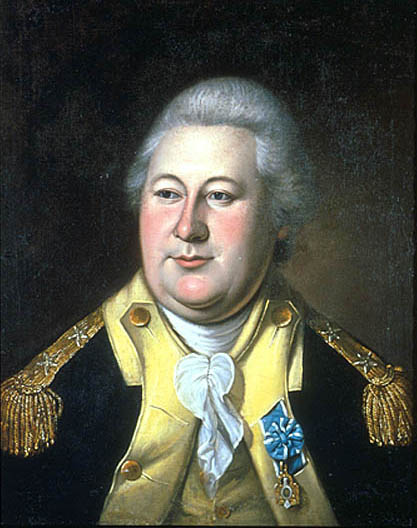
In addition to the names dropped above, the paper discusses Henry Knox (shown above) and his in-laws and the shadowy past of the American artillerist Thomas Machin. And in the final version I focused just on people secretly providing intelligence for the American side, so Benjamin Thompson, always a slippery fellow, escaped into a footnote.

As usual in this seminar series, the paper will be available at the M.H.S. for reading in advance. The seminar begins at 5:15 P.M. with Prof. Robert Allison of Suffolk University commenting on my draft. Then there will be a more general discussion with everyone invited to participate, followed by sandwiches. The society asks people to email if you plan to attend so they know approximately how many sandwich fixings to put out. I look forward to chatting with folks there!

Saturday, January 28, 2012

A House in Beverly and Its Revolutionary Owner

In Beverly, a developer has offered a 1715 house to anyone who will move it away from its present location, where the firm plans to build a drugstore. The Salem News reported that offer this month, describing the house like this:
Built in 1715, it is one of the last remaining First Period homes from Beverly’s earliest settlement. It was the home of Nathaniel Greenwood, a captain in the militia and a member of the Sons of Liberty, a group of patriots that included John Adams, John Hancock and Paul Revere.
An earlier article described the building’s history in more detail:
The wood-frame house was built by a shoemaker named Nehemiah Wood between 1715 and 1725 and was later owned by Nathaniel Greenwood, an officer in the Boston Regiment. The building was a grocery store in the early 1900s. It was bought by Johnny Appleseed’s in 1947 and became the clothing company’s headquarters.
It’s currently a real-estate office.

As for former owner Nathaniel Greenwood, the articles appear to be combining two men of that name, father and son. The son owned the house and kept an inn there for a while later in the eighteenth century. He was born in 1732, married Priscilla Snelling of Boston in 1766, and moved out of town during the war. Later he returned to Boston, established a sail-making business, and died in 1823.

The older Nathaniel Greenwood was born in 1693 and became a merchant, militia captain, town official, and Old South member. Everyone seemed to know who “Captain Greenwood” was. He died in 1780, having lived his last couple of years with his son in this Beverly house.

Much of the information about the family comes from The Greenwood Family of Norwich, England in America (1934), and I can’t confirm a lot of it. The genealogy says, “Nathaniel Greenwood belonged to the ‘North End Caucus’, the most important political club in the town at the time.” But I don’t see that name in the only surviving records of that group, published in Elbridge Goss’s Life of Col. Paul Revere.

The name of “Capt. Greenwood” is indeed on the long list of men who dined with the Sons of Liberty in August 1769. This was a large event that involved most of the prominent men in Boston. Some of those diners later became Loyalists, others Patriots.

The Greenwood family included men in both political camps. The captain’s son-in-law John Marston was a fairly prominent Whig. Yet the captain’s son Samuel Greenwood (1741-1826) joined the Sandemanian sect, which preached against rebellion, and became a Loyalist. (Interestingly, Samuel’s second wife was another Snelling. The captain had been business partner with their father.)

In the spring of 1774, Nathaniel Greenwood, Sr., signed a complimentary address to Gov. Thomas Hutchinson as he prepared to sail to England. He also signed a protest against actions of the Whig-dominated town meeting. That put the octogenarian captain into the Loyalist camp, at least that year. [ADDENDUM: In late 1773, during the tea crisis, Greenwood was one of the liaisons between the public meetings and the governor’s sons, who were tea importers.]

When the British military left Boston in 1776, Samuel Greenwood and his family sailed with them. But his brother Nathaniel stayed behind, and the old captain evidently stayed with him. They moved out of Boston, eventually settling in that house in Beverly. So saying that building was home to “a member of the Sons of Liberty” makes a complex picture too simple. But a muddle doesn’t sell buildings.


Friday, January 27, 2012

Intimate Acquaintance

After Abigail Adams learned the details of Dr. Benjamin Church’s correspondence with the British command, conducted at one point through his mistress, she wrote to her husband in Philadelphia:
What are your thoughts with regard to Dr. Church? Had you much knowledg of him? I think you had no intimate acquaintance with him.
This is the sort of query for which there’s really only one acceptable answer. It’s not, “We worked together for years as political organizers, and everyone kept quiet about his mistresses.” It’s, “I barely knew the man, honey.”

(By the time John Adams received that letter, he’d actually already sent Abigail his thoughts about the “detestible Subject” of Dr. Church, so he got the answer right.)

On Sunday, 5 February, at 2:00 P.M. the Shirley-Eustis House in Roxbury will host a performance of “The Intimate Correspondence of John and Abigail Adams,” based on letters like that one. The press release says:
Today, over 230 years later, we can still listen to their conversations, share in their thoughts and desires, and get to know them as real people, not just as words in a history textbook. During the “Love Letters” presentation, the audience will hear letters that began with John’s and Abigail’s courtship, and continuing through John’s years at the Continental Congress. Enjoy these iconic personalities as they reveal their teasing humor, their pleasure in children and farm, their deepest hopes for the future, and their undying love and respect for each other.

“Love Letters” will be presented by two Adams scholars and living history performers—Patricia Bridgman and Thomas Macy—who have over forty years of living history experience between them.
After the show, there will be a question-and-answer session in character and refreshments. Admission is $10 for the general public, $5 for members of the Shirley-Eustis House Association. Call 617-442-2275 to reserve seats.

Thursday, January 26, 2012

Occupy the Royall Estate

Maj. Andrew McClary of New Hampshire was the highest-ranking American officer killed at the Battle of Bunker Hill. After his death on 17 June, the New Hampshire Provincial Congress received an expense account from his estate that included payment “To Horse-keeping six weeks at Colonl. Royall’s.”

That’s one contemporaneous source showing that Col. John Stark’s New Hampshire regiment started using Isaac Royall’s estate in Medford within a short time after arriving at the siege lines outside Boston.

In his Memoir and Official Correspondence of Gen. John Stark, published in 1860, Caleb Stark told this story of how his ancestor had come to use that mansion:
a gentleman named “Royal,” who, on retiring to the city [Boston], had left his lady, with a family of beautiful and accomplished daughters, in possession of his abode. The mansion being conveniently situated for his “head quarters,” Colonel Stark called upon the family, and proposed, if agreeable to them, his occupancy of a few rooms for that purpose; to which Madame Royal most cheerfully assented, being well aware that the presence of an officer of his rank would afford her family and premises the best protection against any possible insult or encroachment
That all sounds mighty chivalric, doesn’t it?

The problem with that story is that Isaac Royall (1719?-1781) was a widower. His “lady” Elizabeth had died in 1770. Their daughters Mary, Elizabeth, and Miriam (the first two shown above, courtesy of the Museum of Fine Arts) had all married before the war.

Col. Stark probably just invoked military necessity and moved into the house that Isaac Royall had left behind in April. Later in the siege, Gen. Charles Lee and Gen. John Sullivan also slept in the Royall House until Gen. George Washington firmly suggested they should be closer to the front lines. Today it’s maintained by the Royall House and Slave Quarters Association and often hosts events of the Medford Historical Society.

Wednesday, January 25, 2012

Symposium on the Deerfield Raid, 3 March

On Saturday, 3 March, Historic Deerfield will host a one-day symposium on “Exploring the 1704 Deerfield Raid.” This event will take place from 8:30 A.M. to 5:30 P.M. at the Deerfield Community Center.

The scheduled speakers are:
  • John Demos, Samuel Knight Professor of History Emeritus, Yale University.
  • William M. Fowler, Jr., Northeastern University, Distinguished Professor of History.
  • Alice Nash, Associate Professor at University of Massachusetts, Amherst.
  • R. Scott Stephenson, Director of Collections and Interpretation, American Revolution Center.
  • Kevin Sweeney, Professor of History at Amherst College.
  • Philip Zea, President of Historic Deerfield.
Demos wrote The Unredeemed Captive. Sweeney cowrote Captors and Captives, which I really liked. Stephenson’s talk is titled “From Deerfield to Deerslayer: Borderlands Conflict and the Origins of the American Rifleman.” I know other speakers and think it’s an impressive lineup.

Participants will receive a copy of a new “1704 Raid Walking Tour,” and can view the Flynt Center’s new exhibit “Furnishing the Frontier: The Material World of the Connecticut River Valley, 1680-1720.” I’d also stop in at the Memorial Hall Museum because I think it’s done a good job of updating its display on the raid, preserving the older form while reflecting modern understandings.

Pre-registration is required to attend the symposium. The registration fee is $75 ($65 for Historic Deerfield members and school teachers, who can also receive P.D.P.’s). Visit the website at top for more information and online registration. Folks can also reserve a space by email or by calling Julie Marcinkiewicz at 413-775-7179.

Tuesday, January 24, 2012

Anna Lætitia Barbauld: “The awe this day struck into me”

Anna Lætitia Barbauld (1743-1825) was a writer, teacher, and minister’s wife in England. She moved in circles of religious and political dissenters, and was acquainted with Samuel Taylor Coleridge.

This is the last part of Barbauld’s poem “Washing Day,” first published in the Monthly Magazine of December 1797. It’s an evocative slice of life, showing a moment when laundry day meant all the women in a household were busy and little girls weren’t allowed jelly or butter, yet science was about to let people fly:
I well remember, when a child, the awe
This day struck into me; for then the maids,
I scarce knew why, looked cross, and drove me from them;
Nor soft caress could I obtain, nor hope
Usual indulgencies; jelly or creams,
Relique of costly suppers, and set by
For me their petted one; or butter’d toast,
When butter was forbid; or thrilling tale
Of ghost, or witch, or murder — so I went
And shelter’d me beside the parlour fire:
There my dear grandmother, eldest of forms,
Tended the little ones, and watched from harm,
Anxiously fond, tho’ oft her spectacles
With elfin cunning hid, and oft the pins
Drawn from her ravell’d stocking, might have sour’d
One less indulgent. —
At intervals my mother’s voice was heard,
Urging dispatch; briskly the work went on,
All hands employed to wash, to rinse, to wring,
To fold, and starch, and clap, and iron, and plait.
Then would I sit me down, and ponder much
Why washings were. Sometimes thro’ hollow bowl
Of pipe amused we blew, and sent aloft
The floating bubbles, little dreaming then
To see, Mongolfier, thy silken ball
Ride buoyant through the clouds — so near approach
The sports of children and the toils of men.
Earth, air, and sky, and ocean, hath its bubbles,
And verse is one of them — this most of all.
Read the whole poem here.

Monday, January 23, 2012

The New Sexual Freedom of the 1700s

Larry Cebula at Northwest History alerted me to this interesting extract in the Guardian from The Origins of Sex: A History of the First Sexual Revolution by Faramerz Dabhoiwala. Although Dabhoiwala focused on life in England, some of the findings would also apply to eighteenth-century America, even New England:
The most obvious change was a surge in pre- and extramarital sex. We can measure this, crudely but unmistakably, in the numbers of children conceived out of wedlock. During the 17th century this figure had been extremely low: in 1650 only about 1% of all births in England were illegitimate. But by 1800, almost 40% of brides came to the altar pregnant, and about a quarter of all first-born children were illegitimate. It was to be a permanent change in behaviour.

Just as striking was the collapse of public punishment, which made this new sexual freedom possible. By 1800, most forms of consensual sex between men and women had come to be treated as private, beyond the reach of the law. This extraordinary reversal of centuries of severity was partly the result of increasing social pressures. The traditional methods of moral policing had evolved in small, slow, rural communities in which conformity was easy to enforce. Things were different in towns, especially in London. . . .

Urban living provided many more opportunities for sexual adventure. It also gave rise to new, professional systems of policing, which prioritised public order. Crime became distinguished from sin. And the fast circulation of news and ideas created a different, freer and more pluralist intellectual environment.

This was crucial to the development of the ideal of sexual freedom. By the later 18th century, for the first time, many serious observers had come to take it for granted that sex was a private matter, that men and women should be free to indulge in it irrespective of marriage, and that sexual pleasure should be celebrated as one of the purposes of life. As well as reinterpreting the Bible, they found support in new ideas about the importance of personal conscience and in the laws of nature, which were regarded as more clearly indicative of God’s will than the inherited dogma of the church and the text of the scriptures. In his 1730 work, Christianity as Old as the Creation, the Oxford don Matthew Tindal ridiculed traditional sexual norms as priestly inventions, no more appropriate to a modern state than the biblical prohibitions against drinking blood or lending money: “Enjoying a woman, or lusting after her, can’t be said, without considering the circumstances, to be either good or evil. That warm desire, which is implanted in human nature, can’t be criminal, when perused after such a manner as tends most to promote the happiness of the parties, and to propagate and preserve the species.” . . .

It’s no accident that all these early celebrations of the new sexual world were voiced by white, upper-class men. In practice, sexual liberty was limited in important ways. The bastardy laws continued to apply to the labouring classes: their morals remained a public matter. The new permissiveness towards “natural” freedoms also led to a sharper definition and abhorrence of supposedly “unnatural” behaviour. . . .

James Boswell’s diary records the tragic story of Jean, the brilliant only daughter of Henry Home, Lord Kames, one of the leading thinkers of the Enlightenment. In the early 1760s, when she was only 16 or 17 and already married, she embarked on a passionate affair with Boswell, arguing to him that they were doing nothing wrong:

“She was a subtle philosopher. She said, ‘I love my husband as a husband, and you as a lover, each in his own sphere. I perform for him all the duties of a good wife. With you, I give myself up to delicious pleasures. We keep our secret. Nature has so made me that I shall never bear children. No one suffers because of our loves. My conscience does not reproach me, and I am sure that God cannot be offended by them.’”

A decade later, when her husband divorced her over another affair, she declared “that she hoped that God Almighty would not punish her for the only crime she could charge herself with, which was the gratification of those passions which he himself had implanted in her nature.” But her father, the scholar and moral authority, took the conventional view that adultery in a man “may happen occasionally, with little or no alienation of affection”, but in a woman was unpardonable. After his daughter’s divorce, he and Lady Kames exiled her to France and never saw her again.
Dabhoiwala’s The Origins of Sex is being published in the U.S. of A. by Oxford University Press in May.

Sunday, January 22, 2012

The End of Gov. Bowdoin’s Dinner Party

Boston saw its first worthwhile snowstorm of the season this weekend, so I’m pulling out an anecdote that real-estate lawyer Nathaniel Ingersoll Bowditch (1805-1861) published under the pseudonym “The Gleaner” in the Boston Daily Transcript in 1855. It concerns Gov. James Bowdoin and his mansion on Beacon Hill:
The house [was…] placed back from the street, being approached by a high flight of stone steps. At a dinner party once…a rain occurred, and the weather becoming cold the steps were found to be entirely covered with ice.

Under any circumstances there would have been almost a certainty that life or limb would be put in jeopardy by an attempt to walk down; and the guests had probably done justice to the generous wines of their host,—a circumstance which tended to increase the difficulty. At last they all concluded to sit down on the upper step, and so hitch along from step to step in a perfectly safe, though, it must be confessed, in a somewhat ungraceful manner.

Probably, indeed, there never was an occasion where so many of our first citizens voluntarily took such low seats; or where the dignity of small clothes, silk stockings, and cocked hats was sacrificed to necessity or expediency in a more amusing manner.
Bowdoin was governor in 1785-87 and died in 1790, so this event—or whatever gave rise to the memory—probably occurred in that decade.

Saturday, January 21, 2012

Actors Wanted for Tea Party Museum

The Boston Tea Party Ships & Museum organization is looking for actors for its opening season this summer. And the organization is advertising on Craigslist. The notice says:
The Boston Tea Party Ships & Museum is dedicated to reliving the historic night of the Boston Tea Party. The museum will be a multilayered experience that will feature interactive exhibits, live historical performance, and historical artifacts. The site will also feature three historically accurate colonial ships which our guests will be free to explore.

We are looking to create an ensemble of actors to portray historical characters throughout the experience and to serve as hosts to our guests as they explore the attraction. Each actor will perform multiple roles. Must be comfortable working with and leading large groups of people. Prior performance experience, experience in improvisation, and an interest in history strongly preferred.
The museum invite hopefuls to email for an appointment and “prepare a one-minute monologue that is appropriate for a historical performance.” Auditions begin 13 February, training in early April, and the museum opening on 25 June.

I believe the museum is opening with only one ship at first, or maybe two. According to the museum website, the third is still in the drawing stage. The Boston Tea Party Museum blog shows progress on the building and its exhibits. I’m really not sure why there will be a statue of John Parker, captain of the Lexington militia in 1775, but he does have nice shoes.

Friday, January 20, 2012

Running the Numbers in 1776

While I was confirming some figures in Charles H. Lesser’s The Sinews of Independence, a Bicentennial book collecting the best records of the size of the Continental Army throughout the Revolutionary War, I spotted a couple of curious trends.

We often think of the first American invasion of British Canada as coming to a spectacular end in the attack on Québec on 31 Dec 1775. Gen. Richard Montgomery was killed; Col. Benedict Arnold wounded; Capt. Daniel Morgan, Capt. Henry Dearborn, and many other men captured. (John Trumbull’s painting of Montgomery’s death above.)

But the Continental Congress actually ordered more troops north after that battle. In late February 1776, Arnold (now a brigadier general) reported having 1,290 soldiers under his command, of whom 964 were able to fight. The next month, that number had grown to 2,505 men, with 1,719 in shape. The invasion of Canada outlasted the siege of Boston. But it doesn’t have a good narrative shape, with a long, dreary second act.

Meanwhile, Col. Henry Knox was moving his artillery regiment south—and losing men. As of February 1776, he reported having 604 artillerists under his command outside Boston, with 563 ready to fight. As soon as the units left New England, where almost all those troops came from, they evidently began peeling off. In April, Knox could report only 421 men, of whom 358 were listed as available. Through October, he never had more than 500 soldiers assigned to him, and never was able to field even 400.

Lesser’s book, thorough as it is, isn’t a useful source for the strength of American armies in really bad times early in the war: when the invasion of Canada collapsed under the onslaught of smallpox, when the British forces drove Gen. George Washington and Knox out of New York and across New Jersey. In those hectic months, the army couldn’t collect and maintain systematic returns, so no total figures survive.

Thursday, January 19, 2012

William Scott’s Wives

In publishing ladies’ reactions to his poem about his beard, and to the beard itself, shoemaker William Scott seemed to argue that some found it attractive, outrageously unfashionable as it was. So I wondered if Scott ever married.

Fortunately, researcher Annie Haven Thwing found some real-estate transactions involving William Scott, cordwainer (an old term for a shoemaker). Those deeds also state his first wife’s name, which allowed Thwing to single him out from the other men named William Scott (or Scot) in Boston records.

Our William Scott married Nancy or Nanny Coit on 24 Nov 1748, in a ceremony conducted by the Rev. Samuel Cooper (shown here, since I don’t have a picture of anyone else). They deeded some land beside their property on Ann Street in 1750, and bought two houses on North Centre Street later that month.

The Scotts had two children: Nanny born in 1751 and William in 1753. Nanny (Coit) Scott must have died shortly after the birth of that son because William married Ann Thomas on 27 Nov 1755. That second marriage produced a son named Benjamin in 1758.

In 1756 and 1758, William Scott bought more North End land from a Gloucester man with the wonderful name of Nymphas Stacey, Jr.; Stacey’s first wife was a Coit, so those deals were probably within the extended family. Stacey was a also shoemaker. In 1757 William Scott and his new wife deeded land to a blacksmith named Edward Marion.

According to Hannah Mather Crocker, Scott started to wear his beard long in the early 1760s, so there’s no evidence that he attracted a wife after growing it. He may well have still been married to his second wife, Ann, of course. It was unusual for a woman in colonial America to have a long marriage and only one child, but maybe Thwing and I just haven’t found the rest.

On 28 Apr 1774, William Scott announced the death of a son in the Boston News-Letter. Later that same week, he deeded land to Jonathan Williams, one of the town selectmen. He died in that year or the next, according to Crocker, but I didn’t find a record of his death.

So over all I’m left with more questions than answers about the hirsute William Scott.

Wednesday, January 18, 2012

For Lovers of a Good Beaumarchais

Pierre-Augustin Caron de Beaumarchais is known for two things. First, he coordinated the initially secret French program to supply the nascent U.S. of A. with money and arms early in the Revolutionary War. (Here’s the C.I.A. version of that history.)

At the same time, he was writing The Barber of Seville and The Marriage of Figaro, two somewhat subversive plays that soon became more famous as the source for Mozart’s adaptation. I recall reading the first in school at some point and liking it, though I haven’t gone back to the whole series.

At Kickstarter, Talia Felix is inviting people to support her project to translate all of Beaumarchais’s plays from the French and release the new English texts into the public domain.

Tuesday, January 17, 2012

Women Respond to William Scott

Yesterday I quoted a rather bad poem that Boston shoemaker William Scott sent to the New-Hampshire Gazette in 1764 explaining why he liked to wear his beard unfashionably, outrageously long. And oiled. And “combed and tied together as the gentlemen of that day wore their cravats,” according to Hannah Mather Crocker.

It appears Scott also sent along some responses to his lines, probably from his relatives or customers (he specialized in women’s shoes).

So the newspaper item continued:
Upon which several young Ladies desire you’ll print their Attempts to rival the Bard.

Sophia’s Face is smooth and fair,
On Scott’s is awful Beard of Hair,
She screams and says it shant be there.
Clarissa Peep.
A Woman’s Face in smooth and fair,
On Man’s is plac’d a Beard of Hair,
But Women love to feel it there.
Arabelle Tickle.
The Women now are out of Shoes,
and sorely they complain,
They view Scott’s Face, and gratify
a curious Taste though vain.
Ann Sober.
The Women being out of Shoes,
to Scott they run for more;
They view his Beard, and then return
saying, he’s now Fourscore.
Betty Simper.

Of course, it’s possible that Scott made up those responses to amuse himself. I even wondered if someone else wrote out the whole thing as a joke on him, but the poetry seems too bad for that.

Shoemakers were usually among the poorest of craftsmen, and we hardly ever hear from them. (Ebenezer Mackintosh and George R. T. Hewes are two exceptions.) Scott was unusual in publishing in a newspaper, as well as for having his portrait made by Joseph Badger (who also started out as a craftsman). Of course, Crocker wrote about Scott as one of Boston’s biggest “excentrics,” so he wasn’t bound by social norms.

Monday, January 16, 2012

“A Beard is sweet as any Rose, Because it’s put so near the Nose.”

Yesterday I quoted Hannah Mather Crocker about a shoemaker named Scott who wore an immensely unfashionable long beard in Boston starting in the 1760s. Crocker didn’t record his first name, but I found the given name William in a contemporaneous source.

In fact, that source is a poem attributed to William Scott himself.  The 3 Feb 1764 New Hampshire Gazette, published in Portsmouth by Daniel Fowle, included this unusual item:
Mr. Fowle,
Please to print the following Lines, as they shew the Poetical Genius of Mr. William Scott, a Shoemaker in Boston, wrote with his own Hand.

MEN love Women with Lips quite bare,
Who on their Chins have got no Hair:
Why Beard on Man, should they dispise,
Pray why not comely in their Eyes?
If God sees fit to plant it there,
It must be equal to the Fair.
The Ladies they may well suppose
A Beard is sweet as any Rose,
Because it’s put so near the Nose.
One Reason more why Beard is sweet,
Is it grows close by where we eat.
It must be so as it is plac’d,
All round the Mouth the Seat of Taste;
For who alive presumes to tell
That God offends both Taste and Smell.
Psalms one Hundred and thirty-third,
There you may find that precious Word,
Inspir’d King David has compar’d,
Unim to Ointment on a Beard.
Once Kings and Princes us’d to wear
Not only Part but all their Hair;
At which some gaze and curse and swear.
But if they dispise Things that are made,
They Slight the Maker, may be said.
God’s Works no one will ridicule,
But a conceited wicked Fool.
Seventeen Hundred sixty-three
These Lines were then compos’d by me,
Boston December twenty-third,
I wrote them all down Word for Word,
Which may be soon quite all forgot,
So may the Author William Scott.
These Lines I hope you will excuse,
As I get Bread by making Shoes.

Mr. Scott has his Picture drawn by Mr. [Joseph] Badger, under which is the following Lines, composed by himself.

IF Women’s Chins are made both smooth and Fair,
And on Man’s is fix’t a Beard of Hair,
Pray why the same should they not wear?
The portrait by Badger has not survived.

TOMORROW: Women respond to Scott’s poetic question.

Sunday, January 15, 2012

“He wore a long beard which he used to oile and comb…”

Last Thursday I went to Eileen Hunt Botting’s talk to the North End Historical Society about how Hannah Mather Crocker described Boston’s religious history through the 1820s. I’d ordered a copy of Crocker’s Reminiscences and Traditions of Boston, co-edited by Botting and Sarah L. Houser, but it hadn’t arrived by that morning. (I found it on my front stoop when I came home that night.)

At the talk I chatted with Eileen Botting, whom I’d met before only by email, about how our childhood memories are often our strongest, and how that might have affected Crocker’s storytelling.

I also chatted with Samantha Nelson of the Bostonian Society about a completely different matter: how eighteenth-century British-American fashion required men to be clean-shaven and what that means for eighteenth-century reenactments today.

Thumbing through Crocker’s Reminiscences, I came across a passage that amazingly speaks to both those points:
Till the [year] 1774 or 5 there was a very singular man in Boston by the name of Scott, a shoe maker by trade famous for making ladies’ shoes. He wore a long beard which he used to oile and comb and tye it together as the gentlemen of that day wore their [cravats]. He used to parade about town to show himself. He used to hold himself justified by the example as expressed in the 133 psalm, “How good and precious it is for brethern to dwell together in unity, (ver 2) tis like the precious ointment upon the head that ran down upon the beard, even Aaron’s beard that went down to the skirts of his garments.” This was his wise plea for wearing a foolish troublesome long beard. He was quite an excentric man. Several now living remember him as he was, a terror to many little children. He died 1774 or 5 and many rejoiced to be “Scott free.”
I get the strong feeling that Crocker herself (born in 1752) was among those “many little children” who were scared by Scott the shoemaker.

And as for reenactors who want to wear beards, here’s a precedent for doing so—as long as you’re portraying an “excentric” who wore what people thought was a “foolish troublesome long beard” in a very peculiar way and scared children so much they delighted in his death. In other words, Scott wasn’t just atypical for his time; he was outlandish! But he did exist.

TOMORROW: William Scott the shoemaker in his own words.

Saturday, January 14, 2012

Going Back to Sybil Ludington

Back in June 2006, less than a month after launching Boston 1775, I wrote my first analysis of the story of Sybil Ludington. I posted a complete quote from Willis Fletcher Johnson’s Colonel Henry Ludington: A Memoir (1907) that November.

Back then, I read that book the old-fashioned way: by tracking down a rare printed copy in a library. Today I don’t even have to stand up to read it. (This does not bode well for my cardiovascular fitness.)

I thought Johnson’s book was the earliest source of the Sybil Ludington tale. He didn’t mention any previous source, and neither did any of the twentieth-century books I’d found about her.

This week, the pseudonymous Samuel Wilson kindly alerted me to an earlier appearance of the story: in the second volume of Martha J. Lamb’s History of the City of New York: Its Origin, Rise, and Progress, published in 1880. Google Books digitized that volume in 2010.

While describing the British army raid on a Continental storage depot in Danbury, Connecticut, Lamb wrote on pages 159-60:
The country was aroused far and near. [Gen. David] Wooster and [Gen. Benedict] Arnold were both in New Haven on furloughs, but were quickly speeding by a forced march to the rescue, and [Gen. Gold Selleck] Silliman was on the wing. Late in the evening a flying messenger for aid reached Colonel [Henry] Ludington in Carmel, New York, whose men were at their homes scattered over the distance of many miles; no one being at hand to call them, his daughter Sibyl Ludington, a spirited young girl of sixteen, mounted her horse in the dead of night and performed this service, and by breakfast-time the next morning the whole regiment was on its rapid march to Danbury. But the mischief had been accomplished.
Lamb’s book also has versions of the Ludington family tales of Sybil [to use the usual modern spelling, odd as it is] and her sister Rebecca guarding the homestead, “guns in their hands on the piazza,” and of the family hosting spy Enoch Crosby. Both those tales resurface in Johnson’s book.

This makes the Sybil Ludington legend a little more credible because:
  • There’s only a 103-year lag between the ride and the earliest known written description of it, instead of 125 years. (Also in 1907, the story appeared in an issue of The Connecticut Magazine.)
  • Lamb published for a national readership while Johnson published for the Ludington family, an uncritical audience.
  • Lamb didn’t claim that Sybil’s ride turned out to be important, which fits the contemporaneous record. The Danbury raid was a success for the British army, and there still doesn’t seem to be any record of Col. Ludington’s militia unit getting into the fight.
That said, Lamb clearly relied on stories from the Ludington family; she mentioned no other sources, and lauded the colonel. Lamb didn’t cite documents to support most of her statements.

For example, Lamb wrote about Col. Ludington working closely with Gen. George Washington. The family claimed he was an “aide” to the commander at the Battle of White Plains in 1776. But the Ludington name appears in the commander-in-chief’s papers only three times, all after 1778 and all referring to the man’s house, not the man.

Lamb stated that Gen. William Howe offered a “large reward” for Ludington’s capture or killing. Johnson and later authors specified that the reward was 300 guineas. But no one seems to have provided a source for such a specific statement.

So I’m still skeptical until more solid evidence turns up.

Friday, January 13, 2012

“We should be suspicious of stories.”

And as long as I’m going all theoretical, I might as well quote economist Tyler Cowen on the danger of storytelling at an event unpronounceably named TEDxMidAtlantic:
I was told to come here and tell you all stories, but what I'd like to do is instead tell you why I'm suspicious of stories, why stories make me nervous. In fact, the more inspired a story makes me feel, very often the more nervous I get. So the best stories are often the trickiest ones. The good and bad things about stories is they're a kind of filter. They take a lot of information, and they leave some of it out, and they keep some of it in. But the thing about this filter, it always leaves the same things in. You're always left with the same few stories. . . .

There was a study done, we asked some people to describe their lives. And when asked to describe their lives, what's interesting is how few people said, "mess". It's probably the best answer; I don't mean that in a bad way. "Mess" can be liberating, "mess" can be empowering, "mess" can be a way of drawing upon multiple strengths. But what people wanted to say was, "My life is a journey." 51% wanted to turn his or her life into a story. 11% said, "My life is a battle." Again, that's a kind of story. 8% said, "My life is a novel," 5% "My life is a play." I don't think anyone said, "My life is a reality TV show."

Again, we're imposing order on the mess we observe, and it's taking the same patterns, and when something is in the form of a story, often we remember it when we shouldn't. So how many of you know the story about George Washington and the cherry tree? It's not obvious that's exactly what happened. The story of Paul Revere, it's not obvious that that's exactly the way it happened. So again, we should be suspicious of stories.

We're biologically programmed to respond to them. They contain a lot of information. They have social power. They connect us to other people. So they're like a kind of candy that we're fed when we consume political information, when we read novels. When we read nonfiction books, we're really being fed stories. Nonfiction is, in a sense, the new fiction. The book may happen to say true things, but everything's taking the same form of these stories. . . .

The point of a narrative is to strip it way, not just into 18 minutes, but most narratives you could present in a sentence or two. So when you strip away detail, you tend to tell stories in terms of good vs. evil, whether it's a story about your own life or a story about politics. Now, some things actually are good vs. evil. We all know this, right? But I think, as a general rule, we're too inclined to tell the good vs. evil story. . . .

Another set of stories that are popular - if you know Oliver Stone movies or Michael Moore movies. You can't make a movie and say, "It was all a big accident." No, it has to be a conspiracy, people plotting together, because a story is about intention. A story is not about spontaneous order or complex human institutions which are the product of human action but not of human design. No, a story is about evil people plotting together. So you hear stories about plots, or even stories about good people plotting things together, just like when you're watching movies. This, again, is reason to be suspicious.

As a good rule of thumb, "When I hear a story, when should I be especially suspicious?" If you hear a story and you think, "Wow, that would make a great movie!" That's when the "uh-oh" reaction should pop in a bit more, and you should start thinking more in terms of how the whole thing is maybe a bit of a mess.

Another common story or storyline - the claim that we "have to get tough". You hear this in so many contexts. "We have to get tough with the banks." "We had to get tough with the labor unions." "We need to get tough with some other country, some foreign dictator, someone we're negotiating with." Now, again, the point is not against getting tough. Sometimes we should get tough. That we got tough with the Nazis was a good thing. But this is a story we fall back upon all too readily. When we don't really know why something happened, we blame someone, and we say, "We need to get tough with them!" as if it had never occurred to your predecessor this idea of getting tough. . . .
How many of the stories of the American Revolution we hear take the form of good v. evil, a conspiracy, or finally getting tough? Basically all of them. After all, that’s how the two sides interpreted events for themselves.

I think there are some other archetypal stories in our standard accounts as well. But they all derive from the same assumptions Cowen points to here: that one trend is superior to another, that human intent drives events, and that something happened because someone finally wanted it hard enough. Of course, sometimes those things are true.

Thursday, January 12, 2012

“Skills and understandings that are unique to the discipline”

Last month Abby Reisman spoke at the National Council for Social Studies meeting about her experiments in teaching U.S. history to high school juniors. Craig Thurtell’s report on that talk for the History News Network listed Reisman’s theoretical bases:

One premise of this approach holds that history requires the application of certain cognitive skills and understandings that are unique to the discipline.

A second premise is that these skills are neither natural nor intuitive; on the contrary, to be learned effectively, they require an explicit naming and repetitive use. They must be incorporated into history curricula as an essential component of historical understanding.

Another premise is that when students approach history as an inquiry-based enterprise, they come to grasp that history is not a single story, but a contested one, and they can, once they have mastered the skills, make their own meaning out of the evidence left to us by the past.

With this understanding, the study of history can actually provoke excitement—the late Roy Rosenzweig’s nationwide survey of attitudes toward history classes found that “boring” was the most common word associated with the subject.
I was particularly struck by the assumption that the skills for studying history don’t come naturally. But surely after a certain age (and Piagetian stage) we learn that life is “not a single story, but a contested one.” We learn that the same events appear differently to different people because of incomplete knowledge, competing desires, divergent attitudes, and other factors. Is it actually counterintuitive to apply the same thinking to the past?

Perhaps it is. Perhaps we want our past to be more stable and uncontested than our present. We can tolerate uncertainty in the present because we believe that time will bring enough knowledge to settle the contest of views. The present may be unfolding, we acknowledge, but the past should be bound in a narrative.

That desire for solidity might be particularly strong when it comes to the past that’s shaped our collective identity and is therefore most likely to be taught in our schools. In other words, it’s all very well to admit that the history of Serbo-Croatian mining claims is contested, but many Americans want the history of the U.S. Constitution to be rock-solid.

Another detail:
Reisman emphasized that she often found it necessary to modify the language in documents to make them accessible to struggling readers. She acknowledged that this practice is controversial, with many (this writer included) fearing the damage to the “pastness” and integrity of historical documents. Reisman argued pragmatically that the use of documents, crucial to any interrogation of the past, would be rendered impossible for struggling readers without modification.
I wrestle with the same questions here. I preserve spelling, capitalization, and punctuation from sources I quote. However, for this online format I have to alter the style of emphases and abbreviations. And, as in the first passage quoted in this posting, I sometimes break long paragraphs to make them easier to read on the web. Because when I read stuff on the web, I often have even less patience than I did as a high-school junior.