J. L. BELL is a Massachusetts writer who specializes in (among other things) the start of the American Revolution in and around Boston. He is particularly interested in the experiences of children in 1765-75. He has published scholarly papers and popular articles for both children and adults. He was consultant for an episode of History Detectives, and contributed to a display at Minute Man National Historic Park.

Subscribe thru Follow.it


•••••••••••••••••


Sunday, July 09, 2017

John Pigeon Retires to the Country

John Pigeon (1725-1800) was a prominent Boston merchant specializing in dry goods, meaning cloth and clothing.

Pigeon married Jane Dumaresq, from a wealthy Huguenot family, in 1752. He was an Anglican, a warden of Christ Church in the North End.

In the 1750s Pigeon ran notices in the Boston News-Letter and Boston Evening-Post announcing what people could buy “At his Shop near Doctor [John] Clark’s” on Fish Street in the North End. These were long advertisements in small (italic) type listing a broad assortment of cloths with now-unfamiliar names, subtle variations on types of handkerchiefs, and garments of many sorts.

As was typical at the time, Pigeon didn’t confine himself to one line. He also offered “Cheshire cheese, starch, best London pipes,…Philadelphia flour, rice, English west-india rum, New-England cheese, indigo, sugars, cocoa, coffee, whale-bone and turpentine.”

In 1762 Pigeon shifted his business. The 25 October Evening-Post stated:
This is to give Public Notice, That the Underwriters at Mr. John Welsh’s Insurance Office, North-End of Boston, have removed a little further to the Northward, to a New Insurance Office, just opened by Mr. John Pigeon, where he lately kept Shop; and where constant Attendance will be given by said Pigeon, to any Gentleman that will favour him with their Business, and the Business transacted with the greatest Dispatch and Fidelity.
Going into the insurance business didn’t mean Pigeon got out of shopkeeping entirely, however. On 18 Feb 1765 he advertised that “At the Insurance-Office in Fish-Street” people could buy “A small Parcel of choice CYDER, Anchors, Deck and Sheathing Nails, and English GOODS at the cheapest Rate.” On 30 September he offered a schooner, “80 or 90 Tons, nine Months old”; a sloop; salt; fish; anchors; and shoes, as well as those “English GOODS.”

Pigeon showed other signs of prosperity, admirable and regrettable. He was elected one of Boston’s wardens, responsible for enforcing the Sabbath. He was also a slave owner. In 1753 his servants Manuel and Dinah got married. In 1763 Pigeon advertised for the return of another slave named Zangoe, “a middling sized Fellow, about 28 Years old, speaks broken English, but can talk pretty good French.”

Because Pigeon sold so many things, possibly on behalf of others, it’s not clear whether the “convenient Dwelling House with a Shop” that he offered on 29 Sept 1766 was his own. That property came with “a good large Yard and Garden, a Barn, Warehouse and Wharf, situate in Boston, near the Hay-Market,” plus three people, “Two Negro Men and one Negro Woman.”

By 1768, Pigeon had moved out to Newton. In May he asked readers of the Boston News-Letter and Boston Chronicle to alert him to any debts he still owed through “Mr. Nathaniel Barber, at the Insurance Office.” He was by then “but seldom in Boston.” Pigeon had retired to the life of a country gentleman.

Pigeon bought a house and land in Newton in 1769, then 60 acres and another house in 1770, and the house shown above in 1773. It’s possible he was moving around, but he also had two young sons—Henry and John, Jr.—to set up eventually. So maybe those other properties were meant for them.

Newton had no Anglican church for the family. The Pigeons took in John Marrett (1741-1813), a 1763 graduate of Harvard College, probably as a tutor for those boys. After trying for other pulpits, Marrett was installed in 1773 at the Woburn parish that became Burlington. He was a Congregationalist, and it seems significant that John Pigeon, Jr., went to the Presbyterian college at Princeton in May 1773 rather than Harvard, which was closer and more welcoming for Anglicans.

In January 1774, Newton’s town meeting named John Pigeon to its new committee of correspondence, headed by Edward Durant. That September, Pigeon chaired the committee to instruct the town’s representatives to the Massachusetts General Court, including Durant. He joined those men in the first Massachusetts Provincial Congress the following month.

At the congress, one of Pigeon’s committee assignments was assessing the financial losses caused by the Boston Port Bill. His familiarity with Boston business suited him for that. On 29 October, he was also elected to the congress’s crucial committee of safety. Four days later, at that committee’s first meeting, he was chosen clerk. That put John Pigeon right in the middle of Massachusetts’s preparations for war.

TOMORROW: Pigeon as commissary.

Saturday, July 08, 2017

“The Road to Revolution in Newton,” 11 July

On Tuesday, 11 July, I’ll speak at the Newton Free Library on the topic “The Road to Revolution in Newton.”

This will be another talk based on The Road to Concord with a local twist:
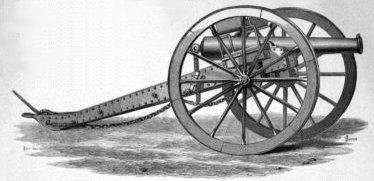
In September 1774 the farmers of Middlesex County rose up and ended royal government in most of Massachusetts. For the next seven months, Patriot activists and the British governor raced to seize artillery. Cannon disappeared from ships, shore batteries and even armories under redcoat guard. In Newton, citizens voted to form their own artillery company. 
Over the next couple of days I’ll consider the rise and fall of the man who donated the cannon for that company, John Pigeon.

This talk is special to me since I grew up in Newton and live there now. In fact, I found the first intriguing tidbits of information about cannons being stolen from Boston armories under redcoat guard in the Newton Free Library’s fine regional history collection. (No matter that the accounts in nineteenth-century chronicles like The Hundred Boston Orators and Tea Leaves are riddled with misinformation it took me years to sort out.)

This event is co-sponsored by Historic Newton. It will start at 7:00 P.M. in the auditorium of the library at 330 Homer Street. There’s ample free parking, and I’ll have books to sell and sign.

Friday, July 07, 2017

EXTRA: Would You Give an Arm and a Leg for These Amputation Kits?

RR Auction is offering the amputation kits that Dr. John Warren used in the Revolutionary War. Bidding ends on 12 July, with the last online bid at 6:00 P.M. and the final bids handled by phone after that.

According to the company’s announcement on Art Daily:
One kit is covered in shark or ray skin (shagreen) and contains: bullet forceps with scissor handles; tissue forceps; a grooved director; a Petit-style tourniquet; bow-framed metacarpal saw; and an extra blade for a large amputation saw. Attached inside the hinged top cover is a 19th-century hand-written card tracing the provenance, reading: “Revolutionary Instruments given by Joseph Warren to John Warren to John C. Warren to Henry J. Bigelow. Copy of letter describing them in possession of J. Collins Warren.” . . .

The second kit is mahogany and contains: a capital amputation saw, with a wooden-handled instrument with hexagonal nut to adjust the blade; a curved amputation knife; surgical scissors; and tissue forceps (possibly non-original). The interior is fitted for the instruments, and one (a scalpel) is absent. Nailed to the front edge is a very faint handwritten 19th-century identification label that is extremely difficult to read, but with enhanced contrast can be deciphered: “Used during the Revolutionary War by Dr. John Warren.”
In addition, in 1850 Dr. John Collins Warren, son of the surgeon who used these instruments, guessed that “The case was probably given to him by his brother General Joseph Warren, when he served as a medical pupil.” He also wrote, “The tourniquet is a French instrument from a model of great antiquity. It is, perhaps, the best instrument of the kind which has been invented.”

“The colonies submit to pay all external taxes”

On 11 Apr 1767, a letter signed “Benevolus” appeared in the London Chronicle. It was reprinted in two other London newspapers within the week.

The Pennsylvania Chronicle, the influential newspaper still co-owned by Benjamin Franklin, ran the letter on 8 June, and Boston newspapers carried it by the end of that month.

“Benevolus” wrote to refute several misconceptions about the American colonists, such as “That they refused to contribute towards the expence of those [recent] wars,” and “That they pay no taxes.”

Misconception number 8 was “That the colonies contend the parliament of Britain has no authority over them.” The essayist assured London readers:
The truth is, that all acts of the British legislature, expressly extending to the colonies, have ever been received there as laws, and executed in their courts, the right of parliament to make them being never yet contested, acts to raise money upon the colonies by internal taxes only and alone excepted.
For “internal taxes” on trade or property within the colonies, Americans insisted—just as Britons did—that only a legislature which represented them could enact such taxes.

But “Benevolus” allowed something else:
The colonies submit to pay all external taxes laid on them by way of duty on merchandizes imported into their country, and never disputed the authority of parliament to lay such duties.

The distinction indeed between internal and external taxes is here looked upon as groundless and frivolous, and some are apt to wonder how a sensible people should ever advance it. But an American founds it thus; an internal tax to be raised in the colonies by authority of parliament, forces the money out of my purse without the consent of my representative in assembly: An external tax or duty is added to the first cost and other charges of the commodity on which it is laid, and makes a part of its price: If I do not like it, at that price I refuse it. If I do like it, I pay the price, and do not need to give my consent by my representative for the payment of this tax, because I can consent to it myself in person.

However, whether there be validity in this distinction or not, seems to be immaterial; since if they are willing to pay external though not internal taxes, and we say they are the same, ’tis then the same thing to us, provided we get the same money from them, as much as they ought or are able to pay, and we may let them please themselves with their futile distinction as long as they think proper.
Assurances like this one emboldened Charles Townshend to propose new bills in May 1767 laying tariffs on tea, wine, glass, paper, and other goods shipped into the American colonies. After all, those were all “external taxes.” That distinction was how Townshend could say ”he would cut off that Hand before he would vote for taxing America” at the same time he was proposing new Customs duties to be collected in America.

“Benevolus” wasn’t just any political observer, though. He was the designated agent for multiple colonial governments and the most respected American in London. He was Benjamin Franklin.

Thursday, July 06, 2017

A New Approach to “American Affairs” in 1767

On 6 July 1767, 250 years ago today, the Boston Post-Boy printed important news from London. A letter dated 11 May described the new policy of Britain’s finance minister, Charles Townshend:
A few Days before the House of Commons adjourned for the Easter Holidays, the Ch[ancello]r of the Ex[cheque]r opened his budget, with very great Applause, even Mr. G——lle [George Grenville, former prime minister] complimented him on the Occasion: among other things he made it appear, that besides paying the Navy and Army and all other Charges for Government for the Last Year, he had sunk [i.e., reduced] Three Millions, nine hundred Thousand Pounds of the National Debt, and assured them that the next Year he would discharge a much greater Sum, notwithstanding they had reduced the Land-Tax one Shilling in the Pound.

He took an Occasion Yesterday to say, that it was reported out of Doors that he was for taxing America. I declare, says he, I am not, nor never was; I thought the Stamp-Act a very improper Measure, and us’d my Endeavours for the Repeal; and (holding out his Hand) he said he would cut off that Hand before he would vote for taxing America; and if any of the Duties laid on Trade shall appear burthensome, nothing shall be wanting in me to remove them.
“Duties laid on Trade”? What did that refer to? The newspaper then printed under the dateline of 14 May:
Yesterday the Chancellor of the Exchequer mov’d the House for Leave to bring in the following Bills, which was agreed to.

An Act to permit Wine, Fruit and Oil to be carried from Spain and Portugal directly to North-America

An Act laying a Duty on China, Paper, Glass, and Painters Colours, shipped from Great-Britain to the Colonies.

An Act for settling a Salary on the Governor, and Judges, &c in North America.

An Act for Establishing a Board of Revenue in North America.
And there was yet more information in letters sent by “some Gentlemen at the New-England Coffee House”—merchants doing business with the region, some of whom had family there as well. Those came with some passengers on a ship that left London on 14 May.
The Parliament met the 13th of May upon American Affairs, and resolved that a Bill be brought in after the following Manner,

That a Tax be laid on Painters Colours, Paper, Glass and China. That the Americans may have Liberty of importing Lemmons, Wine, Fruit & Oil directly from Spain and Portugal, subject to a Duty, the Duty on Wine to be 7£ per Ton

That the Duty on Tea remaining in England be taken off, and a Duty of 3d. per lb. be laid on the Importation in America.

That there be a Board of Customs, as also a Court of Exchequer in New England.

That the Legislative Power of New-York cease until they comply with the Billeting Bill.

That the Governors and Judges be made independent by encreasing their Salary, which is to be paid out of the Revenues of the Customs.

George Grenville made a Motion to oblige the Americans to take an Oath of Allegiance and Obedience to the Parliament of Great Britain, which was put to Vote—for the Question 90[;] against it 180 odd.
The chancellor of the exchequer’s new bills became known as the Townshend Acts—a program that installed new tariffs on selected goods shipped from Britain to America, strengthened the Customs service to collect that revenue, and directed it to officials appointed by the London government.

Another new law put pressure on the New York assembly to supply barracks and firewood for royal troops in that province. Though the House of Commons voted down Grenville’s proposal that Americans have to swear an oath of allegiance, the rest of the package had a lot to concern North American Whigs, regardless of Townshend’s assurance that he opposed “taxing America.”

And by the time the Post-Boy and other newspapers printed that intelligence, the laws had already sailed through the entire Parliament. On 29 June, King George III gave his assent, and the Townshend Acts became law.

TOMORROW: Who assured Townshend that Americans wouldn’t object to tariffs?

Wednesday, July 05, 2017

Gen. Washington at His Headquarters in Cambridge, 8 July

On Saturday, 8 July, John Koopman will once again portray Gen. George Washington at his Cambridge headquarters, now the Longfellow House–Washington’s Headquarters National Historic Site.

That date is the anniversary of when the Massachusetts Provincial Congress’s Committee of Safety voted to fix up the mansion belonging to John Vassall for the new commander-in-chief. Vassall, a Loyalist, had left a very fine house behind when he moved into Boston.

After arriving on 2 July, Washington and Gen. Charles Lee first stayed in the house usually reserved for the Harvard College president. Back in 2012, I shared my thinking on why Washington preferred to move to the Vassall house.

It’s not exactly clear who was in the John Vassall House in early July. Massachusetts Committee of Safety records for 15 May refer to moving “the three companies at Mr. Vassal’s house” out to “Mr. Foxcroft’s house.” Four days later, the committee proposed to use the Vassall house itself, “as soon as General [Artemas] Ward shall provide for the soldiers in said houses in some other places.”

But then came the Battle of Bunker Hill. The provincial army suddenly needed more hospital space for the wounded, and on 22 June Col. John Glover’s regiment was summoned from Marblehead to Cambridge to strengthen the siege lines. Washington’s account book states that the Vassall house “had been occupied by the Marblehd. Regimt” before he moved in, but no other source offers more information about that.

On 28 June, Ward ordered “That Lieut.-Colonel [William] Bond occupy one room, in the south-east corner of Col. Vassall’s house, upon the second floor, for the sick belonging to said regiment.” That was the regiment of Col. Thomas Gardner. Its medical staff consisted of Dr. Abraham Watson, Jr. (1752-1804), of Cambridge as surgeon and Dr. William Vinal (1752-1781) of Watertown as his mate. Though Watson and Vinal, classmates in the Harvard class of 1771, weren’t formally commissioned until early July, they probably treated the wounded in the Vassall house. That may even have been where Col. Gardner himself died of his wounds on 3 July.

Washington’s return visit to his headquarters at 105 Brattle Street will take place on Saturday from noon to 4:00 P.M. The site is free to all visitors, but Cambridge parking rules apply to nearby spaces, so it may be easier to stroll out from the Harvard Square subway station.

Tuesday, July 04, 2017

The Declaration as Historiography

Inspired by the Course of Human Events blog’s “Fresh Takes” project, I’ve been thinking about the Declaration of Independence as a historiographical text. It presents a philosophy of history, describes historical events, and bases its argument on history.

Philosophically, the Declaration reflects Whiggish ideas about the origin of government and the legitimacy of some past revolutions:
That to secure these rights, Governments are instituted among Men, deriving their just powers from the consent of the governed, That whenever any Form of Government becomes destructive of these ends, it is the Right of the People to alter or to abolish it, and to institute new Government, laying its foundation on such principles and organizing its powers in such form, as to them shall seem most likely to effect their Safety and Happiness.
The document finds weight in the passage of time, expressing a respect for “Governments long established.” But it also acknowledges, again drawing on the past, that tyrannies have gone on too long: “all experience hath shewn, that mankind are more disposed to suffer, while evils are sufferable, than to right themselves by abolishing the forms to which they are accustomed.”

At the core of the Declaration is an examination of more recent history as ”a long train of abuses and usurpations, pursuing invariably the same Object”:
The history of the present King of Great Britain is a history of repeated injuries and usurpations, all having in direct object the establishment of an absolute Tyranny over these States. To prove this, let Facts be submitted to a candid world. . . .
The grievances that follow can all (sometimes with a little squinting) be connected to at least one event in the preceding ten to twelve years.

Finally, in addressing the British nation, the Continental Congress wrote: “We have reminded them of the circumstances of our emigration and settlement here.” While looking ahead, the Congress was looking back.

Monday, July 03, 2017

”What is necessary to be done relative to a Colony Seal”

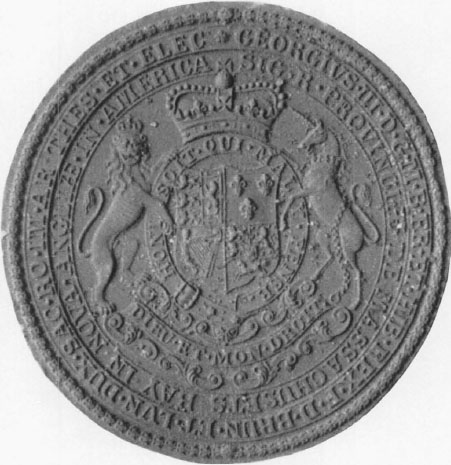
As I described yesterday, in October 1775 Gen. Thomas Gage discovered that the royal seal of Massachusetts had disappeared from the Council Chamber in what’s now the Old State House.

Naturally, we might assume that Patriots had stolen it. After all, they had stolen four cannon from militia armories under redcoat guard in September 1774 [see The Road to Concord].

The British military engineer Capt. John Montresor at some point even wrote in his diary about “General Gage having all his Cabinet papers, Ministers’ Letters, &c., and his Correspondence all stole out of a large Closet, or Wardrobe, up one pair of Stairs on the Landing at the Government House at Boston.” (But there’s no confirmation of such a theft, and Gage’s correspondence seems to be intact at the Clements Library.)

So was the seal spirited out of Boston for the Patriot government to use?

Probably not. Because that government outside Boston had already commissioned and started to use a new seal reflecting its ideology. The state Secretary of State states:
When the conflict between the province and England began in 1775, General Thomas Gage, the royal governor, had custody of the province seal. As his authority was no longer recognized by the province it became necessary to establish a new public seal.

The General Court passed an order on July 28, 1775, appointing a committee to consider ”what is necessary to be done relative to a Colony Seal.” The design adopted was that of an English-American man holding the Magna Carta. The seal was engraved by Paul Revere, whose original signed bill for the work is located in the Massachusetts Archives.

A motto in Latin was also chosen—“Ense petit placidam sub libertate quietem”—which remains the motto of the Commonwealth today. Freely translated this means, “By the sword we seek peace, but peace only under liberty.” It was written about 1659 and is attributed to the famous English patriot, Algernon Sydney [sic].
It’s conceivable that the royal seal was taken out to the Massachusetts Council and that body just decided not to use it. If I were writing a spy novel, I’d imagine Patriots using it to forge a commission or other credentials for an undercover agent. But my bet is that the royal seal went missing during the turbulence of the siege, and within a few months no one cared.

Sunday, July 02, 2017

“All the Seals have been taken out of the Council Chamber”

Hace you seen the last royal seal of Massachusetts?

At left is a picture of the impression the seal made. It shows the royal arms of Great Britain, with the lion and unicorn fighting for a crown, within a motto denoting the reign of George III.

As the Massachusetts Secretary of State’s website explains, royal governors Francis Bernard, Thomas Hutchinson, and Thomas Gage used this seal on official commissions in the 1760s and early 1770s.

And then, in the middle of the siege of Boston, the royal seal disappeared. Gen. Gage issued a proclamation dated 3 Oct 1775 offering “a Reward of Ten Guineas” for its return.

The governor also summoned his Council and appointed a committee to find out where the seal had gone. On 6 October, Lt. Gov. Thomas Oliver, Chief Justice Peter Oliver, Treasurer Harrison Gray, William Browne, and Richard Lechmere reported back that they had conducted “a strict enquiry and examination under oath, of all those persons who have been returned to us, as having had access to the Council Chamber between the Ninth day of September and the Fourth of October.” They had collected affidavits. But they had found no answers and no seal.

As reported in the Colonial Society of Massachusetts Transactions, Gage had to report to the Earl of Dartmouth, Secretary of State:
Boston 9th October 1775

My Lord…

I must inform Your Lordship that a Theft has been committed on the Province, and that all the Seals have been taken out of the Council Chamber where they were kept. This was observed on the 4th Inst; on the 6th I sent a Message to the Lieutenant Governor and Council, to make every necessary enquiry they possibly could, into the matter, which they have done, and I am sorry to tell Your Lordship without any good effect; which you will see by their answer to my message, which I have now the honor to transmit to Your Lordship.
I’m curious why the governor reported that people had noticed the seal was missing on 4 October when his proclamation was dated 3 October. Perhaps the young printer John Howe had made an error, or perhaps Gage had. He was about to leave Massachusetts for good, sailing away on 11 October, so he had a lot of other things on his mind.

TOMORROW: Did Patriots steal the seal?

Saturday, July 01, 2017

A Common-place Sampling

The online history magazine Common-place just released a new issue featuring thirteen essays by young scholars on thirteen varied texts from or about early America. Each short essay is accompanied by a link, so it functions as an introduction to that work. Here are the pieces on eighteenth-century material.

Early America’s Guide to Sex: Aristotle’s Masterpiece
Sarah Schuetze
It is not hard to imagine the allure of such a work for readers—modest or otherwise—for it provided a rare detailed discussion of sex.

Poetic Order in Sarah Kemble Knight’s Journal
Kimberly Takahata
By liberating her thoughts from the space of prose and her account from the limitations of physicality, Knight can transform the landscape through her narration, using poetry to “divert” and contain the threat of the unfamiliar.

On Virtue: Phillis Wheatley with Jonathan Edwards
Michael Monescalchi
Wheatley’s saying that her soul touched by Virtue can “guide [her] steps” is thus more than just a metaphor for God’s ability to change a converted person’s life: it is an acknowledgment of the immense power that God’s virtuous character can have over a person’s body and soul.

Samson Occom’s Missionary Correspondence and the Common Pot
Lauren Grewe
Creating a literary genealogy linking Occom and Wheatley could change conceptions of early American Indian and African American writing and missionary work.

America, the “Rebellious Slut”: Gender & Political Cartoons in the American Revolution
Stephanie McKellop
Combining Revolutionary politics with the social and cultural valences of gender, race, class, nation, and power, this political cartoon serves as a multidimensional cipher which people at every knowledge level can participate in analyzing.

Introduction to The History of a French Louse
Julia Dauer
The satire’s narrator is a louse who has lived on a series of heads in and around Paris and been witness to the political maneuverings happening behind the scenes of the American Revolution.

Gallows Respectability
Ajay Kumar Batra
Sentimental reformist oration, fugitive confession, and the personal epistle are all represented in this text [the address of a African-American man named Abraham Johnstone being hanged—unjustly, he says—for murder in 1797].

Friday, June 30, 2017

Questions Raised by Lunenburg’s Cannon

Yesterday’s posting, thanks to Eileen O’Brien, quoted from the town records of Lunenburg as its citizens voted to mount a nine-pounder cannon and then offer it to the provincial army.

Of course, the town didn’t make that offer until after 13 June 1775, almost two months after the war began. The gun might not have been fully mounted and equipped until then; the effort didn’t start until March. But the records imply that Lunenburg didn’t even alert the Massachusetts Provincial Congress that it might have a cannon until June.

The man given the most responsibility for managing this cannon was Abijah Stearns (1724-1783). He was put on the committee to collect money to mount the cannon, and he was in charge of the guard that trucked it to Cambridge in the summer of 1775.

That makes sense because Stearns had been one of Lunenburg’s representatives to the first Provincial Congress in October 1774, and he became a colonel in the state militia in 1776. His gravestone, complete with rhyming verse, appears above.

During the months when Lunenburg was discussing the cannon, however, the town’s sole representative to the second and third Provincial Congresses was Dr. John Taylor. He wasn’t linked to the gun directly, but he was the medical mentor of Dr. Abraham Haskell, who was added to the cannon committee on the same day as Stearns. So Taylor probably knew about the gun.

In early June 1775, shortly before the decision to turn over the cannon, Dr. Taylor convinced the Provincial Congress that Lunenburg should be allowed to deliver half a barrel of gunpowder instead of the one or two barrels the congress had asked for. Was that arrangement related to the cannon?

As for Lunenburg’s request to the Massachusetts General Court to pay for the cannon, I haven’t found a record of that payment coming through. (The legislature did compensate the town for some costs from April 1775.) If the Continental Army had taken that nine-pounder down to New York in the spring of 1776, the state probably passed Lunenburg’s bill on to the Continental Congress.

Thursday, June 29, 2017

A Cannon in Lunenburg

Eileen O’Brien kindly shared the following extracts from the records of the Lunenburg town meeting. They add Lunenburg to the list of Massachusetts towns which in the months before the Revolutionary War officially began were discussing how to arm themselves with artillery—the focus of my book, The Road to Concord. Thanks, Eileen!

In the “Town of Lunenburg Minute & Report 1763-1796” (which is unpublished) are the following entries:
At a Legal annual Town meeting on monday ye 6th of March 1775 being Legally assembled at the publick meeting house in Lunenburg

Voted to open a Subscribtion to mount the Cannon now in town

Voted & Choose Capt Aaron Willard Lt Philip Goodridge & Mr Zebulon Dodge a Committe to forward sd Subscribtion & to See to the mounting [of] sd cannon . . .

March ye 9th: the town being meet agreeable to the adjournment—

Voted that Capt Abijah Stearns & Docr. Abraham Haskel be added to the Committe that was Choosen to open a Subscribtion for mounting the Cannon and that the Sd Committe Receve any article in the Subscribtion and turn the Same to the best advantage for Sd purpos . . .

At a Legal town meeting at the meeting hous in Lunenburg on Tusday the thirteenth Day of June 1775...

Voted that whereas there is a peace of ordnance viz a cannon carrying a Shot of 9# well mounted & fit for Service now in the town of Lunenburg the property of sd town which the Said town are willing Should be made use of for the Defence of the province or otherwise as the Committe of Safty or Congress for Sd province Shall think proper, & will convey the Same to Cambridge on there Desire or order, and also that the Select men of the Sd. town give proper notice that their is Such a peice of ordinance now at Lunenburg fit for Service, to the Said Congress or Committe of Safty for Sd province

Voted that Capt. Abijah Stearns be an officer of four men for a gard & a teamster to See that the Cannon be Safely Conveyd as above prescribed

Voted that if Capn Stearns Delivers Said Cannon that he take a proper Recipt . . .

the town being [met] December ye 11th: 1775 agreeable to the adjornment

Voted that the Selectmen be a Committe to petition the General assembley for the Chargeses of procuring & mounting a Canon for the Continential army
As Eileen O’Brien noted, the men of Lunenburg were very careful to get a receipt for their property and to ask for payment. After all, cannon don’t grow on trees, and town meetings don’t like to spend money.

TOMORROW: Some observations and questions about this situation.

Wednesday, June 28, 2017

Upcoming Boston By Foot Tours

Boston By Foot offers three walking tours this coming weekend focused on heroes of Boston’s Revolution—most of whom are even non-fictional. Here are the descriptions.

Sunday, 2 July, 10:00-11:30 A.M.
Johnny Tremain’s Boston
Relive the adventures of Johnny Tremain in Colonial Boston based on Esther Forbes’ prize-winning coming-of-age novel featuring a young boy who gets caught up in the whirlwind of events that led up to the American Revolution.

Johnny’s story unfolds in downtown and North End locales, many of which are today’s Freedom Trail sites including the Old State House, Copp’s Hill Burying Ground, Paul Revere’s House, and the Old North Church.

On this tour, hear of Johnny’s fictional friends, like Rab and Cilla, but also of the actual patriots he met along the way, such as Dr. Joseph Warren, John Hancock, William Dawes, and Paul Revere. Get acquainted with the bustling and political town of Johnny’s Boston that has become the great American city of today.

Sunday, 2 July, 3:00-4:30 P.M.
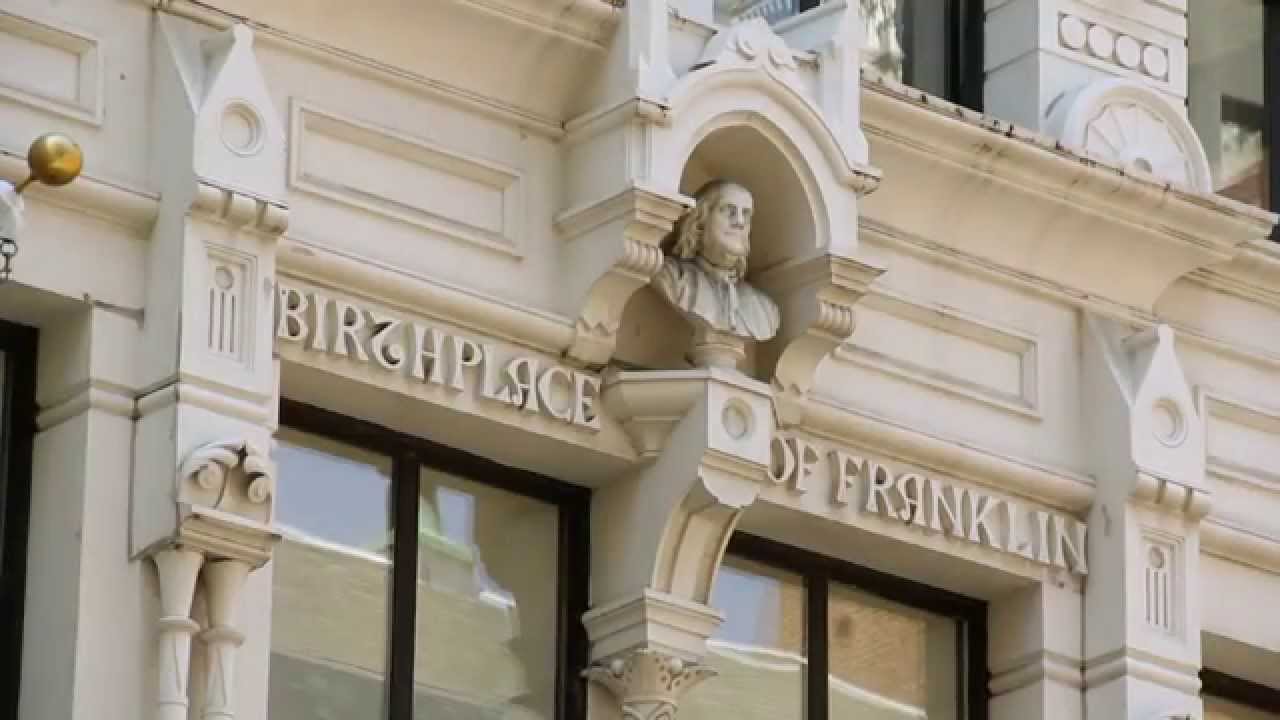
Ben Franklin: Son of Boston
Celebrate and learn about the life of Benjamin Franklin by walking among the sites of his homes and haunts in Colonial Boston.

In his day, Franklin was America’s greatest scientist, inventor, diplomat, humorist, statesman, and entrepreneur. Ben was born in Boston, came of age in Philadelphia, and was the darling of Paris. From his many inventions, creations of civic, philanthropic, and educational institutions, to his roles in the founding of America, his legacy is immeasurable.

Monday, 3 July, 5:30-7:30 P.M.
Adams Family in Boston
“My Eyes are so diverted with Chimney Sweeps, Carriers of Wood, Merchants, Ladies, Priests, Carts, Horses, Oxen, Coaches, Market men and Women, Soldiers, Sailors, and my Ears with the Rattle Gabble of them all...” —John Adams, diary, March 18-19, 1759

Follow the words and history of four generations of Adamses, from their experiences at the Old State House, through Beacon Hill, and into Back Bay. John, Abigail, and their descendants were prolific writers. The trove of documents they left behind intimately describe their lives, public service, and Boston from the eve of the Revolution to the turn of the twentieth century.

General admission for each tour costs $15, or $5 for members; tickets are available through the links above. Boston By Foot also offers these tours on a private basis.

Tuesday, June 27, 2017

The Birth of “Brown Bess”

Last month the Royal Armouries blog posted curator Johnathan Ferguson’s detailed article about the term “Brown Bess” as slang for a British infantryman’s musket.

The article cited three appearances of the term before its first entry in a slang dictionary.
  • John Grose, letter dated 17 Oct 1763: on joining the militia he received a “Coat, Pair of Breeches and musket (alias Brown Bess).”
  • The Adventures of a Kidnapped Orphan, 1767: “he began to handle Brown Bess with tolerable dexterity.”
And the 1771 article about Hannah Snell that I quoted yesterday, which portrays her as saying, “if you are afraid of the sea, take Brown Bess on your shoulders, and march.”

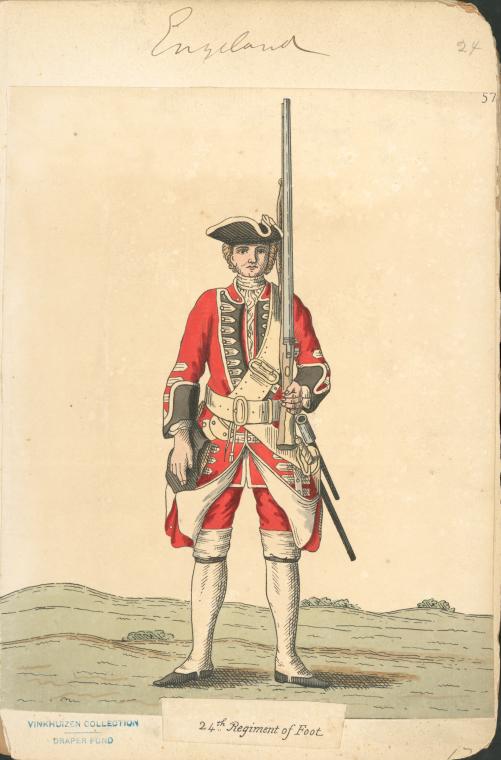
All those items show that the term “Brown Bess” was established in British society during the Revolutionary War. And there’s no indication it applied to some types of army firelocks and not others; it meant a soldier’s musket.

As for the origin of the phrase, Ferguson neatly disposes of several guesses: that “Bess” alluded to Queen Elizabeth, that “brown” referred to browning the musket barrel to protect it, that the whole phrase comes from German.

Instead, English authors were using “Brown Bess” by the late 1500s and early 1600s to mean a common woman or prostitute. In this context, “brown” meant ordinary, nothing special. That adjective was also applied to regular soldiers’ muskets by the early 1700s. So when people started to use “Brown Bess” in the context of the army, they implied that a soldier and his gun were a couple linked for life.

Monday, June 26, 2017

Hannah Snell and the Press Gang

Hannah Snell (1723-1792) was a native of Worcester in England. In 1747, her husband having deserted her and their child having died in infancy, she borrowed a brother-in-law’s clothes and name and enlisted in the British marines.

Over the next three years Snell participated in an abortive expedition to Mauritius and then a long campaign in India. Reportedly she was wounded multiple times to her legs and groin, and at one point whipped on her bare back. Nonetheless, Snell maintained her identity as a male until the ship returned to London, when she revealed her secret to her shipmates.

And then Snell made a deal with a London publisher for her story. The Female Soldier turned Snell into a celebrity. Engravers issued prints of her in her uniform. Prince William, the Duke of Cumberland, ensured that she received a military pension.

With Britain at war off and on throughout the century, Snell’s story was frequently republished to encourage martial patriotism from all British subjects. Isaiah Thomas put a version into his almanac for 1775 as Massachusetts prepared for armed rebellion, reusing an old cut of a woman holding a musket. (For more about that image, see my article here.)

In January 1771 the Oxford Magazine published a new anecdote about Hannah Snell, by this point in her mid-forties, a pub owner, and a mother of two new children by a new husband. The item appears to have come from a British newspaper dated 2 January:
Friday last a press gang was very busy at Newington-butts, and having impressed a poor countryman from his wife and children, the distressed woman followed her husband with lamentations, which induced many women to sally from their houses; among the Amazons was the famous Hannah Snell, who immediately demanded the captive from the Lieutenant; he refusing, and bad words ensuing, she collared and shook him; two sailors advanced to rescue their officer, whom she beat, and challenged to fight any of the gang with fists, sticks, or quarter-staff, only let her be permitted to pull off her stays, gown and petticoats, and put on breeches, declaring she had sailed more leagues than any of them; [“]and if they were seamen, they ought to be on board, and not sneak about as kidnappers; but if you are afraid of the sea, take Brown Bess on your shoulders, and march through Germany as I have done: Ye dogs I have more wounds about me than you have fingers. By G—d, this is no false attack; I’ll have my man[”]; and accordingly took the poor fellow from the gang, and restored him to his wife.

Thus did the long petticoats, headed by a veteran virago, overcome the short trowsers.——

Mrs. Snell has a pension of 50 l. per annum left by the late Duke of Cumberland, for her many manly services by sea and land.
That story was soon circulating in America as well. It appeared in the 25 Mar 1771 New-York Gazette, the 28 March Pennsylvania Journal, the 2 April Connecticut Courant, the 11 April Massachusetts Spy by Thomas, and the 19 April New-Hampshire Gazette.

In addition to giving us another glimpse of Snell, that article is notable for being one of the earliest print appearances of the phrase “Brown Bess” (or “brown Bess,” as the Pennsylvania Journal rendered it).

TOMORROW: But it wasn’t the very earliest appearance.

Sunday, June 25, 2017

Two Maps of Eighteenth-Century Native America

A couple of stories about maps created or co-created by Native Americans in contact with British settlers recently caught my eye.

At Atlas Obscura, Sarah Laskow wrote about a map drawn on deerskin, now lost, in South Carolina in the early 1720s:
It depicted geographic and social relationships among the Native American nations in the surrounding area. Squares represent European settlements, with Charleston at one end and Virginia at the other, and circles in between represent Native American communities, connected by double lines that resemble paths.

This map, now known as the “Catawba Deerskin Map,” is one of the only examples of a map created by a Native American and given to Europeans. Colonial settlers reported that native tribes regularly made maps—etched in ash or on tree bark—and that this local cartographic knowledge helped the settlers develop their own maps of areas they wanted to occupy. . . .

This particular example combined geography with information about the relations between people living in the area, and some scholars argue that the paths drawn between the communities represent social and political distance, rather than geography. “This was a map that was meant to illustrate a trade relationship,” Max Edelson, a historian at University of Virginia, told BackStory radio. Edelson’s new book, A New Map of Empire, explains that the center of the map is the Catawba community of Nasaw, and Edelson compares it to the famous “View of the World From 9th Avenue” map, in which New York City takes on a disproportionate amount of space to represent its inhabitants’ view of the world.

There is some question, though, about who actually made the deerskin map. . . . Historian Ian Chambers, for instance, has argued that the map is of Cherokee origin. One of the keys to his assertion is the path that runs across the top of the map, which connects the Cherokee directly to Charleston. Trade along this connection, Chambers writes, had been logistically challenging, and a Cherokee leader had once promised a trader that “they would make a new path” to ease the way. The central position of the Catawba communities, in this theory, highlights their position as an obstacle to direct trade between the Cherokee and the British, much like a British map might put the Atlantic Ocean at the center of a map of the North American colonies and the British Isles, the center of power, in one corner.
Meanwhile, the Cornell University library spotlighted a recent acquisition “showing Seneca and Cayuga villages and native footpaths in addition to natural features” in what is now upstate New York:
It consists of three maps: a finished map of Hudson County, and sketched maps of Schoharie Creek and Seneca and Cayuga territory.

The Seneca-Cayuga map depicts Cayuga and Seneca lakes as well as six small triangles representing indigenous villages. Five of these villages are named, and all are connected by a network of dotted lines indicating footpaths.

“It’s one of the most detailed early European reconnaissance of what we now call the Finger Lakes, and what’s striking about that from a colonial/historical perspective is how late that is,” said Jon Parmenter, associate professor of history.

The map was likely created between 1760 and 1770. By then, the Finger Lakes region was well known to European colonists, but they had limited access for detailed surveying. . . .

For example, a spot on Cayuga Lake labeled “Tarry” on the map was probably a spot where people waited for canoes to come and ferry them across to the other shore. A spot near what is now Montezuma, N.Y. is labeled, “The resort of gees and ducks of all sorts all the year.”

Saturday, June 24, 2017

The Literary Legacy of Joseph Strutt

Joseph Strutt (1749-1802) was an English engraver and antiquarian. Most of his career was taken up with researching, drawing, and publishing artifacts of the British past: pictures of kings from old manuscripts, clothing of different periods, and so on.

I’m using Strutt’s Sports and Pastimes of the People of England, published in 1801, as a source in my paper at the Dublin Seminar for New England Folklife today. The paper is titled “Political Football,” and Strutt described the game as played in his time this way.
When a match at foot-ball is made, two parties, each containing an equal number of competitors, take the field, and stand between two goals, placed at the distance of eighty or an hundred yards the one from the other. The goal is usually made with two sticks driven into the ground, about two or three feet apart. The ball, which is commonly made of a blown bladder, and cased with leather, is delivered in the midst of the ground, and the object of each party is to drive it through the goal of their antagonists, which being achieved the game is won. The abilities of the performers are best displayed in attacking and defending the goals; and hence the pastime was more frequently called a goal at foot-ball than a game at foot-ball. When the exercise becomes exceedingly violent, the players kick each other’s shins without the least ceremony, and some of them are overthrown at the hazard of their limbs.
Strutt also wrote poetry and fiction, including a novel set in the fifteenth century that he hadn’t finished when he died. The publisher John Murray asked a young lawyer and poet named Walter Scott to complete the story, which he did rather perfunctorily. But that book gave Scott the idea of writing historical novels of his own.

Friday, June 23, 2017

Raise the Spitfire?

Earlier this month the Associated Press reported on the Lake Champlain Maritime Museum’s proposal to raise, preserve, and display a gunboat that sank in 1776.

The boat is the Spitfire, one of Gen. Benedict Arnold’s fleet during the Battle of Valcour Island. The dispatch says:
The Spitfire was found during a 1997 sonar survey of the lake. Museum divers check on it yearly. Its mast is still erect and the bow cannon still in the firing position. The ammunition and other artifacts from the battle are buried in mud.

For almost 250 years, the Spitfire has been protected by the cold water of the lake. But Cohn said its future is in danger because of the expected arrival in the lake of quagga mussels, an invasive species that has reached the Great Lakes and could potentially destroy metal fastenings that hold the vessel together.
Back in the 1930s another gunboat, the Philadelphia, was pulled up from the lake. The museum made a replica that sails on Lake Champlain today, shown above.

Raising the Spitfire is a huge undertaking. The plan being proposed would take twenty-two years and cost an estimated $44 million. The steps involved:

  • two years of planning at a cost of $1 million.
  • building a facility to house the boat in Burlington, Vermont.
  • bringing the Spitfire to the surface around 2025.
  • preserving the boat by strengthening the cells of the wood with chemicals over fifteen years.
  • building a museum to display the boat near Plattsburgh, New York.

If all goes according to plan, the Spitfire would be ready for its close-up around 2039.

Thursday, June 22, 2017

Declaring Independence , 27 June–July 4

In connection with other historical organizations and venues, the Freedom’s Way National Heritage Area and the American Antiquarian Society are presenting a series of public performances of “Declaring Independence—Then & Now.”

These are presentations about forty minutes long in which a narrator and five costumed re-enactors bring to life the Declaration of Independence as seen from the local level in the community where they are speaking.

Each presentation includes voices from the host town or city in 1776. That spring, the Massachusetts legislature invited town meetings to discuss whether it was time to declare independence from Great Britain. Those responses, as well as newspaper essays and letters, create the tapestry of public debate.

“Declaring Independence” presentations then proceed to a complete reading of the Continental Congress’s Declaration of July 1776 (with the obscure bits explained). Finally, the presenters and audience engaged in a moderated discussion of the issues that the Declaration raises today.

The upcoming performances of “Declaring Independence” are:

27 June, 7:00-8:30 P.M.
American Antiquarian Society, Worcester

29 June, 6:00-8:00 P.M.
Longfellow’s Wayside Inn, Sudbury, with the Sudbury Historical Society

1 July, 7:00-8:30 P.M.
First Parish Church, Fitchburg, with the Fitchburg Public Library & Fitchburg Historical Society

1-4 July, 10:00 A.M. & 12:00 noon
Old Sturbridge Village, Sturbridge

2 July, 1:00, 3:00 & 5:00 P.M.
Old North Church, Boston, with Boston’s Harborfest

4 July, 7:00-8:30 P.M.
The Depot, Lexington, with the Lexington Historical Society

Contact the host organizations for more information about each event. “Declaring Independence” is an outgrowth of the Patriots’ Paths project, in which Freedom’s Way historian Mary Fuhrer works with members of a community to explore its primary documents about America’s move toward independence. If you want your local historical organization to help create and host a future presentation, contact Freedom’s Way.

Wednesday, June 21, 2017

Upcoming Events at Paul Revere House

The Paul Revere House in Boston’s North End has a busy summer of special events coming up. All of these take place on Saturdays unless described otherwise.

27 June, 1:00, 1:45 & 2:30 P.M.
John Adams: The Colossus of Independence
Hear from John Adams himself as he discusses his earliest beginnings in Braintree through his days as delegate of the Continental Congress and foreign ambassador. Hear his opinions of his contemporaries and how he longs to be home with his “dearest friend,” Abigail, and their children. Mr. Adams’ singular wit is appealing to children and adults!

Friday, 30 June, 1:00-3:00 P.M.
A Visit with Paul Revere
David Connor brings Boston’s favorite patriot vividly to life. Ask him about the details of his midnight ride, inquire about his 16 children, or engage him in conversation about his activities as a member of the Sons of Liberty.

1 July, 1:00-3:00 P.M.
Patriot Fife and Drum
Enjoy a lively concert of music that accompanied colonists as they marched, danced, wooed their beloveds, and waged war. David Vose and Sue Walko provide fascinating insight into each selection they perform.

Monday, 3 July, 1:00-3:00 P.M.
Colonial Dance Tunes and Love Songs
In the guise of itinerant musicians, Al Petty & Deirdre Sweeney perform popular 18th-century tunes such as “Mr. Isaac’s Maggot” and “Jack’s Health” on the penny whistle, flute, fife, & other instruments.

8 July, 1:00, 1:45 & 2:30 P.M.
Fife and Drum Concert by the Boston Alarm Company
Treat yourself to a sprightly concert of fife and drum music! Dressed in civilian clothing reproduced from period originals, alarm company members play marches and beat out cadences used to warn citizens of impending attack.

15 July, 1:00-3:00 P.M.
Glass Harmonica Concert
Vera Meyer plays early American melodies on the intriguing instrument that Ben Franklin invented. The ethereal, haunting tones Meyer creates as she places her wet fingers on the rims of rotating glass bowls will mesmerize all who listen!

22 July, 1:00-3:00 P.M.
Colonial Basket Weaving
Rather than in plastic bags or cardboard boxes, colonists stored cheese, chickens, and candles in specially designed baskets. Fred Lawson weaves and sells reproductions copied from period originals.

29 July, 1:00-3:00 P.M.
The Tailor’s Craft
Clothing historian Henry Cooke takes on the role of an early Boston tailor. Watch as he “takes the measure” of visitors, then sits cross-legged, fashioning waistcoats from luxurious fabrics and “slops” from coarse weaves.

5 August, 1:00-3:00 P.M.
Hammered Dulcimer
Award-winning musician Dave Neiman plays jigs, reels, and Baroque and Renaissance tunes that Paul Revere and his family may have enjoyed.

12 August, 1:00-3:00 P.M.
Colonial Leather Working
Find out how colonial era leather workers fashioned scabbards, sword belts, and harnesses. Fred Lawson demonstrates and invites visitors to try their hands at punching holes and sewing leather.

19 August, 1:00-3:00 P.M.
Tinsmithing Demonstration
Who made the ubiquitous lanterns, sconces, and other tin wares of the 18th century? A tinker! Larry Leonard produces and sells examples of his craft while describing the techniques, tools, and materials used since the Reveres’ era.

26 August, 1:00, 1:45 & 2:30 P.M.
A Revolution of Her Own!
The captivating story of the first woman to fight in the American Military: in 1782, Deborah Sampson bound her chest, tied back her hair, and enlisted in the Continental Army. Experience her arduous upbringing, active combat, and success as the first female professional soldier (in part, due to the assistance of Paul Revere). Deborah’s passion takes you back in time! Length: 30 min.

All events are included the price of admission, which is for adults $5, for seniors & college students $4.50, and for children aged five to seventeen $1. Members and North End residents are admitted free at all times. The house is open daily 9:30 A.M. to 5:15 P.M. to the end of October.

(The picture above, courtesy of North End Waterfront, shows the Paul Revere House around 1900, before it was restored and turned into a historical museum. Cigars are no longer available inside.)