


J. L. BELL is a Massachusetts writer who specializes in (among other things) the start of the American Revolution in and around Boston. He is particularly interested in the experiences of children in 1765-75. He has published scholarly papers and popular articles for both children and adults. He was consultant for an episode of History Detectives, and contributed to a display at Minute Man National Historic Park.

Subscribe thru Follow.it


•••••••••••••••••


Showing posts with label Benjamin Galloupe. Show all posts

Thursday, January 22, 2009

Old Boston Photographs on Flickr
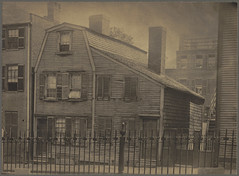
After my recent postings on the now-demolished Galloupe House in the North End, Boston 1775 reader Richard De Fonce alerted me to the Boston Public Library’s Flickr set of Old Boston Photographs.

The collection includes a photograph of the Galloupe House on Hull Street, from the same perspective as its nineteenth-century engravings. I guess there was only one way to get a good look at it since it was hemmed in by other buildings.

De Fonce noted that the nearby Hart House (shown here) is also identified as “Headquarters to General Thomas Gage during the Battle of Bunker Hill” in its online caption. However, this is clearly a case of “memory creep”; all the information about the Galloupe House in MacDonald’s Old Copp’s Hill and Burying Ground, including its construction date of 1724, has been assigned to the Hart House as well. Rambles in Old Boston shows and discusses what it calls the Hartt House without noting any Revolutionary significance.

The B.P.L.’s online collection includes a picture of Province House, official residence of the royal governors—where Gage definitely had his main headquarters. This is not a photograph but an engraving which was printed in many histories.

Province House remained standing until 1922, so why don’t we have good photographs of it? By the time photography was invented, the house had been hemmed in on all sides by other buildings. It no longer looked stately, as it did in the eighteenth century. In fact, it probably looked like what it had become: a dark, rundown commercial building.

I’m going to pull up and discuss other images from the B.P.L.’s collection as it strikes me, but here are some random highlights to check out:

Not all the buildings pictured in the collection go back to the Revolutionary War, and not all of them were significant in how that war turned out, but together they offer a glimpse of lost Boston.

Sunday, January 18, 2009

The Galloupe House Fades from Public Memory

This is a late-1800s engraving of Benjamin Galloupe’s house in Boston’s North End, identified in 1887 as where Gen. Thomas Gage set up a staff headquarters during the Battle of Bunker Hill.

Earlier histories, such as Richard Frothingham’s History of the Siege of Boston, didn’t mention this house. After 1887 many books about Boston said Gage used it, perhaps the latest being Annie Haven Thwing’s Crooked and Narrow Streets of Boston (1925), which was all about local landmarks.

The Galloupe house was taken down in the early 1900s, and its historical significance (if indeed it had any) soon disappeared as well. Two recent histories of the Battle of Bunker Hill don’t mention Gage making any North End building his headquarters for the day. Richard Ketchum’s Decisive Day (1962) says:

It must have been about nine o’clock [A.M.], with the council of war finished, orders issued, and subordinates off attending to preparations, when Gage left Province House to view the situation in broad daylight. (It was the one time he left headquarters, apparently; the rest of the day he was there to receive reports from Charlestown and from the lines at Boston Neck.)
Ketchum’s evidence for Gage leaving Province House at all is the terrific anecdote about Abijah Willard. However, as I discussed back then, that anecdote doesn’t seem to be 100% reliable, more’s the pity.

In contrast, Thomas J. Fleming’s Now We Are Enemies (1960) says:
In the North Church tower, from which the fateful signal to [sic] Paul Revere has been flashed sixty days before, Thomas Gage watched through a field glass. He had planned to direct the battle from Province House. But not even his natural talent for patience could bear the suspense...
General Gage in America by John Richard Alden (1948) doesn’t mention the Galloupe house at all. A. J. Langguth’s Patriots (1988) says Gage had an “advance headquarters,” location unspecified, but I’ve found that book less reliable than Ketchum’s.

So there we have it. Gage oversaw the battle from Province House, from the Galloupe house, from Old North Church—or maybe somewhere else entirely. That level of uncertainty is about what I expect when it comes to Bunker Hill. We’re much more eager to read about details than the chroniclers of the time were to write it down, so the intervening years have provided them.

I suspect Gage kept his headquarters at Province House while making a couple of trips to the North End to observe the fighting as much as he could. (The fire and smoke from Charlestown obscured much of the action.) He left the battlefield command to Gen. William Howe. Meanwhile, Gage had to worry about the possibility of a provincial attack over the Boston Neck, or a civilian uprising in the town, while so many of his troops were occupied to the north. (Similarly, in Cambridge Gen. Artemas Ward was keeping alert for a possible British attack down the Neck.) For that reason, sticking to a central headquarters makes sense.

Saturday, January 17, 2009

House Occupied by “Old Gage”?

Yesterday I described how a Boston 1775 reader asked about a picture of a wooden colonial house identified as Gen. Thomas Gage’s “military headquarters.” But the book with that picture offered no further information.

I did some digging in Google Books and got lucky by finding a similar view in Rambles in Old Boston, by Edward Griffin Porter (1887). That book also offers a description of how Gage had used the Hull Street house on 17 June 1775:

In 1775 this house was occupied by British troops, the Gallop [or Galloupe] family retiring to Saugus. During the Battle of Bunker Hill General Gage made this his staff headquarters,—a convenient place for the purpose, being near his battery yet somewhat under cover of the hill. Mr. William Parkman remembers hearing his grandmother, who lived near by at the time, often speak of this house as having been occupied, on that eventful day, by “old Gage,” as she called him. Several other persons have confirmed the tradition.
Now as to whether there’s stronger evidence for that tradition than a grandmother’s tale and neighborhood memories, I don’t know. It seems possible that people remembered British army officers moving into the empty house sometime during the siege of Boston, or staff officers using it during the battle, without Gage himself setting up an office there. I call that phenomenon “memory creep”—stories edging toward the more famous names and events.

In any event, that book seems to have been the anecdote’s earliest appearance in print. Other authors soon picked up on it. Colored engravings of Province House, which was the governor’s usual headquarters, and the Galloupe house appear side by side in Homes of Our Forefathers in Boston, Old England, and Boston, New England, by Edwin Whitefield (1891).

Edward MacDonald’s little guide to Old Copp's Hill and Burial Ground (1891) added more detail, again without specifying its sources:
The Galloupe House was erected nearly one hundred and sixty years since—in 1724—by a Mr. Clough; it was purchased by a Mr. Benjamin Gallop (afterward called Galloupe) in 1772; he died in 1776, just after the Declaration of Independence. The estate then became the property of his youngest son, Richard, and, at his death, it descended to his youngest daughter, who married Mr. William Marble, a well-known decorator of Boston, and was sold by him in 1877, a short time after the death of his wife, to the present owner.

This house was occupied by British troops in 1775, and was the headquarters of General Gage on the day of the Battle of Bunker Hill. Its timbers were cut in the vicinity.

The Snelling House, now standing on Hull Street, was occupied by British troops, who covered the cellar floor with tombstones taken from the Cemetery; the Snelling House on Salem Street was similarly used, but it has been demolished and replaced by a handsome brick building.
The fact that two Snelling Houses in the North End had the same story attached to them makes me wonder if people got them mixed up.

A final mystery: Histories from the mid-1900s say nothing about the Galloupe house.

TOMORROW: Out of sight, out of mind, out of history.