






Investigating Slaves at the Hooper-Lee-Nichols House
In particular, the society wanted to collect information about any enslaved people living in that farmhouse along the street between Cambridge and Watertown.
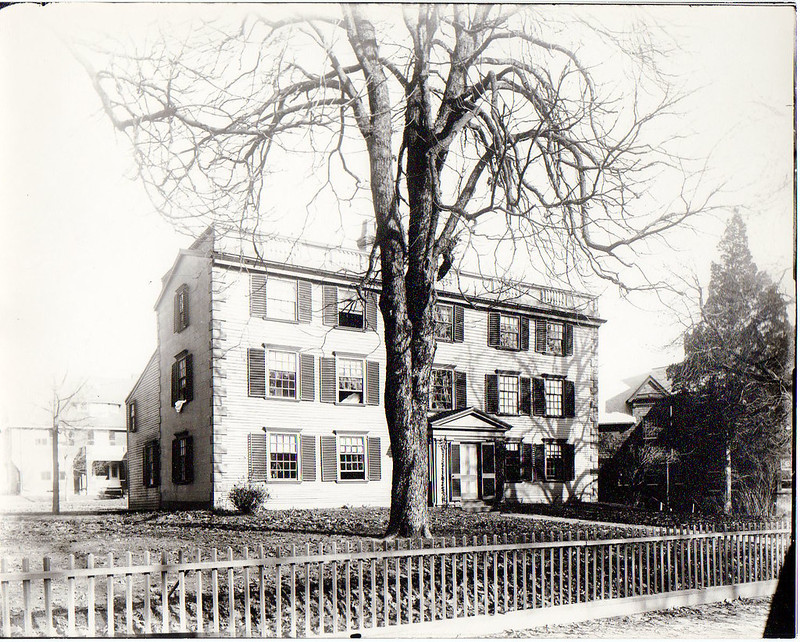
Among the “Tory Row” mansions, the Hooper-Lee-Nichols House is the oldest, built in 1684 and then remodeled inelegantly to look more like its newer Georgian neighbors. It in fact predates the arrival of the Vassalls family, who brought Caribbean slave-labor wealth to the neighborhood.
The elder John Vassall (1713-1747) married Elizabeth Phips (1716-1739), a daughter of Lt. Gov. Spencer Phips. Another daughter, Rebecca Phips, married Joseph Lee in 1755. The society’s report continues the story:
Three years after the marriage the couple bought the house to live among several of her socially prominent and wealthy relatives who resided on [what is now] Brattle Street.The society notes that the records of people like Caesar, Mark Lee/Lewis, and Juno Lewis are frustratingly sparse and sometimes contradictory. But they’re there.
Lee was thought to be a gentleman, respected by his peers, honorable, honest, and a good friend. He was a founder of the Loyalist Christ Church, Cambridge, gave parties for his neighbors and was an avid gardener on his extensive farm with its many outbuildings. About his outlook on slavery we have a glimpse from a letter a friend wrote to him from St. Johns, probably from a slave-worked plantation: “I remember an opinion you once sported – that Negros seems to be intended for Slaves, from their rank in the Scale of being – I combatted that Opinion then, but I adopt it now. I believe the Maker of all never intended Indians, Negroes or Monkeys, for Civilization.”
Lee was chosen…a special justice of the Court of Common Pleas in 1764, a regular justice in 1769 and rose to be a special justice of the Superior Court of Judicature. He was elected to the General Court, or legislature, in 1764.
In 1774 Lee accepted a royal appointment to the much-hated Mandamus Council, a measure taken as one of the Intolerable Acts, which replaced a legislative and executive body elected by Massachusetts Bay Colony citizens. In response, a mob of Cambridge citizens rose against Lee and intended to invade his house, but relented after being offered liquor at a neighbor’s house if they did not. [This was the “Powder Alarm.”] Lee resigned from the Mandamus Council and fled to British-controlled Boston. Perhaps due to his resigning from the Mandamus Council, his house was neither seized nor occupied by the Cambridge Committee of Correspondence, as were others of the neighborhood’s Loyalists. When the British retreated from Cambridge in 1776, Lee returned to his Brattle Street house with its pleasant gardens and view of the Charles River.
Upon Judge Lee’s death in 1802, he left an annuity to Caesar, an enslaved man whom he inherited from his father. Lee also appears to have owned a man named Mark Lee, also known as Mark Lewis, who may have been freed when slavery was abolished in 1783. Mark married Juno and was able to regularly acquire, sell, and rent land. He purchased a house and farmed one-quarter of an acre near Sparks Street in 1786 on the top of the hill that distinguishes the street. Making three more land purchases by 1792, the couple sold nine acres to local landowner Andrew Craigie in 1792 and moved to a farm Judge Lee owned in Sherborn, Massachusetts. In 1798, the couple returned to Cambridge and were taxed for a house, barn, and a small amount of tillage: the following year they rented twenty-nine acres of mowing, tillage, and pasture from Craigie. Lewis continued to farm this Cambridge land until his death in 1808.

