J. L. BELL is a Massachusetts writer who specializes in (among other things) the start of the American Revolution in and around Boston. He is particularly interested in the experiences of children in 1765-75. He has published scholarly papers and popular articles for both children and adults. He was consultant for an episode of History Detectives, and contributed to a display at Minute Man National Historic Park.

Subscribe thru Follow.it


•••••••••••••••••


Showing posts with label Joseph Reed. Show all posts

Friday, November 07, 2025

“The House being jealous of their Priviledges”

As recounted yesterday, on 4 Oct 1775 Gen. George Washington and his fellow generals realized that the Continental Congress’s articles of war weren’t strict enough about passing information to the enemy.

Which was a problem since they had just uncovered evidence that the head of the army’s hospitals, Dr. Benjamin Church, had been doing just that.

In reporting the situation to John Hancock as chairman of the Congress, Washington respectfully wrote that he was “suggesting to their Consideration, whether an Alteration of the 28th Article of War may not be necessary.”

Dr. Church didn’t just have a military appointment. He was also one of Boston’s four representatives in the Massachusetts General Court, elected back on 18 July. Of course, that town meeting hadn’t happened inside British-held Boston. Instead, the “dispersed” inhabitants had gathered in the meetinghouse at Concord.

Dr. Church was active in the first few days of the legislative session in Watertown’s meetinghouse. But in August he took up his new job overseeing the medical care of the army. Two of the other men chosen to represent Boston, Samuel Adams and John Hancock, were away in Philadelphia. That left John Pitts to speak for the town. But that assembly couldn’t do much to affect life in Boston then anyway.

Then in early October came the bombshell news that the army had put Church under arrest. People were soon hearing about why, but this was the house’s first formal response on 14 October:
ORDERED, That Mr. [James] Sullivan bring in a Resolve making a proper Application to General Washington, relative to the imprisonment of one of the members of this House, viz. Doctor Benjamin Church.
The resulting resolution said:
…the House being jealous of their Priviledges, and desirous to know the Cause of said Imprisonment:—— Therefore

Resolved, That the Speaker [James Warren], Mr. Sullivan and Major [John] Bliss, be a Committee to apply to is Excellency George Washington, Esq; requesting him as soon as may be to certify to this House the Cause of the Detention and Imprisonment of said Benjamin Church, Esq; that they may advise thereon.
On 17 October, Warren reported that he had received from Joseph Reed, Washington’s military secretary, “a Letter from Dr. Church to the Enemy, as decyphered by the Rev. Mr. [Samuel] West.” The house voted:
Resolved, That Dr. Church ought to be brought to the Bar of this House, to shew Cause, if any he has, why he should not be expell’d the same.
The next day, Gen. Washington sat down for a council with Benjamin Franklin, Benjamin Harrison, and Thomas Lynch from the Continental Congress and with officials from the New England governments. That meeting would run through 24 October and cover many topics. One item on the agenda was “What Steps are necessary to be pursued with Regard to Dr Church?”

The developments in Watertown offered an out: “Upon a Discussion of all Circumstances it was agreed to refer Doctor Church for Tryal & Punishment to the General Court of Massachusetts Bay.” As for what the army should do, given the articles of war, Washington would wait for the Congress’s guidance.

TOMORROW: Dr. Church makes his move.

Saturday, August 17, 2024

“One hundred barrels of gun-powder has been taken out”

On 2 Sept 1774, Gov. Nicholas Cooke reported that the Rhode Island government had finally acquiesced to Gen. George Washington’s wish for the colony to send an armed ship to Bermuda to pick up some gunpowder that island’s inhabitants were reportedly ready to sell to the American rebels.

The man for the job, Cooke said, was Abraham Whipple (1733–1819, shown here). He had commanded a privateer in the last war and had already taken one Royal Navy vessel: the Gaspee in 1772. Rhode Island had made him commodore of its fleet, which at that time consisted of two ships.

Rising from his sickbed, Whipple had one request:
He requests your Excellency to give him a Line under your Hand assuring the People of Bermuda that, in Case of their Assistance, you will recommend it to the Continental Congress to permit them to fetch Provisions for the Use of the Island. He does not purpose to make any Use of it unless he shall find it utterly impracticable to obtain the Powder without their Assistance.
Washington’s military secretary Joseph Reed drafted that document:
In the great Conflict which agitates this Continent I cannot doubt but the Assertors of Freedom & the Rights of the Constitution are possessed of your most favourable Regards & Wishes for Success. As the Descendants of Freemen & Heirs with us of the same glorious Inheritance we flatter ourselves that tho. divided by our Situation we are firmly united in Sentiment. The Cause of Virtue & Liberty is confined to no Continent or Climate it comprehends within its capacious Limits the wise & the good however dispersed & separated in Space or Distance. . . .
On 9 September, Cooke sent more news: “Zealous to do every Thing in our Power to serve the common Cause of America, the Committee have determined, instead of the small armed Sloop, to send the large Vessel with Fifty Men upon the Bermuda Enterprize.”

Whipple sailed on 12 September. Gov. Cooke probably thought the general would finally be satisfied. Then he noticed an item in the 14 September New-England Chronicle under a Philadelphia dateline:
Extract of a letter from Bermuda, dated August 21.

“Upwards of one hundred barrels of gun-powder has been taken out of our magazine: supposed by a sloop from Philadelphia, and a schooner from South Carolina: It was very easily accomplished, from the magazine being situated far distant from town, and no dwelling house near it.”
In fact, this gunpowder heist was an inside job. A Bermuda gentleman named Henry Tucker had made arrangements with the Continental Congress to trade that gunpowder for regular shipments of food. He had arranged for men to break into the storehouse on 14 August and load the 1,182 pounds of powder inside onto the two American vessels. Tucker even sent the Congress a bill for around £162. Read all about that in Hugh T. Harrington’s article for the Journal of the American Revolution.

Back in early August, Gov. Cooke had told Gen. Washington that there was no need for a special voyage since the Bermudans might very well move the gunpowder on their own. Now that turned out to be true. In fact, Tucker’s team had acted even as Cooke was maneuvering his legislature to fund Rhode Island’s effort for Washington’s sake. By the time Cdre. Whipple had sailed, the gunpowder in question had arrived at Philadelphia. Unfortunately, Cooke was unable to get Whipple and his armed ship back to Narragansett Bay.

Remarkably, the governor managed not to write to the general ‘I told you so.’

TOMORROW: Whatever happened to…

Thursday, August 15, 2024

“The General would be glad to confer with you”

Yesterday I started to profile Elisha Porter, as of July 1775 Hadley’s representative in the Massachusetts General Court and militia colonel.

Porter helped fellow lawyer Joseph Hawley of Northampton write this letter to the Continental Congress waxing eloquent on the need for more gunpowder:
Were you now in the Continental Army which invests Boston, it would beget unutterable vexation and torment in your hearts, to behold so large a body of so active brave men as that army consists of, insulted by the fire and blaze of the enemy’s cannon and mortars from their lines, ships, and floating batteries; and the same brave men, although possessed of divers good pieces of great ordnance, and willing, at any hazard, to improve them, yet wholly restrained from returning any fire of the kind, lest, by so doing, their little stock of gunpowder should soon be exhausted, and they reduced to the fatal necessity of laying down their arms or flying into the woods, leaving their houses to be burnt, their fields wasted; in short to give up and abandon the just claims of all America, and in effect to resign themselves and the lives of all the children of liberty in this whole Continent, to the arbitrary pleasure of a haughty Administration, instigated and influenced by enraged tories of our own breeding.
I couldn’t resist quoting that sentence, as transcribed by Peter Force.

In mid-July, Porter made a trip to New York, seeking “2 hhds Flints & 10 Tons Lead,” as the general wrote. He returned on 2 August, having succeeded in arranging for ”80,000 Flints & eight Tons of Lead.”

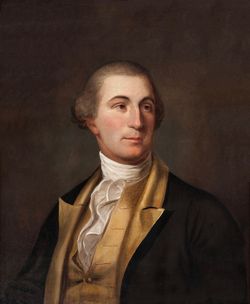
The next day, a council of war disclosed how little gunpowder the army had. Joseph Reed (shown above), Gen. George Washington’s military secretary, sent Porter a quick note:
If you could spare Time to ride down to Head Quarters this Afternoon the General would be glad to confer with you on a Matter of some Importance which you mentioned to him on your Return from New York
Porter made the short trip from Watertown to Cambridge. Later that day Washington wrote to Rhode Island governor Nicholas Cooke about the urgent need for gunpowder and the possibility of obtaining it from Bermuda, as quoted here. He concluded:
Col: Porter has undertaken to assist in the Matter or to provide some suitable Person to accompany [William] Harris to you who will communicate all Circumstances to you.
Porter personally carried that letter to Cooke. There was a brief glitch when they lost track of Harris, a sea captain who was continuing to shuttle among American ports. On 11 August, Cooke sent Porter back to Washington with a letter.

Gov. Cooke had already expressed his position: reports suggested that Bermudans were inclined to sell that powder to Continental forces, so there was no need to send a ship to the island, and besides Rhode Island didn’t have the resources for such a mission, anyway.

TOMORROW: The general’s response.

Monday, January 08, 2024

Who Was the “person out of Boston last Night”?

The Pennsylvania Packet article describing the flag on Prospect Hill in January 1776 also reported that the British inside besieged Boston had misinterpreted it:
…the Boston gentry supposed it to be a token of the deep impression the [king’s] Speech had made, and a signal of submission—That they were much disappointed at finding several days elapse without some formal measure leading to a surrender, with which they had begun to flatter themselves.——
This is bunk. According to the article’s own timing, the flag went up on 2 January and the latest news from Cambridge was written on 4 January, so “several days” had not elapsed.

This newspaper anecdote is thus too good to be true. Joseph Reed, who most likely supplied the article, must have been tickled with the idea of the royalists falsely thinking the Continental Army was ready to give up.

In fact, no sources created inside Boston show the royal authorities thinking the rebels were about to surrender. The two British mentions of the flag later that January correctly interpreted it as a signal of colonial unity. So where did the story come from?

The first version appeared in Gen. George Washington’s 4 January letter to Reed:
we had hoisted the Union Flag in compliment to the United Colonies, but behold! it was receivd in Boston as a token of the deep Impression the Speech had made upon Us, and as a signal of Submission—so we learn by a person out of Boston last Night
That person might have had an idiosyncratic interpretation of the flag. More likely, I suspect that person described initial perplexity inside the town on seeing the new flag, which Washington preferred to interpret in the way that made his enemy seem most foolish.

So who was that person who arrived at Cambridge headquarters on 3 January?

On the same day that Washington wrote to Reed, he sent a more formal letter to John Hancock as chairman of the Continental Congress. In that report the general wrote:
By a very Intelligent Gentleman, a Mr Hutchinson from Boston, I learn that it was Admiral [Molyneux] Shuldhum that came into the harbour on Saturday last . . .

We also learn from this Gentleman & others, that the Troops embarked for Hallifax, as mentioned in my Letter of the 16—were really designed for that place . . . 

I am also Informed of a Fleet now getting ready under the Convoy of the Scarborough & Fowey Men of War, consisting of 5 Transports & 2 Bomb Vessels, with about 300 marines & Several Flat bottom’d Boats—It is whispered that they are designed for Newport, but generally thought in Boston, that it is meant for Long-Island . . .
Washington sent that same information to Reed, and it went into the newspaper.

Also, at “8 o’clock at night” on “the 3d.” of January, Washington’s aide Stephen Moylan wrote to Reed:
a very inteligent man got out of Boston this day, says, two of the Regiments of the Irish embarkation pushed for the River of St. Lawrence . . .

he allso says that it was generally thought in Boston that Nova Scotia was in our possession——
Reed didn’t include that last tidbit in his digest for the newspaper—probably because he knew it was false.

Thus, although Gen. Washington mentioned “others,” his headquarters’ main source for information from inside Boston in those two days was “Mr Hutchinson.” Both letters called him “intelligent,” which Dr. Samuel Johnson described as meaning both “knowing” and “giving intelligence.”

A footnote in the Washington Papers says, “Mr. Hutchinson has not been identified.” So let’s do something about that.

On Tuesday, 9 January, the Rev. Dr. Samuel Cooper wrote in his diary:
I din’d at Mr. [Edward] Payne’s with Mr. Shrimpton Hutchinson, Deacon [Ebenezer] Storer, [Joseph] Barrell &c.
The transcription of Cooper’s diary published in the American Historical Review in 1901 doesn’t identify the men Cooper dined with. But at this time Cooper and his family were living in Waltham, and Edward Payne’s son later wrote that during the siege his father “lived at Medford and at Waltham.” Payne, Storer, and Barrell all came from the top echelon of Boston businessmen, and they all appeared several times in Cooper’s diary before this date.

Shrimpton Hutchinson (1719–1811, gravestone shown above) was another well established Boston merchant. As an Anglican and a cousin of Gov. Thomas Hutchinson, he had reasons to become a Loyalist. But instead he kept out of politics, even as a justice of the peace. We know he lived in Boston after the war, becoming one of the leaders of the King’s Chapel congregation.

I’ve looked for other signs of Shrimpton Hutchinson’s movements during 1775 and 1776 without success. Therefore, I can’t say for sure that he had left Boston just a few days before his dinner at Payne’s, which was the first time Cooper mentioned him. But he was the sort of older, upper-class, well-connected man that Gen. Washington and his aides would have respected as a valuable intelligence source.

TOMORROW: The missing copies of the king’s speech.

Sunday, January 07, 2024

Joseph Reed’s Third Source?

I’ve been analyzing the likely sources for the 15 Jan 1776 article in John Dunlap’s Pennsylvania Packet about the flag on Prospect Hill and other information from Cambridge.

It’s clear one source was muster-master general Stephen Moylan’s letter to Joseph Reed, dated 2–3 January. Another was Gen. George Washington’s letter to Reed on 4 January. But the article contained some details not from either of those documents.

One possibility is that Reed received yet another letter from his Cambridge contacts dated 3 or 4 January which he added to the mix. But Reed and his family appear to have been conscientious about preserving his papers, and no such letter survives. I think the key to that mystery lies in Joseph Reed himself.

Reed was a leading Philadelphia lawyer before the war, with top contacts in London. He was also one of the city’s active Whigs, though not a member of the Continental Congress.

When the Congress commissioned Washington as its generalissimo, Reed decided to accompany the Virginian on the first leg of his journey north. Then on the second leg. Then all the way to Cambridge to help set up a headquarters.

At each of these stages, Reed wrote back to his wife, Esther, saying he’d be home soon. And then finally he had to break the news that Washington had convinced him to stay on as military secretary.

Reed worked alongside Washington in Cambridge from early July to late October. He drafted the general’s most important official correspondence, took notes on the top councils, and managed such initiatives as launching armed schooners against British supply ships. As part of the last task, Reed established Connecticut’s “Appeal to Heaven” banner as the flag those schooners should fly in battle.

In November Reed returned to his wife and young children. But he kept up a busy correspondence with the commander-in-chief and with other aides and officers he knew in Cambridge. The general hoped Reed would return as his secretary, so he didn’t give Robert Hanson Harrison that job on a permanent basis until 16 May 1776.

In the winter of 1775–76, Reed continued to serve Washington, unofficially. He was the general’s ears in Philadelphia; “you cannot render a more acceptable service, nor in my estimation give me a more convincing proof of your Friendship,” Washington wrote, “than by a free, open, & undisguised account of every matter relative to myself.”

Reed promoted Washington’s interests in the Philadelphia press. As one example of this work, the general sent a copy of the laudatory poem that Phillis Wheatley had written for him. After the British evacuated Boston, those lines appeared in the Pennsylvania Magazine. Reed probably spoke up for the commander in private conversations among politicians as well.

Even more important (and unusual) for Washington, Reed became an epistolary confidant. The general’s letters to his late secretary were more personal, emotional, even confessional than to almost any other colleague. Washington wrote about his frustrations, doubts, and personal wishes. Those letters said things that the general never expressed so bluntly to the Congress or never would have wanted to be public.

As for Reed’s side of that correspondence? We don’t know. In the dark days of late 1776, Washington opened a letter from Reed, who by then had been lured back into the military establishment as adjutant-general, to Gen. Charles Lee, thinking it might have vital military information. That letter revealed that Reed and Lee had been criticizing Washington behind his back. After that, the commander-in-chief was never so friendly with Reed, or practically anyone else. And Reed’s side of their personal correspondence in late 1775 and early 1776 disappeared.

Thus, we have Washington’s 4 January letter to Reed, as saved by Reed and his heirs, but we don’t have the 23 Dec 1775 letter from Reed that Washington was responding to, or any of Reed’s following responses.

In the absence of those documents, I’ll proffer three speculations about what Reed wrote.

First, the details about the Continental troops being “all in barracks, in good health and spirits,” and “impatient for an opportunity of action” came from Reed himself. They were what he as a Patriot politician wanted the people of Philadelphia to think. He certainly wasn’t going to publicize Washington’s actual gloomy assessment of the situation.

Second, the details about how the British had delivered copies of the king’s speech to the Continental lines in Roxbury and how the Continentals had raised their new flag on Prospect Hill before that speech reached Washington’s headquarters also came from Reed. Because he had worked in Cambridge for months, Reed knew how the two warring armies communicated. He knew where the big flagpole along the American lines stood. He could read Washington’s anecdote and fill in the blanks about how and where events unfolded.

Lastly, the new Continental flag that article referred to probably also came from Reed. I posit that he had sent a large version of the Congress’s new naval banner up to Cambridge, knowing there was a flagpole at Prospect Hill. Reed did that as Washington’s liaison in Philadelphia, and because he was concerned about naval banners.

Washington in turn sent back his anecdote about that flag, knowing his former secretary would be interested. And because Reed knew the size of that standard, his account for the Pennsylvania Packet referred to it as “the great Union Flag.” It was a form of Union Flag, not only adapted with the Congress’s thirteen stripes but also notably big.

As I said, those are all speculations. It’s possible that letters from Reed or others will come to light showing I’m all wrong. But I think these suggestions fit the evidence we have now.

TOMORROW: Another mystery in the flag anecdote.

Saturday, January 06, 2024

Joseph Reed’s Second Source

As I discussed yesterday, Joseph Reed (or someone close to him) adapted a 4 Jan 1776 letter from Gen. George Washington into part of an article that appeared in John Dunlap’s Pennsylvania Packet on 15 Jan 1776.

That article started by announcing its sources: “authentic advices from the Camp at Cambridge, of the 3d and 4th instant”—i.e., letters sent on 3 and 4 January. That meant it was based on at least one other source.

The second major source was Stephen Moylan’s letter to Reed dated 2–3 January, particularly the later pages penned on the 3rd. That document has been digitized by the New-York Historical Society.

Reed knew Moylan in Philadelphia before the war. The two men worked together in Cambridge as Washington’s military secretary and muster-master general. When Reed went home to his wife, he passed off a lot of his tasks to Moylan. So it was natural for those two men to correspond.

The Pennsylvania Packet article contained many items of intelligence, in addition to the general’s anecdote about the new flag. Here are those topics, and in whose letter that information appeared:

  • Boston’s harbor was open. (Moylan)
  • A British warship was outside Salem, Beverly, and Marblehead harbor. (Moylan)
  • 500 British soldiers arrived from Ireland, later identified as from the 55th and 17th. (Moylan, Washington)
  • Two British regiments had been sent to Halifax. (Moylan, Washington)
  • Two more regiments were moving up the St. Lawrence River to Québec. (Moylan)
  • Admiral Molyneux Shuldam arrived in Boston. (Washington)
  • H.M.S. Scarborough and Fowey would lead nine transport ships and other vessels south; they were said to be headed to Newport, but more likely were going to Long Island or Virginia. (Washington, Moylan slightly different)
  • British ships were taking on drinking water and biscuits. (Washington, Moylan slightly different)
  • The British army had no intention of attacking the Continental siege lines. (Moylan)
  • The redcoats were grumbling, so they were told that Gen. John Burgoyne had headed home to Britain to help settle the whole colonial dispute. (Moylan)
  • Four ships had sailed from Hispaniola with arms and ammunition. (Moylan)
  • The Continental “army were all in barracks, in good health and spirits.”
  • Five thousand militiamen were filling in for soldiers who had gone home when their enlistments ran out. (Washington)
  • The “whole army [was] impatient for an opportunity of action.”
Thus, almost every piece of information in the article came from one or both of those letters. The few exceptions were details of the anecdote about the flag, as listed yesterday, and positive descriptions of Continental soldiers being “all in barracks, in good health and spirits,” and “impatient for an opportunity of action.”

In fact, Gen. Washington had written gloomily about how few troops he had left after the end of 1775 and what he could now expect:
for more than two Months past I have scarcely immerged from one difficulty before I have plunged into another—how it will end God in his great goodness will direct, I am thankful for his protection to this time. We are told that we shall soon get the Army compleated, but I have been told so many things which have never come to pass, that I distrust every thing.
But of course Reed would never have those thoughts printed in a Patriot newspaper. In fact, sections like that are probably why he edited the general’s letter for public consumption.

Likewise, Moylan wrote a lot about how George III’s uncompromising speech to Parliament should impel the Continental Congress into seeking help from foreign powers like Spain—a big step toward independence which top politicians were not yet ready to go public with. His 2–3 January letter is becoming famous for containing the earliest appearance of the phrase “the United States of America,” months before the Congress adopted that moniker.
In the quest to find out more about the flag on Prospect Hill, however, Moylan’s letter is a dead end. He wrote nothing about the banner, and therefore didn’t provide the details that appeared in the Pennsylvania Packet without first appearing in Washington’s letter. Did Reed draw on another source?

TOMORROW: My theory that belongs to me.

Friday, January 05, 2024

“Our advices conclude with the following anecdote”

It’s easy to identify the main source of the report in John Dunlap’s Pennsylvania Packet about the new Continental flag on Prospect Hill.

That source has long been recognized as Gen. George Washington’s 4 Jan 1776 letter to his erstwhile military secretary, Joseph Reed (shown here). The commander-in-chief wrote:
We are at length favourd with a sight of his Majesty’s most gracious Speech, breathing sentiments of tenderness & compassion for his deluded American Subjects; the Eccho is not yet come to hand; but we know what it must be; and as Lord North said, & we ought to have believed (& acted accordingly) we now know the ultimatum of British Justice.

the Speech I send you—a volume of them was sent out by the Boston Gentry—And, farcical enough, we gave great Joy to them (the red Coats I mean) without knowing or intending it, for on that day, the day which gave being to the New Army (but before the Proclamation came to hand) we had hoisted the Union Flag in compliment to the United Colonies, but behold! it was receivd in Boston as a token of the deep Impression the Speech had made upon Us, and as a signal of Submission—so we learn by a person out of Boston last Night—by this time I presume they begin to think it strange that we have not made a formal surrender of our Lines.
Here’s a recap of the pertinent portion of the Pennsylvania Packet article, with phrases taken directly from Washington’s letter in boldface:
Our advices conclude with the following anecdote:—That upon the King’s Speech arriving at Boston, a great number of them were reprinted and sent out to our lines on the 2d of January, which being also the day of forming the new army, the great Union Flag was hoisted on Prospect Hill, in compliment to the United Colonies—this happening soon after the Speeches were delivered at Roxbury, but before they were received at Cambridge, the Boston gentry supposed it to be a token of the deep impression the Speech had made, and a signal of submission—That they were much disappointed at finding several days elapse without some formal measure leading to a surrender, with which they had begun to flatter themselves.
It therefore seems certain that Reed adapted or helped in adapting Washington’s letter for public consumption—a common way of spreading news in colonial America.

However, the article’s retelling also included details not in the general’s letter, including:
  • that events occurred on 2 January.
  • the king’s speech was delivered through Roxbury.
  • the flag went up on Prospect Hill.
  • the phrase “great Union Flag.”
So where did those details come from? Was there a second source for the Pennsylvania Packet article that could tell us more about the flag?

TOMORROW: Looking for clues in the longer article.

Monday, February 06, 2023

“Go down to the ferry ways so as to see Charls”

Even after the siege of Boston began, the nearby ferries continued to operate, at least intermittently. Those boats offered ways to transmit information or goods, sometimes illicitly.

There was a ferry between Boston’s North End and Charlestown, operated by a man named Enoch Hopkins (d. 1778). On 15 June 1775, a Boston magistrate named William Stoddard wrote to James Littlefield in Watertown:
Your letter and the last, dated the 13th instant, by Mr. Hopkins, I have received. I waited on the Admiral [Samuel Graves] this morning, and have got you a fishing pass for your boat and three men, to come in and out of this harbour, which I now send you. You will carefully observe the pass; you must observe to go a fishing from Salem, before you come up here, and then you may come in and go out. I hope you will not meet with any obstruction at Salem; not forgetting, if in your power, to bring up veal, green peas, fresh butter, asparagus, and fresh salmon.

Mr. Miles went away yesterday in the afternoon, by water, in order to come to you, and we suppose he is with you before this. I hope you have received a cloak, with a bag of brown sugar, I sent over yesterday by Mr. Hopkins’s son. I have paid some of the ferrymen, and I shall pay them all for their trouble, when I have done with them. Do not pay them any thing; if you have, let me know; keep that to yourself. . . .

I wish you would send me last Monday’s newspaper, and this day’s paper. I shall be much obliged to you, if you can, before you go for Salem, send me some fresh butter, and half a bushel of green peas. I now send you two dollars in this letter, and an osnaburgh bag, by Mr. Hopkins’s son, to put the peas in. What other charges you are at I will settle with you hereafter.
On 28 July, Joseph Reed, Gen. George Washington’s military secretary, wrote about getting a secret message into Boston via “a Waterman” operating north of Boston, possibly Hopkins. And at some point during the siege, a Boston shopkeeper warned Gen. Thomas Gage that ferrymen named Hopkins and Goodwin were “as bad Rebels as any”:
I have seen them bring men over in Disguise—and they are up in Town every Oppertunity they have gathering what Intelegence they can and when they return communicate it to the Rebels the other side, and they again to the Rebel Officers.
This may be the same Enoch Hopkins who with his wife and seven children arrived in Concord as war refugees in November, as Katie Turner Getty has written about.

The British army took the Charlestown peninsula two days after the Stoddard letter above. That meant the ferry across the Charles River was fully within royal territory, and the Mystic River now defined the siege line. There were two ferries crossing the Mystic to Charlestown, one from Malden called the Penny Ferry and one from Chelsea called the Winnisimmet Ferry (spelled variously, of course).

On 6 August, British army raiders burnt the Penny Ferry landing house in Malden, and it was never rebuilt.

At Chelsea, Lt. Col. Loammi Baldwin was in charge, stationed at the ferry landing. On 28 July he became part of Reed’s chain of men sending information into Boston, and in return he sent headquarters several reports about people coming over the Winnisimmet Ferry.

As I quoted yesterday, in the summer of 1775 Dr. Benjamin Church discussed using the Winnisimmet Ferry as a conduit for information and what he really wanted, money:
If I am to Continue in your Service Major be so good to send me out a little Cash, Charly the ferry Man if you can trust him may give it me—Slyly—by heavens Major I shou’d loose my life if it was known by these people.

I attempted some time ago to write you, over Chalsey ferry but the Committy would not let me go down to the ferry ways so as to see Charls. After that I did not try but went to Newport and from thence wrote.
Clearly the local Patriot authorities (“the Committy”) understood that people might use that ferry for nefarious purposes and didn’t let Church, or probably anyone, go there alone. 

I’ve tried to identify this ferryman named “Charly” or “Charls” (or, presumably, Charles) without success. While the men granted the right to run a ferry sometimes show up in the records, Charly may well have been an employee instead.

Stymied by that route, Church instead sent information through Newport, and ultimately that led to his arrest.

TOMORROW: Church’s report on the Arnold expedition.

Wednesday, August 14, 2019

Dinner at the Sign of Liberty Tree

On 14 Aug 1769, 250 years ago today, Boston’s Sons of Liberty gathered to celebrate the anniversary of the first public protest against the Stamp Act, four years earlier.

Of course, they were also celebrating what they saw as their triumph over Gov. Francis Bernard, who had sailed away from Massachusetts at the start of the month, never to return.

The celebration actually began with fourteen toasts at Liberty Tree at eleven o’clock. Those started with “The KING” and “The QUEEN and Royal Family,” moved through John Wilkes, the “Glorious Ninety-Two,” Paschal Paoli and his Corsicans, “American Manufactures,” and finally “May the 14th of August be the annual Jubilee of Americans, till Time shall be no more.”

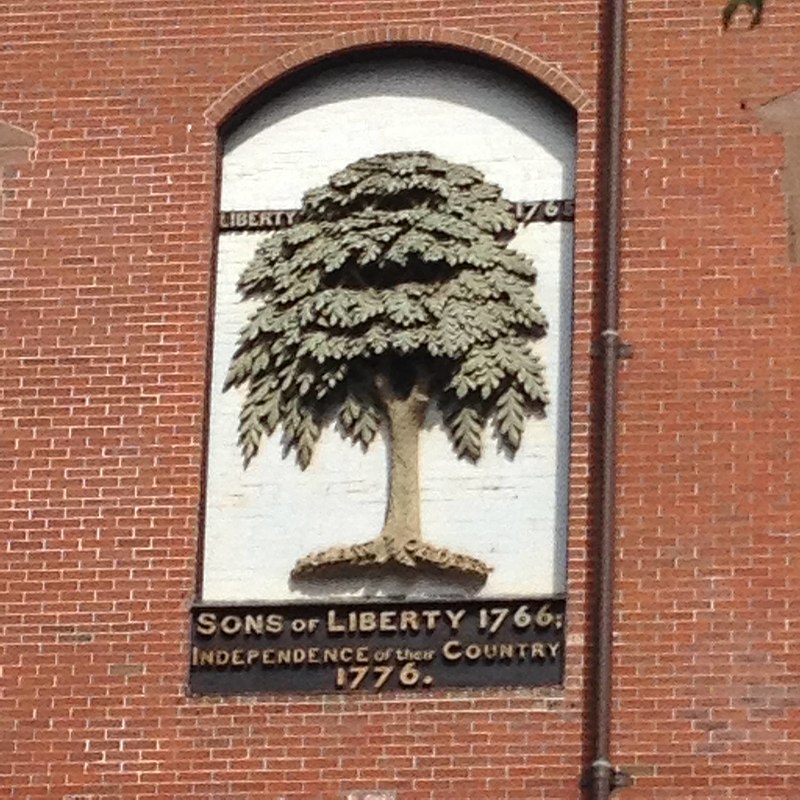
Then the company left town. The Sons had organized dinner for more than 300 at Lemuel Robinson’s tavern in Dorchester, the Sign of Liberty Tree. [In the winter of 1775, that tavern was a crucial spot in the story of The Road to Concord.] By dining outside of Boston, the upper-class politicians guaranteed that they could control their setting and the level of festivity.

This dinner was in honor of “the Farmer”—John Dickinson, author of The Farmer’s Letters and coauthor of “The Liberty Song.” He wasn’t there. But two of his friends from Philadelphia were: his brother, Philemon Dickinson, and Joseph Reed, then secretary of the colony of New Jersey.

John Hancock’s business protégé William Palfrey made a list of 355 gentlemen at the dinner. That list included far more than Boston's political activists. The most important elected officials were all there, including some who would later be Loyalists. The town’s schoolmasters had taken the day off, as had many merchants, doctors, lawyers, and militia officers. John Adams wrote in his diary about feeling pressure to attend: “many might suspect, that I was not hearty in the Cause, if I had been absent whereas none of them are more sincere, and stedfast than I am."

Adams described the banquet setting this way:
We had two Tables laid in the open Field by the Barn, with between 300 and 400 Plates, and an Arning of Sail Cloth overhead, and should have spent a most agreable Day had not the Rain made some Abatement in our Pleasures.
There’s that New England non-rhotic R in how Adams spelled “awning.”

Because the fourteen toasts before noon weren’t enough, after dinner the party drank forty-five more. This series started with the “King, Queen and Royal Family,” followed by “A Discharge of Cannon, and three Cheers.” The toasters named fourteen British politicians considered friendly to America and the historian Catharine Macaulay. They honored “The Cantons of Switzerland,” “The States General of the seven United Provinces” of Holland, and “The King of Prussia.”

Some of the after-dinner toasts delineated the Whigs’ political ideals: “Annual Parliaments,” “A perpetual Constitutional Union and Harmony between Great Britain and the Colonies,” and “Liberty without Licentiousness.” Others identified enemies: “May the detested Names of the very few Importers every where, be transmitted to Posterity with Infamy” (more cannon). And finally “Strong Halters, Firm Blocks, and Sharp Axes, to all such as deserve either.”

Evidently the diners didn’t imbibe deeply at each and every toast because Adams declared, “To the Honour of the Sons, I did not see one Person intoxicated.”

As for the subsequent entertainment, the Sons of Liberty had provided…a hatter.

TOMORROW: But not just any hatter.

Tuesday, May 29, 2018

Meeting “Capt. Yoking”

Here’s more from the diary of the Rev. David Avery, who as chaplain accompanied a regiment to Chelsea in the wake of the fight over Hog and Noddle’s Island.

This is Avery’s entry from 29 May 1775 as the provincial forces finished salvaging useful material from H.M.S. Diana, which had run aground during the fighting.
29. Monday. Lodged last night in a comfortable bed. Went down to the Ferry, much treasure was got out to-day. Two large anchors & one Kedge & several large square pig iron as ballast, with several articles of consequence & a barrel of pork
When this diary was published in the D.A.R.’s American Monthly Magazine in 1900, the word I typed as “Kedge” (a sort of small anchor) was transcribed as “Kelly.” I haven’t seen the original document to confirm my guess.

Avery’s entry continued:
About noon Capt. Yoking, a Stockbridge Indian & I reconnoitered the Ground East of the schooner & judged that the taking off the cattle was practicable. The Capt. with 3 men took a canoe & went about a mile & a quarter upon the north side of the river from the Ferry & went across to Noddle’s Island & reconnoitered & scouted round about an hour & a quarter, when he fixed his centuries & another canoe went over to his assistance & soon took 2 horses & mired a 3d when a cannon ball fell pretty near them & four barges landed upon which all the scout retreated to the main shore & came over.

Upon that I advised that they should go back & get the stock. Accordingly they got off the Stock about sunset.

Stood upon guard two hours near Winnisimmit Ferry. Prayed with company.
The reference to “Capt. Yoking, a Stockbridge Indian” is very interesting.

Massachusetts Soldiers and Sailors of the Revolutionary War notes one state record of a captain named Jehoiakim Youkin in Col. John Paterson’s regiment. The same name also shows up on the records of Gen. George Washington’s headquarters. In August 1775 the general’s military secretary, Joseph Reed, paid Jehoiakim Youkin for digging necessaries—though perhaps he was collecting money for other men.

According to Patrick Frazier’s The Mohicans of Stockbridge, Jehoiakim Yokun or Yokum was a Mahican leader and landowner in western Massachusetts in the mid-1700s. Sites in the region still bear the Yokun name.

When the war began, Jehoiakim’s son Timothy Yokun became the first sergeant in Capt. William Goodrich’s company of Stockbridge Indians within Col. Paterson’s regiment. These soldiers were part of the Massachusetts forces and yet set apart in their style of living and fighting. Most company records don’t list Jehoiakim Yokun’s name at all. But evidently he was in command alongside Goodrich, perhaps particularly in combat. Less than two months into the war, Avery was calling him “Captain.”

One historian appears to have conflated father and son, saying Timothy gained the rank of captain during the war. Yet other authors list Timothy Yokun among the Stockbridge soldiers killed by Lt. Col. John Graves Simcoe’s rangers near Yonkers, New York, in August 1778. Diaries of the Sullivan expedition, the postwar diaries of the Rev. Samson Occom, the pension application of David Freemoyer, and an early history of the town of Stockbridge all refer to a “Captain Yoke or Yokun” active later in the war and returning to Stockbridge afterwards. That was most likely Jehoiakim.

Another source tells us the name of one of the Stockbridge men who went out onto Noddle’s Island and brought back those two horses. As quoted here, he was Henries Vomhavi. The Provincial Congress granted him the smaller of those two horses as a reward.

Thursday, June 15, 2017

EXTRA: Celebrating “Grand Union Flag” Day in Somerville

Somerville usually celebrates the flag-raising on Prospect Hill on the anniversary of that event. Unfortunately, that’s on 1 January—not always the most comfortable time to be outside on a New England hilltop. So this year the city is celebrating that event on the Saturday after Flag Day, or 17 June.

Now that date happens to be the anniversary of the Battle of Bunker Hill, the major historical event in neighboring Charlestown. Which Somerville split off from 175 years ago—an event the city is celebrating all this year. But Charlestown had its Bunker Hill parade last weekend because that ceremony is always on the Sunday before the exact anniversary. So 17 June was up for grabs.

The Somerville celebration is scheduled to take place from 10:00 A.M. until 12:00 noon. Vexillologist Byron DeLear will speak about the significance of the “Grand Union Flag.” There will be tours of Prospect Hill Tower, colonial-era music, and other happenings. The event is sponsored by the Somerville Historic Preservation Commission and Historic Somerville.

[ADDENDUM: In addition, DeLear will speak in more detail about his research and conclusions on Sunday, 18 June, at the Somerville Museum. That event will start at 2:00 P.M., and a reception will follow at 3:00. The museum’s address is 1 Westwood Road.]

Byron DeLear also spoke about the flag on Prospect Hill a few years back, but that was, you know, in January. He argues that the “Grand Union Flag,” more formally the American naval flag, was not only “flown atop Somerville’s Prospect Hill in 1776” but was also “not just the first flag of the united colonies, but the first flag of the United States.”

Another vexillologist, Peter Ansoff, has expressed doubts about the standard [get it?] story of the “Grand Union Flag,” noting that contemporary accounts are far from clear that it was a single banner with a new design. Supporting that hypothesis is the lack of any document from the Continental Congress informing Gen. George Washington about the naval ensign it had just adopted or enclosing a flag for him to fly near Boston.

One of the most likely candidates for sending that flag to Washington was Joseph Reed, the Philadelphia lawyer who had served as his first military secretary. Reed had shown an interest in flags, proposing that the army schooners fly the “Appeal to Heaven” banner. On 4 Jan 1776 Washington wrote back to Reed about how the army had “hoisted the Union Flag in compliment to the United Colonies.” So should we look for evidence of the Congress’s new flag in Reed’s letters to Washington?

Unfortunately, those letters don’t survive. For late 1775 and early 1776, we have only Washington’s side of the correspondence. He alluded to many letters from Reed that must have been mislaid or destroyed sometime after their falling-out at the end of 1776. So what, if anything, the Congress told its commanding general about a new flag remains a mystery.

Thursday, October 13, 2016

Ward and Washington

When George Washington arrived in Cambridge on 2 July 1775, he took over command from Gen. Artemas Ward. The Continental Congress made Ward its second-ranking general.

There doesn’t seem to be any evidence that Ward resented having Gen. Washington installed over him. He was a politician as well as a military man, and he was probably aware of the Massachusetts delegates’ hope to secure the other colonies’ support for a Continental Army by letting them name its commander-in-chief.

During the siege of Boston Washington gave Ward command of the southern wing of the American line. The Massachusetts general had overseen the Battle of Bunker Hill, the event that convinced the British army commanders there was nothing to be gained by staying in Boston. (Gen. William Howe stayed over the winter only because it took so long for the government in London to agree with that strategy.) Ward was also the chief voice for putting cannon on Dorchester Heights, the move that eventually made Howe sail away. So Ward’s contributions were crucial to the success of that first campaign.

Yet he rubbed Washington the wrong way. I sometimes wonder if Washington didn’t get along with Ward because they were too similar in some ways and too different in others. Most of the other generals were significantly older (Spencer, Putnam, Thomas) or younger (Sullivan, Heath, Greene). But Ward was in his forties, just a few years older than Washington. Both men had been provincial colonels during the French & Indian War, seeing major British campaigns in a subordinate capacity. Both were highly respected gentlemen and legislators in their home colonies.

Yet Ward had the qualities that New England respected: a Harvard education, Calvinist piety. He was conscientious and cautious, moving carefully to be certain he was moving in the right direction, a leader through finding consensus rather than bold strokes. Washington was a Virginian. He had no college education, and he was more philosophical than religious. Especially in those early years of the war, he liked bold strokes. He kept proposing bold strokes against the British inside Boston. And all the other generals, with Ward speaking first as the highest-ranking, kept voting him down.

By the end of the siege, Washington didn’t have much respect for his second-in-command. On 1 Apr 1776 he told his former military secretary Joseph Reed that “Nothing of Importance has occurr’d—in these parts” except perhaps for Ward resigning and then rescinding his resignation:
on Acct, as he says, of its being disagreeable to some of the Officers—who those Officers are I have not heard. I have not enquired—When the Application to Congress & notice of it to me, came to hand, I was disarm’d of Interposition because it was put upon the footing of Duty, or conscience, the General being perswaded, that his health would not allow him to take that share of Duty that his Office required. the Officers to whom the resignation is disagreeable have been able, no doubt, to convince him of his mistake, and that his health will admit him to be alert and Active—I shall leave him till he can determine Yea or nay, to Command in this Quarter.
Washington was even more caustic in comments to Gen. Charles Lee on 9 May:
General Ward, upon the Evacuation of Boston, and finding that there was a probability of his removing from the smoke of his own Chimney, applied to me, & wrote to Congress, for leave to Resign—A few days afterwards (some of the Officers, as he says, getting uneasy at the prospect of his leaving them) he applied for his Letter of Resignation, which had been committed to my care; but behold! it had been carefully forwarded, and as I have since learnt judg’d so reasonable—want of health being the Plea—that it was instantly complied with.
Lee evidently brought out the cattiness in the commander-in-chief.

As it turned out, the Congress accepted Ward’s offer to stay on—though it kept him away from Washington. Gen. Ward oversaw the “Eastern Department,” or New England, until March 1777, when he reported that the region was so quiet that he didn’t deserve his salary and stepped down. Later, in 1780-82, Ward represented Massachusetts in the Continental Congress itself.

Meanwhile, at the end of 1776 Washington learned that Lee and Reed were writing about him critically behind his back. He never wholly trusted either man again. As a result, his later letters to those men aren’t nearly so fun.

Ten years after Lee died in 1782, a former Congress delegate from Georgia named Edward Langworthy published Memoirs of the Life of the Late Charles Lee. That book included some of the late general’s correspondence—including Washington’s May 1776 letter that referred to Ward in less than flattering terms.

When that letter became public in 1792, Ward was serving the first of his two terms in the new U.S. Congress. Generally he voted with the Federalists and President Washington. But now they had a personal matter to sort out.

TOMORROW: Two former generals in one room.

Monday, June 20, 2016

Samuel Gerrish, First Officer of the Massachusetts Army

Last month I wrote about how the Massachusetts Provincial Congress finally started commissioning infantry officers for its army (as opposed to its militia) on 19 May 1775.

The first colonel to receive a commission was Samuel Gerrish (c. 1729–1795) of Newbury. I thought it would be interesting to look at what happened to him.

First of all, according to historian Richard Frothingham, Gerrish’s regiment wasn’t as complete as the congress had been led to believe; “there were difficulties in relation to six of the companies, which were investigated June 2.” Five of the companies originally listed under Gerrish’s name asked to serve under another Newbury colonel, Moses Little. It took another twenty days before eight companies were fully commissioned under Gerrish.

During that spring the regiment was spread out along the north side of Boston harbor with three companies at Chelsea, three in east Cambridge, and two at Sewall’s Point, the finger of Brookline land in front of the Charles and Muddy Rivers. On 16 June the officers of the regiment met at Chelsea and assigned jobs: Loammi Baldwin to be lieutenant-colonel, Richard Dodge major, Christian Febiger adjutant, and so on. This was the New England way, electing from below rather than the colonel appointing from above.

One day after that meeting, of course, came the Battle of Bunker Hill. In 1870 the Quincy family presented to the Massachusetts Historical Society one sheet of what had been a two-page letter describing the fight. Whoever wrote that account took particular notice of Col. Gerrish’s behavior, referring to him by his rank from the French & Indian War:
Major Gerrish was ordered also to Charlestown with a reinforcement, but he no sooner came in sight of the enemy than a tremor seiz’d him & he began to bellow, “Retreat! retreat! or you’l all be cutt off!” which so confus’d & scar’d our men, that they retreated most precipitately, & our soldiery now sware vengeance against him & determine not to be under his commd.
The historian Samuel Swett later wrote that Gerrish “was unwieldy from excessive corpulence”; on reaching Bunker’s Hill above the fighting, “he declared that he was completely exhausted, and lay prostrate on the ground.” Col. Israel Putnam roared at all the men stalled on that hill, hitting some with his sword, but they refused to go farther down and eventually retreated.

There was plenty of blame to go around after that battle. Other Massachusetts officers hadn’t even taken their troops onto the peninsula as Gerrish had. Swett wrote, “A complaint was lodged against him with [Gen. Artemas] Ward immediately after the battle, who refused to notice it on account of the unorganized state of the army.”

Not that Col. Gerrish was helping alleviate that disorganization. On 7 July the new commander-in-chief’s secretary, Joseph Reed, wrote to him to ask a second time for a return of all the men in the regiment. “The Express [to the Continental Congress] has been detain’d some time thro’ this Inattention,” Reed chided, “The Forces raised in Connecticut, New Hampshire & Rhode Island having sent in their Returns very complete.”

Gerrish finally reported having 258 men in his regiment. Even after that, there were administrative problems. In August eight officers at Sewall’s Point wrote to headquarters to complain that most of them had “been here in actual Service, since the Beginning of the Campaign, and been to a vast Deal of Expense, and not receiv’d one farthing of our pay.”

In early August, British floating batteries made some attacks on American positions near the water. One fired on Sewall’s Point. Instead of shooting back at that boat, Gerrish told his men to put out any lights and hunker down behind their fortifications. He was reported to have said, “the rascals can do us no harm, and it would be a mere waste of powder, to fire at them with our 4 pounders.” Technically, Gerrish might have been right. The British shots caused no casualties. But the colonel had used up any benefit of the doubt about his behavior in battle.

TOMORROW: Washington weighs in.

Tuesday, January 06, 2015

Christopher Ludwick and the Prisoners of War

Yesterday I spotlighted a new picture book called Gingerbread for Liberty!, about a baker named Christopher Ludwick and his activity during the Revolutionary War. Author Mara Rockliff’s main source for that book was Dr. Benjamin Rush’s friendly short biography written shortly after Ludwick died, so how much documentary support is there for his feats?

In fact, Ludwick shows up a bunch of times in the papers of the Continental Congress and Gen. George Washington’s headquarters. He had served in the Austrian and Prussian armies before settling in Philadelphia, so he could speak to the Crown’s Hessian soldiers in their native German language and with some shared experience.

In August 1776, Ludwick was with the Continental forces in New Jersey, perhaps observing the system for supplying the men with bread. On the 14th the Congress resolved to offer fifty acres of land and guaranteed religious freedom to any foreigner who deserted from the British army. That offer was translated into German and copied for distribution among the Hessian troops. But who would pass out those handbills?

Gen. Hugh Mercer summoned Ludwick and on 19 August sent him to Washington’s headquarters. Later that day quartermaster general Joseph Reed, who had (badly) handled Washington’s first espionage efforts back in Massachusetts, passed Ludwick on to William Livingston, about to be governor of New Jersey, writing:
Mr. Ludwig the bearer of this, puts his Life in his Hand on this Occasion in order to serve the Interests of America. We cannot doubt your kind Advice & Assistance as to Mode but must beg it may not be communicated farther least a Discovery may be made which must prove fatal to Mr. Ludwig
Ludwick crossed the Raritan River to Staten Island late on 22 August and returned the next day. Livingston told Mercer, “Ludwig is just now returned disappointed.” But the baker apparently tried again. On 26 August Gen. Washington reported to the Congress: “The papers designed for the Foreign Troops have been put into several Channels in order that they might be conveyed to ’em, and from the Information I had yesterday, I have reason to beleive many have fallen into their Hands.”

A couple of days later, Ludwick was on his way back to Philadelphia, carrying a letter to John Adams complaining about the bread supply—a hint he may have already been lobbying for that business.

The following months didn’t go well for the Continental Army, but they did take some German-speaking prisoners. Ludwick ended up overseeing eight such men. In November Gen. Washington wrote to the Congress “to request you will negotiate an Exchange of the Hessian Prisoners at Elizabeth Town under the Care of Mr Ludwick as soon as possible. They have been treated in such a Manner during their Stay in this City, that it is apprehended, their going back among their Countrymen, will be attended with some good Consequences.”

Ludwick argued that treating Hessians well before exchanging them would make those men eager to desert at their next opportunity, and to bring others with them. Rush’s biography of Ludwick suggested that tactic was sucessful. However, Daniel Krebs’s recent study A Generous and Merciful Enemy: Life for German Prisoners of War During the American Revolution (its title taken from Ludwick’s writing) states that none of the eight Hessian men exchanged in late 1776 ever deserted.

In March 1777 Ludwick was still making that argument to Congress, recommending that it designate a “discreet & humane German Person” as “Guardian of the German Prisoners” to be “their Counsel & solemn Witness in Contracts which they may make with their Employers.” He assured the Congress that
Many of the Hessians and Waldeckish Prisoners of War especially single men are so well pleased with this Country and the Way of its Inhabitants that at all Events they would rather prefer to settle here than to return to the dreary abodes of Bondage from whence they came.
Krebs notes that Ludwick might have been hoping to gain the labor of these prisoners for little money. But he also seems to have been genuinely motivated by charity and enthusiasm for life in America. In the end, the Congress didn’t adopt that plan, and few of the German-speaking soldiers captured in that campaign defected to the U.S. of A.

Instead, the Congress asked Ludwick to take on another position.

TOMORROW: “Baker General.”

Saturday, July 26, 2014

“An object of nearly universal detestation”

After the royal authorities published the private letters they had captured on Benjamin Hichborn in August 1775, what was the fallout for the men who had written those letters?

Unfortunately for unabashed gossips, there aren’t a lot of good sources on Benjamin Harrison’s reaction. We can imagine that he quickly wrote another letter to Gen. George Washington promising that his earlier one had never really hinted that they might both enjoy a pretty washerwoman’s daughter. (If so, that follow-up letter doesn’t survive.)

It’s conceivable that Harrison volunteered to be part of the Continental Congress committee that met with Washington in Cambridge in October in order to confirm their personal relationship.

In November, Harrison was very insistent on having a ball in Philadelphia to honor Martha Washington, passing through the city on her way north. Was he so passionate because he wanted to make up for embarrassing her? That’s possible, but it’s also possible that Harrison had laughed off the publication of the falsified letter and just liked parties.

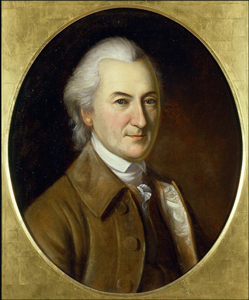
As for John Adams, the letters published over his initials had managed to denigrate most of the Congress in general, John Dickinson (shown above) in particular, and Gen. Charles Lee in passing. Printers in Philadelphia chose not to reprint the letters from the Boston News-Letter, but things were still pretty bad for a while. On 16 September Adams wrote in his diary:
Walking to the Statehouse this Morning, I met Mr. Dickinson, on Foot in Chesnut Street. We met, and passed near enough to touch Elbows. He passed without moving his Hat, or Head or Hand. I bowed and pulled off my Hat. He passed hautily by. The Cause of his Offence, is the Letter no doubt which Gage has printed in Drapers Paper.
And Dickinson wasn’t the only one snubbing Adams, according to the memoir of his friend Dr. Benjamin Rush:
It exposed him to the execrations of all the prudent and moderate people in America, insomuch that he was treated with neglect by many of his old friends. I saw this profound and enlightened patriot…walk our streets alone after the publication of his intercepted letter in our newspapers in 1775 an object of nearly universal detestation.
A British spy in Philadelphia named Gilbert Barkly reported that local Quakers had decided that Adams was dangerous to America; he also planned to push that sentiment along by circulating his own copies of the letters.

Adams might have told people he hadn’t written exactly what was published. In his autobiography decades later he said: “Irritated with the Unpoliteness of Mr. Dickinson and more mortified with his Success in Congress, I wrote something like what has been published. But not exactly. The British Printers made it worse, than it was in the Original.” And the originals are gone, so there’s no proof one way or the other.

But historians generally think that the Boston News-Letter quoted Adams accurately. Unlike the Harrison letter, there are no copies without the embarrassing lines. Adams never identified what bits he hadn’t written, but instead tried to justify one of the more controversial parts (as I quoted yesterday). Most tellingly, Adams had written quite similar things in previous letters, including two he’d sent the previous day.

Looking back, Adams claimed that the publication of his letters had actually benefited him, and he may have been right. For one thing, he liked to think of himself as unpopular because of his principled stands. At times he exaggerated the criticism and downplayed the support he received to justify that feeling. But in the summer of 1775, he could feel that way naturally.

Furthermore, the publication of the letters opened a public discussion on the possibility of independence, and raised his profile as an advocate for it. In his autobiography Adams even wrote that Joseph Reed had told him, “Providence seemed to have thrown these Letters before the Public for our good.”

Meanwhile, events were bending Adams’s way. Before copies of his letters arrived in London, the royal government had already declared all the colonies at the Congress to be in rebellion and rejected the Olive Branch petition. Thus, by the end of the year Dickinson’s moderate position had lost some credit and Adams’s advocacy of independent governments seemed smart.

In fact, on 1 Jan 1776, while Adams was back home in Massachusetts, the Boston Gazette reprinted the letters. Obviously, printer Benjamin Edes, working out of his temporary quarters in Watertown, didn’t view those documents as too awkward or scandalous to share with the world.

But there was still that comment about the “Oddity” of Gen. Lee.

TOMORROW: Abigail Adams extends the hand of friendship.

Saturday, December 28, 2013

Annual Flag-Raising in Somerville, 1 Jan.

The new year can’t start without Somerville’s annual commemoration of the raising of the “Grand Union flag” at Prospect Hill Park. That will start on 11:30 A.M. on Wednesday as an actor on horseback portraying Gen. George Washington leads a procession from Somerville City Hall to Prospect Hill Park, just north of Union Square.

This year’s ceremony will feature a presentation by Byron DeLear of the North American Vexillological Association. He’s found evidence that the phrase “United States of America” was first written in Washington’s Cambridge headquarters early in 1776, soon after that flag-raising.

Back on 4 July 1775, the new commander-in-chief had told the army that “They are now the Troops of the UNITED PROVINCES of North America.” That was still the Continental Congress’s official term for the entities it represented. The shift to calling those entities “states” was a step toward thinking of them as independent of Britain. Ironically, the first man on record to do so was an immigrant to America.

The Somerville ceremony will also feature songs, readings, and His Majesty’s 10th Regiment of Foot representing the British Army. A Grand Union flag will be raised atop the Prospect Hill Tower.

Of course, the term “Grand Union flag” was coined by George Preble in 1872, an error for what Dunlap’s Pennsylvania Packet called “the great Union Flag” in its 15 Jan 1776 issue. (The Pennsylvania Gazette used the same phrase on 17 January.) Gen. Washington had termed that banner a “Union flag” in his letter to Joseph Reed on 4 January.

Another vexillologist, Peter Ansoff, has argued that “Union flag” was the standard term for the British standard, showing how the Congress and Washington were not yet ready to break with Britain but still fighting for British rights within the Empire. Byron believes that the evidence supports the tradition that the Prospect Hill flag was a new design of the Union Jack with thirteen stripes. Unfortunately, a definite answer to that question harder to pin down than the phrase “United States of America” in a letter.