J. L. BELL is a Massachusetts writer who specializes in (among other things) the start of the American Revolution in and around Boston. He is particularly interested in the experiences of children in 1765-75. He has published scholarly papers and popular articles for both children and adults. He was consultant for an episode of History Detectives, and contributed to a display at Minute Man National Historic Park.

Subscribe thru Follow.it


•••••••••••••••••


Showing posts with label John Watts. Show all posts

Thursday, February 25, 2016

Jerusalem on the Road

Yesterday I quoted a couple of sources from Philadelphia about a model of ancient Jerusalem built by “an illiterate shoemaker” in Germantown.

On 7 May 1764 the New-York Gazette announced that “JERUSALEM, a View of that famous City, after the Work of 7 Years,” was “To be seen (opposite the Honourable John Watts’s, Esq; and near the Exchange,)” downtown. Watts was a prominent merchant and member of the Council; you can read his business letters from this period here.

Viewing hours were 8:00 A.M. to 10:00 P.M. with an hour off for supper. Admission was a straight shilling at all times. The advertisement stated that this exhibit, “worthy to be seen by the Curious” would be in New York for only “Three Months.”

Sure enough, on 30 July the Gazette warned that the model’s last day in New York would be on 3 August. That notice also revealed that the man hosting it was “Thomas Evans, Clock and Watch-Maker.”

Jerusalem’s next stop was in Newport, Rhode Island. The 13 August Newport Mercury announced that it could “be seen at the House of Mr. [William] EARL, at the Sign of the White Bear, in Broad-Street” until 6 September. Earl had moved his tavern “above the Court House” or Colony House (shown above) in April. The admission was now “Twenty Shillings each Person.” Otherwise, the ad used the same language to describe the model as in New York.

The model city then moved north to “the House of Mr. Noah Mason, in Providence.” The 22 September Providence Gazette also clarified that that higher admission price of twenty shillings was “Old Tenor”—devalued local paper currency instead of specie. Mason (1729-1791), a carpenter who had become a constable and trader, had started to keep a tavern in 1762. Once again, the exhibit was going to stay in the town for three weeks.

The next logical place to exhibit was Boston, third largest settlement in British North America. But Boston had both policies and traditions against theater and similar displays. Would the town fathers view this model as a work of piety or an idle distraction?

TOMORROW: An “imposition on the public.”

Friday, October 16, 2015

Did John Rutledge Meet Sir William Johnson in 1765?

As quoted yesterday, Richard Barry’s 1942 biography of John Rutledge described in dramatic detail how that South Carolina jurist met Sir William Johnson (shown at right, in red), the British Empire’s representative to the Six Nations.

According to Barry, Rutledge was in New York for the Stamp Act Congress in October 1765, and Johnson was making his yearly visit to the city with a retinue of Iroquois warriors.

Barry directly quoted Johnson’s joke about the congress, but he didn’t provide any specific citations for those words. Instead, his notes were general, pointing to the Thomas Addis Emmett Collection on the Stamp Act Congress in the New York Public Library, the Laurens Papers at the Long Island Historical Society [now at the Kendall Whaling Museum], and the Rutledge Family Papers at the Historical Society of Pennsylvania.

But we don’t have to go through all those archives to check Barry’s story. We can look at Sir William Johnson’s papers in the New York state library. In 1909 the state published a Calendar, or chronological list, of that correspondence. Two years later, that institution suffered a disastrous fire. In the 1920s, New York published transcripts of the surviving Johnson documents.

Both the Calendar of the Sir William Johnson Manuscripts and the published correspondence show that in October 1765 Johnson was writing letters from Albany and from his home at Johnson Hall, another hundred miles farther from New York City. He was nowhere near the Stamp Act Congress. (One of Sir William’s sons was in New York on 12 October, heading to Britain, according to a letter by John Watts.)

Furthermore, there’s no mention of a large body of Native American men camping north of New York in the city newspapers for that month. Merchant Thomas Ellison wrote a series of letters about events in the city that year, and the Iroquois didn’t come up.

Barry’s book turns out to be full of other refutable claims, stories without evidence, and outlandish interpretations. When he wrote John and Edward Rutledge of South Carolina (University of Georgia Press, 1997), James Haw wrote: “The only previous biography of John Rutledge, Richard Barry’s Mr. Rutledge of South Carolina, is unreliable. I have followed the advice of Professor George C. Rogers, Jr., to ignore Barry’s book.”

TOMORROW: And yet the Rutledge-Johnson meeting is in a respected textbook today.

Thursday, October 08, 2015

The Choice between Ruggles and Otis

One of the first acts of the Stamp Act Congress when it convened in New York in October 1765 was to elect a chairman.

Arguably, that was the first political office to derive its authority from the thirteen colonies that would form the U.S. of A. eleven years later. Even if only nine of them had actually sent delegates to that congress, the others (plus Nova Scotia) at least got an invitation.

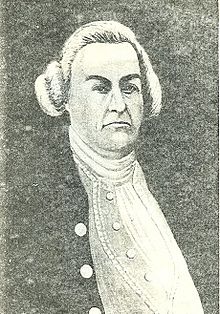
The winner of the vote was Timothy Ruggles (1711-1795, shown here), brigadier in the Massachusetts militia. According to the New York merchant John Watts, writing to a friend:
Brigr. Ruggles is Chairman, [James] Otis aimed at it and would have succeeded but they thought as he had figured much in the popular way, it might give their meeting an ill grace, but it is observed Otis is now a quite different man, and so he seems to be to me, not riotous at all.
Nearly forty years later, delegate Thomas McKean of Delaware recounted his version of events to John Adams, starting:
In the congress of 1765 there were several conspicuous characters: Mr; James Otis appeared to me to be the boldest and best speaker.—I voted for him as our President, but Brigadier Ruggles succeeded by one vote, owing to the number of the committee from New-York, as we voted individually
The record of the Stamp Act Congress states that the delegates chose Ruggles, and suggests the vote wasn’t unanimous, but it doesn’t mention any other candidates or any vote count. No delegates kept diaries or sent gossipy letters that have survived. Thus, there’s no contemporaneous evidence to confirm or refute McKean’s recollection. (More on his claims to come.)

As its clerk, the congress chose John Cotton (1728-1775), who was deputy secretary of the province back in Massachusetts, as well as registrar of wills in Suffolk County. Cotton was also half-brother to Lt. Gov. Thomas Hutchinson’s late wife and to the wife of former stamp agent Andrew Oliver, who was also his boss in the secretary’s office. In 1770 Hutchinson called Cotton “attached to Government and serviceable so far as his Sphere would permit.” He continued to hold offices in the royal bureaucracy until he died of the flux inside besieged Boston.

Cotton’s record of the congress is very spare, recording only the actions the body agreed to and not the preceding proposals, debates, and amendments. As their first procedural decision, later that first day, the delegates decided that each colony should have one vote, a precedent that remained for the Continental Congress of the 1770s. If McKean’s memory was accurate, then that form of voting would have made Otis the chairman instead of Ruggles.

Tuesday, October 13, 2009

“Great excitement here against inoculation for small pox.”

When Justice Nathaniel Ropes of Salem came down with smallpox in early 1774, as reported yesterday, Essex County was already in an uproar over the disease and its treatment.

As Andrew Wehrman described here, in late January a crowd from neighboring Marblehead burned down the smallpox hospital on Cat Island (now Children’s Island, shown here via the Marblehead Reporter).

Salem’s selectmen had given their approval to that hospital in the summer of 1773. Then they approved creating a smaller hospital in Salem, according to these quotes from Joseph B. Felt’s Annals of Salem (1827):

Nov. 1 [1773]. Small pox of so mortal a kind had prevailed here, that 16 out of 28, who were seized with it and sent to the Pest house, died. The town grant leave to some of the inhabitants to build a hospital in the S. E. part of great pasture for the purpose of inoculating. . . .

[Dec.] 9th. First class of 132 enter the Hospital for inoculation. James Latham, called the Suttonian Doctor, inoculated them. . . .

Jan. 7th [1774]. Second class of 137 enter the Hospital for inoculation.
The Marblehead hospital went up in flames on 26 Jan 1774. Almost a month later, on 25 February, authorities jailed two men, John Watts and John Gulliard, on suspicion of setting that fire. Felt’s Annals report what happened that night:
In the evening 4 or 500 persons from Marblehead rescued the two men and carry them back. Military companies are ordered out to prevent this, but to no effect.

March 1st. By order of the High Sheriff, his deputy in Salem assembles several hundreds of the people here with arms, for recovering the two prisoners and seizing the principals concerned in their rescue. In the mean while, 6 or 800 were prepared at Marblehead to resist this force. The proprietors of the consumed hospital, fearful that if these two bodies came in collision, lives would be lost, agree to give up the prosecution of their claims for satisfaction. Such an agreement being made known here, the sheriff releases the men, whom he had summoned to enforce the law.
Salem’s town meeting then voted to stop inoculation at their own hospital, promising to reimburse the proprietors.

Two days later, those investors sat down with Dr. Latham to ask some pointed questions about his methods. Rumors said that “his patients had not done so well as those of American physicians.” Did that mean they might still be infectious?

Given all that, it’s no wonder that Felt’s Annals concludes its entry for 9 March with: “Great excitement here against inoculation for small pox.”

And just around that time, the people of Salem must have heard that Justice Ropes had the disease—perhaps even as a result of being inoculated at one hospital or the other. He was already known as a supporter and appointee of the unpopular royal government, and of course he was a rich man.

The common people of Salem might have perceived Ropes as having gotten a form of inoculation they couldn’t afford, then having brought the disease into their town. Such feelings could have been enough to spur a crowd to surround the judge’s house, breaking his windows and decorations—a time-honored way for a New England community to express disapproval of a wealthy citizen.

In any event, the very next item in Felt’s annals after the “Great excitement” over inoculation was Nathaniel Ropes’s death. As I noted yesterday, his family believed that the mobbing had hastened his death. I’m not sure how susceptible a man with late-stage terminal smallpox would be to psychological stress, but that couldn’t have been an easy night for his family.