J. L. BELL is a Massachusetts writer who specializes in (among other things) the start of the American Revolution in and around Boston. He is particularly interested in the experiences of children in 1765-75. He has published scholarly papers and popular articles for both children and adults. He was consultant for an episode of History Detectives, and contributed to a display at Minute Man National Historic Park.

Subscribe thru Follow.it


•••••••••••••••••


Showing posts with label Newburyport. Show all posts

Wednesday, April 22, 2026

“They were much insulted by the people”

Yesterday we left William Jackson on the road from Portsmouth, New Hampshire, to Boston, having reached the town of Newburyport on 11 April 1776.

Jackson and dozens of fellow Loyalists had been captured aboard the brig Elizabeth while trying to sail to Halifax with the rest of the British evacuation fleet.

Most of the king’s army, and most of the Loyalists inside Boston, had managed to get away. Which meant popular anger about those people focused on the prominent few remaining—like Jackson.

In Newburyport, an angry crowd surrounded the tavern where the captives were eating, objecting to how they were riding in carriages. Carriages that Jackson, ship captain Peter Ramsey, and the others had hired.

Jackson later recounted:
we sent for the Committe of safety to Appease them, but all to no purpose, finding our selves in such a situation we comply’d, the Committe not thinking it safe they Appointed a Guard of five Men and Obliged us to pay the Expence the rest of the Journey,

as soon as we came out of the Inn we received Blow’s, mud, stones, Eggs, and every other abuse and proceeded to Boston being 40 miles on foot
In Salem, the lawyer William Pynchon (1723–1789) wrote in his diary:
Wm. Jackson, merchant, and others, with some regular soldiers, went thro’ Salem on foot for Boston, under guard; ’t is said they were much insulted by the people (it must be presumed to be the rabble) at Newburyport, in their way hither; that Jackson was stopped and obliged to leave his carriage, and walk on foot from Newbury to Salem, and thence to Boston
Pynchon then said: “in Newbury street he was stopped again and obliged, after his hat was knocked off, to fall on his knees and beg pardon of the mob and of the Country, and to say whatever was required of him.” At first I thought that might be a reference back to the streets of Newbury, but the placement suggests this story described when Jackson reached Newbury Street in Boston’s South End. Jackson himself didn’t specify such an incident.

Fellow gentlemen—merchants, professionals, landowners—sympathized with Jackson for coming under fire from crowds of poorer citizens. On 16 April, Isaac Smith, Sr., wrote to John Adams from Salem:
You have heard of Bill Jackson’s being taken. He received some Insult on the road which am sorry for and lamented by all, persons of any consequence. He is in Boston goal, but I dont learn he has behavd any way Ill att Boston dureing the seige.
Indeed, Jackson’s letter complained that after reaching Boston:
we was again carried to Wartertown 9 miles before the late Councill and being each seperately ask’d a few Question’s and not properly Examined was sent back to Boston and committed on a supposed Crime of being concern’d with Crean Brush denied the Use of pen Ink and paper and Candle light not suffer’d to speak to any one but in presence of the keeper whare we have been ever since 13th April
That accusation must have been especially galling to Jackson since one month before he’d been trying to stop Crean Brush from taking away Cyrus Baldwin’s goods.

TOMORROW: In the Boston jail.

Tuesday, April 21, 2026

William Jackson “shipt on board the Brig Elizabeth”

When I started to look at the Continental capture of the brig Elizabeth in early April 1776, I didn’t expect to find so much drama and mystery in the Wheaton family.

I thought they’d be a one-day diversion before I got back to the main storyline, following the other Loyalists on that ship—those sent to Portsmouth, New Hampshire.

Instead, the Wheatons’ story took me right through Patriots Day. But now I’m returning to the others—which also means resuming the Saga of the Brazen Head!

On 6 July 1776, the brazier William Jackson wrote to the Continental Congress, describing his experience of trying to evacuate Boston. His letter started with a bunch of special pleading about not intending to be political when he signed two documents that marked him as a Loyalist. Mind you, that was five years after he’d put himself among the “Enemies of their Country” for not signing the Boston Whigs’ non-importation agreeement.

Eventually Jackson got to his escape narrative:
General [William] How’s quiting this Town in so short a time as he did must of Consequence be attended with the utmost Confusion and gave no one time to settle his thoughts what to do with themselves or property, but the past unhappy situation we had been in this Town I finally concluded to take the Opportunity to go to Halifax their to have tarried or gone from thence to England untill the unhappy disputes whare settled leaving my Property behind,

but upon the proceedings of Mr. [Crean] Brush takeing away the property of the people of this Town as you will see by the copy of paper’s accompanying this which I have related to the Hon’ble Councill of this Province [Massachusetts], I then alter’d my mind and concluded to carry my Goods with me which I shipt on board the Brig Elizabeth being Twenty-Six packages

on the Passage was taken by three of the United Colony Vessell’s and brought in Portsmouth New Hampshire
The Congress had appointed the merchant Joshua Wentworth (1742–c. 1809) as its agent in that port. His job included using the admiralty court to “condemn” captured ships, then selling them and their cargo for the benefit of the government and the mariners who’d made those captures. Wentworth’s house—since expanded, moved, and restored—appears above.
Upon my landing your agent Mr Wentworth Inform’d me he must Examine my Baggage as also what Money and Paper’s I had, from the former he has detain'd about £35- LMy [lawful money] and from the latter five setts of Bills of Exchange amounting to £100- stirlg payeable to my self Only,

after he Examined my Baggage had his leave to carry it with me but haveing no Acquaintance in the Town accepted his Offer of his store, and haveing tarried one day upon Parole the next morning the Master [Peter Ramsey] and two other passenger’s and my self haveing provided Carriadge’s at our own Expence and being attended by a Man sent with us by Mr. Wentworth we set of for head Quarter’s,

but upon our reaching Newbury Port about 20 miles whare we stopt to refresh our selves the popular Assembled and swore we should not ride and threatened to destroy the Carriadge
This was the anti-Loyalist sentiment I wrote about yesterday.

TOMORROW: Escape from Newburyport.

Wednesday, February 18, 2026

A Last Word on Basile Boudrot

Whenever I recount a story at length, I like to add some new sources, connections, or interpretations. I don’t want to just repeat what other writers have said.

But when I started researching suspected murderer Basile Boudrot, I couldn’t find that sort of material. I felt so stymied that I thought I’d have to confine the story to my Ko-fi updates, where I’ve started to share loose ends and research in progress. 

Ultimately, I spotted enough sources to fill the past several postings. But like everyone else who’s written about this case, I hit a brick wall in August 1776, when the Continental Congress voted to send Boudrot to Massachusetts.

As my closing thoughts, I’ll offer this scenario for how the sources fit together. Bear in mind that this is only one possible reconstruction, perhaps tinged by a fiction writer’s search for plot twists, liable to be upended with a single new document. But here goes.

February 1772: Capt. Thomas Parsons and his eight-man crew sail a schooner (name unknown) out of Newburyport, headed for the Caribbean.

March 1772: Parsons’s ship founders in a storm that blows a lot of vessels north. Meanwhile, Basile Boudrot boards a ship in France, heading to Nova Scotia. Along the way he opens a letter from his relative Marguerite Landry to the D’Entremont family, describing where their relatives hid money as the British expelled Acadians almost twenty years before.

April 1772: Boudrot reaches Nova Scotia and registers for his land grant on St. Marys Bay. But first he follows the directions in the Landry letter and unearths “1004 pieces of money.” Meanwhile, people in Newburyport worry about Thomas Parsons’s ship; no one reports seeing it in the Caribbean.

May 1772: Boudrot visits the D’Entremonts in Pubnico, assuring them that Marguerite Landry and her family are in good circumstances in France. Then he takes off for the province of Canada, abandoning his land since he’s already found a fortune with much less work. Benoni d’Entremont gets suspicious and writes to Landry in Cherbourg.

Summer 1772: The D’Entremonts ask questions in Nova Scotia about Boudrot. Passing ship captains from Massachusetts, including Hector McNeill, ask questions about the missing schooner. Locals talk about Basile Boudrot suddenly having a lot of money and no good explanation for it.

Fall 1772: Folks in Newburyport piece together information and conclude that Basile Boudrot was behind the disappearance of Parsons’s schooner, that he got suddenly rich from plundering that ship after killing all its crew.

Spring 1773: Marguerite Landry writes to the D’Entremonts from Cherbourg, describing the buried money and reporting that French sea captains have spotted Basile Boudrot in North America. In Massachusetts, the Parsons family presses for an inquiry into the alleged attack on the schooner.

Late 1773: Basile Boudrot has spent through most of his windfall. He picks up whispers that the D’Entremonts and Yankee mariners are all hunting him. He adopts the alias “Dugan” to work on ships around Montréal, Lake Champlain, and points west.

Fall 1775: Americans invade Canada, besieging Québec. Massachusetts mariners Hector McNeill and William Farris leave the city and go to work for the Continental Army.

Spring 1776: As the Continentals withdraw to Montréal, McNeill spots “Dugan” working on another supply ship. McNeill identifies this man as Basile Boudrot and demands his arrest.

Summer 1776: The Continental Army holds Boudrot prisoner in New York City until the Congress endorses Gen. Samuel Holden Parsons’s plan to send him to Massachusetts to stand trial.

Fall 1776: Soon after Boudrot reaches Massachusetts, the authorities realize the accusation against him doesn’t hold water: he wasn’t even in North America when Thomas Parsons’s ship disappeared. Out of embarrassment, they drop the case and never mention it again. People in Newburyport persist in believing that Nova Scotians plundered the schooner. Basile Boudrot disappears once more.

[The photograph above shows Smuggler’s Cove park on St. Marys Bay, Nova Scotia. Nothing says “law-abiding maritime community” like naming a place Smuggler’s Cove.]

Monday, February 16, 2026

“An Order to try one Basil Bouderot, Accused of Murther”

According to the New-York Journal article I quoted yesterday, on 10 July 1776 Basile Boudrot was sent from New York to Newburyport to stand trial for murdering Thomas Parsons and his crew in Nova Scotia four years earlier.

But it appears that rendition wasn’t official; it may never have happened at all. Although newspapers in Massachusetts reprinted the New York article, none confirmed that Boudrot actually arrived in the commonwealth.

Instead, the next document in this case is a letter from Thomas Parsons’s brother, Samuel Holden Parsons, to John Adams. The two men had been at Harvard College together. Parsons was now a respected colonel in the Connecticut Line of the Continental Army.

On 24 July, Col. Parsons wrote to Adams from New York:
The Unhappy Fate of my Brother about 4 Years ago occasioned my prefering a Memorial to Congress for an Order to try one Basil Bouderot, Accused of Murther and Robbery, in the Province of the Massachusetts Bay; The Propriety of the Application I am in some Doubt of; whither it should be to Congress or to your Provincial Legislature. I beg you Sir to take the Memorial, make such Alterations as you think proper, or if not proper to be Preferd to Congress advise me in what Way to proceed to Avenge my Brother’s Death.
That memorandum has been lost, alas. All we have in the Continental Congress’s records is that the file was referred to a committee of Thomas Jefferson, James Wilson, and Roger Sherman the next day.

On 3 August, Adams wrote back: “Your Memorial has been duely attended to, and is under Consideration of a Committee. It is a difficult Case.” But for several days, nothing happened except that Parsons was promoted to brigadier general.

On 16 August, Adams got himself “added to the Committee to whom were referred the Letters and Papers respecting the murder of Mr. Parsons.” Five days later, that committee offered its recommendation, which the Congress adopted:
Resolved, That Bazil Bouderot…be sent to the state of Massachusetts bay, and there delivered to the council of the said state, and that it be recommended to the said council to proceed against the said Bazil Bouderot according to the laws of their state; but, if they have no law by which crimes committed out of their state may be tried within the same, that then they confine the said Bazil Bouderot, until the situation of public affairs will admit his being removed to Nova Scotia, where the crime is alleged to have been committed, and there submitted to a fair trial, according to the ancient laws of that province.
That wording suggests that Boudrot had not actually been sent from New York in July, but would be now. Or maybe this resolve made an earlier action official, legally turning over the case, and the prisoner, to one of the new states. The Congress record thus offers another place to look for more documents, in the archive of the Massachusetts Council.

Because that’s where the trail ends. The Congress never took up the case again. The editors of the Washington Papers found no more traces. The editors of the Adams Papers wrote:
This episode remains a mystery. . . . The full story was in a memorial Parsons sent to Congress, but this has not been found, and the ponderous Life and Letters of Samuel Holden Parsons by Charles S. Hall, Binghamton, 1905, does not even mention the matter.
TOMORROW: A change of venue?

Sunday, February 15, 2026

“The Villain that murdered Colo: Parsons Brother is here”

Back here I described the family of the Rev. Jonathan Parsons of Newburyport, including his fourth son, Thomas Parsons, who disappeared in 1772.

The third son, Samuel Holden Parsons, became an attorney in Lyme, Connecticut. He prospered, getting elected to the colonial assembly, and then moved to New London. At the start of the Revolutionary War Parsons raised a regiment and marched north.

Parsons served through the siege of Boston and in the spring of 1776 led his troops south through Connecticut to defend New York.

Soon after Continental officers detained Basile Boudrot (alias Dugan) on suspicion of murdering Thomas Parsons and his crew, someone sent the news to Col. Parsons.

The next trace of Boudrot that we have is therefore Gen. Philip Schuyler’s 12 June letter from Albany to Gen. George Washington:
The Villain that murdered Colo: Parsons Brother is here. The Colo: desired Me to send him to New York I wait Your Excellency’s Directions.
Washington replied on 24 June:
As Colonel Parsons has requested you to send the Person who is supposed to have murdered his Brother, I have no objection to your doing it, if you judge it necessary. He, from what I have been told, designs to apply to Congress, for instituting some Mode of Trial for the Offence.
Schuyler (shown here) proceeded on that course. On 11 July, John Holt’s New-York Journal reported:
Last Sunday [7 July] one Bazel Bonderot, a native of Nova-Scotia, was brought to this city from Canada, charged with being a principal in the murder of Captain Thomas Parsons, and eight other persons, in Nova-Scotia, in February 1772.

Soon after this murder was perpetrated, he fled his country, and has been wandering from place to place ever since, till last April, when he was providentially detected by Captain Hector McNeil, properly secured, and sent forward to receive the just reward of his crimes.

He was yesterday sent on from this city to Newbury Port, the place where Captain Parsons last lived, for examination and trial.
That article was reprinted in several newspapers, and eventually in the 19 July Essex Journal of Newburyport.

That same issue of the Essex Journal reported:
This Morning, between 6 and 7 o’clock, departed this life after a long tedious illness, the Rev. JONATHAN PARSONS, in the 71st year of his age, and in the 31st of his MINISTRY in the PRESBYTERIAN Church, in this Town—His remains to be interred on Tuesday next, at three o’clock in the afternoon.
It’s not clear whether the minister heard about the capture of his son’s alleged killer before he died.

TOMORROW: Deliberations in the Congress.

Saturday, February 14, 2026

“Appointed to the command of the Schooner Isabella”

In the April 1776 letter from Capt. Hector McNeill to Col. Benedict Arnold (shown here) that I quoted yesterday is the line, “My William Farris is Saild for you I hope you will be kind to him.”

William Farris was twenty-three years old that year, having been born in Belfast in 1753. He came to Newburyport at the age of twelve. Then he went to sea.

In an 1832 pension application, quoted in John J. Currier’s History of Newburyport, Mass.: 1764-1905, Farris described what he did at the start of the war:
he was at Quebec as first officer of the Ship Mary Ann, belonging to Boston, in the summer of the year 1775, and there made arrangements with Captain Hector McNiel, and was under further engagement with him for a voyage and as first Officer of a vessel, in the Merchants service with him, and while thus engaged, and before the lading of the vessel, information was received of an expedition undertaken by General Arnold, in the service of the United States, who was then on his way through the woods.

To the best of his remembrance, General Arnold appeared with his Army in the month of November of that year [14 Nov 1775], and immediately thereupon a proclamation was issued by Lieutenant Governor Crambries [Hector Theophilus Cramahé] requiring every Individual in the City to take arms in its defence, or depart therefrom within three days, and declaring all who did not thus manifest their allegiance Rebels and Spies.

Your petitioner did not hesitate to make his election, but immediately procured a passport, leaving all his effects behind him, excepting only such few articles as were necessary for a change, and those contained in a single handkerchief, left the City, and proceeded to join the standard of his country, under General Arnold, who was then at about thirteen miles distance; he was favorably received by the General, and was immediately stationed by him at a place called Point aux Trembles, and there given in charge the care of several vessels, which had been captured from the British, and placed in a small creek at that place; from these vessels various articles which were considered useful and necessary for the American Army were selected and sent down from thence by land.

At this place he was stationed during the whole of the following Winter, having with him an officer from General Arnold’s Army, and a few soldiers, for the protection of this property. On the breaking up of the ice in the spring following, he was sent across the river to direct some Canadians, who were employed for that purpose, in making a number of sweeps, or large bars, for the use of gondolas, which were to be employed in transporting heavy cannon, and as soon as the Ice was sufficiently cleared away he was appointed to the command of the Schooner Isabella, one of the prises which had been captured from the British, mounting four carriage guns, and with this vessel was ordered for Montreal, as a transport, with supplies for the American army.

On arriving at said Montreal, it was found that General Arnold had been superceded in the command at Quebec [by Gen. David Wooster], and that information had been received of the arrival of a British fleet, upon which General Arnold immediately ordered all the materials which were considered useful and proper for the American Army to be selected, and these were laden and put on board the said Schooner, which was then under the command of your petitioner, and General Arnold, Colonel [Aaron] Burr, and several other officers of the American Army took passage in said Schooner with him and went down to the River Sorcel, where reinforcements for the Army were arriving, and at that place said Schooner was hauled in near the banks, and the General and all his officers continued on board several days, having no convenient place on shore for their accommodation.

When it became necessary to leave the said Schooner, there appearing no further use for her, or for the services of your petitioner at that place, he procured a passport from Colonel Burr, with which about the middle of June, 1776, he proceeded for the United States, with a view of entering the Navy, having been employed in the service of the United States, having the charge of said prises, and in the command of said Schooner, the full term of seven months.
I quote that at length because it offers a picture of the environment in which Capt. McNeill spotted the man he identified as Basile Boudrot.

In addition, Farris offers a link between McNeill, his mentor in Québec, and Newburyport, the port that Thomas Parsons had sailed from on his last voyage.

TOMORROW: Transporting the prisoner.

Thursday, February 12, 2026

“Cast away upon the Isle of Sable”

There are a lot of unanswered questions about the disappearance of Capt. Thomas Parsons, his ship, and his crew in early 1772.

As colonial newspapers show, shipwrecks happened all the time. The rocky shores of Nova Scotia were notorious for their dangers.

For example, on 16 Sept 1773, the Massachusetts Spy ran this report from John Callahan, just arrived from London:
Capt. Callahan, last Thursday se’nnight, went on shore at Cape Sable, where he saw the Wreck of a Snow, New-England built, Pink Stern, called the Kitty, loaded with Lumber, had all her Cargo on board, but her Sails, Rigging and Crew gone.
That might seem mysterious, even suspicious. But back on 10 May the Boston Post-Boy had reported:
A Fisherman, who arrived here last Week, informs, that the Snow Katy, Capt. Major, from this Port for Newfoundland, is cast away upon the Isle of Sable: The Vessel and Cargo is entirely lost; the Captain and Mate, with great Difficulty saved their Lives, and the Remainder of the Crew, (five in Number) perished.
In the case of Capt. Parsons’s schooner, within a year New Englanders suspected he’d met with foul play. What led them to that conclusion? Unfortunately, our sources don’t say.

Those sources do raise some geographic questions about this voyage. One is why, if Capt. Parsons was heading from Newburyport to the Caribbean, he’d ended up far north. Perhaps that was a way of catching trade winds. Perhaps a storm had pushed his ship off course. Perhaps people didn’t remember his destination accurately. Or perhaps Parsons’s ship was returning from the islands and overshot Cape Cod because of weather.

The March 1773 news item quoted here said a schooner had been lost “near Cape-Sable,” which is the southernmost corner of the Nova Scotia peninsula. In Newburyport people came to believe Parsons had met his fate at “St. Mary’s,” which must mean St. Mary Bay’s at the westernmost corner. Was that close enough to count as “near Cape-Sable” to a New Englander?

Yet another mystery: Near the mouth of St. Mary’s Bay sits the village of Comeauville, where Basile Boudrot was granted 300 acres in May 1772. That was three months after Capt. Parsons reportedly left Newburyport, and in that season Boudrot was supposedly busy digging up buried money. Yet somehow the people of New England came to believe that Basile Boudrot was responsible for the death of Capt. Parsons and his crew.

TOMORROW: Spotting the culprit?

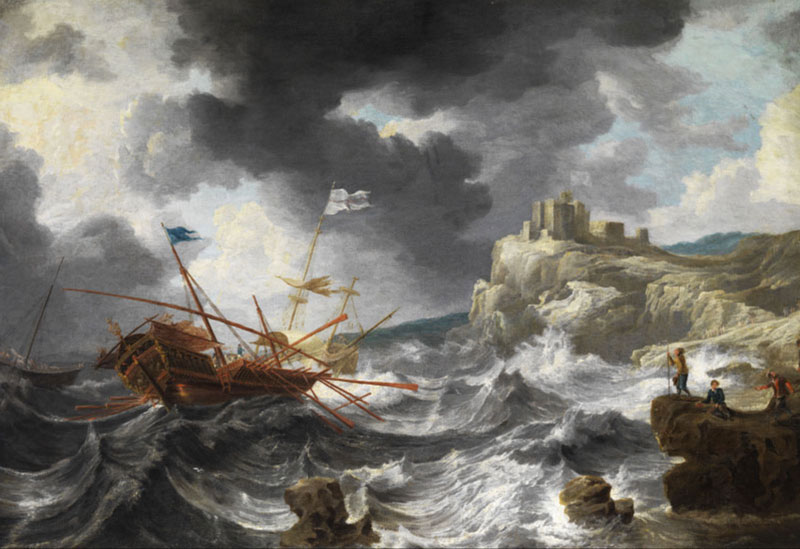
[The picture above is Bonaventura Peeters’s “Shipwreck,” ca. 1652, courtesy of the Journal of Historians of Netherlandish Art.]

Wednesday, February 11, 2026

“The supposed Plunder of the Cargo and burning of the Vessel”

Alas, the first newspaper printed in Newburyport, Massachusetts, Henry-Walter Tinges’s Essex Journal and Merrimack Packet, wasn’t founded until the end of 1773.

That means we don’t have published accounts of ships coming and going from that port in 1772, or stories on topics of local interest.

It’s possible a historian digging into the local sources like Alexander Cain will uncover a contemporaneous source on what happened to Capt. Thomas Parsons in 1772. But for now the closest he’s found is the lore published by Joshua Coffin in A Sketch of the History of Newbury, Newburyport, and West Newbury, from 1635 to 1845:
February 10th [1772]. Captain Thomas Parsons sailed from Newburyport, in a schooner, for the West Indies; was wrecked at St. Mary’s, Nova Scotia. It was supposed that he, with all his crew, eight in number, were massacred by the inhabitants there, after plundering the vessel, and setting it on fire.
We don’t know the name of Parsons’s ship or of his crewmen. Coffin also offered no sources—no indication of how the news got back to Newburyport, or when. I suspect that for months people thought the schooner had been lost at sea. Then something—the sight of a burned wreck, a bit of loot, seamen’s gossip—made people suspect there had been foul play.

On 11 Mar 1773, more than a year after Capt. Parsons’s departure, the Boston News-Letter ran this item:
We are informed, that the Accounts sent from hence of the Loss of a Schooner, belonging to Newbury, near Cape-Sable, and the supposed Plunder of the Cargo and burning of the Vessel if not the Murder of the Crew, had been received by the Governor of Nova-Scotia, and that there would be the strictest Inquiry and Prosecution by the Authority of that Province.
That was reprinted in the following weeks in the Essex Gazette of Salem and in Connecticut newspapers. (Capt. Parsons had brothers and other relatives in Connecticut who might be interested.)

It’s not certain that news item referred to rumors about Capt. Parsons’s ship, but the details are similar, and I’ve found no other possible cases. That suggests the suspicions about what happened in Nova Scotia built up over time until someone demanded an investigation.

Unfortunately, I also haven’t found any follow-up stories. Because of national boundaries, I can’t search the Halifax Gazette. Government archives in Nova Scotia might hold information. In early 1773 the royal governor, Lord William Campbell, was busy chasing smugglers and securing a better berth for himself in South Carolina, but maybe he did start an inquiry. Or at least file the “Accounts” from Massachusetts.

It’s also conceivable that some archive in the Caribbean holds a clue. Did Capt. Parsons sail to an island successfully only to run into difficulty on the way back? If he was on some sort of smuggling voyage, what sort of records would he have left?

TOMORROW: Probing the mystery.

Tuesday, February 10, 2026

Parson Parsons and His Sons

Jonathan Parsons was born in West Springfield in 1705, the son of a church deacon. As an adolescent he “worked at a trade,” but a Yale tutor named Jonathan Edwards persuaded him to try college.

Parsons graduated at the late age of twenty-four. He then studied more theology under Edwards, who had become the minister at Northampton.

In 1731 Parsons took the pulpit himself in the town of Lyme, Connecticut. He married Phebe Griswold, from a prominent local family, and they started having children—thirteen in all, but six died in infancy.

The children who grew up were four sons, born every two years from 1733 to 1739 (Marshfield, Jonathan, Samuel Holden, and Thomas), and three daughters, born 1748 to 1755 (Phebe, Lucia, and Lydia).

At Lyme the Rev. Mr. Parsons also got caught up in the “New Light” revival inspired by his old mentor Edwards and further inspired by the Rev. George Whitefield, who came through town in 1740. Parsons was soon known for his energetic preaching and evangelical outreach.

In 1745 the minister’s fervor grew too much for his congregation, and they decided on a separation. Parsons moved his family to Newbury to preach to a small “New Light” congregation that set itself up as Presbyterian, independent of New England’s independent network.

That meeting grew, erecting what’s now called the Old South Presbyterian Church in Newburyport in 1756. Whitefield died during a visit to Parsons in 1770 and was buried in its crypt. The minister’s wife Phebe died later the same year. He married the widow Lydia Clarkson of Portsmouth, New Hampshire, in 1771. 

Of the Parsons sons, Marshfield and Samuel Holden moved back to their birthplace of Lyme. Marshfield was a merchant and with his succession of four wives kept a tavern. Samuel Holden graduated from Yale and became a lawyer. Jonathan, Jr., and Thomas kept Newbury as their base and went to sea.

In particular, Thomas Parsons had a son by his first wife, Mary Gibson, and four daughters by his second wife, Sarah Sawyer. The New-Hampshire Gazette shows a captain named Thomas Parsons sailing out of Portsmouth harbor:
  • on the Charming Sally to Guadaloupe in 1762.
  • on the Success to Dominica and the West Indies in 1769.
  • on the Three Friends to the West Indies and Guadaloupe in 1770.
In February 1772, according to secondary sources, Capt. Thomas Parsons took a schooner out of Newburyport for another voyage to the Caribbean. He never came home.

TOMORROW: Mystery off Cape Sable.

Thursday, December 18, 2025

“Promised on receiving a bribe, to let a person bring out £240”

Along with the other reports on life inside besieged Boston that I discussed yesterday, on 17 Dec 1775 Capt. Richard Dodge reported this dastardly deed:
Morson Scotch menster took Bribe of A Sertain Genttelmen of 36/ Starling to Gett Out of Boston and 72/ to Let him Bring Out A trunk of £240 Pound in Cash Wich when he Had it in his Power sezd the Holl and Carreed it to Boston A Gain.
In more familiar spelling, the Rev. John Morrison, a Presbyterian minister from Peterborough, New Hampshire, who had come to the siege lines as a chaplain and then defected to the British, charged a man more than £5 to slip out of Boston with cash, but then confiscated the cash.

That story soon got to printer Benjamin Edes, as reported in his next issue of the Boston Gazette on 25 December:
That one Morrison, who officiates as a Presbyterian minister, being appointed searcher of those people who were permitted to leave the town, promised on receiving a bribe, to let a person bring out £240 sterling in cash and plate: but afterwards basely deprived him of the whole of it:—
That article was reprinted in the Pennsylvania Packet on 1 Jan 1776, and here on Boston 1775 in 2008.

One of Capt. Dodge’s informants, a ship captain named Nowell, then went home to Newburyport and told the same story for the 22 December Essex Journal:
That one Morrison a Scotch minister, was appointed to search the inhabitants upon their leaving the town, who received a bribe of two Johanneses to let a small trunk pass unmolested, yet notwithstanding his engagements, he opened the trunk and took out 2400 pounds in cash and a quantity of plate, which was all the trunk contained; what we suppose induced him to this, was, because the informer is intitled to one half of the plunder.
But this time, the numbers got bigger.

(Shown above: Two Portoguese Johannes coins from the mid-1700s, courtesy of BrianRxm.)

Wednesday, December 17, 2025

Eight Runaway Men in a Boat from Boston

Capt. Richard Dodge was a Continental Army officer stationed in Chelsea during the second half of 1775. Like his regimental commander, Lt. Col. Loammi Baldwin, he sent periodic reports to Gen. George Washington’s headquarters about what he saw in Boston harbor.

On 16 December, Dodge reported some exciting news: “Last Eveing Eight men Runaway in a bote from Boston to our guard at the farry.”

Following recently enacted protocol, Dodge sent those men to a local health committee who “Clensed them by Smooking them” against the smallpox.

Six (or seven, according to the 25 December Boston Gazette) of those eight men were “masters of Vassels” captured by the Royal Navy and brought into Boston over the preceding months.

One, Capt. James Warden, had sailed for the Philadelphia merchant Thomas Mifflin and was anxious to renew their acquaintance now that Mifflin was the army’s quartermaster general. Naval Documents of the American Revolution reports that Warden was commanding the schooner Tryal on 22 August when it surrendered to H.M.S. Nautilus under Capt. John Collins.

The Essex Journal of Newburyport identified another of those ship’s captains as named Nowell, possibly Silas Nowell (who wouldn’t have been held that long). He came out with a copy of the Boston News-Letter, the only newspaper still being published in the town, and the news that Gen. John Burgoyne had sailed for England.

On 17 December, 250 years ago today, Dodge wrote out a précis of what those men told him about life inside Boston. The prices for food were high. One escapee reported that “he Dined with a man that Dined with Lord parsey a feu Day ago upon horse beaff.”

Firewood was even scarcer with winter coming on. Gen. William Howe had ordered the Old North Meeting-House and empty houses torn down for fuel. We also know Howe told London that he might have to order wharves torn up next.

Citing Capt. Nowell, the newspapers added that “all the drugs and medicines in the town have been seized for the use of the army.”

TOMORROW: Tales of the searcher.

Saturday, October 25, 2025

“Mr. Bass was conducted into his deviations”

The Rev. Edward Bass of Newburyport was under pressure from both sides during the Revolutionary War.

As a minister in the Church of England, still feeling personal loyalty to the Crown, he tried to avoid complying with the independent governments’ demands.

But that exposed him to attacks from the Patriot populace. On 4 May 1782 the Rev. Jacob Bailey (1731–1808, profile shown here), an Anglican minister who moved around the New England frontier, wrote to the Society for the Propagation of the Gospel in Foreign Parts (S.P.G.) in London:
I am very confident, both from the repeated assertions of Mr. Bass himself, and other circumstances, that he refused to read the Declaration of Independency, and he became, on that account, extremely obnoxious to the violent party.

I am certain that he was publicly reported for a Tory, and I was, one evening just upon my arrival at his house, witness to a scene equally ludicrous and indecent, for as he was returning from an entertainment with his wife, he was pursued along the street by near two hundred persons, who pelted him with dirt and stones, and treated him with the most indelicate language.
Meanwhile, Anglican ministers who had fled New England complained that Bass was too compliant toward the Patriot authorities. The Rev. Joshua Wingate Weeks of Marblehead reported that Bass had preached in support of American soldiers—and he said he’d heard that from Bailey.

Bailey wrote his 1782 letter to refute that charge. He recalled:
being compelled to leave my family to avoid confinement on board a guard ship, I wandered through the country, and about the middle of November came to Newburyport, and was at Church on a day of public thanksgiving appointed by the Congress. Mr. Bass desired me to preach, but I refused, assuring him that I would never deliver a charity sermon to collect money for clothing the rebel soldiers.

This I repeated soon after to Mr. Weeks, but, as nearly as I can remember, Mr. Bass gave us a general discourse, without descending to particulars, or even mentioning the occasion of the solemnity. After sermon, the collection was made. Many refused to contribute, and a lady of some distinction declared with a spirited voice, “I will never give a single penny towards the support of rebels.” This bold declaration was perhaps the occasion of my retaining the above in my memory.

On the whole, I am persuaded that Mr. Bass was conducted into his deviations, not from even the least inclination to the cause of the revolters, but from a mistaken zeal for the Church, which, he imagined, in some measure, would justify his compliance.
As noted yesterday, by 1776 Bass had stopped receiving the half of his salary paid by the S.P.G. Later in the war he realized his situation was even worse: the organization had marked the St. Paul’s pulpit as empty, no longer recognizing his existence as a minister.

TOMORROW: Routes to reinstatement?

Friday, October 24, 2025

“In Lieu of that Part of his Salary received annually from England”

New England’s Puritan heritage made those colonies less than welcoming for the Church of England.

There was an Anglican missionary organization called the Society for the Propagation of the Gospel in Foreign Parts (S.P.G.). It paid for ministers to visit Native American communities.

It also supplemented the salaries of ministers in New England on the assumption that their congregations were small and their work difficult.

The Rev. Edward Bass was one of those ministers. He was born in 1726 in Dorchester into a family that had arrived early in the English settlement of Massachusetts. He studied at Harvard College and spent a couple of years teaching and preaching in Congregationalist meetings.

But by 1752 Bass decided that he really belonged in the Church of England. He sailed to Britain to be ordained, returning to take up the pulpit of St. Paul’s church in Newburyport.

Twenty years later came the war. As quoted yesterday, news of the Declaration of Independence prompted the wardens and vestrymen of St. Paul’s to ask their minister to leave prayers for King George III and his family out of their services for the sake of the church. On 16 July 1776 the Rev. Mr. Bass agreed: “I think it incumbent on me for so important an end to comply with this request during the present state of our political affairs.”

Bass tried to walk a narrow line. He dropped the public prayers for the king but continued to support the Crown personally. When the Massachusetts Council ordered all ministers to read the Declaration of Independence to their congregations, he declined to declaim it from the St. Paul’s church pulpit but evidently allowed a lower church official to do so.

But already other Anglican ministers were complaining about Bass’s conduct. On 15 July 1775 the Rev. Dr. Henry Caner of King’s Chapel in Boston had written to the S.P.G.: “Mr. Bass has complied perhaps too far with the orders of the Rebels.”

The war stopped the S.P.G.’s regular payment to Bass. On 25 Nov 1776, nine Newburyport men signed this pledge:
We the Subscribers of St. Paul’s Church in this town being truly sensible of the Distress which our worthy minister must suffer without some Relief in Lieu of that Part of his Salary received annually from England, and which the present unhappy Times prevent his obtaining, do promise to pay on Demand to Mr. John Vinal the several sums affixed to our Names to be by him delivered to the Rev. Mr. Bass.
The promised amounts ranged between £10 from Tristram Dalton and John Tracy to 18 shillings from Abram Gallisham. As for Vinal the schoolteacher and church warden, his signature doesn’t appear on this document. Perhaps he chipped in on his own, or perhaps his contribution lay in wrangling the contributions of others.

TOMORROW: Did that settle matters?

Thursday, October 23, 2025

The “Doctrine of Projectiles” and Other Doctrines

On 10 Aug 1775, the Newburyport schoolmaster John Vinal wrote out the text of a new advertisement to appear in the next day’s Essex Journal and succeeding issues.

That was nearly four months into the war, and Vinal’s ad reflected that situation:
AT a Time when our Enemies are endeavouring our Ruin it is highly proper to qualify ourselves in the best Manner we can to defend our injured Country:

And as the Doctrine of Projectiles, or Art of GUNNERY is of such Importance that no Person should undertake the Direction of any Piece of Ordnance without a competent Knowledge of it, the Want of which has proved fatal to many:

The Subscriber therefore proposes to instruct those who may incline to attend four Afternoons in a Week, from five to seven o’Clock, or from eleven to one A.M. [sic] in the above Art at a very moderate Price

JOHN VINAL.

N.B. The Subscriber received his Knowledge of the above Art from a Gentleman who was an Engineer in the British Army the whole of the last War.

Newbury Port, August 10th, 1775.
In April and October 1776 Vinal went back to advertising private lessons for the “youth of both sexes” in the standard school subjects, not gunnery.

Vinal was also a warden of St. Paul’s, the town’s Anglican church, founded in 1711. On 16 July 1776 he, fellow warden Joseph Cutler, and eight vestrymen gave this letter to their minister, the Rev. Edward Bass (1726–1803):
Rev’d Sir;—

The Representatives of the United Colonies in America, having in Congress declared s’d colonies free and Independent States, and disavowed all Allegiance to the King of Britain and the service of the Church to which we belong, prescribing certain prayers, &c., to be used for s’d King, his Family & Government, We find ourselves under the necessity of requesting you to omit in your use of the Service all Prayers, Collects, or Suffrages which relate to the King, Royal Family, or Government of Great Britain, both as we would avoid great Inconsistency and as we value the welfare of the church, being assured that without such omission the Existence thereof would immediately cease.
Most of Boston’s Anglican clergymen had left with the British military, and others in Massachusetts were keeping a low profile. Bass had to worry about local opinion, his congregation, his sacred oaths—and his salary.

TOMORROW: A special collection.

Wednesday, October 22, 2025

“To open his EVENING-SCHOOL, as usual”

Isaiah Thomas and Henry-Walter Tinges launched the Essex Journal newspaper in Newburyport in 1773.

Among its advertisers was town schoolmaster John Vinal, offering private lessons in a broad range of subjects. His notice on 5 Oct 1774 said:

JOHN VINAL,
INTENDS to open his EVENING-SCHOOL, as usual at the NORTH-SCHOOL the 10th Instant, for Writing and the several practical Branches of the Mathematics, enumerated in a former Advertisement of his.
Alas, I haven’t found that “former Advertisement.” 

On 15 Mar 1775 Vinal was more expansive:
JOHN VINAL,
ACQUAINTS his Friends that he intends to begin his private School for Youth of both Sexes, on Monday the third of April next at 11 o’Clock A.M. in the room he improved the last Summer, nearly opposite Mr. Davenport’s Tavern, and from 5 to 7 o’Clock, P.M. at the Town School House for those who can best attend in the Afternoon.

N.B. The Said VINAL has a very genteel BOWFAT, with a Glass Door to dispose of, very cheap, for almost any Pay that will suit the Purchaser.
A what now?

A week later the same ad ran again except the item offered for sale was “a very genteel BUFFET, (commonly pronounced Bowfat,) with a Glass Door.”

Ah.

Dr. Samuel Johnson’s dictionary defined a buffet this way:
Buffet. n.s.  [buffette, Fr.] A kind of cupboard; or set of shelves, where plate is set out to shew, in a room of entertainment.
The rich buffet well-colour’d serpents grace,
And gaping Tritons spew to wash your face.
Pope.
”Mr. Davenport’s Tavern” referred to the tavern started by William Davenport and inherited by his sons Anthony and Moses in 1773. Its sign showed Gen. James Wolfe, so it was also called the Wolfe Tavern.

Vinal’s eagerness to sell that genteel piece of furniture suggests a need for quick cash. Of course, he often seems to have wanted extra cash. But the spring of 1775 wasn’t the best time for selling a luxury item, especially one you didn’t know how to spell.

TOMORROW: War!

Monday, October 20, 2025

A New Schoolmaster for a New Town

In January 1764 the Massachusetts General Court passed a law allowing part of the town of Newbury to split off as the new town of Newburyport.

The new town held its first meeting on 8 February, choosing a clerk, selectmen, and other officials. The inhabitants also chose a committee to determine what schoolhouses the children needed. They decided to keep paying the masters of the Newbury grammar and writing schools for now.

In March that committee recommended:
that at least three large schools should be provided and maintained in sd. Town, viz: one Grammar school not far from the Revd. Mr. [John] Lowel’s meeting house, and two reading, writing & arithmetick schools, one of them adjoining to Queen street, Ordua Lane, or Bartlet’s Lane, preferring the latter, and the other adjoining or near Cross street or Elbow Lane.
That summer, the town bought some land on what is now Winter Street, beside Route 1, and started building a schoolhouse.

To oversee that school the selectmen hired John Vinal, usher of Boston’s South Writing-School. They offered him £80 per year, significantly more than he had been earning in Boston though less than what the bigger town’s schoolmasters earned. In addition, each pupil was to bring “two pistareens” to pay for firewood used during the year.

The selectmen announced: “Boys that can read in a Psalter will be received and carefully taught Reading, Writing & Arithmetick.” The school would meet 8 A.M. to noon and 1 to 4 P.M.

Vinal’s school opened on Monday, 5 November, with the Rev. Mr. Lowell and the selectmen present. Given that Newbury’s youth usually celebrated Pope Night with a big procession and bonfire, I imagine that student body was rather antsy that day.

John Vinal continued to look for ways to supplement his salary. The town needed to survey the “common and undivided land” near the Frog Pond, and in 1771 Vinal produced the map shown above, shared by History Newburyport. Around the pond it shows a burying-ground, a potash house, a ropewalk, a powderhouse, and a windmill.

TOMORROW: Vinal’s lessons.

Tuesday, September 16, 2025

Commemorating the 1775 Expedition to Québec in Newburyport

This weekend the town of Newburyport will commemorate the 250th anniversary of when Col. Benedict Arnold and his Continental volunteers passed through the town on their way to Québec.

There are multiple events on the schedule. It looks like the Custom House Maritime Museum at 25 Water Street is the main base, open 10 A.M. to 4 P.M. all three days, but the Museum of Old Newbury and several churches are involved.

Friday, 19 September, 12 noon
Newburyport’s Bells Ring Out!

Three of the town’s oldest churches will ring their bells to herald the coming of the Continental troops.

Friday, 19 September, 7 to 8:30 P.M.
Through a Howling Wilderness: 1775 March to Quebec
Tom Desjardin
St. Paul’s Church, Newburyport

In September 1775, Arnold commanded eleven hundred Colonial soldiers on a daring, top-secret mission: to march and paddle nearly 200 miles through the untamed wilderness of Maine and Quebec to seize British-held Quebec City. It was a journey marked by hypothermia, disease, starvation, hurricanes, and blizzards. Dozens perished; survivors endured eating everything from dogs to lip salve before reaching their target. Though the attack ultimately failed, Arnold’s expedition helped pave the way for America’s eventual victory. Through a Howling Wilderness tells this gripping story of endurance, sacrifice, and leadership before Arnold’s name became synonymous with treason.

Tom Desjardin holds a Ph.D. in U.S. History and is the author of multiple acclaimed books. A former archivist and historian at Gettysburg National Military Park, he has taught at Bowdoin College, advised film and television productions (including Gettysburg and Gods and Generals), and appeared on the History Channel, A&E, Discovery, PBS, and CSPAN. He is a former Commissioner of Education for Maine and director of the Maine Bureau of Parks and Lands.

Saturday, 20 September, 10 A.M. to 4 P.M.
Revolutionary Living History Experience: Bringing 1775 to Life
Downtown Newburyport

A special one-day living history event featuring reenactors, tactical demonstrations, and engaging historical interpretation, this immersive celebration brings 1775 to life and honors the city’s pivotal role in America’s fight for independence. The day’s schedule will begin with Col. Arnold reviewing his troops. He will address them about their orders at around 3:30 P.M.

Saturday, 20 September, 10:30 A.M.
A Moment of Resolve: Reenactment of the Dedication Service
First Parish Church, 20 High Road

Commemorate the 250th anniversary of the Quebec Expedition with a powerful reenactment of the 1775 dedication service for departing troops. Reverend Samuel Spring, portrayed by Edward Speck, delivers the historic sermon that inspired courage and faith, honoring the spiritual strength that sustained Newburyport’s patriots on their journey to liberty.

Saturday, 20 September, 11 A.M. to 4 P.M.
Revolutionary Newburyport
Museum of Old Newbury, 98 High Street

Tours starting every hour highlight objects linked with the American Revolution not usually on display. Buy tickets and reserve spaces through this page.

Saturday, 20 September, 1:00 P.M.
DAR America 250 Patriots Marker Dedication
Old South Presbyterian Church, 29 Federal Street

The Brigadier General James Brickett–Old Newbury Chapter, N.S.D.A.R., will dedicate an America 250 Patriots Marker in Newburyport. This ceremony honors Revolutionary War patriots with reflections from civic leaders and descendants, preserving their legacy for generations to come.

Saturday, 20 September, 1:30 P.M.
Walk to the River: A Tribute to Newburyport’s Revolutionary Departure
Federal Street to Water Street

Following the dedication of the America 250 Patriots Marker, attendees are invited to join a commemorative walk through downtown Newburyport to the riverfront. The walk will conclude near the original embarkation site with brief remarks honoring the 1775 departure of local patriots on their daring expedition to Quebec.

Saturday, 20 September, 2 to 4 P.M.
Discover Your Family’s Story: Genealogy Drop-in Clinic
Museum of Old Newbury, 98 High Street

Discover your roots and deepen your community connection at this engaging genealogy workshop. Participants will learn how to trace family history, uncover ancestral ties to early settlers and patriots, and explore Newburyport’s revolutionary and colonial past. Trained genealogists will be available to assist with family history research.

Sunday, 21 September, 10:00 A.M.
Burying Ground Tour: Old Hill and Newburyport’s Road to Revolution
Old Hill Burying Ground, 25 Greenleaf Street

Join Newburyport historian Ghlee Woodworth on a captivating cemetery tour honoring Revolutionary War patriots. Explore gravestones, hear stories of bravery and sacrifice, and discover how these local heroes shaped America’s fight for independence. A fascinating journey connecting past to present through tales of courage, resilience, and Newburyport’s rich revolutionary heritage.

Sunday, 21 September, 11 A.M. to 4 P.M.
Revolutionary Newburyport
Museum of Old Newbury, 98 High Street

Tours starting every hour highlight objects linked with the American Revolution not usually on display. Buy tickets and reserve spaces through this page.

Sunday, 21 September, 1 P.M.
Faith and Freedom: Old South Presbyterian Church and the Revolution
Old South Presbyterian Church, 29 Federal Street

Explore Old South Presbyterian Church and uncover its rich Revolutionary War history on this guided tour. Learn about its role in 1775 as a gathering place for patriots, hear stories of prominent figures connected to the church, and discover how faith and freedom intertwined in Newburyport’s fight for independence.

Sunday, 21 September, 3 P.M.
The 1775 Quebec Expedition from Newburyport: Following Their Footsteps
Central Congregation Church, 14 Titcomb Street

On September 19, 1775, over 1,100 men departed Newburyport on a secret mission to capture Quebec—led by Benedict Arnold and planned with George Washington. Join Jack Santos as he recounts the stories of Newburyport’s patriots on this daring expedition through the wilderness as we celebrate its 250th anniversary.


Wednesday, July 02, 2025

“Alarmed that the Regulars were advancing towards Our Entrencment”

Among the presentations at this Saturday’s commemoration of Gen. George Washington’s arrival in Cambridge is a talk by Longfellow House archivist Kate Hanson Plass on the diary of Moses Sleeper.

Hanson Plass and her team have recently shared the diary online: transcription with annotations and illustrations, plus a link to page images on Archive.org.

The introduction explains:
In the museum collection of the Longfellow House-Washington’s Headquarters National Historic Site is a diary written by a soldier who participated in the early days of the American Revolution. No one knows how the diary got to the house, though it seems likely that a collector in the Longfellow family acquired it for its Revolutionary War connection in the early 20th century.

The book itself is small (5” by 8”), pocket size; its cover and the first and last three pages are missing. There is no indication of the identity of the writer of the diary; at first reading it seems to be anonymous. Using clues inside the diary – references to family members and locations of military service – the author has been established as Corporal Moses Sleeper of Newburyport, Massachusetts, who served for 19 months in Colonel Moses Little’s Regiment (later the 12th Continental Regiment).
Sleeper and Sgt. Paul Lunt of the same regiment obviously shared their diaries since many of their entries are the same. They weren’t keeping private, personal notes but making a record of their military service for people back home and in the future.

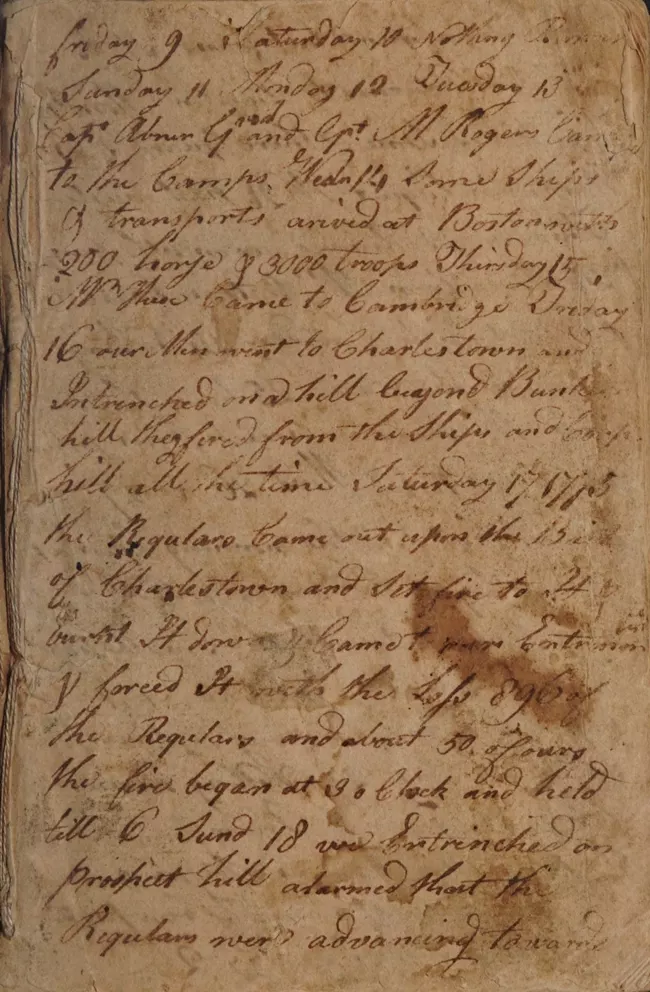
Cpl. Sleeper’s surviving pages start right before the Bunker Hill battle, which his regiment wasn’t involved in. Here’s his terse account of those days:
Friday 16 our Men went to Charlestown and Intrenched on a hill beyond Bunker hill they fired from the Ships and Copps hill all the time.

Saturday 17 1775 the Regulars Came out upon the Back of Charlestown and Set fire to It & burnt It down & Came to our Entrenen[?] forced It with the Loss 896 of the Regulars and about 50 of ours The fire began at 3 o Clock and held till 6

Sund 18 we Entrinched on prospect hill alarmed that the Regulars were advancing towards Our Entrencment but found It to be false Returned to Quarters

Mondy 19 Wee killed Some of there Guard

T 20 Went upon Picquet

W 21 past musters

Thirsday 22 Received our month pay
You wouldn’t know from those entries that Capt. Benjamin Perkins’s company, including Cpl. Sleeper, went onto the Charlestown peninsula on 17 June and saw combat. I’ve quoted later recollections of the Bunker Hill fight from other men in that company: Lt. Joseph Whitmore and Pvt. Philip Johnson.

Sgt. Lunt’s description of the battle offered a little more detail:
Saturday, 17th. - The Regulars landed a number of troops, and we engaged them. They drove us off the hill, and burnt Charlestown. Dr. [Joseph] Warren was lost in the battle: the siege lasted about three hours. They killed about 50 of our men, wounded about 80: we killed of the king’s troops 896, - 92 officers, 104 sergeants.
Both Sleeper and Lunt listed an exact number of enemy casualties—a piece of intelligence it usually takes days or weeks to acquire. In Sleeper’s case, we can see that number was written right into the entry, not inserted later. That suggests these provincial soldiers didn’t write their diary entries on the evening after the battle but after time had passed, they had recovered, and they might have had less to do.

Saturday, April 13, 2024

James Warren: “News we have”

On 6 Apr 1775, James Warren was in Concord, representing Plymouth in the Massachusetts Provincial Congress.

He started writing home to his wife, Mercy, that day. That letter contains a passage I’ve quoted many times in my Road to Concord talks, but there’s a lot more going on, too.

So over the next few days I’ll analyze of Warren’s whole letter.
My Dear Mercy,—

Four days ago I had full Confidence that I should have had the pleasure of being with you this day, we were then near closeing the Session. Last Saturday we came near to an Adjournment, were almost equally divided on that question, the principle argument that seemd to preponderate, and turn in favour of sitting into this week was the prospect of News and News we have.

Last week things wore rather a favourable aspect, but alas how uncertain are our prospects. Sunday Evening brought us accounts of a Vessel at Marblehead from Falmouth, and the English Papers etc by her. I have no need to recite perticulars. you will have the whole in the Papers, and wont wonder at my forgoeing the pleasure of being with you. I dare say you would not desire to see me till I could tell you that I had done all in my power to secure and defend us and our Country.

We are no longer at a loss what is Intended us by our dear Mother. We have Ask’d for Bread and she gives us a Stone, and a serpent for a Fish.
That last line is an allusion to Matthew 7:9–11.

The British news that Warren alluded was printed in the Essex Journal of Newburyport before spreading to other papers. “Capts. Barker and Andrews” had sailed from England on 17 February, bringing the latest.

The Essex Journal reprinted a long report on debate in Parliament on 5 April and an even longer one on 12 April. Those two articles don’t agree in all the details, but they’re clear on the basic developments.

For years the Massachusetts Whigs had hoped that their pleas, protests, and persistence would prompt a change in British government policy. Instead, the Lords refused to hear the latest petitions from America.

The Earl of Chatham, formerly William Pitt and still America’s favorite, moved that Parliament repeal the Coercive Acts and remove troops from Boston. Other peers argued for “compelling the Americans to the immediate obedience of the legislature of the mother country.” Ultimately the House of Lords rejected all of Chatham’s proposals by margins like 77 to 18.

Furthermore, on 9 February both houses of Parliament had signed off on an address to the king that declared in part:
…we find that a part of your majesty’s subjects in the province of Massachusetts Bay have proceeded so far to resist the authority of the supreme legislature; that a rebellion at this time actually exists within the said province. . . .

we consider it as our indispensible duty, humbly to beseech your majesty that you will take the most effectual measures to enforce due obedience to the laws and authority of the supreme legislature; and we assure your majesty that it is our fixed resolution, at the hazard of our lives and properties, to stand by your majesty against all rebellious attempts…
The king’s official response was to promise “the most speedy and effectual measure for enforcing due obedience to the laws, and the authority of the supreme legislature.”

And that was just the official record. The London newspapers also threw in comments like “Lord N—h is determined that the Americans shall wear chains.”

TOMORROW: Keeping up spirits, keeping up defenses.

Monday, February 12, 2024

“Command of a vessel without arms, and with but one eye”

Aside from having several children, what did Sylvanus Lowell do after being so badly injured at the Marblehead smallpox hospital in 1773?

First he returned to the maritime business, as shown by this advertisement from the 23 Mar 1774 Essex Journal, published in Newburyport:
For NEWFOUNDLAND,
THE Schooner ROSE, JACOB LOWELL, master, now lying at Marquand’s wharf, will sail by the first of April.—For Freight or Passage apply to Robert Jenkins, or Silvanus Lowell.
Newbury Port, March 21st, 1774.
Shortly after that, Parliament closed the port of Boston to most trade from outside Massachusetts, thus making secondary ports like Newburyport more important for about a year.

But then the war began, and sailing out of any Massachusetts port put ships at risk for being seized by the Royal Navy. At the same time, the province needed military supplies, and there was money to be made in privateering.

Sylvanus Lowell, despite his injuries, went back to sea. As the Newburyport Herald copied from the Saco Democrat in 1830:
No better evidence of his enterprising spirit is watnng, than the fact of his obtaining command of a vessel without arms, and with but one eye. It is said he was enabled to do much of his own writing, by screwing a pen into the hook attached to his arm.
In February 1777, the Massachusetts board of war commissioned Lowell to sail to St. Eustatia to trade for salt and these goods:
500 Effective Fire Arms, fit for Soldiers, with Bayonets —
500 Soldiers Blankets —
50 Barrels Gun-powder
200 ps Ravens Duck or Tent Cloth —
300 lb Twine —
25 Casks 20d Nails —
30 do 10d do
15 do 4 do
If the above Articles are not to be got, bring the proceeds in Russia Duck, Cordage from 4½ Inches downwards, Coarse Checks & Linnens —
He commanded a crew of at least nine men. The captain was back by July, when he bought a house in Newbury for his growing family.

In 1779 Lowell became captain of a privateering brig listed as the Porgee (also Porgee and Pauga), with a letter of marque from New Hampshire. Though descendants recalled it as “a large war-ship,” the American War of Independence at Sea website says it carried only four guns and eleven men.

Nonetheless, the Porgee managed to capture a ship called the Lively, as shown by a legal notice in the 17 July 1780 Boston Gazette. AWIatsea.com says the ship then received a Massachusetts letter of marque and went out under another captain.

In 1781 Capt. Lowell invested in a privateering sloop named the Betsey, and reportedly he commanded other privateers himself. According to his 1830 obituary:
About 3 days before Peace was concluded, he was captured by the British; but by the time they reached the shore, this news was received, and he was liberated and sent home.

After this, he followed the sea 7 years, as master of a vessel out of Newburyport, in the employ of Tristram Dalton.
Dalton had backed many privateers during the war, including the Betsey.

Levi Mills of Newburyport sailed under Capt. Lowell to Richmond on the “good ship Diana” one winter in the mid-1780s. According to an item about Mills’s journal published by the Colonial Society of Massachusetts, this tobacco-buying trip meant navigating the ice and shoals of the James River.

In 1791, as I wrote yesterday, Lowell’s second wife Elizabeth died. By the end of the year he married a third wife, also named Elizabeth. It also appears that the captain’s remaining eye started to fail around this time, eventually leaving him totally blind.

Lowell “quit the sea,” sold that Newbury house, and moved his whole blended family up to Maine, where some of his siblings had already settled. His stepdaughter Fannie later described the part of Biddeford where they made their new home as “then a wilderness.”

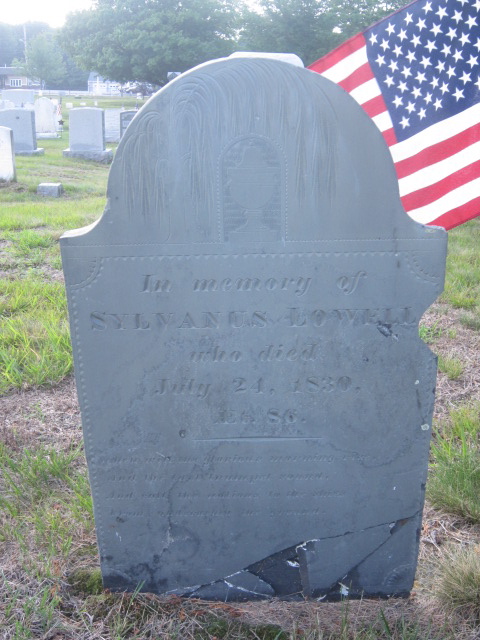
I’m not sure how Sylvanus Lowell supported his family after that, but reportedly the children grew up “in comfort.” In Biddeford the captain was “greatly esteemed.” Around 1825 Lowell “was visited with a severe shock of the numb palsy,” and he died on 21 July 1830, aged 86. His third wife survived him for another nine years.