J. L. BELL is a Massachusetts writer who specializes in (among other things) the start of the American Revolution in and around Boston. He is particularly interested in the experiences of children in 1765-75. He has published scholarly papers and popular articles for both children and adults. He was consultant for an episode of History Detectives, and contributed to a display at Minute Man National Historic Park.

Subscribe thru Follow.it


•••••••••••••••••


Showing posts with label Joseph Lee. Show all posts

Monday, September 16, 2024

Reading the Middlesex Resolves

On 30–31 Aug 1774 delegates from “every town and district in the county of Middlesex” met at Concord to discuss the political situation in Massachusetts.

The body chose a committee headed by Jonathan Williams Austin of Chelmsford to draft its response to Parliament’s recent Coercive Acts. Austin was a young lawyer, raised in Boston, educated at Harvard, and trained by John Adams.

At the end of that convention, the body voted 146 to 4 to adopt the Austin committee’s report offering nineteen resolutions. Here’s the preface, as printed in a broadside:
IT is evident to every attentive Mind, that this Province is in a very dangerous and alarming Situation. We are obliged to say, however painful it may be to us, that the Question now is, Whether by a Submission to some late Acts of the Parliament of Great Britain, we are contented to be the most abject Slaves, and entail that Slavery on Posterity after us, or by a manly, joint and virtuous Opposition assert & support our Freedom.

There is a Mode of Conduct, which in our very critical Circumstances we wou’d wish to adopt, a Conduct, on the one Hand, never tamely submissive to Tyranny and Oppression, on the other, never degenerating into Rage, Passion and Confusion. This is a Spirit, which, we revere as we find it exhibited in former Ages, and will command Applause to latest Posterity.

The late Acts of Parliament pervade the whole System of Jurisprudence, by which Means, we think, the Fountains of Justice are fatally corrupted. Our Defence must therefore be immediate in Proportion to the Suddenness of the Attack, and vigorous in Proportion to the Danger.

We must NOW exert ourselves, or all those Efforts, which for ten Years past, have brightened the Annals of this Country, will be totally frustrated. LIFE & DEATH, or what is more, FREEDOM & SLAVERY are in a peculiar Sense now before us, and the Choice and Success, under God, depend greatly upon ourselves. We are therefore bound, as struggling not only for ourselves, but future Generations, to express our Sentiments in the following Resolves; Sentiments, which we think, are founded in Truth and Justice, and therefore Sentiments we are determined to abide by.
The Middlesex County resolutions complained about three acts of Parliament: the Boston Port Bill, the Massachusetts Government Act (in detail), and the Administration of Justice Act. This convention said nothing about the revised Quartering Act or the Quebec Act, often grouped with those others.

Resolution 17 called out Samuel Danforth and Joseph Lee by name as “judges of the Inferior Court of Common Pleas for this county, [who] have accepted commissions under the new act by being sworn members of his Majesty’s Council.” It’s no surprise, therefore, that those two men were the first targets of the “Powder Alarm” two days after the convention ended. They indeed had enough warning to write out their resignations from the Council.

TOMORROW: A question of style.

Thursday, September 05, 2024

The Flight of the Cambridge Loyalists, part 2

One direct target of the “Powder Alarm” protest in Cambridge on 2 Sept 1774 was Joseph Lee, a judge and appointee to the mandamus Council.

He tried to get ahead of the crowd’s demands by writing out a resignation from that Council in the morning, then reading it aloud on Cambridge common at midday.

But Lee and his wife Rebecca were still nervous. Her brother, Sheriff David Phips, and her niece’s husband, Lt. Gov. Thomas Oliver, took refuge in Boston, as recounted yesterday. Toward the middle of the month, the Lees decided to leave town, too.

Instead of seeking the protection of the troops, the Lees headed south. To make their journey secure, they obtained this certificate from Isaac Foster, Jr., on 16 September:
To our Bretheren the Friends of Liberty

Whereas the honourable Joseph Lee Esqr has proposed to take a Tour through the Country for his [insert: Ladys] health, and it is possible that some Persons unacquainted with the Transactions at Cambridge on the 2d. instant, (when so great a Part of this County were collected there) may still be uneasy at his having taken the Oath as Councellor, on the intended new and unconstitutional Plan; these may certify that the said honourable Joseph Lee Esqr. had voluntarily, before he was called upon, and as we trust from a Conviction of the unconstitutionality of his Appointments, resigned his seat at the Council Board; which resignation he publickly and politely declared to the respectable Inhabitants of this County, with a promise that in future he would accept of no Office inconsistent with the Charter of this Province; and that the said Declaration and Promise was by the People assembled as aforesaid, unanimously voted satisfactory, having given such ample Satisfaction, we doubt not he will be treated by all the Friends of our happy Constitution, with such Civility and Respect, as shall do honour to our common Cause.

By order of the Committee of Correspondence for Charlstown
That’s another document from the Massachusetts Historical Society’s Miscellaneous Bound Manuscripts collection.

During Monday’s commemoration of the “Powder Alarm” in Charlestown, Karen Falb alerted me to a glimpse of Joseph and Rebecca Lee on their journey south. It appears in a letter from Henry Pelham to his half-brother John Singleton Copley, dated 2 November from Philadelphia. Pelham wrote:
I wish I had a more satisfactory account to give than that I have taken this Journey in search of lost Health; but still Happy should I be could I say I had entirely recovered it. I have been for near 10 Months [i.e., pretty much since the Tea Party] past very subject to nervous complaints which shewed themselves in an almost continued Dizziness, Headack, Loss of Appetite, Trembling of the Nerves, and Lowness of Spiritts. for these I early put myself under the Care of Doct’r [William Lee or Nathaniel] Perkins, who ordered me a course of Steel and frequent Riding, and recommended a long journey in the fall which my friends much advised too.

Mr. and Mrs. [Charles and Sarah] Startin [Susanna Copley’s sister and her husband] returning home, I thought it a favourable time for the excursion, and have come thus far in Company with them and Judge Lee and Lady, our Cambridge Friends, who propose passing the winter here. In a few days I intend to sett out for home, stoping for about a fortnight at New Haven, where Mr. [Adam] Babcock has engaged me to do two or three minature Pictures.
This letter shows that Pelham was friendly with the Lees before he drew his monumental map of the siege of Boston. (Another letter in the collection shows that Copley had visited Judge Lee at his home.) That has a bearing on the question of how much accuracy we can assign to Pelham’s rendering of the “Tory Row” estates, shown above.

Joseph and Rebecca Lee sat out the first years of the war in New Jersey and returned to their Cambridge home in 1777. Since they were no longer ”absentees,” Massachusetts did not confiscate that property.

The next mansion west from the Lees belonged to George and Susanna Ruggles. She was a Vassall by birth, thus a paternal aunt to Elizabeth Oliver.

George Ruggles made a unique arrangement for leaving the neighborhood: he swapped houses with the Boston merchant Thomas Fayerweather. On 31 October, Fayerweather deeded his house on Summer Street to Ruggles, and Ruggles deeded his estate on the Watertown road to Fayerweather. That estate included more than fifty acres of land, and Fayerweather paid Ruggles £2,000 to make an even swap.

That’s why Henry Pelham’s map of the siege of Boston labels that property as belonging to “Mr. Fairwather”—the one “Tory Row” estate no longer legally owned by a Loyalist at the start of the war.

TOMORROW: John Vassall’s secret.

Sunday, September 01, 2024

“You have heard of the taking ye. Windmill”

In The Road to Concord I quoted a lot from accounts of the “Powder Alarm” that Dr. Joseph Warren and Dr. Thomas Young sent to Samuel Adams on 4 Sept 1774. (Warren’s letter is undated, so that date is a guess based on context.)

Both those physicians had gone out to Cambridge common on 2 September along with other genteel Boston Whig leaders, hoping to calm the crowd and prevent violence. They could therefore share eyewitness details with Adams.

(In fact, the crowd was already calm, though determined. It didn’t verge on violence until later in the afternoon when Customs Commissioner Benjamin Hallowell, Jr., happened to roll by. And the inland farmers wouldn’t have recognized Hallowell if Bostonians like printer Isaiah Thomas hadn’t pointed him out, calling, “Dam you how doe you like us now, you Tory Son of a Bitch[?]” Needless to say, Thomas wasn’t part of the Boston committee.)

Adams also received a 5 September letter from the Rev. Dr. Samuel Cooper describing the “Powder Alarm.” That minister was not an eyewitness, so all his information was second-hand at best and inaccurate in some details. But that letter offers a look at what the Whigs were telling each other about the event.
You have heard of the taking ye. Windmill, at Cambridg [sic—Charlestown] with the Province Powder there by a Detachment.

The next Morning three thousand assembled at Cambridg. They conducted with Order & great Firmness. [Samuel] Danforth & [Joseph] Lee, expecting a Storm had resign’d the Day before. Sheriff [David] Phips has promis’d not to act upon ye. new Laws. Even the Lt. Governor [Thomas Oliver] resign’d his Seat at ye. Board [i.e., the Council].

The Assembly having done their Business, retir’d.

Hallowell pass’d on that Day thro Cambridg from Salem. When he had got a little Way fro the Assembly, one or two Horsemen follow’d him. He gallop’d with all the Speed he could make thro the blazing Heat to Boston.

When he got upon ye. Neck, as if all the Sons of Liberty in the Province had been at his Heels, He scream’d for the Guard: They ran from their Station to meet him. The Alarm was soon given to the Camp—and an apprehension instantly propagated of a Visit from Cambridg. The Soldiers lay on their arms thro the Night.

They have since doubled their Guard at the Fortification, and planted four Pieces of Cannon there.
Dr. Cooper had other things to say about the mandamus Councilors and what Gen. Thomas Gage was writing to his superiors in London. (How could the minister know?)

Cooper signed this letter “Amicus,” adding, “If you are at a Loss, Mr. [Thomas] Cushing will explain my Signature—conceal my name.”

Monday, March 08, 2021

“The End of Tory Row” Online, 11 March

On the evening of Thursday, 11 March, I’ll offer an online presentation for the Longfellow House–Washington’s Headquarters National Historic Site about “The End of Tory Row.”

For the past several years, I’ve spoken about that mansion’s Revolutionary history each March around Evacuation Day.

Usually those talks have focused on Gen. George Washington, who used the house as his headquarters from July 1775 to April 1776, and challenges he faced. Last year, for example, I shared information about Native American visitors to Cambridge during Washington’s time and his efforts at diplomacy on the continent.

That was the last public event I attended for many months. The audience was small and the chairs distanced, according to the protocols of the time. Soon most local institutions shut down completely for visitors. Historical talks moved online, which has brought both technical difficulties and benefits in wider access.

This year’s talk will look at how what’s now Brattle Street in Cambridge became a neighborhood of wealthy households, all related to John Vassall, the man who in 1759 commissioned and moved into that mansion. And how in September 1774 that enclave dissolved under political and militia pressure. I’ll also discuss how that neighborhood’s lifestyle depended both economically and in daily life on the exploitation of slavery.

I’ve discussed the Vassall family and the events of September 1774 before, but this year I’m trying to make more of the online format by incorporating more visuals and perhaps even moving footage. There will be a live question-and-answer session after the presentation.

This online event is free to all through support from the Friends of Longfellow House–Washington’s Headquarters, the Massachusetts Society of the Cincinnati, and the National Park Service. To register in order to receive the viewing link, please start at this page. The event will start at 7:00 P.M. on Thursday.

Friday, February 26, 2021

Investigating Slaves at the Hooper-Lee-Nichols House

Last month the Cambridge Historical Society issued a report on the history of slavery at its headquarters, called the Hooper-Lee-Nichols House.

In particular, the society wanted to collect information about any enslaved people living in that farmhouse along the street between Cambridge and Watertown.

Among the “Tory Row” mansions, the Hooper-Lee-Nichols House is the oldest, built in 1684 and then remodeled inelegantly to look more like its newer Georgian neighbors. It in fact predates the arrival of the Vassalls family, who brought Caribbean slave-labor wealth to the neighborhood.

The elder John Vassall (1713-1747) married Elizabeth Phips (1716-1739), a daughter of Lt. Gov. Spencer Phips. Another daughter, Rebecca Phips, married Joseph Lee in 1755. The society’s report continues the story:
Three years after the marriage the couple bought the house to live among several of her socially prominent and wealthy relatives who resided on [what is now] Brattle Street.

Lee was thought to be a gentleman, respected by his peers, honorable, honest, and a good friend. He was a founder of the Loyalist Christ Church, Cambridge, gave parties for his neighbors and was an avid gardener on his extensive farm with its many outbuildings. About his outlook on slavery we have a glimpse from a letter a friend wrote to him from St. Johns, probably from a slave-worked plantation: “I remember an opinion you once sported – that Negros seems to be intended for Slaves, from their rank in the Scale of being – I combatted that Opinion then, but I adopt it now. I believe the Maker of all never intended Indians, Negroes or Monkeys, for Civilization.”

Lee was chosen…a special justice of the Court of Common Pleas in 1764, a regular justice in 1769 and rose to be a special justice of the Superior Court of Judicature. He was elected to the General Court, or legislature, in 1764.

In 1774 Lee accepted a royal appointment to the much-hated Mandamus Council, a measure taken as one of the Intolerable Acts, which replaced a legislative and executive body elected by Massachusetts Bay Colony citizens. In response, a mob of Cambridge citizens rose against Lee and intended to invade his house, but relented after being offered liquor at a neighbor’s house if they did not. [This was the “Powder Alarm.”] Lee resigned from the Mandamus Council and fled to British-controlled Boston. Perhaps due to his resigning from the Mandamus Council, his house was neither seized nor occupied by the Cambridge Committee of Correspondence, as were others of the neighborhood’s Loyalists. When the British retreated from Cambridge in 1776, Lee returned to his Brattle Street house with its pleasant gardens and view of the Charles River.

Upon Judge Lee’s death in 1802, he left an annuity to Caesar, an enslaved man whom he inherited from his father. Lee also appears to have owned a man named Mark Lee, also known as Mark Lewis, who may have been freed when slavery was abolished in 1783. Mark married Juno and was able to regularly acquire, sell, and rent land. He purchased a house and farmed one-quarter of an acre near Sparks Street in 1786 on the top of the hill that distinguishes the street. Making three more land purchases by 1792, the couple sold nine acres to local landowner Andrew Craigie in 1792 and moved to a farm Judge Lee owned in Sherborn, Massachusetts. In 1798, the couple returned to Cambridge and were taxed for a house, barn, and a small amount of tillage: the following year they rented twenty-nine acres of mowing, tillage, and pasture from Craigie. Lewis continued to farm this Cambridge land until his death in 1808.
The society notes that the records of people like Caesar, Mark Lee/Lewis, and Juno Lewis are frustratingly sparse and sometimes contradictory. But they’re there.

Monday, June 08, 2015

Massachusetts Issues Invitations for a Stamp Act Congress—in New York

Two hundred fifty years ago on this date, the Massachusetts General Court took its first step to counter the new Stamp Act.

The process started two days earlier when James Otis, Jr., of Boston, proposed that the assembly respond to “the many difficulties to which the colonies are and must be reduced by the operation of some late acts of Parliament.”

To do that, the legislature chose a committee of:
Other colonies were also preparing responses to the Stamp Act. Virginia’s House of Burgesses had issued some bold resolutions, as I recently discussed, but that news hadn’t reached Boston yet. And early in the year, even before Parliament passed the new law, the New York Assembly had raised the idea of a convention of delegates from different colonies—like the Albany Congress of 1754.

In her history of the Revolution, Mercy Warren gave credit for the same idea to someone closer:
All remonstrances against this innovating system had hitherto been without effect; and in this period of suspense, apprehension and anxiety, a general congress of delegates from the several provinces was proposed by the honorable James Otis, of Barnstable, in the Massachusetts. He was a gentleman of great probity, experience, and parliamentary abilities, whose religious adherence to the rights of his country had distinguished him through a long course of years, in which he had sustained some of the first offices in government.
“The honorable James Otis, of Barnstable,” was also Mercy Warren’s father. (According to Benson J. Lossing, he made this proposal while visiting the Warrens in Plymouth with her brother James; however, I’ve found no confirmation for that.)

The younger Otis was most likely the driving force behind the Massachusetts committee’s report:
The committee appointed to consider what dutiful, loyal, and humble address may be proper to make to our gracious Sovereign and his Parliament, in relation to the several acts passed, for levying duties and taxes on the colonies, have attended that service, and are humbly of opinion:

That it is highly expedient there should be a meeting, as soon as may be, of committees from the Houses of Representatives, or Burgesses, in the several colonies on this continent, to consult together on the present circumstances of the colonies, and the difficulties to which they are and must be reduced by the operation of the late acts of Parliament for levying duties and taxes on the colonies, and to consider of a general and humble address to his Majesty and the Parliament, to implore relief.

And the committee are further of opinion, that a meeting of such committees should be held at New-York, on the first Tuesday of October next, and that a committee of three persons be chosen by this House on the part of this Province, to attend the same.

And that letters be forthwith prepared and transmitted to the respective Speakers of the several Houses of Representatives, or Burgesses in the colonies aforesaid, advising them of the resolution of this House thereon, and inviting such Houses of Representatives, or Burgesses, to join this with their committees, in the meeting, and for the purposes aforesaid.
The legislature unanimously adopted the committee’s proposal. It then chose White, Otis, and [I believe] Joseph Lee of Cambridge to “prepare a draft of letters to be sent to the respective Speakers of the several Houses of Representatives in the colonies.” Again, Otis is usually considered the principal author of the circular letter that resulted:
Province of Massachusetts Bay. Boston, June 8, 1765.

Sir—

The House of Representatives of this Province in the present session of the General Court, have unanimously agreed to propose a meeting, as soon as may be, of committees from the Houses of Representatives, or Burgesses, of the several British colonies on this continent, to consult together on the present circumstances of the colonies, and the difficulties to which they are and must be reduced by the operation of the acts of Parliament for levying duties and taxes on the colonies; and to consider of a general and united, dutiful and humble representation of their condition to his Majesty and the Parliament, to implore relief.

The House of Representatives of this Province have also voted to propose that such meeting be at the city of New-York, on the first Tuesday of October next, and have appointed a committee of three of their members to attend that service, with such as the other Houses of Representatives, or Burgesses, in the several colonies may think fit to appoint to meet him: And the committee of the House of Representatives of this Province are directed to repair to said New-York, on said first Tuesday of October next, accordingly.

If, therefore, your honorable House should agree to this proposal, it would be acceptable, that as early notice of it as possible might be transmitted to the Speaker of the House of Representatives of this Province.

SAMUEL WHITE, Speaker.
The Massachusetts legislature also chose Ruggles, Partridge (a veteran of the Albany Congress), and Otis as delegates to this Stamp Act Congress, if it were actually to take place.

Wednesday, October 24, 2012

“Looked for accommodations for my companies”

Ebenezer Storrs was a lieutenant colonel commissioned by Connecticut in the spring of 1775. These are entries from his diary describing what he found when he arrived in Cambridge to add his forces to the New England army.
[2 June 1775] Ordered the companies to proceed as far as Leeson’s in Waltham and make a halt for the night, then left them under the care of Lieut. Gray, and proceeded with Lieut. Dane to Cambridge, at Col. [Joseph] Lee’s house, where we expected to have tarried; found 3 companies. Went to head quarters to Gen. [Israel] Putnam, he came with us to our proposed quarters, looked for accommodations for my companies. Conclude to march in to-morrow. Came out to Watertown with Lieut. Dane; tarried there.

[3 June] Towards noon the companies arrived. Sat off with them to Cambridge; met Gen. Putnam on the road. Come to the house of Mr. [Thomas] Fairweather, where we make our quarters; after dinner went up to head quarters to show ourselves to the General [Artemas Ward]; he recommends our being immediately provided for action.

[4 June] Lord’s day. Heard Mr. [Abiel] Leonard our chaplin on the common.

[5 June] Attended prayers this morning with the companies. Spent some time in aprising the arms, &c., from Mansfield. Ordered the companies to discipline 15 men. Sent to clear the house at head quarters, after prayers at night at head quarters.

[6 June] Sent a letter to Mr. Salter respecting printing the sermon he delivered to our companies on our departure from Mansfield; had liberty for 4 of my men who have been here since the allarrum to return home on a furlough of 12 days. Deacon Freeman and Aaron Hovey at our lodgings. Walked the grand rounds with them and Col. Freeman to view the various fortifications in this place and at Charlestown.

[7 June] Unwell, bad cold. Returning from prayers had orders to take the command of the guard today; unacquainted with the business, unwell; however I am willing to learn my duty, as I have all the customs and rules of the camp to learn; not much sleep to-night, many prisoners. Some drunk, noisy and crazy.

[8 June] Relieved this morning, came home and went to sleep. Mr. Fairweather came home last night out of humor as they tell me. No wonder, his house filled up with soldiers, and perhaps his [financial] interest suffers as it really must. Sent for me, yet appears to act the part of a gentleman. Went to sleep, took some refreshment and am some better, but have a bad cough.

[9 June] Went to Gen. Putnam to make return of my companies to draw soap, beer, &c, out of the Connecticut store; he declines coming to a settlement about it, my company uneasy for want of beer and soap for washing; many visitors from Windham.
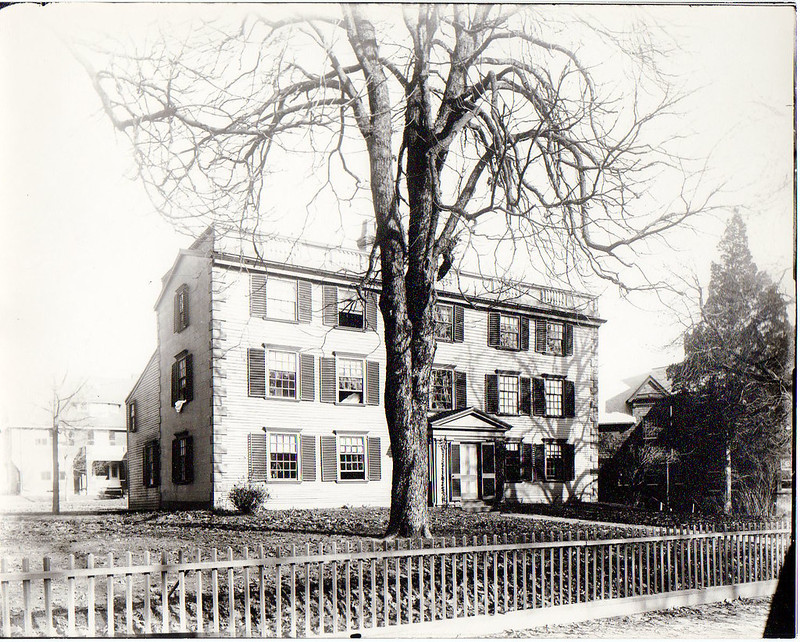
Thomas Fayerweather had bought his house in Cambridge (shown above) from Loyalist George Ruggles just a few months before. Though he supported the Patriot cause, Fayerweather was evidently dismayed to find his property quite so full of troops in need of “beer and soap for washing.”

It’s striking how often Storrs’s diary speaks of sermons and prayers. This was the New England army, composed largely of rural descendants of the Puritans. I also find it interesting how many men from the home province just showed up to see how the siege was going. Presumably they slept somewhere else.

Saturday, August 07, 2010

“A Private and Precipitate Journey from Concord to Cambridge”

This afternoon at 3:30 I’m leading my new “Ladies of Tory Row” walking tour of Brattle Street in Cambridge, starting at the Tory Row historical marker at the Mason Street corner.

One of the sources I’m drawing on for my anecdotes is this apology signed by Dr. Joseph Lee of Concord on 19 Sept 1774. It refers to what he had done earlier that month at the start of the Powder Alarm—he’d warned a Loyalist friend in Cambridge that Middlesex militiamen were on their way.

Whereas I, Joseph Lee of Concord, physician, on the evening of the first ultimo [i.e., of this month], did rashly and without consideration make a private and precipitate journey from Concord to Cambridge, to inform Judge Lee, that the country was assembling to come down, (and on no other business,) that he and others concerned might prepare themselves for the event, and with an avowed intention to deceive the people;

by which the parties assembling might have been exposed to the brutal rage of the soldiery, who had timely notice to have waylaid the roads, and fired on them while unarmed and defenceless in the dark: [Of course, that never happened.]

by which imprudent conduct I might have prevented the salutary designs of my countrymen, whose innocent intentions were only to request certain gentlemen, sworn into office on the new system of government, to resign their offices, in order to prevent the operation of that (so much detested) act of the British Parliament for regulating the government of the Massachusetts Bay:

by all which I have justly drawn upon me the displeasure of my countrymen:

When I coolly reflect on my own imprudence, it fills my mind with the deepest anxiety.

I deprecate the resentment of my injured country, humbly confess my errors, and implore the forgiveness of a generous and free people, solemnly declaring that for the future I will never convey any intelligence to any of the court party, neither directly nor indirectly, by which the designs of the people may be frustrated, in opposing the barbarous policy of an arbitrary, wicked, and corrupt administration.
Confusing matters a little is that both the judge in Cambridge and the physician in Concord were named Joseph Lee. I’m going to look at those events through the eyes of Judge Joseph Lee’s wife, Rebecca. The couple lived in the house shown above, now the headquarters of the Cambridge Historical Society.

Friday, March 20, 2009

Tory Row When the Houses Still Belonged to Tories

My talk last night at Gen. Washington’s 1775-76 headquarters kept coming back to this map of that part of Cambridge in 1776. Some folks wanted yet another look, so here it is.

This is a detail of the wonderful map that Henry Pelham engraved in England after leaving Boston with the British military in 1776. You can explore the whole thing through the Library of Congress’s website of maps from the American Revolution and Its Era. North on this map is at about two o’clock, in case you’re having trouble orienting it with today’s streets and Charles River.

All five mansions that Pelham labeled in the top half of this detail are still standing:

  • The house of “Lt. Govr. Oliver” is Elmwood, official residence of Harvard’s president.
  • The homes of “Mr. Fairweather” and “Judge Sewall” are in private hands, the latter with a redesigned exterior.
  • The house of “Judge Lee” is headquarters of the Cambridge Historical Society.
  • The house of “Col. Vassel” is Longfellow National Historic Site, where I was speaking.
And I bet folks can spot a few other buildings in this part of Cambridge in 1776 that are still standing today. How accurately Pelham was able to depict their footprints while he was stuck behind the British lines is another question.