J. L. BELL is a Massachusetts writer who specializes in (among other things) the start of the American Revolution in and around Boston. He is particularly interested in the experiences of children in 1765-75. He has published scholarly papers and popular articles for both children and adults. He was consultant for an episode of History Detectives, and contributed to a display at Minute Man National Historic Park.

Subscribe thru Follow.it


•••••••••••••••••


Showing posts with label handcrafts. Show all posts

Saturday, July 04, 2026

“Avoid becoming the draughtsman of papers to be reviewed by a public body”

Two hundred fifty years ago today, the Continental Congress finished polishing the Declaration of Independence and voted to approve the final text.

True to his character, Thomas Jefferson chose to be “a passive auditor” as his colleagues hashed over the words he’d drafted. But, he admitted to James Madison, the debate affected him:
during the debate I was sitting by Dr [Benjamin] Franklin, and he observed that I was writhing a little under the acrimonious criticisms on some of it’s parts; and it was on that occasion that, by way of comfort, he told me the story of John Thompson the Hatter, and his new sign. 
Jefferson didn’t explain that allusion in his letter to Madison, but he put it into his notes on Franklin:
When the Declaration of Independance was under the consideration of Congress, there were two or three unlucky expressions in it which gave offence to some members.

the words ‘Scotch and other foreign auxiliaries’ excited the ire of a gentleman or two of that country.
(Yes, suggesting that the Scottish were foreigners from outside the British Empire would have prompted complaints.)
severe strictures on the conduct of the British king, in negativing our repeated repeals of the law which permitted the importation of slaves, were disapproved by some Southern gentlemen, whose reflections were not yet matured to the full abhorrence of that traffic. altho’ the offensive expressions were immediately yielded, these gentlemen continued their depredations on other parts of the instrument.

I was sitting by Dr Franklin who percieved that I was not insensible to these mutilations. ‘I have made it a rule, said he, whenever in my power, to avoid becoming the draughtsman of papers to be reviewed by a public body. I took my lesson from an incident which I will relate to you.

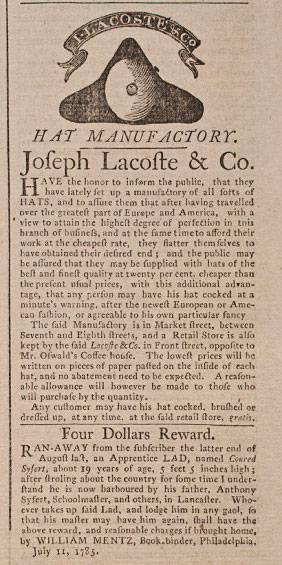
when I was a journeyman printer, one of my companions, an apprentice Hatter, having served out his time, was about to open shop for himself. his first concern was to have a handsome sign-board, with a proper inscription. he composed it in these words ‘John Thompson, Hatter, makes and sells hats. for ready money,’ with a figure of a hat subjoined. but he thought he would submit it to his friends for their amendments.

the first he shewed it to thought the word ‘Hatter,’ tautologous, because followed by the words ‘makes hats’ which shew he was a Hatter. it was struck out.

the next observed that the word ‘makes’ might as well be omitted, because his customers would not care who made the hats. if good & to their mind, they would buy, by whomsoever made. he struck it out.

a third said he thought the words ‘for ready money,’ were useless as it was not the custom of the place to sell on credit. every one who purchased expected to pay. they were parted with, and the inscription now stood ‘John Thomson sells hats.’

‘sells hats’ says his next friend? why nobody will expect you to give them away. what then is the use of that word? it was stricken out, and ‘hats’ followed it, the rather, as there was one painted on the board.

so his inscription was reduced ultimately to ‘John Thomson’ with the figure of a hat subjoined.’
I don’t know any examples of authentic eighteenth-century hatters’ shop signs in the British Empire, but Colonial Williamsburg and the Adverts 250 Project have shared images of hatters’ wordy newspaper advertisements.

TOMORROW: Spreading the word.

Sunday, June 28, 2026

“By dawn on June 18, 1775, nothing was left standing”

The current issue of Archaeology magazine includes a dispatch about the City of Boston’s Archaeology Department recent work in Charlestown, filed by a journalist with the almost-too-good-to-be-true named of Jason Urbanus.

Urbanus writes:
In early 1775, Charlestown was already almost 150 years old. It was a bustling settlement of between 1,500 and 2,000 people representing all walks of life—farmers, artisans, merchants, and mariners, including both free and enslaved Black people.

There were large landholders, such as 53-year-old distiller David Cheever, who owned multiple properties across the peninsula, and those who were less well-off, such as widow Elizabeth Moore, who rented a simple room in a neighborhood tavern. The town’s diverse population also included Margaret Thomas, who bought a humble home in 1773, likely making her the first free Black woman to own property in Charlestown. Among the wide array of craftspeople were goldsmith Nathaniel Austin, chaise maker James Frothingham, and Cato Hanker, a shoemaker. Hundreds of houses, workshops, and other buildings lined the town’s streets and wharves.

By dawn on June 18, 1775, nothing was left standing and everyone was gone. Less than 24 hours earlier, a brutal engagement, known as the Battle of Bunker Hill, had raged across the Charlestown Peninsula. . . . Townspeople were sent fleeing, and many never returned. Nearly all lost everything they owned. . . .

Many of Charlestown’s inhabitants had departed over the previous month amid increasing unrest, but those who remained were jolted from their homes. A widow named Relief Ellery and her 20-year-old daughter of the same name were among those who narrowly escaped the bombardment. The younger woman pocketed two valuable silver tablespoons from the kitchen table—the only things she had time to grab. When the pair returned to Charlestown, none of their property remained. “We have records of British troops coming back the next day and setting fire to any building that still stood,” says [City Archaeologist Joe] Bagley. “It was vindictive.” In a matter of hours, one of the oldest settlements in Massachusetts had ceased to exist. . . .

At the urging of a committee of Charlestown residents, more than 450 families submitted inventories of their lost possessions after the battle in hopes of receiving restitution. . . . Usually, when archaeologists excavate a residence, they record the artifacts that they uncover during the process. In this instance, they already have a list of everything that was in a house before beginning excavations. They know exactly what they might expect to find buried in dozens of backyards and basements.
Or, rather, buried underneath a dense modern city, or perhaps already dug up and tossed aside in construction projects over the past two and a half centuries. It seems unlikely that we’ll see a confluence of household inventory and newly dug artifacts. Still, the written record provides a lot for scholars of domestic material culture to work with.

No doubt Archaeology readers love ceramics, and another section of the article discusses Charlestown early pottery industry, which can also be dated with finality:
No commercial sector was hit as hard as Charlestown’s once-thriving ceramics industry. Although not well-known today, Charlestown had been among the largest pottery production centers in the northeast. That all changed on the day of the battle. With their workshops burned to the ground, Charlestown’s potters scattered throughout New England. “They lost everything—their kilns, all of their work tools—everything was gone,” says Bagley. “None of them came back.”
Pictured above is a milk pan from the site of the Parker-Harris Pottery, excavated during the Big Dig highway project a generation ago.

Saturday, June 27, 2026

New Boston Museum Exhibits to Visit During the Sestercentennial

Two venerable Boston museums are unveiling big reworked exhibit spaces for the Sestercentennial.

At Revolutionary Spaces’ Old South Meeting House, “Ruckus!” opens formally on 2 July. This is a 25-minute “immersive” show that
drops you right into the heart of the debate and defiance that once filled this iconic space, where ordinary people set extraordinary change in motion.

From the floorboards to the balconies, you will be surrounded by dynamic sound, lighting, and projected animations of fiery revolutionaries, determined citizens, and some unlikely troublemakers whose courage shook these walls.
Revolutionary Spaces encourages people to buy tickets in advance since space at each showing is limited. Arrive around the top of the hour, and the show begins at fifteen minutes past. Tickets include admission to all of Old South’s exhibits and the Old State House.

“Ruckus!” includes loud noises and dynamic lighting to reflect the intensity of the story it tells. It therefore might not be comfortable all visitors. Revolutionary Spaces also offers “Sensory-Friendly Mornings” at the Old State House each month.

The Museum of Fine Arts has reopened its “Art of the Americas: 1700–1800” galleries with a new, hemispheric approach. Thomas Sully’s massive painting of Washington crossing the Delaware stayed where it is, but lots of other iconic artworks are arranged in a new way.

The museum says:
The MFA’s reimagined galleries of 18th-century Art of the Americas bring together works from across North, Central, and South America, and the Caribbean—including works by Native American and Indigenous makers. Together, the eight spaces in this suite, organized by theme, explore how artists have contributed to, or in some cases resisted, ideas of nationhood and identity. Visitors can immerse themselves in expansive versions of familiar stories, discovering the interconnectedness of the Americas and its history, institutions, and people.
The galleries have the themes of “Power and Resistance,” “History and Mythmaking,” “Asian Styles in the Americas,” “Boston’s World,” “Something’s Brewing” (not revolutions but caffeinated beverages), “Communities of Makers,” “Families at Home,” and “Copley’s Ambition.”

Wednesday, June 10, 2026

Three Podcast Episodes

Producing a podcast strikes me as a lot of work, but speaking about Boston history on other folks’ podcasts is always fun.

Here are three episodes I’ve recorded in the last few months. Enjoy all you can.

“The Spark: How Boston Ignited the American Revolution” on The Object of History from the Massachusetts Historical Society

We ask several historians for their thoughts on why Boston helped light the spark of the American Revolution. Was there something unique about Boston's community or geography that made it prone to a rebellious spirit? We sit down with J. L. Bell, Historian of the Revolutionary Era in Massachusetts, Garrett Dash Nelson, President & Head Curator at the Leventhal Map & Education Center at the Boston Public Library, and Kathryn Lasdow, Assistant Professor of History and Director of Public History at Suffolk University, to answer this question.
I’d already been mulling about “Why did the Revolutionary conflict flare up in Boston?” when the invitation to explore that question arrived. Hear my threefold answer and more.

“Boston” on History’s Greatest Cities from History Extra
As one of the oldest cities in the United States, Boston played a pivotal role in the outbreak of the American Revolutionary War, as well as the signing of the Declaration of Independence that followed. In this episode of History’s Greatest Cities, Paul Bloomfield is joined by writer John Bell to explore the storied history of the capital of Massachusetts. Together, they wander through Boston’s oldest neighbourhoods, tracing the story of this harbour city from its pre-colonial roots, through Puritan settlement, to its rise as a major port and administrative centre of the British Atlantic world.
This podcast asks its guests to answer a series of questions, from major events to foods a visitor mustn’t miss.

“Not What You Hurd” on Antiques Roadshow Detours from GBH
In the world of rare silver, American Colonial silver is the stuff collectors dream of. So, when a pair of drinking vessels or “canns,” complete with intricate engraving by a master Boston craftsman, were discovered during ROADSHOW’s visit to Akron in 2023, expert Nick Dawes examined the cups’ clues to reveal both the silver’s early-American history and extraordinary value. But does Nick’s tale of the tankards hold water? Join host Adam Monahan as he searches for the untarnished truth, picking through the many stories, half-truths, and wishful legends in a quest for what may or may not have been lost to history forever.
My voice pops up occasionally on this episode, leaving more time for the fine local historians Joel Bohy and Caitlin DeAngelis.

Friday, May 22, 2026

A Long Line of Preserved Claps

Dr. Preserved Clap, the man who stepped forward to render Boston’s broken cannon useful again in the spring of 1776, came from a long line of Preserved Claps.

According to The Clapp Memorial (1876), the doctor’s ancestors Roger Clapp and Joanna Ford arrived in Massachusetts in 1630, settling in Dorchester.

(This genealogy preferred the spelling “Clapp,” even changing how the name appeared in the period sources it quoted.)

Those Clapps named their first children Samuel, William, and Elizabeth, but then went full Puritan for most of the rest: Experience, Waitstill, Preserved, Hopestill, Thanks, Desire, Thomas, Unite, and Supply.

Preserved Clapp (1643–1720) moved to Northampton and had a son named Preserved Clapp (1675–1757), who likewise had a son named Preserved Clapp (1705–1758). That last man moved to Hadley. He married Sarah West in August 1730, and they had their first son the following May: Preserved Clap (1731–1811).

Histories of Northfield and Deerfield say that in the fall of 1754 our Preserved Clap was in charge of a small force—nine or ten men—guarding the settlement of Huntstown, now Ashfield.

The genealogy above didn’t have this information, but more recent researchers have found that in 1756 this Preserved Clapp married Eunice Atherton of Lancaster, and they started having children by 1760. His name appears a couple of times in the Amherst town records in the following decade.

On 1 Jan 1770 the Connecticut Courant of Hartford ran this notice:
CLOCKS and Watches made in the best Manner, by
PRESERVED CLAP
of Amherst.

Likewise all Kinds of Instruments in Surgery.
That’s the first surviving sign that the latest Preserved Clap had ambitions to be more than a country farmer.

The Colonial Society of Massachusetts published the image of a clockface above in an article about the engraver Thomas Johnston (1708–1767). At the top it says: “Preserved Clapp / New England.”

Did Clap order this plate from Johnston for a clock he planned to build, or for one he planned to own? And did he pay for it? Johnston kept that sheet of copper and used the other side to engrave a musical score for his publication of Daniel Bayley’s A New and Compleat Introduction to the Grounds and Rules of Musick (Boston, 1766).

Massachusetts Soldiers and Sailors of the Revolutionary War records that in 1775 a man named Preserved Clap served a few months as a private in the company of Capt. Benjamin Hastings of Bolton. I haven’t found anyone else named Preserved Clap of military age at the time. But it seems unusual for a forty-three-year-old man with military experience, social ambition, and some connection to medicine to serve in the ranks. In any event, Hastings’s company saw action at Bunker Hill.

The next time Preserved Clap surfaces in the records I’ve found is the Rev. Dr. Samuel Cooper’s 29 Apr 1776 letter to Samuel Adams, which refers to him as “a Country Surgeon in our Army.” By this time he was evidently using those “Instruments in Surgery,” not just making them. However, I haven’t found any record of Clap being surgeon for a Continental regiment. Perhaps he had taken that role in one of the militia regiments that Massachusetts raised in early 1776.

TOMORROW: Claiming credit.

Sunday, February 01, 2026

Getting Warmer on the Origin of a Warming Pan

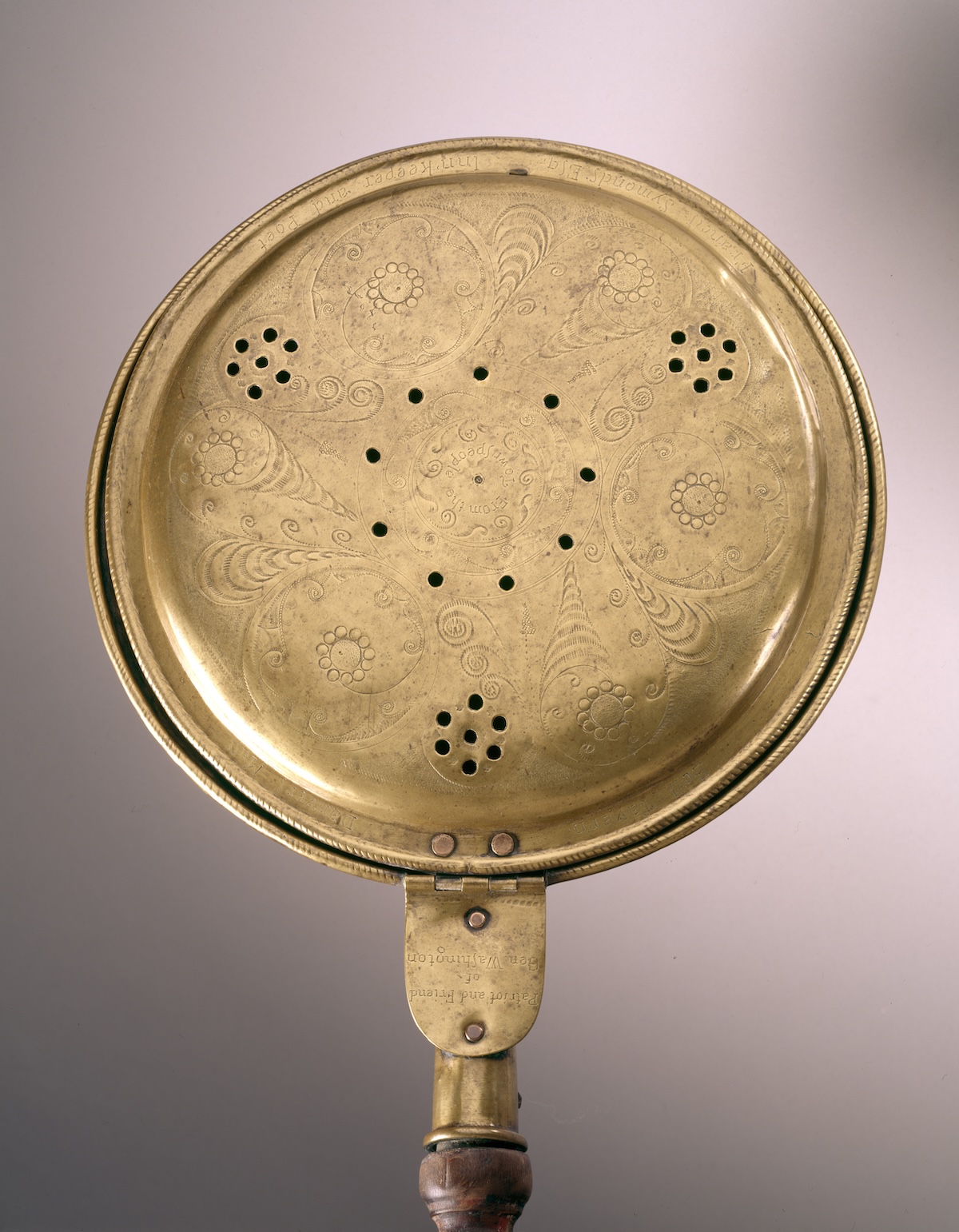
At Historic New England, Erica Lome, curator of collections, shared a behind-the-scenes essay about a warming pan with a Revolutionary heritage of sorts:
Tucked away in the parlor at Historic New England’s Cogswell’s Grant in Essex, Massachusetts, is a warming pan with a turned wooden handle and a brass container pierced with holes and engraved with scrolling vines and flowerheads. Also referred to as bed warmers, warming pans were a common household tool in colonial and post-revolutionary America, filled with embers and placed under the sheets of a bed to warm it before use.

This particular warming pan had more than just decorative motifs adorning its metallic surface. Engraved on its lid are the words:
From the Townspeople / Patriot and Friend of Gen. Washington / Bell Tavern, Danvers, Massachusetts / Francis Symonds Esq. Innkeeper and Poet.
On the pan’s sides, inside the incised outline of a bell:
I’ll toll you / if you have need / and feed you well / and bid you speed.
On the other side:
Francis Symonds / makes and sells / the best of chocolate / also shells.
John Warner Barber’s Historical Collections (1839) recorded that those verses hung on signs outside the Bell Tavern. In 1841 the Boston Cultivator stated that innkeeper Symonds’s “poetic genius caused [those lines] to be inscribed”; as Lome notes, he was known for adding bits of rhyme to his advertisements. (The Cultivator changed “also shells” to “and shells,” which scans better if you put three syllables into “chocolate.”)

The essay continues:
By its history, as recorded by Nina Fletcher Little, the warming pan was presented to Symonds around 1785: “After the war’s close, the citizens of Danvers evidently wished to present Symonds with a token of their esteem and decided on a warming pan as a practical gift.” The engraved inscription inside the bell matched the Bell Tavern’s signpost. The additional inscription praised Symonds as a patriot, friend of George Washington, and a poet, truly a prominent citizen and worthy of appreciation.

When researching this object for [the upcoming exhibit] Myth and Memory, one major detail of Symonds’s life challenged its story: Francis Symonds died on September 22, 1775. According to the Essex Gazette:
“On the 22nd Instant died at Danvers and on the 24th was very decently interred, Mr. Francis Symonds, Innholder, in the 5th Year of his Age. He was very just in his Dealings, and compassionate to the Poor as far as lay in his Power. In his last Sickness, especially towards the Close of Life, his Calmness and Resignation were very remarkable. He has left a sorrowful Widow and 6 Children, for whom we wish that the fame Compassion that he has shown to others may be shown to them.” . . .
Francis Symonds mustered for two days with Colonel [Timothy] Pickering’s regiment during the Battle of Lexington and Concord, and again on April 24, 1775, serving for a little over three months, until August 1, 1775. He was at home when he died of illness.

So, what about the warming pan? It seems very unlikely that the town of Danvers presented it to him on his deathbed, nor to his family immediately after, given the ongoing Siege of Boston. What is its true history?
Lome doesn’t offer a definite conclusion, but I like her hypothesis that the words were inscribed during a commemoration of the Revolution, such as Danvers’s dedication of a memorial obelisk near the Bell Tavern in 1835. Or later, when warming pans themselves were becoming relics of a quaint past. 

Friday, January 30, 2026

Knox Trail Commemorations on 31 Jan.–1 Feb.

This weekend brings another set of commemorations of Col. Henry Knox’s artillery train, including a couple of events displaced by last weekend’s snow.

Saturday and Sunday, 31 January–1 February, 10 A.M. to 4 P.M.
Knox Train of Artillery
Old Sturbridge Village

In partnership with Fort Ticonderoga, this unique event explores the Noble Train as it went through central Massachusetts. For regular museum admission, join staff from the village and Fort Ti and reenactors from Knox’s Regiment of Artillery to learn about the 300-mile journey. Examine reproduction artillery tools and ammunition. Explore the historic village and interact with costumed historians as they demonstrate daily life after the Revolution. Highlights include:
  • See oxen in action hauling cannons. 
  • Watch Knox’s Regiment of Artillery demonstrate cannon firing. 
  • Learn about American artillery of the Revolution compared to the Massachusetts Artillery of the 1830s. 
  • Try using an artillery engine, lifting reproduction cannon from Fort Ticonderoga. 
  • Handle reproduction cannon ammunition and explore their types and use. 
  • See cabinetmakers building a log sled. 
  • Learn about using draft animals and their importance to 19th-century farmers. 
  • See blacksmiths forging cannon carriage hardware. 
  • Hear stories from a recreated patriot who marched on the Knox Trail from Pittsfield to Cambridge in 1976. 
For more details, including the schedule of events on each day, see the Old Sturbridge Village webpage.

Saturday, 31 January, 1 to 4 P.M.
250th Anniversary of Henry Knox & the Noble Train of Artillery
185 Salisbury Street, Worcester

Join Revolution 250, Boston Celebrations, the AC Marriott Hotel Worcester, and citizens of the towns of Brookfield, Leicester, Spencer, Worcester, Shrewsbury, and Northborough for a commemoration of the epic 1776 adventure of Henry Knox and his “Noble Train or Artillery” trekking across Massachusetts on their way to Boston. A procession will step off from Elm Park about 1 P.M. and end at City Hall. An indoor commemorative program will begin at 2 P.M.

Sunday, 1 February, 1:30 to 3 P.M.
“Were so lucky as to get the Cannon out of the River”: Henry Knox and His Noble Train of Artillery
Westford Museum

Alexander Cain will discuss Knox’s journey and its impact on the Continental Army’s firepower and the American cause. At Fort Ticonderoga, the colonel selected 58 artillery pieces, including immense 12-, 18-, and 24-pounders. Once they were ready, some of that artillery was positioned on Dorchester Heights, forcing the British evacuation of Boston. Cain explores Knox’s mission transformed the Continental Army’s firepower while embodying the ingenuity and determination that defined the American cause. Learn more about this presentation.

Sunday, 1 Febuary, 4 to 6 P.M.
Henry Knox: Presentation and Cannon Firing
Martha Mary Chapel, Wayside Inn, Sudbury

Local writer Steven Glovsky explores the improbabilities and inconsistencies of Henry Knox’s story, leading up to his undertaking the transport of urgently needed cannon in the winter of 1775–76. The presentation will be followed by cannon fire from Crane’s Third Artillery. For more information.

For those wanting to-the-date exactitude, as of 250 years ago, the fifty-eight cannon and mortars were parked in Framingham, being equipped for use. Col. Knox had taken command of the artillery regiment on the siege lines, issuing his first regimental orders.

Tuesday, November 18, 2025

Considering Thomas Crafts the Coroner

As recounted yesterday, two documents at the Boston Public Library establish that one of the coroners holding inquiries after the Boston Massacre was Thomas Crafts.

Does that evidence restore that milestone in my mental narrative of Thomas Crafts, Jr.’s rise from a member of the Loyall Nine to artillery colonel and judge in the new republic?

Unfortunately not. Because, as the name implies, Thomas Crafts, Jr., wasn’t the only Thomas Crafts in Boston in 1770.

Thomas Crafts, Sr. (1706–1789), was a housewright of standing. He had moved into Boston from Roxbury and joined the First Baptist Meeting. He and his wife Anne had seven children between 1729 and 1752. Starting in 1745 he held town offices like surveyor of boards, fence viewer, and warden. In 1766 he got the contract to frame the new town jail.

In contrast to his father, Thomas Crafts, Jr. (1740–1799), was a decorative painter. At the time of the Massacre, he was still only twenty-nine years old. He married Frances Pinkney Gore in 1763, and they had two children by 1770. Thomas, Jr., was a member of the St. Andrew’s Lodge of Freemasons and an officer in the militia artillery company. He was on his way up. But he wasn’t yet a respected elder.

Back here I noted that The Massachusetts Civil List for the Colonial and Provincial Periods, 1630-1774 didn’t list any Thomas Crafts among the Boston coroners in the third quarter of the eighteenth century. But that book did list Thomas Crofts, who could be our man. (The Crafts family genealogy notes Craft and Crofts as alternate spellings used in the 1600s.)

If Gov. Francis Bernard appointed Thomas Crofts/Crafts as a coroner in 1761, that definitely wasn’t Thomas, Jr., since he was barely legal at the time. But Thomas, Sr., was then fifty-five years old, the sort of weighty neighbor whom people would trust as a coroner.

Did Crafts the coroner fill out the verdict forms himself? If so, then we could compare his handwriting and the signature on the fifth line to other documents by the two Craftses.

Until such additional evidence arises, I’ll make my best guess based on the social evidence and say that Thomas Crafts the coroner of 1770 was the housewright father, in his mid-sixties with experience in several town offices. He was an example to his sons, but Thomas, Jr., hadn’t yet achieved the same political stature.

TOMORROW: Examining the coroners’ examinations.

Thursday, October 02, 2025

“A fine set of 8 Bells were brought hither”

On 25 July 1745 the Boston News-Letter reported the arrival of a new type of sound in Boston—or at least the potential for one.

The newspaper said:
Last Week a fine set of 8 Bells were brought hither in a Vessel from Bristol, designed for Dr. [Timothy] CUTLER’s Church at the North Part of this Town: We hear the largest of them is near 1500 Weight, and the whole Set about 7000.
That was Christ Church, now also known as the Old North Church. Its steeple was also the tallest in town. As an Anglican place of worship, it could be fancier than the several Congregationalist meetinghouses with their single bells.

The church’s website states:
Old North has a total of 8 bells, each cast to ring at a different pitch. The treble bell, or #1, is the smallest bell and weighs in at about 620 lbs. The largest is the tenor, or #8, which weighs about 1,500 lbs. Each bell is hung inside a wooden wheel and frame, with ropes attached that extends to the bell-ringing chamber two floors down.
Each bell has a unique message cast in its metal:
  • 1: “Abel Rudhall of Gloucester, cast us all, Anno 1744.”
  • 2: “Since generosity has opened our mouths, our tongues shall ring aloud its praise. 1744.”
  • 3: “The subscription for these bells was begun by Iohn Hammock and Robert Temple, Church Wardens, Anno 1743; completed by Robert Ienkins and Iohn Gould, church Wardens, Anno 1744.”
  • 4: “William Shirley, Esq., Governor of the Massachusetts Bay, in New England. Anno 1744.”
  • 5: “God preserve the Church of England. 1744.”
  • 6: “We are the first ring of bells cast for the British Empire in North America. A.R. 1744.”
  • 7: “This Church was founded in the year 1723. Timothy Cutler, DD, the first Rector, A.R. 1744”
  • 8: “This peal of eight bells is the gift of a number of generous persons to Christ Church, in Boston, N.E. Anno 1744.”
“A.R.” usually meant “in the year of his reign,” referring to the current king, but here it appears to be used as a synonym for “A.D.”

Abel Rudhall (1714–1760) was the head of a family firm that cast bells in Gloucester from 1684 to 1835. According to Wikipedia, his grandfather had invented a way of “tuning bells by turning on a lathe rather than the traditional chipping method with a chisel.”

Those bells were designed to be rung together, but that required a group of bell-ringers.

TOMORROW: You rang?

Saturday, February 22, 2025

Zannieri and Martello on Paul Revere in Concord, 25 Feb.

On Tuesday, 25 February, the Concord Museum will host a lecture on “Paul Revere: The Man, the Myth, the Legacy.”

This presentation will be delivered jointly by:
  • Nina Zannieri, Executive Director of the Paul Revere Memorial Association, which operates the Paul Revere House in the North End of Boston.
  • Robert Martello, Professor of the History of Science and Technology at Olin College of Engineering and author of Midnight Ride, Industrial Dawn: Paul Revere and the Growth of American Enterprise.
Revere is, of course, best known for his ride on 18–19 Apr 1775, spreading word of the British army march. He did indeed do that, but his prominence in American culture derives from Henry W. Longfellow turning him into a legend in 1861. The Paul Revere House has to help visitors sort out the history from the myth.

Because the history is even more interesting, if not as poetic. Before the war Revere was a political activist, among the most prominent from the mechanics class. Afterwards, he was a leader in Massachusetts’s business community and an early factory owner, the portion of his life that Prof. Martello studies.

This situation produces a paradox: Revere deserves to be remembered and studied in American history. But he’s a household name for actions that he did only part of, and which may not have been that crucial in history.

For an example on a smaller scale, generations of American schoolchildren have heard Longfellow’s lines:
It was two by the village clock,
When he came to the bridge in Concord town.
But Revere never made it to Concord on 19 April, much less to the North Bridge. He did, however, visit the town in the preceding week, carrying news that helped James Barrett decide to move the cannon and other ordnance on his farm farther away from Boston, and that stymied the British operation.

This event is scheduled to start at 7 P.M. It is free for Concord Museum members (though those seats might be sold out) and $10 for others. But it’s free to anyone who wants to tune in online.

Wednesday, November 27, 2024

Dr. Johnson, Miss M’Queen, and a “book of science”

At the Scilicet blog, James Fox wrote about a gift from Dr. Samuel Johnson:
In 1773, during their now famous tour of the Western Isles of Scotland, Samuel Johnson and James Boswell made a pit stop at a settlement called Aonach in Glen Moriston, near Inverness. As Johnson later recalled, a girl who served them tea ‘engaged me so much’ that he decided to give her a present. Having only what he could source in Inverness to hand, the gift was a copy of the highly popular maths textbook, Cocker’s Arithmetick.

Despite Boswell’s surprise, Johnson justified his giving of a practical gift. ‘When you have read through a book of entertainment’, he said, ‘you know it, and it can do no more for you; but a book of science is inexhaustible’. . . .

On the surface, Cocker’s Arithmetick was hardly riveting stuff. It taught the basics of arithmetic – addition, subtraction, multiplication and division – presented as a set of ‘rules’ to be memorised with many worked examples that began with very basic problems that became increasinging difficult. Yet its popularity is remarkable by any standards. Written by Edward Cocker, a London-based teacher of writing and arithmetic, the book was first published posthumously in 1678. It was then reissued continually for decades after, not only in London, but also Dublin, Edinburgh and Glasgow. Its final edition appeared over a century later, in 1787, and by my own (conservative) estimate, it saw at least seventy editions. . . .

Chapters on commercial arithmetic skills in the second half of the text hinted at its target audience: aspiring businesspeople. It was this facet of Cocker’s appeal that ensured its enormous popularity. The book appeared at just the moment when the currency of arithmetic was exploding thanks to rising literacy and the emergence of a society oriented around commerce, consumerism and sociability. Buying Cocker’s Arithmetick represented a ticket to this new world.
Fox’s article is framed around Boswell’s report that “Several ladies” later found this gift laughable. He concludes that those women laughed because it had become almost cliché to recommend this “humble textbook.”

I suspect at least part of that laughter came from how the scholar had given this book to “a young woman,” as opposed to an ambitious young man. Even a young woman who “had been a year at Inverness, and learnt reading and writing, sewing, knotting, working lace, and pastry”?

Plus, there’s the class issue. Johnson and Boswell were visiting “a village…of three huts, one of which is distinguished by a chimney.” Fortunately for them, the owner of that one hut with a chimney, a man named M’Queen, accommodated them for the night.

M’Queen’s daughter was the young woman who served these visitors. Johnson later described her as “not inelegant either in mien or dress”; “Her conversation, like her appearance, was gentle and pleasing.” He insisted that in Highlander society she was a “gentlewoman.” But clearly he and Boswell (perhaps especially Boswell) were surprised by some of the family’s claim to gentility:
There were some books here: a Treatise against Drunkenness, translated from the French; a volume of the Spectator; a volume of Prideaux’s Connection, and Cyrus’s Travels. M’Queen said he had more volumes; and his pride seemed to be much piqued that we were surprised at his having books.
Dr. Johnson himself would protest that the Scilicet article’s phrase “Having only what he could source in Inverness to hand” might be misleading. He didn’t pop down to the Inverness shops to find the best available book to give as a present. Instead, the men had already passed through Inverness, and Johnson had bought Cocker’s Arithmetic for his own reading. Then when he wanted to give Miss M’Queen a present, “I presented her with a book which I happened to have about me.”

To Boswell, it was “singular” that Johnson “should happen to have Cocker’s Arithmetick.” That prompted the scholar’s observation that “if you are to have but one book with you upon a Journey, let it be a book of science.” His remark about exhausting “a book of entertainment” wasn’t a comment on what a young woman like Miss M’Queen would most benefit from; it was a comment on what kept his own interest.

Thursday, October 31, 2024

“The workmen all pack’d up their tools and left the barracks”

In late September 1774, as described by the Boston merchant John Andrews yesterday, towns neighboring Boston put pressure on their own citizens and on Bostonians to stop helping the British army build barracks.

As commander of all the British army in North American, Gov. Thomas Gage had faced that problem before back in 1768. Then the royal government had ended up renting buildings from willing owners and turning them into barracks. But in 1774 there were more regiments to house, and even more on the way.

Gage asked Boston’s selectmen to forestall what would amount to a labor strike. They replied that they actually wanted the troops grouped in barracks, but they had no power over rural towns’ policies.

The next day, 26 September, Andrews reported that Gage approached John Hancock directly. Since Hancock was one of the selectmen, he might already met with the general. Hancock was also the chair of the Massachusetts Provincial Congress, and thus might have had leverage with other towns, but Gage officially refused to recognize that extralegal body. Furthermore, at the start of August, the governor had dismissed Hancock as commander of the Company of Cadets, so coming to the man for a favor was quite a concession.

Andrews wrote:
Sometime this day the Governor had a conference with Col: Hancock, requesting him to use his influence with the Committee to re-consider their vote respecting the barracks.

The Colonel observ’d to him that he had taken every possible measure to distress us: that notwithstanding it was the Solicitor’s opinion that the [Boston Port] Act could be construed to prevent goods, &ca., being transported within ye. bounds of the harbour, yet he had not suffered it to he done, and the Ships of War had seiz’d whatever had been attempted to be transported in that manner.

He likewise told him that he had been threat’ned, and apprehended his person was in danger, as it had been gave out by some of his people that he deserv’d to he hang’d: upon which the Governor told him he might have a guard, if he chose it, to attend him night and day. You will naturally conclude that he declin’d accepting.
The work stoppage took hold the next day:
At four o’clock yesterday afternoon, the workmen all pack’d up their tools and left the barracks, frames, &ca.; so that I am apprehensive we in the town will feel ill effects of it, as it has been given out that the troops will force quarters next month, if barracks are not provided for ’em: neither should I blame them for so doing, as the nights are so cold already, that it’s impossible for ’em to sleep comfortable under their slight canvas tents. And as to empty houses, now since we have got so many [Loyalist] refugees among us, there is not half sufficient to hold what troops we have got already here.

After the carpenters had left off work, the General sent Col. Robinson [actually James Robertson] and Major [William] Sheriff to Mr. Hancock, to let him know if they would proceed with the barracks, he could suffer any thing to be transported within the limits of the harbour, under the sanction of King’s stores—but all would not avail; as they very justly suppos’d, that after the work was compleated he would withdraw the indulgence, as he deems it, though in justice it not be prevented at all.

They have got the Carpenters from the Ships of War, and have sent an arm’d Schooner to Halifax for all the Artificers they can procure from there. It’s possible they may be as averse to coming as the Yorkers.
New York’s Patriots had already voted not to cooperate with the British army in Boston, a move that reportedly inspired the rural towns’ decision.

On 29 September, the merchant reported:
In the course of a day or two past, the Roxbury people have burnt several load of straw that was bringing in here, which has enrag’d the soldiers to such a degree, that I am in continual apprehension we shall soon experience another fifth of March, which God forbid!
In those same days, Andrews described how the Royal Artillery, Boston’s Patriot leaders, and ordinary people were all maneuvering over the mortars, cannon, and other ordnance in the inventory of hardware merchant Joseph Scott. Meanwhile, other artillery pieces were being seized by one side or the other (the focus of my book, The Road to Concord). Andrews was not alone in fearing that violence could break out any day.

Wednesday, October 30, 2024

“For the workmen here to go on with building barracks”

Like Richard Lechmere, quoted yesterday, the merchant John Andrews watched the conflict over housing the king’s troops in Boston in the fall of 1774.

Unlike Lechmere, Andrews leaned a little toward the Whigs. He, too, had protested the Boston committee of correspondence’s actions earlier in the year, but in a more mild way. He supported resistance against the Crown—as long as it didn’t threaten his business or his health.

In writing to his relative in Philadelphia on 25 September, Andrews emphasized how the people of Boston weren’t making life easy for the soldiers. He didn’t want people in other colonies to get the idea that Bostonians weren’t worthy of their support.
The example of our worthy brethren of New York, in not letting their vessels for Government service, as well as that their Carpenters would not engage in any work for ’em, has induc’d the country people to think seriously whether they were right in supplying with timber, joice, and Straw for the Barracks here.

They accordingly met and determin’d in ye. negative; sent committees to the severall contractors to let them know if they supply’d any further they would incur the resentment of the whole country; and at the same time signified to our committee of correspondence that they did not think it eligible for the workmen here to go on with building barracks or preparing houses for the reception of the troops, as we might possibly, by persisting, not only incur blame from our sister colonies, but essentially affect the union now subsisting between town and country; which circumstance caus’d the Committee to get together Saturday P.M., when they pass’d a vote, that it was not prudent for ye. workmen to go on with ye. frames, &ca., nor in any shape to contribute towards the accommodation of the soldiery, as they might themselves give offence to their country brethren.

The purport of which coming to the Governor [Thomas Gage], he sent his compliments to the Select men, and beg’d their attendance at six o’clock this evening, when he requested of them that they would not take any measures to prevent the workmen from going on with the barracks.

They reply’d it was not in their power to influence the country, and it lay principally with them whether the workmen should proceed or not: that they themselves were dispos’d to have the barracks go on, as they conceiv’d it much more for the benefit of the town (if the Soldiery must be here) to have them kept together, rather than to be scatter’d over the town, as in that case it would be a very difficult matter to keep them in order.

The Governor seem’d a great deal worried about ye. affair, and am told that in the course of the conversation he express’d himself thus—“Good G—d! for G—d’s sake, Gentlemen! they have got two months work to do, and the Soldiers ought to he in barracks in one. Do consider, Gentlemen!”—Thus the tables are in some measure turn’d. Formerly they solicited the Governor, but now it seems he solicits them.
As Andrews pointed out, that discussion happened on a Sunday, when Bostonians weren’t supposed to do any business unless it was really urgent.

TOMORROW: Trying to strike a bargain.

Thursday, August 22, 2024

Picking at the Martha Washington Dress Quilt

In the Colonial Revival period, many Americans came forward with relics of the Revolution passed down in their families or discovered in attics.

And some of those were even authentic.

Others, however, were not. I retold the saga of a reputed Thomas Oliver portrait here, for example.

Among items donated to the Bostonian Society in its early decades, I’m skeptical about the machine-woven “Sons of Liberty flag.”

I worked with Dave Ingram on a report about a powder horn ascribed to Richard Gridley; we determined it was almost certainly a Colonial Revival–era creation.

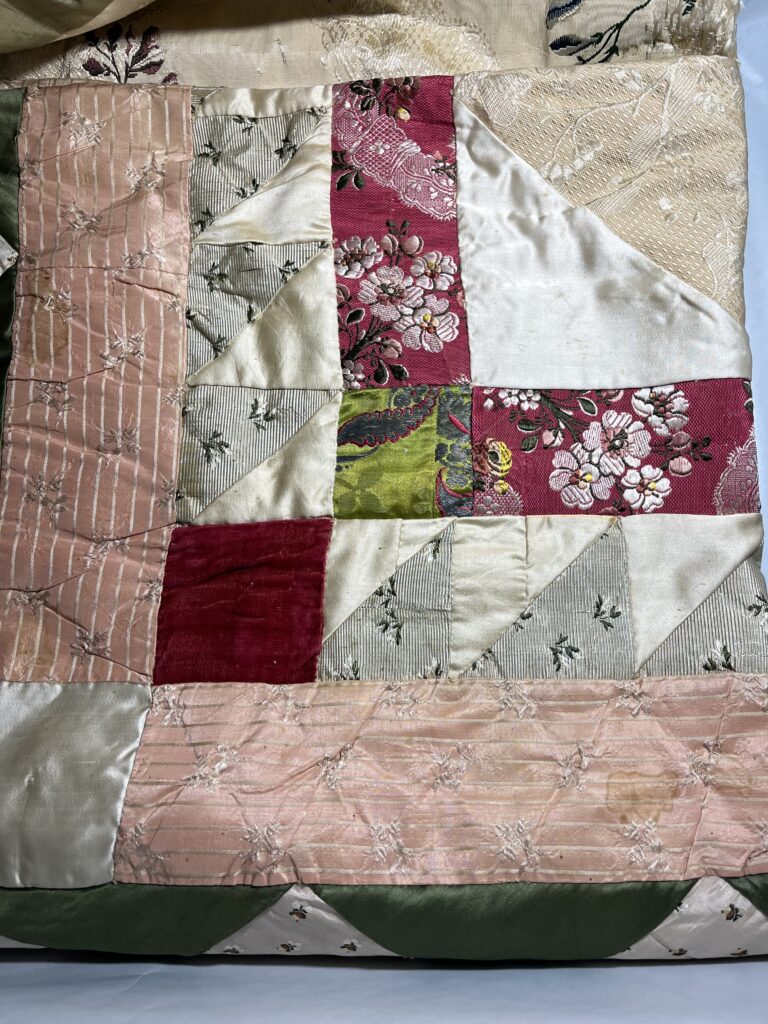
The Old South Meeting House also became a public institution at that time and began receiving donations. In the 1890s one important supporter, Mary Hemenway, gave Old South “a quilt made from fragments of Martha Washington’s dresses,” as Lori Fidler, Associate Director of Collections at Revolutionary Spaces, recently described in this article.

That’s just the sort of object that Americans oohed and aahed over breathlessly during the Colonial Revival. From the Age of Homespun! Touched by the great Washingtons themselves! But how reliable is its lore?

We know the quilt came to Hemenway from Fannie Washington Finch, an actual great-grandniece of George Washington. Her story:
Fannie was born Frances Louisa Augusta Washington in Virginia in 1828. Her mother, Henrietta Spotswood, was the granddaughter of George Washington’s half-brother, Augustine, Jr., while her father, Bushrod, was the grandson of George’s brother, John Augustine. Fannie’s grandmother, Jane Washington, had made the quilt out of scraps she received directly from Martha.
We also know from Finch’s letters in 1884–1886 that she was selling heirlooms from Mount Vernon, including this quilt, because of her “pecuniary condition.” In other words, she needed money.

There are also intriguing details about the quilt itself:
In 1979, a textile curator at Boston’s Museum of Fine Arts examined the quilt, finding the silk pieces to be expensive English-made loom-woven fabrics, consistent with textiles worn by wealthy women of the 1700s. He mentioned that the designs represented a range of time periods, with larger floral patterns from the mid-18th century and tiny blossoms from the late 1700s. . . .

In May 2024,…[Zara] Anishanslin noted that a fabric used in the quilt appeared to be an Anna Maria Garthwaite design. Garthwaite was a female silk designer who lived and worked in the Spitalfields area of London in the mid-1700s.
Thus, Finch might have had a motive to concoct a connection between this quilt and Martha Washington—but the artifact itself really does contain the fabrics a wealthy British-American woman in the mid- to late 1700s would have owned.

Furthermore, Fidler reports, “In her writings, Martha Washington mentions cutting up her garments and distributing pieces to family members and friends as mementos.” Finch couldn’t have inserted that into the historical record.

So on this item, I’m inclined to accept the lore.

Saturday, August 03, 2024

“Revisiting the American Revolution” Lecture Series in Hingham

The Hingham Historical Society is hosting a series of seven lectures from September through April 2025 on the theme of “Revisiting the American Revolution.”

I’m honored to be one of those speakers, and a bit humbled to see the others in the lineup.

15 September
1774: The Long Year of Revolution
Mary Beth Norton

Norton is the Mary Donlon Alger Professor of American History Emerita at Cornell University, where she taught from 1971 to 2018. She has written seven books about early American history, including Liberty’s Daughters: The Revolutionary Experience of American Women, 1750-1800 and In the Devil’s Snare: The Salem Witchcraft Crisis of 1692. She was a coauthor of A People and A Nation, one of the leading U.S. history textbooks. Her most recent work, the basis for this talk, won the 2021 George Washington Prize.

27 October
Making Thirteen Clocks Strike as One: Race, Fear, and the American Founding
Robert Parkinson

Parkinson is Professor of History at Binghamton University. He is the author of The Common Cause: Creating Race and Nation in the American Revolution, and most recently, Heart of American Darkness: Bewilderment and Horror on the Early Frontier.

17 November
The Spies in Henry Barnes’s House
J.L. Bell

Bell is the author of The Road to Concord: How Four Stolen Cannon Ignited the Revolutionary War, a National Park Service report on Gen. George Washington in Cambridge, and numerous articles. He maintains the Boston 1775 website, offering daily postings of history, analysis, and unabashed gossip about the American Revolution in New England.

8 December
From Hingham to Yorktown: The Military Campaigns of General Benjamin Lincoln
Robert Allison

Allison is a professor of history at Suffolk University. His books include a biography of American naval hero Stephen Decatur, and short books on the history of Boston and the American Revolution, and an edition of The Interesting Narrative of Olaudah Equiano, or Gustavus Vassa, the African. Two of his classes, “Before 1776: Life in Colonial America,” and “The Age of Benjamin Franklin” are available from The Great Courses. As chair of Revolution 250, a consortium of organizations planning Revolutionary commemorations in Massachusetts, he hosts its weekly podcast, and he is president of the Colonial Society of Massachusetts.

26 January 2025
Hingham’s Revolutionary Canteens
Joel Bohy

Bohy is the director of Historic Arms & Militaria at Bruneau and Co. Auctioneers and a frequent appraiser of Arms & Militaria on the PBS series Antiques Roadshow. His is also an active member of several societies of collectors and historians, an instructor for Advanced Metal Detecting for the Archeologist, and an advisory board member of American Veterans Archaeological Recovery. Growing up in Concord, Massachusetts, helped lead to Bohy’s passion for historic arms & militaria, conflict archaeology, and artifacts like Hingham’s historic Revolutionary War canteens.

9 March
How to Radicalize a Moderate: John Hancock and the Outbreak of the Revolutionary War
Brooke Barbier

Barbier is a public historian with a Ph.D. in American History from Boston College. She is the author of King Hancock: The Radical Influence of a Moderate Founding Father and Boston in the American Revolution: A Town Versus an Empire. Because she believes beer makes history even better, she founded Ye Olde Tavern Tours in 2013, a popular guided outing along Boston’s renowned Freedom Trail.

6 April
The Declaration of Independence: A Guide for Our Times
Danielle Allen

Allen is James Bryant Conant University Professor at Harvard University and Director of the Allen Lab for Democracy Renovation at Harvard Kennedy School’s Ash Center for Democratic Governance and Innovation. She is a professor of political philosophy, ethics, and public policy. She is also a seasoned nonprofit leader, democracy advocate, tech ethicist, distinguished author, and mom. Her many books include the widely acclaimed Our Declaration: A Reading of the Declaration of Independence in Defense of Equality, and she writes a column on constitutional democracy for the Washington Post.

All these talks will take place live beginning at 3:00 P.M. on a Saturday at the Hingham Heritage Museum, and also be streamed online. The society is now selling subscriptions to the entire series for prices ranging from $175 for someone who’s already a member to $675 for someone who wants to become a society Steward. The subscription price for non-members is $200, or about $29 apiece.

Friday, August 02, 2024

“Redcoats & Rebels” in Sturbridge, 3–4 Aug.

New England’s largest Revolutionary War reenactment will take place this weekend, 3-4 August, at Old Sturbridge Village.

“Redcoats & Rebels” has been an annual event for many years now, attracting large crowds of participants and spectators. The museum village therefore asks people to obtain tickets before showing up. (Members can reserve their slots.)

The event promises:
hundreds of costumed Revolutionary War reenactors, both soldiers and civilians, encamped on the Village Common.

Visitors can explore our exhibits and galleries, watch demonstrations, and talk with our costumed historians about everyday life in early New England. In addition, visitors can tour the camps, witness recreated skirmishes and battles, see special presentations, chat with guest craftspeople, and enjoy fife and drum music.
The Village will open to visitors from 9:30 A.M. to 5:00 P.M. each day, and visitors can “mingle with the troops” until 8:00 P.M. on Saturday.

For a little more information, including the food available on the weekend, go to this page.

Wednesday, June 12, 2024

Tea with Gen. Gage in Salem This Week

In June 1774, 250 years ago, Salem suddenly became more important.

Parliament’s Boston Port Bill took effect on 1 June, and the harbor of Salem and Marblehead became Massachusetts’s largest port open to trade from outside the colony. The Customs office moved there.

Also, Gov. Thomas Gage adjourned the Massachusetts General Court from Boston to Salem, following orders from London. That move didn’t require a new law since the royal governor already had the power to convene the legislature where he chose. That didn’t stop most of the new session being taken up with complaints about being in Salem.

When Gage moved to the region, renting a house in nearby Danvers, he also brought a contingent of British soldiers. There doesn’t appear to have been as much friction between those troops and the locals as in Boston in 1768–1770, but the town governments still raised concerns.

This week the city’s historical organizations are commemorating that period with some public events.

Thursday, 13 June, 7:00 P.M.
Tea’s Party: From Boston to Salem and Back Again
Salem Armory Regional Visitor Center

James R. Fichter speaks about how, despite the so-called Boston Tea Party of 1773, large shipments of tea from the East India Company were sold in North America. The survival of the Boston tea shaped Massachusetts politics in 1774, impeded efforts to reimburse the company for its losses, and hinted at the enduring conflict between consumer demand and political boycotts.

That tension was not confined to Boston. As Gen. Gage and the colonial government relocated to Salem in the summer of 1774, Essex County residents found committing to a boycott just as difficult as Bostonians had.

Fichter is Associate Professor in Global and Area Studies at the University of Hong Kong. He is the author of So Great a Profit: How the East Indies Transformed Anglo-American Capitalism and Tea: Consumption, Politics, and Revolution, 1773–1776.

This event is free. For directions, visit this page.

Saturday & Sunday, 15–16 June, 10 A.M. to 4 P.M.
Governor Gage Comes to Salem
Derby Wharf, Salem

The British army will encamp on the waterfront, with some of New England’s finest living history practitioners portraying soldiers, officers, legislators, and the Loyalist and Patriot citizens of Salem. Over the weekend, visitors can meet people from many walks of life: shoeblacks, teachers, merchants, tavern-keepers, midwives, and more. Activities to be reenacted include military drill, camp cooking, placing ads in a newspaper, and political debate at the tavern.

Here is the full schedule of events.

Sunday, 16 June, 9:00 A.M.
Join the Royal Governor at Church
St. Peter’s Church, Salem

Gen. Gage attended the local Anglican Church when he was in America. In Salem, that meant St. Peter’s, which will recreate an eighteenth-century service with the general occupying the same pew that he used in 1774.

Friday, May 24, 2024

Summer Saturdays at the Paul Revere House

The Paul Revere House has a special program included with admission on every Saturday afternoon this summer. Unless otherwise stated, all these events run 1:00 to 3:00 P.M.

25 May
Colonial Dance Tunes and Love Songs from Al Petty & Deirdre Sweeney.

1 June
Colonial Weaving Demonstration by fiber artist Zoe Lawson.

8 June, 1:00, 1:45, 2:30 P.M.
Meet Harriet, Daughter of Paul Revere: Diane Lent portrays one of Paul Revere’s sixteen children, reminiscing about her father and growing up in the North End.

15 June
Patriot Fife and Drum concert by David Vose and Sue Walko.

22 June, 1:00, 1:45, 2:30 P.M.
Meet Loyalist Tea Consignee Joshua Winslow: Father of young chronicler Anna Green Winslow, Winslow was named one of the East India Company’s tea consignees. After watching one protest, he retreated to a family home in Marshfield. Meet him today, as portrayed by Michael Lepage, on a rare venture into Boston before he was forced into exile.

29 June
Hammered Dulcimer played by award-winning musician Dave Neiman.

6 July
Colonial Dance Tunes and Love Songs from Al Petty & Deirdre Sweeney.

13 July
Patriot Fife and Drum concert by David Vose and Sue Walko.

20 July
Hammered Dulcimer played by award-winning musician Dave Neiman.

27 July, 1:00, 1:45, 2:30 P.M.
John Adams: The Colossus of Independence: The lawyer discusses his beginnings in Braintree through his days as delegate to the Continental Congress and diplomat. As portrayed by Michael Lepage, hear how he longs to be home with his wife and children. 

3 August, 1:00, 1:45, 2:30 P.M.
The Many Rides of Paul Revere: The silversmith traveled far from home many times as a courier for the Boston Patriots, including a May 1774 trip to New York and Philadelphia bearing news of the Boston Port Bill. Learn about these trips as Michael Lepage portrays the home owner.

10 August
The Tailor’s Craft: Clothing historian Henry Cooke takes on the role of an early Boston tailor. 

17 August
Hammered Dulcimer played by award-winning musician Dave Neiman.

24 August
Patriot Fife and Drum concert by David Vose and Sue Walko.

31 August, 1:00, 1:45, 2:30 P.M.
Meet Harriet, Daughter of Paul Revere: Diane Lent portrays one of Paul Revere’s 16 children, reminiscing about her father and growing up in the historic North End.

Wednesday, April 10, 2024

Elijah Sanderson of Lexington and Salem

Elijah Sanderson has appeared on Boston 1775 several times, but usually as a source on other people’s experiences of the April 19 battle.

Several years back, Donna Seger highlighted Sanderson’s memories of that day and his subsequent career on her Streets of Salem site.

In 1775 Sanderson signed off on a brief account of his experience for the Massachusetts Provincial Congress. But he had much more to say in Elias Phinney’s History of the Battle of Lexington, on the Morning of the 19th of April, 1775, published in 1825.

Seger wrote:
Phinney took oral histories from participants who were still alive, published in the form of sworn affidavits in the book’s appendix, and the very first account was that of Elijah Sanderson, who was at the end of a long career as one of Salem’s most successful cabinetmakers. Sanderson’s testimony was given just weeks before his death in early 1825, and published not only in Phinney’s account but also in the regional newspapers that year, when historical consciousness of the importance of the Battles of Lexington and Concord seems quite well-developed.

Elijah Sanderson and his younger brother Jacob were among the most prolific and consequential cabinetmakers of Salem, who spread the city’s craftsmanship and style far beyond New England through an expansive export trade in alliance with their partner Josiah Austin and several prominent merchants and shipowners.
That’s the same Josiah Austin quoted in this document describing how he moved ammunition out of Concord. Since that account seems incredible, perhaps Austin was spurred to invent his tale after hearing his partners talk about their presence at Lexington. Or perhaps someone else thought that if one Salem cabinetmaker was in the thick of the fight, another could be inserted into that action as well.
…in 1775 the Sanderson brothers were living in Lexington, in the home of their elder brother Samuel…on the main road from Boston. . . . relatively late on the evening of the 18th Elijah noted the passing of a party of British officers “all dressed in blue wrappers”. He decided to discern what was up, so made his way to John Buckman’s tavern where an older gentleman encouraged him to “ascertain the object” of these officers, so he did so, on a borrowed horse in the company of two other comrades. . . .

Elijah’s party was stopped by nine British officers a few miles down the road in Lincoln, and they were detained and examined, along with two other “prisoners”, a one-handed pedlar named Allen and Col. Paul Revere. After “as many question as a Yankee could” ask, the entire party mounted and made their way to Lexington, where [fellow detainee John] Loring observed “The bell’s a ringing, and the town’s alarmed, and you’re all dead men” but [the officers] let them go, after cutting the bridle and girth of Elijah’s horse.

We hear no more of Revere, but Elijah made his way to the tavern in Lexington and there promptly fell asleep! Yes, he fell asleep in the middle of the opening act of the American Revolution.
But then came the drums signalling that the British column was in sight. To follow Sanderson through what happened next, visit Streets of Salem.

(The picture above is a secretary bookcase from the Sanderson brothers’ shop, now the property of the U.S. Department of State.)

Wednesday, April 03, 2024

James Smither, Engraver of Philadelphia

The 18 Apr 1768 Pennsylvania Chronicle included this advertisement:
James Smither, Engraver,
At the first house in Third Street, from the Cross Keys, Corner of Chestnut-Street, Philadelphia,
PERFORMS all manner of ENGRAVING in Gold, Silver, Copper, Steel, and all other Metals—Coats of Arms, and Seals, done in the neatest Manner. Likewise cuts Stamps, Brands, and metal Cuts for Printers, and ornamental Tools for Bookbinders. He also ornaments Guns and Pistols, both engraving and inlaying Silver, at the most REASONABLE RATES.
Smither had come from Britain, where he reportedly worked for a while in the Tower of London engraving guns for the government.

In January 1769, Smither proposed to start a drawing school for “young gentlemen and ladies.”

Meanwhile, he was also doing a wide range of engraving jobs, including:
In October 1775, the colony was at war, and it needed to print more money. Pennsylvania hired Smither to engrave another series of notes, issued through April 1776.

In the fall of 1777, the British army took Philadelphia.

By May 1778, Smither was engraving the tickets for the Meschianza, Maj. John André’s elaborate ball and theatrical tournament for army officers and wealthy Loyalists.

But that may not have been the only job James Smither did for the royal authorities in Philadelphia. On 11 April, Thomas Paine wrote to Henry Laurens, then president of the Second Continental Congress, about counterfeiters. He made this proposal:
As Forgery is a Sin against all men alike and reprobated by all Civil Nations. Query, would it not be right to require of General [William] Howe, the Persons of Smithers and others in Philadelphia suspected of this Crime; and if he or any other Commander, continues to conceal or protect them in such practices, that in such case the Congress will Consider the Crime as the Act of the Commander in Chief.
The idea that the Congress could ask Gen. Howe to hand over anyone suspected of forging Continental or state notes was ludicrous, but no one ever said Thomas Paine wasn’t visionary.

On 18 June, the British army pulled out of Philadelphia, heading across New Jersey back to New York. James Smither probably went with them. In 1778 the Pennsylvania council put him on a long list of people who had “willingly aided and assisted the enemies of this state,” and at the end of the war it seized his property.

TOMORROW: Meeting Maj. Donkin.