J. L. BELL is a Massachusetts writer who specializes in (among other things) the start of the American Revolution in and around Boston. He is particularly interested in the experiences of children in 1765-75. He has published scholarly papers and popular articles for both children and adults. He was consultant for an episode of History Detectives, and contributed to a display at Minute Man National Historic Park.

Subscribe thru Follow.it


•••••••••••••••••


Showing posts with label Salem Poor. Show all posts

Monday, September 01, 2025

Colonel Louis, Caesar Marion, and More

Here are a couple of new online resources exploring aspects of the first months of the Revolutionary War in New England.

The Longfellow House–Washington’s Headquarters National Historic Site has posted Dr. Benjamin Pokross’s article “General Washington in the Native Northeast.” It begins:
It had been ten days since the Caughnawaga Mohawk men had arrived at the camp in Cambridge with their wives and families, and George Washington was still not sure what he was going to do. This was the second time that one of their leaders, Atiatoharongwen (also known as Col. Louis Cook), had come to Cambridge, and he had again made it known that he could raise four or five hundred men to fight for the colonists if he was given a commission in the Continental Army. But Washington was unsure how he would pay for all these additional soldiers if Atiatoharongwen did what he said, and even more apprehensive about the idea of engaging Indigenous allies at all. At least it had stopped snowing on the clear, cold, morning of January 31, 1776; this was the day Washington had promised to meet the Mohawk delegation outside.

Washington’s “Out-Door’s Talk”, as he called the subsequent conversation in a letter to General Phillip Schuyler, would be the most extensive of several interactions with Indigenous people he had had while he lived in the Vassall House. These visits did not result in decisive alliances or enduring treaties. They matter, however, for two reasons. The first is that they emphasize how the Revolution—normally thought of as a conflict between American colonists and the British—occurred on Native land, in areas that had long been stewarded by Indigenous communities and where Native people continued to find ways to survive in spite of colonial upheaval. Secondly, these visits highlight the unsettled and transitional character of the very early days of the Revolution. For both Washington and the Native diplomats who came to visit him, this was a moment of experimentation, of exploring what a possible relationship between the Continental Army and Indigenous Nations could look like.
At the HUB History podcast, Jake Sconyers shared an episode on “The Well Known Caesar Marion.”
In this somewhat brief episode, we’re going to look at why Mr. Marion was thrown into Boston’s notorious jail 250 years ago this week, and then we’ll compare his treatment inside British-occupied Boston with the experience of Black volunteers in the Continental Army outside Boston, once Virginia enslaver George Washington took command.
Both Pokross and Sconyers explore moments when Washington was pushed out of his comfort zone by encounters with men of color. And in both cases, while he never stopped being a planter with aristocratic ambitions, Washington was able to shift his habits and show respect for allies.

(Hearing the podcast also reminded me that I broke off a short series about Marion, promising more was “COMING UP,” nine years ago. I won’t get back to that story this week, but it’s back on my to-do list.)

Tuesday, December 31, 2024

Battling Myths and Misinformation about 1775

As we reach the cusp of the Sestercentennial year of 2025, I’m highlighting some articles I’ve written for the Journal of the American Revolution discussing myths and mistaken beliefs about the events of 1775.

Some of these articles were published in the past year, some more than a decade ago.

Here are the tl;dr versions with links to the full-length originals.

American Patriots didn’t call the laws that Parliament passed in 1774 to reform Boston (and Massachusetts as a whole) the “Intolerable Acts.” That term arose decades later in U.S. history textbooks. George III’s blanket term for those laws was “Coercive Acts.” Full article.

Tarring and feathering was a painful and humiliating public punishment, but it wasn’t fatal. Full article.

Dr. Joseph Warren didn’t obtain inside information about the British army march to Concord in April 1775 from Margaret Gage, Gen. Thomas Gage’s wife. Instead, he consulted with a man we’ve never heard of: a knife-maker named William Jasper. Full article.

Israel Bissell didn’t carry news of the fighting at Lexington south, and no single courier rode went all the way to Philadelphia. The first rider was named Isaac Bissell, and he carried the news to Hartford, Connecticut. Full article.

There’s solid evidence that Col. Israel Putnam (not Col. William Prescott) issued the order “Don’t fire till you see the whites of their eyes” at the Battle of Bunker Hill in June 1775. That phrase didn’t come from the Prussian army but from the Royal Navy. Full article.

Maj. John Pitcairn wasn’t fatally shot as he topped the wall of the provincial redoubt at Bunker Hill. Of the many men credited with that fatal shot, the best evidence points to Salem Poor, but he probably shot a different British officer. Full article.

Gen. George Washington didn’t respond to news of a gunpowder shortage in August 1775 by creating a false rumor of an adequate supply and feeding it to the British inside Boston. That was a novelistic touch created by a biographer misreading his sources. Full article.

Finally, my article for Age of Revolutions on how the “Join Or Die” snake evolved into the “Don’t Tread on Me” snake remains one of that site’s most read. While this essay doesn’t refute a clearly mistaken belief, I argue that those were two different species of American snakes: the glass snake and the rattlesnake.

If more people avoid repeating those myths and errors in the coming year, then my work will have benefited the world. And we can all move on to repeating new myths and errors.

Wednesday, June 19, 2019

The Myths of Lt. Col. James Abercrombie’s Death

Lt. Col. James Abercrombie (1732-1775) led the battalion of British grenadiers, detached from their regiments, at the Battle of Bunker Hill. He was mortally wounded, becoming the most senior British officer to die in the fight.

Not only did Abercrombie outrank all the other British dead, but he was known to be close to Gen. Thomas Gage and he was a Scotsman. Some combination of those factors meant that his death almost immediately began to accrete myths like barnacles on an underwater wreck.

Don Hagist wrote about Abercrombie at the Journal of the American Revolution, quoting from a letter the lieutenant colonel dictated to solidify the real story:
The grenadiers and light infantry were the first to land on Charleston Neck at a point out of American musketry range. Here they formed, the grenadiers into a line facing the rail-fence breastwork that extended from the redoubt down to the shore, the light infantry into a column for their advance along the beach to the right. Two regiments formed on the left facing the redoubt. While the grenadiers advanced with deliberate slowness as a distraction, the light infantry trotted along the beach. It was expected that the narrow beach would provide an avenue around the end of the breastwork. Unknown to the attackers, the Americans had constructed a barrier across the beach and manned it. . . .

It is not clearly exactly when the grenadiers became aware of the failure of the flanking movement, but they fatefully continued their advance towards the breastworks. Progress was perilously slow…because of a series of fences, brick kilns, enclosures and other obstructions. . . . The battered light infantry battalion, having withdrawn from the barricade on the beach, reformed into a line near their initial staging area. The shape of the coastline put them behind the advancing grenadier battalion. From this disadvantageous position they opened fire. The distance was too great to have any material effect on the enemy, but the impact on the grenadier battalion was disastrous.

This friendly fire incident is occasionally mentioned by historians, but the importance of it is largely overlooked. . . . In a letter dated three days after the battle, Abercrombie indicated that “our Light Infantry killed many of the Grends.” After ordering them to desist, the friendly fire abated for eight or ten minutes, but then the light infantry “gave me a plumper & killed two officers & 3 private.” He used the vernacular “plumper” to refer to a volley of lead. . . . Of particular importance was that the grenadiers’ commander, Abercrombie himself, was among the wounded.
In my own J.A.R. article about who really killed Maj. John Pitcairn, I quoted an 1880 Massachusetts local history which said Salem Poor shot Abercrombie “As that officer sprang on the redoubt.” That was how American sources described his death. But the lieutenant colonel had been taken out of action much earlier, before the final British push against the main provincial position. In addition, from 1775 the British press reported that Abercrombie was a victim of what we now call friendly fire—shot “supposed accidentally from some of his own soldiers.”

As with Pitcairn, Americans wanted to believe that their soldiers killed such an important officer at the climax of the battle. Therefore, Abercrombie was listed among the officers shot storming the redoubt on Breed’s Hill. And after both Peter Salem and Salem Poor got credit for killing Pitcairn, one American author decided that Salem Poor must have killed Abercrombie instead.

John Trumbull’s painting of the death of Dr. Joseph Warren reflects the American belief that Abercrombie should have died at the end of the battle and near the center of the action. The detail above portrays the lieutenant colonel lying dead at the redoubt as Maj. John Small steps over (on?) him. In the key that identified figures in the painting, Trumbull acknowledged that he didn’t know what Abercrombie actually looked like.

Another legend of Abercrombie’s death appeared in the 14 Oct 1775 Pennsylvania Ledger, quoting the Public Ledger of London:
A letter from an officer who was wounded at the late engagement at Boston, says, that when the troops were very near the trenches, the rebels called out to Col. Abercrombie, who was among the first of the troops, “Abercrombie, we won’t miss you.” However, the Colonel got into the trenches unhurt, and was run through the body. When he was dying, he told the officers about him, that if they took Gen. [Israel] Putnam prisoner, not to hang him as he was a brave fellow.
That story was reprinted in many American newspapers and, through Samuel Swett’s early history of the battle, many history books. It’s attached to inaccurate information—Abercrombie wasn’t “run through” but shot—and seems unlikely.

Lt. Col. Abercrombie didn’t die until 22 June. At first doctors didn’t think his wound would be fatal, but then infection set in. Back in 2014, I quoted a description of his death from the British press. The August 1775 Scots Magazine said the musket ball had pushed “a toothpick-case, which he had in his waistcoat pocket, along with it. . . . part of the toothpick being got so far, it baffled the art of the surgeons, and began to mortify.” Don’s article quotes the 17 Aug 1775 Edinburgh Advertiser saying something very similar except that the fatal foreign body was “part of the pen case…which he had in his side pocket.” I have no idea why those reports differed.

The Pennsylvania Ledger also quoted a speech that Abercrombie supposedly delivered two hours before his death:
My friends, we have fought in a bad cause, and therefore I have my reward, as the rest have had that have gone before me; had I fell in fighting against the enemy, I had died with honour, but posterity will brand us for massacreing our fellow subjects; therefore, my friends, sheath your swords till you have an enemy to engage with.
I’ve found this printed in the 27 July 1775 Middlesex Journal and Evening Advertiser, so it definitely circulated in Britain. It’s almost certainly propaganda from someone supporting the Americans, using Abercrombie’s good name to discourage men from joining the British military.


Monday, June 18, 2018

EXTRA: Who Killed Pitcairn?

The Journal of the American Revolution has just published an article by me titled “Peter Salem? Salem Poor? Who Killed Major John Pitcairn?”

This exploration of one aspect of the Battle of Bunker Hill grew out of a series of postings here from 2009, which I then rewrote as an article for the first Journal of the American Revolution print collection. With that book no longer available, we’re sharing the full essay online.

Here’s a taste:
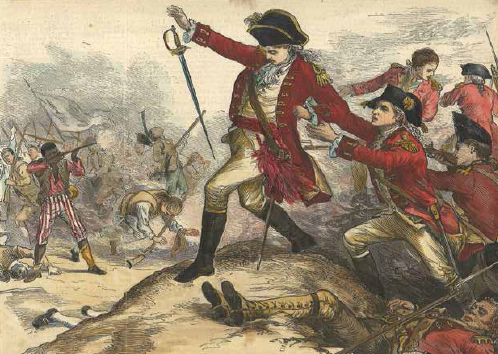
…after Lexington lots of New England men were gunning for the major. They wanted to see Pitcairn receive his just deserts for supposedly ordering his men to fire. They, and later generations of Americans, wanted his story to have meaning, and being brought low just when he thought he had triumphed — by a black man, of all soldiers — provided that satisfaction. A popular nineteenth-century engraving encapsulated that story in its caption: “The shooting of Major Pitcairn (who had shed the first blood at Lexington) by the Colored Soldier Salem.”
But the best evidence shows, I argue, that Maj. Pitcairn wasn’t killed by a black soldier as that print depicted, or by any of the other nineteenth-century claimants. Whatever Salem Poor did to merit extraordinary praise from Massachusetts officers, and whatever Peter Salem did in his Continental Army service, neither man shot Pitcairn as he mounted the edge of the Breed’s Hill redoubt.

Monday, June 23, 2014

Reports of Lt. Col. James Abercrombie’s Death

The highest-ranking British officer to be killed at the Battle of Bunker Hill was Lt. Col. James Abercrombie, commander of a special battalion of grenadiers. Sometimes Salem Poor is credited with shooting Abercrombie rather than the most popular target among the British officers, Maj. John Pitcairn (who never scaled the wall of the redoubt as stories claimed).

A contemporary source suggests instead that Abercrombie was a victim of friendly fire. This passage is from the Scots Magazine, August 1775:
A private letter mentions the following particulars of the death of Lt-Col. Abercromby. This gallant officer, who on a slight repulse almost maintained his ground, by his example immediately recovered the troops, who returned with impetuosity to the charge.

In this tumultuous onset he unfortunately received a ball near the groin, (supposed accidentally from some of his own soldiers), which came with such power from its proximity, as to force a toothpick-case, which he had in his waistcoat pocket, along with it.

From the lodgement of the ball it could readily be extracted: but part of the toothpick being got so far, it baffled the art of the surgeons, and began to mortify. In this state amputation was thought necessary; but he died in the operation.
Abercrombie died on 23 June. Some sources say he died in the house used by Capt. John Montresor of the Royal Artillery.

Another letter from Boston quoted in British periodicals told a different story about Abercrombie. The 27 July 1775 Middlesex Journal and Evening Advertiser (and probably London papers earlier) stated that a letter described the officer telling the people around his deathbed:
My friends, we have fought in a bad cause, and therefore I have my reward, as the rest have had that have gone before me. Had I fell in fighting against the enemy, I had died with honour, but posterity will brand us for massacreing our fellow subjects; therefore, my friends, sheath your swords till you have an enemy to engage with.
Lt. Col. Abercrombie supposedly died two hours after saying that.

I find the Scots Magazine report a lot more convincing.

Saturday, February 04, 2012

Gen. Washington Changes His Mind

For the last three days I’ve been tracing the debate within the Revolutionary leadership over whether to enlist black troops in the Continental Army in 1775. There were, in fact, already African-American soldiers among the troops besieging Boston. But when Gen. George Washington arrived, he saw their presence as a sign of weakness.

The Continental Congress had a heated debate about whether to discharge all those men right away. John Adams made inquiries. Washington and his fellow generals discussed whether to let black men enlist for the new year, and voted strongly against. As of the end of October 1775, that was the clear Continental policy, approved by two levels of government and pushed by the commander-in-chief himself.

And then on 30 Dec 1775 Washington announced in his general orders:
As the General is informed, that Numbers of Free Negroes are desirous of inlisting, he gives leave to the recruiting Officers to entertain them, and promises to lay the matter before the Congress, who he doubts not will approve of it.
And the next day he wrote to the Congress:
it has been represented to me that the free negroes who have Served in this Army, are very much disatisfied at being discarded—as it is to be apprehended, that they may Seek employ in the ministerial Army—I have presumed to depart from the Resolution respecting them, & have given Licence for their being enlisted, if this is disapproved by Congress, I will put a Stop to it.
Once again the legislature followed their generalissimo’s lead and approved a new policy.

The stricture that only blacks who had already been in the army could join “but no others” doesn’t appear to have taken hold in practice. There were new black soldiers every year of the war.

Furthermore, they enlisted on the same terms as white soldiers, and for the most part they served in the same units. There were some companies composed entirely of African-American and Native American men from Rhode Island in the late 1770s, but their regiments were eventually integrated as well. Washington supported the move “to abolish the name and appearance of a Black Corps.” The Continental Army was thus the last American army to be integrated—if only at the enlisted level—until after World War 2.

What caused Gen. Washington to make a 180° turnaround on that issue in two months? I’ve been studying Washington’s work in Cambridge during the siege, and see multiple influences on his thinking:
  • At the end of 1775, the general was worried that his troops would all go home when their enlistments were up and the British would try an attack. He didn’t feel he could afford to send away any men willing to fight.
  • He could see that the black soldiers in the army were doing their duty, not weakening the army. Officers even singled out Salem Poor for praise in that period.
  • In Virginia, Governor Dunmore’s offer of freedom for enslaved blacks who joined his royal troops changed the politics of the question—though the importance of that factor has also been overstated.
  • Washington couldn’t have missed that he was supposed to be leading a fight for natural liberty. He enjoyed his lifestyle, based on slavery, but he actually believed in that value.
Boston National Historical Park historian Marty Blatt and I will discuss Washington’s change of mind and other parts of black history in Revolutionary America in a public conversation scheduled for noon on 3 March at the park’s visitor center, 15 State Street. This was initially planned as a briefing for park employees and interpreters, but the public can attend as well.

(At top is John Trumbull’s painting of Washington from 1780, with an African-American groom in the background, courtesy of the George Washington Papers.)

Tuesday, February 17, 2009

Making Meaning of Major Pitcairn

So what’s the right question about the story of Maj. John Pitcairn’s death in the Battle of Bunker Hill? I think it’s why so many stories—some quite dubious—have grown up around that fatally wounded Marine when he was only one of 226 British men killed that day (including nineteen officers).

We humans want stories with meaning. That instinct might be especially strong when it comes to boiling down big, chaotic events such as battles, and even stronger when they’re battles our side has lost—and, really, everybody lost the Battle of Bunker Hill.

Pitcairn was the officer in charge of the British troops that fired on the militia at Lexington. Though he didn’t order those soldiers to fire, many Americans in the early republic believed he did. Therefore, his death two months later was bound to be treated by American chroniclers as historic justice.

As a result, a lot of stories about killing British officers at Bunker Hill appear to have gravitated toward Pitcairn. So a man who shot an officer (such as Phinehas Whitney and Benjamin Webber) was eventually credited with shooting Pitcairn. Men who simply aimed at an officer (such as Joseph Spalding) were said to have shot Pitcairn.

And as the decades passed, that shooting became the battle in miniature. The proud British officer mounts the embattled redoubt, boasts too loudly (saying the provincials have fled, “The day is ours”), and is shot down. And shot not just by any soldier, but by a “boy” or “black,” the most common of common men. How republican is that! (It’s not surprising that people whose idea of a republic included equal rights for all citizens were most vigorous in promoting the story of an individual soldier shooting Pitcairn.)

For Pitcairn to have been shot as he moved forward in a body with his Marines—to have been shot by multiple soldiers, impossible to identify for certain—to have been shot without having a memorable verbal exchange with his killer—that just wasn’t meaningful enough. It might even get too close to the truth, which was that two groups of close to three thousand men were trying to kill each other, all in the name of British values, over a small peninsula that turned out to be virtually meaningless in the war.

(On the other side of the battle line, Pitcairn’s comrades also sought meaning in his death. Gen. John Burgoyne praised how Pitcairn’s son had carried him from the battlefield and bade farewell, saying the incident belonged “in the hands of a good painter or historian.” A story arose that many of Pitcairn’s Marines wailed with his son that they, too, had lost a father, demonstrating the loyalty of his men. And then there’s the legend of the major’s stoic death somewhere in the North End.)

So did any of the Massachusetts men who’ve been credited with killing Pitcairn have a hand in doing so? I suspect the most commonly named shooter, Peter Salem, got linked to Pitcairn’s death only because Emory Washburn read about that “black soldier named Salem” in Samuel Swett’s history, recalled a black veteran of the battle named Salem from Leicester, and put 2 and 2 together to make 5 for the glory of his home town. Washburn never cited any more specific evidence for his claim about Peter Salem.

I think Salem Poor is more likely the man whom John Winslow recalled as the “black soldier named Salem.” Salem Poor might also be the “negro man belonging to Groton” whom the Rev. Dr. Jeremy Belknap wrote about. He wasn’t from Groton, but Col. William Prescott—who tried to get Poor special recognition from the Massachusetts legislature—was from that town, and people might have assumed it was Poor’s home as well. Whether Winslow correctly reported what Poor did to be commended is another question, but I think the earliest sources put him on top of the list of Pitcairn’s likeliest killers.

As for the other guys, their stories imply that they killed other officers in different circumstances—somebody had to have done so, after all. However, some of those stories appeared in print so late, and were shaped by the growing legend of Maj. Pitcairn’s death, that they might not be reliable.

But when it comes to assigning credit, I think we have to remember Pitcairn died in a pitched battle which involved thousands of men. Most of the provincial soldiers probably never had a clear shot at the Marines major, but by staying in the redoubt and manning the rail fence they held off two British advances while inflicting the worst casualties that army would suffer in the entire war. In the middle of that chaos, Maj. John Pitcairn was fatally wounded—which isn’t that surprising. All the provincial soldiers at Bunker Hill helped to kill Maj. Pitcairn.

COMING UP: Sooner or later, what happened to Maj. John Pitcairn’s body? (But first, another break from CSI: Colonial Boston.)

Sunday, February 15, 2009

The Growing Memory of Peter Salem

As I noted a couple of days ago, the first history of Framingham published after Peter Salem died there said nothing about the town native fighting at Bunker Hill, much less shooting Maj. John Pitcairn. Elsewhere in New England, other men or families appear to have been making their own claims to having killed the British Marines commander.

Within a couple decades, however, histories were not only naming Salem as Pitcairn’s slayer, but they were illustrating his feat. The picture above first appeared in William Cooper Nell’s The Colored Patriots of the American Revolution (1855), though this version comes from Edward A. Johnson’s A School History of the Negro Race in America (1890). It’s clearly derived from John Trumbull’s painting The Death of General Warren, with the dramatic young white man standing in front of Salem on the canvas shooed out of sight.

Nell’s book was not only a pioneering work of African-American history; it was also part of the Abolitionist argument for emancipation and equal rights for black Americans. Nell and other authors used the story of Peter Salem as evidence of black contributions to the U.S. of A.

Abolitionists worked, against some indifference or hostility, to preserve the memory of that soldier. For example, Theodore Parker wrote to the historian George Bancroft on 16 Mar 1858:

In the engravings of the battle when I was a boy, the black man, Peter Salem, appears in the act of shooting Major Pitcairn; but now-a-days a white man is put in his place. Richard Frothingham, in his account of Bunker Hill battle, makes no mention of Peter. He appears, however, on some of the bills [i.e., currency] of the Monument, Freeman’s and Charlestown Banks.
Eventually, in the same way that Crispus Attucks became better known than other Boston Massacre victims, so Peter Salem became better known than most other veterans of Bunker Hill. They served as defiant symbols of African-American patriotism.

The engraving below, captioned “The shooting of Major Pitcairn (who had shed the first blood at Lexington),” was published by Benson J. Lossing in the late 1800s. Lossing was selling books, not promoting Abolitionism, but by that point he and his engraver had to depict the man who shot Pitcairn as black. It was part of standard American history.
Abolitionists also pointed to Salem Poor, an African-American recognized in 1775 as having fought especially well at Bunker Hill. But because it’s not clear what Poor had actually done to earn officers’ praise, his story never gained as much traction. (No doubt because of that vacuum, a story much like Peter Salem’s developed around Salem Poor, as I described back here.)

Those two men became symbols for many more non-white men who fought with the provincial forces early in the Revolutionary War—over a hundred documented in George Quintal’s report Patriots of Color. It’s easier for us to remember individuals with names than to remember large groups.

Finally, while researching this series of postings, I realized that a third name has become linked to the death of Maj. Pitcairn. In a footnote in The First Year of the American Revolution (1934), Allen French suggested that the American with the best claim to having killed Pitcairn was “Salem Prince, a negro.” That name appeared subsequently in Richard Ketchum’s Decisive Day, John Jakes’s Rebels, David H. Fischer’s Paul Revere’s Ride, and A. J. Langguth’s Patriots. Some websites now say that Salem Prince was, like Salem Middlesex, simply another name for Peter Salem.

However, Quintal found no record of any soldier named Salem Prince in the provincial army in 1775. And I can’t rouse any mention of a “Salem Prince” through Google Books before French’s footnote. I fear it was a simple error that’s now muddied the waters, which were never clear to begin with.

TOMORROW: My conclusions about who killed Maj. John Pitcairn.

Thursday, February 12, 2009

Salem Poor: “a Brave & gallant Soldier”

Starting in 1826, or more than half a century after the Battle of Bunker Hill, Peter Salem of Framingham and Leicester has been most often identified as the black soldier who killed Maj. John Pitcairn of the British Marines.

However, another African-American soldier named Salem was singled out for special commendation in the same year as the battle. This was Salem Poor of Andover, who had purchased his own freedom for £27 in 1769.

On 5 Dec 1775, thirteen Continental Army officers and a brigade surgeon sent the following petition to the Massachusetts General Court:

The Subscribers begg leave to Report to your Honble. House, (which wee do in Justice to the Character of So Brave a Man) that under Our Own observation, Wee declare that A Negro Man Called Salem Poor of Col. Fryes Regiment Capt. Ames. Company in the late Battle at Charlestown, behaved like an Experienced officer, as Well as an Excellent Soldier, to Set forth Particulars of his Conduct Would be Tedious, Wee Would Only begg leave to Say in the Person of this Sd. Negro Centers a Brave & gallant Soldier. The Reward due to so great and Distinguisht a Caracter, Wee Submit to the Congress—
Among the signers were Col. William Prescott, commander in the redoubt; Col. Jonathan Brewer; and Lt.-Col. Thomas Nixon, who had links to Peter Salem.

If only those men had “Set forth Particulars” of what Salem Poor had done! Because it’s absolutely extraordinary to see high-ranking white gentlemen in 1775 compare a black man to “an Experienced officer.”

This special recognition might have been what John Winslow was recalling when he told historian Samuel Swett that the black soldier who killed Pitcairn was presented to Gen. George Washington and given a financial prize by provincial officers. Or perhaps Poor had done something else entirely, also worthy of notice.

In any event, the legislature gave the men who submitted this petition “leave to withdraw it”—the period’s way of saying no. Salem Poor didn’t receive any special official recognition in his lifetime.

By 1880, the stories of Salem Poor and Peter Salem were converging. Sarah Loring Bailey then wrote in her Historical Sketches of Andover:
The story goes that “Salem Poor,” a slave, owned by Mr. John Poor, shot Lieutenant-colonel [James] Abercrombie. As that officer sprang on the redoubt, while our men were in retreat, and exclaimed, “The day is ours,” Salem turned and took aim and fired. He saw the officer fall.
This is the very same story, down to the words the British officer yelled, that other writers were telling about Peter Salem. (But of course the Andover tradition said Salem Poor shot a higher-ranking officer.)

What’s more, other men also claimed to have shot Maj. Pitcairn.

TOMORROW: Two more early identifications of Maj. Pitcairn’s killer.