J. L. BELL is a Massachusetts writer who specializes in (among other things) the start of the American Revolution in and around Boston. He is particularly interested in the experiences of children in 1765-75. He has published scholarly papers and popular articles for both children and adults. He was consultant for an episode of History Detectives, and contributed to a display at Minute Man National Historic Park.

Subscribe thru Follow.it


•••••••••••••••••


Showing posts with label Elisha Porter. Show all posts

Thursday, March 27, 2025

The Short Military Career of Lt. Col. Thomas Williams, Jr.
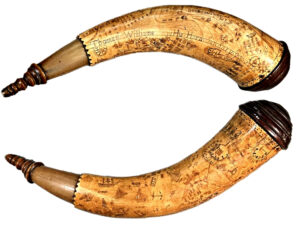
The Journal of the American Revolution just published Tim Abbott’s article about Lt. Col. Thomas Williams, Jr. (1746–1776), of Stockbridge.

Williams left behind an engraved powder horn, now in the collection of the Stockbridge Library Museum and Archives. It shows Boston landmarks.

(This is different from the Dr. Thomas Williams powder horn recorded by Rufus Alexander Grider in 1888 and now lost.)

The siege lines around Boston contained some professional horn carvers selling their work to men who wanted souvenirs of military service. I suspect the Williams horn is one like that. As an officer and as a lawyer in civilian life, he probably didn’t have the time or inclination to do his own carving.

As Abbott’s article recounts, Williams was one of two minute company captains who responded to the Lexington Alarm from Stockbridge. The other company included a score of men from the town’s Native community and thus gets more attention.

As the troops besieging Boston organized themselves into an army enlisted through the end of the year rather than an emergency militia force, Williams became part of Col. John Paterson’s regiment. In September he volunteered for Col. Benedict Arnold’s expedition through Maine to Québec.

However, Williams was in the rear guard led by Lt. Col. Roger Enos (1729–1808), who in late October decided to turn back. That was controversial. Enos was tried and acquitted in a court-martial. He was probably lucky to go through that procedure before the army at Cambridge received “Colonel Arnolds evidence,” as Gen. George Washington reported.

Williams left Paterson’s regiment at the end of 1775, but on 9 Jan 1776 he became lieutenant colonel of a new regiment under Col. Elisha Porter to be sent up to Québec along Lake Champlain and the St. Lawrence River. This time Williams made it to the outskirts of the city, but smallpox was weakening the Continental forces.

Those Americans were trying to inoculate and fight the war at the same time. Abbott writes:
The timing for the deliberate exposure of Porter’s Regiment to smallpox could not have been worse. The inoculation process required effective quarantine for three to four weeks, during which the men were both weak and contagious. Even for those under treatment, severe cases could still develop and mortality rates under the best conditions still ran 1 to 2 percent. Porter’s men had no more than three days in hospital after they were inoculated before the siege was dramatically lifted by the arrival of a British fleet on May 6 and the American forces were soon driven back upriver in full retreat. Not only were they exposed to physical stress while they developed smallpox symptoms, but they became a significant vector for the spread of the disease to others in its more deadly form.
The American commander, Gen. John Thomas, died on 2 June. Lt. Col. Williams led his men back to Crown Point, New York, before falling ill. He didn’t make it home to Stockbridge.

Williams doesn’t appear to have left behind his own diary or letters—his powder horn might have been his only personal record of military service, and it probably wasn’t his own creation. Abbott has therefore done the work of reconstructing his career by weaving together official records and other officers’ accounts.

Monday, August 19, 2024

“Claimed to be Burgoyne in order to get better quarters”?

Sherman Lohnes left a helpful comment on these lines in yesterday’s posting about Elisha Porter:
He later served in the Saratoga campaign as a militia colonel and escorted Gen. John Burgoyne east. According to the Porter family, Burgoyne left his host a dress sword.
Since December 2022 Lohnes has shared a blog on The 1777 March of the Saratoga Convention Army, the prisoners of war in Continental custody after the Saratoga battles.

Using sources and reminiscences of that journey, the blog reexamines a lot of the lore and local traditions about it.

Lohnes commented:
It's highly unlikely that General Burgoyne gave Elisha Porter his sword - or even that Porter accompanied Burgoyne from Saratoga to Cambridge.

Burgoyne offered his sword in surrender to General Horatio Gates on October 17th at Saratoga, who graciously allowed him to keep it. Prior to the surrender, Burgoyne took pains to negotiate terms with Gates that allowed all of his officers to not only keep their swords, but wear them while they were being held in Massachusetts.

Finally, Burgoyne didn't stay with Porter in Hadley. New Hampshire Militia Brigadier-General William Whipple, who did travel with Burgoyne and kept a journal of their trip, indicates that they crossed the Connecticut River south of Hadley, from West Springfield into Springfield, before continuing on through Palmer to Brookfield, and eventually Cambridge…
In this blog post, Lohnes wrote:
Though Porter was a colonel, and commanded the 4th Hampshire County Regiment of the Massachusetts Militia, which marched on September 24, 1777, to reinforce the Northern Army and served until October 17, 1777, Brigadier-General William Whipple’s Journal indicates Burgoyne did not pass through Hadley.

If Burgoyne didn't stop in Hadley (or Northampton), what may have led its residents think that he did? Perhaps the source of these tales is explained by British Ensign (and author) Thomas Anburey. According to Anburey, at some point along the march one of the officers with the British column went on ahead, and claimed to be Burgoyne in order to get better quarters. Being the first to reach "a small village, he personated General Burgoyne, and with such an air of confidence..." that his hosts being "compleatly outwitted, they assigned him the best quarters."
Another possibility is simply that the Porter family’s understanding of what happened grew in the telling from one generation of children to another. Marching out to Saratoga and back again in parallel with some prisoners from Burgoyne’s army could have become escorting the British general himself. A British officer’s dress sword acquired in any sort of way could have become connected to the most famous officer in that army.

Family and local historians writing in the 1890s and 1900s described seeing that sword, and they didn’t use the same language, indicating they observed independently. That strongly suggests the Porter family did own such an artifact. But evidently not an accurate knowledge of where it came from.

Sunday, August 18, 2024

The Life of “an exceeding active Man”

As I recounted this past week, in the summer of 1774 Elisha Porter of Hadley traveled to New York, Providence, and at least some way to New London seeking military supplies for the Continental Army besieging Boston.

In late September, the Patriot authorities called on Porter for another sensitive job: deciphering the letter that Dr. Benjamin Church, Jr., had given to his mistress Mary Butler, and which she unwisely asked her ex-husband, Godfrey Wenwood, to send into Boston.

Elbridge Gerry gave Porter a copy of that letter to work on. Porter’s deciphering exactly matched one by the Rev. Samuel West. Gerry then spread around news of the results.

During those months Porter was also busy on many committees of the Massachusetts General Court, and in August 1775 he became sheriff of Hampshire County.

In January 1776, Porter volunteered to raise a Massachusetts regiment to go into Canada and shore up the effort to win over that territory by force. Gen. George Washington introduced him by letter to Gen. Philip Schuyler as ”Colo. Porter, said to be an exceeding active Man.” I think that praise is a little faint for someone who had worked directly for the general.

Washington also gave Porter instructions urging him to act quickly, and the Massachusetts government supplied him with money.

Col. Porter started to keep a diary in January 1776, published in 1893. It describes how he got as close as the Plains of Abraham outside Québec City on 27 April, and how a week later the American forces started to withdraw.

Porter took a leave in August because of illness but returned in time to help with the Trenton campaign. He later served in the Saratoga campaign as a militia colonel and escorted Gen. John Burgoyne east. According to the Porter family, Burgoyne left his host a dress sword.

In 1778 Porter married a second time, to Abigail Phillips of Boston, first cousin of his first wife. That couple had no children, and I have no clue who brought up the young children of his first marriage while he was away from home.

After the war, Porter continued to serve as sheriff and militia officer and occasionally a town representative. He argued for Massachusetts to ratify the new U.S. Constitution. In 1796 he died unexpectedly at the age of fifty-four.

As for the other man involved in Gen. Washington’s plan to obtain gunpowder from Bermuda, sea captain William Harris appears to have gone back to sailing out of New London, Connecticut. He may have been the captain named Harris who spread word of a British fleet approaching New York in August 1776.

The 15 Mar 1809 Connecticut Gazette of New London reported the death of “Capt. WILLIAM HARRIS, aged 66 years.”

Friday, August 16, 2024

“The only Chance of Success is by a Sudden Stroke”

On 11 Aug 1775, Elisha Porter returned to Gen. George Washington’s headquarters with a letter from Rhode Island governor Nicholas Cooke, the second Cooke had sent within four days.

Both letters said the same thing about the general’s proposal to send an armed ship to Bermuda to collect gunpowder: Rhode Island couldn’t spare the resources to do it, and the Bermudans might deliver the gunpowder on their own.

That was not what Gen. Washington wanted to read. During the siege of Boston, he constantly sought to do something about the king’s troops in Boston. He felt the Continental Congress had sent him to drive that force out of Boston, not just to prod them until its commanders decided to leave.

The lack of gunpowder seemed like the biggest obstacle to any plan, so Washington was eager to take any action to fix that problem. Then he could get on to other schemes, like sending Col. Benedict Arnold up through Maine, launching armed schooners, or eventually proposing an attack across the frozen Charles River.

On 14 August, therefore, the general wrote back to the governor that the Bermuda plan was really good, and it depended on not quibbling and acting fast:
Having conversed with Collo. Porter and farther considered the Matter, I am of Opinion it ought to be prosecuted on the single Footing of procuring what is in the Magazine. The Voyage is short, our Necessity is great: The Expectation of being supplied by the Inhabitants of the Island under such Hazards as they must run, is slender: so that the only Chance of Success is by a Sudden Stroke. . . .

I should suppose the Captain who is to have the Direction of the Enterprize, would rather chuse to have Men whom he knew, and in whom he could confide in Preference to Strangers. From what Collo. Porter informs me, I do not see that [William] Harris’s Presence is absolutely necessary, and as his Terms would add considerably to the Expence, after obtaining from him all the Intelligence he could give, his Attendance might be dispens’d with.
Sea captain William Harris of New London, Connecticut, had come to Massachusetts proposing the voyage to Bermuda and obviously hoped to profit from it. Now Washington and Porter planned to milk him for information and cut him out of the deal.

Cooke didn’t write back until the end of the month. He hadn’t even proposed to the Rhode Island assembly that the colony undertake this mission, choosing instead to maneuver until he could work with a select committee. But he was still pessimistic: “At present the Undertaking appears to me extremely difficult. The most suitable Man we have for the Purpose is confined to his Bed by Sickness.”

Washington would not have been pleased to hear that.

TOMORROW: A mission from Rhode Island.

Thursday, August 15, 2024

“The General would be glad to confer with you”

Yesterday I started to profile Elisha Porter, as of July 1775 Hadley’s representative in the Massachusetts General Court and militia colonel.

Porter helped fellow lawyer Joseph Hawley of Northampton write this letter to the Continental Congress waxing eloquent on the need for more gunpowder:
Were you now in the Continental Army which invests Boston, it would beget unutterable vexation and torment in your hearts, to behold so large a body of so active brave men as that army consists of, insulted by the fire and blaze of the enemy’s cannon and mortars from their lines, ships, and floating batteries; and the same brave men, although possessed of divers good pieces of great ordnance, and willing, at any hazard, to improve them, yet wholly restrained from returning any fire of the kind, lest, by so doing, their little stock of gunpowder should soon be exhausted, and they reduced to the fatal necessity of laying down their arms or flying into the woods, leaving their houses to be burnt, their fields wasted; in short to give up and abandon the just claims of all America, and in effect to resign themselves and the lives of all the children of liberty in this whole Continent, to the arbitrary pleasure of a haughty Administration, instigated and influenced by enraged tories of our own breeding.
I couldn’t resist quoting that sentence, as transcribed by Peter Force.

In mid-July, Porter made a trip to New York, seeking “2 hhds Flints & 10 Tons Lead,” as the general wrote. He returned on 2 August, having succeeded in arranging for ”80,000 Flints & eight Tons of Lead.”

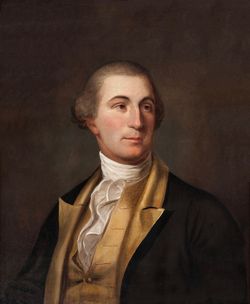
The next day, a council of war disclosed how little gunpowder the army had. Joseph Reed (shown above), Gen. George Washington’s military secretary, sent Porter a quick note:
If you could spare Time to ride down to Head Quarters this Afternoon the General would be glad to confer with you on a Matter of some Importance which you mentioned to him on your Return from New York
Porter made the short trip from Watertown to Cambridge. Later that day Washington wrote to Rhode Island governor Nicholas Cooke about the urgent need for gunpowder and the possibility of obtaining it from Bermuda, as quoted here. He concluded:
Col: Porter has undertaken to assist in the Matter or to provide some suitable Person to accompany [William] Harris to you who will communicate all Circumstances to you.
Porter personally carried that letter to Cooke. There was a brief glitch when they lost track of Harris, a sea captain who was continuing to shuttle among American ports. On 11 August, Cooke sent Porter back to Washington with a letter.

Gov. Cooke had already expressed his position: reports suggested that Bermudans were inclined to sell that powder to Continental forces, so there was no need to send a ship to the island, and besides Rhode Island didn’t have the resources for such a mission, anyway.

TOMORROW: The general’s response.

Wednesday, August 14, 2024

Elisha Porter: Widower, Militia Officer, Legislator

I’ve been writing about Gen. George Washington’s wish to obtain gunpowder from Bermuda in August 1775.

Today I’ll focus on one man involved in that effort: Elisha Porter (1742–1796) of Hadley.

Son of a member of the Council, Porter graduated from Harvard College in 1761 before going home to establish himself as a lawyer. In 1773 he became a captain in the Hampshire County militia.

Because of his college degree, there’s an entry for Porter in Sibley’s Harvard Graduates, but it says little about his personal life, blaming how “the collection of his manuscripts at the Massachusetts Historical Society consists chiefly of commissions and like documents.” Even so, I think that profile omitted some important events.

In 1762 Porter married Sarah Jewett, daughter of the minister in Rowley, and they had six children together. Then Sarah Porter died on 5 Apr 1775. Thus, Porter was a single father of six, still grieving, when news of the Concord battle arrived.

Porter marched east with the men of Hampshire County as a colonel, arriving in Cambridge on 25 April. Then came the transition from militia force to a Massachusetts army enlisted for the rest of the year. Still in his early thirties, Porter was probably one of the more junior of the provincial colonels. According to committee of safety records, Porter raised some men for the army, but as of 10 June they had still not arrived. “Col. Porter said he was willing to resign, rather than the public service should be hindered.”

Hadley showed its continued support for Porter by electing him to the Massachusetts Provincial Congress for the session starting on 31 May. In Watertown, colleagues addressed him by his militia rank, and he served on several committees on army matters, including trying to sort out issues for the artillery regiment.

Then on 8 June, according to Sylvester Judd’s History of Hadley, Porter’s son David drowned at the age of seven. We have no accounts of how he took this news, but he had “leave of absence” by the next day. Losing two members of his family in a little over two months must have been profound.

Porter soon returned east to throw himself into the war. Among the anecdotes of the Battle of Bunker Hill that the Rev. Jeremy Belknap wrote down in 1787 was: “Col Porter…conveyed 2 Hhd of Liquor to ye. Men in ye. works thro’ showers of shot from ye. floating batteries.” Porter also lost a gun on that battlefield.

On 24 June, after the congress learned that Gen. Washington was on his way, Porter was one of six members delegated to organize a reception “with proper respect, and to provide a house for him.” Later that same day the congress authorized him “to procure a scythe, and carry it to a blacksmith, to be fitted for a spear, in such a manner as he thinks fit, and bring it before this Congress, when fixed.” Porter was evidently a man of ideas.

Three days later, the congress added Porter to the committee on supplies, meeting in the Edmund Fowle house, shown above. He was also put on a committee to write to the Continental Congress and to Gov. Jonathan Trumbull of Connecticut, “requesting their aid in furnishing us with gunpowder.” On 10 July, Porter was the first man named to a committee to confer with Gen. Washington about adding to what was now the Continental Army.

Massachusetts held elections for a new General Court to meet on 19 July. Hadley must have elected Porter to this official legislature, but his name doesn’t appear in its records until late August. Evidently he was traveling out of the province on special assignments for some of that time.

TOMORROW: Working with the general.

Tuesday, August 13, 2024

“They gave Information of the Powder”

As I quoted back here, on 3 Aug 1775 Gen. George Washington wrote to Gov. Nicholas Cooke of Rhode Island asking him to send all available gunpowder and lead.

Washington also urged the governor to dispatch one of the colony’s armed ships with a man named Harris to Bermuda to seize more gunpowder.

As I wrote yesterday, I think Harris was a Connecticut-based sea captain named William Harris.

Cooke wrote back promptly on 8 August. His responses were:
  • Rhode Island didn’t have that much gunpowder and lead left, and needed all it had.
  • The colony couldn’t spare either of its armed sloops.
  • There wasn’t enough money available to buy the gunpowder in Bermuda.
  • Washington’s agent, Elisha Porter, “can hear nothing of Harris…but is greatly apprehensive that he is fallen into the Hands of the Enemy.”
But aside from those details, Cooke was eager to cooperate with the general’s plans.

I believe Capt. Harris had gone on to New York. The 10 August issue of Rivington’s New-York Gazetteer reported that the Customs office had just cleared “Bittern, Harris,” to sail for “Rhode-Island.”

On 11 August, Cooke told Washington that Harris was back in Providence. And he had news to share about that powder in Bermuda:
Since my last to you Mr [Samuel] Ward One of the Delegates hath returned from the Congress. He informs me that some of the Bermudians had been at Philadelphia soliciting for Liberty to import Provisions for the Use of the Island. They gave Information of the Powder mentioned in your Letter to me, and were of Opinion it might be easily obtained. They were told by the Delegates that every Vessel they should send to the Northward with Powder should be permitted to carry Provisions to the Island. Whether their Situation will not probably prevent them from bringing the Powder I submit to your Excellency.
Gov. Cooke sent that letter back to Cambridge with Porter.

TOMORROW: The general’s operative.

Saturday, August 10, 2024

“One Harris is lately come from Bermuda”

Here’s a story I ran across in preparing my History Camp Boston 2024 presentation on the British colonies beyond the thirteen represented at the Second Continental Congress.

As I’ve written about before, at a council of war in Cambridge on 3 Aug 1775 Gen. George Washington learned that the Continental Army had only 38 barrels of gunpowder in reserve and not, as he’d thought based on previous reports, more than 400 casks.

That crisis produced some wild schemes for obtaining gunpowder quickly. The council endorsed the idea of a raid on Nova Scotia, which was soon abandoned but led to a couple of other enterprises: the army launching the schooner Hannah and the ships transporting Col. Benedict Arnold’s force from Newburyport to Maine.

The next day, Washington set a somewhat less wild idea in motion with a letter to Gov. Nicholas Cooke of Rhode Island:
I am now, Sir, in strict Confidence to acquaint you that our Necessities in the Articles of Powder & Lead are so great as to require an immediate Supply—I must earnestly intreat you will fall on some Measures to forward every Pound of each in the Colony which can possibly be spared—

It is not within the Propriety & Safety of such a Correspondence to say what I might upon this Subject: It is sufficient that the Case loudly calls for the most strenuous Exertions of every Friend of his Country and does not admit the least Delay—No Quantity however small is beneath Notice, & should any arrive I beg it may be forwarded as soon as possible—But a Supply of this kind is so precarious not only from the Danger of the Enemy but the Oppy of purchasing that I have revolved in my Mind every other possible Chance & listned to every Proposition on this Subject which could give the smallest Hope—

Among others I have had one made which has some Weight with me as well the General Officers to whom I have proposed it. One Harris is lately come from Bermuda, where there is a very considerable Magazine of Powder in a remote Part of the Island, & the Inhabitants well disposed not only to our Cause in General, but to assist in this Enterprize in particular:

We understand there are two armed Vessels in your Province commanded by Men of known Activity & Spirit: One of which it is proposed to dispatch on this Errand with such other Assistance as may be requisite: Harris is to go along as the Conductor of the Enterprize & to avail ourselves of his Knowledge of the Island but without any Command:

I am very sensible that at first View this Project may appear hazardous, & its Success must depend upon the Concurrence of many Circumstances but we are in a Situation which requires us to run all Risques—No Danger is to be considered when put in Competition with the Magnitude of the Cause & the absolute Necessity we are under of increasing our Stock—Enterprizes which appear chimerical often prove successful for that very Circumstance
The general concluded that letter: “Since writing the above Col: [Elisha] Porter has undertaken to assist in the Matter or to provide some suitable Person to accompany Harris to you who will communicate all Circumstances to you.”

TOMORROW: Who was “One Harris”?

Friday, March 16, 2018

“Enlisted for six months & served that time”

Capt. Moses Harvey’s November 1775 advertisement (which I quoted Wednesday) pointedly described five men who had deserted from his Continental Army company in the preceding summer.

What happened, I asked myself, to those men? And quickly I had to give up on Simeon Smith of Greenfield and Matthias Smith of (I think) Springfield because their names are just too common.

Nor could I find anything about John Daby of Sunderland, even under the spelling Darby or Derby. (There was a different John Daby from Harvard.)

Likewise, there are multiple men named John Guilson or Gilson in Massachusetts Soldiers and Sailors and U.S. pension records, but their details don’t mesh with the guy in Harvey’s company. White and Maltsby’s Genealogical Gleanings of Siggins, and Other Pennsylvania Families (1918) states that our John Gilson was born in 1750 in Groton, but was in Sunderland in 1769 to marry Patience Graves. According to descendants, they married on 20 June; their first daughter, Lydia, arrived on 30 December, explaining why they married.

The Gilsons were still in Sunderland in 1783, but by 1791 they had moved to Salisbury, Connecticut, where they had a daughter named Betsey. (There may well have been other children.) After some time in New York the family moved out to western Pennsylvania in 1803—different sources say they traveled “by ox-cart” or “in canoes and flat-boats.” John Gilson died in Warren, Pennsylvania, in 1811, and was later considered one of that town’s pioneers.

The best documented of Capt. Harvey’s five deserters is Gideon Graves, though once again I had to sort him out from a man of the same name. Gideon Graves of Palmer (1758-1834), when applying for a Revolutionary War pension, said he had served “two months at Roxbury & four months at Ticonderoga” before joining Col. John Crane’s artillery in March 1777. Somehow he produced two pension files.

The Gideon Graves from Sunderland was a younger brother of Patience (Graves) Gilson. He was a son of Reuben and Hannah Graves, born in 1753. John Montague Smith’s History of the Town of Sunderland (1899) quotes an unidentified local diary from “sometime in the ’70’s” saying: “Gideon Graves caught a buck alive.” Which is rather impressive, though hard to pin down.

Graves applied for a federal pension while living in Stillwater, Saratoga County, New York, in 1818. He stated
That in the year 1775 he enlisted for six months & served that time and was in the battles of Bunker Hill near Boston & in 1776 he served nine months in Capt. [Phineas] Smiths Company Colonel [Elisha] Porters Regiment of the Massachusetts line [a militia regiment assigned to the northern campaign]. That for the last term of his Service he was a Sergeant.
Furthermore, this Graves enlisted for a third time in Bennington in 1777, joining Col. Rufus Putnam’s regiment and serving until 1782. He also testified to having been wounded at Saratoga.

Thus, in his pension application Graves stretched his service in 1775 and said nothing about how he had gone home without permission. But he did reenlist and spent years as a soldier. For him, not wanting to serve under Ens. Eliphalet Hastings wasn’t just an excuse to justify leaving the army for good. The U.S government awarded Graves a pension. He died intestate in Saratoga County, New York, in 1824.

Wednesday, January 26, 2011

“General Washington was exceedingly affronted…”

Back in 2007, when I first wrote about Dr. Benjamin Church’s intercepted letter into Boston, I said that among the men who volunteered to decipher it “was Elbridge Gerry, the Marblehead merchant and politician, who also recruited Col. Elisha Porter.”

And that’s what several authors say. But Gerry’s own letters suggest that he played only a minor part in the deciphering. His major role was obtaining a copy of the coded letter for Porter, a Massachusetts House representative from Hadley, and then spreading around the results.

On Sunday, 1 Oct 1775, Gerry started a letter to Continental Congress delegate Robert Treat Paine with the bad news about Church’s apparent treachery. The next day, Porter received a copy of the doctor’s document. Before Gerry mailed his letter to Paine on 3 October, he could add this confirming postscript:

the Letter (I am informed by Colo. [Joseph] Palmer) is decyphered; the Contents respect the State of the Army, the Quantity of powder now in our possession, what is expected & where, together with other Intelligence of a black & treacherous Nature.
Porter’s decoding exactly matched a translation by the Rev. Samuel West, who had delivered his work directly to Washington at what is now Longfellow House–Washington’s Headquarters National Historic Site. Thus, no one could deny what Church’s letter said.

Was Gen. Washington pleased with Gerry’s activity? Not at all. Gerry also sent Paine a copy of the deciphered letter, and Washington disliked having the Congress learn important news from anyone but him. He hadn’t written his own report on the Church affair yet.

Washington expressed his displeasure to his secretary Joseph Reed, who sent a note to James Warren, speaker of the Massachusetts House and thus in some way Gerry’s boss. On 5 October, Gerry responded to Reed somewhat hotly:
Col. Warren communicated your Letter which you sent him yesterday, affirming that General Washington was exceedingly affronted at my sending to Philadelphia a copy of Dr. Church’s Letter, that I ought to have known better than to have interfered in a matter in which I had not been consulted, to have seen ye impropriety of copying a Letter intrusted in confidence to another person & that I had just as much Right to have taken the original; all of which must appear highly injurious & if not supported by reason & grounded on Facts to be meer Invective, rendered the more unjustifiable by ye Manner in which it was conveyed.

With respect to ye Letter of Doctor Church’s referred to, hearing Sunday Morning that it was intercepted & wrote in cypher, & knowing the Colo. Porter was expert in decyphering, I desired him (as every friend of America had a Right to do) to offer to ye General his services for ye purpose mentioned, but did not apply in person, or by any other conduct whatever give you an opportunity of asserting as you ungenerously have that I had interfered in a Matter in which I had not be consulted. When ye Letter was sent here on Monday Evening Colo. Porter informed me of it, & shewed it without ever a suspicion that it was intrusted in Confidence as is unreasonably represented in your letter to Colo. Warren.

In consequence of which & being somewhat acquainted with decyphering I continue with him untill ye Business was finished agreeable to his desire, He had no objection to my taking a copy & ye person who wrote it having contrary to Directions taken a second copy it was immediately recovered & delivered to Colo. [Thomas] Mifflin who promised to hand it to ye General and take no other without his leave

I think it must now appear that ye copy of ye Letter came properly into my hands; that ye sending it to some particular Gentleman of ye Congress cannot effect ye Tryal of Doctor Church or with any propriety be considered an affront to ye General
Washington and Gerry—who was elected to the Continental Congress and then the Constitutional Convention—continued to work together, but I don’t think their relationship was ever warm. Gerry became an Anti-Federalist, then a Republican governor of Massachusetts and Vice President of the U.S. under Madison. (The bust of Gerry above sits in the U.S. Capitol.)