J. L. BELL is a Massachusetts writer who specializes in (among other things) the start of the American Revolution in and around Boston. He is particularly interested in the experiences of children in 1765-75. He has published scholarly papers and popular articles for both children and adults. He was consultant for an episode of History Detectives, and contributed to a display at Minute Man National Historic Park.

Subscribe thru Follow.it


•••••••••••••••••


Showing posts with label French. Show all posts

Monday, September 07, 2026

“Ever afterwards, he was known as Dr. Bush”

David Bushnell’s pioneering submarine didn’t do much damage to the Royal Navy in 1776, but the next year he came back with another invention.

As Christian McBurney relates in this article, in August 1777 Bushnell oversaw an attack on H.M.S. Cerberus with explosive mines. They didn’t hit the warship, but they did destroy a schooner and kill three British sailors.

In August 1779 Bushnell became an officer in a new Continental corps of “Sappers and Miners.” Two years later, Capt. Bushnell led his specialized unit in the siege of Yorktown.

In 1787 Bushnell moved from Connecticut to France. There’s not much evidence of what he did there. Some people speculate that he crossed paths with Robert Fulton, who would design his own submarine as well as a steamboat. However, it looks to me like Fulton didn’t go to France until 1797, and by then Bushnell was back in the U.S. of A.

Not in Connecticut, however. Instead, Bushnell settled in Georgia “in 1795 or 96,” according to the Rev. George White’s Historical Collections of Georgia (1854). At first he was “a teacher in the County of Columbia.”
He was eminently distinguished for his classical and scientific learning. His chief enjoyments were found in the instruction of his classes, and an occasional visit to a few men of congenial spirit. . . .

His old fellow soldier, the Hon. Abraham Baldwin, received him into his family, under whose auspices he had no difficulty in placing himself at the head of one of the most respectable schools in Georgia. In this vocation he spent several years, and under his guidance and tuition many of our most useful citizens received valuable instructions in learning and morals.
Bushnell and Baldwin (1754–1807, shown above) had met at Yale in the early 1770s. Baldwin was barely a “fellow soldier,” though; he had been a chaplain for Connecticut troops but spent most of the war preparing for the Congregationalist pulpit. Then in 1783 he suddenly changed direction, became a lawyer, and moved to Georgia.

Within a few years Baldwin was representing the state in the Confederation Congress, the Constitutional Convention, and the first federal House of Representatives. He also served as president of the nascent University of Georgia while it was organized.

As for the “family” that Baldwin welcomed Bushnell into, both men were lifelong bachelors. It looks like Bushnell shared Baldwin’s house for several years before the younger man died suddenly in 1807 while serving in the U.S. Senate.

The Historical Collections of Georgia profile of Bushnell continued:
Late in life, he settled in Warrenton as a practitioner of physic. Then, and ever afterwards, he was known as Dr. Bush. For reasons which have never been disclosed, he had some time before he settled in Georgia, dropped the last syllable of his name; and until the publication of his last will and testament, no person in this country, except his old friend Baldwin, was apprised of the fact that his family name was Bushnell.
The name of “David Bush, Phicion [physician]” does appear on Georgia tax records for 1805, owning “Stock in trade & House adjoining Warrenton.” Three years later, he bought more real estate. In 1810 David Bush was one of the commissioners to incorporate the town of Warrenton, named for Dr. Joseph Warren.

At least one other local did know Dr. Bush’s real name, however. In 1814 George Hargraves, a notary in Warren County, wrote a letter to Thomas Jefferson enclosing a “description and drawing of a Torpedo” that might be useful to the U.S. in the current war. He said the inventor was “a man of science” mentioned in David Ramsay’s history of the Revolution, hinting: “you will readily conjecture who the Inventor is.” Bushnell must therefore have entrusted Hargraves with his secret, just as he trusted the man to be an executor of his will.

Dr. Bush probably died in early 1826. Hargraves started advertising for his debtors to come pay what they owed the estate on 15 March of that year.

On 9 August an item appeared in the Middlesex Gazette of Middletown, Connecticut, reminding readers about Bushnell and his “destructive machine.” It reported:
About 30 years since, Mr. Bushnell left his native town, and from that period no information was received respecting him, until very recently, when a gentleman arrived in Saybrook from Georgia, with the intelligence that Mr. Bushnell had lately died in that State, leaving about 9,000 dollars in cash; accumulated principally by the practice of Medicine; which Mr. B. had given to him, he being a particular friend, provided that if he should, upon inquiry, discover that Mr. B’s connexions in Saybrook, were from their character, worthy of the property, such connexions were to receive the whole amount.

The gentleman with whom it was entrusted, ascertained, on reaching Saybrook, that Mr. Bushnell’s nearest relatives were four nephews, and those all men of worth and integrity, and faithfully divided the property among them.
Those were the sons of David Bushnell’s brother Ezra. In addition to the money, this article said, he bequeathed them an “unfinished a piece of mechanism, upon which he had bestowed much pains”—but what it was, the newspaper didn’t, or couldn’t, say.

The Middlesex Gazette stated: “Mr. Bushnell…bore a very high reputation as a mechanical genius, and was esteemed an exemplary member of society, although possessing many eccentricities of character.” Again, the paper didn’t say what those eccentricities were.

Monday, July 20, 2026

“At the French lines on Prospect Hill”

In 2019 Ric Detwiller published an excellent article at the Journal of the American Revolution about a Frenchman recruited as a provincial engineer early in the siege of Boston.

Though “Monsieur Dubuque” (Jean-Baptiste du Buq?) lasted only a short time before defecting to the British, he left behind a fortification near Prospect Hill labeled “French Redoubt” on Henry Pelham’s map of the siege, as shown in this posting.

In a comment to the Detwiller article, Les Haskell added a pertinent entry from the diary of his relative, Caleb Haskell, on 26 July 1775:

This morning our regiment was ordered out of the great Fort [on Prospect Hill] to man the French lines — where we are for the future to repair in an alarm. A grenadier, belonging to the enemy’s side when on sentry, quitted his post, came over to us and delivered himself a prisoner to our guards.
In addition, the Massachusetts archives has a return of Capt. Edward Crafts’s artillery company dated 12 Oct 1775 from the “French lines.”

While preparing yesterday’s talk on the Convention Army, the prisoners of war held at Prospect and Winter Hills in 1777–78, I spotted how the label “French lines” lasted past the siege of Boston.

In 1894 the Maine Historical Society published the “Military Journal of Col. Ichabod Goodwin,” an orderly book for a militia contingent detailed to help guard those prisoners. That document shows that the three main positions where the Continental forces posted guards included “french lines.”
The editor of this volume guessed that term “probably refers to Hessians, no French troops having been present.”

However, the German-speaking prisoners (actually Brunswickers) were housed on Winter Hill. Pelham’s map locates the “French Redoubt” much closer to Prospect Hill. And the transcript of the early 1778 inquiry into Col. David Henley’s treatment of the British prisoners shows Col. Jacob Gerrish speaking of “the guard at the French lines on Prospect Hill.”

Thus, nearly three years after “Monsieur Dubuque” slipped away from his job with the Americans, military men in New England still referred to the fortifications he oversaw as the “French lines.”

Saturday, July 11, 2026

New Dramas at Old Places in Newport, Deerfield, and East Granby

This is a very busy summer for Plays in Place, which works with historic sites to create new plays built on their past, informed by their archives, and designed for their spaces.

At the Hunter House in Newport, Rhode Island, Newport Mansions presents Loyalty or Liberty, a trio of short plays set between 1778 and 1781 as control of that port changed hands.

“Dinah” by Ken Green follows an enslaved woman in a Loyalist household whose husband plans to enlist in the Continental Army, seeking freedom for the family. “For Love and Glory” by Patrick Gabridge dramatizes the conference between Axel von Fersen, aide-de-camp to Gen. Rochambeau, and Adm. de Barras, who has to be convinced to sail his fleet to Yorktown. “Where We Once” by Lily Mathews picks up the story of Dinah’s enslaver, Sarah Wanton, as she faces life in an independent republic. These plays are directed by Rachel Walshe and produced by Jessica Chace.

Loyalty or Liberty will run Tuesday and Saturday evenings through 1 September. Normally the plays will be staged outdoors, overlooking Narragansett Bay, but in bad weather the production will move into the Guild Hall at St. John’s Church. Buy tickets here.

Historic Deerfield is hosting A Stake in the Ground: 1774, three short plays about conflicts in that Loyalist-leaning town as Massachusetts slid out of royal control.

In the summer of 1774, Patriots brought a Liberty Pole into Deerfield. “The Liberty Lark” by Talya Kingston, “Jinny and Cato” by Valyn Lyric Turner, and “Sparks on Dry Tinder” by Patrick Gabridge explore the political divisions, tangled family relations, and complexities of enslavement stirred up by that political act and the protest against it. These dramas are directed by Brianna Sloane and produced by Talya Kingston.

Performances will take place on Friday and Saturday evenings and Sunday afternoons through 16 August. A Stake in the Ground will be staged outside, with the audience walking to each location and sitting on folding chairs. On 31 July–2 August, and in very bad weather, the same plays will be performed inside the Deerfield Community Center for a more traditional and accessible theatrical experience. Tickets available here.

At the Old New-Gate Prison & Copper Mine in East Granby, Connecticut, visitors can take in The Slippery Truth: Prisonbreak at New Gate by Patrick Gabridge, directed by Zoë Golub-Sass and produced by Nicole Young-Martin.

On 18 May 1781, a group of captive Loyalists rushed up a 35-foot ladder and overpowered their guards, killing one man before escaping into the night. Was this brave resistance by political prisoners or a desperate blow by criminals? Did they have inside help? Prison trustee John Forward interrogates guards and recaptured prisoners to find the truth.

The Slippery Truth will be produced indoors—to be precise, inside the mine. The audience will enter via 33 steps and a 100-yard loop starting at 35 feet below ground and descending to 75 feet below. The shortest tunnel is 4 feet. The mine is always 52 degrees and wet. Strollers, wheelchairs, walkers, and similar devices are not permitted, and visitors should consider their medical history and physical limitations before attending.

Performances will happen on Friday, Saturday, and Sunday evenings through 30 August. Tickets at this page.

Friday, February 20, 2026

The J.A.R.’s Books of the Year

The Journal of the American Revolution has announced its 2025 Book of the Year Award.

The winner is The American Revolution and the Fate of the World by Richard Bell (no relation, for the record).

The citation says:
The American Revolution undoubtedly changed world history. Many nations seeking their own independence tried to emulate the ideals of the Declaration of Independence, a document whose words still influence national and world events. What many people do not realize was that, at the time, the Revolution directly affected places all over the world. It was truly a global happening, reaching not only Europe, but also Latin America, India, China, and even Australia.
This is a book of synthesis, bringing together recent scholarship by many people to provide a global look at.

One of the runners-up took the opposite approach, looking at one community within one Massachusetts port: Enemies to Their Country: The Marblehead Addressers and Consensus in the American Revolution by Nicholas W. Gentile.
Gentile demonstrates how, even before a single shot was fired, the Revolution lived in the minds of this town’s residents as they harshly reacted to thirty-three signers of a letter of support to the departing governor Thomas Hutchinson. What follows is an interesting look at dynamics in this town—heavily influenced by Puritan theology—and the ways in which residents exerted social pressure to essentially coerce the signers back to the Patriot cause, placing ultimate importance on maintaining unity. Signers (“Addressers,” as they were called) ended up recanting through written and published statements, showcasing the growing importance of print culture during this period and the role that it played in creating a uniform identity going into the conflict. Gentile traces the fate of each of the thirty-three as they recanted and either rejoined the Patriot cause or, in the case of several, led lives in exile.
The other runner-up, The Course of Human Events by Steven Sarson, is a study of the intellectual roots and immediate impetuses behind the Declararion of Independence.

Wednesday, February 18, 2026

A Last Word on Basile Boudrot

Whenever I recount a story at length, I like to add some new sources, connections, or interpretations. I don’t want to just repeat what other writers have said.

But when I started researching suspected murderer Basile Boudrot, I couldn’t find that sort of material. I felt so stymied that I thought I’d have to confine the story to my Ko-fi updates, where I’ve started to share loose ends and research in progress. 

Ultimately, I spotted enough sources to fill the past several postings. But like everyone else who’s written about this case, I hit a brick wall in August 1776, when the Continental Congress voted to send Boudrot to Massachusetts.

As my closing thoughts, I’ll offer this scenario for how the sources fit together. Bear in mind that this is only one possible reconstruction, perhaps tinged by a fiction writer’s search for plot twists, liable to be upended with a single new document. But here goes.

February 1772: Capt. Thomas Parsons and his eight-man crew sail a schooner (name unknown) out of Newburyport, headed for the Caribbean.

March 1772: Parsons’s ship founders in a storm that blows a lot of vessels north. Meanwhile, Basile Boudrot boards a ship in France, heading to Nova Scotia. Along the way he opens a letter from his relative Marguerite Landry to the D’Entremont family, describing where their relatives hid money as the British expelled Acadians almost twenty years before.

April 1772: Boudrot reaches Nova Scotia and registers for his land grant on St. Marys Bay. But first he follows the directions in the Landry letter and unearths “1004 pieces of money.” Meanwhile, people in Newburyport worry about Thomas Parsons’s ship; no one reports seeing it in the Caribbean.

May 1772: Boudrot visits the D’Entremonts in Pubnico, assuring them that Marguerite Landry and her family are in good circumstances in France. Then he takes off for the province of Canada, abandoning his land since he’s already found a fortune with much less work. Benoni d’Entremont gets suspicious and writes to Landry in Cherbourg.

Summer 1772: The D’Entremonts ask questions in Nova Scotia about Boudrot. Passing ship captains from Massachusetts, including Hector McNeill, ask questions about the missing schooner. Locals talk about Basile Boudrot suddenly having a lot of money and no good explanation for it.

Fall 1772: Folks in Newburyport piece together information and conclude that Basile Boudrot was behind the disappearance of Parsons’s schooner, that he got suddenly rich from plundering that ship after killing all its crew.

Spring 1773: Marguerite Landry writes to the D’Entremonts from Cherbourg, describing the buried money and reporting that French sea captains have spotted Basile Boudrot in North America. In Massachusetts, the Parsons family presses for an inquiry into the alleged attack on the schooner.

Late 1773: Basile Boudrot has spent through most of his windfall. He picks up whispers that the D’Entremonts and Yankee mariners are all hunting him. He adopts the alias “Dugan” to work on ships around Montréal, Lake Champlain, and points west.

Fall 1775: Americans invade Canada, besieging Québec. Massachusetts mariners Hector McNeill and William Farris leave the city and go to work for the Continental Army.

Spring 1776: As the Continentals withdraw to Montréal, McNeill spots “Dugan” working on another supply ship. McNeill identifies this man as Basile Boudrot and demands his arrest.

Summer 1776: The Continental Army holds Boudrot prisoner in New York City until the Congress endorses Gen. Samuel Holden Parsons’s plan to send him to Massachusetts to stand trial.

Fall 1776: Soon after Boudrot reaches Massachusetts, the authorities realize the accusation against him doesn’t hold water: he wasn’t even in North America when Thomas Parsons’s ship disappeared. Out of embarrassment, they drop the case and never mention it again. People in Newburyport persist in believing that Nova Scotians plundered the schooner. Basile Boudrot disappears once more.

[The photograph above shows Smuggler’s Cove park on St. Marys Bay, Nova Scotia. Nothing says “law-abiding maritime community” like naming a place Smuggler’s Cove.]

Monday, February 09, 2026

Basile Boudrot and “1004 pieces of money”

According to the Musée des Acadiens des Pubnicos website, Basile Boudrot was born in 1739 in Port Royal, which the British had renamed as Annapolis Royal, Nova Scotia, in 1713.

War broke out between the British and French Empires in the 1740s and again in the 1750s. At some point the Boudrot family moved to Cherbourg, France. Basile’s father was a mariner, and the young man worked as a fisherman “now and then.”

In 1764 Basile married Magdelene d’Entremont in Cherbourg. She, too, had roots on Nova Scotia, in Pubnico on the southeastern shore.

Four years later, the lieutenant governor of Nova Scotia, Michael Francklin, signed a charter creating the settlement of Clare in the easternmost corner of the peninsula. That area was set aside for French-speaking Acadians.

Three important things happened to Basile Boudrot in 1772. First, the Musée des Acadiens des Pubnicos tells this story:
It was in April when he left [France] with a letter from his sister[-in-law] Marguerite Landry for her brother-in-law in Pubnico, asking him to send her the money which had been hidden at the “Cabanaux.”

On his way to Acadia, Basile opened the letter and went right straight to the spot indicated where the money had been hidden and unearthed “1004 pieces of money.”

Then he went to Pubnico and told the d’Entremont bothers that their relatives in France were well provided for, having received money from “the town-hall and a quarter out of two vessels.” Thus, he was going to keep the money. It is obvious that he did not give them Marguerite’s letter.

He left Pubnico on May 7 and disappeared forever. In a letter, we read that some captains from Cherbourg had seen him several times “in America” without saying exactly where.

A few days after Basile had left, Benoni d’Entremont wrote to his sister-in-law Marguerite Landry and told her about the visit that he and his brothers had received from Basile Boudrot. Marguerite answered April 20, 1773, telling of the letter she had entrusted him with and of the lies he had told of her being well provided for, and these the whole story of Basile’s “prevarication” came to light.
Benoni d’Entremont (1745–1841) had spent his adolescence in Marblehead, Medfield, and finally Walpole, Massachusetts, having been expelled from Acadia with his family after the capture of Louisbourg. His father died in 1759 and was reportedly buried in Roxbury. After years as “French neutrals,” the rest of the family returned to Nova Scotia.

Back to Basile Boudrot. According to Isaiah W. Wilson’s A Geography and History of the County of Digby, Nova Scotia (1900), in May 1772 the government of Nova Scotia granted him 300 acres on St. Mary’s Bay within the Clare settlement. Today the village of Comeauville claims him as a founder.

I have questions about how those events fit together, assuming all the details are correct. Did Boudrot use the money he unearthed to buy that land? The timing would be tight if he left France in April and completed the real estate deal by the end of May. Or did he return to Nova Scotia to settle on a land grant and as a bonus stumble onto buried treasure?

Pubnico and Comeauville are more than fifty miles apart, but there weren’t a whole lot of people living on eastern Nova Scotia at that time. Did the D’Entremonts really never hear about Boudrot living in the same province?

As for the third event in 1772, that’s coming up later this week.

TOMORROW: Parson Parsons’s sons.

Saturday, February 07, 2026

A Super Bowl Toss-up

Through Craig Bruce Smith I learned that the coin to be tossed at the start of this year’s Super Bowl has a Revolutionary pedigree.

It’s a replica of the Libertas Americana medal that Benjamin Franklin commissioned in 1782 after learning of the French and Continental victory at Yorktown.

That medal has the date 1776 on one side, but the 1777 and 1781 dates of Saratoga and Yorktown are on the other. It’s not quite a Sestercentennial artifact, in sum.

The Super Bowl could have chosen a replica of Washington Before Boston medal, commemorating an event that occurred 250 years ago next month.

That, too, has a 1776 date on it, albeit in Roman numerals. The Continental Congress voted in 1776 to commission that medal, though the project didn’t get done until 1789.

Of course, choosing a coin this year that celebrates the recovery of Boston, based on a medal held by the Boston Public Library, might seem biased toward the New England Patriots.

Thursday, February 05, 2026

“I fired two guns & my Master Mr. Manwarring fired one”

Another document related to the Boston Massacre in the collections of the Boston Public Library is catalogued as “Examination and answers of a servant of Edward Manwaring.”

Though his name doesn’t appear in the manuscript, that servant was Charles Bourgate, the “French boy.”

The handwriting identifies this document as having been made by Samuel Winthrop (1716–1779, shown here), long-time clerk of the Massachusetts superior court.

So far as I can tell, this text has never been published. It doesn’t contain information not found elsewhere—in fact, given that Charles Bourgate was lying, it doesn’t contain actual information at all. But here it is.
Q. was you at the Custom house in Boston on the Eveng. of the 5th. of March last
A. I was there

Q. at what time did you go there
A. I do not know at what hour I went there; it might be half an hour or an hour after Sunset

Q. how long did you stay there
A. after I got into the Custom house I staid there not quite half an hour

Q. Did you leave the Custom house before the firing was over
A. the guns were all discharged before he [sic] left the house

Q. was you at the Custom house at the time the bells rung for fire
A. I went there while the bells were ringing & staid there while the bells rang, when I came out of the house the bells had done ringing—

Q. do you know of any guns being fired out of the Custom house at that time
A. I fired two guns & my Master Mr. Manwarring fired one—

Q. Where were you when Mr. Manwarring fired
A. I was below. I had come from the Chamber down stairs I did not see him fire, I saw him direct the gun out of Window

Q. how came you to give those guns
A. my Master & the tall man ordered me

Q. What Chamber was those guns fired out of
A. Right over the Sentry box

Q. Whether when you went home you found Mr. Hudson & his Wife at home
A. I found them at home in the same Room where I left them when I went away—
There’s no date on this document, but I think it comes from the week after the Massacre. That was when Bourgate first told his story to legal authorities, but before John Munro came forward to provide an alibi for Edward Manwaring. Bourgate subsequently changed his story to accuse Munro as well, and a grand jury indicted both men and a couple more.

The indictment of Capt. Thomas Preston and the soldiers, also in the Boston Public Library, was written and signed by the Massachusetts attorney general, Jonathan Sewall. He then retired from the case. The indictment of Manwaring, Munro, and other men connected to the Customs service appears in Samuel Winthrop’s handwriting, based on Charles Bourgate’s testimony.

Monday, December 08, 2025

Examining the American Attack on Québec

Even as Col. Henry Knox was moving cannon south from Lake Champlain, Gen. Richard Montgomery was besieging Québec.

The American Revolution Institute is offering two online events about that invasion this week, two hundred fifty years later.

Tuesday, 9 December, 6:30 to 7:30 P.M.
The Battle for the Fourteenth Colony
Mark R. Anderson

Anderson examines the American colonies’ efforts to bring Quebec into the Continental confederation and free Canadians from British “tyranny.” He offers new insight into the key political and military factors that ultimately doomed America’s first foreign war of liberation and resulted in the Continental Army’s decisive expulsion from Canada on the eve of the Declaration of Independence.

Mark R. Anderson is a retired U.S. Air Force officer, having earned his M.A. in military studies from American Military University, with a concentration in early American land warfare. He is the author of several books, including The Battle for the Fourteenth Colony: America’s War of Liberation in Canada, 1774–1776 (2013), The Invasion of Canada by the Americans, 1775–1776: As Told through Jean-Baptiste Badeaux’s Three Rivers Journal and New York Captain William Goforth’s Letters (2017), and Down the Warpath to the Cedars: Indians’ First Battles in the Revolution (2022).

Anderson will be speaking at the American Revolution Institute in Washington, D.C. Register for the livestream of his talk through this webpage.

Friday, 12 December, 12:30 to 1 P.M.
The Revolution’s First Winter: Loyalist Thomas Ainslie’s Account of the 1775 American Assault of Quebec
Thomas Lannon

With unrest spreading in the southern colonies, British leaders worried rebellion might cross into Canada. That fear was justified, and Canada figured prominently in the American strategy for an opening campaign in the Revolution. Congress authorized the invasion in 1775, with the expectation that French Canadians would embrace union with the colonies.

At the center of this Lunch Bite presentation is a letter authored by Quebec’s Collector of Customs, Thomas Ainslie, preserved in the institute’s collections. Ainslie’s recollections provide a reliable day-to-day record from inside Quebec City during the American siege until British reinforcements arrived. The presentation will also explore the crucial role Loyalists played in defending the city, the uncertain loyalties of French Canadians, and the constant British fear that revolutionary fervor might spill over the border.

Lannon is the institute’s library director. Sign up to hear his virtual presentation here.

Wednesday, November 05, 2025

“The English have a great festival”

Back in July, I discussed how Simeon Potter of Rhode Island had commanded a privateer in 1744 and attacked “Fort d’Oyapoc,” a small French settlement in Guyana.

In Historical Scenes from the Old Jesuit Missions, the Right Rev. William Ingraham Kip included a translation of a long report from Father Elzéar Fauque about that raid.

Writing from the port of Cayenne on 22 Dec 1744, Father Fauque described this exchange with Capt. Potter:
“Monsieur,” he said to me, “do you know that tomorrow, being the fifth of November, according to our method of computation” [for we French people count it to be the fifteenth], “the English have a great festival?”

“And what is the festival?” I asked him.

“We burn the Pope,” he answered, laughing.

“Explain to me,” I said; “what is this ceremony?”

“They dress up in a burlesque style,” he said, “a kind of ridiculous figure, which they call the Pope, and which they afterwards burn, while singing some ballads; and all this is in commemoration of the day when the Court of Rome separated England from its communion. To-morrow,” he continued, “our people who are on shore will perform this ceremony at the fort.”

After a while, he caused his pennon and flag to be hoisted. The sailors manned the yard-arms, the drum was beaten, they fired the cannon, and all shouted, five times, “Long live the King!” This having been done, he called one of the sailors, who, to the great delight of those who understood his language, chanted a very long ballad, which I judged to be the recital of all this unworthy story.

You see in this, my Reverend Father, an instance which fully confirms what all the world knew before, that heresy always pushes to an extreme its animosity against the visible Head of the Church.
This anecdote confirms the popularity of the holiday called Pope Night in New England and Guy Fawkes Day in Britain today. This Rhode Island crew was even exporting the practice into Catholic territory.

It also confirms that the popular knowledge of the history behind commeorating the 5th of November was fuzzy. That holiday was the anniversary of the foiling of the Gunpowder Plot in 1605, not of England’s break with the Roman Catholic church nor (as a broadside in Boston said) the Spanish Armada.

Thursday, October 09, 2025

“Remember the Ladies” Conference in London, May 2026

The Benjamin Franklin House in London has issued a call for papers for a conference on “Remember the ladies”: Women and Revolution, to be held there…well, sometime in May 2026.

The invitation says:
In March of 1776, Abigail Adams wrote to her husband, advising him to “Remember the Ladies, and be more generous and favourable to them than your ancestors.” An eighteenth-century woman, – albeit a woman of relative means – Abigail witnessed first-hand acts of resistance great and small performed by the women of her generation. She stressed that women, like the men who sacrificed alongside them during the American Revolution, were not only deserving of fair laws that promoted equality, but also that her sex was more than capable of fomenting revolution in the face of marginalisation.

Yet, while women have historically played vital roles in revolutionary processes, their social, political, cultural, and intellectual contributions remain overlooked and undervalued.

We mythologise the infamous ride of Paul Revere, but little is known about the story of Sybil Ludington. When Jean-Paul Marat was assassinated for his fierce written tracts, he was viewed as a martyr; yet, Olympe de Gouges was sentenced to death for demanding equal rights for women and people of colour. The historical record is ripe with accounts of how Toussaint Louverture inspired the people of Saint-Domingue and transformed a burgeoning rebellion into a full-fledged revolution, but we less frequently hear about Cécile Fatiman and the immense courage she instilled in the enslaved people of Haiti as both a revolutionary and a priestess.

This conference aims to highlight the legacies of women whose lives were uniquely shaped by resistance, not just during the age of revolution, but also in more modern social movements.

Dr Megan King (Public Engagement Manager, Benjamin Franklin House), who specialises in eighteenth-century radicalisation and mobilisation, will spearhead a program of keynote speakers, paper presentations, and 10-minute ‘lightning talks’ to unpack works in progress. We welcome submissions from a range of research interests and disciplinary perspectives, and we particularly invite submissions from PGR students, ECRs, and those employed in the heritage sector.
Jargon translations: “PGR” means post-graduate students, or what we call grad students; “ECRs” are early career researchers; and “the heritage sector” means museums, historic sites, archives, conservation, and public history.

Dr. King invites scholars to email abstracts of no more than 500 words to supervisor@benjaminfranklinhouse.org by 10 Nov 2025.

Tuesday, August 19, 2025

“Hang Together” on the Restoration Stage

Yesterday I alluded to a Professor Buzzkill podcast as my spur to look for the statement “We must hang together or separately” in a letter by the Virginia politician Carter Braxton.

That same episode from 2022 stated that the “hang together” wordplay can be traced further back to “John Dryden’s 1717 book, The Spanish Fryar, where it is referred to as a ‘Flemish proverb.’”

Dryden (1631–1700) produced his play The Spanish Fryar, or The Double Discovery in 1681, and it was reprinted often after that. In Act IV, Scene 1, one character says, “I’ll not hang alone, Fryar,” and Friar Dominick eventually replies, “in the Common Cause we are all of a Piece; we hang together.”

Dryden wasn’t the only playwright to play on the phrase “hang together” in 1681, however. Aphra Benn (1640–1689, shown here) wrote this exchange in The Round-Heads; Or, The Good Old Cause (Act III, Scene 1):
Fleet. My Lords and Gentlemen, we are here met together in the Name of the Lard———

Duc. Yea, and I hope we shall hang together as one Man—a Pox upon your Preaching. [Aside.
Unsurprisingly, Dr. Samuel Johnson chose Dryden over Benn to demonstrate the use of “hang together” in his dictionary.

As for Professor Buzzkill’s remark about a “Flemish proverb,” I can’t find any mention of that phrase in three early editions of Dryden’s Spanish Fryar. Perhaps that was an annotation by the editor of a later edition based on the 1717 text. Or perhaps separate references to a “hang together” saying got muddled together.

It would be striking if the “hang together” witticism came from another language because double meanings of that sort are often hard to translate. Indeed, the Rev. E. O. Haven’s 1869 textbook on Rhetoric uses Edouard Laboulaye’s unsuccessful attempt to render the saying (credited to Benjamin Franklin) in French as evidence for his warning “Puns usually Untranslatable.”

Be that as it may, the idea that a “Flemish proverb” was the seed of this American quotation has taken hold and now appears several places—all apparently after 2022. I welcome any earlier reference.

TOMMOROW: A post-Revolutionary reference.

Monday, August 04, 2025

“The most profitable Business he could at present Employ himself about”

Here’s another transcribed letter from the Papers of John Hancock.

Thomas Cushing, having been replaced as a Massachusetts delegate to the Continental Congress in favor of Elbridge Gerry, was back home in Massachusetts as a member of the Council.

On 4 Apr 1776, less than a month after the British military evacuated Boston, Cushing wrote to Hancock:
Some time before you wrote to me concerning Your Brother [Ebenezer Hancock], I had not been unmindful of him, I saw him at Watertown & he told me he should like to be Employed if possible in that town in writing for the Council or House, as he should in that Care be near his family & could often Visit them, I accordingly made Enquiry after some Employ of this Sort for him & sspoke to divers Members of the Council & it appeared to me that there would soon be an opening for him –

a few days ago I saw him at Boston and told him what you hard wrote me concerning him & what prospect I thought there was of his being Employed, he told me he was oblidged to me, but it would not suit him & tarry at Watertown now as the Town of Boston was again retured to its Inhabitants, that he had found all his goods & merchandize were safe and in good Condition, that he determined to return to Boston & that he apprehended that the most profitable Business he could at present Employ himself about was in attending to the Sale of his Goods, in which I think he judged wisely. I give you joy that his Goods are Safe
John eventually got Ebenezer the job of a deputy paymaster of the Continental Army. As a result, Ebenezer sometimes had huge sums of silver money from France under guard in his Boston home.

Ebenezer Hancock’s house in downtown Boston is now on the market. It’s being promoted as John Hancock’s house because the older brother owned it, but he’d inherited a lot of property in Boston. Ebenezer, who had received a smaller bequest from their uncle, ran into business reverses and went bankrupt in 1769. According to W. T. Baxter’s article on Ebenezer’s bankruptcy, John helped him out with “rent-free premises.”

Eventually, Baxter noted, the property flowed the other way. Gov. Hancock died intestate, so Ebenezer inherited a third of his fortune, including the stone mansion on Beacon Hill.

Monday, July 28, 2025

A Hero of Lake George

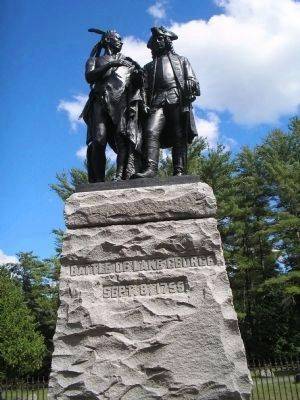
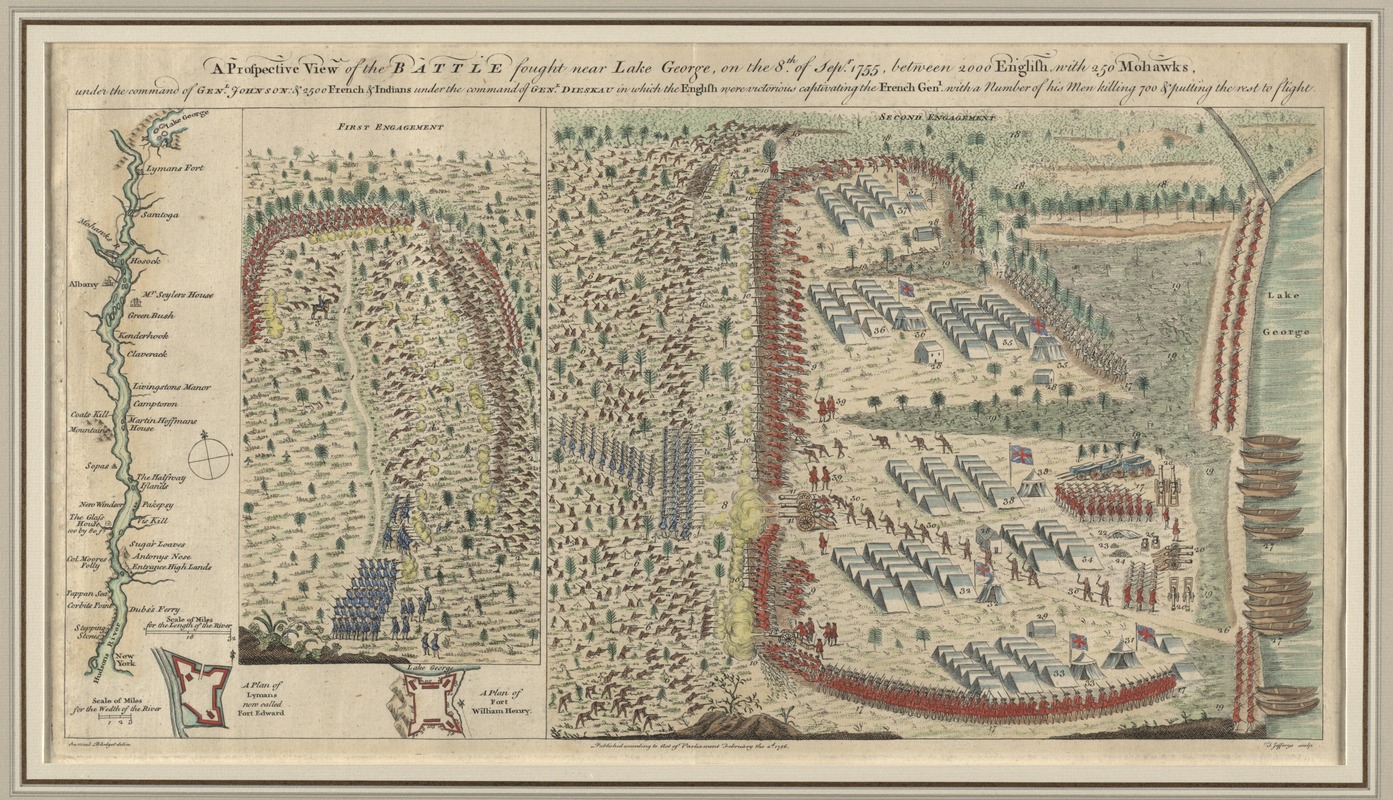
The Battle of Lake George on 8 Sept 1755 probably involved fewer than 3,500 men, a little more on the British side than the French. Each commander reported that his force had faced a much larger foe, however.

Each commander also reported inflicting more casualties than his force suffered, and more casualties than the rival commander reported. In fact, it seems impossible to pinpoint the number of dead and wounded.

Both sides lost leaders, however. On the French side, Baron Dieskau was wounded and captured, and Canadian commandant Jacques Legardeur de Saint-Pierre was killed. The British lost Col. Ephraim Williams and Mohawk ally Hendrick Theyanoguin. Among the provincial officers who died of their wounds was Capt. William Maginnis of New York.

Gen. William Johnson was wounded early in the fighting near Lake George and had to sit out the rest of the battle. Not that he mentioned the last detail in his report to the Crown. Nor did he name Col. Phineas Lyman as the officer who took over and completed that part of the fight. But of course Johnson portrayed the battle as a great victory for Britain.

It probably was a British victory, though limited and costly. Crown forces could now move safely from Fort Lyman to Lake George, and the lakefront was clear enough to build another fort there.

But that clash was an even bigger win for William Johnson, Britain’s liaison to the Iroquois and new provincial general. He was made a baronet, thus Sir William Johnson. Eventually Benjamin West painted Johnson nobly sparing a French officer from attack by a Native warrior, as shown above.

The new baronet returned the king’s favor, renaming the nearby landmarks for the royal family: Lac du Saint-Sacrement became Lake George after George II, Fort Lyman became Fort Edward after one of the king’s grandsons (another slight for Phineas Lyman), and the new fort was dubbed Fort William Henry after the king’s younger son and another grandson. Since the territory remained in British hands, those names prevail.

As the senior (and surviving) British captain in the last part of this battle, Nathaniel Folsom enjoyed some of that glory. He rose within the New Hampshire military establishment, ranked as a colonel within a couple of years. Folsom’s businesses in Exeter prospered.

In 1774 the province chose Nathaniel Folsom as a representative to the First Continental Congress, alongside John Sullivan. His son, Nathaniel, Jr., participated in the first raid on Fort William and Mary that December. Decades later a veteran named Gideon Lamson stated (using military titles the men acquired later):
At nine, Colonel [John] Langdon came to Stoodley’s and acquainted General Folsom and company with the success of the enterprise,—that General Sullivan was then passing up the river with the loaded boats of powder and cannon.
Folsom took charge of one barrel of gunpowder removed from the fort.

Given Nathaniel Folsom’s success in the last war, his support for the Patriot resistance, and his activity in the New Hampshire Provincial Congress, it’s no surprise that that body voted to make him commander of the province’s troops on 21 Apr 1775. The legislators reaffirmed that decision on 23 May.

The problem was that no one had checked with the officer who was actually leading the New Hampshire troops around Boston.

TOMORROW: Stark divide.

Sunday, July 27, 2025

“We march’d into the camp & told the army what we had done”

I’ve been quoting Capt. Nathaniel Folsom’s account of his New Hampshire troops’ fight against a French and Indian force south of Lake George in the late afternoon of 8 Aug 1755.

He continued with lively detail:
After being closely engaged for about three quarters of an hour, they kill’d two of our men & wounded several more on our left wing, where they had gain’d a great advantage of us.

Which, with our being very much tired and fatigued, ocсаsioned us to retreat a little way back; but finding by our retreat we were likely to give the enemy a greater advantage we rallied again in order to recover the ground we had lost, and thinking that if we quitted the ground we should loose our greatest advantage, about fifteen or twenty of us ran up the hill at all hazard. Which we had no sooner done but the enemy fired upon us vigorously; & then, seeing us coming upon them (we being charg’d & they discharg’d) they run & gave us the ground.

Whereupon we all shouted with one voice and were not a little encouraged. In this skirmish Ensign Jonathan Folsom [the writer’s brother] was shot through the shoulder & several others wounded. At every second or third discharge during the engagement we made huzzas as loud as we could but not to be compar’d to the yells of our enemies, which seem’d to be rather the yellings of devils than of men.

A little before sunsetting I was told that a party of the Yorkers were going to leave us, which surpris’d me. I look’d & saw them in the waggon road with packs on their backs. I went to them & asked where they were going. They said to Fort Edward. I told them they would sacrifice their own lives & ours too. They answer’d they would not stay there to be kill’d by the damn’d Indians after dark but would go off by daylight.

Capt. [John] Moore and Lieut. [Nathaniel] Abbott & myself try’d to perswade them to tarry, but to no purpose till I told them that the minit they attempted to march from us I would order our New Hampe. men to discharge upon them. Soon after which they throw’d off their packs & we went to our posts again.

Upon my return to my tree, where I had fought before, I found a neat’s tongue (as I tho’t) and a French loaf, which, happening in so good a season, I gave myself time to eat of; & seeing my lieut. at a little distance, much tired & beat out, I told him if he would venture to come to me, I would give him something to comfort him. He came to me & told me I was eating a horse’s tongue. I told him it was so good I tho’t he had never eat anything better in his life.

I presently saw some Yorkers handing about a cagg of brandy, which I took part of & distributed amongst the men. Which reviv’d us all to that degree that I imagin’d we fought better than ever we did before.

Between sunsett and the shutting in of daylight we call’d to our enemies: told them we had a thousand come to our assistance; that we should now have them imediately in our hands; and thereupon made a great shouting & beat our drums. Upon which they drew off upon the left wing, but stood it on the front & right wing till daylight was in & then retreated & run off.

Then we begun to get things ready to march to the lake, when Providence sent us three waggon horses upon which we carry’d in six wounded men; made a bier & carried one on, lead some & carry’d some on our backs. We found six of our men kill’d & mortally wounded so that they dyed in a few days, and fourteen others wounded & shot through their cloaths, hatts, &c. With much difficulty we persuaded the Yorkers to go with us to the lake.

In about an hour after the battle was over we march’d & sent two men forward to discover who were inhabitants at the lake. Who met us and told us all was well. Whereupon we march’d into the camp & told the army what we had done. As soon as they understood by us that we had drove the enemy off & made a clear passage for the English between forts, the whole army shouted for joy, like the shouting of a great host.
That was the third part of the Battle of Lake George. The French forces had won the first stage with their ambush of the British column heading south to Fort Lyman (Edward). But pressing that attack brought out the larger British force camped at Lake George, and the Crown won the second stage. Then Capt. Folsom, Capt. William Maginnis of New York, and other provincials came up behind the French fighters who had fallen back and started this third and smallest stage.

TOMORROW: Who won?

Saturday, July 26, 2025

“Ye most vilolent Fire Perhaps yt Ever was heard of in this Country”

Yesterday we left Capt. Nathaniel Folsom of New Hampshire and Capt. William Maginnis of New York leading their provincial companies north from Fort Lyman (soon renamed Fort Edward) on the afternoon of 8 Sept 1755. They were headed to Gen. William Johnson’s camp at Lake George, a distance of at least fifteen miles.

That morning, French forces had successfully ambushed a British column that had tried to come the other way. The column’s commanders were killed, leaving Lt. Col. Nathan Whiting of Connecticut and Lt. Col. Seth Pomeroy of Massachusetts in charge.

Pomeroy’s diary, published by the Society of Colonial Wars in New York in 1926, offers a vivid description of what happened:
we this Morning Sent out about 1200 men near 200 of them our Indians went Down ye Rhode toward ye Carrying pla[ce] got about 3 miles they ware ambush’d & Fir’d upon By ye Franch and Indians a number of ours yt war Forward Return’d ye Fre & fought bravely but many of our men toward hind Part Fled

ye others being over match’t ware oblig’d to fight upon a Retreet & a very hansom retreet they made by Continuing there fire & then retreeting a little & then rise and give them a brisk Fire So Continued till they Came within about 3/4 of a mile of our Camp

there was ye Last Fire our men gave our Enenies which kill’d grate numbers of them Sean to Drop as Pigons yt put ye Ennemy to a Little Stop

they very Soon Drove on with udanted Corage Doun to our Camp

ye Regulars Came rank & File about 6 abrest So reach’d near 20 rods In Length Close order the Canadans & Indians Took ye Left wing Hilter Scilter down along Toward the Camp

they had ye advantage of the ground Passing over a hollow & rising a note within gun Shot then took Trees & Logs & Places to hide them Selves-we made ye best Shift we Could for battrys to get behind but had but a few minuts to do It in

Soon they all Came within Shot ye regulars rank & file they Came towards yt Part of ye Camp whare we had Drew 3 or 4 Field Peaces ye others towards the west Part of ye Camp there I Placed my Self Part of Coll. [Timothy] Ruggles & of our Rigement a long togater

the Fire begun between 11 & 12 of ye Clock and Continued till near 5 afternoon ye most vilolent Fire Perhaps yt Ever was heard of in this Country In any Battle then we beat ’em of ye ground

we Took ye French General wounded
That general was Jean-Ardman, Baron Dieskau. He’d been shot four times and declared that the last wound was mortal. But in fact he survived as a prisoner of war in Britain until 1763 and then at home another four years.

Meanwhile, Folsom and Maginnis were moving north. According to Folsom’s March 1756 letter to the Rev. Samuel Langdon, published by the Massachusetts Historical Society in 1904, Capt. Maginnis neglected to send out “advance guards” to prevent an ambush and moved too slow besides.

(Maginnis might have countered that for all of Folsom’s claim that he and his officers were hungry to enter the fight, they’d managed to beat the Yorkers back to Fort Lyman and then lagged them in returning to face the enemy.)

Toward the late afternoon:
Captain McGennes and company started nine Indians, who run up the wagon road from us, upon which Captain McGennes stopt. I, seeing them halt (being on a plain) ordered our men to move forward and pass by them. As soon as I came up with McGennes, I asked the reason of his stopping, which he told me was the starting of the Indians.

I then moved forward and we ran about 80 rods and discovered a Frenchman running from us on the left. Some of us chased him about a gunshot, fired at him, but, fearing ambushments, we turned into the wagon road again and traveled a few rods, when we discovered a number of French and Indians about two or three gunshots from us.

Then we made a loud huzza and followed them up a rising ground and then met a large body of French and Indians, on whom we discharged our guns briskly, till we had exchanged shots about four or five times.

When I was called upon to bring up the Yorkers, who I thought had been up with us before but finding them two or three gunshots back, I ordered them up to our assistance. And though but a small number of them came up, we still continued the engagement and soon caught a French lieutenant and an Indian, who informed us that we had engaged upward of 800.
Folsom said his force consisted of “but 143 men”—leaving out the 90 Yorkers, of course.

TOMORROW: Endgame.

Friday, July 25, 2025

“We should go to the assistance of our friends at the lake”

Nathaniel Folsom (1726-1790) came from an old and prominent New Hampshire family. He was a merchant and owner of a sawmill and shipyard.

Early in the French and Indian War, Folsom became a captain in the New Hampshire provincial regiment. His company was stationed at Fort Lyman, soon to be renamed Fort Edward, on the Hudson River.

On the morning of 8 Sept 1755, having heard shots in the night, Col. Joseph Blanchard told Folsom to send out a scouting party. Folsom dispatched Lt. Jeremiah Gilman, a relative, with some troops. According to a letter the captain wrote in March 1756, those men “marched up between Hudson’s River & the waggon road that leads to Lake George about two miles and a half, where they discovered one [Jacob] Adams lying by the waggon road, dead & scalp’d, & several waggons almost burnt up.”

After hearing this news, Col. Blanchard sent out Capt. Folsom with fifty men. They found signs of a large force of Natives and French in the area. Furthermore, “while we were tying up the dead man to carry him into the fort we heard the discharge of a great gun at the lake & soon after the continual report of others.”

This was the start of the Battle of Lake George, specifically the attack by that French force later called the “Bloody Morning Scout.” Gen. William Johnson had sent troops and supplies from his camp at the lake south toward Fort Lyman with a warning about the enemy being in the area, but that enemy had set up an ambush. The Crown commanders, Col. Ephraim Williams of Stockbridge and Mohawk leader Hendrick Theyanoguin, were both killed. Their remaining men withdrew toward their camp, with the French forces in pursuit.

As William R. Griffith recreated events in The Battle of Lake George (2021), Capt. Folsom returned to Fort Lyman with news that a battle was under way to the north. Shortly after noon, Col. Blanchard sent him back out with a larger force of New Hampshire men, augmented by a company of New Yorkers under Capt. William Maginnis.

Folsom’s own account from 1756 presents himself and his men as acting more aggressively and independently than that:
I call’d together our officers to advise whether we should go to the assistance of our friends at the lake whom we suppos’d to be engaged in battle; upon which officers & souldiers unanimously manifested their willingness to go. At that instant I was told that there were more men coming, who were presently with us. They were a company of the York regiment, who, when detached at Fort Edward, were commanded by Capt. McGennes.

I told him our army was attack’d at the lake, that we had determined to go to their assistance & ask’d him to go with us. Upon which he answer’d that his orders were to come to that spot, make what discoveries he could, return & make report. I told him that was my orders, but that this being an extraordinary case I was not afraid of being blamed by our superr. officers for helping our friends in distress. Whereupon he turn’d & ordered his company to march back again.

I then told our officers that as our number was so small—but, as it were, a handfull—I tho’t it most adviseable to return to the fort and add to our number & then proceed to the lake. We march’d, soon overtook the Yorkers & ran by them a little distance, where we met near fifty of our own regiment running towards us.

I ask’d, “What tidings?” They said they tho’t we had been engag’d & that Coll. Blanchard had sent them to our assistance.

Whereupon we imediately concluded to go to the lake; but not having orders therefor, as before hinted, I despatch’d Lieut. [Richard] Emery with some few men with orders to go to the fort and to acquaint Coll. Blanchard with what we had discover’d and of our design to go to the lake.

Meanwhile Capt. McGennes marched forward. We followed for about two miles but as I tho’t they marched too slow & kept out no advance guard (by means of which we might be enclos’d in the ambushments of the Canadeans) I propos’d to our New Hampshire men to go by them. But one of our officers told me he tho’t it not best to go before the Yorkers for that he was more afraid of them than of the enemy.
We might presume that officer was afraid of being accidentally shot from behind, but clearly there was a rivalry between the two colonies’ forces.

TOMORROW: Engaging the enemy.

Wednesday, July 09, 2025

“Capt. Potter answered that he would share none”

Rhode Island actually began its military build-up back in December 1774, as detailed in a letter from former governor Samuel Ward that I quoted back here.

At that time the colony appointed its first ever major general: Simeon Potter (1720–1806).

Potter was a militia colonel, representative of the town of Bristol in the colonial assembly, and veteran privateer captain.

Indeed, Potter had already helped to lead one attack on the British military: while several fellow merchants supported the assault on H.M.S. Gaspee in 1772, he actually commanded one of the boats.

Now in fact, Potter’s most successful privateering haul came in 1744 not from attacking enemy ships but from raiding a poorly defended settlement in French Guyana that hadn’t even heard the empires were at war.

According to one of his captives, he sailed away with:
seven Indians and three negroes [none previously enslaved], twenty large spoons or ladles, nine large ladles, one gold and one silver hilted sword, one gold and one silver watch, two bags of money, quantity uncertain; chests and trunks of goods, etc., gold rings, buckles and buttons, silver candlesticks, church plate both gold and silver, swords, four cannon, sixty small arms, ammunition, provisions, etc.
Father Elzéar Fauque reported that the looting included “tearing off the locks and the hinges of the doors, particularly those which were made of brass,” before burning everything to the ground.

Potter’s lieutenant Daniel Vaughan testified in 1746 that at Suriname
Capt. Potter put a Quantity of sd. Merchandize up at Vendue on board a Vessel in the Harbour and purchased the most of them himself and ship’t them to Rhode Island on his own account; then said Sloop Sailed for Barbadoes on wch. passage the men demanded that Capt. Potter would Share the Money taken, according to the Articles, to which Capt. Potter answered that he would share none until his Return for all the Men were indebted to the Owners more than that amounted to and Swore at and Damn’d them threatning them with his drawn sword at their Breasts, which Treatment Obliged the Men to hold their Peace and when said Sloop arrived at Barbadoes Capt. Potter without consulting the Men put part of the afore mentioned Effects into the Hands of Mr. Charles Bolton and kept the other part in his own Hands and Supply’d the Men only with Rum and Sugar for their own drinking, and further this Deponent saith that Capt. Potter refusing to let the men have their Shares and his Ill Treatment of them by beating them occasioned about twenty-four to leave the Vessel whose Shares Capt. Potter retained in his Hands
Simeon Potter came home to Bristol a rich man. A few years later, in 1747, the peninsula that contained that town was shifted from Massachusetts to Rhode Island, making Potter one of the richest men in the small colony.

Potter launched various maritime businesses: a ropewalk, a distillery, a wharf, a store, and so on. He invested in slaving voyages to Africa. By the 1770s he owned more enslaved people than anyone else in Bristol. According to a nephew, Potter declared, “I would plow the ocean into pea-porridge to make money.”

In those years, Potter’s neighbors recognized his status by electing him to the legislature and to militia commands, and he was happy with the power.

TOMORROW: A fighting man.

Thursday, June 12, 2025

“The Continental Barracks on Noddle’s Island”

As soon as the siege of Boston ended, the Massachusetts government moved to fortify Noddle’s Island and other spots in Boston harbor.

On 6 Apr 1776, the lower house of the General Court formed a “Committee for fortifying the Harbour of Boston” and told those members
immediately to take a View of Noddle’s-Island, and report to this Court what Time it will probably take a Regiment, consisting of Seven Hundred and Twenty-eight Men, to perform the Business of Fortifying said Harbour.
Twelve days later the house empowered that committee
To purchase on the best Terms they may be had, eight Hundred Feet of the Continental Barracks (provided their Cost, with the Expence of removing and rebuilding them, shall in the Opinion of the Committee, be less than the Value of new ones) and cause them to be removed to, and re-built on Noddle’s-Island
The Council approved that plan the next day. Until John Hancock took office as an elected governor in 1780, the Council would serve as both the upper house of the legislature and the executive branch of the state government, carrying out legislative policies.

The barracks were assembled on Jeffries’s Point, the southwestern corner of the island. It looks like that building housed provincial soldiers while they built the harbor fortifications, but not year-round.

Those barracks were put to another use in 1780, after French warships started arriving in Boston harbor. That summer Thomas Chase, the state’s deputy quartermaster general, wrote to the Council:
The Commanding Officer of the French Troops has applyed to me for a Hospital for the sick, and as there is Continental Barrack on Noddles Island, suitable for that purpose, and as Mr. [Henry Howell] Williams owns the Soil, and I suppose he will make Objection to their going into Barracks, I pray your Honors would be pleased to give Orders that they shall not be molested in said Barracks.
Chase’s colleague from the “Loyall Nine” fifteen years earlier, John Avery (shown above), had become the state secretary. He reported this action by the Council on 15 July:
Read & Ordered — that Col. Thomas Chace, D.Q.M.G., be, and hereby is directed to take Possession of the Continental Barracks on Noddle’s Island for the Use of the sick Soldiers on Board the Ship Le isle de France, arrived this morning from France, belonging to his most Christian Majesty.
The local historian William H. Sumner, having accepted family lore that Gen. George Washington had given Henry H. Williams barracks from Cambridge before leaving New England in April 1776, concluded that these barracks converted into a hospital must have been a second building. But, as I wrote yesterday, there’s no evidence for such a grant. Nor any mention of multiple barracks on Noddle’s Island.

Furthermore, Chase didn’t write about Williams as having a home on the island, only as protective of his “Soil” there. Chase clearly expected Williams to interfere with turning the barracks into a hospital for the French, so the state explicitly approved his plan. That action suggests the Patriot government still didn’t trust Williams to cooperate with the war effort.

TOMORROW: Where was Henry Howell Williams during the war?

Monday, April 14, 2025

Revisiting the Spies of 1775

I recently spoke in the Acton 250 series of talks on the start of the Revolutionary War.

My topic was “The Spies of 1775,” reeling off stories of disparate people drawn into intelligence-gathering efforts on both sides of the siege lines around Boston.

Since I didn’t want to go back over the spies at the center of The Road to Concord, I talked about:
The Acton Exchange just reported on the event:
Speaking to a capacity audience in the Francis Falkner Hearing Room on March 31, author and historian John L. Bell related a fascinating story of the spies used by the commanders on both sides of the conflict. While many informants chose to provide information due to loyalty to their cause, others were primarily driven by money, property, revenge, or self-promotion.
Acton 250 television has now posted its video recording of the event, neatly edited to remove evidence of some technical difficulties.

And here’s a postscript to that evening. On Friday I participated in the conference “1775: A Society on the Brink of War and Revolution” hosted by the Concord Museum and organized by the David Center for the American Revolution at the American Philosophical Society and and the Massachusetts Historical Society.

That program included Iris de Rode from the University of Virginia presenting on “French Observers of Early American Unrest: How Lexington and Concord Shaped France’s Entry into the American Revolution.” Among other people she discussed Bonvouloir, one of the spies I’d described in Acton, so I gossiped with her afterwards.

Bonvouloir and his companion, the Chevalier d’Amboise, were in London in the late summer of 1775. A British government agent pumped them for information. The Frenchmen described witnessing “the Affair of Lexington, and the Affair of the 17th [Bunker Hill].” They claimed to have met “Putnam and Ward.”

But Dr. de Rode said that there’s no evidence of similar reports in French government sources. Even though Bonvouloir lobbied to become his government’s agent to the American rebels, which would make his experience with the war relevant, he doesn’t appear to have told those stories to the French ambassador to pass on to the Foreign Ministry. So she thinks he was just talking through his no doubt fashionable hat.

The British intelligence service was definitely shadowing Bonvouloir in London, and he was definitely involved in a secret mission to Philadelphia at the end of 1775. So he fits into a talk on spies. But whether he was in New England in 1775 is in question. I must consider the possibility that in London he engaged in a disinformation campaign—not to help the Americans or the French but to make himself look more important.