J. L. BELL is a Massachusetts writer who specializes in (among other things) the start of the American Revolution in and around Boston. He is particularly interested in the experiences of children in 1765-75. He has published scholarly papers and popular articles for both children and adults. He was consultant for an episode of History Detectives, and contributed to a display at Minute Man National Historic Park.

Subscribe thru Follow.it


•••••••••••••••••


Showing posts with label Molyneux Shuldam. Show all posts

Thursday, April 02, 2026

“The Continental Arm’d Schooner Hancock, Came up, and Gave me a Broadside”

Last week I recounted the Loyalist evacuation of Boston as tragedy. This week I’m retelling it as farce.

Capt. John Manley was the first American naval hero of the Revolutionary War, lauded for capturing several British supply ships in the fall of 1775.

After that success, Manley was made commodore with authority over other armed ships launched under Gen. George Washington’s authority. (Soon that little fleet would become part of the Continental Navy.)

In the spring of 1776 Manley was commanding the Hancock, Capt. Daniel Waters the Lee, and Capt. John Ayres the Lynch. They patrolled the waters off Cape Ann.

On 2 April, 250 years ago today, those three schooners spotted a 140-ton brigantine named the Elizabeth. It had sailed out of Boston with the evacuation fleet but fell behind.

Months later, the captain of the Elizabeth, Peter Ramsey, described the action this way:
on or about the 21st of March A D 1776 in Boston in the Colony of the Massachusetts Bay your Deponent then and there received verbal orders from Admiral [Molyneux] Shuldham to go On Board said Brigantine Elizabeth and take the Charge of her and Navigate her to Halifax,

and on Friday the 29th of said March Between the Hours of three & four oClock P M I came to Sail with said Brigantine under Convoy of His Majestys Ship Niger, and Sabbath Evening about six or seven oClock I parted from said Convoy, and proceeded on my Voyage to Halifax,

and about Four or Five oClock P M on the next Tuesday following Commodore John Manly in the Continental Arm’d Schooner Hancock, Came up, and Gave me a Broadside, and I Returned the Fire with Small Arms, Capt Danl Waters in the Continental Arm’d Schooner and Capt John Ayres in the Continental Arm’d Schooner Came up when I struck to the Commodore,

and your Deponent then saw no other vessel besides the before mentioned, and your Deponent in said Brigantine was Brot by the Commodore and Capt Waters into the River of Piscataqua
That was the harbor for Portsmouth, New Hampshire. Ramsey’s testimony was necessary to resolve disputes over who could claim the value of his vessel and its cargo.

Because there was a lot of cargo.

TOMORROW: On board the Elizabeth.

Friday, March 27, 2026

“Here I took my leave of that once happy country”

Even after the destruction of Castle William, described yesterday, Judge Peter Oliver’s ship Pacific remained in Boston’s outer harbor, waiting for the right weather.

On 24 March, Oliver recorded, the night was so cold “that the vessell’s bows and cables were loaded with ice.”

The next day the winds were more favorable. A packet ship sailed for London, carrying Oliver’s son Peter, Jr., and his wife Sally; Sally’s brother Thomas Hutchinson, Jr., and his wife Sarah (who was also the judge’s niece); and their children among the passengers. At the same time, the “first Division” of the Loyalist fleet headed toward Halifax.

Still, Oliver’s ship remained. On 26 March he was rowed over to H.M.S. Renown and dined with “Commodore [Francis] Banks,” that ship’s captain.

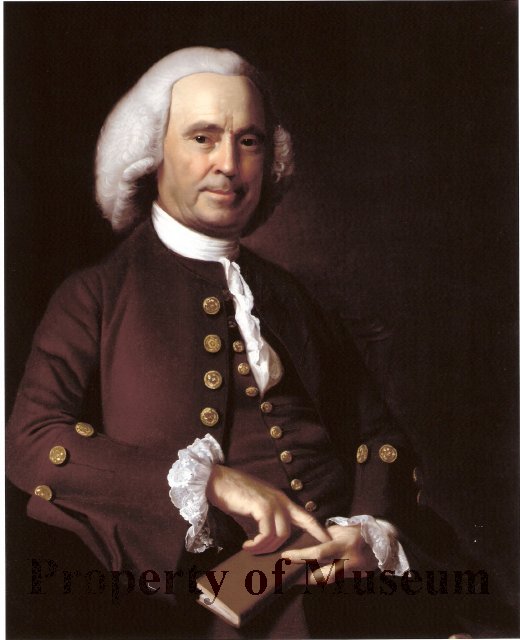
On 27 March, 250 years ago today, Adm. Molyneux Shuldam (c. 1717–1798, shown above) was ready to sail, his flagship H.M.S. Chatham leading a fleet of Royal Navy warships, army troop transports, and merchant vessels to Nova Scotia. But first he wrote out orders for Capt. Banks:
You are hereby required and directed to employ His Majesty’s Ship under your Command, in such manner as you shall judge best, either by Cruizing or Anchoring occasionally in preventing all communication or Commerce with the Town and Harbour of Boston; And whereas many Vessels are daily expected here with Stores and Provisions for the use of His Majesty’s Fleet and Army, which are in extreme want of them; You are to take under your Command the Ships and Vessels mentioned in the Margin and employ them in Cruizing between the Latitudes of Cape Cod, and Cape Anne at such distance from the Shore, where they are most likely to fall in with the above Expected Vessels, which you are to direct them to see in safety to Halifax, and then return to you.

You are also hereby required and directed on the Arrival of any of His Majesty’s Ships and Vessels at Nantasket (except those you have Orders to take under your Command) to give their Commanders Orders to proceed immediately to join me at Halifax, or where ever else you shall from good Authority hear I may be.

You are to take, sink, burn, or destroy, all Rebel Armed Vessels you may meet with, and to continue upon this Service till further Order, Governing yourself in the Executing of it, by the General Code of Orders and Instructions, you have already received from me, sending all Vessels you may seize or detain to Halifax, to be proceeded against according to Law, and giving me an Account of your Proceedings by all opportunities that offer.
The naval ships that the admiral listed in the margin were the frigates Lively, Niger, and Fowey; the sloop Swan; the brigs Hope and Bolton; and the schooner Dispatch. That flotilla would remain to limit New England shipping.

Judge Oliver wrote in his diary for that day:
I sailed from Nantasket, abt. 3 o’clock, afternoon, in the 2nd and last Division of the fleet, about 70 sail, for Hallifax, under convoy of the Chatham, Admiral Shuldham, and of the Centurion, Capn. [Richard] Braithwaite.

Here I took my leave of that once happy country, where peace and plenty reigned uncontrouled, till that infernal Hydra Rebellion, with its hundred Heads, had devoured its happiness, spread desolation over its fertile fields, and ravaged the peacefull mansions of its inhabitants, to whom late very late if ever, will return that security and repose which once surrounded them; and if in part restored, will be attended with the disagreeable recollection of the savage barbarities, and diabolical cruelties which had been perpetrated to support rebellion, and which were instigated by Leaders who were desperate in their fortunes, unbounded in their ambition and malice, and infernal in their dictates.

Here I drop the filial tear into the Urn of my Country.

O fortunatos nimium, sua si bona norint—Nov-Anglicanos!

And here I bid A Dieu to that shore, which I never wish to tread again till that greatest of social blessings, a firm established British Government, precedes or accompanies me thither.
Oliver’s Latin riffed off of one of Virgil’s lines in Georgics, saying that the farmers (or New Englanders) would count themselves lucky if only they knew how good they had it.

Peter Oliver was one of the wealthier Loyalists, as well as having a royal appointment (and salary). He soon moved on from Halifax to London, where he lived the rest of his life until 1795.

Oliver’s diary of departing Massachusetts was published in a volume of his friend and in-law Thomas Hutchinson’s diary and letters. Oliver also left of bitter, detailed, and gossipy account of the coming of the Revolution, written in the early 1780s and finally published in 1961. (Highly recommended.)


Wednesday, March 25, 2026

“Near or quite fifty Sail are got out to Sea”

Lt. Nahum Ward, son of Gen. Artemas Ward, carried Gen. George Washington’s letter (quoted yesterday) to Josiah Quincy, Esq. (shown here), of Braintree on 24 Mar 1776.

The squire, encouraged, started to make detailed notes about what the British fleet was doing out on the Nantasket Road, the shipping channel in the outer harbor.

“The Admiral [Molyneux Shuldam] has a Signal now flying at his main top mast Head,” Quincy wrote the next day, 250 years ago today. “I wish it was in my Power to construe it.” Yes, that would have been more helpful.

But then he saw movement.
11 OClock. This Moment an Explanation of the above Signal occurrs: Part of the Fleet are come to Sail: I shall proceed, journalwise, to inform your Excellency of their Movements, ’till the Bearer, who is gone to see Colo. [Benjamin] Tupper, returns.

1 OClock They are still coming to sail: near or quite fifty Sail are got out to Sea; about half of them Brigs, Schooners, and Sloops; one or two Frigates, and the remainder Transport Ships; their Course shaped for Cape Cod: May not this Division be bound for Martha’s Vineyard, and the Islands in that Sound to procure fresh Provision for the Fleet, which is to rendevous at Hallifax, and from thence to proceed to Quebec?

3 OClock My Servant, who was directed to take an Account of the Number that have sailed, informs me, there are in all fifty two: One transport Brig: is just arrived: . . .

5 OClock The Adml has just now hoisted another Signal a Pendant under his Flagg two more Ships are under Sail going out of the Harbor: 7 O’Clock, Mr Ward & Colo. Tupper are just arrived: They are of Opinion, that the Ships which sailed to Day, have carried off the Tories, and are bound with them to Lewisburgh.

Tuesday Morng [26 March] Mr Ward’s tarrying in Town, gives me a further Opportunity to inform your Excellency that the Fleet, consisting of about 100 Sail, chiefly large Ships, remain as they were last Night.

10 OClock The same Signal is now flying at the Admiral’s Main top mast Head as was hoisted yesterday morning: Scarce hoisted before it was lower’d again, & in abt ½ an hour a blew [blue] flag is flying at mizen Top mast Head and a Pendant at his mizen Peek.

11 O’Clock The above Signals are changed, for a red Ensign hoisted just under his Mizen Yard: A signal is just now hoisted upon the Top of the Light House, for Vessels in the Offing; and immediately followed, by a blew broad Pendant from the middle of the Tower: In less than 10 Minutes the Signal first mentioned vizt a Pendant is flying from his main top mast Head.

12 O’Clock A red Ensign is now flying at his mizen top mast Head; a blew Ensign at his starboard mizen Shrouds, and a pendant thrown out between, by hand, & immediately taken in again.

2 OClock The 60 gun Ship in King Road is come to Sail & going down to Nantasket: The Admiral’s red Ensign is struck; the blew one remains: a large transport Ship and a Brig are just arrived within the Light.
Quincy wasn’t sure all that detail could be useful, but he promised Washington he’d keep sending it until the general said otherwise. He really wanted to be part of the effort to defeat the British.

About half of the fleet had moved off, heading for the safe port of Halifax, Nova Scotia. Most of the rest would follow by the end of 26 March. A few warships stayed behind to patrol Boston harbor.

TOMORROW: Aboard one of those ships.

Saturday, March 07, 2026

“A more interesting and bloody scene is apprehended”

The Rev. William Gordon’s account of the end of the siege of Boston continues, picking up (in the present historical tense) just after Gen. William Howe has spotted the Continental Army positions on the hills of the Dorchester peninsula:
The admiral [Molyneux Shuldam] informs him, that if the Americans possess those heights he cannot keep one of his majesty’s ships in the harbour. A council of war determines to attempt dislodging them.

General [George] Washington has settled his plan of defence and offence. Boston is so surrounded on every land side by neighbouring hills, that nothing can take place on the wharves or next to the water, but it may be noted by the help of glasses. Proper signals having been agreed on, by means of the hills, which are in view one of another, intelligence can be conveyed instantly from Dorchester heights to Roxbury, and from Roxbury to Cambridge and so the reverse. This mode of communicating information is the speediest and safest.

General Washington’s plan is, in case any number of the enemy leave Boston to attack the heights and are defeated, to communicate such defeat by the proper signal, when 4000 provincials are to cross over from Cambridge side, and attempt the town in the confusion that the regulars will be under. The boats are prepared, and the men paraded ready to embark. General [John] Sullivan commands the first division, and general [Nathanael] Green the second. Gen. [William] Heath objected to the command when offered, and remains in perfect safety with the troops left in Cambridge. The whole force which the commander in chief now has, including all the militia, is not much short of 20,000.

All is hurry and bustle in Boston. General Howe orders the ladders in town to be cut to ten feet lengths, that they may be fit for scaling. A large body of troops are to embark on board the transports, and to proceed down the harbour, with a view of landing in the hollow between the furtherest of the two fortified hills and the castle.

The men are observed by one, at whose door they are drawn up before embarking, to look in general, pale and dejected; and are heard to say, “It will be another Bunker’s Hill affair, or worse”—they have adopted the prevailing mistake of Bunker’s for Breed’s Hill. Some show great resolution and boast of what they will do with the rebels. When these troops, amounting to about 2,000, and designed to be under the command of lord Percy, are upon the wharves, and passing in the boats to the transports, the Americans expect they are intended for an immediate attack, clap their hands for joy, and wish them to come on.

General Washington happens at that instant to be on one of the heights; thinks with his men; and says to those who are at hand, “Remember it is the fifth of March, and avenge the death of your brethren.” It is instantly asked by such as are not near enough to hear, “What says the general?” His words are given in answer. They fly from man to man through all the troops upon the spot, and add fuel to the martial fire already kindled, and burning with uncommon intenseness.

The surrounding hills and elevations about Boston, affording a secure view of the ground on which the contending parties are expected to engage, are alive with the numerous spectators that throng them. A more interesting and bloody scene is apprehended to be just upon commencing, than what presented at Charlestown. They wait, as do the troops, officers and privates, the morning through; and till far into the afternoon, when they are convinced of the tide’s being so far ebbed, that no attack can be made by general Howe on the Tuesday, which indeed is not his intention, for he is preparing to do it on the Wednesday.

The transports go down in the evening toward the castle, a floating battery is also towed down, but the wind is unfavorable, and before they reach their destination blows up fresh, and forces three of the vessels ashore on Governor’s Island. A storm succeeds at night, such as few remember ever to have heard; and toward morning it rains excessively hard.

[March 6.] The design of general Howe was hereby frustrated, and a deal of bloodshed providentially prevented. A council of war, was called in the morning, and agreed to evacuate the town as soon as possible. The time that had been gained by the Americans for strengthening their works, before any attempt could be now made upon them, took away all hope of success…
And with that return to the past tense, Gordon signaled that the height of suspense was past. The siege would not end with a second mighty battle.

TOMORROW: When is an exchange of messages not an exchange of messages?

Thursday, March 05, 2026

“The enemy had thrown up three very extensive works”

Two hundred fifty years ago this morning Gen. William Howe looked across Boston harbor and saw that the Continental Army had erected fortifications on the heights of the Dorchester peninsula.

Those weren’t strong fortifications—they were primarily wooden, with fascines (bundles of sticks) lying between chandeliers (frames sticking up like the pickets of a fence). But Howe could see men at work strengthening those barriers with earth.

Sixteen days later, Howe described his response in a letter to the Earl of Dartmouth:
On the 2d instant [i.e., of this month], at night, the rebels began a cannonade upon the town from Roxbury and Phipps’s Farm [in Cambridge], and threw some shells from both places, without doing any personal damage, and but little to the buildings; the same was repeated on the evenings of the 3d and 4th, by which only six men were wounded; the fire being returned from our batteries, but at such a distance as to be very uncertain in the execution.

It was discovered on the 5th, in the morning, that the enemy had thrown up three very extensive works, with strong abatis round them, on the commanding hill on Dorchester Neck, which must have been the employment of at least twelve thousand men in a situation so critical.

I determined upon an immediate attack, with all the force I could transport. The ardor of the troops encouraged me in this hazardous enterprise; regiments were expeditiously embarked on board transports to fall down the harbor, and flat-boats were to receive other troops, making the whole two thousand four hundred men, to rendezvous at Castle William, from whence the descent was to be made, on the night of the 5th, but the wind unfortunately coming contrary and blowing very hard, the ships were not able to get to their destination, and this circumstance also making it impossible to employ the boats, the attempt became impracticable.

The weather continuing boisterous the next day and night, gave the enemy time to improve their works, to bring up their cannon, and to put themselves into such a state of defence that I could promise myself little success by attacking them under all the disadvantages I had to encounter; wherefore I judged it most advisable to prepare for the evacuation of the town, upon the assurance of one month’s provision from Admiral [Molyneux] Shuldham, who, in this emergency, as he has on every other occasion, offered all the assistance he could afford.
The Continentals had actually armed their new forts with cannon on that first night. They had even brought the makings of barracks so that hundreds of soldiers could man those positions all night. It was a very well planned operation, a great contrast to the brave but ultimately unsuccessful improvisation that marked the provincial move onto the Charlestown peninsula the previous June.

Howe wrote that report on board H.M.S. Chatham, floating off the Massachusetts coast. The siege of Boston was over.

Saturday, January 06, 2024

Joseph Reed’s Second Source

As I discussed yesterday, Joseph Reed (or someone close to him) adapted a 4 Jan 1776 letter from Gen. George Washington into part of an article that appeared in John Dunlap’s Pennsylvania Packet on 15 Jan 1776.

That article started by announcing its sources: “authentic advices from the Camp at Cambridge, of the 3d and 4th instant”—i.e., letters sent on 3 and 4 January. That meant it was based on at least one other source.

The second major source was Stephen Moylan’s letter to Reed dated 2–3 January, particularly the later pages penned on the 3rd. That document has been digitized by the New-York Historical Society.

Reed knew Moylan in Philadelphia before the war. The two men worked together in Cambridge as Washington’s military secretary and muster-master general. When Reed went home to his wife, he passed off a lot of his tasks to Moylan. So it was natural for those two men to correspond.

The Pennsylvania Packet article contained many items of intelligence, in addition to the general’s anecdote about the new flag. Here are those topics, and in whose letter that information appeared:

  • Boston’s harbor was open. (Moylan)
  • A British warship was outside Salem, Beverly, and Marblehead harbor. (Moylan)
  • 500 British soldiers arrived from Ireland, later identified as from the 55th and 17th. (Moylan, Washington)
  • Two British regiments had been sent to Halifax. (Moylan, Washington)
  • Two more regiments were moving up the St. Lawrence River to Québec. (Moylan)
  • Admiral Molyneux Shuldam arrived in Boston. (Washington)
  • H.M.S. Scarborough and Fowey would lead nine transport ships and other vessels south; they were said to be headed to Newport, but more likely were going to Long Island or Virginia. (Washington, Moylan slightly different)
  • British ships were taking on drinking water and biscuits. (Washington, Moylan slightly different)
  • The British army had no intention of attacking the Continental siege lines. (Moylan)
  • The redcoats were grumbling, so they were told that Gen. John Burgoyne had headed home to Britain to help settle the whole colonial dispute. (Moylan)
  • Four ships had sailed from Hispaniola with arms and ammunition. (Moylan)
  • The Continental “army were all in barracks, in good health and spirits.”
  • Five thousand militiamen were filling in for soldiers who had gone home when their enlistments ran out. (Washington)
  • The “whole army [was] impatient for an opportunity of action.”
Thus, almost every piece of information in the article came from one or both of those letters. The few exceptions were details of the anecdote about the flag, as listed yesterday, and positive descriptions of Continental soldiers being “all in barracks, in good health and spirits,” and “impatient for an opportunity of action.”

In fact, Gen. Washington had written gloomily about how few troops he had left after the end of 1775 and what he could now expect:
for more than two Months past I have scarcely immerged from one difficulty before I have plunged into another—how it will end God in his great goodness will direct, I am thankful for his protection to this time. We are told that we shall soon get the Army compleated, but I have been told so many things which have never come to pass, that I distrust every thing.
But of course Reed would never have those thoughts printed in a Patriot newspaper. In fact, sections like that are probably why he edited the general’s letter for public consumption.

Likewise, Moylan wrote a lot about how George III’s uncompromising speech to Parliament should impel the Continental Congress into seeking help from foreign powers like Spain—a big step toward independence which top politicians were not yet ready to go public with. His 2–3 January letter is becoming famous for containing the earliest appearance of the phrase “the United States of America,” months before the Congress adopted that moniker.
In the quest to find out more about the flag on Prospect Hill, however, Moylan’s letter is a dead end. He wrote nothing about the banner, and therefore didn’t provide the details that appeared in the Pennsylvania Packet without first appearing in Washington’s letter. Did Reed draw on another source?

TOMORROW: My theory that belongs to me.