J. L. BELL is a Massachusetts writer who specializes in (among other things) the start of the American Revolution in and around Boston. He is particularly interested in the experiences of children in 1765-75. He has published scholarly papers and popular articles for both children and adults. He was consultant for an episode of History Detectives, and contributed to a display at Minute Man National Historic Park.

Subscribe thru Follow.it


•••••••••••••••••


Showing posts with label Newbury. Show all posts

Monday, May 11, 2026

“Not playing cards but fondling and kissing each other”

In preparation for tomorrow’s talk about Benjamin Thompson’s early years, I’ve been reviewing the evidence of his affair with Mary (Dill) Thomas, wife of printer Isaiah Thomas.

When Isaiah moved to divorce Mary in 1777 by petitioning the Massachusetts Council, he submitted testimony from several people who had seen his wife traveling with the militia major from New Hampshire in February 1775, behaving like man and wife.

The printer’s file also offered an affidavit from Mary Fowle of Londonderry, New Hampshire, who had stayed with the Thomases in Boston from 20 Sept 1774 to 16 April 1775.

In Sex and the Scientist, Jane Merrill quotes Fowle describing how “Major Thompson [was] then a refugee in Boston who borded in a house opposite.” Mary Thomas started visiting him several times a day even though (or because) she had two children under the age of three.

One Saturday the printer’s wife “dressed herself, shifting her Linen, which I knew was not her custom,” said her house guest. Mary Thomas came home with “a small piece of parchment, on which a Lady’s face had been drawn with a black lead pencil. . . . the Major had taken much pains with it.”

Soon Mary Thomas visited Thompson’s ”bed-chamber, where they staid the whole afternoon and part of the evening.” Fowle stated, “I could not but think there was more intimacy between them than I before tho’t of.” She observed the couple “kissing each other, laying in each others laps, speaking fondly of each without regarding me.”

One day Isaiah came home from business after his wife had gone to play cards with Maj. Thompson. Mary Fowle and a household servant went across to fetch her. They found the couple “not playing cards but fondling and kissing each other, she often laying her head on the Major’s shoulder, and their arms round each other.”

As if that wasn’t clear enough, in February 1775 Mary Thomas insisted on taking that trip to Newbury with Maj. Thompson, first having her hair “in the greatest taste much powdered.” Later the printer gathered testimony from several innkeepers about that journey. At the time, however, he just seems to have felt trapped.

On one Sunday, Isaiah Thomas and Mary Fowle went to church. When they came home, his daughter Mary Ann, who turned three years old that March, showed them a “copper” that Maj. Thompson had given her to go into another room. Fowle stated the little girl said, “The major kissed her Mama and felt her bosom.” In response, little Mary Ann’s mother told her she was lying and threatened to whip her.

Isaiah finally demanded that Mary admit to what was going on. She acknowledged having a sexual affair. And when did it start? True to Benjamin Thompson’s character, he first got into Mary Thomas’s bed right after writing a letter to his own wife back in Concord, New Hampshire.

I won’t bother asking if these marriages can be saved.

TOMORROW: Who was Mary Fowle?

Monday, October 20, 2025

A New Schoolmaster for a New Town

In January 1764 the Massachusetts General Court passed a law allowing part of the town of Newbury to split off as the new town of Newburyport.

The new town held its first meeting on 8 February, choosing a clerk, selectmen, and other officials. The inhabitants also chose a committee to determine what schoolhouses the children needed. They decided to keep paying the masters of the Newbury grammar and writing schools for now.

In March that committee recommended:
that at least three large schools should be provided and maintained in sd. Town, viz: one Grammar school not far from the Revd. Mr. [John] Lowel’s meeting house, and two reading, writing & arithmetick schools, one of them adjoining to Queen street, Ordua Lane, or Bartlet’s Lane, preferring the latter, and the other adjoining or near Cross street or Elbow Lane.
That summer, the town bought some land on what is now Winter Street, beside Route 1, and started building a schoolhouse.

To oversee that school the selectmen hired John Vinal, usher of Boston’s South Writing-School. They offered him £80 per year, significantly more than he had been earning in Boston though less than what the bigger town’s schoolmasters earned. In addition, each pupil was to bring “two pistareens” to pay for firewood used during the year.

The selectmen announced: “Boys that can read in a Psalter will be received and carefully taught Reading, Writing & Arithmetick.” The school would meet 8 A.M. to noon and 1 to 4 P.M.

Vinal’s school opened on Monday, 5 November, with the Rev. Mr. Lowell and the selectmen present. Given that Newbury’s youth usually celebrated Pope Night with a big procession and bonfire, I imagine that student body was rather antsy that day.

John Vinal continued to look for ways to supplement his salary. The town needed to survey the “common and undivided land” near the Frog Pond, and in 1771 Vinal produced the map shown above, shared by History Newburyport. Around the pond it shows a burying-ground, a potash house, a ropewalk, a powderhouse, and a windmill.

TOMORROW: Vinal’s lessons.

Saturday, July 13, 2024

“Many among us, who are for compromising matters”

John Andrews was another merchant who left a lively record of the discussions in Boston in spring 1774 as the business community grappled with the impending effects of the Boston Port Bill.

Andrews was more aligned with the Whigs than John Rowe, but still didn’t always see eye-to-eye with the radicals.

Andrews’s account appears in a series of letters to an in-law in Philadelphia, now in the collections of the Massachusetts Historical Society. On 18 May he wrote in the most dire tone:
Imagine to yourself the horror painted in the faces of a string of slaves condemn’d by the Inquisition to perpetual drudgery at the oar! Such is the dejection imprinted on every countenance we meet in this once happy, but now totally ruin’d town.
Andrews urged his correspondent to sign on to “an entire stoppage of trade, both to England and the West Indies, throughout the continent.” Any alternative would be to “acknowledge the right of parliament to d—n us whenever they please.”

Later that day Andrews added the news that “we have had advice from Salem, Newbury, etc’a., that they will haul up all their vessels, and stop every trade, provided it becomes general through the continent.”

If accurate, that news must have after the day’s town meeting session, where a committee reported merely that the selectmen of Marblehead and Salem had sounded sympathetic and promised to call meetings in their towns, too.

Note how the promise from those smaller Massachusetts ports was contingent on all the other ports in North America signing on to a boycott as well. That’s often how collective action has to be organized: promising party A that party B is ready to act if party A will, and promising party B that party A is ready to act if party B will.

Yet Andrews also reported some Boston merchants calling for a different approach:
At the same time, we have many among us, who are for compromising matters, and put forward a subscription to pay for the Tea.

George Erving has declar’d this day. that if it should be promoted, he is ready to put down two thousand pounds sterling towards it, and will take it upon himself to wait on Governor [Thomas] Gage and know what his demands upon us are—which circumstance Jno. Amory mentioned at ye. town meeting this day, which was in general rejected, though he urged the matter much.
George Erving (1738–1806) and John Amory (1728-1803, shown above) were both Loyalists during the war. Amory ultimately returned to Massachusetts, and Erving’s son became a U.S. diplomat.

Though the Boston Tea Party had cost the East India Company over £9,000, five merchants pledging the amount Erving promised would have been enough to cover that sum. But the community “rejected” that idea.

At that point in late May 1774, Boston’s committee of correspondence may well have felt they had solid popular support for promoting a general boycott to protest the Port Bill. But when the committee drafted its “Solemn League and Covenant” and sent it to other towns and provinces, its members may have overplayed their hand.

TOMORROW: Going too far?

Monday, February 12, 2024

“Command of a vessel without arms, and with but one eye”

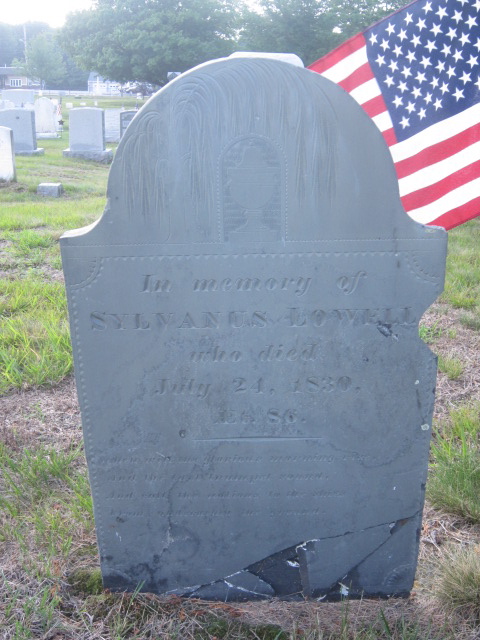
Aside from having several children, what did Sylvanus Lowell do after being so badly injured at the Marblehead smallpox hospital in 1773?

First he returned to the maritime business, as shown by this advertisement from the 23 Mar 1774 Essex Journal, published in Newburyport:
For NEWFOUNDLAND,
THE Schooner ROSE, JACOB LOWELL, master, now lying at Marquand’s wharf, will sail by the first of April.—For Freight or Passage apply to Robert Jenkins, or Silvanus Lowell.
Newbury Port, March 21st, 1774.
Shortly after that, Parliament closed the port of Boston to most trade from outside Massachusetts, thus making secondary ports like Newburyport more important for about a year.

But then the war began, and sailing out of any Massachusetts port put ships at risk for being seized by the Royal Navy. At the same time, the province needed military supplies, and there was money to be made in privateering.

Sylvanus Lowell, despite his injuries, went back to sea. As the Newburyport Herald copied from the Saco Democrat in 1830:
No better evidence of his enterprising spirit is watnng, than the fact of his obtaining command of a vessel without arms, and with but one eye. It is said he was enabled to do much of his own writing, by screwing a pen into the hook attached to his arm.
In February 1777, the Massachusetts board of war commissioned Lowell to sail to St. Eustatia to trade for salt and these goods:
500 Effective Fire Arms, fit for Soldiers, with Bayonets —
500 Soldiers Blankets —
50 Barrels Gun-powder
200 ps Ravens Duck or Tent Cloth —
300 lb Twine —
25 Casks 20d Nails —
30 do 10d do
15 do 4 do
If the above Articles are not to be got, bring the proceeds in Russia Duck, Cordage from 4½ Inches downwards, Coarse Checks & Linnens —
He commanded a crew of at least nine men. The captain was back by July, when he bought a house in Newbury for his growing family.

In 1779 Lowell became captain of a privateering brig listed as the Porgee (also Porgee and Pauga), with a letter of marque from New Hampshire. Though descendants recalled it as “a large war-ship,” the American War of Independence at Sea website says it carried only four guns and eleven men.

Nonetheless, the Porgee managed to capture a ship called the Lively, as shown by a legal notice in the 17 July 1780 Boston Gazette. AWIatsea.com says the ship then received a Massachusetts letter of marque and went out under another captain.

In 1781 Capt. Lowell invested in a privateering sloop named the Betsey, and reportedly he commanded other privateers himself. According to his 1830 obituary:
About 3 days before Peace was concluded, he was captured by the British; but by the time they reached the shore, this news was received, and he was liberated and sent home.

After this, he followed the sea 7 years, as master of a vessel out of Newburyport, in the employ of Tristram Dalton.
Dalton had backed many privateers during the war, including the Betsey.

Levi Mills of Newburyport sailed under Capt. Lowell to Richmond on the “good ship Diana” one winter in the mid-1780s. According to an item about Mills’s journal published by the Colonial Society of Massachusetts, this tobacco-buying trip meant navigating the ice and shoals of the James River.

In 1791, as I wrote yesterday, Lowell’s second wife Elizabeth died. By the end of the year he married a third wife, also named Elizabeth. It also appears that the captain’s remaining eye started to fail around this time, eventually leaving him totally blind.

Lowell “quit the sea,” sold that Newbury house, and moved his whole blended family up to Maine, where some of his siblings had already settled. His stepdaughter Fannie later described the part of Biddeford where they made their new home as “then a wilderness.”

I’m not sure how Sylvanus Lowell supported his family after that, but reportedly the children grew up “in comfort.” In Biddeford the captain was “greatly esteemed.” Around 1825 Lowell “was visited with a severe shock of the numb palsy,” and he died on 21 July 1830, aged 86. His third wife survived him for another nine years.

Thursday, October 19, 2023

Open House at Boston Archaeology Program, 25 Oct.

On Wednesday, 25 October, the city of Boston’s Archaeology Program will open its new Mary C. Beaudry Community Archaeology Center to the public.

At this open house in West Roxbury, visitors can meet staff members, take a behind-the-scenes tour of the facility, and see the new exhibit on the archaeology of a Charlestown house dating from the 1630s.

The new facility features, behind glass walls:
  • two processing laboratories
  • an artifact-digitizing lab with 3D scanners, printers, and photography equipment
  • a repository of over 1,000,000 artifacts from dozens of ancient and historical sites in Boston
  • an extensive collection of historical ceramic and lithic raw material for comparisons
  • a “specialized wet laboratory”
  • a research library containing over 2,000 reference books and archaeological reports
The Archaeology Program still shares a building with the City of Boston Archival Center. Neighbors include archivists and collections librarians from the Boston Planning & Development Agency and the Boston Public Library.

This open house will start with a ribbon-cutting ceremony with special guests at 9:00 A.M. and last the whole workday at the City of Boston Archival Center, 201 Rivermoor Street. The first-floor exhibits will be available for viewing year-round during business hours.

For the curious, Mary C. Beaudry (1950–2020) was a historical archaeologist and professor at Boston University. In the latter part of her career she focused on the anthropology of food. Among many other sites she studied the Spencer-Pierce-Little Farm in Newbury.

Tuesday, September 15, 2020

An Acquittal and a Conviction

On 29 Aug 1775, Gen. George Washington told Richard Henry Lee, “I have at this time one Colo., one Major, one Captn, & two Subalterns under arrest for tryal.”

The colonel was John Mansfield of Lynn, originally scheduled to be tried in early August. The major was Scarborough Gridley of Stoughton, in the artillery regiment. As I described yesterday, Gridley had stayed out of the main fighting at Bunker Hill and ordered Mansfield (who had a higher rank) to keep his infantry regiment nearby.

The captain was another artillery officer, Capt. Edward Crafts (1746-1806). He was a younger brother of Thomas Crafts, one of the Loyall Nine who organized the first public protest against the Stamp Act and then remained active in Whig politics. Thomas was an officer in Boston’s militia artillery company, and Edward trained in that unit as a young man.

Edward Crafts was a tinner by profession. He was still in Boston in 1770, when he supplied a deposition for the town’s Short Narrative of the Horrid Massacre. But back in 1768 he had married a country girl, Eliot Winship of Lexington. In 1771 the growing family moved to Worcester. At the end of 1773 Edward became a founding member of the American Political Society, his new town’s new club for Whig politics.

As the province moved toward military conflict in 1774, Worcester put Crafts on a committee to acquire and mount four cannon. He started to train a militia regiment to use those guns. Both Massachusetts Provincial Congress records and spy reports to Gen. Thomas Gage describe a large number of artillery pieces in the town by the spring of 1775.

When war broke out, however, Edward Crafts marched as a private in the town’s minuteman company. Then he returned home and recruited an artillery company to serve through the rest of the year. According to most listings of the Massachusetts artillery regiment under Col. Richard Gridley, Crafts was the senior captain.

That might have given him the stature, and the boldness, to challenge Maj. Scar Gridley. The colonel’s son was nominally fourth in command of the regiment, but in practice he was the colonel’s main aide and protégé. Sometime in the summer of 1775, after Maj. Gridley had behaved so ineffectually at Bunker Hill, he and Capt. Crafts exchanged words and accusations.

That led to the first of a series of court-martial proceedings, starting 1 September. The next day’s general orders announced the verdict:
Capt. Edward Crafts of Col. Gridley’s regiment of Artillery, tried yesterday by a General Court Martial, is acquitted of that part of the Charge against him, which relates to [“]defrauding of his men,” and the Court are also of opinion, that no part of the Charge against the prisoner is proved, except that of using abusive expressions to Major Gridley; which being a breach of the 49th Article of the Rules and Regulations for the Massachusetts Army; sentence the Prisoner to receive a severe reprimand from the Lt Col. of the Artillery in the presence of all the Officers of the regiment and that he at the said time, ask pardon of Major Gridley for the said abusive language.
The lieutenant colonel of the regiment was William Burbeck. I have no idea if he made Capt. Crafts perform this ritual before the end of the month because there was still more legal business to get through.

According to the diary of Lt. Benjamin Crafts (an Essex County cousin of the Crafts brothers from Boston), Col. Mansfield’s court-martial started on 8 September. A week later, on 15 September, the commander’s general orders declared the outcome:
Col. John Mansfield of the 19th Regt of foot, tried at a General Court Martial, whereof Brigdr Genl [Nathanael] Green was president, for “remissness and backwardness in the execution of his duty, at the late engagement on Bunkers-hill”; The Court found the Prisoner guilty of the Charge and of a breach of the 49th Article of the rules and regulations of the Massachusetts Army and therefore sentence him to be cashiered and render’d unfit to serve in the Continental Army.

The General [Washington] approves the sentence and directs it to take place immediately.
Notably, although the Continental Army kicked Mansfield out, the voters of Lynn chose him for their town committee of correspondence, inspection, and safety almost every year until the end of the war, and also voted to have him moderate town meetings.

Likewise, the voters of Newbury sent Samuel Gerrish to the Massachusetts General Court in 1776, the year after the army cashiered him the same way. Those gentlemen’s neighbors felt they still deserved leadership responsibilities.

COMING UP: The trial of Scarborough Gridley.

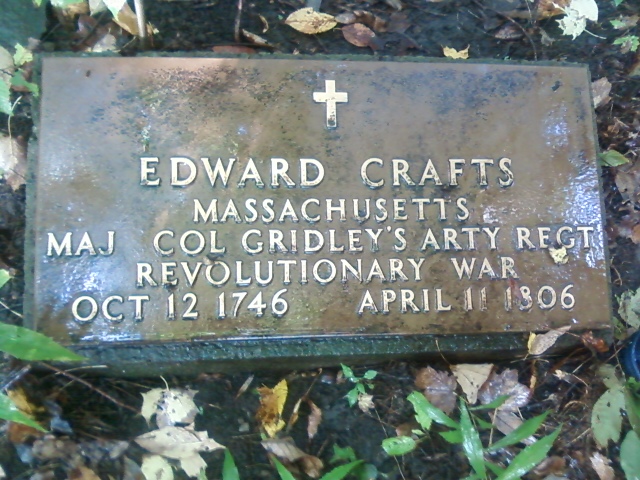
[The photo above shows the modern marker on Edward Crafts’s grave in Potter, New York, where the family moved in 1792, courtesy of Find a Grave. The original stone also survives there.]

Tuesday, August 04, 2020

“Assertions that Salem, Marblehead and Newbury had departed”

On 31 July 1770, Faneuil Hall hosted another meeting of “The Trade and Inhabitants of the Town of Boston.” The group of people invited to participate had widened again to include not just businessmen but all “Inhabitants.”

Per the report in the 13 August Boston Gazette, the spur for this meeting appears to have been “some very positive Assertions that Salem, Marblehead and Newbury had departed from the Non-Importation Agreement.”

In his copy of that newspaper, Harbottle Dorr wrote that those assertions came from the merchant John Amory (1728-1803, shown here courtesy of the Museum of Fine Arts).

Amory and his brother Jonathan (1726-1797) had a mercantile house together. They hovered in the political middle—not taking strong stands, signing the non-importation agreement but not following it strictly, protesting against too much protest. Eventually John would be a Loyalist exile while Jonathan remained in America.

At this juncture, it appears, John Amory was telling his colleagues in the Boston business community that other ports in the province would soon be bringing in goods, so they might as well drop their boycott.

The meeting responded by appointing a committee of William Molineux, William Phillips, William Cooper, William Greenleaf, and, for diversity, Ebenezer Storer ”to repair forthwith to the Towns above said and Haverhill” and find out what was going on.

In addition, the Body named a larger group of top Whig politicians—John Hancock, Phillips, Samuel Adams, Molineux, Greenleaf, Dr. Joseph Warren, Dr. Thomas Young, John Adams, Josiah Quincy, Richard Dana, Henderson Inches, Thomas Cushing, and Jonathan Mason—“to consider what may be proper to be done toward strengthening a Union of the Colonies.”

On 7 August, the Molineux committee returned from Essex County and “reported that the Conduct of our Brethren in said Towns was honorable and sincere.” The Boston meeting that day “VOTED UNANIMOUSLY” to express their “utmost satisfaction” and “sincere Respect” for their colleagues to the north.

That gathering then appointed a similar committee—Molineux, Cooper, William Whitwell, Thomas Boylston, and Mason—to take the same message to “Providence and New Port in Rhode Island.”

Only after that 7 August meeting—two weeks after the initial 31 July response to Amory—did Edes and Gill report on these proceedings. The Boston Whigs had evidently been sitting on the story until they had good news to announce. It wouldn’t have helped the non-importation movement for other port to read any hint that some Massachusetts towns were dropping out.

TOMORROW: What really happened in Salem?

Saturday, September 07, 2019

Fortifying Newburyport Harbor

Last month Alexander Cain laid out some new research about how Newburyport and nearby towns worked quickly at the start of the Revolutionary War to fortify that small harbor against the Royal Navy:
It appears two possible events triggered the move to fortify the Merrimack River in 1775. The first was the Ipswich Fright which occured in the days after Lexington and Concord. This particular event was the result of a false rumor that British soldiers had landed in Ipswich and had killed the local populace. As the rumor spread, widespread panic set in among the residents of several North Shore Massachusetts towns and many, including those from Newburyport, fled to New Hampshire.

The second event transpired the following month when a detachment of British sailors and officers from the HMS Scarborough entered Newburyport Harbor under the cover of darkness to scout the town’s defensive capabilities. According to the Essex Journal, “last Tuesday evening (May 23) a barge belonging to the man of war lying at Portsmouth, rowing up and down the river to make discoveries with two small officers and six seamen.” Unfortunately, the mission was an utter failure as the “tars not liking the employ, tied their commanders, then run the boat ashore, and were so impolite as to wish the prisoners good night, and came off.” Upon entering Newburyport, the deserters alerted the town of the mission and the location of the officers. However, “the officers soon got loose and rowed themselves back to the ship” before they were apprehended.

The two events rattled Newburyport. Many residents realized that if a Royal Navy warship entered the Merrimack, it could easily sail down the river and not only bombard the town, wharves and shipyards, but it could also raze Salisbury and Amesbury. As a result, officials from the three towns and Newbury agreed that the mouth or the river, as well as the harbor itself, needed to be fortified.
The result, Alex Cain writes, was “an early warning network and at least three defensive lines that included coastal fortifications, physical obstructions, floating batteries, interior redoubts and two companies of militia that were on a constant state of alert.” This made Newburyport a refuge for merchant ships sympathetic to the American cause and a base for American privateers. At least for a couple of years. When the war moved south, the port and its protection became less important.

Saturday, July 27, 2019

Considering Jonathan Plummer, Jr.

Last year Alex Cain shared a detailed profile of Jonathan Plummer, Jr., a Revolutionary War veteran celebrated as “poet laureate to Lord Timothy Dexter.”

Alex wrote:

Jonathan Plummer Jr. was born in 1761 Newbury, Massachusetts and was the oldest of eight children. According to historian Roger W. Higgins, Plummer was “sickly through infancy and early childhood was mentally weak and easily imposed upon.” As a teenager, he acquired a “reputation records from for being a strange and wayward boy with a flair for revival meetings.”

Even Plummer himself noted “my reading, traveling, and thirst for knowledge, too … began to operate to my disadvantage . . . to make me what they called an odd fellow — that is, different from the young fellows who were not readers . . . I was already so insufferably unfashionable as to begin to talk in young company of religion, virtue, poets, philosophers, lords, generals, statesmen, kings, battles, sieges, &c. &c. . . . this made the young people think that I thought myself better than them, and made them resolve to make me feel the torturing effects of their vindictive vengeance.”
This description makes me wonder if Plummer would today be diagnosed as on the autism spectrum. He was clearly intelligent, with a particularly good memory, but socially awkward throughout his life. Historians shy away from applying modern psychiatric diagnoses to people of the past, in large part because those diagnoses are themselves often culturally shaped. At the same time, recognizing that some conditions may have been part of being human all along might be helpful.

Wednesday, May 29, 2019

Capt. Robert Newman, Freemason

I’m seeking to distinguish the two men named Robert Newman who lived in the North End and died two years apart in 1804 and 1806.

According to the records of the St. John’s Lodge of Freemasons in Boston, a Robert Newman became a member in 1783. At the end of 1792 he was chosen to be one of the “Toilers for the ensuing year.”

In 1790 a new Masonic lodge was founded in Newburyport. Four years later, those Freemasons conferred the higher title of “Knight Templar” on Robert Newman.

I’m convinced both these items refer to Capt. Robert Newman, the mariner who commanded a privateer during the Revolutionary War. He had a house in Boston in the mid-1780s and a family in Newbury by 1790. As a ship’s captain he was of the right socioeconomic class to join a Masonic lodge in that period.

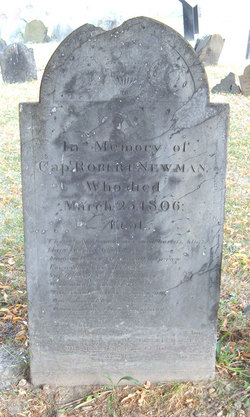
The mariner’s early-1800s gravestone at the Copp’s Hill Burying Ground displays Masonic emblems (above the word “Memory”). That stone reads:
In Memory of
Capt. ROBERT NEWMAN,
Who died
March 23, 1806;
Æt. 51.

Though Neptune’s waves and Boreas’ blasts
Have tossed me to and fro,
Now well escaped from all their rage,
I’m anchored here below.
Safely I’ll ride in triumph here,
With many of our fleet,
Till signals call to weigh again,
Our Admiral Christ to meet.
O may all those I’ve left behind
Be washed in Jesus’ blood,
And when they leave this world of sin
Be ever with their Lord.

ALSO IN MEMORY OF CAPT. ROBERT NEWMAN, JUN.
WHO DIED AT SEA Dec. 14, 1816.
The other Robert Newman living in Boston’s North End until 1804 was unlikely to have been a Freemason, I believe. He was a church sexton, a profession then associated with poverty. He didn’t command genteel authority in that society. But through the quirks of history, Newman the sexton has been posthumously made a Mason.

Tuesday, May 28, 2019

Two Robert Newmans in the North End

Map of Boston's North End, bristling with wharves, in 1769
On 13 Mar 1806, the Independent Chronicle of Boston ran this death notice:
Mr. Robert Newman, aged 51. His funeral will be from his late dwelling-house, head of Battery-Wharf, north-end, this afternoon, at 4 o’clock; which the relations and friends are requested to attend.
This was not the same Robert Newman as the man who hung the lanterns in the Old North Church on 19 Apr 1775. That Newman’s death notice had appeared in the Independent Chronicle two years earlier on 28 May 1804:
On Saturday last, Mr. Robert Newman, aged 52—for many years sexton of the North Church. He put a period to his existence with a pistol.
Those two death notices show that there were two men named Robert Newman living in Boston’s North End at the same time. I don’t know if they were related, but they weren’t part of the same household.

Those two Robert Newmans have been thoroughly confused and conflated in local history. So I’m going to try to sort them out.

The Robert Newman who died in 1806 was born in or around 1755. He enlisted in Col. Moses Little’s regiment out of Ipswich in May 1775, as shown in Massachusetts Soldiers and Sailors of the Revolutionary War. He served a few months that year. He may have also served short stints in 1778 and 1779 and then on the brigantine Pallas during the Penobscot expedition. This Newman married Esther Treadwell in Ipswich on 22 May 1778.

In September 1779 a group of men petitioned the Massachusetts Council to commission this Robert Newman as commander of a privateer ship: the Adventure out of Beverly. The 16 Mar 1780 Independent Chronicle ran a legal notice referring to “Robert Newman, commander of the armed schooner Adventure.” He turned twenty-five that year.

Robert Newman “at the North End” of Boston was appointed to administer a shipwright’s estate in 1785, according to the 26 September Boston Gazette. This was probably the mariner. He appears to have made a home in Boston while maintaining his family up on the North Shore.

In July 1790 a child of Robert Newman died in Ipswich of “fits.” On 13 Aug 1797, a four-month-old child of Robert and Esther Newman died in Newbury. One week later, four children of Robert Newman were baptized in that town at once: Robert, Sally, Thomas, and William.

The 25 Mar 1800 Newburyport Herald reported that “Mrs. Newman, consort, of Capt. Robert Newman,” had died. Newbury vital records confirm her name was Esther, and she was forty-three years old. Six years later the captain himself died in Boston.

Meanwhile, the other Robert Newman was working as the sexton of Christ Church, better known now as Old North. In addition to hanging the lanterns in April 1775, he has also appeared on Boston 1775 charging visitors to see the bodies of British officers killed in the Battle of Bunker Hill.

In May 1786 the selectmen of Boston designated twelve men as “Undertakers” and set the prices for burial, tolling a bell, alerting mourners, and “Extraordinary cases, such as putting the bodies into tar’d sheets.” Most if not all those men were sextons, and among them was Robert Newman.

On 14 June 1794 the Centinel reported that the next day Mrs. Abigail Sumner’s funeral would take place “from the house of Mr. Robert Newman, Salem Street.” That looks like part of his work as an undertaker since I can’t find any family connection.

The sexton had married Rebecca Knox in 1772, but divorced her for having an affair with “one John Skinner.” On 5 Feb 1791 the Columbian Centinel reported the death of “Mrs. Rebecca Newman, formerly the wife of Mr. Robert Newman, aged 41.” The sexton had already married again, to Mary Hammond, who would bear more of his children and settle his estate. This Robert Newman took his own life in 1804.

TOMORROW: The Freemasonry connection.

Friday, January 11, 2019

The Brazen Head and a Bridge in Newbury

An item one could buy at the Sign of the Brazen Head in 1759, but which Mary Jackson didn’t list in her advertising, was a lottery ticket.

We know that from an ad that appeared in the Boston Evening-Post on 30 April:
The Drawing of Newbury Lottery
(the Second Part) will punctually commence at the Town-House in Newbury, on Thursday the last Day of May next, there being a Subscription for the Tickets then unsold, if any there shall be.———

[pointing hand] Tickets to be had of Ebenezer Storer, Esq; Messrs. Timothy Newell, William Jackson and James Jackson, in Boston; Capt. Bowen and Mr. Chipman in Marblehead; Mr. Pyncheon in Salem; Mr. Symonds in Danvers; Daniel Gibbs, Esq; and Mr. Daniel Sargent in Gloucester; Major Epes, Capt. Staniford, and Mr. William Dodge in Ipswich; James M’Hard Esq; and Mr. Joseph Badger in Haverhill, and of the Managers in Newbury.

Note, But two Blanks to a Prize.
What was all that about? The town of Newbury wanted to build a bridge over the Parker River to replace a ferry that had operated for over a century. In fact, the town had wanted to build such a bridge since 1734, according to John J. Currier’s “Ould Newbury” (1896). In that year the town meeting had voted to approve such a bridge on certain conditions:
  • It had to be wide enough for coaches.
  • Its main arch had to be tall and wide enough for boats laden with hay to pass through.
  • It wouldn’t cost the town of Newbury anything.
  • It would be free to use.
  • It had to be built within ten years.
It may not be surprising that no one undertook to fulfill all those conditions.

But the idea remained. In 1750 the Newbury town meeting and the Massachusetts General Court again approved of the idea of building a bridge. The legislature was involved because this time the planners proposed financing the bridge with a lottery, and the law needed provincial approval. The development team received authority to raise £1,200 that way.

In 1758 Ralph Cross finished building the bridge. It was 26 feet wide, 870 feet long, and had eight wooden arches. That structure no longer exists, but the present Parker River Bridge, built mainly in 1853 with stone arches, stands at the same spot.

Even after the bridge opened, however, the men behind it were still raising money. In fact, in April 1760 the legislature authorized a second lottery, and in February 1763 a third, to finish paying for the bridge and then to pay for its maintenance. Ads in the Boston newspapers for lottery tickets continued to direct customers who felt lucky to William and James Jackson, especially William.

When managers announced such lotteries, they had to be open about the terms. For example, the 1760 Newbury lottery stated that there were 5,000 tickets costing $2 apiece. One ticket would win $500, four would win $100, five $50, six $40, ten $30, fourteen $20, forty-five $10, seventy-five $8, and 1,495 tickets $4. The remaining 3,345 tickets were “blanks,” meaning their holders won nothing.

In all, just under one-third of all the tickets in the Newbury Lottery gave back more than a ticket-buyer had invested. That’s what the ad above meant by “Note, But two Blanks to a Prize.”

The goal of the 1760 lottery was to bring in $10,000. Of that sum, $9,000 was earmarked for prizes and the rest for the bridge. But raising a full £1,000 meant selling through the whole run of tickets, and that was a challenge. The 1759 drawing advertised above depended on some people promising “a Subscription for the Tickets then unsold.” As of March 1761 there were still unsold tickets for the second lottery, and the Newbury town meeting was asked what the town should do about it.

Today’s state lotteries operate under different rules, but one thing hasn’t changed: the expectation value of a ticket is still less than its price.

TOMORROW: Technical info.

[Above: A 1765 ticket from the long-running Faneuil Hall lottery signed by one of the managers, John Hancock.]

Sunday, December 30, 2018

“Overset in the Storm near the Isle of Sholes”

In the Boston newspapers printed on Thursday, 15 Sept 1735, we can watch the maritime town struggle to gather and digest news of a calamity at sea. First, the Boston Post-Boy:
Last Monday Night we had a hard Storm, the Wind from N. E. to S. E. in which sundry Vessels were drove on Shoar in the neighbouring Ports . . .

We hear, that a Sloop belonging to Newbury, one Offin Boardman Master, bound from Casco-Bay to this Place, having a Raft of Masts at her Stern, was overset in her Passage, on Monday Night last, and thirteen People drown’d, being all the Persons on board, Nine of them were Passengers; she was carried into the Isle of Shoals last Wednesday.
This Offin Boardman (1698-1735) was the grandfather of a man of the same name who commanded a privateer during the Revolutionary War and lived on Historic New England’s Spencer-Pierce-Little Farm after 1796.

Here’s the 15 Sept 1735 Boston Gazette:
Monday Night last in the Storm Offin Boreman bound from Casco to Newbury in a Sloop laden with Lumber, was overset in the Storm near the Isle of Sholes she had on board 8 or 10 Passengers, some belonging to this Town, among whom were three Married Women, all lost; we have heard the Names of some of ’em but not with the certainty as to mention ’em. Mr. Boreman has left a Wife and 3 or 4 Children, and had on board with him a valuable Negro.
That evening came the Boston Evening-Post:
Monday Night last we had a very severe Storm of Wind at N. E. which did some Damage to the Shipping in our Harbour . . .

The same Night a Sloop coming from Casco-Bay, Offin Boardman of Newbury Master, was overset near the Isle of Shoals, and all the People drowned. ’Tis said there were on board, (besides Three Men belonging to the Sloop,) Ten Passengers, some of which belonged to this Town, but tho’ several Sloops came in Yesterday from Casco-Bay, yet we cannot get a particular Account of their Names. We hear that the Sloop has been since found, and is towed into the Isle of Shoals.
A week later, the 22 Sept 1735 Boston Post-Boy finally provided specifics:
We have now certain Information, That in the Sloop which was overset in the violent Storm we had last Monday Night was Se’n-night, as mention’d in our last, there were but Eight Persons, all of whom were drowned, viz. Offin Boardman, Master, Thomas Coker and Edmund Pilsbury, all of Newbury; a Man belonging to the Sloop, whose Name was cannot learn; Mr. James Jackson of Boston, Founder; the Wife of Nathaniel Lock, the Wife of John Sweet, and the Wife of William Bucknam, all of Casco-Bay.
At the Sign of the Brazen Head in Boston, Mary Jackson was left a widow with two sons. William was four years old, and James was only four months.

COMING UP: Picking up the pieces.

Tuesday, June 21, 2016

Samuel Gerrish “unworthy an Officer”

As I described yesterday, Col. Samuel Gerrish of Newbury was the first infantry officer to receive a Massachusetts commission in May 1775, but then ran out his string with a series of embarrassing actions and lack of action.

On 17 August, the Continental Army court-martialed Gerrish on the charge “That he behaved unworthy an Officer.” With Gen. Nathanael Greene presiding, a panel of officers found him guilty and ordered him “to be cashiered, and render’d incapable of any employment in the American Army.” Gen. George Washington approved that sentence on 19 August.

Washington’s private letters show that he was pleased with that outcome and, whatever incident was behind the formal charge, linked it to Gerrish’s behavior at Bunker Hill. To his overseer Lund Washington the commander wrote:

The People of this Government have obtained a Character which they by no means deserved—their Officers generally speaking are the most indifferent kind of People I ever saw. I have already broke one Colo. and five Captain’s for Cowardice, & for drawing more Pay & Provision’s than they had Men in their Companies. . . .

in short they are by no means such Troops, in any respect, as you are led to believe of them from the Accts which are published, but I need not make myself Enemies among them, by this declaration, although it is consistent with truth. I daresay the Men would fight very well (if properly Officered) although they are an exceeding dirty & nasty people. had they been properly conducted at Bunkers Hill (on the 17th of June) or those that were there properly supported, the Regulars would have met with a shameful defeat; & a much more considerable loss than they did. . .

it was for their behaviour on that occasion that the above Officers were broke, for I never spared one that was accused of Cowardice but brot ’em to immediate Tryal.
Likewise he told Richard Henry Lee that he “Broke one Colo. and two Captains for Cowardly behaviour in the action on Bunker’s Hill.” Gen. William Heath later told John Adams that Gerrish’s fault had been “Backwardness in Duty on the 17th. of June.”

According to Swett, judge advocate general William Tudor later said that Gerrish “was treated far too severely.” (At the time, however, Tudor’s main complaint to his mentor John Adams was that the courts-martial were unfair to him because of all the work he had to do.)

Samuel Gerrish went back to Newbury. Loammi Baldwin took over the leadership of the regiment. However, not everyone had lost respect for Gerrish since his town elected him to the Massachusetts General Court the next year.

Monday, June 20, 2016

Samuel Gerrish, First Officer of the Massachusetts Army

Last month I wrote about how the Massachusetts Provincial Congress finally started commissioning infantry officers for its army (as opposed to its militia) on 19 May 1775.

The first colonel to receive a commission was Samuel Gerrish (c. 1729–1795) of Newbury. I thought it would be interesting to look at what happened to him.

First of all, according to historian Richard Frothingham, Gerrish’s regiment wasn’t as complete as the congress had been led to believe; “there were difficulties in relation to six of the companies, which were investigated June 2.” Five of the companies originally listed under Gerrish’s name asked to serve under another Newbury colonel, Moses Little. It took another twenty days before eight companies were fully commissioned under Gerrish.

During that spring the regiment was spread out along the north side of Boston harbor with three companies at Chelsea, three in east Cambridge, and two at Sewall’s Point, the finger of Brookline land in front of the Charles and Muddy Rivers. On 16 June the officers of the regiment met at Chelsea and assigned jobs: Loammi Baldwin to be lieutenant-colonel, Richard Dodge major, Christian Febiger adjutant, and so on. This was the New England way, electing from below rather than the colonel appointing from above.

One day after that meeting, of course, came the Battle of Bunker Hill. In 1870 the Quincy family presented to the Massachusetts Historical Society one sheet of what had been a two-page letter describing the fight. Whoever wrote that account took particular notice of Col. Gerrish’s behavior, referring to him by his rank from the French & Indian War:
Major Gerrish was ordered also to Charlestown with a reinforcement, but he no sooner came in sight of the enemy than a tremor seiz’d him & he began to bellow, “Retreat! retreat! or you’l all be cutt off!” which so confus’d & scar’d our men, that they retreated most precipitately, & our soldiery now sware vengeance against him & determine not to be under his commd.
The historian Samuel Swett later wrote that Gerrish “was unwieldy from excessive corpulence”; on reaching Bunker’s Hill above the fighting, “he declared that he was completely exhausted, and lay prostrate on the ground.” Col. Israel Putnam roared at all the men stalled on that hill, hitting some with his sword, but they refused to go farther down and eventually retreated.

There was plenty of blame to go around after that battle. Other Massachusetts officers hadn’t even taken their troops onto the peninsula as Gerrish had. Swett wrote, “A complaint was lodged against him with [Gen. Artemas] Ward immediately after the battle, who refused to notice it on account of the unorganized state of the army.”

Not that Col. Gerrish was helping alleviate that disorganization. On 7 July the new commander-in-chief’s secretary, Joseph Reed, wrote to him to ask a second time for a return of all the men in the regiment. “The Express [to the Continental Congress] has been detain’d some time thro’ this Inattention,” Reed chided, “The Forces raised in Connecticut, New Hampshire & Rhode Island having sent in their Returns very complete.”

Gerrish finally reported having 258 men in his regiment. Even after that, there were administrative problems. In August eight officers at Sewall’s Point wrote to headquarters to complain that most of them had “been here in actual Service, since the Beginning of the Campaign, and been to a vast Deal of Expense, and not receiv’d one farthing of our pay.”

In early August, British floating batteries made some attacks on American positions near the water. One fired on Sewall’s Point. Instead of shooting back at that boat, Gerrish told his men to put out any lights and hunker down behind their fortifications. He was reported to have said, “the rascals can do us no harm, and it would be a mere waste of powder, to fire at them with our 4 pounders.” Technically, Gerrish might have been right. The British shots caused no casualties. But the colonel had used up any benefit of the doubt about his behavior in battle.

TOMORROW: Washington weighs in.

Thursday, January 03, 2013

Reviewing the Review

The Massachusetts Historical Review is the Massachusetts Historical Society’s annual journal. It usually contains about four scholarly papers and some book reviews. Copies go to members and subscribers, and people with access to J-STOR can see the articles individually.

Volume 14, published at the end of last year, has three articles on eighteenth-century New England history, which made it particularly interesting for me. (Some issues focus on the U.S. Civil War, industrialization, and other minor topics.) There’s also a review by Chernoh M. Sesay of both Vincent Carretta’s biography Phillis Wheatley (discussed back here) and the essay collection Venture Smith and the Business of Slavery and Freedom.

The issue’s first paper is “Boston’s Historic Smallpox Epidemic,” by Amalie M. Kass. It recounts the dispute over the new smallpox inoculation in 1721-22. The Rev. Cotton Mather and Dr. Zabdiel Boylston favored the new technique. Dr. William Douglass and the young printer James Franklin were the loudest voices against it. In the end, the numbers showed its value—one of the earliest uses of epidemiological statistics to settle a scientific question.

There have been many studies of that event over the years because the principal figures helpfully wrote a lot about it. This webpage from Harvard offers links to their original back-and-forth pamphlets and a bibliography of later studies. Here’s a PDF download of one more article from John Hopkins, another from Illinois Wesleyan, and a recent undergraduate thesis at William & Mary.

I found Kass’s article to be a solid and thorough narration of events without many surprises. One thing that did intrigue me was that Mather had stumbled onto the germ theory of disease:
The Animals that are much more than Thousands of times Less than the finest Grain of Sand, have their Motions; and so, their Muscles, their Tendons, their Fibres, their Blood, and the Eggs wherein their Propagation is carried on. The Eggs of these Insects (and why not the living Insects too!) may insinuate themselves by the Air, and with our Ailments, yea, thro’ the Pores of our skin; and soon gett into the Juices of our Bodies.
The minister’s microscopes weren’t good enough to really see germs, much less the smallpox virus, and this passage from his book The Angel of Bethesda wasn’t published until the 20th century. So he was very lucky to hit on the right idea without strong evidence and quite unlucky not to be able to publish his work and get credit for it.

The next paper is Douglas L. Winiarski’s “The Newbury Prayer Bill Hoax: Devotion and Deception in New England’s Era of Great Awakenings.” Winiarski is writing a study of changing New England Congregationalism in the 1700s, to be titled Darkness Falls on the Land of Light. As I reconstruct events, that research included cataloguing “prayer bills,” or short handwritten notes seeking prayer that congregants handed to ministers or left at meetinghouses to be read during services. And that led Winiarski to one such prayer bill, preserved at the Historical Society of Old Newbury and published in Joshua Coffin’s 1845 local history (with modernized spelling and capitalization).

That handwritten document purports to be a prayer by the Rev. Christopher Toppan of Newbury himself, worried about the devil causing his horse to throw him. Winiarski examines it against scores of other prayer bills, finding it unusually long and detailed, as well as oddly spelled and not from Toppan’s own hand. (It’s also inconsistent in its use of the long S, a detail not noted in the paper.)

Winiarski describes the furor of what was later called the “First Great Awakening,” in which Toppan first welcomed and then opposed the preaching of the Rev. George Whitefield. The paper concludes that this document was written and posted to lampoon Toppan and not, as first published, a sincere (if “deranged”) prayer by him. There’s no clue pointing to the real culprit, however. The great value of Winiarski’s paper is its look at New England religious practices in the 1740s. That one curious document can be a peephole into the New Light/Old Light debate.

TOMORROW: A study of one runaway slave, or many.

Tuesday, May 29, 2012

Samuel Williams: minister, astronomer, fugitive,…

Along with future physician Isaac Rand (profiled yesterday), Prof. John Winthrop took a young man named Samuel Williams (1743-1817) up to Newfoundland in 1761 to help observe the transit of Venus.

After that experience Williams, son of a Waltham minister (and former young captive from the Deerfield raid of 1704), set out on a rather conventional career path. He became minister at Bradford, Massachusetts. But he also kept up his scientific interests. In 1769 Williams observed the decade’s second transit of Venus from Newbury, publishing his observations through the American Philosophical Society seventeen years later.

In 1780 Williams succeeded Winthrop as Hollis Professor of Mathematics and Natural Philosophy at Harvard. That year he wrote about New England’s famous “Dark Day” and led a small college expedition to Maine to watch the Moon eclipse the Sun.

That trip was hampered by the fact that Williams decided that the best place to make his observations was an island in Penobscot Bay which the British military had just defended from a large Massachusetts attack. As with the 1761 transit of Venus, however, warring governments were willing to let gentlemen make observations for the sake of science.

Later in the 1780s, Harvard student John Quincy Adams wrote: “Mr. Williams is more generally esteemed by the students, than any other member of this government [i.e., college faculty]. He is more affable and familiar with the students, and does not affect that ridiculous pomp which is so generally prevalent here.”

But in 1788 Prof. Williams suddenly had to depart Harvard—and the U.S. of A. He was charged with forgery for falsifying a receipt from a trust he administered. Williams rode north, leaving his family in Cambridge to await word of where to find him.

Williams settled in Rutland, Vermont, and found work as a legal copyist and minister, first fill-in and then full-time. He brought his family north and rebuilt a respectable life. Williams launched the Rutland Herald newspaper and edited it for three years. He published a history of the state and a short history of the Revolution for use in schools. Williams helped found the University of Vermont and in 1806 used his astronomical knowledge to settle the state’s northern boundary with Canada.

One of the telescopes Williams reportedly used is shown above courtesy of the Smithsonian Institution. The museum’s webpage says Williams used this one to observe the 1769 transit of Venus, but also implies he was a Harvard professor at the time. Soon I’ll share links to more of Williams’s equipment.

In 2009 Robert Friend Rothschild published Two Brides for Apollo, a sympathetic biography of Williams. I believe the title refers to the two types of astronomical events Williams studied: the transit of Venus and the solar eclipse.

Monday, June 21, 2010

Elizabeth Royal: sergeant’s wife and refugee

The records of the Massachusetts Provincial Congress’s Committee of Safety for 21 June 1775 contain this intriguing resolution:

That Joseph Adams, driver of the stage from Newbury, be, and he hereby is directed, to transport back to Newbury, Elizabeth Royal and her child, who, as she says, is wife to William Royal, first sergeant in the 63d regiment of foot, now in Boston, and deliver her to the care of the selectmen of said Newbury, who are hereby directed to provide for her and her child, at the expense of the colony.
I haven’t been able to turn up anything more about this situation or these people. (A Joseph Adams set up a stage service between Haverhill and Boston in 1793 and engaged in an advertising war with a rival; but that Adams appears to have been new to the coach business.)

Was Elizabeth Royal a native of Newbury who had married Sgt. William Royal? Had she and her child been living in Newbury, separate from her husband? Had Elizabeth been captured on a ship that came into Newbury harbor, and then the local authorities had to figure out what to do with her?

Most important, if Elizabeth wanted to go into Boston to reunite with her husband, why did the Committee of Safety send her away and take on the expense of maintaining her?

More about this story might exist in manuscript form—the Newbury selectmen’s records, the 63rd’s muster rolls, the state’s expense accounts, &c. But for now it’s a mystery.

Monday, October 05, 2009

“Accompanied by a drum and the common cryer”

In his 1845 history of Newbury and Newburyport, Joshua Coffin described an event he dated to 15 Nov 1774:

One Holland Shaw, having been detected in stealing a shirt, was immediately taken before a sort of ex tempore court, convened for the occasion, was sentenced as follows, namely, ‘that he parade through the principal streets of the town, accompanied by the town crier with his drum.’ The sentence was forthwith put into execution.

The town crier, William Douglass, with his brass barreled drum, and the thief with the shirt, headed the procession, which took up its line of march. The paper of that day informs us, ‘that he was compelled to proclaim his crime and produce the evidence, which was the shirt with the sleeves tied round his neck, the other part on his back,’ The proclamation, which he was compelled to utter with a loud voice, was, ‘I stole this shirt, which is tied round my neck from Mr. Joseph Coffin’s house in Salisbury, and I am very sorry for it.’

Having been thus marched through the principal streets, and satisfied the demands of this new court of justice, he was dismissed, and never, after that night, was he seen in Newburyport.
Coffin quotes from a “paper of that day,” which sent me to my favorite newspaper database to look for the original article. After several fruitless searches, I came across an item from the 16 Feb 1774 Essex Journal, published in Newburyport.

It’s a letter to the newspaper signed “Philo Publis Justicia” (Love of Public Justice). Most of the text is taken up with mild complaints about local magistrates (“very often out of town”) and more serious complaints about how the London government was paying salaries to the judges on the Massachusetts Superior Court, thus making them independent of the local people. And it closes:
it seem the public have lost confidence in the executive part of government since the Judges are pensioned by our step-mother for yesterday the posse assisted prestine justice in the arrest of a theif who had stole a shirt, and upon his trial before her bar confessed;

upon which, (similar to her sentences in other parts of the province, for justice is always the same every where) ordered the convict to parade the length [?] of this town, accompanied by a drum and the common cryer, who at the corner of each street [?] should proclaim his crime and produce the evidence, which was the shirt, with the sleeves tied round his neck, the other part on his back, making the appearance of a stripped jackcoat, which sentence was punctually performed to the satisfaction of the court.
This item doesn’t contain any of the names that Coffin listed—those of the thief, the victim, and the crier. It also suggests that the “common cryer” rather than the thief made the announcements of the crime, and that the “drum” was separate from that crier, most likely one of the militia regiment’s usual drummers.

So where did Joshua Coffin get the details he wove around into the newspaper account? The victim was his great-grandfather, so the full story might have been part of his family lore.

The photograph above shows the house, built starting in 1678, where both Joseph Coffin and Joshua Coffin lived. It’s now owned by Historic New England. The image comes courtesy of Newbury 375, which is preparing to celebrate the 375th anniversity of the founding of Newbury next year.

TOMORROW: More town criers at work.

Sunday, November 05, 2006

Pope Night in Newbury, Massachusetts

In the pre-Revolutionary decades, New Englanders (and, Prof. Brendan McConville has told me, folks in some parts of New Jersey) celebrated the Fifth of November—called Bonfire Night or Guy Fawkes' Day in England—as "Pope Night" or "Pope Day." This detailed description of the celebration comes from Joshua Coffin's A Sketch of the History of Newbury, Newburyport, and West Newbury, published in 1835.

In the day time, companies of little boys might be seen, in various parts of the town, with their little popes, dressed up in the most grotesque and fantastic manner, which they carried about, some on boards, and some on little carriages, for their own and others’ amusement. But the great exhibition was reserved for the night, in which young men, as well as boys, participated.

They first constructed a huge vehicle, varying, at times, from twenty to forty feet long, eight or ten wide, and five or six high, from the lower to the upper platform, on the front of which, they erected a paper lantern, capacious enough to hold, in addition to the light, five or six persons. Behind that, as large as life, sat the mimic pope and several other personages, monks, friars, and so forth.

Last, but not least, stood an image of what was designed to be a representation of old Nick himself, furnished with a pair of huge horns, holding in his hand a pitchfork, and otherwise accoutred, with all the frightful ugliness that their ingenuity could devise.

Their next step, after they had mounted their ponderous vehicle on four wheels, chosen their officers, captain, first and second lieutenant, purser, and so forth, placed a boy under the platform, to elevate and move round, at proper intervals, the movable head of the pope, and attached ropes to the front part of the machine, was, to take up their line of march through the principal streets of the town.

Sometimes, in addition to the images of the pope and his company, there might be found on the same platform, half a dozen dancers, and a fiddler, whose
‘Hornpipes, jigs, strathspeys, and reels,
Put life and mettle in their heels,’
together with a large crowd, who made up a long procession.

Their custom was, to call at the principal houses in various parts of the town, ring their bell, cause the pope to elevate their head, and look round upon the audience, and repeat the following lines.
‘The fifth of November,
As you well remember,
Was gunpowder treason and plot;
I know of no reason
Why the gunpowder treason,
Should ever be forgot.
When the first king James the sceptre swayed,
The hellish powder plot was laid.
Thirty-six barrels of powder placed down below,
All for old England’s overthrow:
Happy the man, and happy the day,
That caught Guy Fawkes in the middle of his play.
You’ll hear our bell go jink, jink, jink;
Pray madam, sirs, if you’ll something give,
We’ll burn the dog, and never let him live.
We’ll burn the dog without his head,
And then you’ll say the dog is dead.
From Rome, from Rome, the pope is come.
All in ten thousand fears;
The fiery serpents’ to be seen,
All head, mouth, nose, and ears.
The treacherous knave had so contrived,
To blow king parliament all up alive.
God by his grace he did prevent
To save both king and parliament.
Happy the man, and happy the day,
That caught Guy Fawkes in the middle of his play.
Match touch, catch prime,
Is the good nick of time.
Here is the pope that we have got,
The whole promoter of the plot.
We’ll stick a pitchfork in his back,
And throw him in the fire.’
After the verses were repeated, the purser stepped forward, and took up his collection. Nearly all on whom they called, gave something. . . . After perambulating the town, and finishing their collections, they concluded their evening’s entertainment with a splendid supper; after making, with the exception of the wheels, and the heads of the effigies, a bonfire of the whole concern, to which were added, all the wash tubs, tar barrels, and stray lumber, that they could lay their hands on.
TOMORROW: How Boston's Pope Night was different.