J. L. BELL is a Massachusetts writer who specializes in (among other things) the start of the American Revolution in and around Boston. He is particularly interested in the experiences of children in 1765-75. He has published scholarly papers and popular articles for both children and adults. He was consultant for an episode of History Detectives, and contributed to a display at Minute Man National Historic Park.

Subscribe thru Follow.it


•••••••••••••••••


Showing posts with label George Baylor. Show all posts

Saturday, March 30, 2024

Leafing through the “Davenport Letters”
The Museum of the American Revolution in Philadelphia has just unveiled a webpage displaying seventeen letters written by Continental soldiers Isaac How Davenport (1754–1778) and James Davenport (1759–1824) of Dorchester.

The original letters don’t survive, but a nephew copied them into a ledger book, which remains in the family.

The museum is sharing scans of those transcripts as well as P.D.F. files of their text in the raw and with modernized punctuation for easier reading.

I presume the older brother was the “Isaac Davenport” listed among the Dorchester men who responded to the militia alarm on 19 Apr 1775.

Middle names were rarely used in New England at this time. It looks like Isaac How Davenport received his father’s mother’s maiden name, sometimes spelled Howe, as his middle name. In nineteenth-century histories of Dorchester, that man’s name was misprinted as “Isaac Shaw Davenport.”

Isaac became a member of the commander in chief’s guard and then the dragoons under Col. George Baylor. He spent several months of 1777–78 at Valley Forge, where he wrote two of the letters in this collection. Isaac Davenport was among the Continental dragoons killed in a nighttime raid on their billets on 27 Sept 1778.

The younger brother, James, enlisted in the Continental Army in February 1777, when he was seventeen years old, leaving behind an apprenticeship to a shoemaker. He served for the rest of the war, rising to the rank of sergeant in 1780. In 1777–78 he was also at Valley Forge, but his surviving letters start in 1780, getting more numerous late in the war when there was less to do besides write home.

After the war James Davenport returned from New York to Dorchester and used his earnings to build a house, marry, and start a family. He lived long enough to apply for a pension in 1818, sending in copies of his promotion to sergeant and his discharge signed by Gen. George Washington. Many veterans didn’t have such documentation.

The U.S. government initially awarded Davenport a pension, but then rescinded it. I suspect the problem was that Davenport wasn’t poor enough; the pensions of that decade required applicants to show need, and he owned a farm, a house, and cash.

Davenport tried to present himself as in need: “my health is much impaired by my services in the Army,” “My House was built more than 30 years ago,” his wife Esther was prone to illness.

In the end, though, James Davenport’s best claim to public support was his service. He described himself as “engaged at the Capture of Burgoyne, Cornwallis, at Monmouth & always with my Regiment.” (His regiment wasn’t actually at Yorktown.) A later law would have let him keep his pension because it wasn’t need-based, but by then there were fewer veterans to pay for.

After James Davenport died in 1824, Dorchester’s minister, the Rev. Thaddeus Mason Harris, preached at his interment. The published sermon reportedly “included excerpts from a journal of his wartime experiences.”

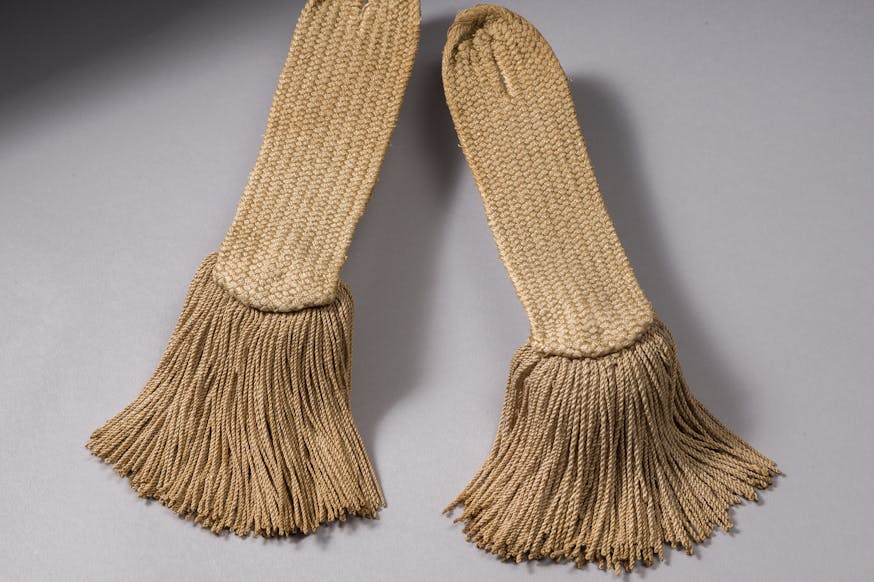
The Davenport family had not only preserved that journal until then and the texts of the letters, but also some mementos of James’s military service: a sword, epaulettes (shown above), and a pair of red wool baby booties reportedly made from a British coat. Those are now part of the Museum of the American Revolution’s collection, and can be viewed through the “Davenport Letters” webpage.

Tuesday, September 25, 2018

Meeting George Washington’s Indispensable Men

Back when I was researching Gen. George Washington’s life and work in Cambridge for the National Park Service, one of the books I drew on heavily was Arthur S. Lefkowitz’s George Washington’s Indispensable Men.

This is a study of the commander’s military secretaries and aides de camp throughout the Revolutionary War. It starts with a useful definition of its subject because descendants and local histories seem to have named almost any officer who was ever in a council with Washington as an aide. Lefkowitz focused on the men whom Washington officially appointed in his daily orders. Then he added Caleb Gibbs of the headquarters guard and Martha Washington, both of whom can be identified as helping with the headquarters paperwork.

And that paperwork is a major theme of the book. Early on Washington learned that he didn’t need young men to dash messages around battlefields.  (See George Baylor.) Instead, he needed penmen to help keep up with a vast correspondence directing an army spread out over thirteen governments. Washington quickly came to prefer professional men: lawyers (e.g., Robert Hanson Harrison), experienced merchants (William Palfrey), and even doctors (James McHenry).

One result of that preference is that it’s a mistake to think of Washington’s most famous aide, Alexander Hamilton, as a typical staff officer. He was younger and less established than most of his colleagues. Each of those men gets a thorough biographical profile in this book as Lefkowitz moves through the war, discussing how the work at headquarters developed in response to changing needs.

And speaking of Hamilton, I got to meet Arthur Lefkowitz last year. I suggested that Hamilton’s new Broadway hotness might help the book. He took that message back to folks at the publisher, Stackpole, and I’m pleased to report that George Washington’s Indispensable Men is now coming out in paperback—with the new subtitle Alexander Hamilton, Tench Tilghman, and the Aides-De-Camp Who Helped Win American Independence. I recommend it for anyone wanting to know about how Gen. Washington learned to manage the war.

Saturday, March 16, 2013

How Do You Solve a Problem like George Baylor?

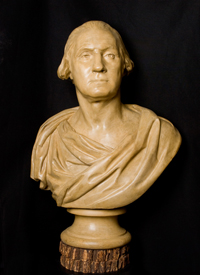
Yesterday I quoted a letter from Gen. George Washington noting that George Baylor (shown here) held a unique position among his aides de camp. Baylor was the equivalent of a bike messenger among paralegals. While the rest of the staff were good at composing and copying letters, orders, and other paperwork, Baylor was not a “ready Pen-man” and good only for riding.

(Which is not to say that Baylor wasn’t from the same genteel class as the other aides de camp. He was a Virginia planter not unlike Washington himself. But he didn’t have professional training as an attorney, businessman, or doctor, as Washington came to prefer in his aides.)

Of course, the commander-in-chief couldn’t just fire Baylor and fill the slot with another penman. Not when Baylor was the son of a companion from the French & Indian War. Not when he was the senior aide and perfectly agreeable about doing all the riding tasks Washington asked of him.

But there was a tradition in the eighteenth-century British army that after a major victory the commander would choose one aide to carry his official report back to the capital. That was a big honor for the junior officer, not least because another tradition held that the bearer of such good news usually got a promotion.

In 1762, for example, Gen. Robert Monckton sent Capt. Horatio Gates to London with word that the British forces had taken Martinique. The general recommended Gates “to His Majesty’s Favour, as a very deserving Officer.” Within five weeks of landing in England, Gates was promoted to major and given £1,000 toward purchasing a lieutenant colonelcy.

(The only problem is that victories like Martinique meant the war was soon over, the army downsized, and Gates never got the chance to rise further. That soured him on the whole British patronage system, turned him into a “red hot Republican,” and led him to move to America in 1773. But I digress.)

Washington didn’t have any battlefield victories to report to the Continental Congress until late December 1776, when he surprised the British and Hessian troops at Trenton. And whom did he choose to carry that news to Baltimore (the Congress having left Philadelphia because the royal forces were getting closer and closer)?

Washington chose George Baylor, of course! The general even added:
Colo. Baylor, my first Aid de Camp, will have the honor of delivering this to you, and from him you may be made acquainted with many other particulars; his spirited Behavior upon every Occasion, requires me to recommend him to your particular Notice.
The Congress accordingly made Baylor head of the new 3rd Continental Light Dragoon Regiment. Problem solved!

Friday, March 15, 2013

Washington Asks Lee for an Aide

In February 1776, Gen. George Washington was desperate enough for an aide de camp with the right skills that he asked Gen. Charles Lee to send him one. Specifically, he wanted William Palfrey (1741-1780, shown here), one of Lee’s aides in New York. Palfrey had worked for John Hancock before the war and was well respected by the Boston Whigs.

At that time, Washington was keeping the job of his military secretary open for Joseph Reed to return to it—which Reed never did. Aide de camp Robert Hanson Harrison was doing the secretary’s job, mustermaster general Stephen Moylan was helping out, but aide de camp George Baylor wasn’t much help at all when it came to office work.

On 10 February, Washington explained the situation to Lee in a letter:
It is unnecessary for me to observe to you, the multiplicity of business I am Involved In—the number of Letters, Orders, & Instruction’s I have to write—with many other matters which call loudly for Aids that are ready Pen-men—I have long waited in exasperation of Colo. Reeds return, but now despair of it. [Edmund] Randolph who was also ready at his Pen, leaves me little room to expect him [back from Virginia]; my business in short, will not allow me to wait, as I have none but Mr. Harrison (for Mr. Moylan must be call’d of to attend his duty as Commissary of Musters) who can afford me much assistance in that way, and he, in case Colo. Reed should not return, has the promise of succeeding him.

Now the Intention of this preamble is to know, whether, if Mr Palfrey (who from what I have seen and heard, is ready at his Pen) should Incline to come into my Family, for I have never directly or indirectly intimated the matter to him, although he has been very warmly recommended to me by some of his Friends for any thing that might cast up, you would consent to it—He would be of Singular use to me on another Acct also, and that is, the universal acquaintance he has with the People & characters of this Government [i.e., Massachusetts], with whom I have so much business to Transact.

Mr Baylor is as good, and as obliging a young Man as any in the World, and so far as he can be Serviceable in Riding, & delivering verbal Orders as useful; but the duties of an Aid de Camp at Head Quarters cannot be properly discharged by any but Pen-men—Mr [Anthony Walton] White in case of vacancy expected to be provided for in my Family, but as I believe he would be just such another as Baylor I must however disappointed he is be excused. Business multiplies so fast upon my hands that I am confined almost intirely to the House, and should be more so, if I am depriv[e]d of that assistanc[e] which is necessary to divide, & take of part of the trouble from my own Shoulders.
Lee would have had to invoke a military emergency to resist such a clear request by his superior and stand in the way of a promotion for Palfrey. At the time there was much more action in Boston than in New York. So Lee cheerfully sent Palfrey north, thus saving Washington’s headquarters from the return of Anthony Walton White.

In 2005 Sotheby’s sold this letter for $36,000.

TOMORROW: How Washington managed to divest himself of George Baylor.

Wednesday, March 13, 2013

Anthony Walton White Does Not Impress

On Thursday, I’m going to Gen. George Washington’s headquarters in Cambridge to speak about how he managed his generals and his staff. Back on 25 July 1775, a young man showed up at the same building hoping for a place on that staff.

Anthony Walton White (1750-1803) was a grandson of Lewis Morris, governor of New Jersey. He arrived with a recommendation letter from George Clinton of New York. His grandfather wrote another letter on his behalf, and his father wrote to Washington twice.

White wanted to join the Continental Army—but not, of course, at the enlisted level. All the New England regiments were fully stocked with officers or didn’t want anything to do with a stranger from New Jersey. So the only opportunity was in some sort of staff job.

The Continental Congress had authorized Gen. Washington to hire a military secretary and three aides de camp. As of late July, he had filled two of those aide positions with Thomas Mifflin and John Trumbull. So White stuck around.

In August, Mifflin took the more important post of quartermaster general. Two young men from Virginia, Edmund Randolph and George Baylor, arrived and became aides de camp. But Trumbull went back to the Connecticut troops, leaving an opening. And White still stuck around.

Washington wrote to White’s father about his “modest deportment,” but what worried him were White’s modest talents. In fact, he was more interested in the young man’s horse. On 3 October, the general paid White £48 “for a Riding Mare.” White may have needed that money to get home. He returned to New Jersey and sought a commission there instead.

Months later, Washington was still using White as an example of someone he did not want as an aide. In January 1776 he told former secretary Joseph Reed that it “pains me when I think of Mr. White’s expectation of coming into my family if an opening happens.” (In fact, there was still an opening at that time—Washington was keeping the secretary post vacant, hoping Reed would return.)

White never grew in Washington’s esteem. In September 1798 the former President told federal officials that the man hadn’t accomplished anything but “frivolity—dress—empty shew & something worse—in short for being a notorious L—r.” Authors have interpreted the last word as “liar,” but it could also have been “lecher.” And I doubt White developed any personal fondness for Gen. Washington.

Thursday, February 21, 2013

Washington’s Birthday at Washington’s Headquarters

Tomorrow, 22 February, is the date America finally settled on as the anniversary of George Washington’s birth. And shortly before the Bicentennial the federal government established its Washington’s Birthday (Presidents’ Day) holiday as the third Monday in February, which can never be the 22nd.

At least one part of the government still celebrates Washington on the 22nd, however. The National Park Service rangers at Longfellow House–Washington’s Headquarters National Historic Site in Cambridge are offering free tours of that mansion each half-hour from 1:00 to 4:00 on Friday afternoon. These tours focus on how the commander-in-chief used the house as his headquarters in 1775-76. Each tour takes about half an hour, well suited for kids on school vacation.

On Thursday, 14 March, the site will offer longer tours on the hour from 1:00 to 4:00 P.M. These, too, will focus on Gen. Washington’s life and work in the house as Evacuation Day approaches.

That evening, I’ll speak at the site on:
George Washington, Crisis Manager: The Shaky Startup of the Continental Army Headquarters

When George Washington became commander-in-chief of the Continental Army, he had to assemble an effective headquarters staff. Over his first several months the new general struggled to identify the talents he needed, to recruit the right men, and then to replace them when they left. This talk looks at Washington’s learning curve as a manager and the workings of the military “family” he brought together in Cambridge.
At this talk I’ll gossip about which men Washington insisted that the Continental Congress commission as generals. And what quartermaster Thomas Mifflin and military secretary Joseph Reed didn’t tell their wives. And why, after Reed and aide Edmund Randolph left the Cambridge headquarters short-handed in the fall of 1775, Washington nevertheless sent his other aide George Baylor off to Connecticut.

To reserve a seat for that 14 March talk or any of the house tours about Gen. Washington, email the site.

Thursday, October 18, 2012

The George Washington’s Headquarters Download

As I announced on Tuesday, the National Park Service has published my book-length historic resource study George Washington’s Headquarters and Home—Cambridge, Massachusetts.

Nathaniel Philbrick, author of In the Heart of the Sea: The Tragedy of the Whaleship Essex and Mayflower: A Story of Courage, Community, and War, has called this study “an amazing piece of work that will be an invaluable resource for years to come.”

The Park Service printed a limited number for institutional use, but anyone can obtain a digital copy in P.D.F. form by clicking here. Be warned—the file is 5.61 megabytes!

Reformatting my finished pages resulted in some errors that might cause confusion. We’re looking into whether the digital version can be changed, but here’s the erratum list as it stands now.

Figures 3 and 4 appear between pages 197 and 199, not on page 173.

The full text of the caption on page 232 is:
Figure 5. Martha Washington’s New England itinerary, as preserved in the expense account that aide de camp George Baylor submitted in January 1776. The first column shows the dates of Baylor’s travel away from headquarters, from 27 November to 11 December 1775. The second column names the towns (or in one line the tavern) where Baylor and his party stopped, presumably for a midday dinner or overnight accommodations. The third column shows the cash he laid out. Image from the George Washington Papers at the Library of Congress.
Many commas after dates have gone missing, but the only one I spotted producing an error of fact rather than punctuation is on page 526. The first sentence in section 16.12 should read: “On 10 December, Rhode Island governor Nicholas Cooke reported, two Frenchmen arrived in Providence from Haiti aboard a ship ‘despatched some time since from this place for powder.’” Those men arrived from Martinique on 10 December; Cooke wrote of their arrival the next day.

Those Frenchmen, Pierre Penet and Emmanuel de Pliarne, went to Cambridge to meet with Gen. Washington, arriving about the same time as Martha Washington. [See how the last two paragraphs tie together?] On their way home, they asked the general to pass on to “Madam Your Lady” a selection of oranges and other tropical fruit, wines, and sugar. The next day, I was pleased to find, the Rev. Dr. Samuel Cooper recorded visiting headquarters to meet the general’s wife and being “Treated with Oranges and a Glass of Wine.”

And that in turn lets me repeat that tonight at 6:00 P.M. Longfellow House–Washington’s Headquarters will host a slide talk by archeologist Alicia Paresi on the many shards of wine bottles recently found encased in mortar in the mansion’s basement. Did any of those bottles come from Penet and De Pliarne?