J. L. BELL is a Massachusetts writer who specializes in (among other things) the start of the American Revolution in and around Boston. He is particularly interested in the experiences of children in 1765-75. He has published scholarly papers and popular articles for both children and adults. He was consultant for an episode of History Detectives, and contributed to a display at Minute Man National Historic Park.

Subscribe thru Follow.it


•••••••••••••••••


Showing posts with label Samuel Swift. Show all posts

Thursday, July 13, 2023

The Gap in the Town Clerk’s Records
The official published records of the town of Boston say that on Monday, 3 Apr 1775, the inhabitants held a meeting in Faneuil Hall.

With Samuel Adams busy at the Massachusetts Provincial Congress at Concord, that meeting chose Samuel Swift to preside in his place.

Voters filled some offices that the men they elected in the preceding month had declined. For instance, this town meeting chose the sons of William Molineux and Royall Tyler to be clerks of the market, an entry-level job for young gentlemen.

The other agenda item was collecting a tax approved in July 1774 “for the Relief of the Poor”—a response to the Boston Port Bill. A committee recommended naming collectors, but the citizens put off a decision until their next gathering.

To get around the Massachusetts Government Act’s limit on town meetings without Gov. Thomas Gage’s approval, the citizens then voted to adjourn to 17 April. As long as they kept the same meeting going by adjournment, they were within the law, right?

If a town meeting took place as scheduled on that day, it wasn’t recorded on the following page. That’s because the town clerk, William Cooper, slipped out of Boston around 10 April. He was apparently acting in response to intelligence that the secretary of state, Lord Dartmouth, had recommended to Gage that he start arresting leaders of the rebellion in Massachusetts.

Cooper took the notebooks that recorded town meetings with him. Some of the selectmen remained in town: Timothy Newell, John Scollay, Thomas Marshall, and Samuel Austin. In the following months, as Newell’s journal shows, they tried to document the damages and injustices of war and to stand up for their fellow citizens.

According to Cooper’s records, the next Boston town meeting took place in Watertown on 5 March. This was the annual oration in memory of the Boston Massacre, delivered that year by the Rev. Peter Thacher. That was, of course, the same day the British army saw the Continental fortifications on the Dorchester heights, so Thacher’s speech probably didn’t command people’s total attention.

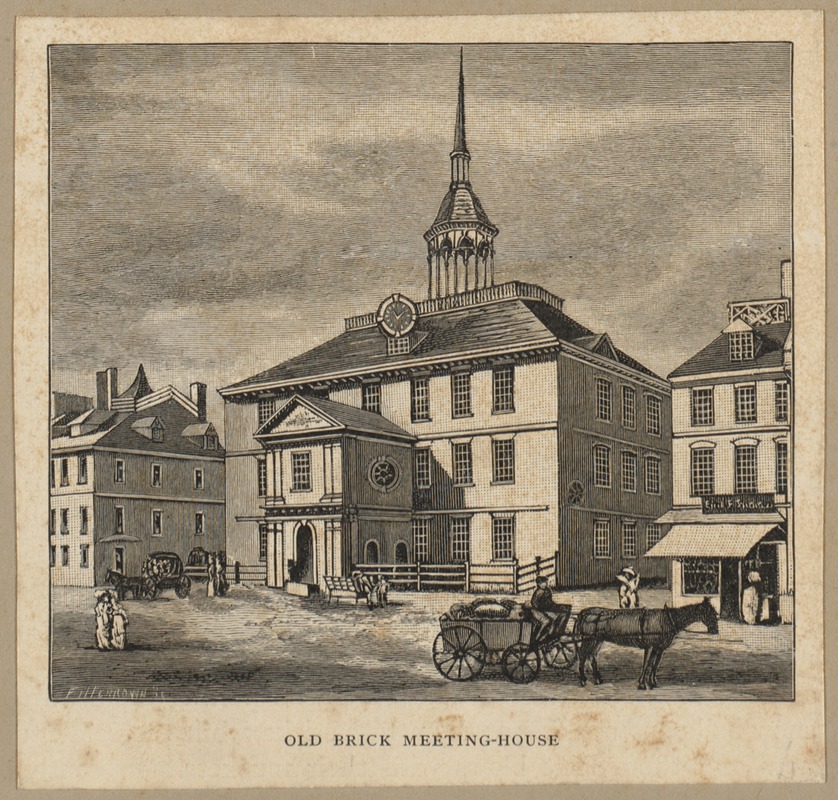
The British military sailed away on 17 March. Bostonians gathered for another town meeting twelve days later, on 29 March. They met in the Rev. Dr. Charles Chauncy’s church, the “old Brick Meeting House” (shown above). The main order of business was to elect officials for the upcoming year, starting with the town clerk. William Cooper continued to fill that role until his death in 1809.

However, there were at least two town meetings held inside besieged Boston that never got recorded in Cooper’s notes.

TOMORROW: The first lost meeting.

Friday, July 07, 2023

How Samuel Swift Sought Scipio

While researching the Boston lawyer Samuel Swift last month, I came across a series of advertisements he placed in Boston newspapers in 1770.

The Boston Evening-Post, 28 May:

SCIPIO, a smooth fac’d Negro Fellow, pretty black, 22 Years old, on the 23d Inst. [i.e., of this month] ran away from his Master; he has since chang’d his Cloaths: His Hair or Wool grows something onward upon his Cheeks, is good natured and artful, inclines to a Seafaring Life; bent his Course towards Providence or Rhode-Island. Whoever will convey him to his said Master in Boston, shall be handsomly rewarded by
SAMUEL SWIFT.

P.S. It may be needless for any Captain of a Ship or other Vessel to harbour him, as it may not eventually be either for their Profit or Honor, he is such an Urchin.

Boston, May 26, 1770.
Usually people seeking other people they claimed as property put the same ad in as many newspapers as they could afford, and then kept those ads running week after week until the runaway was found or they gave up. But Swift wrote multiple versions of his notice.

The Boston Gazette, 4 June:
Run-away from his Master the 23d Instant, a Negro Fellow about 22 Years old, has since chang’d his Cloaths. His Hair or Wool grows pretty much on his Cheeks, smooth-fac’d, his Fore-teeth jet out a little, is artful and good natured, went towards Providence. Whoever conveys him to his Master, shall be well rewarded, by
SAMUEL SWIFT.

N.B. It is taken for granted all Captains of Vessels will discountenance him.

Boston, May 26, 1770.
Those ads didn’t have any effect, so on 28 June the Boston News-Letter published this:
TO all worthy Brothers and other Generous Commanders of Ships or other Vessels sailing between the Poles,—as also to all the valourous Sons of Zebulon and others, however dispers’d upon the wide surface of old-Ocean, or upon any Island or Main-laid upon this habitable Globe, into whose Hands these may chance to fall:—

Note well,—THAT on the 23d of May 1770, SCIPIO, a Negro Man near 23 Years old, Ran from the Subscriber,——He is five Feet and 3 or 4 Inches high, little more or less, and well set, his Hair or Wool (unless shav’d) comes low upon his Cheeks, his Fore-teeth rather splaying, has an Incision mark on one of his Arms where he was Inoculated, and 2 or 3 Scars in his Legs where he was lanc’d, is pretty black, with a flattish-Nose, tho’ not that flat so peculiar to Negroes, is very Artful—Speaks plain but something inward and hollow, inclines much to the Sea, will make an able Seaman, and is a Cooper,—

If he returns voluntarily he shall not be whipt as he deserves, but I will either sell him to a Good Ship-Master, or lett him as he shall chuse, till he has Earnt his prime Cost, &c, when I will give him his Freedom,—but if any shall bring or convey him to his Master, shall be paid EIGHT DOLLARS, by
SAMUEL SWIFT.

P. S. I at present forbear mentioning the Ship I am satisfy’d he went off in.
The word “Brothers” in the top line might have been an address to Swift’s fellow Freemasons. “Sons of Zebulon” referred to mariners, but rarely enough that it’s an example of Swift’s uncommon phrasing.

The term “prime cost” usually appears in Boston newspapers of this time to mean a good price for the consumer, so Swift appears to have been promising Scipio he wouldn’t have to pay the maximum amount for his freedom. But he’d still have to pay.

Swift’s last ad continued to run through late July. I see no evidence Scipio ever came back to the attorney, voluntarily or not.

Tuesday, June 27, 2023

The Mystery of “Mr. Swift from the North”

I’ve been analyzing the publication of the story from Samuel Swift’s descendants that he tried to instigate an uprising against British troops inside besieged Boston before dying in the summer of 1775.

In the early twentieth century American historians did a lot of debunking. The Colonial Revival period had brought a lot of dramatic stories and traditions into print. Taking a more evidence-based approach, the next generations of authors lopped away at myths and hagiography.

The dramatic story of Samuel Swift’s martyrdom—coming from his family, unsupported by other evidence, incredible in its details—was the sort of lore that debunking authors tried to clear out of reliable histories.

But Samuel Swift’s reputation as a strong Patriot survived into the mid-1900s.

That’s because of a conjunction of sources. First, back on 7 Nov 1765 the Boston News-Letter reported about that year’s tightly controlled 5th of November celebration:
The Leaders, Mr. McIntosh from the South, and Mr. Swift from the North, appeared in Military Habits, with small Canes resting on their Left Arms…
(Pierre Eugène du Simitière’s sketch of leaders of the 1767 Pope Night parades, with canes and speaking trumpets, appears above.)

In the nineteenth century the authors Caleb Snow, Samuel A. Drake, and Francis S. Drake reprinted or paraphrased that 1765 news story, including the name “Swift.”

In 1891, the editors of the Jeremy Belknap Papers from the Massachusetts Historical Society identified Samuel Swift as “one of the Committee of Safety, and a prominent man at the North End.”

The “Committee of Safety” reference probably derives from a line in Samuel Swift’s 2 Oct 1774 letter to John Adams: “The Committee of Safety by me pay their best Regards to you.” But there was no formal “committee of safety” at the time. The town of Boston hadn’t named Swift to its committee of correspondence. He wouldn’t even be on the larger committee named on 7 December to enforce the Continental Congress’s Association boycott. It appears Swift was passing on regards from other men.

As for being “a prominent man at the North End,” Swift wasn’t a member of the North End Caucus. He didn’t hold high political office or militia rank. He was a justice of the peace from 1741 to 1760, but wasn’t reappointed under George III. As an attorney, Swift wasn’t a big employer, like shipyard owner John Ruddock.

I suspect the mention of “Mr. Swift from the North” in the 1765 newspapers caused those Belknap editors to identify that leader of the North End gang as Samuel Swift, thus making him “a prominent man” in that neighborhood.

Certainly that’s where George P. Anderson stood when he presented his ground-breaking paper “Ebenezer Mackintosh: Stamp Act Rioter and Patriot” to the Colonial Society of Massachusetts in 1924:
The leaders—Mackintosh of the South End and Samuel Swift of the North End—appeared in military habits, with small canes resting on their left arms, having music in front and at flank.
For decades after that, historians identified Samuel Swift as the leader of the North End gang. After all, well respected scholarly sources said so. 

But that never made sense. The Pope Night gangs were composed of young men and older boys from the working classes. Samuel Swift, a genteel fifty-year-old lawyer in 1765, was the sort of man they begged money from, not the sort to lead their raucous street processions.

In The Boston Massacre (1970), Hiller B. Zobel noted that Samuel Swift didn’t even live in the North End. The Thwing database shows he owned a house on Pleasant Street in the South End.

But among the people indicted for rioting after the 1764 Pope Night disturbances, Zobel reported, was a teen-aged shipwright named Henry Swift. Following his lead, many authors since 1970 have identified Henry Swift as the North End captain.

References to Samuel Swift as a politically active North End leader survive, however, including in the footnotes of older volumes digitized at Founders Online. He was an interesting character, but he wasn’t a militant in either 1765 or 1775.

Monday, June 26, 2023

“This scheme was revealed to General Gage”

Yesterday I analyzed the untenable claim that John Adams told descendants of Samuel Swift how the man had tried to spark an uprising inside besieged Boston.

So let’s set aside the claim that Adams was the source of this claim. How does the story itself stand up on its own?

The version published in The Memoirs of Gen. Joseph Gardner Swift (1890) stated:
the zeal and resolution of Samuel Swift…caused many Bostonians to secrete their arms when Gov. [Thomas] Gage offered the town freedom if arms were brought in to the arsenal; and that Mr. Swift presided at a freemason’s meeting where it was covertly agreed to use the arms concealed, and, in addition, pitchforks and axes, if need be, to assail the soldiery on the common; which scheme was betrayed to Gage, causing the imprisonment of Swift and others.
That wording has led some authors to state that Swift died in jail. In fact, we have jailhouse diaries from John Leach and Peter Edes covering the period when he died, and they don’t mention the prominent lawyer being locked up with them.

Another version of the story, published in Teele’s History of Milton (1887) and reprinted in Roberts’s history of the Ancient and Honorable Artillery Company, said:
This scheme was revealed to General Gage, and Mr. Swift was arrested, he was permitted to visit his family, then at Newton, upon his parole to return at a given time. At the appointed time he returned, against the remonstrance of his friends, and so high an opinion of his character was entertained by General Gage that he was permitted to occupy his own house under surveillance. From disease induced by confinement, he died a prisoner in his own house…
Again, the military authorities were locking up people like Leach, Edes, and James Lovell for lesser threats, but this tale asks us to believe that not only did they not lock up Swift, they let him leave town.

And then Swift supposedly went back into Boston. Because, according to this lore, he was willing to lead an attack on soldiers with pitchforks and axes, but not to break his promise to Gen. Gage.

Even before that, the story is hard to believe. Swift was sixty years old, had no military experience, and had never been a militant political activist. It’s true he told Adams in October 1774, “I am no Swordsman but with my Gun or flail I fear no man…,” so it’s conceivable that he made similar boasts when the townspeople discussed turning over their weapons in late April 1775. But few Bostonians would have chosen Samuel Swift to lead an armed revolt.

No contemporaneous source mentions such an uprising. Gage, John Burgoyne, Peter Oliver, and other royal appointees wrote a lot about threats from Patriots, but none of them complained about Swift and an attack with pitchforks and axes. Samuel Swift was popular in Boston’s legal and mercantile circles, and no other American credited him with proposing an assault on the troops.

From early on, Swift’s widow and descendants perceived him to be a victim of Gen. Gage. Furthermore, they complained that Swift’s death led to the disappearance of the family wealth. (Though they also blamed “the unfaithfulness of his agent” for that.) They believed the fallout of his death meant his eldest son, fifteen-year-old Foster Swift, couldn’t follow his path to Harvard College. (In fact, by 1768 Foster had dropped out of the college-prep Latin School and was attending a Writing School; he went on to train in medicine under Dr. Joseph Gardner and had a long professional career.)

We don’t know why Samuel Swift didn’t receive a pass to leave Boston while his wife and children went out to Springfield. We don’t know what health issues contributed to his death on 30 Aug 1775. But the Swift family perceived great significance in how Samuel Swift died, and, at least in later generations, they wanted it to be significant for the nation as well.

TOMORROW: A debunking derailed.

Sunday, June 25, 2023

Three Ways to Misquote John Adams

There are a number of problems with the claims in The Memoirs of Gen. Joseph Gardner Swift (1890), quoted back here, about the last months of the general’s grandfather, Samuel Swift.

That book told a dramatic story of Swift starting to organize an uprising against the British troops inside besieged Boston, only to be punished by being kept from his family and dying of illness as a result. It also credited that story to John Adams, a highly respected source who definitely knew Swift.

According to the section of that book in Joseph G. Swift’s own voice, Adams told him on 8 Oct 1817 about his grandfather: “I have written to Mr. [William] Wirt my opinion of the merits of that Whig, who fell a martyr to the fury of [Thomas] Gage.”

Adams’s first letter to Wirt did indeed mention Samuel Swift. However, Adams didn’t write that letter until 5 Jan 1818, three months after J. G. Swift’s well documented visit to Quincy.

Indeed, according to this letter from Thomas Cooper to Thomas Jefferson, as of 30 September Wirt’s biography of Patrick Henry was still in press; “about 100 pages are printed.” That was one week before Swift was in Quincy, leaving not enough time for Adams to get that book, read it, and resolve to write to the author.

J. G. Swift’s memory of what Adams said (or genealogist Harrison Ellery’s rendition of that memory) must therefore have been shaped by later knowledge of Adams’s letter, which was published in 1819.

As quoted back here, the general wrote to Adams in 1824, asking for any details about his grandfather. That shows he hadn’t heard the story of the uprising by then. But there’s no evidence that Adams ever wrote back, much less sent the dramatic story printed in that family memoir. At the time Adams was busy telling stories about heroic Boston lawyers in the Revolution, yet none of his other letters includes this story about Swift, either.

The Memoirs of Gen. Joseph Gardner Swift was sloppy about citing Adams in other ways. In the genealogical section Ellery wrote that Adams called Samuel Swift “a martyr to freedom’s cause.” But the J. G. Swift memoir says Adams actually said “martyr to the fury of Gage.” The “martyr to freedom’s cause” phrase came from A. K. Teele’s History of Milton. (Neither phrase appears in the surviving Adams Papers.)

Not that Teele’s book was on more solid ground. It followed James M. Robbins’s 1862 address on the history of Milton by quoting Adams this way: “Among the illustrious men who were agents in the Revolution must be remembered the name of Samuel Swift.”

In fact, Adams’s 1818 letter to Wirt said [emphases added]:
And in imitation of your example I would introduce Portraits of a long Catalogue of illustrious Men, who were Agents in the Revolution

Jeremiah Gridley the Father of the Bar in Boston and the Preceptor of Prat Otis Thatcher Cushing and many others; Benjamin Prat Chief Justice of New York James Otis of Boston Oxenbridge Thatcher Jonathan Sewal Attorney General and Judge of Admiralty Samuel Quincy Solicitor General, Daniel Leonard, Josiah Quincy Richard Dana and Francis Dana his Son, Minister to Russia and afterwards Chief Justice, Jonathan Mayhew D.D. Samuel Cooper D.D. James Warren and Joseph Warren, John Winthrop Professor at Harvard Colledge, And Member of Counsal, Samuel Dexter the Father John Worthington of Springfield Joseph Hawley of Northampton, Governors Huchenson Hancock Bowdoin Adams Sullivan and Gerry Lieutenant Governor Oliver Chief Justice Oliver, Judge Edmund Trowbridge Judge William Cushing, and Timothy Ruggles ought not to be omitted. The Military Characters Ward Lincoln Warren Knox Brooks & Heath &c must come in of Course. Not should Benjamin Kent, Samuel Swift or John Read be forgotten.
Adams named thirty-eight prominent men, some of them Loyalists and all but one occurring to him before he came to Samuel Swift.

[I’m not going to bother adding H.T.M.L. links for all those guys.]

TOMORROW: Examining the legend itself.

Friday, June 23, 2023

“It was covertly agreed to use their concealed arms”

As I quoted yesterday, Ann Swift was convinced that her husband, Samuel Swift, was essentially “murdered” by royal authorities when they wouldn’t let him leave besieged Boston in the summer of 1775.

The Swifts’ grandson Joseph Gardner Swift inherited that idea, telling John Adams in 1824 that Samuel Swift “died in 1775 a Prisoner & Martyr under the Tyrrany of [Gen. Thomas] Gage.”

Over the course of the nineteenth century, that family tradition got into print and became more detailed and dramatic.

When Samuel and Ann Swift’s son, Dr. Foster Swift, died in 1835, the Army and Navy Chronicle’s obituary stated that the attorney had been “a distinguished Whig and martyr to the cause of Freedom while a prisoner in Boston, anno 1775.”

In the 1880s Harrison Ellery, who had married into the Swift family, assembled a genealogy that incorporated the family lore.

Ellery loaned his page proofs to local historian Albert Kendall Teele, so the first public version of the full tale of Samuel Swift, zealous Patriot, appeared in Teele’s History of Milton in 1887:
When General Gage offered the freedom of the town to Bostonians who would deposit their arms in the British Arsenal, Mr. Swift opposed the movement. He presided at a meeting where it was covertly agreed to use their concealed arms, also pitchforks and axes, to assail the soldiers on Boston Common.

This scheme was revealed to General Gage, and Mr. Swift was arrested, he was permitted to visit his family, then at Newton, upon his parole to return at a given time. At the appointed time he returned, against the remonstrance of his friends, and so high an opinion of his character was entertained by General Gage that he was permitted to occupy his own house under surveillance.

From disease induced by confinement, he died a prisoner in his own house, a martyr to freedom’s cause, Aug. 31, 1775. He was interred in his tomb, which had formerly belonged to the father of his first wife, Samuel Tyler, Esq.
Oliver Ayer Roberts relied on that account in his collection of biographies of members of the Ancient and Honorable Artillery Company. It contained some clear errors, such as the date of Samuel Swift’s death and the surname of his first wife.

Ellery published his genealogy in 1890 as part of The Memoirs of Gen. Joseph Gardner Swift. In the introduction to that book Ellery wrote of seeing Joseph G. Swift’s “journal,” but the chapters that follow are a retrospective narrative in the general’s voice. I can’t tell if Gen. Swift actually wrote out a memoir and Ellery called it a journal, or if Ellery himself adapted a real journal into narrative form. Either way, that’s the source on Gen. Swift’s one meeting with John Adams that I quoted back here.

The genealogical section of that volume offered Ellery’s rendering of the Samuel Swift legend:
President John Adams told his distinguished grandson, General Swift, while on a visit to his seat in Quincy in 1817 with President [James] Monroe, that Samuel Swift was a good man and a generous lawyer, and was called the widows’ friend; that he was a firm Whig whose memory the State ought to perpetuate. The same sentiments Mr. Adams expressed in a letter to William Wirt, of Virginia.

Mr. Adams also said it was owing to the zeal and resolution of Samuel Swift that caused many Bostonians to secrete their arms when Gov. Gage offered the town freedom if arms were brought in to the arsenal; and that Mr. Swift presided at a freemason’s meeting where it was covertly agreed to use the arms concealed, and, in addition, pitchforks and axes, if need be, to assail the soldiery on the common; which scheme was betrayed to Gage, causing the imprisonment of Swift and others.

This imprisonment brought on disease from which he never recovered, and he died August 30, 1775, aged 60 years, as President Adams said, “a martyr to freedom’s cause.” His remains were interred in the tomb in the stone chapel ground that had belonged to Samuel Tylly, Esq., the father of his first wife.
It’s certainly a dramatic picture, sixty-year-old lawyer Samuel Swift organizing an uprising against the British troops using guns, pitchforks, and axes. And the family’s stated source for that story was none other than President John Adams.

COMING UP: What’s wrong with this picture.

Thursday, June 22, 2023

“Do what you can to forward Mr. Swift to me”

Contemporaneous sources about Samuel Swift’s last months are thin.

Swift turned sixty years old on 9 June 1775. His first wife, the former Eliphal Tyley or Tilley (1713–1757), had borne three daughters in the 1740s.

One of those daughters, Sarah, had gone to live with her husband Amos Putnam in Sutton. The other two, Ann and Eliphal, were still unmarried in 1770, but I can’t trace them further.

In October 1757 Swift had married for a second time, to Ann Foster (1729–1788). That couple had six children between 1758 and 1773, and those children were with their parents in Boston when the war began.

The Swifts were still in the besieged town two months later, during the Battle of Bunker Hill. Abigail Adams wrote to her husband on 25 June 1775:
As to Boston, there are many persons yet there who would be glad to get out if they could. Mr. [Thomas] Boylstone and Mr. [John] Gill the printer with his family are held upon the black list tis said. Tis certain they watch them so narrowly that they cannot escape, nor your Brother Swift and family.
Around that time, however, Ann Swift managed to get a pass for herself and her children from a British army officer named Handfield—probably Capt. William Handfield of the 94th Regiment, who was attached to the quartermaster’s department in June.

By the end of that month, Ann Swift and her family were in Springfield. She wrote in her diary, as printed in The Memoirs of Gen. Joseph Gardner Swift:
Here I am in the woods, Boston being so surrounded by armies that we could not enjoy our home: no school for the children, and the town forsaken by the ministers—the pillars of the land.
In the following weeks she wrote to that army officer for another favor:
Capt. Handfield, S[i]r,

Your kindness in undertaking to get a pass for me emboldens me to ask the like favor for my dear husband whom I hear is in a very weak state of health. The anxiety of my mind is great about him. A word from you would have more weight than all the arguments that he could make use of.

Could I come to him, this favor I would not ask. O, S[i]r I trust in your goodness that you will do what you can to forward Mr. Swift to me and in doing so you will greatly oblige
Your distressed friend,
ANN SWIFT.

Should be glad if he would bring out two trunks which there is clothing in that I want very much for myself and children.
Evidently the royal authorities didn’t provide a second pass. Samuel Swift remained inside Boston. Margaret Draper’s Boston News-Letter reported that he died on 30 August.

On 4 September, Mercy Warren reported to John Adams in a bald postscript: “Swift of Boston is Really Dead.”

Ann Swift put in her diary this note about that 30 August date:
Departed this life, in the 61st year of his age, my dear husband, Samuel Swift. He died in Boston, or in other words, murdered there. He was not allowed to come to see me and live with his wife and children in the country. There he gave up the ghost—his heart was broken; the cruel treatment he met with in being a friend to his country was more than he could bear, with six fatherless children (in the woods) and all my substance in Boston.
Thus began the family tradition of blaming Gen. Thomas Gage for Swift’s death—not through violence but by not letting him leave Boston when ill to rejoin his family.

Swift’s body was placed in a tomb belonging to his first wife’s family in the burying-ground beside King’s Chapel, shown above.

TOMORROW: The family legend.

Wednesday, June 21, 2023

“My opinion of the merits of that Whig”

In 1817, Gen. Joseph G. Swift (1783–1865), the U.S. Army’s chief of engineers, accompanied the new President, James Monroe, on a tour of fortifications and battlefields in the northern states.

On 8 July, Monroe and his company stopped in Quincy to meet former President John Adams (who was also the father of Monroe’s secretary of state).

Gen. Swift wrote in his memoir:
Mr. Adams at first mistook me for the son of his brother lawyer, Samuel Swift, and poured out his commendation, saying: “I have written to Mr. [William] Wirt my opinion of the merits of that Whig, who fell a martyr to the fury of [Thomas] Gage.”

I replied: “It was my grandfather, and you gave me my cadet’s warrant eighteen years ago,” upon which he was pleased to subjoin some civil commendation. The conversation naturally attracted the attention of the whole dinner party; and it was a scene of deep interest to hear the old man scan the days of his life in Congress, when he nominated Washington, etc.
In fact, Thomas Johnson of Maryland was the Continental Congress delegate who had nominated George Washington to be commander-in-chief. Adams told a great story about making that nomination, but the Congress’s records contradict it.

As for the mention of William Wirt, in this period Adams was on a campaign to undercut Wirt’s biography of Patrick Henry, which he felt gave too much credit for the Revolution to that legislator and Virginians as a whole. (Awkwardly enough, Wirt was President Monroe’s attorney general.) The former President was writing long letters to other authors laying out his version of history and encouraging William Tudor, Jr., son of his former law clerk, to write a biography of James Otis, Jr.

Seven years later, having retired from the army to become a civil engineer, Swift wrote back to the former President about his family:
When I had the honour to be at your residence in 1817 (while accompanying President Monroe) I was gratified by some account which you were pleased to give me, of my Grand Father Samuel Swift, formerly a Lawyer of Boston, whom you designated as a friend of yours & as the “Widows friend”—& whose name you had before mentioned, in some Printed Letters, as a distinguished Whig:—It is natural &, with just views, it is commendable in man to reflect with interest upon the conduct & character of his progenitor.—

I have heard that my G. Father was a zealous & a effective Whig—that he died in 1775 a Prisoner & Martyr under the Tyrrany of Gage,—that he was foremost & useful in Public Meetings in urging his fellow Citizens to resist oppression & especially to resist Gages call to the Bostonians to deliver up their Arms:—The premature death of their G Father led to the dilapidation & final loss of his Property while Boston was a Garrison,—This then Young family driven to various parts of this Country & made Poor, were dispersed, & thus we know little of this G. Father except from tradition.—

If you will at a leisure moment cause an amanuensis to note to me any information of the Character & Conduct of Saml. Swift & especially as touching the great struggle for Independence, it will be received as a distinguished favour,—One of my objects in taking this liberty is to be Enabled to tell my Six Sons what share their progenitor may have had in contributing to bring about that War which made a nation Free & Happy!—
If Adams wrote back over the next two years before his death, that letter doesn’t survive. But Swift’s letter certainly lays out the image of his grandfather that he wanted to confirm.

TOMORROW: Swift family sources.

Tuesday, June 20, 2023

Samuel Swift, Established Lawyer

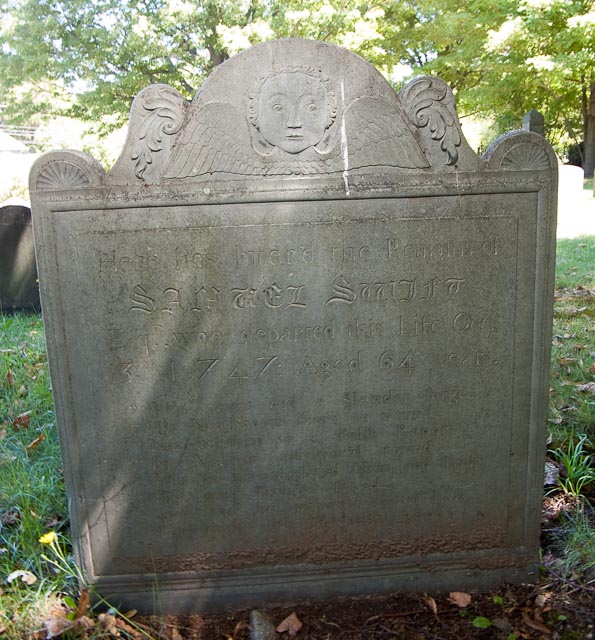
Samuel Swift was a member of colonial Boston’s legal establishment—son of a Milton militia colonel and town representative (gravestone shown here), graduate of Harvard College, trained in the law by Jeremy Gridley.

Swift was a member of the St. John’s Lodge of Freemasons. John Adams recorded dining with him several times. John Rowe listed him as socializing with “the Possee,” a merchants’ club. 

Swift also maintained friendly relations with Gov. Thomas Hutchinson, who had an estate in Milton. In fact, two weeks after the Tea Party, Swift sent the governor a note (now lost) which prompted this reply:
I am obliged to you for the favorable opinion you express, in your letter of the 30 Dec, of my general disposition, and I think you will be satisfied of the propriety of my conduct in the particular instance you refer to, when I put you in mind that I have taken a solemn oath, as Governor, to do every thing in my power that the Acts of trade may be carried into execution. Now to have granted a pass to a Vessel which I knew had not cleared at the Custom house would have been such a direct countenancing & encouraging the violation of the Acts of Trade that I believe you would have altered your opinion of me and seen me ever after in an unfavorable light. I am sure if I could have preserved the property that is destroyed, or could have complied with the general desire of the people consistent with the duty which my station requires I would most readily have done it.
Reading backward, it appears Swift wrote that he generally admired Hutchinson’s adherence to the law, but that he should have been more flexible in this case. By that time, the most fervent Boston politicians had decided Hutchinson was two-faced and corrupt, so they wouldn’t have sent any praise.

Swift’s name appears on many Boston town committees over the years, but those rarely involved radical political action. He was in the group designated to invite James Lovell to deliver an oration commemorating the Massacre in April 1771, and the group tasked with responding to the remarks in the “Hutchinson Letters” in 1773. On those committees Swift’s role was to add establishment heft, not to plan tough action.

Swift’s letters to John Adams show that he grew more radical in the last months before the war. On 20 Oct 1774 he even said, “I am no Swordsman but with my Gun or flail I fear no man more especially my Cause being Good as I think other wise I would not engage.” Still, Swift wrote more in those letters about the wording of pamphlets and about food than about military preparations.

On 13 Mar 1775, Swift also told Adams, “I am in a Measure Confin’d,” hinting at some infirmity. He was fifty-nine years old. Nonetheless, on 3 April when Boston had a town meeting and Samuel Adams was busy at Concord, the inhabitants chose Swift to be their “Moderator of this Meeting Pro Tempore.”

Two weeks later, the province was at war. Two months after that, Adams complained about not having received a letter from Swift since he had departed for Philadelphia.

On 30 August, Samuel Swift died inside besieged Boston.

In his last decades, John Adams, now a former President, wrote letters listing Swift among the Boston lawyers who had advocated resistance to the Crown’s new laws. Adams was pushing a version of the Revolution which emphasized Massachusetts moving before Virginia, the legal profession leading the people instead of being pulled along, and, incidentally, himself near the center of events.

Adams’s telling did include Swift, but that man’s name appeared at the end of a long list of other men. In another letter, Adams recalled that when he said the bar shouldn’t provide a polite farewell address to Hutchinson at the end of his time as governor, “Samuel Swift Esquire, as if appalled and astonished, Sat mute.” I’m not saying any of Adams’s memories was fully reliable, but they were definitely mixed.

TOMORROW: A descendant seeking answers.

Sunday, June 18, 2023

“I have lamented excessively the Want of your Correspondence”

In his letter to Abigail Adams on 17 June 1775, which I started quoting yesterday, John Adams continued:
I have never been able to obtain from our Province, any regular and particular Intelligence since I left it. [Benjamin] Kent, [Samuel] Swift, [William] Tudor, Dr. [Samuel] Cooper, Dr. [John] Winthrop, and others wrote me often, last Fall—not a Line from them this Time.
Adams was referring to his time away at the First Continental Congress in late 1774, when he felt well informed.

Three days later, he wrote directly to Tudor:
I have lamented excessively the Want of your Correspondence ever since I have been here. Not a Line from Dr. Winthrop, Dr. Cooper, Mr. Kent, Swift, Tudor, from some or other of whom I was accustomed the last Fall, to receive Letters every Week. I know not the state, the Number, the Officers of the Army—the Condition of the poor People of Boston or any Thing else.
I decided to look into John Adams’s complaint, using the Adams Papers and Founders Online. He and his heirs were unusually conscientious about saving letters, so we’re at least very close to seeing all the correspondence he received.

To begin with, this chiding wasn’t fair to William Tudor (1750–1819, shown here later in life), who was Adams’s former law clerk. All the other men were senior to Adams, so he couldn’t nag them the same way.

Furthermore, back in the fall of 1774, those older gentlemen had actually sent Adams rather few letters. Tudor had sent more than all the other men combined. He’d also traveled to Philadelphia himself, carrying the only letter that Cooper wrote to Adams in that season.

The first two men Adams named were Benjamin Kent (1708–1788) and Samuel Swift (1715–1775), senior figures in the Boston bar. Indeed, Kent had founded the bar association and liked to preside over its get-togethers. Each man had written Adams one letter in the fall of 1774, and Swift had sent another to the whole Massachusetts delegation. Neither wrote Adams in spring 1775.

As I said above, young Tudor had brought Adams a letter from the Rev. Dr. Samuel Cooper (1725–1783) in October 1774. That minister didn’t send anything in the spring of 1775.

Finally, no 1774 letters to Adams survive from Prof. John Winthrop (1714–1779) of Harvard College. But four days after Adams’s initial complaint on 17 June 1775, Winthrop did send him one. Tudor wrote a few days later. Both men described what had happened on the same date when Adams complained—namely, the Battle of Bunker Hill.

Because while Adams was aching to know how the war was going, all the men he wanted to hear from were actually living in the war zone. They had other things on their minds besides correspondence.

TOMORROW: Getting out of Boston, and getting news from Boston.

Tuesday, July 06, 2021

Listening in on Pope Night with The Dollop

A friend alerted me that the Dollop podcast recently cited my name.

The Dollop is a conversation about history between two comedians, Dave Anthony and Gareth Reynolds. Anthony reads up on a topic and presents the facts to Reynolds, and they both riff on the implications. It’s been going strong since 2014.

In Episode 480 Anthony and Reynolds discuss “Pope Day,” a topic I’ve had a lot to say about. Anthony notes my observation that the 5th of November celebration evolved into Halloween, an observation others have also made. (My main thesis is how the holiday’s overt patriotism licensed the raucous violence.)

All in all, this Dollop episode offers a detailed, grounded introduction to a weird colonial tradition. I’d add two important points about Pope Night in the mid-1700s:
  • Colonial New Englanders were expending all that anti-popery energy when there were no practicing Catholics anywhere closer than Canada. They weren’t really intimidating a local Catholic minority; they were showing off for themselves.
  • By the 1750s the Boston processions added a contemporary villain in place of the Pretender: Adm. John Byng, Charles Paxton, John Mein, and so on. That gave the holiday a link to current politics even before the Stamp Act, and then it grew stronger.
One less conceptual correction involves the leader of the North End gang in 1765. That year’s anti-Stamp protests made Ebenezer Mackintosh, the South End gang’s captain, internationally notorious. His North End counterpart didn’t become a concern for the royal governors or the ministers in London, so all the surviving contemporaneous sources mentioned only his last name: Swift.

For a long time authors decided that must be the most visible man named Swift in pre-Revolutionary Boston: Samuel Swift. He was friendly with the Whigs, especially John Adams.

The fact that Samuel Swift was a political moderate, a Harvard-educated attorney, and fifty years old during the Stamp Act crisis should have made people skeptical that he was the leader of a working-class youth gang. Plus, it turned out he lived on Pleasant Street in the far South End.

In The Boston Massacre (1970), Hiller Zobel argued that a far more likely candidate was Henry Swift, a shipwright. He:
  • was a mechanic, like Mackintosh.
  • was born in 1746, thus in his late teens during the Stamp Act rumbles.
  • lived in the North End.
  • was indicted for rioting after the fatal Pope Night of 1764.
I’ve therefore always named Henry Swift as the North End captain.

However, some books continue to point the finger at Samuel Swift, and the Dollop gents must have relied on those sources. Given the class distinctions in the eighteenth century, I think the genteel attorney would have been horrified to be linked to the Pope Night disorder. Now that’s comedy!

Before leaving the topic of digital appearances, here’s a reminder that History Camp America is coming up this Saturday, 10 July. Registration closes on Thursday.

Sunday, June 06, 2021

“I told Cushing as Ruggles told Tyler”

Yesterday I quoted a long anecdote that John Adams wrote out in 1789 about a discussion between two Massachusetts politicians seventeen years earlier.

The specifics of Adams’s anecdotes aren’t always reliable when he was trying to make a point about politics or personalities or, in this case, both.

Adams dated that exchange to 1772. At that time one of the men he quoted, Timothy Ruggles, no longer had a seat in the Massachusetts General Court. He lived in Hardwick, in western Worcester County. The Boston merchant John Rowe recorded several encounters with Ruggles in the late 1760s but none in the early 1770s, suggesting he didn’t routinely visit the coast. So how likely was Ruggles to be socializing with Royall Tyler and other Boston Whigs in 1772?

As it turns out, however, Adams also left us solid evidence that he had heard (or heard about) that exchange between Ruggles and Tyler by the end of 1772.

On 1 Jan 1773, Adams recorded this event in his diary:
This Evening my Friend Mr. [Samuel] Pemberton invited me and I went with him, to spend the Evening with Jere. Wheelwright. Mr. Wheelwright is a Gentleman of a liberal Education about 50 Years of Age, and constantly confined to his Chamber by Lameness. A Fortune of about two hundred a Year enables him to entertain his few Friends very handsomely, and he has them regularly at his Chamber every Tuesday and Fryday Evening.
Wheelwright (1717-1784) was a wealthy heir who graduated from Harvard College in 1736. On receiving his master’s degree three years later, he delivered a speech against slavery, its effect diluted by being in Latin. After that he enjoyed a long life of wealthy obscurity, keeping out of religious and political controversies. Among Wheelwright’s properties were “the Hills at New-Boston,” which we now call the crest of the Beacon Hill neighborhood, and settlements in New Hampshire and Maine.

In Sibley’s Harvard Graduates, Clifford K. Shipton wrote:
About 1770 one of Wheelwright’s legs was so badly broken by the upsetting of his riding chair that he was confined to his chamber for the rest of his life. Having an income of about £200 a year, he moved into comfortable quarters in Newton from which, during his remaining years, he surveyed the world with intelligent curiosity.
Wheelwright kept notes on current events in his almanac diaries for more than forty-five years. Only one folder’s worth of that work survives at the Massachusetts Historical Society. He never married or had children.

Back to Adams’s diary entry, which describes a New Year’s visit to Wheelwright’s house. (Shipton identified “Mr. Swift” as John Swift, Harvard 1733; Adams doesn’t mention that man in his papers while Samuel Swift was a good friend and a link between him and Wheelwright, so I put Samuel Swift in this party.) Adams wrote:
The Speaker [Thomas Cushing], Dr. [Joseph] Warren and Mr. [Samuel] Swift were there— And We Six had a very pleasant Evening. Our Conversation turned upon the Distress of Rhode Island [during the Gaspee investigation], upon the Judges Dependency [salary grants from the tea tax], the late numerous Town Meetings, upon [William] Brattles Publication in [Richard] Drapers Paper [the Boston News-Letter] of Yesterday, and upon each others Characters. We were very free, especially upon one another.

I told Cushing as Ruggles told Tyler, that I never knew a Pendulum swing so clear.

Warren told me, that Pemberton said I was the proudest and cunningest Fellow, he ever knew.

We all rallied Pemberton, upon the late Appointment of Tommy Hutchinson [the governor’s son] to be a Judge of the common Bench, and pretended to insist upon it that he was disappointed, and had lost all his late Trimming, and Lukewarmness and Toryism.

Warren thought I was rather a cautious Man, but that he could not say I ever trimmed. When I spoke at all I always spoke my Sentiments. This was a little soothing to my proud Heart, no doubt.
Thus, by the time of this gathering Adams definitely knew that Ruggles got off a good line about Tyler and was happy to borrow it to tease Cushing. Perhaps the original conversation happened earlier than 1772, and perhaps it didn’t really start with Dr. Thomas Young, but it happened.

Now I can’t imagine anything more antsy for John Adams than waiting for his colleagues to tease him and having to chuckle about it.

Saturday, April 11, 2020

“The Town make choice of a proper Person to deliver an Oration”

Yesterday I described how Bostonians commemorated the first anniversary of the Boston Massacre in 1771, including Dr. Thomas Young delivering a political oration in the Manufactory.

Six days later, on Monday, 11 March, Boston had its first town meeting of the year. As usual, attendees took up the first day with electing various officials, from the selectmen on down.

One agenda item on the second day was “Whether the Town will determine upon some suitable Method to perpetuate the memory of the horred Massacre perpetrated on the Evening of the 5. of March 1770—by a Party of Soldiers of the 29. Regiment.” Town leaders were getting on the commemoration bandwagon.

The meeting assigned that topic to a committee of active upper-class Whigs: John Hancock, Samuel Adams, Dr. Benjamin Church, Benjamin Kent, Richard Dana, Dr. Joseph Warren, and Samuel Pemberton. A second committee was chosen to vindicate the townspeople from “some partial and false publications” about the Massacre trials the previous fall.

The perpetuation committee returned on Tuesday, 19 March with this recommendation:
That for the present the Town make choice of a proper Person to deliver an Oration at such Time as may be Judged most convenient to commemorate the barbarous murder of five of our Fellow Citizens on that fatal Day, and to impress upon our minds the ruinous tendency of standing Armies in Free Cities, and the necessity of such noble exertions in all future times, as the Inhabitants of the Town then made, whersby the designs of the Conspirators against the public Liberty may be still frustrated–

And the Committee in order to compleat the Plan of some standing Monument of Military Tyrany begg’d to be indulged with further time
The meeting “Voted unanimously” to adopt that plan for an oration. (No “standing Monument of Military Tyrany” would be erected for more than a century.)

The next question was who should deliver the oration. Dr. Young already had a text, of course, but now that was old news, and possibly too radical as well. Instead, people proposed two possible orators:
  • Samuel Hunt, master of the North Latin School
  • James Lovell, longtime usher, or assistant master, of the South Latin School
The townspeople “as directed then withdrew and brought in their Votes.” Not only did James Lovell win, but he was “unanimously chosen.” (I wonder how Mr. Hunt took that. Maybe it was supposed to be an honor just to be nominated.)

The same committee, with the addition of Samuel Swift, was sent off to invite Lovell to speak at Faneuil Hall on Thursday, 2 April, at 10:00 A.M. In essence, this would be a special edition of the usual “Thursday Lecture,” or sermon, that one minister or another had delivered on Thursday mornings for years. But this oration would also be an official session of the town meeting.

As it happened, on 2 April such a big crowd came out to hear Lovell that the meeting had to officially adjourn from Faneuil Hall to the Old South Meeting-House, the largest enclosed space in town (shown above). Afterwards, the town asked for Lovell’s text so that it could print his oration and spread its message. You can read it here.

All of those steps became an annual ritual in Boston: the proposal in town meeting to commission an oration, the committee visiting a respectable young gentleman with a speaking invitation, the adjournment on 5 March (or 6 March if the anniversary fell on the Sabbath) to Old South, the town’s publication of the text. Even in 1776, when Boston was under siege, there was an oration for Bostonians in exile out in Watertown. That tradition lasted until 1783, after the Revolutionary War ended.

And it all started with the town meeting deciding to commemorate the Massacre one month after the first anniversary.