J. L. BELL is a Massachusetts writer who specializes in (among other things) the start of the American Revolution in and around Boston. He is particularly interested in the experiences of children in 1765-75. He has published scholarly papers and popular articles for both children and adults. He was consultant for an episode of History Detectives, and contributed to a display at Minute Man National Historic Park.

Subscribe thru Follow.it


•••••••••••••••••


Showing posts with label Timothy Pickering. Show all posts

Friday, July 03, 2026

“They unanimously pressed on myself alone to undertake the draught”

A few days after Timothy Pickering delivered an Independence Day oration in Salem in 1823, casting doubt on Thomas Jefferson’s importance in drafting the Declaration of Independence, Joseph E. Sprague (1782–1852) sent the text of that speech to Jefferson himself:
Supposing you might feel some little curiosity to see Col Pickering unwilling & ungrateful tribute to the illustrious Author of the Declaration of Independence I have taken the liberty to enclose it to you
Sprague was a postmaster and a Jeffersonian politician between terms in the Massachusetts House, so he had time to stir up trouble.

Near the end of the month Jefferson shared his version of the drafting story with his good friend and ally James Madison:
You have doubtless seen Timothy Pickering’s 4th of July Observations on the Declaration of Independance. if his principles and prejudices personal and political, gave us no reason to doubt whether he had truly quoted the information he alledges to have recieved from Mr [John] Adams, I should then say that, in some of the particulars, mr Adams’s memory has led him into unquestionable error. at the age of 88. and 47. years after the transactions of Independance, this is not wonderful.

nor should I, at the age of 80, on the small advantage of that difference only, venture to oppose my memory to his, were it not supported by written notes, taken by myself at the moment and on the spot.

he says ‘the Committee (of 5. to wit, Dr [Benjamin] Franklin, [Roger] Sherman, [Robert R.] Livingston and ourselves) met, discussed the subject, and then appointed him and myself to make the draught; that we, as a subcommittee, met, & after the urgencies of each on the other, I consented to undertake the task; that the draught being made, we, the subcommittee, met, & conned the paper over, and he does not remember that he made or suggested a single alteration.’ now these details are quite incorrect.

the Committee of 5. met, no such thing as a subcommittee was proposed, but they unanimously pressed on myself alone to undertake the draught.

I consented; I drew it; but before I reported it to the committee, I communicated it separately to Dr Franklin and mr Adams requesting their corrections; because they were the two members of whose judgments and amendments I wished most to have the benefit before presenting it to the Committee; and you have seen the original paper now in my hands, with the corrections of Doctor Franklin and mr Adams interlined in their own hand writings   

their alterations were two or three only, and merely verbal. I then wrote a fair copy, reported it to the Committee, and from them, unaltered to Congress. this personal communication and consultation with mr Adams he has misremembered into the actings of a sub-committee.
Jefferson didn’t write to Madison because he thought his friend might need convincing about this story. Rather, he was writing for posterity, putting his version of history on paper for us.

Though Pickering quoted John Adams’s letter, Jefferson took pains to excuse Adams of any fault but poor memory. By this time the two men had been corresponding amicably for over a decade. Indeed, Jefferson praised Adams in his letter:
had mr Adams been so restrained, Congress would have lost the benefit of his bold and impressive advocations of the rights of revolution. for no man’s confident & fervid addresses, more than mr Adams’s, encoraged and supported us thro’ the difficulties surrounding us, which, like the ceaseless action of gravity, weighed on us by night and by day. . . . he supported the declaration with zeal & ability, fighting fearlessly for every word of it.
Jefferson was less respectful of the arch-Federalist Pickering, though:
Timothy thinks the instrument the better for having a fourth of it expunged. he would have thought it still better had the other three fourths gone out also, all but the single sentiment (the only one he approves) which recommends friendship to his dear England, whenever she is willing to be at peace with us.
TOMORROW: Doctor’s advice.

Tuesday, June 30, 2026

“In the shape in which Mr. Jefferson had presented it”

In August 1822, Timothy Pickering wrote to John Adams with questions about the drafting of the Declaration of Independence.

Pickering had served as Secretary of State while Adams was President. The men fell out over foreign policy, and Adams chose a new Secretary of State. Later Adams grouped Pickering in the “Essex Junto” he said undermined him, to Pickering’s puzzlement.

But by 1822 both men were out of public office. Thomas Jefferson and his adherents had been in the White House for two decades. Old intraparty enmities didn’t seem so important as ongoing interparty enmities.

Pickering asked to clear up what he considered mysteries about how the Continental Congress chose its committee to write the Declaration:
Mr. Jefferson being first on the list, became the chairman. This, considering the composition of the committee, and that Mr. Jefferson was the youngest man, would appear remarkable. Mr. Charles Lee, who married a daughter of R. H. Lee, once gave me this account: That Mr. Lee having moved the resolution for declaring the Colonies independent, would, according to the usual course, have been elected chairman of the committee for preparing the declaration; but sickness in his family caused him to return home.—Mr. Jefferson, another Virginian, was then chosen to supply his place.
As Pickering said, in many committees of this sort, the first man named was not only expected to be chairman but also the principal writer of the committee’s report—in this case, the Declaration.

However, Pickering misstated the history in a couple of ways. Jefferson was older than another committee member, Robert R. Livingston. And Richard Henry Lee had a second reason to return home besides a sick wife: he wanted to be involved in how Virginia formed a state government.

The letter went on:
The late [Massachusetts] Chief Justice [Theophilus] Parsons once told me, that in conversing on this subject, you informed him, that you and Mr. Jefferson were the sub-committee to prepare the declaration, and that you left to Mr. Jefferson the making of the draught. . . . But I was at a loss to account for the committee’s letting it be reported in the shape in which Mr. Jefferson had presented it to them.
Pickering guessed that the other members of the committee held back their criticism of the wordy draft after “observing a strong attachment of the parent to his offspring,” figuring Jefferson would more easily accept revisions from the Congress as a whole.

As an arch-Federalist, Pickering invited Adams, the last Federalist President, to confirm his theories because:
there is no end of the praises of Mr. Jefferson as the author of the declaration of independence:—if he had been the author of our independence itself, he could hardly have been more eulogized.—I have thought it desirable that the real facts in this case should be ascertained.
Could Adams’s recollections knock former President Jefferson down a peg or two?

TOMORROW: Adams’s reply.

Wednesday, May 13, 2026

“Stimuli to induce him to be useful to this Country”

One of the questions asked after yesterday’s talk on young Benjamin Thompson’s life in America was whether he interacted with any representatives of the U.S. of A. during his European career.

For example, did the former Woburn farmboy, royal government undersecretary, and British cavalry officer cross paths with John Adams, minister to Britain in the 1780s?

It appears that the two men never met since the first letters they exchanged, in 1796, show no personal acquaintance. By then Thompson had become the celebrated Count Rumford, and he was sending Adams a volume of his scientific papers and a large sum to endow a prize through the American Academy of Arts and Sciences. Rumford continued sending volumes to Adams through the Rev. William Walter.

In 1799, Abigail Adams wrote of “Rumfording our Chimney’s, which I shall be for trying. I am persuaded half the expence of fuel may be saved, and Rooms kept equally warm.” The Woburn native had become famous enough to be a verb.

In 1820, John Adams sent off multiple letters pursuing the theory that “the late learned ingenious scientific public Spirited and benevolent Count Rumford” was a descendant of “the well known Rev. William Tompson of Braintree.” (He was not.)

But the most striking intersection between Rumford and Adams arose in June 1799, when Adams’s secretary of war, James McHenry, wrote about inducing the count to offer his talents to the U.S. Army:
I think it was mentioned to you, some time last winter, by the Secretary of State [Timothy Pickering], in consequence of a letter he had just received from Mr. [Rufus] King [minister to Britain 1796–1803 and 1825–26], that Count Rumford intended to visit his native country, at which you seemed pleased, and expressed yourself favourably of his talents.

Mr. King has renewed the subject to the Secretary of State, and in a letter to me, which I have the honour to inclose. As the reference of the subject to me, can only be meant so far as it respects the military department, I beg leave to submit for your consideration, whether it would not be to the advantage of the United States to make such a proposal to the Count, which if accepted, would ensure to the army the full benefits of his skill and experience.

There is still a vacancy of Lt. Colonel, to be filled for one of the Regiments of Artillerists & Engineers. . . .

1. He may be offered the vacant commission of Lt. Colonel and be made also Inspector of Artillery. Or if he prefers it. 2d. He may be invited to accept of the office of Engineer…

As I consider him to be less of an Engineer than an Artillerist, altho in this I may be mistaken I should think it most adviseable to give a preference to the first proposition. If he accepts of it, he can also superintend the establishment of a military academy which the laws so far contemplate, as to have made provision for books, instruments, and teachers.

At any rate, if the Count should refuse himself to either office, the offer cannot be otherwise than grateful, and if he wanted any stimuli to induce him to be useful to this Country, to the extent of his talents, it might have its effect.
Adams had no idea that back in 1775 Thompson had been slipping secret intelligence to Gen. Thomas Gage—a fact that would probably have changed his admiration for the man.

As for Rumford, it’s hard to imagine that a man who had administered an entire country in Europe could be swayed by the prospect of being a lieutenant colonel in America. He never did come back.

Sunday, February 01, 2026

Getting Warmer on the Origin of a Warming Pan

At Historic New England, Erica Lome, curator of collections, shared a behind-the-scenes essay about a warming pan with a Revolutionary heritage of sorts:
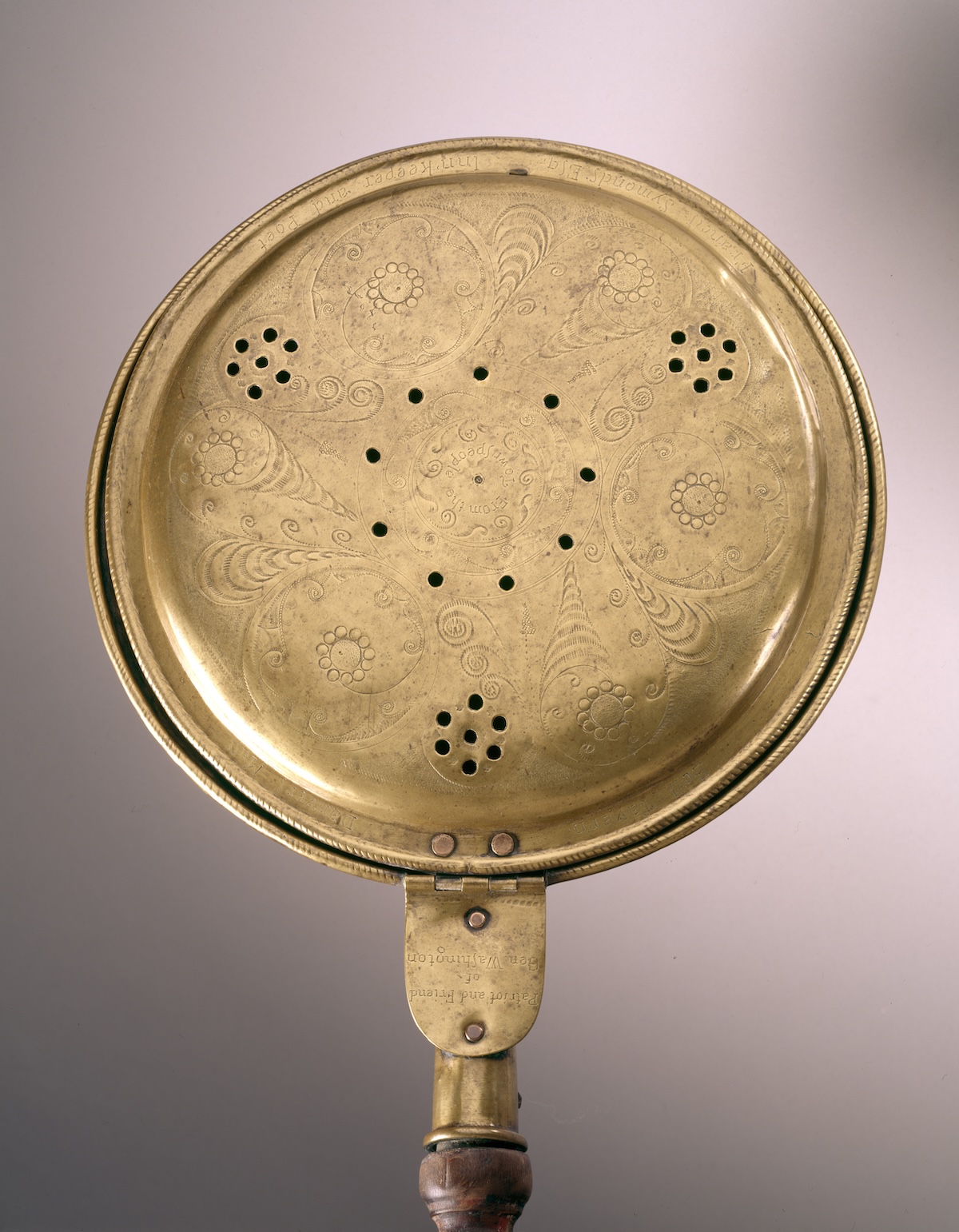
Tucked away in the parlor at Historic New England’s Cogswell’s Grant in Essex, Massachusetts, is a warming pan with a turned wooden handle and a brass container pierced with holes and engraved with scrolling vines and flowerheads. Also referred to as bed warmers, warming pans were a common household tool in colonial and post-revolutionary America, filled with embers and placed under the sheets of a bed to warm it before use.

This particular warming pan had more than just decorative motifs adorning its metallic surface. Engraved on its lid are the words:
From the Townspeople / Patriot and Friend of Gen. Washington / Bell Tavern, Danvers, Massachusetts / Francis Symonds Esq. Innkeeper and Poet.
On the pan’s sides, inside the incised outline of a bell:
I’ll toll you / if you have need / and feed you well / and bid you speed.
On the other side:
Francis Symonds / makes and sells / the best of chocolate / also shells.
John Warner Barber’s Historical Collections (1839) recorded that those verses hung on signs outside the Bell Tavern. In 1841 the Boston Cultivator stated that innkeeper Symonds’s “poetic genius caused [those lines] to be inscribed”; as Lome notes, he was known for adding bits of rhyme to his advertisements. (The Cultivator changed “also shells” to “and shells,” which scans better if you put three syllables into “chocolate.”)

The essay continues:
By its history, as recorded by Nina Fletcher Little, the warming pan was presented to Symonds around 1785: “After the war’s close, the citizens of Danvers evidently wished to present Symonds with a token of their esteem and decided on a warming pan as a practical gift.” The engraved inscription inside the bell matched the Bell Tavern’s signpost. The additional inscription praised Symonds as a patriot, friend of George Washington, and a poet, truly a prominent citizen and worthy of appreciation.

When researching this object for [the upcoming exhibit] Myth and Memory, one major detail of Symonds’s life challenged its story: Francis Symonds died on September 22, 1775. According to the Essex Gazette:
“On the 22nd Instant died at Danvers and on the 24th was very decently interred, Mr. Francis Symonds, Innholder, in the 5th Year of his Age. He was very just in his Dealings, and compassionate to the Poor as far as lay in his Power. In his last Sickness, especially towards the Close of Life, his Calmness and Resignation were very remarkable. He has left a sorrowful Widow and 6 Children, for whom we wish that the fame Compassion that he has shown to others may be shown to them.” . . .
Francis Symonds mustered for two days with Colonel [Timothy] Pickering’s regiment during the Battle of Lexington and Concord, and again on April 24, 1775, serving for a little over three months, until August 1, 1775. He was at home when he died of illness.

So, what about the warming pan? It seems very unlikely that the town of Danvers presented it to him on his deathbed, nor to his family immediately after, given the ongoing Siege of Boston. What is its true history?
Lome doesn’t offer a definite conclusion, but I like her hypothesis that the words were inscribed during a commemoration of the Revolution, such as Danvers’s dedication of a memorial obelisk near the Bell Tavern in 1835. Or later, when warming pans themselves were becoming relics of a quaint past. 

Thursday, February 13, 2025

“Leslie’s Retreat” Commemorations in Salem and Marblehead

Essex County is gearing up to commemorate the Sestercentennial of “Leslie’s Retreat,” the frustrated British army expedition on 26 Feb 1775 to seize cannon that Patriot rebels were collecting in north Salem.

Redcoat troops landed in Marblehead and marched through town to Salem. The militia companies of other nearby towns mobilized in response. That confrontation could have led to serious violence in the midst of Massachusetts’s second-largest settlement, but fortunately it was resolved peacefully.

Here are all the commemorations that I’ve learned about through Salem 400, the Marblehead Museum, and partner organizations.

Saturday, 15 February, 10 A.M.
Leslie’s Retreat: Salem on the Brink of Revolution
Salem Armory Visitor Center, 2 New Liberty Street, Salem

The National Park Service opens its exhibit on why Crown soldiers under Lt. Col. Alexander Leslie came to Salem on February 26, 1775, who were the major players in the event, and how this event has been remembered and celebrated in Salem in the last 250 years. This free exhibit wlll be on display through 27 April.

Saturday, 15 February, 11:30 A.M.
250th Anniversary of Leslie’s Retreat Forum and Discussion
Pickering House, 18 Broad Street, Salem

Local historians David Moffatt, Benjamin Shallop, Jeff Swartz, and Vijay Joyce discuss the British army expedition and the local reaction. $25 admission, $20 for Pickering House members. (Currently listed as sold out.)

Sunday, 16 February, noon to 3 P.M.

Tours of the Pickering House
18 Broad Street, Salem

The caretaker of the oldest house in Salem will introduce eleven generations of Salem history, including the Patriot activist Timothy Pickering, later a Continental Army general and U.S. Secretary of War and Secretary of State. The tour will cover the oldest parts of the house and end with tea and coffee. Order tickets here.

Friday, 21 February, 6:30 P.M.
Leslie’s Retreat exhibit opening reception and lecture
Salem Armory Visitor Center, 2 New Liberty Street, Salem

Emily Murphy, Ph.D., curator of this exhibit and for the Salem Maritime National Historic Site and Saugus Iron Works National Historic Site, will speak about the history and its interpretation at this free event.

Saturday, 22 February
Commemorative March and Tours
Salem
  • 9:30 A.M.: Presentation at St. Peter’s San Pedro’s Episcopal Church, 24 St. Peter’s Street, Salem.
  • 11 A.M.: Redcoat March to North Bridge. The public will view the reenactors from the site of the bridge. Spectaors should plan to be at the North Bridge at 11 A.M. sharp.
  • Noon to 4 P.M.: Self-guided tours of St. Peter’s San Pedro Episcopal Church.
  • 12:30 P.M. and 2:30 P.M.: Salem-Marblehead Trolley Tour lead by local architectural historian Judy Anderson. Reservations encouraged. The trolley starts boarding fifteen minutes before the tour, and everyone with a reservation must be aboard by 12:20 or 2:20. Then the remaining seats will be made available on a first-come first-served basis.
  • 2:30 P.M.: Fashion in the Season of Revolution: A Panel Discussion & Revolutionary Reenactor Promenade, Peabody Essex Museum, 161 Essex Street, Salem, free with museum admission.
  • 7:30 P.M.: Revolution Ball, Hamilton Hall, 9 Chestnut Street, Salem. An evening of live music, dancing, food, and drinks, with attendees in colonial dress or black-tie fashion. General admission $150.

Sunday, 23 February
Indoor Commemorations
Salem
  • 10:30 A.M.: “A Revolutionary Reckoning,” a joint religious service led by First Church in Salem, Unitarian Universalist, and Tabernacle Congregational Church. All ages and denominations welcome. Attendees can stay for a special Fellowship Hour of coffee, tea, and refreshments.
  • Noon to 3 P.M.: Tours of the Pickering House, 18 Broad Street, Salem (see above).
  • 12:30 to 1:30 P.M.: Norumbega Harmony concert, First Church, 316 Essex Street, Salem. Norumbega Harmony is a choral ensemble founded in 1976 and dedicated to the preservation, promotion, and performance of New England psalm singing from the colonial and early American periods.
  • 3 to 5 P.M.: “In Open Rebellion,” Old Town Hall, 32 Derby Square, Salem. World premiere of a drama written by Kristina Wacome Stevick, directed by Samantha Searles, and produced by History Alive. In the fall of 1774, Salem’s Patriots, Loyalists, and enslaved Africans debate the meanings of liberty and loyalty. Free, but attendees must reserve tickets.

Thursday, 27 February, 7 P.M.

When Redcoats Marched in Marblehead
Marblehead Museum, 170 Washington Street, Marblehead, and online

I’ll speak about both the history and the mythology of “Leslie’s Retreat,” drawing on eyewitness accounts and primary sources to illuminate a day the Revolutionary War might have begun, but didn’t. This talk will put the event in the context of the maneuvering between Gov. Thomas Gage and the Massachusetts Provincial Congress, and cut away some of the myths that have stuck to it. $15 admission, $10 for museum members.

Wednesday, February 22, 2023

Reading Nathanael Greene, Quartermaster General

The American Philosophical Society in Philadelphia has just finished digitizing its collection of Nathanael Greene Papers.

All the scans can be read through the Revolutionary City portal, created by the A.P.S., the Historical Society of Pennsylvania, and the Library Company of Philadelphia.

The A.P.S. collection comes from Gen. Greene’s years working as the quartermaster general, 1778 to 1780, and doesn’t contain any private correspondence.

As Thomas Johns III writes on the society’s blog:
As Quartermaster General, Nathanael Greene struggled with, but ultimately improved, the transportation of troops and supplies that the Continental Army depended upon. The need for supplies fluctuated throughout the war, but their successful transportation remained essential to the American cause. . . .

During the Philadelphia Campaign, fear of impressment caused many Pennsylvanians to conceal their wagons, horses, oxen, etc. When property was taken, those affected sought to have their damages repaid. Attempts at this, both formal and informal, are documented in the collection. Further, this collection mentions legislation from the General Assemblies of Rhode Island and New York that limited the impressment of articles and wagon-teams by the Continental Army.
Greene was the most successful quartermaster general the Continental Army produced. He took the job reluctantly months after Thomas Mifflin had resigned the post for the second time, and was able to stabilize the office and hand it off to Timothy Pickering.

Mifflin and Pickering were both merchants, so they understood bargaining for goods, but Greene brought a different sort of peacetime experience. As manager of his family’s anchor-making workshop in Rhode Island, he oversaw a proto-industrial factory with a skilled workforce to manage, supplies to obtain, customers to satisfy. Very few men in the young U.S. of A. had that sort of knowledge.

Understanding logistics and supplies for the whole army in turn helped Greene in waging that southern campaign in the last years of the war—but that’s beyond the timeframe of this documentary collection.

The largest collection of Nathanael Greene Papers is in the Clements Library at the University of Michigan. A small collection is in Manuscripts and Archives at Yale.

Friday, April 15, 2022

What Towns Fought in the Battle of Lexington and Concord?

Twice in the past few weeks I’ve found myself discussing the question of which towns’ militia companies were actually in the fighting on 19 Apr 1775.

That’s not the same question as which towns saw fighting. There were fatal exchanges of fire in (west to east) Concord, Lincoln, Lexington, Cambridge, and Charlestown.

Later the west Cambridge village of Menotomy became the town of Arlington, and the west Charlestown area formed Somerville, so those modern municipalities are also on the Battle Road, but they didn’t exist as legal entities in 1775.

Scores of other towns mobilized their militia companies that day. Indeed, the “Lexington Alarm” continued to spread, so even more towns got the word the day after, and the day after that. Within a week there were men from western Massachusetts, New Hampshire, Rhode Island, and Connecticut on the siege lines around Boston.

But because of geography, timing, and the way Lt. Col. Francis Smith and Col. Percy directed the British army column as it withdrew to the east, only some militia companies came close enough to exchange fire with the redcoats.

All the militia companies that turned out in April 1775 could apply to the Massachusetts government for pay for the days they were active. The surviving pay records, now in the state archives, offer data on the companies, commanders, and men. They’re often reprinted in local histories. But those documents don’t differentiate between the units that saw combat and those that were ready to but didn’t.

To identify the towns that did exchange fire, therefore, we have to turn to news accounts (especially casualties), memoirs, anecdotes, and lore. Frank Warren Coburn set out to do this in The Battle of April 19, 1775 (1912), particularly the special edition with a long appendix of muster rolls, digitized here. Derek W. Beck retraced that research in Igniting the American Revolution, 1773-1775 (2015), appendix 14.

The towns with men killed or wounded were, in alphabetical order: Acton, Bedford, Beverly, Billerica, Brookline, Cambridge, Concord, Charlestown, Chelmsford, Danvers, Dedham, Framingham, Lexington, Lincoln, Lynn, Medford, Needham, Newton, Roxbury, Salem, Sudbury, Stow, Watertown, and Woburn.

However, the man from Salem who died, Benjamin Peirce, appears not to have marched with the Salem companies. The commander of that regiment, Col. Timothy Pickering, was bitterly criticized for not moving fast enough to engage the British. Peirce died in the fighting at Menotomy along with several men from Danvers and Lynn, so he had probably mustered in the company of a neighboring town.

Likewise, although two people from Charlestown were shot and killed—septuagenarian James Miller and teenager Edward Barber—that town’s militia company may never have officially mustered and entered the fight. According to Jacob Rogers:
In the afternoon Mr. James Russell [a town official and appointee to the mandamus Council] received a letter from General [Thomas] Gage, importing that he was informed the people of Charlestown had gone out armed to oppose his majesty’s troops, and that if one single man more went out armed, we might expect the most disagreeable consequences.
Since the most populated part of Charlestown was well within range of British army and naval artillery, town leaders had good reason to keep the militia company out of action. Miller and a friend were apparently shooting at the redcoats on their own in west Charlestown. Barber was a non-combatant looking out a window of his family home.

Thus, while the list of towns that suffered casualties is a good guide to which towns’ companies were in combat, it’s not the same.

TOMORROW: Coburn and his honorable mentions.

Monday, May 10, 2021

The Exchange between President Washington and Red Jacket

During George Washington’s first term as President, the War Department had primary responsibility for dealing with the Native nations living on land that the young U.S. of A. claimed.

Sometimes this went very badly, as in the Harmar Campaign of late 1790 and Battle of the Wabash in November 1791. Those were utter defeats of the small U.S. army in the Northwest Territory by a confederacy of Miamis, Shawnees, and Delawares. They made it imperative for President Washington’s administration to forge better relations with nearby Indian nations.

The Haudenosaunee or Iroquois was an ancient confederation which had split during the Revolutionary War but formed again afterward. Some of the Stockbridge community had moved into western New York and allied with them. The U.S. government wanted this confederation to serve as intermediaries with the other Native nations further west.

In March 1792, a delegation of about fifty Haudenosaunee men arrived in Philadelphia for talks with the U.S. government. Timothy Pickering handled the negotiations, with Secretary of War Henry Knox watching over his shoulder.

On 23 March, President Washington himself spoke to the delegation. At the end of his remarks he delivered a “large White belt” to the visiting diplomats.

On the same day, Washington wrote to the Senate to confirm his main goal was “that the chiefs should be well satisfied of the entire good faith and liberality of the United States…conditioned on the evidence of their attachment to the interests of the United States.” Feeling his way within the U.S. Constitution, he asked Senators for their “advice” on whether the Congress would agree to this provision:
The United States, in order to promote the happiness of the five nations of indians, will cause to be expended ann[u]ally the amount of one thousand five hundred dollars, in purchasing for them clothing, domestic animals and implements of husbandry, and for encouraging useful artificers to reside in their Villages.
On 31 March, a Seneca leader named Sagoyewatha or Red Jacket replied to Washington’s speech. As reported by the War Department, Red Jacket held up Washington’s belt and proffered another in returned. He declaimed:
The President of the thirteen fires, while continuing his Speech made also this remark. That in order to establish all his words for the best good of Your nation & ours—we must forget all the evils that were past, and attend to what lies before us, and take such a course as Shall cement our peace, that we may be as one.

The President again observed, That it had come to his ears, that the cause of the hostilities now prevailing with the Western Indians, was their persuasion that the United States had unjustly taken away their lands. But he assured us this was not the case. That it was not the mind of any of his Chiefs to take any land on the whole Island without agreeing for it. . . .

Now Brother, which you continue to hear in behalf of the United States let all here present also open their ears, while those of the five nations, here present Speak with one voice. We wish to see Your words verified to our Children & Childrens children. You enjoy all the blessings of this life: to you therefore we look to make provision that the same may be enjoyed by our Children. This wish comes from our hearts. but we add, that our happiness cannot be great if in the introduction of your ways, we are put under too much constraint.
Within the Seneca nation, Red Jacket was a traditionalist. He wanted the Senecas to be able to continue to live and worship as they had, not pressuring into adopting European ways. But all the Haudenosaunee at that conference wanted the Americans to respect their territories and independence.

In April, the Senate approved Washington’s proposal for annual grants to the Haudenosaunee. While this is sometimes labeled as a treaty, it was internal U.S. legislation, not signed by Indian delegates. Washington passed the news along, and Knox and Secretary of State Thomas Jefferson formally affirmed the promise.

The 1792 meeting led to another conference two years later, when Pickering negotiated the Treaty of Canandaigua. Red Jacket was among the Haudenosaunee leaders who signed that document. It promised “perpetual peace and friendship,” affirmed Native land claims, and tripled the annual payment. The last provision is the only one the U.S. of A. has faithfully observed; each year the federal government supplies $4,500 worth of cloth to the Haudenosaunee.

TOMORROW: A remembrance of the 1792 meeting.

Saturday, May 11, 2019

Pickering on the Beginning of the Siege

Earlier this week the Journal of the American Revolution made the first publication of a 21 Apr 1775 letter by Timothy Pickering, colonel of the Essex County militia. The letter now belongs to the Harlan Crow Library in Dallas.

The title of library curator Samuel Fore’s article emphasizes Pickering as an “Eyewitness to the British Retreat from Lexington.” However, the letter doesn’t say anything about the events of 19 April (including Pickering’s own actions, which were controversial for decades).

Rather, on 21 April Pickering wrote about how the siege of Boston was taking shape. Or at least about the situation on the northern wing of the siege; he didn’t mention what was going on in Roxbury at all. Instead, he told a colleague from Essex County:
The regulars were entrenching on the first hill beyond Charlestown neck; also on a point of ground (as well as I could learn) in Cambridge river, just as it opens to the Bay. For what purposes I cannot tell, but conjecture to prevent the provincials entering Boston by the way of Charlestown, or by boats going down Cambridge river. The provincials, perhaps three or four thousand men, were scattered about Cambridge common too much at random.
Lack of discipline by the common soldier was a fairly constant theme in Pickering’s military writings.

As a regimental commander, Pickering was invited to a council of war in Cambridge headed by Gen. Artemas Ward and Gen. William Heath, with Dr. Joseph Warren sitting in. Characteristically, Pickering voiced his opinions, including on whether the Massachusetts troops should attack the British positions:
I ventured to declare my opinion “That we ought to act only on the defensive; but some thought that now was the time to strike, & that now the day might be our own, & end the dispute. I could not think so: for besides the scanty portion of ammunition we at present could come at, our men were not sufficiently prepared for action; they were not disciplined even for an irregular engagement; few, very few, have had experience; & the officers in general have neither instructed themselves nor men how to act: The confusions of yesterday, testified by every officer I could talk with, fully justify these assertions. . . .

Another & what appeared to me an important reason for acting only on the defensive was this. The attack is universally said by our people to have been begun by the King’s troops: This may serve to justify a return of fire from us; and tho by pursuing them we seemed to act offensively, yet that was a natural consequence of the first attack, & might be excused: but to attack the troops, while they remained, as now, quiet in the trenches, would be deemed a much more atrocious act, & fatally prevent an accommodation, which notwithstanding yesterday’s skirmish, did not appear wholly impracticable.[”]
That reinforces Pickering’s reputation for wanting to find an “accommodation” with the royal government when other Massachusetts Patriots were ready to push harder. People groused that his attitude had kept the Essex County troops from engaging with the British column on 19 April.

Another question the Massachusetts commanders faced was whether to maintain maximum forces around Boston or send some militia units back home to defend their coastal towns from possible attack by the Royal Navy. Pickering didn’t want to leave Salem undefended:
I told them the seaports were so greatly exposed it appeared to me & others not expedient that any of the militia should leave them, & therefore, after consulting with the chief officers present I had directed and advised the Salem, Beverly, and Manchester militia to return. This was rather contrary to the previous desire of the Council of War, (composed of the General & field officers above mentioned;) but afterwards it appeared that they also judged it expedient, by directing the Ipswich companies to return:
That shows us how loose Gen. Ward’s authority was. The previous day’s council of war had agreed to keep troops at the siege lines, but Pickering had already sent some of his men home.

Toward the end of his letter, Pickering wrote: “I have also just heard by a man from Boston, that Earl Percy is badly if not dangerously wounded.” That rumor was false. Lt. Col. Francis Smith had been wounded, though not badly, but Col. Percy was unhurt.

Wednesday, October 10, 2018

“Unintimidated by all the obloquy cast upon me”

As described yesterday, in the late 1760s Timothy Pickering, newly appointed an officer in the Essex County militia, took up the cause of halting the tradition of “firing,” or discharging muskets (without balls) at or near officers or other people for fun.

He addressed that crusade in a characteristically long newspaper essay published in the 30 Oct 1770 Essex Gazette. Here’s a taste:
The practice appeared to me so foolish and unreasonable, that, young and inexperienced as I was with the manners of men, I had no conception of any difficulty attending the execution of my design. Yet I had no sooner begun to exert myself for that end, than I had, not the soldiers only, but almost the whole town upon my back. I was reproached with being a stiff, obstinate, severe, precise fellow, afraid of gun-powder, a coward, and I know not what. Many who did not approve, but condemned the firing, thought, as it had been the practice time out of mind, that I was to blame in opposing it. “But none of these things moved me.” [Echoing Acts 20:24.]

Unintimidated by all the obloquy cast upon me, I still persevered in my design. I found the practice I was endeavouring to eradicate was condemned by many thinking, judicious people: that strengthened my hands; and by degrees I learned to bear unmerited reproach without uneasiness. And at length my endeavours, seconded by some of my brethren, have been crowned with success, to the no small comfort and quiet of the town.

That I have not relaxed in my endeavours to form an orderly, well disciplined militia, maugre [i.e., despite] all opposition, the whole town is witness. And the last training-day affords a fresh proof that I have not sought-----that I do not seek---popularity, by falling in with the prevailing humour and inclination of the people, when that humor and inclination militates with truth, with reason, and, in the instance referred to, with the rules of the military art.
There are at least three notable things about Pickering’s essay. First, the articles he was replying to didn’t actually say anything about how he led the militia. They complained that he was too close to friends of the royal government. He got onto the militia topic on his own.

Second, at the end of this quoted passage Pickering added, “What happened on that day is well known in the town, and need not be related.” So what happened on that day? His son suggested that might refer to when he hit a man for firing at his feet, but we’ll never know.

Finally, for all of Pickering’s efforts to ward off accusations of being “a stiff, obstinate, severe, precise fellow,” his critics got that absolutely right.

Tuesday, October 09, 2018

“Some would fire at all sorts of persons”

Yesterday I posted a Boston Evening-Post advertisement from 1768 asking the public to identify the militiaman who “discharge[d] his Musket against the Legs of a Gentleman then passing thro’ the Town-House” on 22 September.

That was, Boston 1775 readers may recall, the same date that the Massachusetts Convention of Towns opened in Faneuil Hall. The town’s Whigs were complaining about the imminent arrival of British regiments. They were using a short-lived scare about war with France to justify talk of strengthening local self-defense. So how did musket fire in the Town House fit into the routine of the Massachusetts militia?

Unfortunately, it was pretty standard. Timothy Pickering, a vociferous critic of shenanigans during militia drills, reported that startling citizens with musket fire was a common prank on training days. Writing as “A Military Citizen” for more than a page in the 21 Jan 1769 Essex Gazette, Pickering complained:
Did any awkward, or uncommon Figure of a Man unfortunately come in Sight of these Heroes,—by a sudden Excursion, they surprized, surrounded, and for a while buried him in Fire and Smoke, then, with self-approving Shouts, and Breasts glowing with the Thoughts of their valourous Deeds, they made a gallant Retreat, and again joined the main Body.
Writing under his own name in the 30 Oct 1770 Essex Gazette, Pickering said the prank was so institutionalized there was even a name for it:
I will instance in the article of firing. It had been the custom in Salem from my earliest remembrance, and for 50 or perhaps 100 years before, to fire at the officers, under the senseless notion of doing them honour. And not content with this, some would fire at all sorts of persons; and it gave them singular satisfaction to make women the objects of their dangerous diversion. Nor did strangers escape the hazard and inconvenience of their inhuman, inhospitable sport. This base custom I set myself to oppose and destroy.
Pickering’s son Octavius later said in a biography: “On some occasion a soldier in Mr. Pickering's company saluted him by firing at his feet; whereupon Mr. Pickering struck him with the flat of his sword.” Commissioned a lieutenant in 1766 and a captain in 1769, Pickering was determined to wipe out that “dangerous diversion.”

TOMORROW: And how did that go, Capt. Pickering?

Thursday, February 08, 2018

More Special Events in February

Here are a couple more events this month that caught my eye.

On Sunday, 11 February, at 12:30 P.M. the Pickering House in Salem will host a presentation on “17th- & 18th-Century Food and Cookery” by Karen Scalia of Salem Food Tours.
What would the Pickerings and their contemporaries have been eating back then? How would it have been cooked? What about spices? Utensils? Where did they get their ingredients? How dangerous was standing over a fire? What about our friend, the Rumford Roaster?
(That would be the type of oven invented by Benjamin Thompson of Woburn, later Count Rumford, shown here.)

This lecture includes a “mini spice tasting.” The cost is $25, or $20 for Pickering House members. Advance registration required through pickeringhouse1@gmail.com.

Down in New Jersey, Somerset County’s Heritage Trail Association will offer its “Five Generals Tour” on Sunday, 18 February.
The popular bus tour…gives participants an opportunity to visit five of the existing houses where Generals George Washington, Henry Knox, Baron Von Steuben, Nathaniel Greene, and William Alexander were headquartered during the Middlebrook Cantonment of 1778-79. The historic homes include the Abraham Staats House in South Bound Brook, the Jacobus Vanderveer House in Bedminster, the Wallace House in Somerville, the Van Veghten House in Finderne, and the Van Horne House in Bridgewater.
At the Vanderveer House, Bob Heffner of the American Historical Theatre in Philadelphia will portray Gen. Knox (as shown at right). The artillery commander used that house as his headquarters in the winter of 1778-79. Knox also established America’s first military training school in nearby Pluckemin.

The tour begins at the Van Horne House, 941 East Main Street in Bridgewater. Docents will welcome visitors at each home. The bus will return to the Van Horne House between each visit for refreshments. The entire tour will take a little less than three hours, with departures on on the hour from 11:00 A.M. to 2:00 P.M. Each tour is limited to twenty people. The cost is $25 for adults, $15 for students, free for children under age six. Register through the Heritage Trail Association.

Friday, October 28, 2016

Mr. Jefferson’s Respects on the President’s Birthday

Amid the controversy over the birthday ball for George Washington in Philadelphia in 1798, Abigail Adams wrote home to a relative:
I have heard that there is a design to shift this matter off upon the Vice President, but in Justice to him, he had no hand in it further than to subscribe to it, being told that the President would certainly attend. when he found that he would not go, he refused also, this I am sure of so that let no more be laid upon him than he deserves.
Thomas Jefferson had indeed bought a ticket to support the ball on 2 February. That suggests the Vice President had early word of the event. The organizers didn’t send an invitation to President John Adams for another ten days.

Furthermore, on 15 February Jefferson wrote to his friend James Madison from Philadelphia about the celebration and its political implications:
A great ball is to be given here on the 22d. and in other great towns of the Union. This is at least very indelicate, & probably excites uneasy sensations in some. I see in it however this useful deduction, that the birthdays which have been kept have been, not those of the President, but of the General.
As a republican, Jefferson viewed balls honoring officeholders on their birthdays as monarchical. But he was ready to make an exception for one that tweaked his rival.

By the day of the ball, it had blown up into a big controversy of both politics and politesse. Jefferson ducked out of attending with a note to one of the organizers:
Th: Jefferson presents his respects to mr Willing, and other gentlemen managers of the ball of this evening. he hopes his non-attendance will not be misconstrued. he has not been at a ball these twenty years, nor for a long time permitted himself to go to any entertainments of the evening, from motives of attention to health. on these grounds he excused to Genl. Washington when living in the city his not going to his birthnights, to mrs Washington not attending her evenings, to mrs Adams the same, and to all his friends who have been so good as to invite him to tea- & card parties, the declining to go to them. it is an indulgence which his age and habits will he hopes obtain and continue to him. he has always testified his homage to the occasion by his subscription to it.
From his safe distance, Jefferson seems to have rather enjoyed the turmoil. He wrote again to Madison on 2 March:
The late birthnight has certainly sown tares among the exclusive federals. It has winnowed the grain from the chaff. The sincerely Adamites did not go. The Washingtonians went religiously, & took the secession of the others in high dudgeon. The one sex threaten to desert the levees, the other the evening-parties. The whigs went in number, to encourage the idea that the birthnights hitherto kept had been for the General & not the President, and of course that time would bring an end to them. [Benjamin] Goodhue, [Nathaniel?] Tracy, [Theodore] Sedgwick &c did not attend: but the three Secretaries & Attorney General [Charles Lee] did.
Abigail Adams’s assessment of the event was based on the small number of ladies she heard had attended. Jefferson gave more attention to how President Adams’s Cabinet—which included Secretary of State Timothy Pickering, Secretary of War James McHenry, and Secretary of the Treasury Oliver Wolcott, Jr.—was acting more loyal to Washington than to him. Which was indeed a problem.

Thursday, March 12, 2015

Washington Jumping Rope and Sleeping with a Black Soldier

Here are two anecdotes of Gen. George Washington and an African-American soldier from Massachusetts, as reported by the Rev. Henry F. Harringon in Godey’s Magazine and Lady’s Book, July 1849:
There lately died [in 1842 actually], in the city of Boston, a very respectable negro, named PRIMUS HALL. He lived to an advanced age, and was the possessor of considerable property. Throughout the Revolutionary war he was the body servant of the late Col. [Timothy] Pickering, of Massachusetts. He was free and communicative, and delighted to sit down with an interested listener and pour out those stores of absorbing and exciting anecdotes with which his memory was stored.

It is well known that there was no officer in the whole American army whose friendship was dearer to Washington, and whose counsel was more esteemed by him, than that of the honest and patriotic Col. Pickering. [So much for Lafayette.] He was on intimate terms with him, and unbosomed himself to him with as little reserve as, perhaps, to any confident in the army. Whenever he was stationed within such a distance as to admit of it, he passed many hours with the colonel, consulting him upon anticipated measures, and delighting in his reciprocated friendship.

Washington was, therefore, often brought into contact with the servant of Col. Pickering, the departed Primus. An opportunity was afforded to the negro to note him, under circumstances very different from those in which he is usually brought before the public, and which possess, therefore, a striking charm. I remember two of these anecdotes from the mouth of Primus. One of them is very slight indeed, yet so peculiar as to be replete with interest. The other conveys a high and holy moral, and deserves to be recorded among the public and remarkable acts of our country’s saviour, as a brilliant illustration that disinterestedness and true humility were guiding principles of his character. The authenticity of both may be fully relied upon.

Washington once came to Col. Pickering’s quarters, and found him absent.

“It is no matter,” said he to Primus. “I am greatly in need of exercise. You must help me to get some before your master returns.”

Under Washington’s directions, the negro busied himself in some simple preparations. A stake was driven into the ground about breast high, a rope was tied to it, and then Primus was desired to stand at some distance and hold it horizontally extended. The boys, the country over, are familiar with this plan of getting sport. With true boyish zest, Washington ran forwards and backwards for some time, jumping over the rope as he came and went, until he expressed himself satisfied with the “exercise.”

Repeatedly, afterwards, when a favorable opportunity offered, he would say—“Come, Primus, I am in need of exercise;” whereat the negro would drive down the stake, and Washington would jump over the rope until he had exerted himself to his content.

On the second occasion, the great general was engaged in earnest consultation with Col. Pickering in his tent until after the night had fairly set in. Head-quarters were at a considerable distance, and Washington signified his preference to staying with the colonel over night, provided he had a spare blanket and straw.

“Oh, yes,” said Primus, who was appealed to; “plenty of straw and blankets—plenty.”

Upon this assurance, Washington continued his conference with the colonel until it was time to retire to rest. Two humble beds were spread, side by side, in the tent, and the officers laid themselves down, while Primus seemed to be busy with duties that required his attention before he himself could sleep. He worked, or appeared to work, until the breathing of the prostrate gentlemen satisfied him that they were sleeping; and then, seating himself on a box or stool, he leaned his head on his hands to obtain such repose as so inconvenient a position would allow. In the middle of the night Washington awoke. He looked about, and descried the negro as he sat. He gazed at him awhile, and then spoke.

“Primus!” said he, calling; “Primus!”

Primus started up and rubbed his eyes. “What, general?” said he.

Washington rose up in his bed. “Primus,” said he, ”what did you mean by saying that you had straw and blankets enough? Here you have given up your blanket and straw to me, that I may sleep comfortably, while you are obliged to sit through the night.”

“It’s nothing, general,” said Primus. “It’s nothing. I’m well enough. Don’t trouble yourself about me, general, but go to sleep again. No matter about me. I sleep very good.”

“But it is matter—it is matter,” said Washington, earnestly. “I cannot do it, Primus. If either is to sit up, I will. But I think there is no need of either sitting up. The blanket is wide enough for two. Come and lie down here with me.”

“Oh, no, general!” said Primus, starting, and protesting against the proposition. “No; let me sit here. I’ll do very well on the stool.”

“I say, come and lie down here!” said Washington, authoritatively. “There is room for both, and I insist upon it!”

He threw open the blanket as he spoke, and moved to one side of the straw. Primus professes to have been exceedingly shocked at the idea of lying under the same covering with the commander-in-chief, but his tone was so resolute and determined that he could not hesitate. He prepared himself, therefore, and laid himself down by Washington; and on the same straw, and under the same blanket, the general and the negro servant slept until morning.

I say that this lost incident conveys a high and holy moral. It affords additional evidence, and that of the clearest nature, that the reverential admiration of the American people for their Washington is not misplaced. He acted from that pure and deep-seated principle, that true nobility of character and self-respect, which enabled him to bear himself with lofty dignity in the presence of the proudest, and, at the same time, impelled him to respect the rights and sympathize with the sufferings of the humblest.
Hall did work as a waiter for Pickering toward the end of the war, as he stated in his pension applications. Otherwise, I don’t believe a word of this.

Hall never mentioned such close encounters with Washington in his applications or, so far as I know, anywhere else. As Harrington told the story, it reinforced everything that Sarah Josepha Hale’s ante-bellum magazine readers would want to believe: Washington a “saviour” kind even to blacks rather than a slightly conflicted slaveholder totally invested in formal hierarchy and manners, Hall an obedient servant to his “master” and to Washington rather than a stubborn fighter for his pension and for civil rights in the new republic.

Tonight I’ll speak about how Washington started to think differently about black soldiers and African-Americans in general. But I really don’t think that ever extended to sharing his bed.

Saturday, December 08, 2012

The Wall Calendar Contest Answers!

Last Sunday I announced a quiz on early American politicians with the prize of a Colonial Williamsburg wall calendar. The deadline for entries was last night, so now I can reveal the answers.

The most useful key to my trivia questions is that I fancy myself a tricky bastard. So what look like obvious answers are usually wrong. To put it another way, I like questions based around facts that caught me by surprise when I first read them.

1) What office(s) in the government of the United States of America did John Hancock hold and when?

I tried to write this question to restrict the period to after the states adopted the Articles of Confederation in 1781, thus forming a permanent government of the U.S. of A. That would eliminate Hancock’s stretch as chairman of the Second Continental Congress from May 1775 to October 1777. By the time the Articles were ratified, he was home as Massachusetts’s most popular politician.

Hancock declined to run for reelection as governor at the end of 1784, citing poor health, and then put his name in as a delegate to the national Congress. When he came back to Philadelphia in late 1785, members of the Congress voted him chairman again for old times’ sake. The legislature barely met for the next few months and Hancock hardly did anything, but he got to sit out the Shays’ Rebellion and the controversial measures to suppress it. Hancock made a triumphant return to the governorship, popularity intact, in May 1787. Best political instincts of his generation, I say!

Thus, in the government of the U.S. of A., Hancock held the office of President of the United States in Congress Assembled (or President of the Congress) from November 1785 to June 1786. No points off for mentioning his earlier term, but a correct answer should include that later tenure.

The closest to the correct answer to this question came from Nathan C. Traylor of The History Tavern.

2) Gouverneur Morris was never a governor, alas, but he was a member of the Continental Congress, the Constitutional Convention, and the U.S. Senate. From where?

Morris (pictured above) represented New York in the Continental Congress, but then moved to Philadelphia in 1779. He represented Pennsylvania in the Constitutional Convention, but then moved back to New York in 1788. He represented New York in the U.S. Senate in 1800-1803.

Ben answered this question exactly.

3) In 1789 Alexander Hamilton took office as the first Secretary of the Treasury, but he was ineligible to be President. Why?

It’s often said that the U.S. Constitution’s requirement that the President be an American citizen from birth would have kept—perhaps was even written to keep—Hamilton from holding that office. He was born on the Caribbean island of Nevis. But in fact the Constitution says the President must be “a natural born Citizen, or a Citizen of the United States, at the time of the Adoption of this Constitution.” No one’s met the second qualification for a long time, but Hamilton did.

So why wasn’t Hamilton eligible to be President in 1789? He was too young. He was born in 1755, making him only thirty-four in that year. Indeed, when Hamilton first came to New York, he told people that he’d been born in 1757, perhaps to make himself seem even more precocious than he was.

This question stumped everyone. The force of myth is strong. Not to mention tricky bastards.

4) What Pennsylvanian did George Washington appoint as Postmaster General?

Again, there’s a first-thing-that-comes-to-mind answer: Benjamin Franklin, famous as our first Postmaster and famous Pennsylvanian! But he was appointed Postmaster by the Continental Congress back in July 1775. (He had also held the post under the Crown.)

President Washington appointed three men as Postmaster General: Samuel Osgood, Timothy Pickering, and Joseph Habersham. Which one was Pennsylvanian? Pickering (shown here).

But wait! Wasn’t this the same Timothy Pickering who commanded the Salem militia during the Battle of Lexington and Concord? The same who served as Secretary of War under Washington and Secretary of State under Washington and John Adams? Yes!

In 1786, after business reversals, Pickering moved from Massachusetts to northeastern Pennsylvania to make a new start. He was living there when he secured the appointment as Postmaster General. Eventually he moved back to Massachusetts in time for Adams to accuse him of being part of the mythical “Essex Junto.”

Nathan, Ben, and Phillip Blancher all picked out Pickering.

5) Of the first seven Presidents of the United States, which men had publicly acknowledged biological sons as heirs when they were in office?

George Washington, James Madison, and Andrew Jackson had no biological children; they helped to raise stepchildren and adopted children. Thomas Jefferson had several children, but his only son by his wife died as an infant and he didn’t acknowledge his likely sons by Sally Hemings. Likewise, James Monroe’s only son died young, leaving him with two daughters.

John Adams had three adult sons when he was President (two when he left office). John Quincy Adams also had three. It’s notable that one of John Adams’s sons became President, and one of John Quincy Adams’s became a U.S. Representative and top diplomat.

So for a country that eschewed hereditary political power, America did accept a sort of dynasty from the only early Presidents for whom that was biologically possible. If the other early Presidents had had sons as heirs, would we have had more Presidents named Washington, Jefferson, Madison, Monroe, and Jackson?

Ben and GSGreatEscaper correctly named the brace of Adamses. Mike Barresi named those two but also guessed Monroe.

Well played, all! No one had all correct answers (that slippery Hamilton question!), and everyone got some points. By a nose, the winner of the wall calendar is…Ben!

(Send me a comment or email with a mailing address, Ben, and I’ll mail the calendar this week.)

TOMORROW: And you thought this was over.

Wednesday, June 09, 2010

Fichter to Speak on So Great a Proffit

Prof. James R. Fichter of Lingnan University in Hong Kong is speaking at three New England historic sites this month on his book So Great a Proffit: How the East Indies Trade Transformed Anglo-American Capitalism. Here’s a review in The New Republic.

Britain started trading with east Asia through the East India Company in the 1600s, and that economic and political link eventually led to major battles on the subcontinent in the Seven Years’ War and War of American Independence, and to the Boston Tea Party.

After independence, American merchants found themselves shut out of the British Empire’s trading system. (Some of them had apparently not thought through what “independence” would mean.) Among the risky new business ventures they tried was the China Trade.

Fichter’s first venue is the Salem Maritime National Historic Site’s visitor center on Sunday, 13 June, at 2:00 P.M., which makes sense since Salem was a center of America’s China Trade. Among the pioneering merchants was Elias Hasket Derby, who had marched with the Essex County militia on 19 Apr 1775, arguing the whole way with his colonel, Timothy Pickering, about whether they should march faster.

On Wednesday, 16 June, at 7:00 P.M., Fichter will speak at the Forbes House Museum in Milton, in an event co-sponsored by the Shirley-Eustis House Association. That Milton mansion was built by Robert Bennet Forbes, who started work for his opium-trading uncle Thomas Handysyd Perkins in 1816 at the age of twelve. The lecture is free, but seating is limited, so the organizers request an R.S.V.P. There will be refreshments supplied by Prof. Fichter’s publisher, Harvard University Press.

Finally, Fichter will cross state lines on Thursday, 17 June, at 5:00 P.M. and talk at the Rhode Island Historical Society’s John Brown House Museum at 52 Power Street in Providence. In 1787 Brown sent the General Washington to Canton with a cargo of “anchors, cannon shot, bar iron, sheet copper, ginseng…, tar, spermaceti candles,” and several types of alcohol, thus launching Rhode Island’s direct trade with east Asia.

Thursday, April 08, 2010

When the Real Battle Started—and Where

One of the basic questions about the Battle of Lexington and Concord is why it took so long for the major fighting to get started. There were men killed at Lexington at dawn, about 5:00 A.M. There were men on both sides killed at Concord’s North Bridge about 10:00. But then the militia commanders pulled half their men back from the bridge, and held their fire when four British companies marched by. The concerted provincial counterattack didn’t start until the early afternoon.

Some, but not all, of the answer lies in how the provincials had to work up to fighting against fellow British subjects. The Massachusetts Provincial Congress had built up a military over the preceding six months in the hopes that it would cause the royal authorities to back down. People wanted a peaceful solution, not a civil war. Of course, after seeing regulars fire first at the North Bridge, the militiamen in Concord felt less reluctance about shooting at them.

This question also makes me think of a comparison I once read between the provincials attacking the British column and a dog chasing a car. If the dog ever catches the car, what would he do with it?

There was an argument well after the war over whether the Essex County militia under Col. Timothy Pickering could have cut off the British before they reached Charlestown. But if the provincials had captured Col. Percy and several hundred soldiers, what would they have done with those men? Who was ready to assume that authority? I doubt the men of Massachusetts really tried to stop the British withdrawal. I think they wanted to exact some punishment and hurry those regulars back to their garrison.

I have to acknowledge that waiting until early afternoon meant that more militia companies showed up, but I don’t think that was decisive.

I think the most significant factor in the the timing is that the Middlesex County militiamen started their concerted attack after the British troops had left the center of Concord. Until then, there had been hundreds of soldiers in the middle of the civilian population and some valued public property. (The print by Amos Doolittle above, courtesy of Colonial Williamsburg, gives an impression of that brief occupation.) Once those troops were a mile to the east, at Meriam’s corner, it was open season.

Sunday, October 15, 2006

Timothy Pickering Oversees the Essex Militia

Timothy Pickering, later U.S. Secretary of State, was colonel of the Essex County militia at the start of the Revolutionary War. He was also the author of An Easy Plan of Discipline for a Militia (available from King's Arms Press) and a Whig activist, though by no means the most radical leader in Salem. Pickering's papers at the Massachusetts Historical Society include some documents from before the war that offer clues about how the militia trained and what equipment men came with.

On 26 February 1775, Lt.-Col. Alexander Leslie and 250 British soldiers entered Salem to search of cannons said to be in a shop north of town. David Mason, secretly employed by the Massachusetts Provincial Congress to gather and prepare those weapons, forced a stand-off at the North River by having the drawbridge hauled up.

Pickering called the first militia drill of the year less than three weeks later, on Tuesday, 14 March. Obviously, war with the Crown army was a serious possibility, and he wanted his men prepared.

Pickering's drill manual listed the equipment for every militiaman as "A firelock, bayonet, waistbelt, a cartridge box, cartridges, and a knapsack." However, in reckoning what his own companies had at hand, he had his officers count the following:

  • firelock
  • bayonet
  • pouch
  • flints
  • cartridges (and loose gunpowder)
  • sword
  • cartouche box
  • balls
  • knapsack
  • screwdriver
Every man in the regiment apparently came with a musket, but far fewer had bayonets or swords. And at least one of the seven companies in the regiment didn't bother to provide an inventory at all, just the men's names.

Pickering's papers also offer insight on the work of the regimental musicians: the drummers and fifers who were the signal corps of the unit. For example, what did the regiment pay a drummer to play at training musters? On 11 Dec 1767, regimental clerk Samuel Derby paid David Hillard “fifteen Shilling Lawfull money for my Son Druming 4 Day in Sd: year.” That was the same amount Derby paid on 12 May 1769 to James Barr, Jr., for “my Last years Druming.” On 14 Feb 1769, Thorndick Dellano provided a receipt for “Six Shilling for Druming in 1768.” Either Dellano didn't work as many days as the other drummers or he ate more. Pickering himself paid for the drummers’ “dinners at the Tavern,” but then deducted the cost from their wages.

The collection also includes a bill for “2 Months Schooling, for John Archer Fifer” and “1 months Schooling for Benja. Thomson on the Fife.” Was this the Benjamin Thompson who became Count Rumford? He worked in Salem from Oct 1766 to sometime after Nov 1768 as a teenaged assistant to merchant John Appleton, and he'd be just the sort of clever, ambitious lad to attach himself to the regiment.