


J. L. BELL is a Massachusetts writer who specializes in (among other things) the start of the American Revolution in and around Boston. He is particularly interested in the experiences of children in 1765-75. He has published scholarly papers and popular articles for both children and adults. He was consultant for an episode of History Detectives, and contributed to a display at Minute Man National Historic Park.

Subscribe thru Follow.it


•••••••••••••••••


Showing posts with label John G. W. Hancock. Show all posts

Friday, December 16, 2022

Flagging the “Object of History” Podcast

The latest episode of the Massachusetts Historical Society’s podcast, The Object of History, is titled “Who Were the Bucks of America?”

The description says:
In this episode, we closely examine one of the most noteworthy items in the MHS collection: the Bucks of America flag. The flag is one of the only remaining artifacts of the Bucks of America, an African American militia based in Boston during the Revolutionary era. There is very little known about the unit with no official military record of their service. We discuss the few pieces of evidence that we have including the flag presented by Governor John Hancock after the end of the Revolutionary War.
The guests are Ben Remillard from the University of New Hampshire and myself.

I haven’t listened yet. Last month I talked with Cassandra Cloutier for an hour, dumping all my thoughts and theories about the Bucks of America and George Middleton on her—the Dr. James Lloyd connection, the false link to the Battle of Groton Heights, the evidence that he and Lewis Glapion both had wives and children when they owned a house together. Only the best and most relevant pronouncements made this thirty-five-minute episode, I presume.

The first person with whom I shared ideas about the Bucks of America flag, several years ago, was curator Anne Bentley. So I’m taking this opportunity to note that the New England Museum Association just gave Bentley one of its 2022 Awards for Excellence. The citation says:
Her almost 50 years of service to the organization highlights her dedication and passion for Art and artifacts. She has had the privilege to work on such notable collections as the Adams and Winthrop families, her final lab project was Thomas Jefferson’s manuscript “Notes on the State of Virginia.” As curator of the art and artifact collection and acting registrar from 1998 through 2021, she enjoyed collaborating with curators and registrars in New England and beyond. . . .

“Retiring” at the end of 2021, Anne now works a three-day week, recataloging artifacts and numismatics and assisting the reading room staff in making these materials available to researchers.

Friday, March 09, 2018

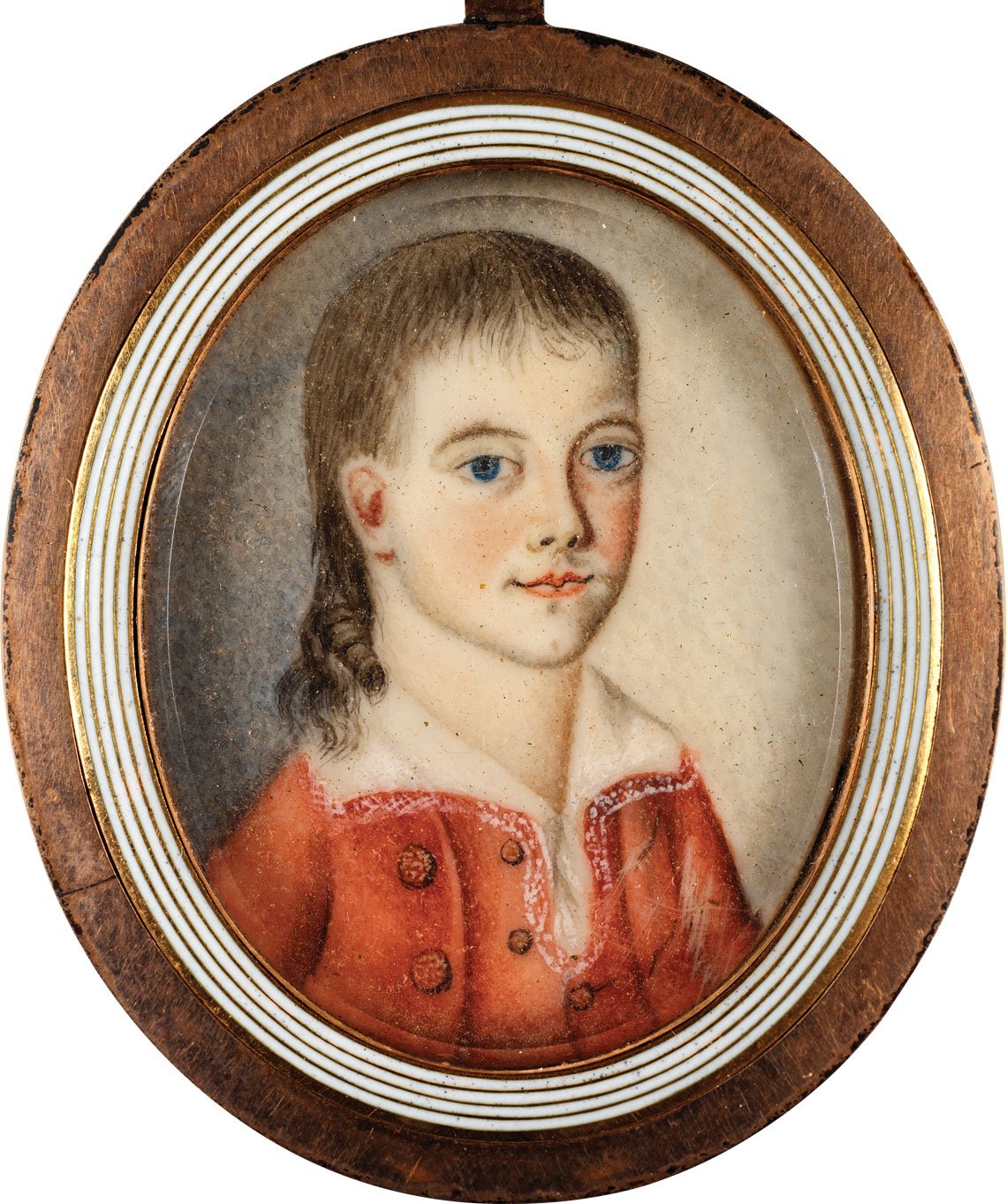
Peale Portraits of the Hancock Children Brought to Light

Last month Pamela Ehrlich published an article in Antiques & Fine Art magazine and at the Incollect site titled “A Hancock Family Story: Restoring Connections.”

Ehrlich wrote:
While researching portraits of Lydia [Hancock], I discovered a listing in the Smithsonian Art Inventories Catalog for an “unlocated” portrait miniature in oil [sic] of “Hancock, Thomas, Mrs. (Lydia Henchman)–Child” painted by Charles Willson Peale (1741–1827) in 1777. It was further identified as No. 354 in Charles Coleman Sellers’ Portraits and Miniatures by Charles Willson Peale (hereafter P&M). However, the death date was incorrect—Lydia Henchman Hancock died April 25, 1776. Furthermore, Peale could not have painted her as a child since she was twenty-seven years old when he was born.
That miniature was at the Rhode Island School of Design in Providence.

Investigating further allowed Ehrlich to identify the baby girl in that portrait as John and Dorothy Hancock’s daughter Lydia, named after her great aunt. Little Lydia died in 1777 at the age of only nine months.

Furthermore, Ehrlich found a corresponding miniature of the Hancocks’ son John George Washington Hancock, shown above. (Terribly sad story of that boy’s death here.) And in the same purchase the art school obtained a Peale portrait of John Hancock himself, painted in the year he signed the Declaration of Independence. Read the article for the full story of the investigation, as well as the remaining mystery of a matching miniature of Dorothy Hancock.

Monday, November 27, 2006

John G. W. Hancock: governor's son

The Smithsonian Institution's website offers a look at the silver and coral rattle that John and Dolly Hancock bought for their son, John G. W. Hancock, when he was born in 1778. He remained their only child. (The couple also had a daughter in 1776, but she died the following year.)

In 1787, when little John was eight, his father was reelected governor. (With his keen instincts for the electorate's mood and for avoiding tough decisions, Hancock had served in that office from 1780 to 1785, sat out the year in which the Shays Regulators closed down Massachusetts's courts and were then closed down themselves, and then returned to state politics with his popularity undiminished.)

In January, father and son were walking with a family friend in Milton. The boy saw a pair of skates in a store window and asked his father to buy them. The governor refused, so the friend said he'd make young John a present of the skates.

John G. W. Hancock soon tried out his new toys on a small patch of ice, fell, and hit his head. He died of the injury shortly afterwards, on the 27th.

The American Herald newspaper wrote:
This amiable child gave every indication of future eminence; and while his sweetness of temper, his strength of memory, and brilliancy of genius, led his parents to hope, that he would be not only the staff of their age, but eminently useful in the world!—Their hopes are suddenly blasted, and they feel the deepest affliction:
Why falls the budding flower? why dies the youth?
Presumptuous reason crys. 'Tis not for us
To search the ends of fate nor fault its means;
Religion answers and our breasts are calmed.
In fact, some friends said that John Hancock, son and grandson of ministers, never recovered emotionally from this loss. He died six years later, only fifty-six years old.

(Well, that was terribly sad, wasn't it? One aspect of this episode that strikes me is how the Hancocks and others of the time obviously knew who that well-meaning family friend was, but I've never seen an account of the boy's death that names him.)