


J. L. BELL is a Massachusetts writer who specializes in (among other things) the start of the American Revolution in and around Boston. He is particularly interested in the experiences of children in 1765-75. He has published scholarly papers and popular articles for both children and adults. He was consultant for an episode of History Detectives, and contributed to a display at Minute Man National Historic Park.

Subscribe thru Follow.it


•••••••••••••••••


Showing posts with label Reading. Show all posts

Friday, October 22, 2021

Revolutionary Events on Saturday, 23 Oct.
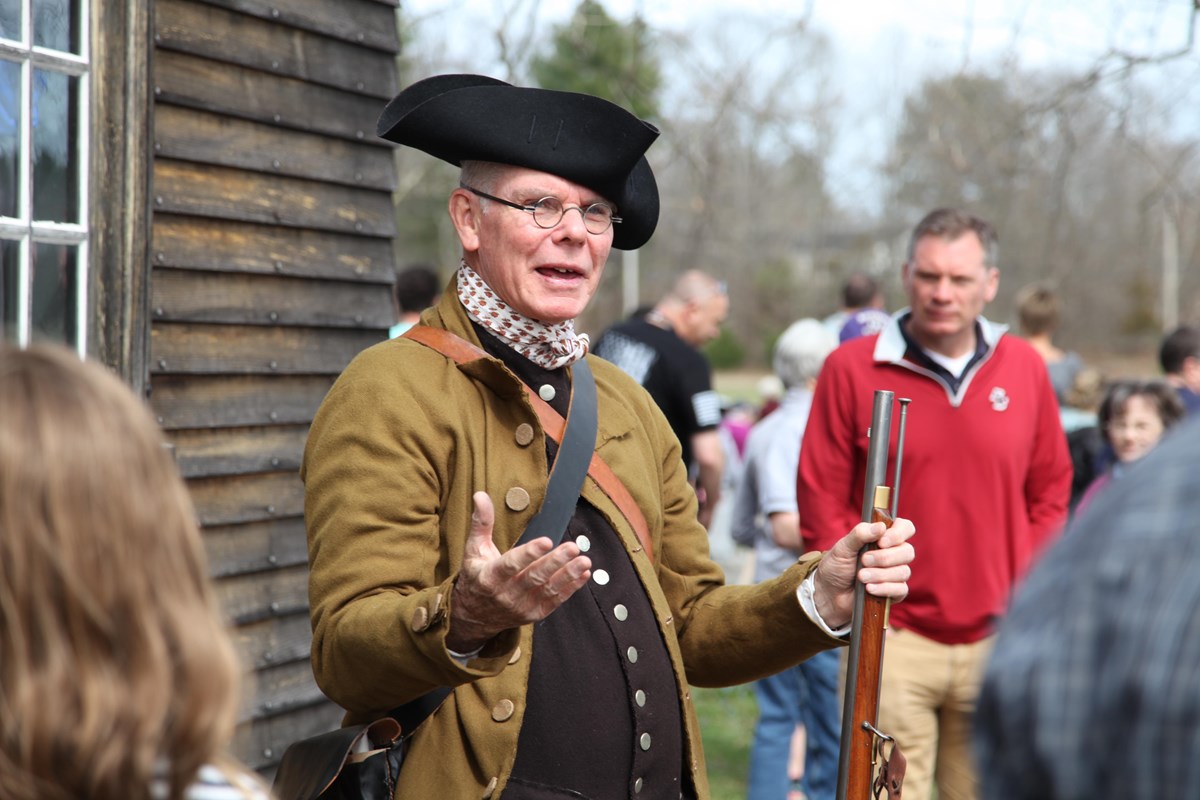
Here are two outdoor Revolutionary events happening in New England tomorrow.

At Minute Man National Historical Park’s Hartwell Tavern site in Lincoln, two knowledgeable volunteers will lead a walking tour of a crucial corner along the Battle Road back from Concord:
Elm Brook Hill (formerly known as “Bloody Angle”) was the site of a violent ambush against the British column on the afternoon of April 19, 1775. Edmund Foster, a volunteer from Reading, Massachusetts (portrayed by Park Volunteer Ed Hurley, shown above), will lead a tour to this battle site where he fought in 1775. Learn about this action from the words of one who was there! Ed will also be accompanied by local historian and author Don Hafner of the Lincoln Minute Men.
That tour will happen twice, at noon and 1:15 P.M. The walk is less than a half mile along a hard-packed dirt surface.

It looks like Frank Coburn was the first author to apply to label “Bloody Angle” to this area and the fight that took place there. In his 1912 The Battle of April 19, 1775, he used the phrase first without capital letters, then with them. But he was borrowing the term from parts of the Gettysburg and Spotsylvania battlefields during the Civil War.

Coburn’s coinage of “Parker’s Revenge” for the skirmish at a site on the Lexington border has been vindicated by archeological evidence, so it will probably stick, even though nobody used that label before him. So he can afford to lose “Bloody Angle.”

Up in Rollinsford, New Hampshire, the Association for Rollinsford Culture & History is hosting a “Colonial Market Fair and Militia Muster” at the Col. Paul Wentworth House. This event will includes artisans in eighteenth-century attire demonstrating such crafts as joinery, coopering, lacemaking, and blacksmithing. A militia unit will perform musket firings and military drills, explain their equipment, and raise a Liberty Pole and flag.

That gathering will happen from 10:00 A.M. to 4:00 P.M. with cannon firings at 11:00, 1:00, and 3:00. Admission is $5 for adults, free for children.

For folks from outside the region or staying inside, American History TV is broadcasting two lectures recorded in 2019 on C-SPAN2:
Those two lectures will be shown back to back starting at 8:00 A.M., 11:00 A.M., 8:00 P.M., and 11:00 P.M. And one can watch them anytime on the web.

Wednesday, March 11, 2020

David Lamson, a Middle-Aged Man of Menotomy

David Lamson was among the men from Cambridge who served in the French and Indian War, according to provincial muster rolls examined by local historian Lucius R. Paige.

Lamson himself had some Native ancestry and probably some African since he was later described as “mulatto” and “half Indian.” He may have been only in his teens when he enlisted.

The man next appears recognizably in government records in March 1767, when he “came from Medford to live at Peter Tufts, jr.’s.” in Charlestown. The town warned Lamson out the next year, disclaiming responsibility if he became ill or needed public assistance, but then taxed him in 1770.

Another Charlestown document puts Lamson in Reading in 1769 before returning, listed as an Indian and described as a “young man” still. His mobility indicates he had no land of his own and moved around the county seeking work.

Within the next few years, Lamson returned to Cambridge, in the western village known as Menotomy. There he had a positive reputation as “a man of undoubted bravery and determination,” respect gained at least in part from his military service.

As a man of color, Lamson was exempt from militia training, despite being only a few years removed from the “young man” label. However, he was on the area’s “alarm list” along with older men and others who didn’t have to train but were still expected to turn out with their guns in an emergency.

And on 19 Apr 1775, Menotomy faced an emergency. Hours before dawn, a column of British soldiers moved through the village on its way to Concord. Around noon, another column of about the same size marched through: Col. Percy’s reinforcements. In between those two sets of redcoats, the local militia company mustered and headed west to confront the king’s troops—from a strategic distance, of course.

That left the “alarm list” or “exempts” in the town. Sometime in the afternoon, word came of a couple of British army supply wagons rolling west. These wagons had been held up, possibly at the bridge across the Charles River. Hastening to meet Lt. Col. Francis Smith’s troops on their way back from Concord, Col. Percy had left those wagons to travel under the protection of several soldiers.

According to nineteenth-century chronicler Samuel Abbot Smith, the Menotomy exempts “met at once in [Benjamin] Cooper’s tavern…to form some plan of capturing” the wagons. “They chose for their leader David Lamson, a mulatto.” Putting a man of color in a leadership role was unusual for this society, but Lamson’s neighbors respected his military experience, his bravery, and most likely his relative youth.

George Quintal, Jr., located a May 1775 document listing “David Lampson” among the men present at that confrontation. Richard Frothingham’s 1849 History of the Siege of Boston stated that Lamson, “a half Indian, distinguished himself in the affair.” Those sources help to confirm Smith’s local lore, published in the 1860s.

Lamson’s group ambushed one British wagon near what would become the corner of Massachusetts Avenue and Medford Street. A company from Chelsea, led by the Rev. Phillips Payson, attacked another wagon. The militiamen killed two of the redcoats in the escort, wounded others, and downed some of the horses. Some of the regulars fled, dropping their weapons and reportedly seeking protection from “an old woman” they found “digging dandelions,” possibly Ruth Batherick.

Menotomy later became the town of Arlington, and it memorializes this short skirmish with a monument crediting the “Old Men of Menotomy.” But their leader was a middle-aged man, exempt from militia training not because of his age but because of his skin color.

I’ll say more about David Lamson and about other Continental soldiers of Native American descent at tomorrow’s Evacuation Day lecture at Longfellow House–Washington’s Headquarters in Cambridge.

Friday, April 08, 2016

Planning Your Patriots’ Day Season

The anniversary of the outbreak of the Revolutionary War is coming up on 19 April, and commemorations of that event start this weekend.

At one point I tried as a public service to catalogue all the celebrations, reenactments, parades, and other historic events scheduled for that season. I wore myself out keeping up with the details.

So I’m just going to point you to some fairly authoritative sources for information:
There are other events as well, especially communities’ local commemorations and traditions.

My own annual ritual usually includes listening to the Lincoln Salute, an outdoor assembly of fife and drum corps at Pierce Park in Lincoln, and watching the Boston Marathon four blocks from my house. This year I’ll probably throw in some PowerPoint preparation for our history comics workshops in the days that follow.

But I’ll note a couple of special tours of the Minute Man Park scheduled for next weekend.

Saturday, 16 April, 10:30 A.M.
Explore Bloody Angle with Edmund Foster
Hartwell Tavern, Hartwell Tavern Parking Area, 100 North Great Road, Lincoln
Edmund Foster, a volunteer from Reading (portrayed by park volunteer Ed Hurley), will lead a tour to this key battle site where he fought in 1775.

Sunday, 17 April, 2:00 P.M.
Revolutionary Dogs: “Paws for the Cause!”
Minute Man Visitor Center, Route 2A, Lexington
Join Park Ranger Roger Fuller and his pug, Cricket, in a 45-minute walk on the Battle Road to explore the lives of dogs in colonial America and in the Revolution. The tour proceeds about half a mile west with four stops along the way. Well-behaved, friendly dogs welcome.