J. L. BELL is a Massachusetts writer who specializes in (among other things) the start of the American Revolution in and around Boston. He is particularly interested in the experiences of children in 1765-75. He has published scholarly papers and popular articles for both children and adults. He was consultant for an episode of History Detectives, and contributed to a display at Minute Man National Historic Park.

Subscribe thru Follow.it


•••••••••••••••••


Showing posts with label Francis Bernard. Show all posts

Saturday, November 15, 2025

The Coroners of Suffolk County, 1747–1774

Early this month I started to discuss the office of coroner in pre-Revolutionary Boston. Then came Pope Night, followed by postings about the espionage of Dr. Benjamin Church, Jr. Now I’m going back to pick up the coroners’ thread.

Coroners were royal appointees: chosen by the governor, who was chosen by the ministry in London, who was chosen with the approval and authority of the king.

As such, their commissions lapsed six months after the death of the king in whose name they were appointed. The new monarch could remove them before that date or authorize new appointments.

The same rule applied to many other legal documents issued in the king’s name, such as the writs of assistance that granted Customs officials the power to search buildings for smuggled goods.

The death of King George II on 25 October 1760 started that clock ticking. In January 1761 sixty-three Boston merchants with James Otis, Jr., as their attorney sued to challenge the validity of new writs of assistance under Massachusetts law. Customs official Charles Paxton responded with his own filing, and the case was argued before Massachusetts judges in February and November 1761.

The merchants lost. But John Adams’s memory of the case (and his wish to put Massachusetts ahead of Virginia in challenging Crown policies) made the Writs of Assistance Case a milestone on the way to independence and eventually the Fourth Amendment.

When it came to the coroners, there was much less trouble. With the advice and consent of the Council, Gov. Francis Bernard simply issued new appointments in the name of King George III for what appear to have been all the existing coroners, and perhaps some new ones, on 5 Nov 1761.

In 1870, William H. Whitmore went through government records, compiled a list of every man elected or appointed to Massachusetts offices before independence, and published The Massachusetts Civil List for the Colonial and Provincial Periods, 1630-1774. You can read it here, though it’s not that sort of book.

Here are scraps of The Massachusetts Civil List’s section on Suffolk County coroners. Recall that Suffolk County then included all of today’s Norfolk County, so this list includes men who examined unexpected deaths in rural towns well outside Boston.

That list doesn’t say when a coroner left office, usually by becoming a potential subject for a coroner’s inquiry. But it should include the names of the Boston coroners in 1770, the year of the Massacre, and 1774, the year of William Molineux’s death.

That’s why I started to worry I’d tripped into a Boston 1775 emergency.

TOMORROW: A chill of doubt.

Wednesday, April 23, 2025

“Putting all matters of politicks out of view”?

Esther Quincy married Jonathan Sewall in January 1764, after a courtship of more than four years.

She was the daughter of the Boston merchant and magistrate Edmund Quincy, who had come back from bankruptcy a couple of years before.

He was a young lawyer of sharp wit and moderate means trying to establish himself, building up from the position of justice of the peace.

Jonathan Sewall didn’t enter the political debate over the Stamp Act, but in December 1766 he came out swinging on behalf of Gov. Francis Bernard and royal policy in newspaper essays signed “Philantrop.”

The governor rewarded Sewall with appointments as the province’s solicitor general and then attorney general. He later got to be a judge in the Vice Admiralty Court as well.

Esther’s father was on the other side of the political divide. He was one of the justices the Boston Whigs called on when they had a complaint about a royal official or soldier. He joined other magistrates in resisting Gov. Bernard’s call for barracks in 1768. He took the (conflicting) testimony of Charles Bourgate after the Boston Massacre. He issued the warrant to arrest John Malcolm for assault.

Most of Esther Sewall’s other male relatives were also Whigs. Uncle Josiah Quincy, Sr., in Braintree was on the Council, one of several thorns in the royal governors’ sides. Cousin Josiah, Jr., practiced law in Boston, wrote newspaper essays, counseled local activists, and traveled to meet fellow Whigs in the southern colonies and London. The major exception within the Quincy family was cousin Samuel Quincy, who followed in Jonathan’s wake as the province’s solicitor general.

Many of Jonathan’s old friends were Whigs, including John Adams, and that produced some awkward social moments. Jonathan prosecuted John Hancock on smuggling charges (eventually dropping the case for lack of solid evidence). But in 1772 the merchant wrote to him expressing
my inclination and wish (putting all matters of politicks out of view) that a perfect harmony and friendship may be kept up between us, and wish rather more familiarity than the common shew of friendship expresses, considering the connection I have formed with the sister of your Lady.
That was Esther’s sister Dorothy. She became Hancock’s fiancée, their engagement almost as long as the Sewalls’ had been.

By 1774 the Sewalls were living in Cambridge in a country mansion bought from Richard Lechmere. Their household included three small children, three young men studying the law, and at least one enslaved young man.

Early on 1 September, Gen. Thomas Gage’s soldiers seized militia gunpowder in Charlestown and cannon in Cambridge. Around noon, Jonathan Sewall suddenly left home and headed to Boston. The governor might have sent for him, or he might have feared how the neighbors would react to the army operation. Or he might have had a whim.

After dark, those neighbors came to the Sewalls’ house. They refused to take Esther’s word that Jonathan was out. Some men pushed into the house, and the young men inside beat them back. One of those boarders, Ward Chipman, fired a pistol inside the house—some sources say accidentally, some not. Either way, that noise got everyone’s attention. The two groups of men agreed not to do further violence as long as they could enjoy some of the Sewalls’ wine.

Soon afterward, Esther took the children into Boston to be with Jonathan. That might have been as early as 2 September when the “Powder Alarm” brought thousands of militiamen into the street outside.

Unlike some people threatened by crowd violence, Esther Sewall never renounced Massachusetts. Her family ties were too strong. In 1778 she wrote to her father: “I had not forgot my own Country, and Friends no, my D[ea]r Father, I should as soon forget myself.” But as of September 1774 she was stuck inside Boston with her unpopular husband.

TOMORROW: Can this marriage be saved?

Wednesday, April 09, 2025

Richard Draper’s “Report of these Images”

As long as I’m discussing nomenclature for Boston’s political groups in the 1760s, I’ll tackle “the Union Club.”

America’s first public, outdoor demonstration against the Stamp Act took place along Boston’s main road on Wednesday, 14 Aug 1765. The big elm where the protesters hung effigies hadn’t yet been named Liberty Tree.

The next day, Richard Draper published his Boston News-Letter newspaper with a two-page supplement. It didn’t report on the protest, however—that sheet was entirely devoted to foreign news.

The News-Letter did print Gov. Francis Bernard’s 15 August proclamation of a reward for the rioters who had torn down stamp agent Andrew Oliver’s building the night before. That was the paper’s only description of the event.

Boston’s Whigs complained that Draper was tilting his coverage to please the royal government. In his 22 August issue the printer objected to the News-Letter being called “a Court-Paper…under the Controul of higher Powers.” He insisted:
IN regard to the Occurrences of last Week, we would observe, that it was out of our Power to give a perfect Account thereof, as the Transactions were not finished, and a partial one would perhaps have drawn down the Resentment of many of the true Sons of Liberty, and caused us to be more in Fear, than it is said were of publishing any Thing relating thereto:—

Had the Gentleman who furnished one of the Papers with a decent Account of the Affair, been so kind as to have sent us something of the same Nature, he would have saved himself the Trouble (if he really took the Trouble) to inform the Public that we filled an extraordinary Half Sheet with immaterial Foreign Articles.
The News-Letter’s account of the anti-Stamp Act protest, “as concise and true…as it is in our Power,” followed. In the details it agreed with the Monday newspapers, but it also included several sarcastic zings at the protest.
VERY early on Wednesday Morning, the 14th Instant, were discovered hanging on a Limb of the Great Trees, so called, at the South Part of this Town, two Effigies, one of which by the Labels appeared to be designed to represent a Stamp-Officer, the other a Jack-boot, with a Head and Horns peeping out of the Top. said by some of the Printers, to be the Devil or his Imp; but, as we are not acquainted with that Species of Gentlemen, we cannot so well determine whether it was an exact Resemblance or not:

The Report of these Images soon spread thro’ the Town, brought a vast Number of Spectators, and had such an Effect on them that they were immediately inspired with a Spirit of Patriotism, which diffus’d itself through the whole Concourse: So much were they affected with a Sense of Liberty, that scarce any could attend to the Task of Day-Labour; but all seemed on the Wing for Freedom.

About Dusk the Images were taken down, placed on a Bier, (not covered with a Sheet, except the Sheet of Paper which bore the Inscription) supported in Procession by six Men, followed by a great Concourse of People, some of the highest Reputation, and in the greatest Order, ecchoing forth, Liberty and Property! No Stamp! &c—

Having passed through the Town-House, they proceeded with their Pageantry down Kingstreet, and it is said intended for the North Part of the Town; but Orders being given, they turned their Course thro’ Kilbystreet, where an Edifice had been lately erected, which was suppos’d to be designed for a Stamp-Office.

Here they halted, and went to work to demolish that Building, which they soon effected, without receiving any Hurt, except one of the Spectators, who happened to be rather too nigh the Brick Wall when it fell: This being finished many of them loaded themselves with the wooden Trophies, and proceeded (bearing the two Effigies) to the Top of Fort-Hill; where a Fire was soon kindled, in which one of them was burnt; we can’t learn whether they committed the other to the Flames, or if they did whether it did not survive the Conflagration, being its said like the Salamander conversant in that Element.—

The Populace after this went to work on the Barn, Fence, Garden, and Dwelling-House, of the Gentleman against whom their Resentment was chiefly levelled, and which were contiguous to said Hill; and here entering the House they bravely showed their Loyalty, Courage, and Zeal, to defend the Rights and Liberties of Englishmen:——

Here, it is said, by some good Men that were present, they established their Society by the name of The Union Club.—

Their Business being finished, they retired, and proceeded to the Province-House, which was at about 11 o’Clock, gave three Huzzas, and all went quietly home.
The report went on to events of 15 August: Oliver’s resignation and an aborted action against Lt. Gov. Thomas Hutchinson’s house.

The 19 August Boston Gazette offered a detailed and favorable description of the protest in its own two-page supplement. The same day’s Boston Evening-Post printed a positive report from “A.Z.,” who also got in the dig at Draper’s paper. The Boston Post-Boy, friendly to the royal government, ran nothing. None of the three Monday papers reprinted Gov. Bernard’s proclamation.

TOMORROW: The long and short of “The Union Club.”

Friday, June 07, 2024

“The Remains of Captain Daniel Malcom”

On Thursday, 26 Oct 1769, the Boston News-Letter announced:
On Monday last departed this Life, Capt. DANIEL MALCOM, of this Town, Merchant, in the 44th Year of his Age: His Remains are to be interred To-Morrow at half after Three o’clock Afternoon.
The following Monday, 30 October, the Boston Gazette reported:
On Friday last were interred the Remains of Captain Daniel Malcom of this Town Merchant, who died a few Days before in the 44th Year of his Age.

By Means of his honest Industry, he left his Family in good Circumstances. And tho’ this Gentleman was one whom the Nettleham Baronet had stigmatiz’d in his infamous Letters, his Funeral was attended by a long Train of his Fellow Citizens, as a Token of Respect to the Family of one who in his Life was zealously attached to the Liberties of his Country.
The “Nettleham Baronet” was Sir Francis Bernard, the royal governor who had sailed away from Boston a three months earlier. He had mentioned the 1766 stand-off between Malcom and the Customs service in reports to London, and those letters had been leaked back to Boston—which only enhanced Malcom’s local reputation.

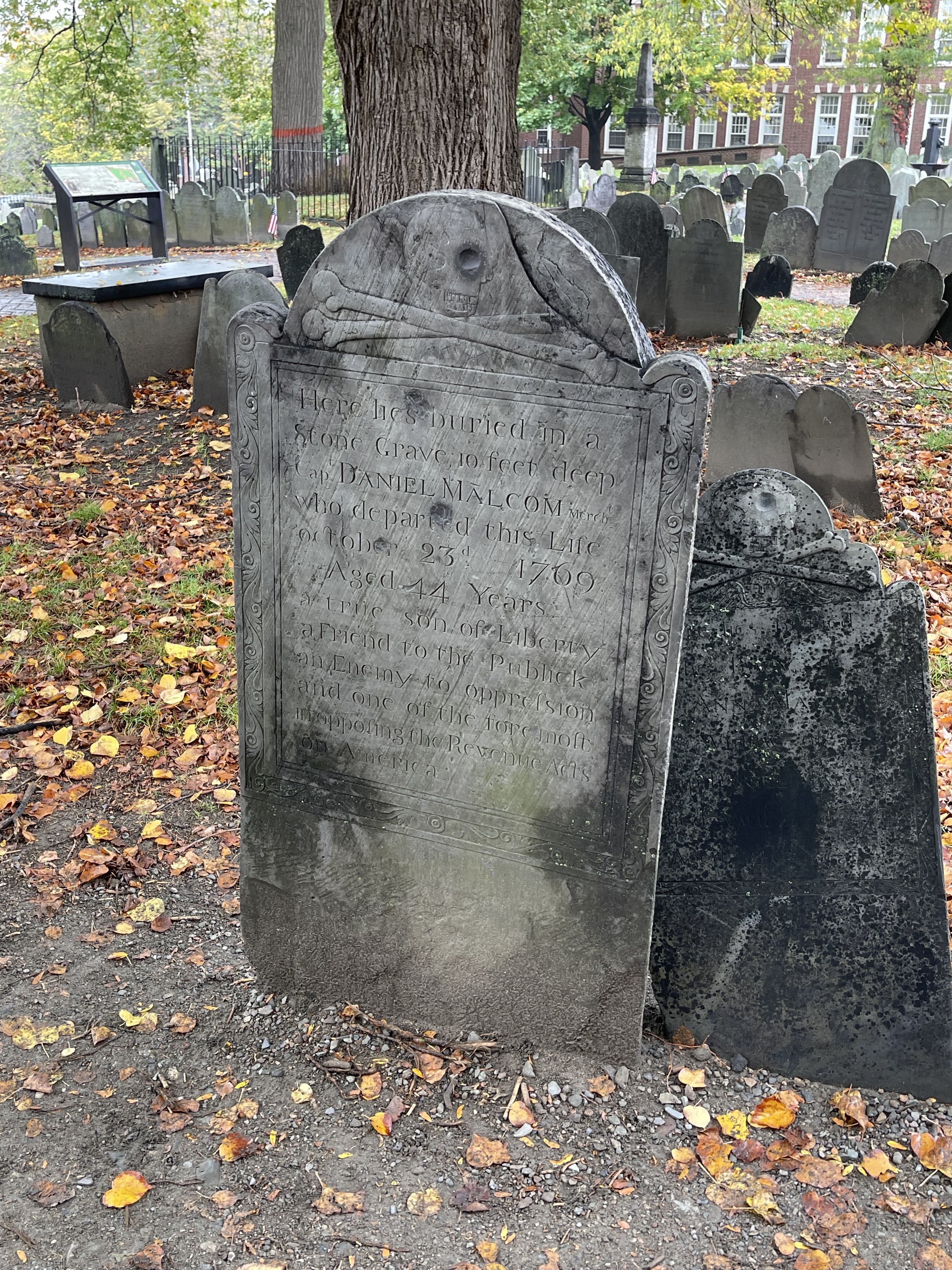
In fact, Malcom’s profile was so high that even his grave marker made news, in the 17 November Boston News-Letter:
The following Inscription is on the Grave-Stone of the late Capt. Malcom.

Here lies buried in a Stone Grave 10 feet deep, Capt. DANIEL MALCOM, Merchant, who departed this life October 23d 1769. aged 44 Years.

A true Son of Liberty.
A Friend to the Publick.
An Enemy to Oppression.
And one of the foremost in Opposing the Revenue Acts on America.
That stone, shown above courtesy of Find-a-Grave, stands in the Copp’s Hill Burying Ground.

In addition, there’s a memorial plaque inside Old North Church, as shown here on Vast Public Indifference. That inscription must have been put up years after the captain’s death. It doesn’t use the long s like the gravestone, and it refers to “British Bullets” while in 1769 Bostonians still saw themselves as British.

Daniel Malcom’s widow Ann died the following April, aged only forty.

TOMORROW: Balls for Capt. Malcom.

Tuesday, June 04, 2024

Capt. Daniel Malcom, Brandy, Wine, and Punch

In the mid-1760s, while John Malcom was trading out of Québec, his younger brother Daniel Malcom was becoming prominent in Boston.

On 24 Sept 1766, three high officials came to his home on Bennett Street in the North End:
Those men had brought some lesser Customs officers as well, to do the heavy lifting.

Malcom didn’t really want the honor of their visit. Those authorities had come to search his cellar for brandy and wine allegedly smuggled onto shore without the legal duties being paid.

To be technical, the Customs officers wanted to search Malcom’s whole cellar, while he was happy to show them part of it but insisted he’d rented a locked portion to his friend William Mackay, so it wasn’t up to him to open that. Also, Malcom insisted the writs should name the officers’ source of information, which of course they didn’t want to do. And occasionally he brandished (empty) pistols to make his point.

This produced a stalemate that lasted hours. A crowd grew to watch and/or intimidate the legal authorities. Among the people involved in the incident were John Ruddock, Paul Revere, John Pigeon, John Tudor, Nathaniel Barber, and the boys of the North Latin School. Ebenezer Richardson, whom I’m speaking about tonight, hovered just off-stage.

Ultimately the Customs officials gave up on this particular search, but they used Malcom’s intractability and the threat of crowd violence to lobby for beefing up their powers. Gov. Francis Bernard ordered an inquiry. The many depositions thus created are printed in George G. Wolkins’s “Daniel Malcom and Writs of Assistance,” a study presented to the Massachusetts Historical Society in 1924 and now available through JSTOR.

After that event, the Boston town meeting started to name Daniel Malcom to committees on merchants’ issues, particularly complaints about the Customs. Late in 1768 he was on hand for the Liberty riot, and his testimony about events was sent to London and even published in the St. James’s Chronicle.

Malcom, Mackay, Barber, and twelve more friends commissioned Revere to make and engrave a silver punch bowl, now in the Museum of Fine Arts. The text on that bowl celebrates the Massachusetts General Court’s refusal to rescind the Circular Letter of 1768. It’s called the “Sons of Liberty Bowl,” but those fifteen men weren’t the town’s political leaders. Daniel Malcom was the only one at the head of a crowd.

TOMORROW: 1769, a year of change.

Friday, February 23, 2024

“Becoming dependent for their Salaries upon their Crown”

The dispute that led to colonial Massachusetts’s second impeachment action started with the Townshend Acts of 1767.

Parliament imposed new tariffs on a handful of goods, particularly tea. And it said the revenue from those taxes would go to administering the colonies.

The expenses of that royal administration included salaries for the governors in most colonies and for the judges those governors appointed.

In the fallow period of 1771 to early 1773, with no new taxes and no troops on the streets of Boston, Samuel Adams didn’t have many issues to raise, so he highlighted those judicial salaries.

Through Boston’s committee of correspondence, Adams argued that not only had Parliament imposed taxation without representation, but those salaries would insulate judges from local pressure. The colonial legislatures would no longer be able to limit or delay judges’ pay to signal displeasure with their rulings.

On 14 Dec 1772, Cambridge called a town meeting to consider that problem. Most men at that meeting endorsed the Boston committee’s position. But one local big man objected.

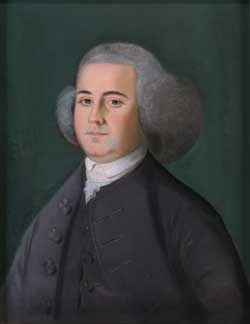
William Brattle (shown here) was an old-fashioned type of country gentleman—a little bit of a lawyer, a little bit of a doctor, a little bit of a merchant, a little bit of a farmer. In politics he had become a member of the Council, and in the militia he had risen to the rank of general.

Back in 1765, Brattle had marched at the head of the anti-Stamp Act processions beside Ebenezer Mackintosh. Gov. Francis Bernard saw him as one of his most nettlesome enemies. But Gov. Thomas Hutchinson had apparently won Brattle over to the Crown side, possibly with those militia promotions.

Brattle told his fellow Cambridge citizens that judicial salaries weren’t anything to worry about. He claimed that judges were appointed for life as long as they maintained “good behavior.” Once judges were on the bench, therefore, neither the royal government nor the populace had leverage over them. (He also said that since official word about judicial salaries hadn’t come from London yet, the town shouldn’t vote on the matter.)

After losing that vote, Brattle published his argument in the 31 December Boston News-Letter.

In the 4 Jan 1773 Boston Gazette someone signing “M.Y.” addressed “W.B. Esq.,” asking how he could hold such a position when as a member of the Council he had heard that Gov. Bernard had written to Gov. Hutchinson that judicial salaries were definitely a go. Brattle denied having heard any such letter.

The 11 Jan 1773 Boston Gazette brought a more vigorous response to Brattle from John Adams. Citing various legal authorities, he wrote that judges were appointed “at the pleasure” of the Crown, forcing those men to maintain the approval of the royal government to keep their jobs.

The next week, Adams published another essay saying the same thing, with different sources. And then the week after that. In all, Adams published seven essays to Brattle’s two. By March, even Adams wrote in his diary: “I have written a tedious Examination of Brattle’s absurdities.”

In his diary Adams also claimed that in the town meeting Brattle had said “Mr. [James] Otis, Mr. Adams, Mr. John Adams I mean, and Mr. Josiah Quincy” wouldn’t be able to refute his argument, and that he had later issued a public challenge in the newspapers. I can’t find Brattle doing the latter. But Adams was clearly rankled. He also told his diary in March:
My own Determination had been to decline all Invitations to public Affairs and Enquiries, but Brattles rude, indecent, and unmeaning Challenge of me in Particular, laid me under peculiar Obligations to undeceive the People, and changed my Resolution. I hope that some good will come out of it.—God knows.
Remember the xkcd cartoon, “Someone is wrong on the internet”? That was basically Adams’s reaction.

Those newspaper essays didn’t have much effect. The exchange probably raised Adams’s profile a little and pushed Brattle further into the royal governor’s camp. But the London government had a plan, and all the resolutions passed by all the town meetings in Massachusetts wouldn’t change that.

In February, as John Adams’s essays rolled on, Gov. Hutchinson confirmed that Lord North had ordered the judges paid from the tariffs. The Massachusetts assembly, with Samuel Adams as its clerk and guiding voice, responded:
We conceive that no Judge who had a due regard to Justice, or even to his own Character, would chuse to be placed under such an undue bias as they must be under, in the Opinion of the House, by accepting of and becoming dependent for their Salaries upon their Crown. Had not his Majesty been misinformed with Respect to the Constitution and Appointment of our Judges by those who advised to this Measure, we are persuaded he would never have passed such an Order.
That dig about “misinformed” was how Samuel Adams and his allies were representing the larger situation: Bernard, Hutchinson, and other royal appointees were feeding the government in London false information, and the result were these unjust measures that Massachusetts didn’t deserve.

TOMORROW: Rival salaries.

Saturday, April 01, 2023

“The present uncomfortable state of the College”

Yesterday’s posting left the Harvard College community on 26 Sept 1766 roiled with controversy over butter.

Or rather, the undergraduates and faculty (at least the tutors, the younger ones who habitually dined with the undergraduates) were in agreement about the butter supplied by steward Jonathan Hastings. It was bad.

The controversy was over how far the students had gone to protest that situation. The faculty objected to the boys:
  • complaining in the dining hall, possibly using the word “stinketh.”
  • gathering in a large group to plan actions, or what the college laws called a “combination.”
  • walking out of the dining hall en masse before being dismissed with prayer.
But, President Edward Holyoke said, he could be forgiving if the students just confessed their guilt.

Daniel Johnson, the senior who was one of the leaders of the protest, refused to do that. And almost the whole student body showed up at the president’s house to support Johnson.

During evening prayers on 26 September, Holyoke threw all his authority behind the demand that the undergraduates sign an acknowledgment of wrongdoing written by the faculty. As Johnson had predicted, the student body stood firm against doing that.

On 4 October, Holyoke and the tutors endorsed a report on the situation written by Prof. Samuel Wigglesworth. They sent that to the Harvard Corporation, which met three days later, alongside the Harvard Board of Trustees. The latter group included Gov. Francis Bernard, Lt. Gov. Thomas Hutchinson, provincial treasurer Harrison Gray, and several impressive clergymen.

Those gentlemen considered “the present uncomfortable state of the College” and came down firmly on the side of the administration. Both bodies said the students’ action was “irregular & disorderly in an high Degree” while the faculty response was “mild & gentle.” As for the students’ threat to withdraw as a mass protest, the boards resolved:
That if any Scholar shall leave the College in persuance of the Combinations enter’d into as afforesd. or shall go out of the Town of Cambridge wtḥout Leave, before ye Fall vacation which will begin on Wednesday the fifteenth Instant, every Scholar so offending shall be adjudged to have renounc’d his Relation to the College & shall not be again rec’d. into it, wtḥ out a Vote of the Presdt. Professrs. & Tutors.
The overseers agreed to act together (in what might otherwise be called a combination) by attending the chapel service when President Holyoke read all those resolutions. Surely that show of authority would cow the student body into agreeing “to sign a full & ample Confession of their Crimes.”

Instead, the students submitted a defense of their actions more than 1,500 words long. It was signed by seven undergraduates as a “College Committee”—four seniors plus one representative from each of the other classes. The first signatory was senior Thomas Bernard, son of the governor.

Incidentally, other prominent men who had sons at Harvard at this time included Lt. Gov. Hutchinson, colony secretary Andrew Oliver, new clerk of the legislature Samuel Adams, and Prof. John Winthrop. Even steward Hastings had a son in the college, though he was staying out of the protest.

The students’ defense repeated how their protest against the butter was the only way they could be heard, expressing gratitude that the faculty had finally done something about that shared problem. As for the charge of being “disorderly in an high Degree,” they emphasized their group discipline: in visiting President Holyoke, “we formed ourselves into regular Ranks, & marched in a Body to his House,” showing “remarkable good Order.” That quasi-military behavior was similar to the 5 Nov 1765 anti-Stamp Act march in Boston, and to the rural court closings of 1774.

The Board of Overseers gathered again on 10 October, with only five days left before the fall vacation.

TOMORROW: The opposition melts.

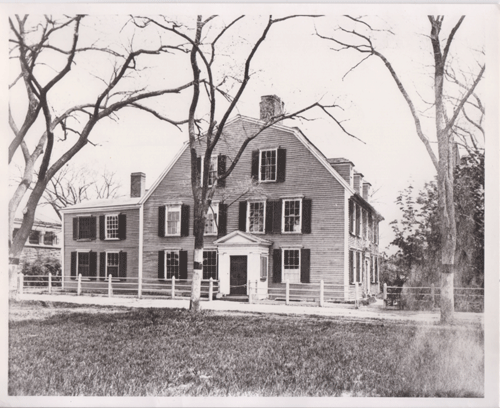
(The photo above shows steward Jonathan Hastings’s house, which stood near Harvard Yard in an area now used by the Harvard Law School. It became the headquarters of the provincial army in April 1775.)

Monday, August 02, 2021

Podcast Episodes to Search Out

I subscribe to several podcasts dedicated to Revolutionary history (broadly defined).

I also listen to several podcasts that range more widely in topics but every so often land in the eighteenth century.

Here are a few recordings from the latter group that I’ve found interesting in recent weeks.

At HUB History, Jake Sconyers recounted “The Liberty Riot” of 1768, “Three Battles for Boston Light” during the siege, and “The Prison Ship Uprising” in 1780.

At Mainely History, Ian Saxine welcomed Tiffany Link for a discussion of “The Bombardment of Falmouth,” Maine, on 18 Oct 1775. The podcast also hosted a “Pageant of Corruption,” with Saxine, Kristalyn Shefveland, and Alexandra Montgomery presenting their case for the most string-pulling, greedy, and petty gentleman of colonial America. The contenders were Virginia lieutenant governor Alexander Spotswood, New Jersey and Massachusetts governor Francis Bernard, and Maine developer Samuel Waldo.

On the B.B.C. interview show In Our Time, Melvyn Bragg led discussions by academic experts on “Edward Gibbon,” author of The History of the Decline and Fall of the Roman Empire (1776–), and “Kant’s Copernican Revolution,” about the significance of Critique of Pure Reason and its sequels (1781–).

The In Our Time discussion of “Longitude” makes a good companion for the Travels Through Time podcast interview of author Nicholas Crane on “Latitude.”

And cementing the Anglophiliac theme of this posting, the History Extra podcast offers interviews with Jacqueline Riding about “Hogarth: The Chronicler of the 18th Century,” with Sir Tom Devine on “The Highland Clearances,” and with Norman Davies on “George II.”

Friday, March 12, 2021

“The same Spirit spreads like a Contagion”

I’m returning to the second Boston Tea Party and the other events of March 1774. And who better to ease us into that mindset than John Adams?

On 12 March he filled his diary with this essay:
There has been and is a Party in the Nation, a very small one indeed, who have pretended to be conscienciously perswaded, that the Pretender has a Right to the Throne. Their Principles of Loyalty, hereditary Right, and passive obedience have led them to this judgment, and Opinion.—And as long as they keep these Opinions to themselves, there is no Remedy against them.

But as soon as they express these opinions publicly, and endeavour to make Proselytes, especially if they take any steps to introduce the Pretender, they become offenders, and must suffer the Punishment due to their Crimes.

Private judgment might be alledged in Excuse for many Crimes—a poor Enthusiast [may?] bring himself to believe it lawfull for him to steal from his rich Neighbour, to supply his Necessities, but the Law will not allow of this Plea. The Man must be punished for his Theft.

Ravaillac and Felton probably thought, they were doing their Duty, and nothing more, when they were committing their vile assassinations But the Liberty of private Conscience, did not exempt them from the most dreadfull Punishment that civil Authority can inflict or human Nature endure.

[Thomas] Hutchinson and [Andrew] Oliver might be brought by their interested Views and Motives, sincerely to think that an Alteration in the Constitution of this Province, and an “Abridgment of what are called English Liberties,[”] would be for the Good of the Province, of America, and of the Nation. In this they deceived themselves, and became the Bubbles of their own Avarice and Ambition.
Adams there quoted the most notorious phrase from the ”Hutchinson letters” published the year before.

Gov. Hutchinson would have protested that he was describing the colonies’ situation, too distant to participate in Parliament, and not prescribing how the British government should treat them. (Oliver, in contrast, had indeed suggested changes to the Massachusetts charter.)

Nevertheless, in supposing that Hutchinson and Oliver might be sincere in their misguided political beliefs, Adams came as close as he ever did to granting them some respect. Even as he compared the two men to Jacobites and assassins.
The rest of the World are not thus deceived. They see clearly, that such Innovations will be the Ruin not only of the Colonies, but of the Empire, and therefore think that Examples ought to be made of these great offenders, in Terrorem.

The Enmity of Govr. [Francis] Bernard, Hutchinson and Oliver, and others to the Constitution of this Province is owing to its being an Obstacle to their Views and Designs of Raising a Revenue by Parliamentary Authority, and making their own Fortunes out of it.

The Constitution of this Province, has enabled the People to resist their Projects, so effectually, that they see they shall never carry them into Execution, while it exists. Their Malice has therefore been directed against it, and their Utmost Efforts been employed to destroy it.

There is so much of a Republican Spirit, among the People, which has been nourished and cherished by their Form of Government, that they never would submit to Tyrants or oppressive Projects.

The same Spirit spreads like a Contagion, into all the other Colonies, into Ireland, and into Great Britain too, from this single Province, of Mass. Bay, that no Pains are too great to be taken, no Hazards too great to be run, for the Destruction of our Charter.
This thinking shows how Adams and other Massachusetts politicians reacted to the Massachusetts Government Act, passed by Parliament later in 1774. It was a “we told you so” moment. No matter that the new law was a response to the Tea Party—both of them—and other unrest the Boston Whigs had promoted over the years.

Adams also hopefully foresaw the popular resistance to that law stemming from “a Republican Spirit,” though he wasn’t yet ready to espouse a republic without a monarchy. And like any good son of Massachusetts, he was sure other provinces, even the mother country, would follow its example.

TOMORROW: Tales of the second Boston Tea Party?

Thursday, December 31, 2020

“A determination to discourage a faithful Servant of the Crown”

For acting governor Thomas Hutchinson, the dispute between his Council and the provincial secretary Andrew Oliver was yet one more headache in 1770.

On 28 September, Hutchinson told the departed but still official governor, Sir Francis Bernard: “[Royall] T[yle]r is sowered by that deposition of the Secretarys which was published in England and it has hurt me every way.” (Bernard had been responsible for that publication, at least in part, but Hutchinson didn’t let on that he suspected that.)

Writing to John Pownall, an official in the Colonial Office, two days later, Hutchinson was more careful to avoid suggesting the controversy had hurt his effectiveness:
The Council except a few are…very friendly to me though there is some abatement of their friendship since the deposition of the Secretary taken by my order relative to the Affair of the Troops has been published. These publications & the sufference of the Letters to the Ministry of which a fresh parcel was sent by the last Ship to be made publick do infinite disservice.
Ironically, Hutchinson was just as upset about leaks as the Council—just different leaks.

There was also a private dimension to this dispute. On 10 October, while the Council was in the midst of collecting the depositions I quoted over the past couple of days, the acting governor’s son Thomas, Jr., married Sally Oliver, daughter of the secretary.

The families were already related by marriage. Thomas Hutchinson and Andrew Oliver had married sisters. In February 1770, Hutchinson’s daughter Sarah married Dr. Peter Oliver, son of Andrew Oliver’s brother Peter.

All three of those men were royal appointees. Thomas Hutchinson was lieutenant governor, thus acting governor, and also chief justice of Massachusetts. Andrew Oliver was secretary and was supposed to have been the stamp agent. Peter Oliver was a judge. Furthermore, other relatives were in the provincial government. John Cotton, the deputy secretary, was half-brother to the sisters who had married Hutchinson and Andrew Oliver. And Hutchinson had been trying to get his nephew Nathaniel Rogers appointed provincial secretary before the young man died.

Of course, there were family alliances on the other side of the political divide as well. James Bowdoin, the principal author of the complaint against Oliver, was a son-in-law of fellow Councilor John Erving, brother-in-law of fellow Councilor James Pitts, and father-in-law of Customs Commissioner John Temple, whom other royal appointees regarded as a snake.

Eighteenth-century society ran on such familial connections. People expected officials to look out for their relatives, and officials expected their relatives to be loyal assistants in government. Neither side was pure in this regard, and both sides complained about the other using family ties too much.

On 30 October, Hutchinson summed up his view of the controversy over Oliver’s description of the Council meeting in another letter to Pownall:
Unfortunately it has got published. Mr. Tyler denied that he made any mention of the Commissioners. I am sure I heard it from him but could not be certain whether that Day or a day or two before. Three or four Witnesses present swore, they heard it that Day. All the Council say they do not remember it.

They have not however directly charged the Secretary with false swearing but to a long Narrative drawn up by Mr. Bowdoin there is added divers Resolves declaring him guilty of a Breach of trust in taking the Minutes &c. The whole is a weak but malicious injurious performance which they have ordered to be recorded. . . .

I gave them my Opinion that these Resolves would be more resented than any thing which preceeded them as they plainly indicated a determination to discourage a faithful Servant of the Crown from doing his Duty as far as lay in their power.

These proceedings I hope will not pass without censure either in [privy] Council or when the State of the Province comes before the Parliament. Such a censure would mortify the party and being made matter of Record here would remove the reproach which otherwise will be transmitted to posterity upon the Secretarys Character.
In fact, the London government was already preparing to reward Andrew Oliver for his service. When Hutchinson officially became the royal governor, Oliver was promoted into his brother-in-law’s spot as lieutenant governor. And in 1772 Peter Oliver succeeded Hutchinson as chief justice.

(Hutchinson’s 1770 letters will appear in the Colonial Society of Massachusetts’s next collection of his correspondence, scheduled to be published in the new year.)

Tuesday, December 29, 2020

The Massachusetts Council Investigates Itself

Yesterday we left off as provincial secretary Andrew Oliver’s sworn statement about what members of the Massachusetts Council had said on the day after the Boston Massacre made its way back to Massachusetts.

That statement was the final item in A Fair Account of the Late Unhappy Disturbance at Boston, published in London. Capt. James Scott, who worked for John Hancock, carried a copy of that pamphlet to Boston. Edes and Gill printed Oliver’s deposition without comment in the 24 September Boston Gazette.

The Whigs quickly leapt to the conclusion that Oliver’s description of the 6 March Council meeting was the latest move by royal appointees to misrepresent the province as rebellious.

And in a way they were right—the statement and its publication were part of a campaign by high officials. As Lt. Gov. Thomas Hutchinson later wrote (modestly referring to himself in the third person), they wanted to be sure the London government understood what they were dealing with:
he asked the secretary to recollect, as well as he could, what passed in the debate at council, and to commit it to writing, intending to send it to England, to shew in the fullest manner the reasons for the lieutenant governor’s complying with their advice, and not with any intention to set the council in general or any particular member, in an unfavourable light.

The secretary informed him, that, of his own mere motion, and for his private satisfaction, he had done it the evening before, while the debates were fresh in his mind.

After he had transcribed and corrected the minutes, he made oath to them; and they were transmitted at the same time with the copies of the votes or minutes of council, and other papers relative to the transaction, not to the secretary of state, but to governor [Francis] Bernard, who, at that time, continued governor of the province.
Oliver (shown above) made his oath before justice of the peace Foster Hutchinson, the acting governor’s cousin. 

Soon after the pamphlet arrived, the Massachusetts General Court started a new legislative session in Cambridge, with the Council meeting in Harvard’s Philosophy Chamber. On 4 October, the Council took up Oliver’s statement:
ONE of the Members of the Board having acquainted the Board that he had seen a Deposition signed Andrew Oliver, which was published in the Appendix to a Pamphlet lately printed in London; in which Deposition divers Gentlemen of the Council, which consisted of 8 Members then present, therein said to be convened on the 5th Day of March last, are represented as having made such a Declaration to His Honor the Lieutenant-Governor, respecting a plan formed by the People to remove the King’s Troops and the Commissioners of the Customs from the Town of Boston, as was likely to be attended with the most pernicious Consequences to this Province—He thereupon moved that the Board would make Enquiry of the Gentlemen of which said Council consisted, what Foundation there was for such a representation—

Which motion being seconded, the Board desired said Gentlemen, namely, Mr. [Samuel] Danforth, Mr. [John] Erving, Mr. [Thomas] Hubbard, Mr. [Harrison] Gray, Mr. [James] Russell, Mr. [Royall] Tyler, Mr. [James] Pitts, and Mr. [Samuel] Dexter, to prepare a true State of the Matter and lay the same before the Board as soon as may be.
Those were the eight Council members present at the 6 March meeting. Oliver had named five of them in his account. (To be exact, he had named three and referred to two more by title, and the London pamphlet had helpfully identified them in footnotes.)

The next day, Oliver asked for a chance to respond and to call witnesses to support his account of the discussion. The Council therefore accepted evidence on 9 October from Capt. Benjamin Caldwell of H.M.S. Rose, Lt. Col. William Dalrymple of the 14th Regiment, deputy secretary John Cotton, and clerk Francis Skinner.

All those witnesses basically agreed with Oliver’s description of what Royall Tyler had said about the town and countryside being angry enough to attack the troops if the governor didn’t remove them, and to drive the Customs Commissioners out of Boston as well. They also agreed that no other members of the Council had objected to Tyler’s statement.

Councilors bore down on Cotton and Skinner about one important detail. When Tyler said of the Whigs, “they had formed their plan, and that this was a part of it to remove the troops out of town, and after that the commissioners,” did he let slip news of a plan predating the Massacre? No, said those provincial employees; they didn’t think Tyler’s mention of a ”plan” on 6 March necessarily referred to any planning more than a day old.

TOMORROW: The Councilors’ contentions.

Tuesday, June 30, 2020

“The principal cause of the Mobbish turn in this Town”?

Early this month I recounted some moments in the mid-1700s when the royal governors of Massachusetts found themselves stymied by crowds protesting for their traditional liberties.

Without army units nearby or a large, full-time police force, no power in the province was strong enough to pacify the mass of ordinary men. Except, that is, a government that accommodated their demands for respect and rights.

In letters to London, those governors offered their diagnoses of how that situation had come about. Gov. William Shirley didn’t say the root of the problem was the Royal Navy forcing sailors and other young men into service. Gov. Francis Bernard didn’t say that Parliament made a mistake in imposing a tax without representation. Those officials said the basic problem was that Boston and Massachusetts’s forms of government were too democratic.

On 1 Dec 1747, Shirley wrote to the Lords of Trade:
But what I think may be esteem’d the principal cause of the Mobbish turn in this Town, is it’s Constitution; by which the Management of it is devolv’d upon the populace assembled in their Town Meetings; one of which may be called together at any time upon the Petition of ten of the meanest Inhabitants, who by their Constant attendance there generally are the majority and outvote the Gentlemen, Merchants, Substantial Traders and all the better part of the Inhabitants; to whom it is Irksome to attend at such meetings, except upon very extraordinary occasions;

and by this means it happens, as it would do among any other Community in a Trading Seaport Town under the same Constitution, where there are about Twenty thousand [actually about 16,000] Inhabitants, consisting among others of so many working Artificers, Seafaring Men, and low sort of people, that a factious and Mobbish Spirit is Cherish’d; whereas the same Inhabitants under a different Town-Constitution proper for the Government of so populous and Trading a place, would probably form as well dispos’d a Community for every part of his Majesty’s Service as any the King has under his Government.
Here’s Bernard in 1765, arguing for an appointed Council rather than one elected by the Massachusetts elite, in turn elected by the white men of property in their towns:
The Authority of the King, the Supremacy of Parliament, the Superiority of Government are the real Objects of the attack; and a general levelling of all the powers of Government, & reducing it into the hands of the whole people is what is aimed at, & will, at least in some degree, succeed, without some external assistance.

The Council, which formerly used to be revered by the people has lost its weight, & notwithstanding their late spirited exertion, is in general timid & irresolute, especially when the Annual Election draws near. That fatal ingredient in the Composition of this Constitution is the bane of the whole: and never will the royal Scale be ballanced with that of the people ’till the Weight of the Council is wholly put into the former. The making the Council independent of the people (even tho’ they should still receive their original Appointment from them) would go far to cure all the disorders which this Government is Subject to.
Making the Council appointed instead of elected was one of the big changes of the 1774 Massachusetts Government Act.

Thomas Hutchinson was speaker of the house under Gov. Shirley and lieutenant governor and chief justice under Gov. Bernard. He became royal governor himself in 1770 and took up his predecessors’ complaints about the people (i.e., the white men of property) having too much power.

Here’s Hutchinson writing to Bernard on 24 May 1771:
The town of Boston is the source from whence all the other parts of the Province derive more or less troubled water. When you consider what is called its constitution, your good sense will determine immediately that it never can be otherwise for a long time together, whilst the majority which conducts all affairs, if met together upon another occasion, would be properly called a mob, and are persons of such rank and circumstance as in all communities constitute a mob, there being no sort of regulation of voters in practice; and as these will always be most in number, men of weight and value, although they wish to suppress them, cannot be induced to attempt to do it for fear not only of being outvoted, but affronted and insulted. Call such an assembly what you will, it is really no sort of government, not even a democracy, at best a corruption of it.

There is no hopes of a cure by any legislative but among ourselves to compel the town to be a corporation. The people will not seek it, because every one is sensible his importance will be lessened. If ever a remedy is found, it must be by compelling them to swallow it, and that by an exterior power,—the Parliament.
To “compel the town to be a corporation” meant ending the town-meeting form of government and becoming a city with an elected mayor and council—a change Boston eventually made in 1822, to some controversy.

Instituting a mandamus Council didn’t quell disturbances in Massachusetts. In fact, it spread them, producing militia uprisings in the countryside within weeks. Ending Boston’s town meetings didn’t end riots in Boston. Instead, American governments became more democratic than the royal governors would have imagined in their worse nightmares, and popular protests became less destructive.

Friday, June 05, 2020

“The Militia…would never act against the Rioters”

In August 1765, eighteen years after Gov. William Shirley struggled to deal with anti-impressment riots, his successor Francis Bernard faced a similar challenge.

This time the people of Boston were upset about the Stamp Act. On 14 August, there was a full day of public protests under what was later dubbed Liberty Tree, followed by an attack on the office and fence of stamp agent (and province secretary) Andrew Oliver.

The next day, Gov. Bernard wrote to the Board of Trade from Castle William:
I sent a written order to the Colonel of the Regiment of Militia, to beat an Alarm; he answered that it would signify nothing, for as soon as the drum was heard, the drummer would be knocked down, & the drum broke; he added, that probably all the drummers of the Regiment were in the Mob. Nothing more being to be done, The Mob were left to disperse at their own Time, which they did about 12 o’clock.

The next day I called a Council, having summoned all the Members within 10 Miles of Boston. I asked their advice in general, & particularly recommended to them, the Protection of Mr Olivers House & Family from further Attacks. They lamented the Impotence of the Government, & said that it would be to no purpose to attempt to raise a Military Force; as the Militia, the only force we had, would never act against the Rioters, if they would assemble at all, which was much doubted.
This was the same lesson Gov. Shirley had to learn. Despite being commander-in-chief of the provincial defenses, a governor couldn’t call the militia out to suppress a large crowd when the men in that crowd were also the men in the militia.

In Britain, common men had few formal ways to express their political and social grievances, and such riots were common. Violent disturbances might have been less frequent in the strange corner of the empire called New England, with its mix of more democratic governance and stricter religious culture. But common enough that political thinkers and actors had to anticipate them.

In From Resistance to Revolution, the historian Pauline Maier wrote:
Eighteenth-century Americans accepted the existence of popular uprisings with remarkable ease. Riots and tumults, it was said, happened “in all governments at all times.” To seek a world completely free of them was vain; it was to pursue “a blessing denied to this life, and reserved to complete the felicity of the next.” Not that extra-legal uprisings were encouraged. They were not. But in certain circumstances, it was understood, the people would rise up almost as a natural force, much as night follows day, and the phenomenon often contributed to the public welfare.
The quoted phrases came from the political philosopher Algernon Sidney (1623-1683). John Adams quoted them in one of his “Novanglus” essays.

COMING UP: What the governors saw as solutions.

Monday, June 01, 2020

“The Illegality of holding the Court in any other Town than Boston”?

On 1 June 1770, the Massachusetts house continued its discussion with acting governor Thomas Hutchinson about why the legislature was meeting in Cambridge.

The dispute over that issue began in 1769, when Gov. Francis Bernard moved the Massachusetts General Court out of Boston. It continued when Hutchinson convened a second session of that term in March.

The first thing the new house did after electing their officers was to prepare a “remonstrance” against not meeting in Boston. The committee to write that protest included James Bowdoin (named first and thus probably the principal author), Samuel Adams, Joseph Hawley, John Hancock, and Daniel Leonard.

The remonstrance began:
BEING returned by our respective Towns to represent them in the Great and General Court or Assembly of this Province, directed by his Majesty’s Writ under your Hand and Seal, to be convened at Harvard-College in Cambridge, We beg Leave to represent to your Honor our Opinion: That the only Writ established by Law for the convening a General Assembly, is apparently formed, upon a Supposition that the Town-House in Boston is the only Place where the said Assembly is to be convened, held and kept.

Our Fathers in the Year 1721 were evidently of Opinion, that the convening holding and keeping the Assembly at any other Place, was contrary to the Act of this Province, of the Tenth of William the Third, which establishes the Form of the Writ: Accordingly, when the Assembly was then adjourned to this Place, though the Providence of God had rendered it impossible for them, consistent with Safety to their Lives, to meet in Boston, by reason of a contagious Distemper which raged there, Governor [Samuel] Shute declared, that he did not mean the Adjournment should ever after be drawn into Precedent; And the three Branches of the Legislature passed a Resolve, to make valid their Proceedings; which they would not have done, if they had thought the Adjournment from the Town-House in Boston, however necessary, had been consistent with the aforementioned legal Establishment.
The message went on to discuss Gov. William Burnet convening the assembly in Salem in 1729.

Hancock was the one member of the drafting committee also named to the committee to deliver the result to Hutchinson. But the lieutenant governor avoided meeting with Hancock and his colleagues on 30 May. He read the remonstrance and replied with a letter dated the next day, and it was entered into the house record 250 years ago today.

The acting governor said:
By the Charter the Governor has the sole Power of Adjourning and Proroguing the General Assembly. There is no Limitation of Time or Place. Can it be supposed that merely by Force of the Form of a Writ for calling the General Assembly, this Power is taken away or abridged? Will it not rather be supposed that the Word Boston in this writ, is meer Matter of Form, especially when it is considered that it will be equally necessary for the Writ to be dated at Boston, (for that is a Part of the Form) as it is for the Court to be convened there? Now it must, in the very Nature of the Thing, be perfectly indifferent in what Place the Writ is dated.
As for deploying historical precedents, you don’t address the author of The History of the Colony of Massachusets-Bay without having all your evidence in order. Hutchinson acknowledged what happened under Shute and Burnet but said those disputes actually showed the question had been decided in favor of his position. He then went on to a historical moment of his own:
I must put you in Mind that in the Year 1737, the King, for the more convenient carrying into Execution a Commission for settling the Line between this Province and New-Hampshire, instructed the Governor to remove the General Court to Salisbury, where more than one Session was held: Whether this was necessary or not, I will not determine; but if it was necessary, I know that his late Majesty was the sole Judge of the Necessity.

I was then a Member of the House, and do not remember a Word to have been said of the Illegality of holding the Court in any other Town than Boston. The Point had been settled a few Years before, and was fresh in the Memory of the House.
Neither side in this debate mentioned how the General Court had met in Cambridge during the smallpox epidemic of 1764, only six years before. As under Gov. Shute, people agreed that a raging contagious distemper required taking unusual steps, especially when their own health was concerned.

Friday, May 29, 2020

Preparing for the Political Season to Reopen

Back in May 1768, the Massachusetts General Court added seven Whig House members involved in the Circular Letter dispute to the Council, which functioned as the legislature’s upper house and an advisory board for the governor.

Gov. Francis Bernard had vetoed six of those seven men.

In May 1769, a new legislature convened and elected those six men to the Council again. On 1 June, Gov. Bernard vetoed them again. He also vetoed five more names, including:
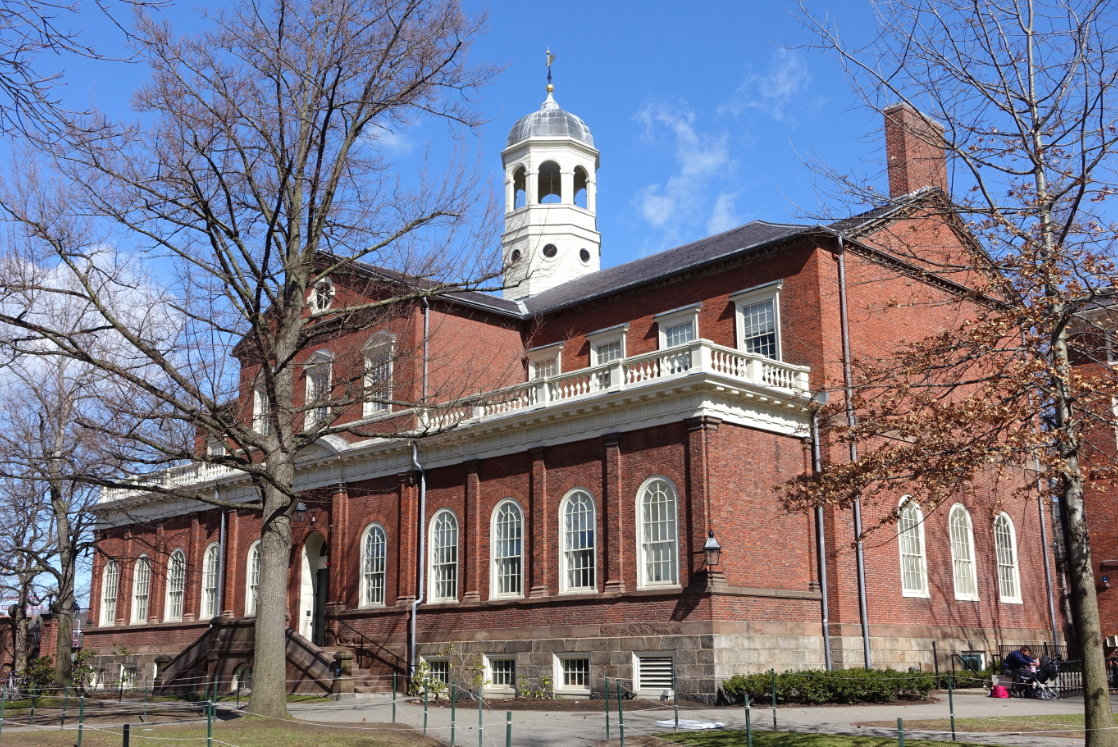
A couple of weeks later, Gov. Bernard moved the whole legislature out to Cambridge. Meeting in Harvard Hall (a building the governor himself had designed, shown above) instead of Boston’s Town House produced even more controversy. The House petitioned the Crown to remove Bernard from office. The legislative session ended in July. Bernard left Massachusetts forever in August.

On 15 Mar 1770, acting governor Thomas Hutchinson called the Massachusetts General Court back into session, once again in Cambridge. He said that he didn’t feel he had the authority to change the venue. There was a lot more arguing about that, as well as about Bernard’s and other officials’ letters to London, the recent Boston Massacre, and more.

Towns held elections for new General Court representatives in May. I discussed the Boston election here. The legislature was due to reconvene on 30 May, once again in Cambridge, and one of the first tasks would be to elect a new Council. The 28 May Boston Gazette shows the Whigs maneuvering to resume the arguments from the previous years.

One Councilor whom Bernard had removed in 1768 and 1769 was James Otis, Sr., but he would be back in the legislature nonetheless:
The Town of Barnstable have made Choice of the Hon. JAMES OTIS, Esq; to represent the Great and General Court the Year ensuing.——It is observable the good old Patriot had 92 Votes out of 101.
Edes and Gill also reported a complaint from the legislature’s unwitting host:
We hear that the Honorable Corporation of Harvard College, from a Regard to the Rights of the People and the good of that Seminary, have lately presented a Remonstrance to his Honor the Lieutenant-Governor, on the General Court’s being summoned to meet at that Seat of Learning, and have also entered a Protest on their Records to present this illegal Measure from being drawn into a Precedent.
The other big political development chronicled in that issue of the Boston Gazette was that Parliament had repealed most of the Townshend duties while keeping the most lucrative one, the tax on tea. What did that mean for the North American non-importation protest against all those tariffs? Merchants in Newport were reportedly shipping in goods already. Committees in Philadelphia and New York were asking what Boston would do.

On 23 May the Whigs had convened another public meeting of “the Trade” in Faneuil Hall, which “VOTED almost unanimously” to “still strictly adhere to the Non-importation Agreement.” The Boston Gazette assured “our Brethren of the other Colonies” that Boston wouldn’t be the first to reopen for regular business.

TOMORROW: Election day in Boston.

Friday, May 08, 2020

After James Otis “behaved very madly’

On 8 May 1770, 250 years ago today, Bostonians gathered for one of their annual town meetings.

Every March, the white men of the town elected its selectmen and other officials for the coming year. Every May, a smaller section of those white men, those who owned more property, elected the town’s four representatives to the Massachusetts General Court.

For the last few years the town had reelected the same four men:
But Otis was no longer in his right mind. He’d gotten into a coffee-house brawl with a royal official in September, suffering a bad head injury. For a while he appeared to recover, but in March, in the wake of the Boston Massacre, he had broken windows in the Town House.

Then on 22 April, the day after Ebenezer Richardson was convicted of murder for shooting at a crowd from his window, the merchant John Rowe wrote this in his diary:
This afternoon Mr. Otis behaved very madly, firing guns out of his window, that caused a large number of people to assemble about him.
Personally I’d stay far away from Otis’s house in that situation, but people might have felt safe once he’d emptied his guns. In any event, the man’s family subdued him and bundled him away to a doctor’s estate in the country.

One item of official business at the May town meeting, therefore, was:
The Honble. James Otis Esq. having by the advice of his Physicians, retired into the Country for the recovery of his Health.

Voted, that the Thanks of the Town be given to the Honble. James Otis Esq; for the great and important Services which as a Representative in the General Assembly through a Course of Years He has rendered to this Town and Province; particularly for his undaunted Exertions in the Common Cause of the Colonies from the beginning of the present glorious Struggle for the Rights of the British Constitution. At the same Time the Town cannot but express their Ardent Wishes for the recovery of His Health, and the continuance of those publick Services that must long be remembered with Gratitude, and distinguish his Name among the Patriots of America Voted, that the Gentlemen the Selectmen be a Committee to transmit to the Honble. James Otis Esq. an attested Copy of the aforegoing Vote
Otis’s departure meant that there was now an opening for the town’s fourth representative.

By a happy coincidence, there was also a prominent Whig politician in Boston who’d been shut out of his usual legislative seat the previous year. James Bowdoin (shown above as a young man) had served in the Massachusetts house back in the 1750s before rising to a seat in the Council. In that body he had led the opposition to Gov. Francis Bernard. In May 1769, the legislature chose Bowdoin for the Council again, but this time the governor “negatived” or vetoed him. Bowdoin therefore had had no official political role for a year.

Bowdoin had used that free time to publicize the letters of Gov. Bernard that leaked from London. After the Massacre, Bowdoin was the principal author of the town’s report on the shooting. So voters knew what he had done for Boston.

The official tally in the records was that out of 513 total votes the top candidates were:
The Honble. James Bowdoin Esq. - - - - - 439
Honble. Thomas Cushing Esq. - - - - - 510
Mr. Samuel Adams - - - - - - - - 510
Honble. John Hancock Esq. - - - - - 511
It’s possible that Bowdoin’s lower number meant there was another candidate or two but clerk William Cooper kept that man’s name out of the record.

(I don’t know if there’s any significance to the way those tallies appear in the minutes, from the lowest to the highest vote-winner. John Rowe attended the meeting and recorded the same numbers in his diary, but he listed Hancock second. In the next couple of years, there was no similar pattern in the order of votes recorded.)

TOMORROW: More town business.

Wednesday, May 06, 2020

“The Commissioners seemd rather inclined to Ad”

The Colonial Society of Massachusetts’s publication of the correspondence of Francis Bernard and Thomas Hutchinson, royal governor and lieutenant governor of Massachusetts in the 1760s, lets us cross-check John Adams’s recollection of being recruited to be advocate general.

Adams wrote in the early 1800s that his friend Jonathan Sewall came to him sometime in 1768 and said he was about to leave that post. According to Adams’s memory, Sewall said that Gov. Bernard wanted to offer it to Adams, despite their political differences. Furthermore, “one of great Authority,” which Adams took to mean Hutchinson, had recommended him as the best qualified candidate.

The Bernard and Hutchinson papers tell a different story. As Bernard recalled the situation in early 1769, Sewall first offered his resignation as advocate general the preceding July. At the time he was enmeshed in a dispute with the Customs Commissioners which only grew worse after the Liberty seizure and riot.

At that time, Bernard wasn’t interested in accepting Sewall’s resignation. Instead, the governor put his energy toward patching up the differences between the Commissioners and the attorney general. Eventually, it appears, all the principals decided to agree that the problem was the Commissioners’ secretary, Samuel Venner, stirring up trouble. He was removed in January 1769, and everyone made nice.

Late in 1768, however, word had arrived that the London government had reorganized the Vice Admiralty courts in North America and made Sewall a judge in Halifax. That gave Sewall a higher salary, but he had to leave Boston for court sessions. Bernard may have been pleased not to have Sewall around so much, but he wanted someone doing the job of advocate general in Massachusetts.

In early 1769, therefore, Bernard got serious about recruiting someone to replace Sewall. But there’s no indication in the governor's papers that he wanted John Adams. In fact, in a 15 March letter to an Admiralty official in London, Bernard explained that he definitely didn’t want a lawyer connected to the province’s Whigs:
at present I am not ready to name fit Persons for either of the Offices: such has been the prevalence of the popular Party in this Government, that some of the Lawyers, whom I should have been glad to have engaged in his Majesty’s Service, have by their abetting the Factious party rendered themselves unfit Objects of the favor of Government. . . .

For these Reasons it will be most advisable that Mr Sewall should continue to act in these Offices till the Causes in which he is now engaged shall be concluded & his Places can be properly filled.
Bernard asked the Admiralty to allow Sewall to appoint a local deputy in Halifax to do his job while he remained at work in Massachusetts.

Gov. Bernard himself sailed out of Boston harbor in early August 1769, to much rejoicing. That left Lt. Gov. Hutchinson in charge. On 20 September, he wrote to Bernard that Sewall had tendered his resignation at last.
Mr. Sewall has sent me his resignation of the place of Advocate, in form, and I have made the appointment of Mr [Samuel] Fitch until His M[ajesty’s]. pleasure shall be signified. The Commissioners seemd rather inclined to Ad[ams] but I think it very dangerous appointing a man to any post who avows principles inconsistent with a state of government let his talents otherwise be ever so considerable. Until this post & that of Attorney general have salaries annexed they will never be of very great use.
Bernard wrote back from London on 17 November:
I will certainly take Care to introduce the Subject of the Advocate & Attorney general by the first Opportunity, & will urge the Necessity of their being supported from hence. The Appointment of Mr. Fitch I will not neglect. . . .

I don’t see how you could possibly appoint or recommend the Person proposed to you under the present Notoriety of his Connections. I was asked by one of the Ministry to day who that John Adams was. I gave as favourable an Answer as I could, but not such as would have justified the Appointment of him to an Office of Trust.
Thus, there’s no evidence in Bernard’s papers that he wanted to name John Adams as advocate general, and no evidence in Hutchinson’s papers that he would have recommended him for a post in the royal government.

Bernard’s remark about “Lawyers, whom I should have been glad to have engaged in his Majesty’s Service” before they joined the political opposition suggests he may have been interested in Adams earlier in his career. That could fit with the story that Samuel Quincy later told Hutchinson about Sewall’s attempt to entice Adams with an appointment as justice of the peace.

It’s plausible that Sewall talked to his friend Adams in 1768 or 1769 about his thoughts of resigning, and the professional opportunity that would create, and in his memory Adams amalgamated that conversation with one in the early 1760s about the governor being ready to appoint him to a lower post. But if Sewall really did tell Adams that Bernard wanted to make him advocate general in 1768, he was getting way ahead of himself.

More mysterious is Hutchinson’s statement that “The Commissioners seemd rather inclined to Ad[ams]” for the post in late 1769. That was after Adams had argued in print against the Stamp Act and in court against the Liberty seizure. Perhaps the Commissioners thought that the appointment would bring a skilled lawyer to their side and muzzle a political opponent all at once. But it’s impossible to imagine Adams becoming a Customs Department protégé.