J. L. BELL is a Massachusetts writer who specializes in (among other things) the start of the American Revolution in and around Boston. He is particularly interested in the experiences of children in 1765-75. He has published scholarly papers and popular articles for both children and adults. He was consultant for an episode of History Detectives, and contributed to a display at Minute Man National Historic Park.

Subscribe thru Follow.it


•••••••••••••••••


Showing posts with label Rhode Island. Show all posts

Saturday, July 11, 2026

New Dramas at Old Places in Newport, Deerfield, and East Granby

This is a very busy summer for Plays in Place, which works with historic sites to create new plays built on their past, informed by their archives, and designed for their spaces.

At the Hunter House in Newport, Rhode Island, Newport Mansions presents Loyalty or Liberty, a trio of short plays set between 1778 and 1781 as control of that port changed hands.

“Dinah” by Ken Green follows an enslaved woman in a Loyalist household whose husband plans to enlist in the Continental Army, seeking freedom for the family. “For Love and Glory” by Patrick Gabridge dramatizes the conference between Axel von Fersen, aide-de-camp to Gen. Rochambeau, and Adm. de Barras, who has to be convinced to sail his fleet to Yorktown. “Where We Once” by Lily Mathews picks up the story of Dinah’s enslaver, Sarah Wanton, as she faces life in an independent republic. These plays are directed by Rachel Walshe and produced by Jessica Chace.

Loyalty or Liberty will run Tuesday and Saturday evenings through 1 September. Normally the plays will be staged outdoors, overlooking Narragansett Bay, but in bad weather the production will move into the Guild Hall at St. John’s Church. Buy tickets here.

Historic Deerfield is hosting A Stake in the Ground: 1774, three short plays about conflicts in that Loyalist-leaning town as Massachusetts slid out of royal control.

In the summer of 1774, Patriots brought a Liberty Pole into Deerfield. “The Liberty Lark” by Talya Kingston, “Jinny and Cato” by Valyn Lyric Turner, and “Sparks on Dry Tinder” by Patrick Gabridge explore the political divisions, tangled family relations, and complexities of enslavement stirred up by that political act and the protest against it. These dramas are directed by Brianna Sloane and produced by Talya Kingston.

Performances will take place on Friday and Saturday evenings and Sunday afternoons through 16 August. A Stake in the Ground will be staged outside, with the audience walking to each location and sitting on folding chairs. On 31 July–2 August, and in very bad weather, the same plays will be performed inside the Deerfield Community Center for a more traditional and accessible theatrical experience. Tickets available here.

At the Old New-Gate Prison & Copper Mine in East Granby, Connecticut, visitors can take in The Slippery Truth: Prisonbreak at New Gate by Patrick Gabridge, directed by Zoë Golub-Sass and produced by Nicole Young-Martin.

On 18 May 1781, a group of captive Loyalists rushed up a 35-foot ladder and overpowered their guards, killing one man before escaping into the night. Was this brave resistance by political prisoners or a desperate blow by criminals? Did they have inside help? Prison trustee John Forward interrogates guards and recaptured prisoners to find the truth.

The Slippery Truth will be produced indoors—to be precise, inside the mine. The audience will enter via 33 steps and a 100-yard loop starting at 35 feet below ground and descending to 75 feet below. The shortest tunnel is 4 feet. The mine is always 52 degrees and wet. Strollers, wheelchairs, walkers, and similar devices are not permitted, and visitors should consider their medical history and physical limitations before attending.

Performances will happen on Friday, Saturday, and Sunday evenings through 30 August. Tickets at this page.

Friday, June 05, 2026

“I know that our way will bring us there”

Yesterday’s posting mentioned the Rev. Samuel Ashbow, a Baptist minister from the Mohegan community in Connecticut.

A lot of information about Ashbow comes from Samson Occom and the Christian Indians of New England by W. DeLoss Love (1899). Both Ashbow and Occom studied with the Rev. Eleazer Wheelock and worked on his conversion missions before breaking with him theologically and organizationally.

The Rev. David McClure (1748–1820, shown here) also left a glimpse of Ashbow in his diary. This passage comes from the summer of 1768 when McClure was an undergraduate at Yale College. He “took a ride to the Sea Shore & in company with Mr. Chester Bingham tarried a few days at Narraganset,” the Native community in what’s now Charlestown, Rhode Island.
Sabbath, attended the Indian meeting, at their meeting house, which was small & about the size of a common school house. About 50 Indians were present. They were mostly elderly people. They sung, prayed & exhorted. There were 4 or 5 who exhorted. The principal speaker was called Sam’l Ashpo.

They were all very earnest in voice & gesture, so much so that some of them foamed at the mouth & seemed transported with a kind of enthusiasm. When they prayed, all spake audibly, some in english & some in Indian. It was indeed a confused noise. . . .

I stood near to Ashpo, and noticed the following expressions in his prayer er in confession of sins. We must allow for grossness of the style, from his imperfect knowledge. “Lord, thou knowest what a poor vile sinner I have been; how I have been a vile drunkard, and like a beast have lain drunk in my own spue, all night at taverns and on the road; but O Lord, thou has forgiven me my sins, for the sake of our blessed Saviour Jesus Christ, who can save the vilest sinner” &c.— . . .

As a sample of their ready wit even in serious things, among other instances, after meeting passing the house of one of the speakers, standing in his door, He said to me, “How do you like our way of worship?[”] I replied some things are very good; but would it not be more edifying, in prayer for one to pray & the congregation to join?—He replied “that will never do. Must make ’em all pray. Plaguy apt to cheat.”

When in the Meeting, one of the Exhorters addressed me & my companion, & said “this is the way that we Indians have to get to Heaven. You white people have another way. I don't know but your way will bring you there, but I know that our way will bring us there.”
Though McClure was contemptuous about the worshippers’ “simple and vulgar” way of expressing their understanding, I thought the metaphors he recorded them using were actually quite evocative.
One of the exhorters said, “I have been up the North ward in the french war, and when cold weather come on orders come—Go into winter quarters. This was dreadful news, to stay there all winter in cold & hunger; but soon word come again, strike your tents & home boys home. Then was all glad, and so it is with a christian going to Heaven.”

Another said, “I have been to New Port & down the wharf, & seen a ship just going to sea. There friends shake hands, and cry farewell, soon the sails are up & the wind comes & she goes, & all hands huzza, (hurraw) so it is with a christian going to Heaven.”
Three or four of Ashbow’s sons died fighting for the Continental cause, starting with Samuel, Jr., at Bunker Hill. He remained in Connecticut after the war while many other Christian Natives in the northeast, including Occom, were pushed to the Brotherton community in upstate New York and then on to Wisconsin. 

Friday, May 01, 2026

”No other Crime, but retaining their Allegiance to the King”

We left John Hill, his wife Elizabeth (?), and his daughter in the Boston jail in February 1777, suspected of “being Enemical to the States” and “attempting to Carry Intillegence to the Enemy.”

The next trace of Hill that I’ve found is from John Noble’s article “Some Massachusetts Tories” for the Colonial Society of Massachusetts in 1900:
At the July [court] Term, 1777, John Hill of Boston recovers judgment in a plea of the case against Crean Brush for £2.8s.10d lawful money, and costs.
Did Hill sue Brush, his employer during the evacuation from Boston, for some loss? Or was this another John Hill?

There’s firmer information from John Howe’s Newport Gazette, published in the British-occupied city on 20 Nov 1777:
By Mr. JOHN HILL, who left Boston the 15th of October, we learn, that Dr. [Benjamin] Church, Mr. John Dean Whitworth, of the Queen’s Rangers, and a Number of others, are yet confined in Boston; Dr. [Mather] Byles is confined in his own House; and upwards of 70 Persons, who can be charged with no other Crime, but retaining their Allegiance to the King, and Attachment to that happy Constitution under which they were born, and from which they have enjoyed the most solid and inestimable Blessings, are now confined on board a Prison Ship in that Harbour.—

He also adds, that almost every Goal in New England is filled with these unhappy People.

Mr. Hill has also favoured us with the current Prices, in Lawful Money, of the following Articles, at the Time he left it:
Beef, — — 0.1.3
Mutton, — — 0.1.6
Butter, — — 0.4.0
And so on through a list of other meats and foods, alcohols, sugars, teas, and cordwood to shoes for men (£2.2/pair) and women (£1.10/pair).

Presumably Howe was making the point about price inflation in Continental-governed areas, but we’d have to find pre-war costs for comparison.

Years later John Hill told the Loyalists Commission, as recorded by Todd Braisted:
That on the 17th of March 1776, he left Boston, with the Royal Army; but was taken at Sea, by the Rebels, . . . himself, his Wife, & Daughter was carried back to Boston, and he confined in Prison 19 months; they were all tried For their lives, but not Condemned.

In November 1777, they were Exchanged, went to Halifax, and afterwards to New York
Hill’s memory was off by just a few weeks. It’s possible he didn’t remember the port his family came through, or that the Hills went from Newport to Halifax. Adding to the confusion on that point, on 16 Oct 1777 the Independent Chronicle reported that “a Cartel” ship “with upwards 130 Prisoners on board” had sailed the previous day from Boston for Halifax. 

By whatever route they left New England, John Hill, his wife, and his daughter eventually returned to New York, the city he’d been chased out of in the spring of 1775. But now it was held by the British military.

TOMORROW: Inspector Hill.

Monday, April 27, 2026

“Possessed of that sweet Disposition towards all Mankind”

I’ve been hunting for the names of John Hill’s wife and daughter in 1776.

According to the profile of Hill at the Loyalist Directory, his first wife was Ann Powell (1737–1775), and they had a son named John in 1764.

If that’s true, Hill remarried quickly after Ann’s death since newspapers and legal documents say he had a wife by the fall of 1776. We might presume his daughter came from the first marriage.

Intriguingly, Boston’s marriage intentions list the couple ”John Hill & Eliza Kennedy” with the date of 7 Oct 1776. (But as a reminder about common names, that same volume shows men named John Hill marrying women named Elizabeth in 1753, 1759, 1784, and 1793—and women named Hannah in 1756 and 1808.)

The 29 April 1779 New-York Gazette stated that “Mrs. ELIZABETH HILL, Wife of John Hill, Esq;” had just died. It called her “A Woman amiable in her the domestic Relations, and possessed of that sweet Disposition towards all Mankind, which nothing but Christianity can bestow.” I’m guessing she’s the same wife as three years earlier.

As for Hill’s daughter, the 22 Nov 1779 New-York Gazette reported the marriage of “Miss Hill, Daughter of Mr. John Hill,” to “Lieut. Cunningham, of the Legion.” Alas, the newspaper didn’t provide the young people’s first names. The lieutenant might well be Ralph Cunningham, given John’s link to William Cunningham. Lt. Cunningham was killed in a fight at Hanging Rock, South Carolina, on 6 Aug 1780.

The reason John Hill’s wife and daughter are so interesting is that, as recounted yesterday, in 12 Oct 1776 the New London committee of correspondence stopped them from crossing onto Long Island and found they were carrying incriminating papers.

The Connecticut Gazette described “sundry Papers, containing Matters of Intelligence respecting the People, and State of the Country, sent from said Hill and others in Boston, to be communicated to General [William] Howe.”

What’s more, the women didn’t seem to be carrying that correspondence unknowingly. The article went on: “it appeared from the Papers found upon them, that they had been possessed of other Papers, which they had secured or destroyed.”

Hill’s wife and daughter “were both sent back with the Papers, under a proper Convoy, to the Place from whence they came,” reported to be Providence, Rhode Island.

TOMORROW: A family reunited.

Wednesday, April 15, 2026

“Sacrificed his home and domestic ties for the cause of liberty”

The story of Joseph Wheaton’s defection from his Loyalist family to the Continental Army was passed down in both branches of the divided family, but the details got fuzzy and/or exaggerated.

E. Alfred Jones published the Canadian Wheatons’ version in his Loyalists of Massachusetts:
Joseph, also a loyalist, was taken prisoner and confined in Concord gaol, where he was successfully induced to join the Americans and was given a commission as ensign.
I haven’t yet found any connection between Wheaton and Concord, but members of the family were indeed detained in 1776.

A U.S. Congressional report in 1879 accepted this version from Joseph Wheaton’s descendants:
that Lieutenant Joseph Wheaton served in the Rhode Island Line from the commencement to the close of the revolutionary war; that his father and ten brothers all held commissions as officers in the British service, and that he alone sacrificed his home and domestic ties for the cause of liberty; that he was disinherited by his father, Colonel Caleb Wheaton, who commanded a regiment of British pioneers, who to the day of his death never forgave his son for what he considered a disloyalty to the King of Great Britain in joining the “Yankee rebels”…
Joseph Wheaton’s father Caleb was a lieutenant in a provincial company of guards and pioneers, never a colonel. The family boasted that five sons served in branches of the British military, not ten.

Most significant, Joseph Wheaton wasn’t in the Continental Army “from the commencement“ of the war. As I’ve been discussing, in April 1776 he, his father, and the family were captured by Continental schooners trying to sail from Boston to Halifax with the British invasion fleet.

But Wheaton did eventually join the Continental forces. Documents show that in September 1777 the New Hampshire committee of safety began to disburse money to him, and as of January 1778 he had “orders…to Enlist men for Rhod Island,” where the British were holding Newport. In April 1778 he was commissioned as a lieutenant in Capt. Samuel Dearborn’s state company for that campaign.

Francis B. Heitman’s Historical Register of Officers of the Continental Army stated that Joseph Wheaton became an ensign in the Second Rhode Island Regiment on 1 Mar 1779, rising to lieutenant by the end of the war.

According to a letter he wrote in June 1783, Lt. Wheaton went into New York City at the end of the war to seek out his Loyalist relatives. He found that “his parents were gone to England and Nova Scotia”; indeed, Caleb Wheaton, Sr., was in London pursuing a Loyalist claim in the middle of that decade. In 1820 Joseph described this situation as: “[I] found myself disinherited by my father for shedding my blood in the cause of liberty and my country.”

On 12 May 1789, the weeks-old U.S. House of Representatives elected Joseph Wheaton to be its first sergeant at arms, empowered to carry a ceremonial mace and enforce protocol. He held that position until 1807, meaning he moved with the federal government from New York to Philadelphia to Washington, D.C. The picture above shows the unfinished U.S. Capitol in 1800.

During the War of 1812 the old lieutenant returned to the U.S. Army, serving as a captain and then major in the quartermaster department from 1813 to early 1815.

According to the Congressional report quoted above, early in the Revolutionary War Joseph Wheaton had “received a severe saber wound on the head, which troubled his mind through life, and terminated in his dying in the insane asylum, in Baltimore, in the year 1828.”

As we’ll see, there’s reason to doubt that account of his Revolutionary activity.

TOMORROW: Back to Machias.

Monday, April 13, 2026

Caleb Wheaton “industriously vindicating the Measures of the Ministry”

In yesterday’s discussion of how the Massachusetts legislature dealt with Loyalists captured on the Elizabeth in April 1776, I left out Caleb Wheaton and his sons: Caleb, Jr.; Joseph; and John.

That’s because their story is complex and detailed enough to deserve a few postings on their own. And even then there will be holes and mysteries.

Vital records of Rehoboth show Caleb Wheaton born there in 1713. There were lots of Wheatons in that region, however, including across the nearby border in Rhode Island. Unfortunately for us, that means there were other men with the same name moving in and out of the eighteenth-century record.

Documents in Caleb Wheaton’s filing to the Loyalist Commission in 1784 show that he served in the Massachusetts army raised by Gov. William Shirley to hold Annapolis Royal in 1744. Later he was “Commandant of St. George’s Fort in the Eastern Part of the Province of Massachusetts,” now Thomaston, Maine.

Customs Commissioner Charles Paxton certified that his agency made Wheaton “a preventive Officer at Machias in which he conducted himself faithfully and diligently to the Acceptance of the Board.” That couldn’t have been a full-time position, given the size of trade in the region.

By 1774, Wheaton owned 200 acres in Machias, Maine, where he lived, and 173 more acres in Dedham. Capt. Solomon Smith wrote that he “was Situated in the most advantagest place for traid in the harbour of Machias.” Wheaton’s family consisted of a wife and nine children, some grown.

That year, Caleb Wheaton testified, he was “obliged to fly from his Estate and Property…on Account of his Attachment to the British Government.”

The 13 Feb 1775 Newport Mercury ran these two articles:
Rehoboth, February 3, 1775.

A Number of the Inhabitants of this Town assembled on Monday last [28 January], to enquire into the Conduct of Mr. Caleb Wheaton, who lately came here from the Eastward, and who had rendered himself obnoxious, by openly espousing & vindicating the Plan of Despotism now carrying on against the Colonies. A Committee was appointed to wait on him, and after making an Acknowledgment of his Villany, asking Forgiveness, and promising Amendment, he was ordered to depart the Town in twelve Hours. . . .

PROVIDENCE, Feb. 4.

Mr. Caleb Wheaton, who some Time since was obliged to quit this Town for industriously vindicating the Measures of the Ministry, returned here from Rehoboth the Beginning of this Week, which Place he had likewise been obliged to leave; and Yesterday a Number of the Inhabitants paid him a second Visit, to remind him of their former Request, when he thought proper to make a precipitate Flight.—So many all the Enemies to America become destitute of a Resting-Place for the Soles of their Feet.
The reference to “the Eastward” makes me think these items referred to Caleb Wheaton, Sr., from Maine.

Like other New England Loyalists, Wheaton found protection in army-occupied Boston. Gen. Thomas Gage certified that “he was employ’d as an Officer of Guides in the Kings Service.” According to E. Alfred Jones’s Loyalists of Massachusetts, “By orders of General Sir William Howe he pulled down the Old North Meeting House,” which happened on 16 Jan 1776.

TOMORROW: The Wheaton brothers.

Saturday, November 29, 2025

Slocum’s “Authentic Narrative”

In 1844, John Slocum published An Authentic Narrative of the Life of Joshua Slocum: Containing a Succinct Account of His Revolutionary Services through a printer in Hartford.

This book fit into a growing genre: memoirs of unheralded Revolutionary War veterans looking back from old age. The most vital of these was Joseph Plumb Martin’s Narrative of Some of the Adventures, Dangers and Sufferings of a Revolutionary Soldier (1830), but I have a fondness for The Revolutionary Adventures of Ebenezer Fox, of Roxbury, Massachusetts (1838).

U.S. pension laws had encouraged veterans to write down their memories in order to authenticate their claims. I posit that that led men toward composing and then publishing these longer autobiographies. 

Joshua Slocum had died in 1816, at about the age of fifty-six, so he didn’t feel that impetus. Instead, his son John set down the veteran’s stories, shifting between third person, first person, and quoted documents.

Or so John Slocum claimed. He acknowledged pulling large sections of the book from other sources, such as the chapter on the capture of Fort Ticonderoga, which his father had no part in. But in truth he borrowed a great deal more. Over and over, the details in this Authentic Narrative just don’t add up, exposing a later perspective shaped by borrowed details and wishful thinking.

The book starts out by saying: “The subject of this sketch was born in the town of Franklin, Franklin county in the State of Massachusetts, in 1760.” The town of Franklin was never in Franklin County, and neither of those places legally existed in 1760. It’s possible Joshua Slocum was born in the town of Wrentham, which calved off Franklin during the war; there was a Slocum/Slocomb family there, but his birth doesn’t appear in the surviving vital records.

On the day after the town received news of the fighting at Lexington, the Authentic Narrative says, the “Franklin company” set out toward Boston. By the time those men made camp, “The intelligence of the surrender of Ticonderoga and Crown Point, with all their valuable stores, had already reached Roxbury.” That would mean the company took more than a month to travel fifty miles.

Somehow Joshua Slocum wrote a dramatic letter to his Loyalist father from Roxbury on 16 June 1775 but was also in one of the regiments based north of the Charles River that fought the Battle of Bunker Hill the next day.

In fact, Joshua was wounded—but he refused to leave his post! And a good thing, too:
Among the [British] killed was Major [John] Pitcairn, one of the flower of their army. I shall always believe that it was my rifle that sent him to his final account—for, as the enemy ascended the hill, I selected an officer answering his description, for a target, and as I took good aim, and my rifle seldom missing its object, I am very certain I killed him.
This account, then, is yet another claim to have killed Maj. Pitcairn. The narrator almost always refers to his weapon as a “rifle,” though such guns were almost unknown in New England at the time.

A month later, the narrator claims to have been about to volunteer for Col. Benedict Arnold’s expedition to Québec when he received a letter from a family friend dated 20 July. Since Arnold started to recruit in early September, that letter must have traveled even more slowly than the “Franklin company.”

The letter invited Slocum to leave the Continental Army camp, go out to the recruiting station at Worcester, and become a clerk in the friend’s company. Like most armies, the real Continentals frowned on soldiers deciding all by themselves where they’ll serve, but that’s what this account said Slocum did. 

And on it goes. Massachusetts Soldiers and Sailors of the Revolutionary War states that a Joshua Slocumb of Franklin served in the Rhode Island campaign of 1779–80. Ironically, the Authentic Narrative never mentions Rhode Island—most likely the one stint of military service by John Slocum’s father.

In 1882 Dr. Charles Elihu Slocum published A Short History of the Slocums, Slocumbs and Slocombs of America. Ordinarily such family histories are credulous toward sources that offer information and reflect well on members of the clan. But Dr. Slocum wrote of the Authentic Narrative:
This little book—of which but few copies can now be found—is written in a style interesting to the young, but it is open to criticism in some of its references to contemporaneous history.
In other words, don’t believe a word of it.

TOMORROW: The arrival of Washington through Slocum eyes.

Thursday, November 13, 2025

The Vanishing of Mary Wenwood?

As recounted earlier, Gen. George Washington had Mary Wenwood brought his headquarters to answer questions about a ciphered letter she had given to her former husband to pass on.

The woman held out against the general’s questioning for hours. But still under guard the morning after she arrived, she gave up the name of the cipherer: her lover, Dr. Benjamin Church.

After that, Mary Wenwood fades from the historical record. She had every reason to adopt a low profile. Gen. Washington kept her name out of his official report and paperwork. No surviving informal comment on the episode mentions her name. 

But men had a lot to say about her character. Indeed, just as she vanished as a person, she started to appear as a character in a moral fable—the downfall of a doctor.

James Warren, speaker of the Massachusetts house, called her “a suttle, shrewd Jade” and “an Infamous Hussey.” The Rev. Ezra Stiles of Newport said she was “a Girl of Pleasure,” and had carried the ciphered letter “in her stocking on her Leg.” How did he know?

Lt. Ebenezer Huntington of Norwich, Connecticut, told his brother: “the Plot was discoverd by his [Church’s] Miss who is now with Child by him and he owns himself the father (for he has Dismissed his Wife).” Huntington was stationed in Roxbury, far from Washington’s headquarters, and had no link to people in the case. No one closer to the investigation said the woman was pregnant. Some other details in Huntington’s account are wrong. Therefore, unless other evidence turns up, I think this was probably baseless gossip.

Here are further facts possibly about Mary Wenwood.

The 14 December 1775 New-England Chronicle reported that the Cambridge post office was holding mail for a woman named Mary Butler—which was Mary Wenwood’s maiden name.

Mary was the most common given name for women, and Butler a fairly common surname. Wainwood/Wenwood/Wanewood was much less common. Indeed, all mentions of “Wenwood” and its variants in late-1700s New England newspapers lead back to Godfrey Wenwood, Mary’s former husband.

That said, Newport vital records show that another Mary Wenwood, wife of Frederick Wenwood, gave birth to a baby girl named Mary in December 1785, and that couple baptized a baby girl named Mary (perhaps a new one) in June 1787. Even an uncommon name isn’t necessarily unique.

The most tantalizing clues are that a Mary Wainwood/Wanewood was in and out of the Boston almshouse after the war:
  • Admitted 6 May 1785, left 30 May 1786.
  • Admitted 29 Feb 1792.
  • Admitted 12 Jan 1793.
  • Admitted 25 Apr 1797, died 23 May 1797.
And that last entry stated that the woman was from Rhode Island.

Monday, November 10, 2025

“Writing this has employed a day”

Dr. Benjamin Church, Jr., used a variety of ways to send messages into Boston after the start of the war, including:
  • crossing the siege lines himself in April 1775 and pretending to have been placed under arrest.
  • having a letter “sewed in the waist of [a paid confederate’s] breeches.” That unnamed man was stopped and “confined a few days,” but the letter wasn’t found.
  • possibly piggybacking on a letter from Gen. Charles Lee that Church arranged to be sent into Boston in early July.
  • meeting a Crown agent in Salem. William Warden told the Loyalists Commission “he was sent by General [Thomas] Gage to Salem and Marblehead to receive intelligence from Dr. Benjamin Church, but failed to execute his business.” Church wrote in July, “I have been to Salem to reconnoitre, but I could not escape the geese of the capitol.”
  • asking Gen. George Washington’s staff to send in a letter through the channel they established to communicate to their agent, John Carnes. That document was sent through the hands of military secretary Joseph Reed, Lt. Col. Loammi Baldwin, a man named Tewksbury raising sheep what’s now Winthrop, and a waterman going into Boston.
  • And of course asking his mistress, Mary (Butler) Wenwood, to arrange for someone she knew in Newport, Rhode Island, to deliver a letter to a royal official there to pass into Boston. Unluckily for them, she chose her ex-husband, Godfrey Wenwood.
Of those communications, only the last letter survives and can be connected with a transmission route because it was intercepted, proving to be Church’s undoing.

For that letter through Newport, Dr. Church used a cipher for added security. One of the many fine questions asked after yesterday’s presentation on Dr. Church was if there were any other ciphered letters from him in Gen. Gage’s papers. I don’t think there are others. And in fact, since the one that incriminated Dr. Church was never delivered, there aren’t any at all.

As part of his defense Dr. Church displayed and translated a letter from his brother-in-law, John Fleeming, written using the same cipher. The doctor said Fleeming had asked him to use the cipher. That letter survives only in printed translations. Earlier Church told Washington that he had received and destroyed another ciphered letter from Fleeming, but that might have been the same one he later displayed.

In General Gage’s Informants, Allen French identified other letters from Dr. Church in the general’s papers on the basis of internal detail (the writer was about to leave for Philadelphia) or handwriting. Those were all in plain English.

As is the long letter written on 24 Sept 1775 and published in Henry Belcher’s The First American Civil War, which I identified in this post as probably Church’s last report to his royal handlers.

It appears, therefore, that Church used the cipher only in exchanges with Fleeming. Why not all the time?

One reason is that having a cipher and sending lots of coded letters might have raised questions. In one of those letters in Gage’s files Church said that an encounter with an angry man named Timothy had prompted him to destroy his cipher lest people suspect him.

Another factor may simply have been time. It took extra effort to copy each letter symbol by symbol. In the intercepted letter the doctor complained, “Writing this has employed a day.”

We might say that using every means to conceal a spy letter would be time well spent. But in Church’s case, the cipher roused Godfrey Wenwood’s suspicions and was soon broken, but the letters the doctor sent in other ways remained secret for over a century.

Wednesday, November 05, 2025

“The English have a great festival”

Back in July, I discussed how Simeon Potter of Rhode Island had commanded a privateer in 1744 and attacked “Fort d’Oyapoc,” a small French settlement in Guyana.

In Historical Scenes from the Old Jesuit Missions, the Right Rev. William Ingraham Kip included a translation of a long report from Father Elzéar Fauque about that raid.

Writing from the port of Cayenne on 22 Dec 1744, Father Fauque described this exchange with Capt. Potter:
“Monsieur,” he said to me, “do you know that tomorrow, being the fifth of November, according to our method of computation” [for we French people count it to be the fifteenth], “the English have a great festival?”

“And what is the festival?” I asked him.

“We burn the Pope,” he answered, laughing.

“Explain to me,” I said; “what is this ceremony?”

“They dress up in a burlesque style,” he said, “a kind of ridiculous figure, which they call the Pope, and which they afterwards burn, while singing some ballads; and all this is in commemoration of the day when the Court of Rome separated England from its communion. To-morrow,” he continued, “our people who are on shore will perform this ceremony at the fort.”

After a while, he caused his pennon and flag to be hoisted. The sailors manned the yard-arms, the drum was beaten, they fired the cannon, and all shouted, five times, “Long live the King!” This having been done, he called one of the sailors, who, to the great delight of those who understood his language, chanted a very long ballad, which I judged to be the recital of all this unworthy story.

You see in this, my Reverend Father, an instance which fully confirms what all the world knew before, that heresy always pushes to an extreme its animosity against the visible Head of the Church.
This anecdote confirms the popularity of the holiday called Pope Night in New England and Guy Fawkes Day in Britain today. This Rhode Island crew was even exporting the practice into Catholic territory.

It also confirms that the popular knowledge of the history behind commeorating the 5th of November was fuzzy. That holiday was the anniversary of the foiling of the Gunpowder Plot in 1605, not of England’s break with the Roman Catholic church nor (as a broadside in Boston said) the Spanish Armada.

Sunday, October 26, 2025

A New Job for the Rev. Edward Bass

As the Revolutionary War wore on, the Rev. Edward Bass of Newburyport sent letters to the Society for the Propagation of the Gospel in Foreign Parts (S.P.G.) in London, begging to remain in good standing as an Anglican minister.

Bass asked congregants and colleagues to write and even speak to people in London on his behalf. They argued that he’d never embraced the new American governments and merely compromised on small matters for the good of his congregation.

By the end of 1781 the S.P.G. had considered Bass’s case three times, and each time it came to the same conclusion: he was no longer behaving like a loyal representative of the Church of England.

In 1786 the minister appears to have given up on getting anything but the last word since he paid to publish his side of the case in London:
A Brief Account of the Treatment which Mr. Bass, Late Missionary from the Society for the Propagation of the Gospel in Foreign Parts, at Newburyport, New England, Hath Received from Said Society. Drawn up by Himself, with Remarks upon Particular Parts of It, and Addressed to the Impartial Public.
Even as Bass burned his personal bridges, other American Anglicans were trying to build new ones before the supply of priests ran out.

American ministers were casting about for how to institute a national church hierarchy while being independent from the British Crown. Previously all aspiring Anglican priests had gone to England to be ordained since there were no bishops in North America. (Indeed, the threat of a bishop had kept many New Englanders in a state of alarm for years before the war.) And as part of that ordination, men swore the Oath of Supremacy, promising loyalty to the monarch of Great Britain.

In 1783 the formerly Anglican clergymen of Connecticut gathered and elected their first bishop: Samuel Seabury (1729–1796, shown here). Yes, this was the same pamphleteer who serves as the voice of Loyalism in Hamilton. Seabury went to Britain, seeking people in authority to consecrate him as an American bishop, and eventually found those officials in the Scottish Episcopal Church, which had slightly different rites.

In 1785 Seabury began to ordain new ministers in America, and a general convention of former Anglicans drafted a constitution and proposed an American Book of Common Prayer. American representatives negotiated with Church of England officials. To preserve some authority, the English episcopate decided to make some compromises.

In February 1787 bishops in London consecrated two American ministers as bishops. A second general convention in Philadelphia in July–August 1789, with delegations from New York south to South Carolina, approved an Episcopal Church constitution and formed a House of Deputies and House of Bishops.

Meanwhile, in May 1789 formerly Anglican ministers from New England had convened in Salem. They elected a bishop for Massachusetts and Rhode Island. And the man they chose was the senior minister in the state, the chair of their convention, a man who had stuck it out through the war: the Rev. Edward Bass.

The convention in Philadelphia approved of that choice. However, New Englanders had come to value having some say in the choice of their clergy, and only ministers had voted for Bass. Therefore, there was another, broader election for a bishop of Massachusetts, Rhode Island, and New Hampshire seven years later in 1796. The Right Rev. Mr. Bass was officially consecrated the following year.

Friday, October 10, 2025

Call for Proposals on “The Work of Revolution”

The National Council on Public History and the American Association for State and Local History will hold a joint conference in Providence, Rhode Island, on 16–19 Sept 2026.

The theme will be “The Work of Revolution,” and here is the call for papers:
Revolution is at the center of every remarkable societal change. Through formal politics, grassroots organizing, boycott, protest, litigation, war, and a wide range of other mass and individual actions, behind every revolutionary moment are the people working to bring revolutionary ideas into reality.

In the face of rapid cultural, social, political, and technological change, history’s importance as a guide for our future has become clearer than ever. Documenting during crises, archiving our collective past, supporting researchers and revolutionaries alike, public historians are part of the landscape of revolution. We bring history to the public because it matters.

The ongoing work of revolution is front and center in Rhode Island’s story, past and present. Rhode Islanders have always prided themselves on their independent spirit. To wit, 125 years after the Declaration of Independence, state leaders placed a statue called The Independent Man atop the grandest state house in the nation. Scholars, public historians, educators, and avocational historians interpret Rhode Island’s revolutionary roots and legacies as embedded in self-determination and self-rule, traits with often contradictory legacies and implications. On these lands of early contact and conflict, interpretive sites and educational institutions share the stories of vibrant Indigenous communities, African heritage legacies, as well as histories of immigration, industrialization, political tumult, and religious freedom.

As we close out the US Semiquincentennial year in this historically significant city, we are called to a moment of reflection on the work of revolutions past and the work that lies ahead. AASLH and NCPH members come together at this moment to take stock of our field and ask each other important questions. How do the events of the past 50 years shape how we do the work of public history in the next 50 years? How do we effectively respond to the challenges of our world while strengthening the field? What work will drive our revolutions? What revolutionary work needs to be done to forge the future of the field? And how do we as history practitioners continue to create fulfilling careers in the ever-evolving landscape of our field?
The conference organizers welcome proposals for sessions, workshops, and working groups. The deadline is 1 December of this year, and proposals should be submitted through this webpage.

Sunday, October 05, 2025

Covart on “First Drafts of the U.S.,” 8 Oct.

On Wednesday, 8 October, Old North Illuminated will present an online talk by Liz Covart, creator and host of the Ben Franklin’s World podcast, about “The First Drafts of the United States: Early Experiments in American Union.”

The event description says:
Long before the Articles of Confederation, colonial Americans spent over a century struggling to unite—and mostly failing spectacularly.

Discover the forgotten stories of America’s “rough drafts”: the New England Confederacy’s bold 1643 experiment, the authoritarian disaster of the Dominion of New England, William Penn’s visionary continental congress proposal, and Benjamin Franklin’s ahead-of-its-time Albany Plan. Each attempt crashed against the rocks of regional jealousies, cultural clashes, and economic chaos.

These weren’t just boring political experiments; they were high-stakes gambles involving real people grappling with questions that still echo today: How do you balance local autonomy with collective strength? Can diverse communities truly unite?
For over a decade Covart has helmed the award-winning Ben Franklin’s World podcast, now up to more than 400 episodes and 13 million downloads. She was Founding Director of Colonial Williamsburg Innovation Studios and Digital Projects Editor at the Omohundro Institute, and she co-founded Clio Digital Media and the History Explorers Club to connect history lovers outside the academy with cutting-edge scholarship. Covart earned her Ph.D. in history studying Albany, a crossroads of early American cultures.

This event will take place from 7 to 8:30 P.M. To sign up for the Zoom link, in exchange for a donation of your choice, go to this registration page.

Wednesday, July 16, 2025

Who Wants to Be a General Anyway?


Here are a couple more wrinkles in how the Rhode Island legislature commissioned Nathanael Greene to lead its troops in 1775 which I haven’t seen discussed elsewhere.

First, the colony named Greene its brigadier general. That was one rung lower than the rank still held by Simeon Potter, major general.

At the same time the legislature commissioned Greene, it also promoted Potter into its upper house, the Assistants.

Those actions might have kept the hot-tempered man content that he was still being respected. The colony still wanted his cooperation (and his cannon).

At the siege of Boston, Greene was the youngest general and had the least seniority. But he was still lumped in with the other generals. In June, Nathaniel Folsom reported back to New Hampshire: “Mr. [Artemas] Ward is Capt. General, Mr. [John] Thomas Lieut. General, and the other Generals are Major Generals.” That was their practical pecking order, not their formal ranks.

In July, the Continental Congress listed Greene as a brigadier general, alongside Thomas, William Heath, Joseph Spencer, John Sullivan, and others. In the summer of 1776 Greene became a Continental major general, and that remained his official rank throughout the war.

Here’s another possible factor in Rhode Island’s choice of Greene to command its army in 1775: Nobody else wanted the job.

The army of observation was designated as 1,500 soldiers, smaller than the other three New England colonies. Whoever commanded that contingent was bound to be low man on the totem pole around Boston. And in practice Greene was able to collect only about a thousand men.

For a Rhode Island man of military ambition, it might have seemed more promising to stay home and organize the coastal defense against British naval raids. At least you’d be the biggest fish in the pond.

What’s more, prospects might have looked even more promising at sea. Rhode Island was a maritime society. Many of its leading men were merchant captains who in wartime commanded or invested in privateers. As the example of Simeon Potter showed, that form of warfare could be the path to a life-changing windfall. Even naval captains had a chance at wealthy prizes.

On 12 June, Rhode Island became the first rebellious colony to commission its own navy, making Abraham Whipple the commander over two armed vessels. Whipple seized the Diana, a tender of H.M.S. Rose, off Newport three days later.

In October, Rhode Island’s delegates to the Continental Congress pushed for the creation of a Continental Navy. Ultimately delegate Stephen Hopkins’s brother Esek was appointed the first commander in chief of that branch.

That fall, the Rhode Island assembly (having given up on Simeon Potter) had appointed Esek Hopkins a brigadier general for defense of the colony. But the man jumped at the opportunity to go to war at sea. Because that was probably where he and his neighbors saw the real prestige and money.

In sum, Nathanael Greene might have become a general because senior men in Rhode Island didn’t view that job as important. Nobody foresaw what Greene would make of it.

COMING UP: The New Hampshire army.

Tuesday, July 15, 2025

“I have pleased myself with the thought of serving under you”

As discussed yesterday, sometime in the first week of May 1775 the Rhode Island legislature appointed Nathanael Greene to be the brigadier general of its army of observation.

In his biography of his grandfather, George Washington Greene wrote:
There is a tradition, but I will not vouch for it, that the first choice fell upon an Episcopalian, who declined; the second, on a Congregationalist, who also declined; and that, when the third vote was announced as having fallen on Greene, he rose in his place, and said: “Since the Episcopalian and Congregationalist won’t, I suppose the Quaker must.”
That’s about as tepid an endorsement for a “tradition” as a nineteenth-century biographer could provide. And the religious terms “Episcopalian” and “Congregationalist” weren’t standard in 1775, suggesting it wasn’t exact.

One recent biographer of Nathanael Greene has suggested that those first two candidates for command declined on religious grounds. I think that’s a misreading of the tradition. The first two faiths mentioned weren’t pacifist. That was the point of the anecdote—the irony of a (lapsed) Quaker leading an army instead of men from sects that didn’t object to military action. And the story might have some validity, though I doubt it happened in a legislative session.

The legislature’s first choice probably was Simeon Potter, already major general of the colony militia. At least, the body couldn’t ignore him. And Potter was an Anglican, even if he’d punched his minister in the face back in 1761. (Incidentally, the Rev. John Usher died on 30 Apr 1775, just as these discussions about the Rhode Island army were under way.)

Another candidate for command whom G. W. Greene and later biographers mentioned is James Mitchell Varnum (shown here), captain of the Kentish Guards. He’d grown up in Dracut, Massachusetts, as what people would later term a Congregationalist. That said, there were many others of that faith in Rhode Island as well, some probably quite senior to the twenty-six-year-old Varnum.

Varnum and Greene had worked together in the fall of 1774 to form the Guards, an independent militia company based in East Greenwich. Varnum, a rising young attorney, was chosen as the first captain. Encouraged by a cousin, Greene put his name forward to be a lieutenant, only to learn that some members thought his limp meant he didn’t look good marching in an elite company at all.

Sometime in October, it appears, Greene wrote to Varnum:
If I conceive right of the force of the objection of the gentlemen of the town, it was not as an officer, but as a soldier for that my halting was a blemish to the rest. I confess it is my misfortune to limp a little, but I did not conceive it to be so great; but we are not apt to discover our own defects. . . .

I have pleased myself with the thought of serving under you, but as it is the general opinion that I am unfit for such an undertaking, I shall desist. I feel not the less inclination to promote the good of the company, because I am not to be one of its members. I will do anything that's in my power to procure the charter.
Apparently Varnum had spoken of leaving the company himself if Greene was forced out because the letter continued:
Let me entreat you, Sir, if you have any regard for me, not to forsake the company at this critical season for I fear the consequences—if you mean to oblige me by it, I assure you it will not, I would not have the company break and disband for fifty Dollars
Varnum stayed with the company and apparently convinced Greene to do the same.

On 29 October, the legislature, with Greene as a delegate, issued a charter for the Kentish Guards. Its act listed the dozens of men who had petitioned for that charter, starting with Varnum and the other three designated as officers, including Christopher Greene. The fifth name on that list was Nathanael Greene. So officially he was a leading member.

It’s conceivable that some fallout from that affair influenced the choice of Greene as general in May 1775. If the legislature did approach Varnum, he may have thought it was Greene’s turn to lead. Or perhaps, with a real war looming, organizational skills seemed a lot more important than a slight limp.

TOMORROW: Hidden factors in the decision.

Monday, July 14, 2025

The Mysterious Rise of Nathanael Greene

In Massachusetts, the lower house of the General Court published annual detailed journals of what it (officially) discussed each day.

The clerk of the Provincial Congress kept similarly detailed notes, and that record was published in 1838.

Rhode Island’s assembly, in contrast, issued a bare-bones record of each legislative session: lists of elected and appointed officials, texts of resolutions and new laws. No specific dates between the day the assembly convened and when the session ended. No mention of failed petitions, disagreements with the upper house, committee reports, or the like.

As a result, Rhode Island’s legislative process is opaque. We know a session started on 22 April to wrap up the fiscal year and, in response to news from Massachusetts, to form a 1,500-man “army of observation.” But the only official clue to the date of that crucial resolution was how Gov. Joseph Wanton and Lt. Gov. Darius Sessions’s protest against it was dated 25 April.

Among the last actions of that legislature was:
IT is Voted and Resolved, That Mr. Nathaniel Greene be, and he is hereby, appointed in the Room of the Honorable Samuel Ward, Esq; (who is going to the Continental Congress) to wait on the General Assembly of the Colony of Connecticut, to consult upon Measures for the common Defence of the Four New-England Governments.
A new assembly convened on “the First Wednesday in May,” or 3 May. The legislature continued to build up the army. With Gov. Wanton staying home, lawmakers established a committee of safety to oversee that process.

Nathanael Greene and fellow delegate William Bradford were reimbursed for “their Service, Horse-Hire and Expences” on that Connecticut trip. Simeon Potter, Greene, and Daniel Owen were made a committee to audit the accounts of a man making “Six Gun-Carriages” for the colony. There was more activity.

And then suddenly the records shows a long list of new appointments. Simeon Potter was elevated to the upper house. William Bradford went onto the committee of safety. And atop the first list of “Officers of the Army of Observation” was:
Nathaniel Greene, jun. Esq; Brigadier-General.
Greene’s commission was dated 8 May, so the discussion that led to the creation of that handsome formal document must have taken place over the preceding week. But we know next to nothing about it.

We know Greene had represented the town of Coventry in the assembly for a few years. (For a while historians thought this was a different man, and indeed there were other Nathaniel Greenes active in Rhode Island affairs, but documents came to light to confirm his service.) The Greene family was enmeshed in the colony‘s politics.

We know Greene was particularly involved in the formation and training of the Kentish Guards, in Rhode Islanders’ initial response to the Lexington Alarm, and on the military committees listed above.

On the other hand, Nathanael Greene didn’t have a high rank in the colony militia. Indeed, he was only a private in the Kentish Guards, as I’ll discuss tomorrow.

Nonetheless, when the time came to go to war, the legislature promoted Greene above that unit’s captain, James Mitchell Varnum, and all other militia colonels to command its army. How that happened is an enduring mystery.

TOMORROW: Other candidates.

Sunday, July 13, 2025

Simeon Potter and Rhode Island’s Army of Observation

Capt. Simeon Potter’s appeal to Rhode Island’s top court to overturn the verdict against him for assaulting the Rev. John Usher in 1761 didn’t work, despite having Robert Treat Paine to represent him.

So Potter appealed to an even higher court: the Privy Council in London.

According to Bruce Campbell MacGunnigle, who published the surviving record of this case through the Society of Colonial Wars in Rhode Island in 2006:
Usher won again, but under the condition that [he] come to England to collect [the judgement]. As Usher couldn’t afford the voyage, Potter never paid a cent.
Clifford K. Shipton likewise reported that Usher never collected any damages.

Capt. Potter continued to command respect in his home town of Bristol because of his wealth. He continued to serve in public offices. Usher continued to be the minister of St. Michael’s Church in the same neighborhood.

In 1772 Potter personally helped to attack H.M.S. Gaspee. When the Crown started an inquiry and found some witnesses, the captain apparently leaned on people to ensure he wasn’t identified. That whole affair seems to have made him only more popular.

At the end of 1774, Rhode Island made Potter the first major general of its militia forces. He looked like the right man to stand up to the Crown. By then people knew he was violent, possessive, and extremely stubborn—but those were pluses. Nobody could make Simeon Potter do what he didn’t want to do.

Come spring, Simeon Potter didn’t want to fight in the Revolutionary War.

On the evening of 19 April, according to American newspapers, Continental Congress delegate Stephen Hopkins wrote to Potter, calling on him to report to Providence in his capacity as major general; “The King’s troops are actually engaged butchering and destroying our brethren in the most inhuman manner, the inhabitants oppose them with great zeal and courage.”

Potter stayed home. In Beggarman, Spy: The Secret Life and Times of Israel Potter, David Chacko and Alexander Kulcsar wrote that Potter “claimed to have received a letter from the commanding general of the Massachusetts Militia telling him that no troops were needed,” but I can’t trace that reference and don’t trust the claim.

By 22 April Rhode Island’s legislature, having sidelined Gov. Joseph Wanton, was voting to form an “army of observation” which might march into Massachusetts. But the government had no one to lead those men.

TOMORROW: Finding a general.

Saturday, July 12, 2025

“The said Potter, said it was not worth a Cussing”

At the civil trial of the Rev. John Usher v. Capt. Simeon Potter in November 1761, eight witnesses from Bristol, Rhode Island, testified through sworn depositions followed by questioning in court.

Those witnesses for the plaintiff agreed that both Usher and Potter were angry. They described Usher gesticulating with his cane. They all said Potter struck the first blow. One even said that about ten days later he’d asked Potter “if he thought Mr. Usher struck him,” and Potter said no.

Capt. Potter participated in part of that trial, cross-examining Usher’s witnesses. But he appears not to have tried to mount a defense with his own evidence. The court found him in default and awarded Usher £1,000 plus costs.

Potter actually had three witnesses lined up on his side. Jeremiah Bosworth claimed in a deposition, “once I plainly see said Usher strike sd. Potter over the head with his Cane.” Bosworth also accused the minister’s son Hezekiah of hitting and knocking down the captain’s father, Hopestill Potter—the same sort of assault that Capt. Potter was accused of.

A second witness testified to seeing Usher hit Potter. However, that witness was Capt. Potter’s father, obviously an interested party. The third witness said Usher was “aiming as I thought at striking sd. Potter,” but because of a tree he didn’t see any blow before Potter hit Usher. (Potter actually had a fourth deposition, but it came from someone whom Usher’s lawyer had already called.)

Instead of putting up an argument in the county court, Capt. Potter appealed the verdict to Rhode Island’s highest court. The case was scheduled for September 1762. In preparation, Potter collected more testimony. Now his sister Hope claimed, “I saw Mr. John Usher Clerk Strike att Capt. Simeon Potter with his Cane several times.”

Another new witness was Jonathan Fales, who owned the house on the corner where the fracas occurred. Several months after the fight, Fales signed off on this account:
Usher run from off the Causeway up to said Potter with his Cane lifted up as tho’ he was going to strike at him, said Potter not having before said Usher run up to him taken any notice of said Usher nor so much as turned towards him,

Upon said Usher’s coming up to said Potter I saw him shake his Cane over said Potter several times aiming as I thought at striking him
Interestingly, Jemima Gorham and William Lindsey signed depositions describing how they’d seen the same thing in almost exactly the same language.

What’s more, Richard Smith, a witness at the original trial, came forward to say Gorham had told a grand jury in January that she’d gone “into hur hous” and hadn’t seen anyone hit anybody.

And the Bristol justice of the peace who recorded those three new depositions, Daniel Bradford, also took the stand to say he’d asked Fales why he hadn’t testified back in November 1761. Bradford said that Fales
Answered that he went out of the way for fear of being called upon, as an Evidence. . . . Fales further said that a few days before ye Court said Potter asked him for his evidence and that he was in his Calm hours Wrote One and Shend ye same to said Potter, and that the said Potter, said it was not worth a Cussing and then Went and Sent ye Said Fales one already wrote, which said [Fales] Refused to sign.
In sum, it looks like Simeon Potter had leaned on or rewarded some of his neighbors to sign off on testimony he or his lawyer had prepared. I suspect if we knew more about employment and trade in Bristol, we’d see the levers of power that the captain was pulling.

TOMORROW: And did all that effort succeed?

[The photo above shows a fist-headed walking stick owned by Thomas Hancock and displayed at the Massachusetts Historical Society several years back. It has no link to this case, but I thought the design was appropriate.]

Friday, July 11, 2025

“Success in this troublesome affair”?

When I broke off yesterday, Capt. Simeon Potter of Bristol, Rhode Island, had just hit the Rev. John Usher in the face.

And then he did it again.

According to the minister’s son, Hezekiah Usher, that “made the blood fly out of his Mouth.”

The younger Usher described rushing out from his doorway:
I run and catch him [Potter] by the collar & took him off from my Father and received two blows in my Face from sd. Potter.
The captain’s father, Hopestill Potter, aged about seventy-one, also joined the fray. Eventually the minister and captain were pulled apart.

In the fall of 1761, the Rev. John Usher sued Capt. Simeon Potter for the punches “…And also the left Thumb of the Plaintiff at said Time & Place did Sprain by all which the Plaintiffs Life was despaired of.” He asked for “Fifty Thousand Pounds current Money of New England” in damages.

Capt. Potter threw up every roadblock. He argued that he’d been an unarmed man acting in self-defense. That Usher shouldn’t have sued in Newport. That “this Cause might be continued to next Court as he is not provided with an Attorney and his principal Evidence is at Sea.” Ultimately Potter put up no defense and defaulted, and the county court awarded Usher £1,000 plus costs.

Both parties appealed to the Rhode Island Superior Court of Judicature, Usher “because the Damages given were not adequate to the Injury recd.” and Potter because the verdict was “wrong and erroneous and ought to be reversed.”

Meanwhile in January 1762 a grand jury in Bristol County considered criminal assault charges against Capt. Potter. I can’t tell how far that process got.

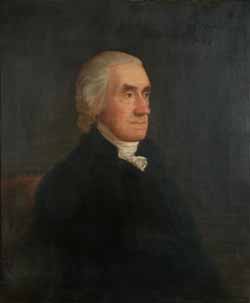
In the summer of 1762 Potter called in a big legal gun from Massachusetts: Robert Treat Paine (shown above, later in life). Paine’s 6 August letter assured Potter that he could appeal both criminal and civil cases with “the Deposition you have of the Jurys dissatisfaction in their Verdict.” Paine called Usher “a Crafty powerfull Antagonist” and closed “wishing you success in this troublesome affair & that you may finally prevail against Ecclesiastical or Political Tyranny.”

On 10 September, Paine traveled to Newport to argue for Potter. The captain was presenting testimony from several witnesses not heard at the original civil trial.

TOMORROW: Examining the evidence.

Thursday, July 10, 2025

“You shake it within an Inch of my Nose”

Some years back, I mentioned Simeon Potter’s dispute with John Usher, but I was relying on a secondary source that I’ve come to see as unreliable.

I’m therefore retelling that story in more detail using the court documents published by the Rhode Island Historical Society in 2006 (available as a P.D.F. from Family Search) and other sources.

In 1761 Potter was a wealthy gentleman in Bristol, Rhode Island. He’d been born in that town forty-one years earlier to a poor or middling family. He’d therefore grown up without much schooling, trained to be a cooper. But because of a privateering windfall at the start of King George’s War, Potter had made himself into one of the richest men in the whole colony.

Reflecting his new genteel status, Capt. Potter took on prestigious positions in politics and the church. He became a warden of the local Anglican church, St. Michael’s. Few New England towns of Bristol’s size—about 1,200 people in 1774—had an Anglican church, but this was at the coast and therefore served mariners.

The minister of St. Michael’s was the Rev. John Usher. He was the son of a wealthy bookseller who had risen to be lieutenant governor of New Hampshire. After graduating from Harvard College, Usher had joined the Church of England, defying the New England orthodoxy. The missionary Society for the Propagation of the Gospel paid part of his salary, and his congregants sometimes paid the rest.

In 1761 Usher was over sixty years old. His exact age is unclear since his tombstone says he was seventy-five when he died in 1775, but a memorial plaque later installed in his church says he was eighty. Either way, he’d been the minister at St. Michael’s since 1724, when Simeon Potter was still a little boy.

According to Usher’s report back to the S.P.G., the trouble started because
Notwithstanding he [Potter] has an agreeable wife, he has by report for some years back kept a criminal conversation with a young woman, one of my parish. . . . After many general hints from the Pulpit…I told her what reason I had to suggest she was guilty of the notorious sin of Adultery. . . . Upon this she told the man immediately what I had said
Frankly the minister shouldn’t have been surprised by that.

On the morning of 14 August, Charles Munro said, “the Rev. Mr. John Usher and Capt. Simeon Potter…engaged in warm words or Differing” on the street. Richard Smith added that Usher told Potter, “wherever he went there was whoring carried on.” Smith also quoted the men as saying:
[Potter:] if it wont for your Age and Gown I would not have your Cane shook over my head

[Usher:] I don’t shake it over your head nor mean to shake it over

[Potter:] you shake it within an Inch of my Nose
Simeon Potter, despite his fearsome reputation, was “small in stature,” according to Father Elzear Fauque. Also, in the manners of the time clubbing another man with a cane implied that the caner was a gentleman and the canee was not; given Potter’s background, his class status might have been a sensitive spot.

The minister’s son, Hezekiah Usher, called this “Ill treatment” of his father. Potter may also have said something about the minister’s daughter, but I can’t find another trace of her.

On 18 August, Usher and Potter met yet again on Church Lane. They picked up where they had left off. Hezekiah Usher stated:
I heard my Father say to sd. Potter if ever he cast any more reflections on his Family especially on his daughter twould cause him to reflect on his family and upon that the said Potter came up to my Father who was then on the edge of the Gravell’d Walk and said who of my Family and my Father said Your Father
Potter’s father, Hopestill Potter, was in fact sitting in a chair at his own front door nearby.

The quarrel caught the ears of several neighbors, though trees along the street blocked some people’s views. Witnesses agreed that Usher was holding his walking-stick in the middle, waving it around as he spoke. Some said this was “Usher’s naturall way of Shaking his Cane at any Person when he is earnest in talk.” One said the cane was “up as if he was agoing to strike.” But all the trial witnesses agreed they never saw the minister actually touch the captain.

According to Hezekiah Usher, after his father mentioned the captain’s father, Capt. Potter “rusht close up to my Father and said what reflections can you cast on him”? Usher replied, “I’ll blow him up.”

The captain then punched his sexagenarian minister in the face.

TOMORROW: In court.