J. L. BELL is a Massachusetts writer who specializes in (among other things) the start of the American Revolution in and around Boston. He is particularly interested in the experiences of children in 1765-75. He has published scholarly papers and popular articles for both children and adults. He was consultant for an episode of History Detectives, and contributed to a display at Minute Man National Historic Park.

Subscribe thru Follow.it


•••••••••••••••••


Showing posts with label William Heath. Show all posts

Wednesday, March 18, 2026

“The next morning presented to the view of the enemy a regular fort”

Samuel Richards (1753–1841) came from Farmington, Connecticut. In May 1775 he marched north with his town’s company to the Boston siege lines.

According to the memoir he wrote for his family decades later, Richards went as a gentleman volunteer, not in the ranks, and in Roxbury, Gen. Joseph Spencer offered him a post as private secretary.

However, contemporaneous records show that the young man was a sergeant in Capt. Noadiah Hooker’s company from May to December 1775. Perhaps Richards preferred his family to consider him as always of genteel class. 

Those sources agree that when the Continental Army was enlisted for a second year, Samuel Richards signed on as an ensign—the lowest rank of officer.

Ens. Richards’s regiment served on the southern side of the siege. For a while they camped on Gen. William Heath’s family farm in Roxbury, then in barracks as close to the Neck as possible.

Richards and his company were part of the reinforcement that went onto the Dorchester peninsula on the morning of 5 Mar 1776 to prepare for an expected British counterattack. He left this account of what followed in his memoir, published in 1909:
the next morning at 8 oClock a relief was sent on—of which I was one—in passing the neck the tide having overflowed it I found my boots filled with mud and water, but we had no dry clothes with us, nor any time or opportunity for changing. . . .

I found a redoubt considerably advanced in a position well calculated for defence. Outside the parapet were casks filled with sand and so placed that a slight touch would set them rolling down the hill which was very steep on every side, and thus break the ranks of the enemy on their advance.
Those barrels had prompted a lot of discussion.
On the afternoon of the 6th we very plainly saw the enemy in motion in the town: dense columns of troops moving down the main street to the wharf and embarking on board the ships which moved down the harbor and formed in a kind of crescent at considerable distance from the hill.

most of the next day [still 6 March] was spent by those ships in beating up nearer to our post—the wind being a head:

we continued our work incessantly in compleating the redoubt, being urged to exertion by a full expectation of being attacked by the enemy’s troops we had seen embark on board the ships; we had no time to spare for reflecting on and counting the cost of the issue of the expected battle, we did not work litterally with arms in our hands, but they were lying by our sides, and it is presumed that every one ardently wished for the opportunity of shewing the enemy what freemen would do when contending for their just rights. No one needed stimulating to the performance of his duty as every one possessed the inclination.

As night approached an uncommonly severe South East rain storm came on with very high wind, and in that elevated situation, surrounded by the sea, it was felt in all its force, but the severity of the storm did not stop our work, which we pushed forward with the utmost alacrity. The next morning presented to the view of the enemy a regular fort, far advanced to completion—and to our view their ships below apparently in a very disorderly condition: the day passed without any thing worthy of particular notice.
In looking back, Ens. Richards skipped over the couple of days that passed before the next action.
At evening we broke ground on Nook, or Nuke point, a small hill very near the water oposite South Boston. The enemy could plainly hear the sound of our entrenching tools, on which they opened and continued an incessant cannonade with a general direction towards this point. I counted the number of discharges up to about 1500 during half an hour and then left off counting; this firing was continued through the night, and the morning shewed a novel sight; the ground all around where the work had been carrying on appeared as if it had been plowed irregularly, and a very great number of cannon balls were picked up: but strange as it may seem there was but a surgeons mate and two privates killed during the night.
Contemporaneous sources say a doctor and three Continental privates were killed.

TOMORROW: Marching into Boston.

(Richards’s portrait, as copied for another family member around 1890, appears above. It was auctioned in 2020.)

Saturday, March 07, 2026

“A more interesting and bloody scene is apprehended”

The Rev. William Gordon’s account of the end of the siege of Boston continues, picking up (in the present historical tense) just after Gen. William Howe has spotted the Continental Army positions on the hills of the Dorchester peninsula:
The admiral [Molyneux Shuldam] informs him, that if the Americans possess those heights he cannot keep one of his majesty’s ships in the harbour. A council of war determines to attempt dislodging them.

General [George] Washington has settled his plan of defence and offence. Boston is so surrounded on every land side by neighbouring hills, that nothing can take place on the wharves or next to the water, but it may be noted by the help of glasses. Proper signals having been agreed on, by means of the hills, which are in view one of another, intelligence can be conveyed instantly from Dorchester heights to Roxbury, and from Roxbury to Cambridge and so the reverse. This mode of communicating information is the speediest and safest.

General Washington’s plan is, in case any number of the enemy leave Boston to attack the heights and are defeated, to communicate such defeat by the proper signal, when 4000 provincials are to cross over from Cambridge side, and attempt the town in the confusion that the regulars will be under. The boats are prepared, and the men paraded ready to embark. General [John] Sullivan commands the first division, and general [Nathanael] Green the second. Gen. [William] Heath objected to the command when offered, and remains in perfect safety with the troops left in Cambridge. The whole force which the commander in chief now has, including all the militia, is not much short of 20,000.

All is hurry and bustle in Boston. General Howe orders the ladders in town to be cut to ten feet lengths, that they may be fit for scaling. A large body of troops are to embark on board the transports, and to proceed down the harbour, with a view of landing in the hollow between the furtherest of the two fortified hills and the castle.

The men are observed by one, at whose door they are drawn up before embarking, to look in general, pale and dejected; and are heard to say, “It will be another Bunker’s Hill affair, or worse”—they have adopted the prevailing mistake of Bunker’s for Breed’s Hill. Some show great resolution and boast of what they will do with the rebels. When these troops, amounting to about 2,000, and designed to be under the command of lord Percy, are upon the wharves, and passing in the boats to the transports, the Americans expect they are intended for an immediate attack, clap their hands for joy, and wish them to come on.

General Washington happens at that instant to be on one of the heights; thinks with his men; and says to those who are at hand, “Remember it is the fifth of March, and avenge the death of your brethren.” It is instantly asked by such as are not near enough to hear, “What says the general?” His words are given in answer. They fly from man to man through all the troops upon the spot, and add fuel to the martial fire already kindled, and burning with uncommon intenseness.

The surrounding hills and elevations about Boston, affording a secure view of the ground on which the contending parties are expected to engage, are alive with the numerous spectators that throng them. A more interesting and bloody scene is apprehended to be just upon commencing, than what presented at Charlestown. They wait, as do the troops, officers and privates, the morning through; and till far into the afternoon, when they are convinced of the tide’s being so far ebbed, that no attack can be made by general Howe on the Tuesday, which indeed is not his intention, for he is preparing to do it on the Wednesday.

The transports go down in the evening toward the castle, a floating battery is also towed down, but the wind is unfavorable, and before they reach their destination blows up fresh, and forces three of the vessels ashore on Governor’s Island. A storm succeeds at night, such as few remember ever to have heard; and toward morning it rains excessively hard.

[March 6.] The design of general Howe was hereby frustrated, and a deal of bloodshed providentially prevented. A council of war, was called in the morning, and agreed to evacuate the town as soon as possible. The time that had been gained by the Americans for strengthening their works, before any attempt could be now made upon them, took away all hope of success…
And with that return to the past tense, Gordon signaled that the height of suspense was past. The siege would not end with a second mighty battle.

TOMORROW: When is an exchange of messages not an exchange of messages?

Friday, January 23, 2026

“A Fine Train of Artillery” Talk in Cambridge, 29 Jan.

On Thursday, 29 January, I’ll contribute to the discourse about Col. Henry Knox’s artillery trek with the talk on “‘A Fine Train of Artillery’: Henry Knox and the End of the Siege of Boston” at the Longfellow House–Washington’s Headquarters National Historic Site in Cambridge.

In the past few months I’ve already shared my take on the myths and realities of the Knox saga, and on Knox’s political profile before the war and how that might have contributed to his rise to command the artillery regiment.

For this new talk, therefore, I’m focusing on what Knox accomplished on his first military mission and how that affected the siege of Boston. Here’s our event description:
On January 18, 1776, Gen. William Heath wrote, “Col. Knox, of the artillery, came to camp. He brought from Ticonderoga a fine train of artillery.” Those 58 guns would nearly double the size of the Continental artillery force. But Gen. George Washington and his commanders still had to figure out the best way to use their new ordnance before they could drive the British military out of Boston.
Gen. Washington’s first proposal appears in his 18 February letter to John Hancock as chairman of the Continental Congress:
The late freezing Weather having formed some pretty strong Ice from Dorchester point to Boston Neck and from Roxbury to the Common, therby affording a more expanded and consequently a less dangerous Approach to the Town, I could not help thinking, notwithstanding the Militia were not all come In, and we had little or no Powder to begin our Operation by a regular Cannonade & Bombardment, that a bold & resolute Assault upon the Troops in Boston with such Men as we had (for it could not take Many Men to guard our own Lines at a time when the Enemy were attackd in all Quarters) might be crown’d with success . . .

from a thorough conviction of the necessity of attempting something against the Ministerial Troops before a Re-inforcement should arrive, and while we were favour’d with the Ice, I was not only ready, but willing and desirous of making the Assault; under a firm hope, if the Men would have stood by me, of a favourable Issue; notwithstanding the Enemy’s advantage of Ground—Artillery—&ca.
An infantry charge across the flat ice of the inner harbor against the British army’s fortified batteries on the Common and in the South End. What could go wrong?

This talk is due to start at 6 P.M. It’s free and open to the public, but because of limited seating the site asks people to register in advance. We’re working on how to record and/or livestream the talk as well.

Tuesday, March 26, 2024

Lt. Ragg in Captivity

The Battle of Brooklyn on 27 Aug 1776 didn’t end well for the Continental Army. Gen. Sir William Howe’s forces inflicted heavy casualties and drove the Americans off Long Island.

At eight o’clock that evening, Gen. George Washington’s military secretary, Robert Hanson Harrison (shown here), wrote to John Hancock as chair of the Continental Congress:
a Smart engagement ensued between the Enemy and our Detachments, which being unequal to the force they had to contend with, have sustained a pretty considerable loss—At least many of our Men are missing, among those that have not returnd are Genls [John] Sullivan & Lord Stirling

The Enemy’s loss is not known certainly, but we are told by such of our Troops that were in the Engagement and that have come in, that they had many killed and wounded—Our party brought off a Lieutt, Sergt, and Corporal with 20 privates prisoners.
Sullivan and Stirling were prisoners, but at least they survived. Hundreds of other Americans were dead.

Continental commanders hoped this would prove to be a Pyrrhic victory for the Crown, like Bunker Hill. Gen. Henry Knox wrote to his wife Lucy, “The enemy lost nearly 1000 kill’d among whom was General [James] Grant and Capt. [Andrew] Neilson of the 52d.”

In fact, Gen. Howe reported only 63 dead from the Crown forces, and fewer than 400 casualties in all. Gen. Grant was fine; a lieutenant colonel of the same name died.

Later American writers seeking actions to praise in that battle had to content themselves with gallant ways to lose. The noble sacrifice of the Marylanders holding off the enemy! The sly evacuation across the river to Manhattan!

Among the few solid successes Knox could firmly claim was, “We took a Lt. Ragg whom I knew at Boston and 25 Grenadiers of the marines.” And even that overstated the details slightly. Harrison’s numbers were closer.

Lt. John Ragg had led Sgt. David Wallace, Cpls. Thomas Pike and Edward Gibbon, and twenty marine privates into captivity because he and his superiors had mistaken the Delaware Continentals for Hessians.

Behind the American lines, on 29 August Gen. William Heath ordered Lt. Nathan Umstead to conduct those prisoners of war to Fairfield, Connecticut.

A month later, Thaddeus Burr of the Fairfield committee of inspection wrote back to Gen. Washington, reporting that they had sent Ragg and his servant, Pvt. Benjamin Jones, on to Middletown. The other twenty-one men were taken to Wallingford and “placed in the Parishes in the interior part of the County agreable to Rules of Congress.”

There was just one more thing, Burr told the commander-in-chief: Who would pay for “the charges of marching them”? The committee had fed those prisoners for eleven days and paid “a Sergeant and Six from our Battery…a penny a Mile” to lead them on to Wallingford. How was the town to be reimbursed £14.6.½?

The Washington Papers editors wrote, “No reply to that letter has been found.”

TOMORROW: The last of Lt. Ragg.

Sunday, April 17, 2022

Beck’s Blow-by-Blow Analysis

A century after Frank Warren Coburn shared his conclusions about which town militia companies fought the British troops at the Battle of Lexington and Concord, Derek W. Beck produced a new analysis.

Coburn sorted out the action by the towns where fighting occurred. In Igniting the American Revolution, 1773–1775, Beck focused more closely on individual skirmishes. Here’s his analysis about which towns’ companies joined the fighting and where.
Coburn listed the Watertown company as entering the fray in Arlington. Beck described those men following an order from Gen. William Heath and sticking near the bridge over the Charles River in Cambridge. In his memoir, Heath wrote (speaking of himself in the third person):
From the committee, he took a cross road to Watertown, the British being in possession of the Lexington road. At Watertown, finding some militia who had not marched, but applied for orders, he sent them down to Cambridge, with directions to take up the planks, barricade the south end of the bridge, and there to take post; that, in case the British should, on their return, take that road to Boston, their retreat might be impeded.
Watertown had an unusually large number of men under Capt. Samuel Barnard, so it’s possible some of them went into the fight on the north side of the Charles while others held the bridge. But Col. Percy avoided any confrontation at the river by turning east from Cambridge toward Charlestown. (Beck suggests the Watertown men might have then come up from the bridge to fight.)

Another town Coburn listed as taking part in the battle but Beck found no place for is Newton. Coburn wrote that three Newton companies joined the fight at Lexington, citing mainly Samuel F. Smith’s town history.

Smith gave a lot of space to a narrative passed down in the Jackson family, which actually says the Newton men started fighting in Concord and carried on all the way to when the redcoats got into their boats at Lechmere’s Point in Cambridge—which never happened.

However, Smith and another local historian, Francis Jackson, also printed a story about Capt. Jeremiah Wiswall’s company, how his seventy-five-year-old father insisted on marching along, and how the old man was shot in the hand. I quoted those passages back here.

It strikes me as potentially significant that two of the Newton companies said they “Marched from Newton to head quarters at Cambridge” while the third, Capt. Wiswall’s, went “upon the Alarm in Newton to Lexington.” That third muster roll includes “Mr. Noah Wiswall,” the captain’s father. Contemporaneous accounts do list Noah Wiswall among the wounded provincials.

All told, I therefore lean toward including Capt. Wiswall’s Newton company among the units that actually engaged the British troops in either east Lexington or west Cambridge. I’m not sure about the other two seeing combat, and the muster rolls contradict the Jackson family tradition.

[Full disclosure: I’m from Newton.]

Wednesday, February 09, 2022

Josiah Waters, “very serviceable in this line”

Josiah Waters (1721–1784) was a painter by training who became a respected merchant in pre-Revolutionary Boston.

Waters joined the Old South congregation at age twenty. He was elected to several town offices, including constable, fence viewer, clerk of the market, and finally warden, one of the most prestigious. In 1747 he joined the Ancient & Honorable Artillery Company and filled many roles in that organization.

Also in 1747, Josiah and his wife Abigail had a son, Josiah, Jr. He grew up to work with his father in the firm of “Josiah Waters and Son” on Ann Street. In fact, it’s difficult to distinguish the two, but fortunately they seem to have acted as a unit, so that task isn’t so important. Josiah, Jr., also became a member of Old South and the Ancient & Honorables, and in 1770 he joined the St. Andrew’s Lodge of Freemasons.

In 1768, Josiah Waters invested in land in Maine, buying out partners to become the main proprietor of the Massabesick Plantation. That area included the modern towns of Alfred, Sanford, and what the family would modestly name Waterboro. The Maine Historical Society has digitized the Waters account book and map.

As of 1770, Josiah Waters, Sr., was a captain in the Boston militia regiment. By 1772, Josiah, Jr., was his lieutenant. (I told you they came as a unit.) According to Mills and Hicks’s British and American Register for the Year 1775, as war approached Capt. Waters’s brother-in-law Thomas Dawes was the regiment’s major, and the adjutant, or administrative officer, was their nephew William Dawes, Jr.

When war broke out in April 1775, it looks like the elder Waters quickly got his family out of town and followed by the 22nd. Then as a gentleman volunteer he took on the job of laying out the fort in Roxbury that was to keep the British army from marching over the Neck. In his memoirs Gen. William Heath listed Capt. Waters among the men “very serviceable in this line.” And of course Josiah, Jr., helped his father with those fortifications.

In October, Gen. George Washington and the Continental Congress started organizing an army for the coming year, with revamping the artillery regiment a big priority. John Adams was a fan of the Waters family. On 21 October, he sent James Warren a letter introducing a couple of Pennsylvanians visiting Massachusetts:
I could wish them as well as other Strangers introduced to H[enry]. Knox and young Josiah Waters, if they are any where about the Camp. These young Fellows if I am not mistaken would give strangers no contemptible Idea of the military Knowledge of Massachusetts in the sublimest Chapters of the Art of War.
Earlier in the same month he wrote to Gen. John Thomas asking about Josiah, Sr.’s work as a military engineer, among other men.

Gen. Thomas didn’t have good things to say, however. He wrote back to Adams that Waters
I Apprehend has no great Understanding, in Either [gunnery or fortifications], any further than Executing or overseeing works, when Trased out, and by my Observations, we have Several Officers that are Equal or exceed him…
Likewise, by 2 November Gen. Washington was writing candidly to Gov. Jonathan Trumbull of Connecticut:
I sincerely wish this Camp could furnish a good Engineer—The Commisary Genl [i.e., the governor’s son, Joseph Trumbull] can inform you how excedingly deficient the Army is of Gentlemen skilled in that branch of business; and that most of the works which have been thrown up for the defence of our several Encampments have been planned by a few of the principal Officers of this Army, assisted by Mr Knox a Gentleman of Worcester
Washington was impressed by Knox, whom he helped to maneuver into the artillery command, but not by Josiah Waters, father or son.

By that fall of 1775 it probably became clear to the Waterses that they hadn’t won over the commander-in-chief. They were unlikely to get appointments in the new army being organized for 1776, at least at the ranks they wanted. But they still had the respect of some New Englanders like Heath and Adams. They took on a new assignment helping to fortify New London, Connecticut. Based on how the state calculated the older man’s pay, he started that work on 25 November. Josiah, Jr., was his assistant, of course.

Before heading south, I posit, Josiah, Jr., traveled north to take stock of the family property in Maine. The Massabesick Plantation sat on the western side of that district. Just over the border in New Hampshire was the town of Dover. And the minister of Dover was the Rev. Jeremy Belknap.

I thus think the “Mr. Waters” who talked to Belknap on 25 October about how the war had started was Josiah Waters, Jr. (1747-1805). We know from Belknap’s later correspondence, preserved at and published by the Massachusetts Historical Society, that the two men were friends in the 1780s and ’90s. Waters collected orders for Belknap’s history of New Hampshire, for example. (By then everyone knew Waters as “Colonel Waters” for his highest militia rank.)

If Josiah Waters, Jr., told Belknap about how the Boston Patriots had learned of Gen. Thomas Gage’s plans, he wasn’t speaking as just some random guy in Dover. He came from Boston, where he had close connections with the town’s militia establishment. Even beyond that, his first cousin, William Dawes, was a key figure in both smuggling artillery out of occupied Boston and Dr. Joseph Warren’s alarm system.

The account Belknap wrote down in October 1775 is looking more reliable.

TOMORROW: More details from Mr. Waters?

Wednesday, February 03, 2021

The Battle for Young’s House

Yesterday I recounted the British army’s march in February 1780 from their lines at King’s Bridge, New York, up to Joseph Young’s farmhouse in White Plains.

The Continental Army had moved into that stone house and used it as a base to impede food shipments into British-occupied New York. That winter, the outpost was under the command of Lt. Col. Joseph Thompson of Brimfield.

According to Gen. William Heath’s report on the fighting, Thompson had five companies under him, led by Capt. Abraham Watson of Cambridge, Capt. Moses Roberts of Marlborough, Capt. Orringh Stoddard of Stockbridge, Capt.-Lt. Michael Farley of Ipswich, and Capt. James Cooper of Taunton. During the night, those companies were spread out two miles and more on each side of the house.

At about nine o’clock on the morning of 3 February a mounted scout named Campbell told Thompson that he’d spotted Crown horsemen about two miles away. The lieutenant colonel decided to maintain his position and sent orders for the companies to consolidate with him.

The British force came closer. In the morning’s first exchange of fire, the Loyalist mounted troops overran and captured a sergeant and eight men serving as a forward guard. Then the horsemen came in sight of the stone house. As Watson, Roberts, and Stoddard’s companies drew up in the garden, British guard units appeared, about two hundred strong.

Heath reported:
Our Troops preserved their order and did not fire untill Some time after the Enemy began; when they received orders to fire the Enemy immediately Scattered, availing themselves of Trees and the Ground, of which, it must be acknowleged, they very judiciously took the advantage, Springing from one tree & place to another, and constantly gaining Ground—
On the British side, Ens. George Eld described a “a spirited & brisk conflict of firing, during which time our detachment formed more collectedly than at the first advance was possible to effect, from the depth of the snow.” Then “the Light Infantry Horn sounded the charge.”

Lt. Col. Chapple Norton’s British companies advanced from multiple directions. Heath wrote: “their fire being directed both against the front and flank of our Troops—and, a number being kill’d & wounded they broke, Some retreating up the road, others into the House, from the doors & windows of which they fired on the Enemy.” The remaining two Continental companies arrived and fired from a distance two or three times, but to little effect.

As Americans fled into the woods, horsemen charged after them. Heath later wrote of “Mayhew, a pedler, well known in Massachusetts,” who veered off the road into the snow, “almost up to his hips.” Two riders charged down his path. He called out to ask if they would ”give him quarter”—let him surrender.

“Yes, you dog, we will quarter you,” the pursuers reportedly answered. Mayhew turned and shot at the first rider. The man shouted, “The rascal has broke my leg!" Both the horsemen turned around. Mayhew waited a few moments, waded out to the road, and got back to the Continental lines.

Back at Young’s house, the Crown forces swarmed over the grounds. Lt. Col. Thompson surrendered. Fourteen of his men were dead, including Capt. Roberts, and seventeen were wounded, some badly. More of the British column, including the Hessian companies, arrived to help corraling nearly a hundred prisoners.

Ens. Eld wrote in his diary: “The house was fired & many of the enemy who had retreated for security to the cellars were crushed in the burning ruins.” However, American and other British sources on the scene don’t mention men being caught in the flames. Instead, Norton ordered the buildings burned to prevent them from being used again.

Casualty reports vary, but it appears the British suffered five dead in all and eighteen wounded. They had successfully pushed the nearest Continental outpost back to “the Quaker church on King’s Street,” according to Maj. Carl Leopold Baurmeister of the Hessians. Lt. Col. Norton’s gamble to proceed with the mission had paid off.

Leaving Young’s house and outbuilding in flames, the redcoats began the twenty-mile trek back through the winter landscape to their lines. This time they could use the roads. They left up to a dozen of the worst wounded prisoners at houses along the way to avoid being slowed down. Lt. George Mathew wrote with pride, “we marched a good forty-six miles in twenty-four hours, in deep snow, and across the country to avoid giving the alarm. . . . We left Kingsbridge at ten o’clock one night, and returned about the same hour the next.”

Once all the Crown soldiers were gone, Continentals ventured back out to the site to collect and bury the dead and then withdraw again. The photograph above, courtesy of M. A. Kleen, shows the 1923 memorial standing near the site of the mass grave for those soldiers.

Thursday, August 13, 2020

“Brisk Firing” along the Rivers in 1775

When we last peeked in on Malden during the siege of Boston, a British raiding party from Charlestown had crossed the Mystic River and burned the building at the Penny Ferry landing.

The Continental Army officer assigned to that spot, Capt. Eleazer Lindsey, was no help. Reports differ about whether he had gone home or took just that moment to go home in a hurry.

The British floating battery remained in the Mystic River, threatening those parts of the American siege lines.

A week later, on 13 Aug 1775, there was another exchange of fire. It started when some British boats came to resupply the floating battery. Capt. William T. Miller of Rhode Island, stationed on Prospect Hill, told his wife there were “2 Boats that were armed from Bunkers hill.” The historian Richard Frothingham later stated there were “two barges and two sail boats, on their way from Boston.”

Men guarding Malden’s ferry landing opened fire. Capt. Miller wrote that the British boats “were Drove back by the brisk firing of Some field pieces from Malden this day which Caused them in a Very great Hurry to Retreat and Run ashore on Bunkers hill Shore.”

Those small cannon might have been the two that had arrived in April from Newburyport. If so, the men firing them appear to have been a local guard rather than men from Lindsey’s company. In addition, Lt. Col. Loammi Baldwin’s soldiers at Winnisimmet in Chelsea fired on the British boats.

There were no known casualties on either side. The Continentals were quite pleased with their performance in comparison to the previous week, though presumably the redcoats would have gone back to their lines anyway.

Both Lindsey and Baldwin reported to Col. Samuel Gerrish of Newbury. His regiment was spread out over several spots along the northern wing of the siege lines. When a group of officers from the regiment sent a petition to Gen. George Washington complaining that they hadn’t been paid, they signed from the “Camps at Chelsea, Malden, Medford, and Sewells Point” near what is now the B. U. Bridge.

Gen. William Heath’s memoir records a similar British attack on that Brookline fortification a couple of weeks earlier, on 31 July:
A little before one o’clock, A.M. a British floating-battery came up the river, within 300 yards of Sewall’s Point, and fired a number of shot at the American works, on both sides of the river.
Some of the works on the Cambridge side survive as Fort Washington Park. The picture above, a detail from Henry Pelham’s map of the siege, shows the area in 1775. (Pelham’s map has north on the right.)

That attack might have been the occasion when Col. Gerrish chose not to shoot back at the British but instead told his men to hunker down behind their walls. Reportedly he said, “the rascals can do us no harm, and it would be a mere waste of powder, to fire at them with our 4 pounders.” That was the wrong attitude for an officer already under criticism for how he had behaved at the Battle of Bunker Hill.

COMING UP: Washington’s “pretty good Slam” among the officers.

Monday, April 13, 2020

Did Josiah Waters Obtain the News of the British March?

Some accounts of the Battle of Lexington and Concord in April 1775 credit Josiah Waters of Boston with helping to provide intelligence about the British army’s plans to Dr. Joseph Warren. How did Waters enter the historical picture?

Waters’s role seems to have been first mentioned in print in 1853, when the New England Historical and Genealogical Register published an article titled “Revolutionary Incidents,” based on the recollections of Joseph Curtis, then 86 years old.

Curtis spoke of “Col. Josiah Waters of Boston, a staunch whig, and who afterwards acted as engineer in directing the building of the forts of Roxbury.” The article summed up the story this way:
The Americans obtained this news, through an individual by the name of Jasper, an Englishman, a gunsmith by trade, whose shop was in Hatter’s Square; he worked for the British, but was friendly to the rebels; a sergeant major quartered in his family and made a confidant of him, telling him all their plans. Jasper repeated the same to Col. Waters, who made it known to the Committee of Safety. The Colonel has often told this story, years after, to his then young friend, Joseph Curtis, who is still living.
There were two men named Josiah Waters in pre-Revolutionary Boston, father and son. The father was born in 1721, became a militia captain by 1770, and died in 1784.

Josiah Waters, Jr., was born to that man and his wife Abigail in 1747. After the war he became active in the Massachusetts militia, rising to the rank of colonel and collecting “many facts, for a history,” before dying in 1805. So when Joseph Curtis referred to “The Colonel,” he meant the younger man. Curtis was in his thirties when Col. Waters died, so he had plenty of time to hear that veteran’s stories.

Both father and son were involved in building forts in Roxbury early in the siege of Boston. Gen. William Heath’s memoir mentioned “Capt. Josiah Waters of Boston” as an impromptu engineer, and in a 21 October 1775 letter John Adams referred to “young Josiah Waters” as another. In 1776 the Connecticut legislature appointed Josiah Waters as engineer for Fort Trumbull in New London with Josiah Waters, Jr., as his assistant. (However, Gen. John Thomas wrote that neither Waters had “great Understanding” of either fortifications or gunnery “any further than Executing or overseeing works, when Trased out.”)

I mentioned Abigail Waters, Josiah, Sr.’s wife (and Josiah, Jr.’s mother). She was a daughter of Deacon Thomas Dawes and thus an aunt of William Dawes, Jr. In 1773, as discussed here, Capt. Waters and Adjutant Dawes were both asking the Boston selectmen if they could use Faneuil Hall for militia training.

The fact that Josiah Waters, Jr., and William Dawes, Jr., were first cousins becomes significant in looking at another of the details Joseph Curtis recounted about the start of the war:
The intelligence, that the British intended to go out to Lexington, was conveyed over Boston Neck to Roxbury by Ebenezer Dorr, of Boston, a leather dresser, by trade, who was mounted on a slow jogging horse, with saddle bags behind him, and a large flapped hat upon his head, to resemble a countryman on a journey. Col. Josiah Waters…followed on foot, on the sidewalk at a short distance from him, until he saw him safely past all the sentinels.
There was a Roxbury farmer named Ebenezer Dorr, but no other source connects him to the 18 April alarm. Many sources, some contemporaneous, credit William Dawes, and Curtis probably just muddled that name. (After all, Yankees would drop the R in “Dorr.”) But it’s reasonable that Dawes’s cousin might have watched to make sure he got out of town safely.

Was Waters also a conduit of crucial information about the British march for Dr. Joseph Warren? There are multiple stories of Bostonians reporting on British military activity, and we know Warren didn’t rely on a single source. Waters may well have supplied helpful intelligence, but he wasn’t the only Bostonian to do so.

TOMORROW: What about this gunsmith named Jasper?

Monday, January 20, 2020

The Fighting Ground “between the Enemy & the American force”

Asa Lord was born on 29 June 1760 in Saybrook, Connecticut. Around the time he turned sixteen, he signed up for a few months of military service, and he continued to do short-term stints as the war continued.

Lord was eighteen years old in April 1779 when he enlisted in a Connecticut regiment for nine months. He was sent to Horseneck or Greenwich, on Long Island Sound, “employed in guarding the lines between the Enemy & the American force & in preparing materials for entrenchments.”

In January 1780 Lord was one of the Connecticut militiamen who raided the Morrisania, New York, house of Isaac Hatfield, Jr., a lieutenant colonel in the Loyalist militia, as I’ve been describing. Decades later Lord’s pension application stated:
On the 17th day of January, About one hundred & ten of their Soldiers, volunteered to go down to Morisena & Attack a British Guard Stationed there. They put themselves under Capt. Samuel Lockwood. They started about noon of the 17th—And about one oclock the next morning, attacked the Said Guard in front of their quarters. A hot engagement ensued & they finale killed most of the British guard, took nine or ten prisoners & Started on their retreat
However, one of the Loyalist officers who had been staying with Hatfield, Maj. Thomas Huggeford (also spelled Huggerford and Hungerford), slipped away from the Connecticut men. Someone who knew him after the war described Huggeford as “a large, fleshy, middle-aged man, active and humane,” but evidently he could move with stealth and speed.

The story continues in James Rivington’s Royal Gazette:
Major Huggerford soon after effected his escape, and returning, formed a small body of Refugees, consisting of thirty-five Dragoons, and twenty-eight Infantry, under the command of Capt. [Henry] Purdy, instantly pursuing the rebels with this detachment.

The Infantry took post upon the heights, beyond East Chester, and the mounted, consisting of Cornet Hilat, Adjutant [John] Pugsley, two Serjeants, and twenty-nine privates, under the command of Lieut. [Samuel] Kipp, continued the pursuit, and came up with their rear between New-Rochelle and Mamarroneck…
Because the Loyalists in that militia all came from the same communities, they had many ties. For example, captured with Isaac Hatfield was his sister Mary’s husband, Moses Knapp. The lieutenant who led the pursuing light horsemen, Samuel Kipp, was a brother-in-law of another of Isaac Hatfield’s sisters, Abigail. And eventually Samuel Kipp married Mary Knapp, daughter of Moses and Mary—i.e., his brother’s sister-in-law’s daughter.

Despite that strong motivation to rescue their friends and relatives, the pursuers were too late to free the men whom the Americans had taken captive. Isaac Hatfield stated that he was “carried to New England; [and] remained Prisoner about 3 months.”

But others in the raiding party moved more slowly, as Gen. William Heath wrote:
The militia after conducting this enterprize with much address and gallantry imprudently loitered in their retreat, were pursued & overtaken by a party of light Horse, a number of them shockingly cut
Rivington’s newspaper reported that the Loyalists had “killed 23, and took 40 prisoners, some of whom are wounded.” Furthermore:
We are assured that the only weapon used by Major Huggerford and his determined band of Refugees, in their attack and defeat of Capt. Lockwood’s party, was the Sabre,---and had not their horses been jaded to a stand-still, every one of the enemy would have fallen into their hands.
Among the prisoners was Asa Lord, who recalled in his 1832 pension application:
Between nine & ten oclock in the morning of the 18th Jany. they were overtaken by a detachment of Queens Guards, many of the Americans killed & the Declarant & Eight others taken prisoners, carried to New York & confined in The Old Sugar House. The Declarant was confined there ten months & three days.—He was then exchanged.
Yet another view of this clash comes from George Eld, who had joined the Coldstream Guards as an ensign—the equivalent of a second lieutenant—in March 1776. A copy of his diary is owned by the Boston Public Library.

The Coldstream Guards were sent to New York in 1779. Since Eld was born in America, that was some sort of homecoming, but unfortunately we don’t seem to have any information about exactly where or when he was born.

Ens. Eld was stationed on the British lines outside New York City, and at the start of 1780 he was put in command of a light infantry company. In his diary he wrote:
The two Light Infantry Companies of the Guards with the mounted refugees were ordered out under the Command of Colo. [Francis] Hall—after a march of 25 miles fell in with their [the enemy’s] rear guard—a trifling but general contest ensued—nine rebels were killed, sixteen taken prisoners, many wounded.—The rebels now appeared to the amount of 800, when on our taking an advantageous situation they retired—

we returned 12 miles & remained the night in some log houses & returned to the lines on being joined by a detachment sent out to Cover Our retreat.
That was the end of this seesaw skirmish in the “neutral ground” of Westchester County. Because there was so much territory between the army lines, such raids meant long marches—the Connecticut lieutenant colonel Matthew Mead wrote of his men marching “30 miles out,” and Ens. Eld recorded a 25-mile march and an overnight stop on the way back. And at the end of all the fighting, both sides had seen some men killed and more taken prisoner.

TOMORROW: Ens. Eld in the city.

Sunday, January 19, 2020

Raid on Isaac Hatfield’s House

As I described yesterday, in January 1780 Capts. Samuel Lockwood and Samuel Keeler of the Connecticut militia attacked the home of Isaac Hatfield, Jr., in Morrisania, New York.

Hatfield (1748-1822) had been born in America to a substantial farming family and raised in Westchester County. The notes of what he later told the Loyalists Commission say:
On breaking out of Troubles, from the first took part with Brit. Was required by rebels to serve in their Militia, & to sign their Association, which he refused. In consequence Of this he made himself Obnoxious. They fin’d him which he refused to pay, & he was obliged to quit home.
While he was away, Hatfield said, “he lost 18 Head Cattle, 4 Horses, farm horses, 50 Sheep.” He “Heard Of some being taken by one person, some by another, some for fines.” In other words, his neighbors were stripping away his property.

When the Crown forces landed on Long Island in the fall of 1776, Hatfield volunteered for the Queen’s Rangers, commanding a company in that Loyalist regiment. In 1777 he joined Gen. Oliver De Lancey’s Brigade. Then came commissions from Gov. William Tryon to be an officer in the Westchester County militia, ultimately a lieutenant colonel.

On 18 January, the Connecticut militia came for Hatfield. The raiders shot three sentries and killed his horse—“a very fine horse,” worth 40 guineas, Hatfield’s lieutenant, Thomas Kipp, recalled.

Hatfield and the men stationed with him raced to the upstairs chambers of the house. There, Lt. Col. Matthew Mead of Connecticut wrote, “they had prepared a number of Casks of salt, of Flour & other lumber” as barricades.

In his memoir Gen. William Heath described the fighting inside Hatfield’s house:
The Colonel and his men took to the chambers, and fired out at the windows and down stairs at those who had entered the house; it appeared difficult, if possible, to dislodge them, the house was instantly set on fire, by putting a straw bed into a closet [i.e., small room], which compelled the enemy to jump out at the chamber windows, to avoid the flames.
On 22 January, James Rivington’s Royal Gazette reported inside New York:
Early on the morning of the 18th instant, a detachment of Rebel Militia, collected from the neighbourhood of Horseneck [i.e., Greenwich], under the command of a Captain Lockwood, attacked ahouse between Kingsbridge and De Lancey’s Mills, in which Lieut. Col. Hetfield, Major [Thomas] Huggerford, Captain [Moses] Knap, a Quarter-Master, and ten private Refugees of the Lieutenant-Colonel’s corps, were quartered:

The house being bravely defended for fifteen minutes; the Rebels were enabled to set fire to it, from the having gained possession of the ground floor; in consequence of which, this small party were reduced to the necessity of abandoning their post, and laying down their arms; they were in course taken prisoners, and the enemy immediately began their retreat.
The Connecticut men had fifteen prisoners of war in all. They triumphantly headed back north to the Continental lines.

But then Maj. Huggeford escaped.

TOMORROW: Rearguard action.

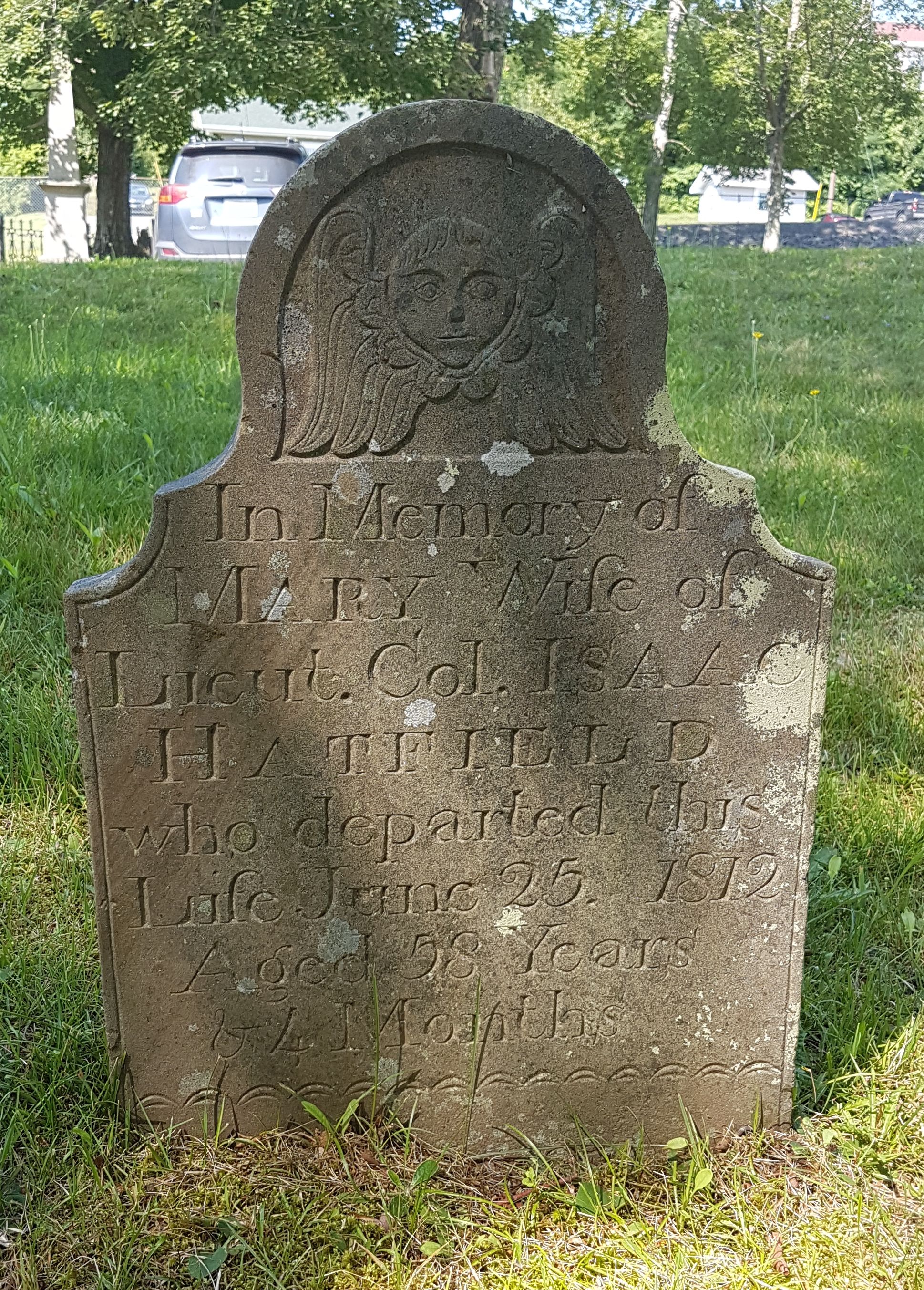
[The photo above, from Find a Grave, shows the headstone of Mary (Bayeux) Hatfield, whom Lt. Col. Isaac Hatfield married in 1786 after settling in Digby County, Nova Scotia.]

Saturday, January 18, 2020

Capt. Samuel Lockwood at War

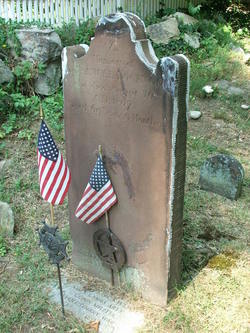
Samuel Lockwood (1737–1807, gravestone shown here courtesy of Find a Grave) of Greenwich, Connecticut, became a second lieutenant in the Continental Army in April 1775.

That fall, he joined Gen. Richard Montgomery’s invasion of Canada. On 5 November Lockwood’s commanders made him an assistant engineer with the rank of captain. The Continental Congress never recognized that rank but later voted to pay Lockwood a year’s salary as an engineer.

Lt. Lockwood’s specialty was really maneuvers on the water. He reconnoitered ahead of the army by boat during the march north and helped to capture eleven Crown vessels and Gen. Richard Prescott at Sorel.

The Battle of Québec didn’t work out so well for Lockwood, however. He was wounded, captured, and not released on parole until late in 1776.

As soon as Lockwood was formally exchanged in early 1777, the Congress commissioned him as a captain in Col. John Lamb’s artillery regiment. He served two years, resigning in 1779.

Capt. Lockwood was then done with the Continental Army, but he wasn’t done with the war. He remained active in his state’s military. In 1779 he commanded an armed vessel on Long Island Sound, attacking British ships in the Oyster Bay harbor in November.

On 17 Jan 1780, Capt. Samuel Lockwood led “forty volunteers from Greenwich” alongside Capt. Samuel Keeler and an equal number of Connecticut militiamen on a raid into New York. Their target was the home in Morrisania of Lt. Col. Isaac Hetfield, Loyalist commander of the Westchester County militia.

Gen. William Heath reported to New York’s Gov. (and Gen.) George Clinton about the Lockwood and Keeler raid a few days later:
they arrived at the place a little after one the next morning, attacked the picket, killed 3 and drove the others in, march’d to the House where Hatfield was, who, with his men took to the chambers [i.e., bedrooms] and kept up a fire down stairs and out at the windows; the militia behaved with great Bravery, call’d to Hatfield to Surrender or they would Set fire to the House…
TOMORROW: The view from inside Hatfield’s house.

Saturday, May 11, 2019

Pickering on the Beginning of the Siege

Earlier this week the Journal of the American Revolution made the first publication of a 21 Apr 1775 letter by Timothy Pickering, colonel of the Essex County militia. The letter now belongs to the Harlan Crow Library in Dallas.

The title of library curator Samuel Fore’s article emphasizes Pickering as an “Eyewitness to the British Retreat from Lexington.” However, the letter doesn’t say anything about the events of 19 April (including Pickering’s own actions, which were controversial for decades).

Rather, on 21 April Pickering wrote about how the siege of Boston was taking shape. Or at least about the situation on the northern wing of the siege; he didn’t mention what was going on in Roxbury at all. Instead, he told a colleague from Essex County:
The regulars were entrenching on the first hill beyond Charlestown neck; also on a point of ground (as well as I could learn) in Cambridge river, just as it opens to the Bay. For what purposes I cannot tell, but conjecture to prevent the provincials entering Boston by the way of Charlestown, or by boats going down Cambridge river. The provincials, perhaps three or four thousand men, were scattered about Cambridge common too much at random.
Lack of discipline by the common soldier was a fairly constant theme in Pickering’s military writings.

As a regimental commander, Pickering was invited to a council of war in Cambridge headed by Gen. Artemas Ward and Gen. William Heath, with Dr. Joseph Warren sitting in. Characteristically, Pickering voiced his opinions, including on whether the Massachusetts troops should attack the British positions:
I ventured to declare my opinion “That we ought to act only on the defensive; but some thought that now was the time to strike, & that now the day might be our own, & end the dispute. I could not think so: for besides the scanty portion of ammunition we at present could come at, our men were not sufficiently prepared for action; they were not disciplined even for an irregular engagement; few, very few, have had experience; & the officers in general have neither instructed themselves nor men how to act: The confusions of yesterday, testified by every officer I could talk with, fully justify these assertions. . . .

Another & what appeared to me an important reason for acting only on the defensive was this. The attack is universally said by our people to have been begun by the King’s troops: This may serve to justify a return of fire from us; and tho by pursuing them we seemed to act offensively, yet that was a natural consequence of the first attack, & might be excused: but to attack the troops, while they remained, as now, quiet in the trenches, would be deemed a much more atrocious act, & fatally prevent an accommodation, which notwithstanding yesterday’s skirmish, did not appear wholly impracticable.[”]
That reinforces Pickering’s reputation for wanting to find an “accommodation” with the royal government when other Massachusetts Patriots were ready to push harder. People groused that his attitude had kept the Essex County troops from engaging with the British column on 19 April.

Another question the Massachusetts commanders faced was whether to maintain maximum forces around Boston or send some militia units back home to defend their coastal towns from possible attack by the Royal Navy. Pickering didn’t want to leave Salem undefended:
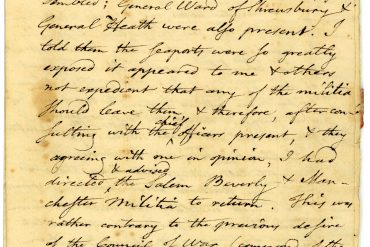
I told them the seaports were so greatly exposed it appeared to me & others not expedient that any of the militia should leave them, & therefore, after consulting with the chief officers present I had directed and advised the Salem, Beverly, and Manchester militia to return. This was rather contrary to the previous desire of the Council of War, (composed of the General & field officers above mentioned;) but afterwards it appeared that they also judged it expedient, by directing the Ipswich companies to return:
That shows us how loose Gen. Ward’s authority was. The previous day’s council of war had agreed to keep troops at the siege lines, but Pickering had already sent some of his men home.

Toward the end of his letter, Pickering wrote: “I have also just heard by a man from Boston, that Earl Percy is badly if not dangerously wounded.” That rumor was false. Lt. Col. Francis Smith had been wounded, though not badly, but Col. Percy was unhurt.

Monday, March 05, 2018

Men Who Brought Us Dorchester Heights

On 5 Mar 1776, Gen. William Howe and his colleagues in the British military woke up to find Continental troops positioned and protected on the heights of the Dorchester peninsula. The cannon up there threatened not only Boston, already under artillery fire from other positions, but the all-important naval and supply ships in the harbor.

The person who deserves the most credit for making the move onto Dorchester Heights possible was Lt. Col. Rufus Putnam, one of the Continentals’ self-taught engineers. As shown by his 11 February letter (quoted here), he knew that soldiers going on to those hills would have to fortify their positions to hold off a British counterattack. But digging in would be hard because the ground was hard—still frozen at the end of the winter.

When Putnam wrote that letter, he could only imagine a long, costly operation that would require fortifying the entire “causeway” or low, narrow approach onto the peninsula. Then, however, Putnam stumbled across a better solution in a book belonging to Gen. William Heath. Some year I’ll tell that whole story. For now, I’ll summarize by saying that Putnam realized the army could build wooden structures in advance of the move, assemble them on the heights, and strengthen them with dirt. Those walls, while not as strong as an earthen fort, would be enough to protect the men as they dug in further.

William Davis, a Boston merchant, suggested adding “Rows of barrels filled with earth” to those fortifications. Heath wrote:
They presented only the appearance of strengthening the works; but the real design was, in case the enemy made an attack, to have rolled them down the hill. They would have descended with such increasing velocity, as must have thrown the assailants into the utmost confusion, and have killed and wounded great numbers.
Heath took credit of relaying Davis’s idea to Gen. George Washington, who loved it.

Finally, the timing of the operation was the brainchild of quartermaster general Thomas Mifflin (shown above), according to the Rev. William Gordon’s eyewitness history of the Revolution. Gordon wrote, “A council of war was called to fix the time for going upon the heights.” However, he didn’t state a date or place for that meeting, and there’s no record of it in Washington’s papers. Perhaps it was a smaller, more informal group than a “council of war.”

Mifflin was brought into the meeting since he was responsible for supplying the carpenters, wood, wagons, tools, and other material essential to the operation Putnam had suggested. Never a shy man, Mifflin also shared his bright idea:
He went prepossessed in favor of the night of March the 4th, a friend having reminded him, that probably the action would be the next day; and that it would have a wonderful effect upon the spirits of the New Englanders, to tell them when about engaging—“Remember the fifth of March, and avenge yourselves for the massacre at Boston.” When required to give his opinion, he spake in favor of the aforementioned night, and supported it in opposition to the contrary sentiment of gen. [Horatio] Gates, who for some reasons deemed it an improper time. After a debate, it was carried for that night, by a majority of one.
Washington would have preferred an even earlier date, though it’s not clear the army would have been ready until the 4th. That night also offered a nearly full moon for the work.

As it turned out, the British were never able to mount an attack on the Continentals’ new position. Gen. Howe was of two minds about that idea, the weather turned bad, and the men on the heights kept working to make their position even stronger. Less than two weeks later, the British military abandoned Boston.

The barrels never got rolled down the hill.

Friday, January 27, 2017

Why Did Knox Stop His Guns at Framingham?

In response to my Wednesday posting about Col. Henry Knox’s arrival in Cambridge on 18 Jan 1776 (a week or so earlier than the traditional date), Boston 1775 friend Charles Bahne commented:
I still wonder how the town of Framingham fits into Knox’s route. The direct route to Boston (and Cambridge) from the west was the Boston Post Road, which in this area is basically today’s U.S. 20 with some minor detours. That road passes through Marlborough, Sudbury, Wayland, Weston, and Waltham. All of these, except Wayland, existed as towns in the 1770s; Wayland was still part of Sudbury. It would have been a significant detour — with all those heavy cannon! — to go to Framingham.

It’s more logical for John Adams and Elbridge Gerry to have passed through Framingham on their way from Cambridge to Philadelphia, since there was another road — today’s “Old Connecticut Path” — which branched off the Post Road at the Weston-Wayland line and headed directly to Hartford, bypassing Worcester and Springfield.
So we have a question of space as well as time. As part of my possible project on Knox, I’m reexamining the traditional stories about him. Among the most visible of those stories is his progress through New York and Massachusetts; the Knox Cannon Trail has been marked with large roadside stones starting in 1926. Yet much of that trail is based on assumptions about where Knox and his cargo passed because the records of his trip are incomplete. Some marker stones have had to be repositioned.

Following the first Knox biography, we assumed Knox brought his artillery from Springfield (a town he mentioned in a letter to Gen. George Washington) to Cambridge, arriving 24 January. And we assumed he took the straightest, most traveled route, which was the Boston Post Road. But that timetable is wrong. What if the route is an unsupported assumption as well—at least for the guns?

As shown in the map above (a detail from the 1775 “Seat of War in New England” map), the Boston Post Road leads east from Marlborough through Sudbury to Watertown. At Marlborough another road diverged southeast into Framingham toward Natick. It seems likely that Col. Knox directed his “noble train” along that second road. But why?

Gen. William Heath wrote in his diary that Knox “came to camp” on 18 January while the guns “were ordered to be stopped at Framingham.” To me that wording implies the order came from above—i.e., from Gen. Washington.

Another clue comes from the Gershom Foster orderly book at the Anderson House library of the Society of the Cincinnati. That’s an orderly book for the artillery regiment. The orders start to come from Col. Knox (in a big, dramatic way) on 28 January. So even though he was in Cambridge on 18 January and presumably received his commission as colonel then, Knox didn’t start directing the regiment for another ten days. What was keeping him busy?

I suspect Knox went ahead of the guns to meet with his commander-in-chief in Cambridge on 18 January, then hurried back west to meet the guns and stop them at Framingham, or divert them to that town. Why? Knox’s papers have a big gap at this point, and Washington’s surviving headquarters papers don’t mention him or the new artillery. (Notably, however, “Framingham” is one of the passwords of the day on 22 January.)

One possibility is that Knox always planned to take that road because he was aiming to deliver the cannon to Roxbury, not Cambridge. He had worked on the big fort in Roxbury. He might have expected to mount most of the guns in that part of the siege lines. In that case, the route through Framingham to Natick and thence to Dedham might make sense.

But it also seems likely that those cannon needed to be mounted and equipped for use in the siege. Washington may well have decided that Framingham was the place to do that work, far enough from the lines to be safe from the enemy. I haven’t found any mention of such work in Framingham, however.

It appears that Knox’s heavy cannon remained in Framingham for a month or so. On 26 February Ezekiel Price, a Boston official and businessman who collected many threads of gossip from his refuge in Stoughton, wrote in his diary:
It is said that the heavy cannon which were left at Framingham are brought down to Cambridge; the mortars are fixed in their new beds; the fort at Lechmere’s Point nearly finished; fascines going constantly to Dorchester; and every thing getting in readiness to make a push by our army.
Not all the gossip Price wrote down was that reliable (I’ll talk about that tomorrow). But it seems unlikely that he would have been wrong about the heavy cannon being left in Framingham for weeks.  And while it’s not clear what Price meant by saying they were brought “down to Cambridge” (Allston was still part of Cambridge then), this diary entry does suggest some of Knox’s artillery did indeed travel into that town. So there’s still a case for some of those markers.

Wednesday, January 25, 2017

When Henry Knox Came Back to Cambridge

On Thursday, 25 January 1776, John Adams and Elbridge Gerry were on their way back to the Continental Congress in Philadelphia. The two Massachusetts delegates stopped at midday to dine in Framingham.

Adams wrote in his diary:
Coll. [Joseph] Buckminster after Dinner shewed us, the Train of Artillery brought down from Ticonderoga, by Coll. [Henry] Knox.

It consists of Iron—9 Eighteen Pounders, 10 Twelves, 6. six, four nine Pounders, Three 13. Inch Mortars, Two Ten Inch Mortars, one Eight Inch, and one six and an half. Howitz, one Eight Inch and an half and one Eight.

Brass Cannon. Eight Three Pounders, one four Pounder, 2 six Pounders, one Eighteen Pounder, and one 24 Pounder. One eight Inch and an half Mortar, one Seven Inch and an half Dto. and five Cohorns.
That’s fifty-eight pieces of artillery in all. (I’ll get back to that number tomorrow.)

Adams’s diary entry for this date in 1776 is notable because the traditional date for Knox reaching Cambridge with his “Noble train of Artillery” is 24 January. Here, for examples, is a Mass Moments page linked to that date. I stated that same date in my study for the National Park Service a few years back. And yet Adams tells us that on the following day all the colonel’s guns were still out in Framingham.

So did Knox leave the ordnance behind and go ahead to Cambridge to report to Gen. George Washington? That makes sense since Knox owed his position to Washington and was acting on orders he received directly from the commander-in-chief. And the historical record indicates that Knox did indeed leave his guns behind—but he did so the previous week.

Gen. William Heath’s memoirs, based on his wartime diary, state this for 18 January:
18th.–Col. Knox, of the artillery, came to camp. He brought from Ticonderoga a fine train of artillery, which had been taken from the British, both cannon and mortars, and which were ordered to be stopped at Framingham. 
At this time Heath was serving under Gen. Israel Putnam in east Cambridge. So “came to camp” almost certainly meant Knox came to Washington’s headquarters.

So where did the 24 January date for his arrival come from? It appears in the first biography of Knox, published by Francis S. Drake in 1873, but that doesn’t cite a source. And the Adams and Heath diaries say that:
  • Knox reached Cambridge six days before that date.
  • All the artillery pieces were still out in Framingham after that date.
So I apologize for repeating the 24 January date without foundation.

TOMORROW: How many cannon and mortars did Knox transport?

Tuesday, June 21, 2016

Samuel Gerrish “unworthy an Officer”

As I described yesterday, Col. Samuel Gerrish of Newbury was the first infantry officer to receive a Massachusetts commission in May 1775, but then ran out his string with a series of embarrassing actions and lack of action.

On 17 August, the Continental Army court-martialed Gerrish on the charge “That he behaved unworthy an Officer.” With Gen. Nathanael Greene presiding, a panel of officers found him guilty and ordered him “to be cashiered, and render’d incapable of any employment in the American Army.” Gen. George Washington approved that sentence on 19 August.

Washington’s private letters show that he was pleased with that outcome and, whatever incident was behind the formal charge, linked it to Gerrish’s behavior at Bunker Hill. To his overseer Lund Washington the commander wrote:

The People of this Government have obtained a Character which they by no means deserved—their Officers generally speaking are the most indifferent kind of People I ever saw. I have already broke one Colo. and five Captain’s for Cowardice, & for drawing more Pay & Provision’s than they had Men in their Companies. . . .

in short they are by no means such Troops, in any respect, as you are led to believe of them from the Accts which are published, but I need not make myself Enemies among them, by this declaration, although it is consistent with truth. I daresay the Men would fight very well (if properly Officered) although they are an exceeding dirty & nasty people. had they been properly conducted at Bunkers Hill (on the 17th of June) or those that were there properly supported, the Regulars would have met with a shameful defeat; & a much more considerable loss than they did. . .

it was for their behaviour on that occasion that the above Officers were broke, for I never spared one that was accused of Cowardice but brot ’em to immediate Tryal.
Likewise he told Richard Henry Lee that he “Broke one Colo. and two Captains for Cowardly behaviour in the action on Bunker’s Hill.” Gen. William Heath later told John Adams that Gerrish’s fault had been “Backwardness in Duty on the 17th. of June.”

According to Swett, judge advocate general William Tudor later said that Gerrish “was treated far too severely.” (At the time, however, Tudor’s main complaint to his mentor John Adams was that the courts-martial were unfair to him because of all the work he had to do.)

Samuel Gerrish went back to Newbury. Loammi Baldwin took over the leadership of the regiment. However, not everyone had lost respect for Gerrish since his town elected him to the Massachusetts General Court the next year.