J. L. BELL is a Massachusetts writer who specializes in (among other things) the start of the American Revolution in and around Boston. He is particularly interested in the experiences of children in 1765-75. He has published scholarly papers and popular articles for both children and adults. He was consultant for an episode of History Detectives, and contributed to a display at Minute Man National Historic Park.

Subscribe thru Follow.it


•••••••••••••••••


Showing posts with label ballooning. Show all posts

Friday, April 14, 2023

“More of a spectacle than a science”

Lily Ford’s Public Domain Review article “‘For the Sake of the Prospect’: Experiencing the World from Above in the Late 18th Century” drifted across my vision a while back.

She made an interesting observation about different national experiences of ballooning:

The first successful manned balloon flights were conducted in France with state support. The ascents themselves became known as “experiments”, and were concerned with an exploration of the upper air. In Britain, the Royal Society withheld support from such endeavours, so the first British ascents were underwritten, in the words of one early balloonist, by “a tax on the curiosity of the public”. This affected the cultural profile of ballooning in England: it was always more of a spectacle than a science.
British balloonists, including the Boston-born Dr. John Jeffries, nonetheless tried to do science in the air. Ford’s focus was one such man, the first to try to convey the experience of human flight through graphic design:
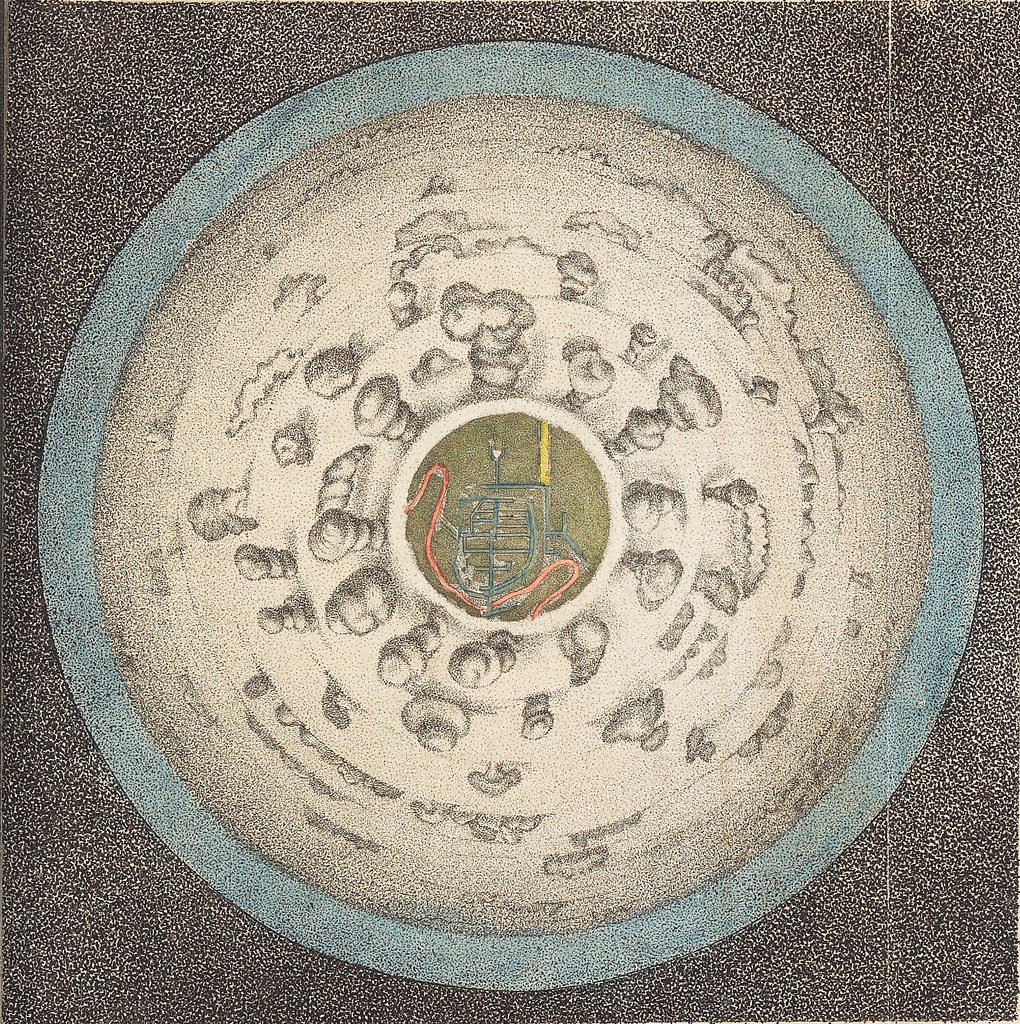
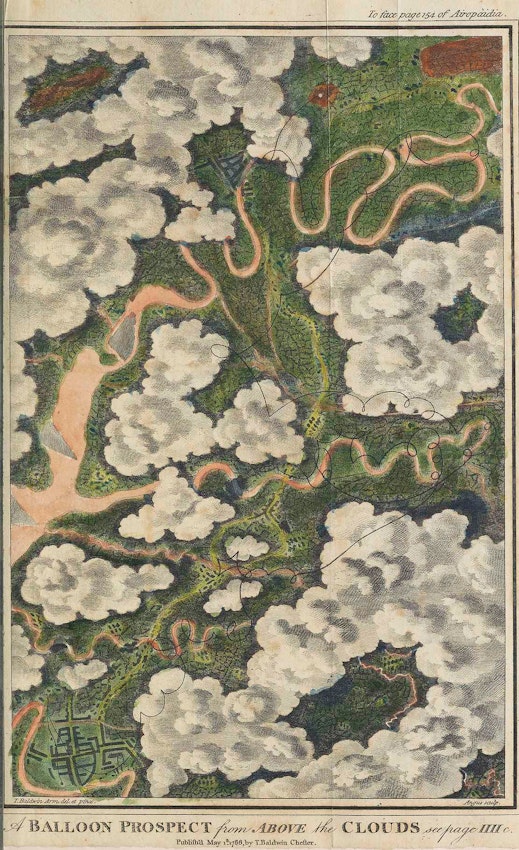
Thomas Baldwin, an early balloonist who hired [Vincent] Lunardi’s balloon for an ascent over Chester in 1785, inscribed a long book about his one day in the air to "the principal inhabitants of Chester" who had covered his costs. Uniquely in this period, Baldwin attempted to describe his experience not only verbally, but using images: three expensively produced plates depicting the view from the balloon, the balloon in the view, and the charted passage of the balloon over the landscape.
The first image in his Airopaidia, “A Circular View from the Balloon at its greatest Elevation”, departs from established conventions of landscape representation. At a quick glance it resembles an eyeball in its spherical regularity. . . . “The Spectator is supposed to be in the Car of the Balloon, suspended above the Center of the View” (Baldwin:iv). The ground is visible in the “iris”, a central roundel which contains, upon inspection, the plan view of a town and its river. This is Chester, fondly placed at the centre of this entirely new kind of view. The town is framed by a thick “Amphitheatre, or white Floor of Clouds” (Baldwin:iv). Drawing clouds was clearly not one of Baldwin’s strengths.
Baldwin even recommended laying the book on the floor or ground and looking straight down on this picture to understand it.

A later image is closer to the aerial views that have become entirely familiar in an age of airplanes and satellites.
The main point of this picture was the path of the balloon over the landscape, as shown by the looping black thread across the landscape.

Indeed, I suspect Baldwin created this image using a map of the area around Chester rather than sketching what he actually saw from the air. Cartographers had actually produced aerial views simply through mental effort.

Sunday, July 19, 2020

“The anarchical dinner which was denominated a civic feast”

Let’s get back to Boston’s Civic Festival of 24 Jan 1793. As I described back here, a wide swath of Bostonians appear to have gone gaga over news of France becoming a republic.

Even the Federalist Columbian Centinel newspaper was breathlessly reporting the details of the celebration, referring to all men with the republican title “Citizen,” and warning French exiles to keep quiet about their objections to the new order.

Of course, some locals were skeptical about celebrating the French republic. But they probably kept their mouths shut, at least in public. For people to criticize the general merriment, they’d have to be dubious about crowds, suspicious of enthusiasm, and willing to court unpopularity.

In other words, the Adams family!

On 31 January, John Adams wrote to his wife Abigail commenting on the planned festival. (It had already happened a week before, but he hadn’t read about how it went.) He indulged in some mild snark about the new republican honorifics replacing old forms of address:
Cit. H. and Cit. A. I presume will grace the Civic Feast. Cit and Citess is to come instead of Gaffer and Gammer Goody and Gooden, Mr and Mrs, I suppose. . . .

Citizen Brisler and Citizen V. P, are very happy together—Since they are equal and on a Level it is proper that sometimes one should be named first and sometimes the other.
“Cit. H. and Cit. A.” meant Gov. John Hancock and Lt. Gov. Samuel Adams—politicians the Vice President expected to be out courting voters by participating in the general celebration. “Citizen Brisler” was his own manservant in Philadelphia, John Briesler, and “Citizen V. P.” himself.

More seriously, Adams was withholding his judgment about the new republic in Europe:
We Shall See, in a few months, the new French Constitution, which may last Twelve months, but probably not more than Six. Robertspierre and Marat with their Jacobin Supporters I suspect will overthrow the Fabric which Condercet [Thomas] Paine and Brissot will erect. Then We shall see what they in their turn will produce.
The Vice President had the spelling wrong but the political tides right.

John Quincy Adams (shown above) was likewise skeptical about the festival and the politics behind it. On 10 February he wrote to his father:
I persisted in refusing to appear at the anarchical dinner which was denominated a civic feast, though I was urged strongly by several of my friends to become a subscriber, upon principles of expediency

Those friends disliked the whole affair quite as much as I did, but thought it necessary to comply with the folly of the day.—

Upon the whole however, it appears to me that the celebration of that day, has had rather an advantageous than an injurious effect. The specimens of Equality exhibited in the course of it, did not suit the palates of many, who had joined in the huzzaes. The Governor thought proper to be sick, and not attend; and I believe has ventured to express his disapprobation of the proceedings in several particulars.
Contrary to Vice President Adams’s assumption, Gov. Hancock had kept away from the feast. His keen political instincts might have warned him the enthusiasm might fade, or his ego might not have countenanced the level of equality that event demanded. The lieutenant governor was the highest elected official at the festival.

Hancock already had a reputation for pleading illness when it was politically or socially awkward for him to do something, so it was easy for people like J. Q. Adams to read his non-appearance as deliberate. But then the governor showed everyone by dying in October.

Another skeptical voice in January 1793 was the Rev. William Bentley up in Salem. In his diary he wrote:
21 [Jan]. Reports of great preparations making in Boston & the towns adjacent for the celebration of next Thursday. No movements with us even in the barber’s shops yet. . . .

24 [Jan]. No notice was taken of this day in Salem, excepting by a few boys with a paper balloon, who first burst it, & afterwards set fire to it. Some faint struggles by individuals were used, but soon ceased without attaining to the firing of a gun, the hoisting of a flag, the kindling a bonfire, or even the noise of a winter evening. This is not owing to an indifference to the revolution in France, but to the manners of the people, who are easily checked in any expences. . . . Vive la nation is not yet translated among us.

25 [Jan]. A particular account of the celebration at Boston last Thursday. The roasted Ox, exhibited with great pomp, fell a prey to the fury of the rabble. Every other ceremony was performed agreably. The children of the schools formed a delightful appearance with national cockades. The several companies dined in the public rooms, & the whole concluded with a bonfire.
In that last entry Bentley might have showed a little regret at missing a swell party.

TOMORROW: Meanwhile, in France…

Monday, February 04, 2019

“Entertainments” for the 2019 Dublin Seminar

This summer’s Dublin Seminar for New England Folklife is on the topic of “Entertainments at Taverns and Long Rooms in New England, 1700-1900.”

The seminar organizers are now accepting proposals for papers, presentations, and performances concerning all types of popular entertainments, including singing and small theatrical groups, street musicians, strolling magicians, and animal showmen who performed in New England taverns, long rooms, coffeehouses, exhibition rooms, assembly halls, barns, and open-air rotundas from 1700 through 1900.

Among the less well-known performers the seminar is open to cover are slack-wire artists, rope flyers (such as John Childs and the gentleman shown above), electrical machine operators and healers, demonstrators of automata and perpetual motion machines, peep-box entertainers, lantern showmen, firework specialists, parachute jumpers, and balloonists.

Pertinent entertainments also include gambling, vaudeville, and even prostitution, as well as stationary exhibits such as waxwork museums and profile or physiognotrace machines. And of course there’s space for amateur community entertainments.

The call for papers says:
Preference will be given to analytical papers exploring subjects such as the cultural origin of these acts; the roles of ethnicity, race and class; their actual popularity; the involvement of children; patterns of advertising and self-naming; the influence of maritime presence and activities; as well as the larger role of competing professional English and French theater and singing troupes. Special consideration will be given to talks accompanied by demonstrations. Our primary focus is on New England, but papers dealing with New York State, adjacent areas of Canada, and the middle and southern colonies are also encouraged.

The Seminar seeks presentations that reflect original research, especially those based on primary or underused resources, such as material culture, archaeological artifacts, advertising and flyers, letters and diaries, vital records, and federal and state censuses, as well as newspapers, portraits, prints and photographs, business records, recollections, autobiographies, and handed-down memories (i.e., oral histories).
To submit a paper proposal for this conference, e-mail a one-page prospectus that cites sources and a one-page vita or biography by 10 Feb 2019 to pbenes@historic-deerfield.org.

The “Entertainments in Taverns and Long Rooms” symposium will take place in Deerfield on 21-23 June 2019, with the support of Historic Deerfield. Selected papers will appear as the 2019 Annual Proceedings of the Dublin Seminar to be published about eighteen months after the conference.

Friday, October 06, 2017

Providence College’s Seminar on the History of Early America

The Department of History & Classics at Providence College in Rhode Island is launching a Seminar on the History of Early America.

Participants in these sessions “will discuss pre-circulated works in progress, including chapters of doctoral dissertations, book projects, and article drafts on any aspect of early American history.”

The material scheduled for the upcoming academic year is:

13 October
Susan Branson, Syracuse University
“Flights of Imagination: The Air Balloon as a Symbol of National Promise”

7 December
Lorri Glover, Saint Louis University
“‘An All Accomplished Woman’: Eliza Pinckney in the Age of Revolution”

1 March 2018
Julie Fisher, George Washington University & National Park Service
“What is Roger Williams?”

9 April
George Elliott, Brown University
Gershom Bulkeley and Alchemical Experimentation in Colonial New England”

3 May
Melissa Morris, Bridgewater State University
“Across the Channel, Across the Atlantic: Anglo-Dutch Collaboration in the Seventeenth Century Americas”

The seminar will meet in the Liberal Arts Seminar Room (room number 202) of the Ruane Center for the Humanities at Providence College in Providence, a couple of miles west of downtown. Each meeting will run from 4:30 to 6:00 P.M. For more information, contact Prof. Sharon Ann Murphy of Providence College.

(The photograph above shows a sack-back gown made for Eliza Pinckney around 1750 from silk harvested on her South Carolina plantation. It is now in the collection of the Smithsonian.)

Saturday, November 12, 2016

A “(Mostly) True” Picture Book Landing Now

On Publishers Weekly’s new list of the best picture books of the year is A Voyage in the Clouds: The (Mostly) True Story of the First International Flight by Balloon in 1785, written by Matthew Olshan and illustrated by Sophie Blackall.

The journal’s review of the book said:
The team behind the The Mighty Lalouche (2013) recounts the first international balloon journey, an expedition across the English Channel undertaken by a British doctor named Jeffries and a French balloonist named Blanchard in 1785. Tension arises even before the balloon leaves the ground as Jeffries discovers that Blanchard is plotting to exclude him from the trip. The two men cold-shoulder each other as the journey gets underway, but when the balloon starts to lose altitude, Blanchard’s heroism turns them into friends and allies. (They’re in their bloomers at the time, and Olshan keeps their rapprochement from getting too sentimental with a hilarious peeing scene.)

The baroque ornamentation and carefully lettered speech balloons of Blackall’s spreads recall the work of George Cruikshank; like him, she has a gift for revealing that people dressed in petticoats and tricorne hats are just as human as the rest of us. With humor that’s never snarky, Olshan reminds readers that, sometimes, the challenge adventurers must overcome is not the elements; it’s their own vanity. Ages 4–8.
Dr. John Jeffries was indeed British at the time of this flight, but he was born and raised in Boston. He had become a Loyalist, serving as a British military physician during the war. In 1789, after tensions had dissipated a bit (and he saw an inheritance in Massachusetts while running out of money in Britain), Jeffries returned to his native town for the latter part of his career.

Deborah Kalb interviewed Olshan about the book, asking in particular about that parenthetical word in the subtitle:
Q: The subtitle describes it as a “(mostly) true story.” What did you see as the right blend of the historical facts and your own imagination?

A: The phrase you singled out from the subtitle—“(mostly) true”—is a source of lively conversation about the book. Roger Sutton of The Horn Book wrote an editorial on this very subject in his blog,…in which he describes the challenge for a reviewer in properly categorizing A Voyage in the Clouds; i.e., can a book that characterizes itself as “mostly true” be considered “non-fiction?”

My story was certainly inspired by the flight of Jeffries and Blanchard; most of the events in the story actually happened as they’re described, as I explain in the Author’s Note. But I did take a few liberties in the interest of keeping young readers engaged.

If a book is to be presented as “non-fiction” or taught in classrooms as “history,” I think an author has a responsibility to volunteer the fact that he has departed from the historical record.

But even a story that hews as closely as possible to historical facts as they’ve been received and strives mightily to represent the “factual” is going to wind up being fiction, to a certain degree, if only by depicting the modern author’s impossible intimacy with his protagonists.

The author can’t have known them, but it’s essential to his “authority” that he seem to have.
For Boston 1775’s intimate retelling of Dr. Jeffries’s voyage with Jean Pierre Blanchard, from all the way back in 2006, start here.

Sunday, January 10, 2016

Dr. Jeffries’s Hat

Last week the anniversary of the first balloon crossing of the English Channel by Jean-Pierre Blanchard and Dr. John Jeffries, a Boston native, got a lot of attention on the web.

There was an article about making a similar journey by Dr. Tom Crouch of the Smithsonian Air & Space Museum, who’s working on a book about Jeffries. His past books include The Eagle Aloft: Two Centuries of the Balloon in America.

And the Houghton Library at Harvard pulled out the hat that Jeffries wore on his first balloon trip and when he had his portrait made. It turns out to be cut from a jaguar pelt.

My father looked at the Houghton material decades back, and he told me it included a fabric sample from the balloon. I didn’t see that when I looked at the documents in the last fifteen years, but I see that’s now a separate collection. Glad it didn’t float away.

My version of the Channel-crossing story from 2006 starts here.

Friday, November 23, 2012

A Monument to Hot Air

Since some folks are reportedly shopping for holiday gifts today, I’ll just say that I wouldn’t mind receiving this at the end of December.

From the collections of the Metropolitan Museum of Art, this is a terra cotta model that Clodion (Claude Michel) sculpted in Paris around 1784. He was proposing a large monument to the invention of the balloon. The Met’s webpage offers several more views of the model.

I love the combination of the latest and greatest science of the day with mythological figures. Winged cherubim gather fuel to make the balloon launch, and winged angels trumpet the achievement.

You’d think with all those wings, the cherubs and angels wouldn’t be that impressed by ballooning. “Oh, you can get off the ground now. That’s lovely. Can you decide which direction to go? No? Well, keep working on that. We’ll be over here. Or over here. Or wherever we choose, you see.”

Friday, November 16, 2012

Crossing the Delaware by Air?

If you’ve long felt that the only problem with the American War for Independence is that it didn’t have enough airships, then you should check out the Kickstarter campaign for Steam Patriots.

Steam Patriots is a “transmedia interactive project” from Noble Beast Books, publisher of speculative fiction in print, digital, and audio forms. Its past titles include Steampunk Holmes.

The image above is a detail of Patrick Arrasmith’s scratchboard illustration “George Washington with Airships.” See the full image at the Steam Patriots site. It “will be included in the interactive iPad edition and will be sold separately as a poster.”

I first heard about this project some months ago, but apparently a necessary part of launching a Kickstarter campaign these days is to create video promotions and previews. That seem circular to me, but then I’m old enough to remember when videos were harder to produce than manuscripts, photographs, and drawings.

Tuesday, January 24, 2012

Anna Lætitia Barbauld: “The awe this day struck into me”

Anna Lætitia Barbauld (1743-1825) was a writer, teacher, and minister’s wife in England. She moved in circles of religious and political dissenters, and was acquainted with Samuel Taylor Coleridge.

This is the last part of Barbauld’s poem “Washing Day,” first published in the Monthly Magazine of December 1797. It’s an evocative slice of life, showing a moment when laundry day meant all the women in a household were busy and little girls weren’t allowed jelly or butter, yet science was about to let people fly:
I well remember, when a child, the awe
This day struck into me; for then the maids,
I scarce knew why, looked cross, and drove me from them;
Nor soft caress could I obtain, nor hope
Usual indulgencies; jelly or creams,
Relique of costly suppers, and set by
For me their petted one; or butter’d toast,
When butter was forbid; or thrilling tale
Of ghost, or witch, or murder — so I went
And shelter’d me beside the parlour fire:
There my dear grandmother, eldest of forms,
Tended the little ones, and watched from harm,
Anxiously fond, tho’ oft her spectacles
With elfin cunning hid, and oft the pins
Drawn from her ravell’d stocking, might have sour’d
One less indulgent. —
At intervals my mother’s voice was heard,
Urging dispatch; briskly the work went on,
All hands employed to wash, to rinse, to wring,
To fold, and starch, and clap, and iron, and plait.
Then would I sit me down, and ponder much
Why washings were. Sometimes thro’ hollow bowl
Of pipe amused we blew, and sent aloft
The floating bubbles, little dreaming then
To see, Mongolfier, thy silken ball
Ride buoyant through the clouds — so near approach
The sports of children and the toils of men.
Earth, air, and sky, and ocean, hath its bubbles,
And verse is one of them — this most of all.
Read the whole poem here.

Friday, June 18, 2010

Twitter Feed, 9-16 June 2010

  • RT @KevinLevin: "Myths That Should By Now Be History" from your friends at Colonial Williamsburg bit.ly/9eL9Q9 #historyteacher #
  • RT @WilliamHogeland: Mindblowing digital #WilliamBlake archive: www.blakearchive.org/blake/main.html #
  • Tonight at NEHGS in Boston, 6:00: Maureen Taylor speaks on her book LAST MUSTER, collecting photos of Revolutionary War Generation #
  • Tonight at Folsom Tavern in Exeter, NH, 7:00: Ben Z. Rose talks about Gen John Stark #
  • Tonight at Shirley-Eustis House in Roxbury, 5:00: Prof Robert Allison concludes lecture series on Massachusetts in the British Empire. #
  • Tonight at my house, about 8:00: collapsing from a surfeit of historical events to choose from. #
  • RT @Britannica: "Founders envy" leads to foundering politics. Let's move beyond it, says Joe Lane. bit.ly/dszZe6 #
  • The British Consul in Boston is surprisingly tall. I'm just saying. #
  • Wiley's NON SEQUITUR comic strip takes on constitutional originalism: www.gocomics.com/nonsequitur/2010/06/10/ #
  • Historic New England's searchable database of collections and artifacts: bit.ly/9SJtBM #
  • Review of Rachel Hope Cleves's book on political response to French Revolution in USA: bit.ly/b6m8xP #
  • John Dixon, sentenced to die for burglary in 1784, and (at first) refusing to play the condemned man's expected role: bit.ly/cuCOCT #
  • Actual tea from the Boston Tea Party, collected from the salt water: bit.ly/dgsiUM #
  • Looking at a life sentence through eighteenth-century American eyes: bit.ly/bKEIMq #
  • RT @historyfaculty: Rare photo of slave children found in NC attic: bit.ly/dodvGm #
  • RT @historyfaculty: D.C.'s Jefferson Memorial is Sinking: bit.ly/9JPfpz // Actually just the sea wall out front. Or is water rising? #
  • RT @PaulRevere1734: This day 1768: Customs officials seized John Hancock's sloop Liberty on charge of landing undutied goods. #
  • RT @history_book: War at Sea Under Queen Anne 1702-1708 - by John Hely Owen. amzn.to/a7AgBe #
  • RT @history_book: Bookseller of the Last Century: Being Some Account of the Life of John Newbery - by Charles Welsh amzn.to/c505kr #
  • RT @SecondVirginia: Charleston SC gets new historical marker commemorating the 1780 siege and surrender bit.ly/9WLSoB #
  • RT @rjseaver: #scgs10 Maureen: last living RevWar widow died in 1906. Esther Damon married Noah Damon when he 75, she 20 #
  • Doubts about reported photo of enslaved kids from @KevinLevin bit.ly/aML9eN and Tim Abbott bit.ly/c70v4i #
  • RT @myHNN: What lies beneath: the fakes, mistakes and discoveries at the National Gallery bit.ly/96DiJc #
  • RT @amhistorymuseum: Today in 1743: Francis Dana, member of the 1777 Continental Congress, is born. His silk waistcoat: ow.ly/1WRGM #
  • Francis Dana became USA's first minister to Russia, but Catherine the Great refused to receive him and his young asst, John Quincy Adams. #
  • Early ballooning in London via @lucyinglis: bit.ly/9Xg90c A Bostonian gets in on the action: bit.ly/bWizji #
  • Gravestone showing the frightened soul of Elizbeth Huntington, Windham, CT, 1729: bit.ly/95zdn1 #
  • In ad, Alabama GOP candidate complains about taxation to faux Samuel Adams, ignorant that Adams was tax collector: bit.ly/9oIy9F #
  • RT @WilliamHogeland: #JohnAdams:"What a poor, ignorant,crapulous mass is #TomPaine's Common Sense." // Tell us how you feel, John! #
  • RT @alberkes: Here's a lovely article in the New York Times about TJ's travels in Burgundy. bit.ly/98O2uO #
  • RT @TJMonticello: We need your help to solve an honest-to-goodness historical mystery from Jefferson's weather records: bit.ly/aoRXEL #
  • RT @franceshunter: Botany, history, spies & the fate of early America - plus a book giveaway. All this week - bit.ly/c2tvAf #
  • RT @WilliamHogeland: "calls G. Washington, as distiller, a 'small businessman'? (Whiskey rebels would have laughed.)" // Amazing ignorance. #
  • .@historianess But for candidates like this one, it appears that representation counts only if his choice wins and does what he says. #
  • @WilliamHogeland I THINK he means that IRS employees aren't directly elected, but that doesn't help his case on the stupid meter. #
  • Historian Laurel Thatcher Ulrich popularizes material history in the DESERET NEWS: bit.ly/9RqAYi #
  • This weekend in Deerfield, MA: Dublin Seminar/Costume Society of America conference on "Dressing New England": bit.ly/9IJdP0 #
  • Mini American Revolution summarizes capture of Fort Ticonderoga in nine blog entries: bit.ly/aTmKIv #
  • Pvt James Cuffe managed to desert from His Majesty's 62d and 22d Regiments AND the 12th Massachusetts: bit.ly/9JI38Y #
  • RT @classroomtools: Questioning How is history used to deceive in this political ad youtu.be/6iQ7ZDUutU4 is critical thinking #

Wednesday, June 02, 2010

Twitter Feed, 23-31 May 2010

  • @jmadelman Yes, Texas history standards still include ancient Rome, but only the REPUBLICAN period. #stuffimakeup #
  • Current reading – R. Arthur Bowler, LOGISTICS & THE FAILURE OF THE BRITISH ARMY IN AMERICA, 1775-1783. #
  • "An army of up to 65,000 operating thousands of miles from its supply base…No European government had faced such a task since Roman times." #
  • Profile of Elizabeth (Peck) Perkins, widowed businesswoman in Revolutionary Boston: bit.ly/d0a3un #
  • NY TIMES columnist David Brooks pits Thomas Paine and Edmund Burke against each other: nyti.ms/cLZvbg #
  • RT @PaulRevereHouse: Slight change for Sat, June 5 event – Henry Cooke, Tailor extraordinaire will be at the museum bit.ly/aRxUp9 #
  • George & Martha Washington juggling their household staff in Philadelphia to ensure those slaves didn't become free: bit.ly/aAmB4U #
  • From @lucyinglis, a profile of Peter the "Wild Boy" (c1710-1785), brought to England in 1725: bit.ly/9KBl8Q #
  • Ladies' high hair fashions in Paris, 1777: bit.ly/bcwJE7 Of course, Paris was a long way from recently Puritan wartime Boston. #
  • RT @2palaver: Concord lodge stumbles on Mason 'jewels' made by Paul Revere? bit.ly/9dIZGb // There were other silversmith Masons #
  • RT @russeltarr: The Proceedings of the Old Bailey, 1674-1913: Great history resource: tinyurl.com/lrxk2w #
  • RT @PaulRevereHouse: To honor the 150th anniversary of "Paul Revere's Ride" our summer Teacher Workshop features poetry bit.ly/a1TBUd #
  • Someone actually made it thru the Revolutionary War with the name Polycarpus Snell: bit.ly/90Ts2q (Looks like a MAYFLOWER descendant) #
  • Looking for iron cannon cast during Revolutionary War at Salisbury, Conn.: bit.ly/bnHyqc #
  • Abigail Adams talks politics with Dr Benjamin Rush in an 1800 letter just bought by Massachusetts Historical Socy: bit.ly/amLhy6 #
  • RT @JBD1: folks inventorying Hancock's library got bored. Entries toward end lump titles together (i.e. "Shakespeare and Spectator"), &c. #
  • Via @JBD1, podcast lecture on the reconstruction of Thomas Jefferson's library: bit.ly/ag7vJE #
  • BOSTON GLOBE urges Walpole, Mass., football fans to make mascots of Rebels of 1775, not those of 1861: bit.ly/9IVpUT #
  • Honored US 6th Amendment and Massachusetts Declaration of Rights today: showed up for jury duty. #
  • .@AlPike: "Walpole could've opted for Federalist Rebels of 1814." // True, but Walpole has a tradition of winning. #
  • Call for papers for journal issue on Seven Years' War in a global perspective: bit.ly/czFrgO #
  • From @LizB, review of two children's books about George Washington, George III, and spying: bit.ly/94BFSF #
  • BOSTON GLOBE column with links on investigating Benjamin Franklin's kite-flying experiment: bit.ly/9JxYK7 #
  • Pvt Augustus Barrett of the British 22d Regiment, the British 24th Regiment—and the 16th Massachusetts Regiment: bit.ly/aeNMYh #
  • Visiting John Hancock's younger brother, who got a financial bailout and later a valuable Continental job: bit.ly/a8hFwl #
  • Parallels between the politicization of debate over climate science with politicization of debate over relativity? bit.ly/c5DAIK #
  • RT @wceberly: 256 yrs today, May 28, 1754, Lieutenant Colonel George Washington begins French & Indian War bit.ly/bz6Ys4 #
  • RT @history_geek: Betsy Ross, Out of the Parlor bit.ly/bGPA3G #
  • RT @jmadelman: Nifty take RT @KevinLevin Interesting post on historical movies at "Past in the Present" bit.ly/aPijSZ #
  • RT @jmadelman: The post has John Adams about right on creating an environment, even if the inaccuracies and shortcomings bother me. #
  • RT @universalhub: What if Boston had become an island city? bit.ly/9vex0x #
  • RT @amhistorymuseum: Today in 1790: Rhode Island becomes 13th state to ratify Constitution. Spinning frame from 1790: ow.ly/1RmUO #
  • May need to visit Museum of London during my next trip: bit.ly/bKctty #
  • A regular podcast for living-history and SCA reenactors: bit.ly/b9HZWp #
  • Rick Beyer & Lexington Historical Socy's FIRST SHOT film won award from American Association of State & Local History! bit.ly/d1C3cO #
  • Learned that artist Jef Czekaj deserves credit for school-play concept in UNITE OR DIE picture book on Constitution: bit.ly/6nRaB #
  • @historianess I ADORE Sir John Soane's Museum. I subject all my relatives to visiting it. That way they understand my decorating tastes. #
  • RT @history_book: Sublime Invention: Ballooning in Europe, 1783-1820 (The Enlightenment World) - by Michael R. Lynn. amzn.to/bg4YYM #
  • NY TIMES review of Jack Rakove's REVOLUTIONARIES: nyti.ms/duXmd5 #

Saturday, October 17, 2009

“The balloon now rose with great velocity…”

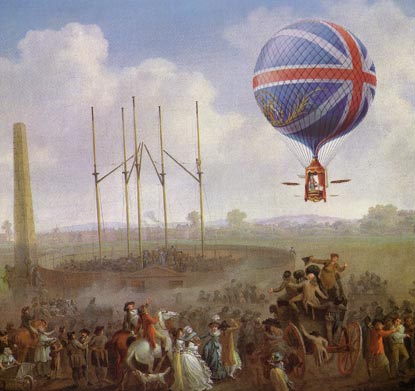
Vincent Lunardi, an Italian diplomat, became Britain’s first aeronaut on 15 Sept 1784. The painting of his spectacular ascent above comes from Fiddlers Green, which offers a paper model of his balloon. The poles are part of the launching apparatus.

Two years later Lunardi prepared his twelfth balloon ascension in Newcastle, but it didn’t go so well. Here’s the report from the Annual Register for 1786, the publication co-founded by Edmund Burke to collect Parliamentary records and notable news in the British Empire.

Newcastle upon Tyne, Sept. 20.

Lunardi’s attempt to ascend yesterday from the Spital ground was productive of a very melancholy accident. The balloon was about one-third full, and a great many gentlemen were holding it by the netting, when Lunardi went to pour into the cistern the rest of the oil of vitriol destined for the purpose.

This having caused a strong effervescence, generated inflammable air [i.e., hydrogen] with such rapidity, that some of it escaped from two different parts, of the lower end of the apparatus, and spread among the feet of several gentlemen who were holding the balloon, and who were so alarmed, that leaving it at liberty, they ran from the spot.

The balloon now rose with great velocity, carrying up with it Mr. Ralph Heron, a gentleman of this town, about twenty-two years of age, son of Mr. Heron, under-sheriff of Northumberland.

This unhappy victim held a strong rope which was fastened to the crown of the balloon, twisted about his hand, and could not disengage himself when the other gentlemen fled; he was of course elevated about the height of St. Paul’s cupola, when the balloon turned downward, the crown divided from it, and the unfortunate gentleman fell to the ground.

He did not expire immediately, having fallen upon very soft ground; he spoke for some time to his unhappy parents, and to the surgeons who came to assist him; but his internal vessels being broken, he died about an hour and a half after the fall.
According to the Monthly Chronicle of North-Country Lore and Legend, published in 1887 based on period sources, Lunardi issued a broadside lamenting the death and reminding the public how he had warned people that everything would be safe if everyone held tight to the balloon’s ropes. The Newcastle Chronicle agreed that he was blameless, and later criticized London newspapers for implying that the provincial crowd had chased the balloonist away.

There are conflicting accounts of Heron’s injuries. Richard Holmes’s Age of Wonder, a recent book, says, “The impact drove his legs into a flowerbed as far as his knees, and ruptured his internal organs, which burst out onto the ground.” The latter detail seems to be mistaken because Robert Robinson, who knew eyewitnesses and Heron’s younger sisters, said he was “found to have sustained no external injury from the fall,” but died of internal injuries.

Another detail that seems suspicious: By 1838, authors were saying that Ralph Heron’s fiancée had been standing beside him when he was lifted away, and the couple was due to be married the next day—details which escaped mention fifty years before.

Wednesday, April 04, 2007

John Childs, Rope Flyer

Yesterday I quoted John Childs’s announcement that he planned to fly from the steeple of Christ Church in Boston’s North End, the church we now call Old North. The 15 Sept 1757 Boston News-Letter duly recorded:

Tuesday in the afternoon, John Childs, who had given public Notice of his Intention to fly from the Steeple of Dr. Cutler’s Church, perform’d it to the Satisfaction of a great Number of Spectators; and yesterday in the Afternoon he again perform’d it twice.

The last Time he set off with two Pistols loaded, one of which he discharged in his Descent; the other missing fire, he cock’d and snap’d again before he reached the Place prepared to receive him.

It is suppos’d from the Steeple to the Place where the Rope was fix’d was about 700 Feet upon a Slope, and that he was about 16 or 18 Seconds performing it each Time.

As these Performances led many People from their Business, he is forbid flying any more in the Town.

The said Child says he had flown from the highest Steeples in England, and off the Monument, by the Duke of Cumberland’s Desire.
So what did Childs actually do? The important technical information is his “Rope was fix’d about 700 feet upon a Slope.” The steeple of Old North is 190 feet tall. So even if the rope were tied to the tippy-top, it must have formed a fairly gentle slope to the ground, far from the vertical. Furthermore, despite the newspaper’s clear interest in the speed and angle of Childs’s descent, its printers didn’t describe him as flying with any apparatus. Finally, to fire off two pistols during his second descent, Childs had to have both hands free.

All those clues, I’m sure, helped scholar Peter Benes connect Childs’s feat to a form of entertainment that daredevils had been offering in England for centuries: rope-flying. (Benes’s discussion appears in the article “Itinerant Entertainers in New England and New York, 1687-1830,” in the Dublin Seminar volume Itinerancy in New England and New York.)

A rope flyer started by stretching a long, strong rope from a steeple or other tall structure down to the ground on a slant. Then after making as big a deal of the event as he could, he went up the tower and waved to the assembled crowd. And then...

William Hogarth depicted a London rope flyer in his painting and engraving titled Southwark Fair. The painting is now at the Cincinnati Art Museum, but the online image is too small to see this detail clearly. Instead, I direct you to Benjamin N. Ungar’s thorough dissection of the engraved image [click the X to get rid of the ad if need be] and particularly its close-up of the “flying man.”

As you’ll see, a rope flyer slid down his rope head-first, arms and legs on either side of the cord. To protect his torso, he wore a board with a groove cut vertically down its center. His dangling limbs helped him keep his center of mass close to or even below the rope, so he didn’t fall off. And at the bottom? Samuel Breck’s memoir of growing up in Boston adds the detail, recalled by his mother, that Childs landed on a stack of feather mattresses.

So what John Childs did wasn’t really “flying” at all. It was, as Woody the Cowboy says in Toy Story, “falling with style.” But this was a quarter-century before the Montgolfier brothers sent up their first balloon. Sliding head-first down a rope, pistols blazing, was the closest anyone had seen to a man flying. Only after balloonists like Jean Pierre Blanchard really did fly for the public was that verb taken away from the rope-flyers, and their feat disappeared from the collective memory.

TOMORROW: Lingering mysteries about John Childs, the “flying man.”

Saturday, August 05, 2006

Dr. John Jeffries: physician, Loyalist, aeronaut, part 7

This series of postings, starting with Part 1, has brought Dr. John Jeffries from his early medical practice in Boston to floating across the English Channel on a balloon in January 1785. Jeffries then returned to London, apparently hoping for adulation as a man of science and adventure.

And to some extent his feat was recognized. Jeffries was made a "Baron of the Cinq Ports," a minor honorary title. His position as a fashionable doctor seemed assured. But he didn't receive the financial reward and pension that the French king had given his companion, Jean Pierre Blanchard.

In 1787, at the age of forty-two, Jeffries remarried, to a twenty-two-year-old Englishwoman named Hannah Hunt. They had several children together, though two died sadly young, according to family records: Harriet Maria “smothered" before her first birthday, and Robinson Ardesoif “burnt to death" at the age of five. Some of their other children lived considerably longer, including a John Jr. who also became a doctor and practiced for 57 years until his death in 1876.

In 1789, Jeffries received letters from family in Massachusetts "urging the necessity of his immediately repairing to Boston, to secure some property which had devolved to him by the death of a near relative.” He returned to his native town with his new wife and children. His father, town treasurer David Jeffries, had never left. Even his medical mentor and fellow Loyalist, Dr. James Lloyd, had ridden out the war in Boston. In April 1790, Jeffries decided to stay and become an American citizen.

Within a few years Dr. Jeffries was a popular local physician, respected despite his service with the British military. Local writers accepted his stories of identifying Dr. Joseph Warren's body on Bunker Hill and finding new ways to treat smallpox, though they were often self-serving. The 1801 Massachusetts Register listed Jeffries as practicing on "Franklin-Street, near the Tontine."

As for the small French aeronaut Blanchard, his republican beliefs made his home country somewhat unwelcoming in the 1780s, so he traveled Europe, making the first or early balloon ascents from Frankfurt-am-Main, Hamburg, Nuremberg, Leipzig, Berlin, Breslau, Warsaw, and Vienna. After the French Revolution, the new government in Paris continued the pension that the king had granted the traveler.

On 9 Dec 1792, Blanchard arrived in Philadelphia on a ship from Hamburg, bringing "4200 weight of vitriolic acid." That was, he announced in the newspapers, "the quantity necessary to effect my own ascension, once." He no longer cared for aerial companions. On 9 Jan 1793, Blanchard made the first balloon flight in America, taking off from the grounds of the Walnut Street Prison, as shown in the engraving above.

Samuel Breck, a Boston native who became a businessman in Philadelphia, met both Jeffries and Blanchard. He wrote of their voyage over the Channel:

I have heard the account of this trip from Blanchard given with feelings of asperity that were not reciprocated in my hearing by the doctor. The Frenchman was from some cause or other displeased, and being intent upon revenge took a very public manner of insulting his companion. He employed Fielding, the best coachmaker of Philadelphia, to build him a vehicle that was to go without horses. The machinery that moved it was worked by a man standing on the footboard behind, who by the alternate pressure of his feet set the wheels going and expanded the wings of an eagle, that by constantly flapping them seemed to draw the carriage along by its flight. On the panels of this carriage, which was exhibited in all the large towns in the United States, he caused the doctor to be painted in the balloon, with a bottle of brandy to his mouth, intimating by the motto beneath that without the aid of this Dutch courage his fortitude would have wholly forsaken him.
Jeffries apparently kept his notes and his cool throughout the flight, so this seems to be Blanchard's jealousy about having to share any glory with his patron and passenger.

Blanchard died in 1809 after suffering a heart attack during a balloon ascent. His widow, Madeléine-Sophie Blanchard, became a famous aeronaut in her own right; she died on 7 July 1819 when her hydrogen balloon caught fire and she fell to the Paris street below.

Two months later, on 16 Sept 1819, Dr. John Jeffries died in Boston of, a medical colleague wrote, “an inflammation in his bowels, originating in a hernia, occasioned by great exertions in his first aërial voyage."

Friday, August 04, 2006

Dr. John Jeffries: physician, Loyalist, aeronaut, part 6

Part 5 of this series of postings left Jean Pierre Blanchard and Dr. John Jeffries dangling in their balloon a few yards above the English Channel. They had tossed out all their ballast, their pamphlets, parts of their balloon's car, and their overcoats. But still the balloon descended. The two men put on their cork life jackets and awaited impact.

Then the weather conditions suddenly changed. "Four or five miles from the shore" of France, the balloon started to rise. Soon, Jeffries judged, "We now ascended to a much greater height than at any former period of our Voyage, and exactly at three o’clock we passed over the high grounds between Cape Blanez and Blackness.” The balloon had completed the first aerial crossing of the English Channel, 7 January 1785.

Blanchard tossed out a packet of letters, and the men enjoyed watching it descend below them, "appearing, in its progress, to pass along over inclosures, houses, roads, &c. as if running after us.” In other words, the papers were traveling at the same speed as the balloon when Blanchard dropped them, and their momentum meant they kept traveling horizontally even as they fell vertically. Isn't Newtonian physics wonderful?

Jeffries and Blanchard then discovered a new problem: “from the height which we were now at, and from the loss of our cloaths, we were almost benumbed with cold.” It was January, after all. But that worry didn't last. The balloon began to descend again, and a large forest appeared below. Since it would be too dangerous to come down there, the aeronauts once again looked for things to throw out so the balloon stay up.

Jeffries and Blanchard “cast away one cork-jacket, and soon after it the other,” those "being the only things we had then left, excepting the Barometer." The doctor refused to discard his instrument—not only did it represent his desire to put aeronautics on a more scientific footing, but it was expensive. (He holds it in his portrait in ballooning gear.) Jeffries reported:

I felt the necessity of casting away something, to alter our course; happily (it almost instantly occurred to me, that probably we might be able to supply it from within ourselves), from the recollection that we had drank much at breakfast, and not having had any evacuation; and from the severe cold, little or no perspiration had taken place, that probably an extra quantity had been secreted by the kidneys, which we might now avail ourselves of by discharging. I instantly proposed my idea to M. Blanchard, and the event fully justified my expectation; and taking down from the circle over our Car two of the bladders, for reservoirs, we were enabled to obtain, I verily believe, between five and six pounds of urine; which circumstance, however trivial or ludicrous it may seem, I have reason to believe, was of real utility to us, in our then function; for by casting it away, as we were approaching some trees of the forest higher than the rest, it so altered our course, that, instead of being forced hard against, or into them (as at that instant appeared probable that we should be), we passed along near them in such a manner, as enabled me to catch hold of the topmost branches of one of them, and thereby arrest the farther progress of the Balloon

While Jeffries held the tree branches, Blanchard opened the balloon's valve, slowly letting out hydrogen. Pushing from one branch or tree to another, the men were able "to descend tranquilly to the surface of the ground" in half an hour. They had arrived in "the Forest of Guines, not far from Andres, and near the spot celebrated for the famous interview between Henry the Eighth, King of England, and Francis the First, King of France.” (This meeting was called the Field of the Cloth of Gold. The engraving above depicts Blanchard and Jeffries's balloon over the French countryside.)

In a short time locals arrived, including the Viscount Desandrouin. They provided the aeronauts with enough clothing to keep them warm and invited them to Calais. After recovering, the two men went on to Paris, where French society lavished most of its attention on Blanchard. He had an audience in Versailles with "the King, the Royal Family, the Minister, and other great Officers of State; and received, by Royal Order, a present of 12,000 livres, with a pension annexed of 1,200 livres a year; and as a perpetual memorial of this event, the place where we descended, to be called in future the Canton of Blanchard.”

Jeffries returned to England and published his account of the trip, which I've been quoting. He closed by noting he had been made "a founder and perpetual Member" of the new museum in Paris and an honorary citizen of Dover. Then he assured his readers that the “approbation…of his countrymen” will be “full compensation for those honours and rewards the French Court have partially bestowed on their Countryman." Hint, hint, hint.

Did Dr. Jeffries get the honor and rewards he was hoping for? See Part 7.

Wednesday, August 02, 2006

Dr. John Jeffries: physician, Loyalist, aeronaut, part 5

After their first flight together, in November 1784, Boston-born Loyalist Dr. John Jeffries and French balloonist Jean Pierre Blanchard set their sights on an aerial voyage more spectacular than any yet attempted: crossing the Channel from England to France.

Such a long voyage, largely over water, would be the most daring feat in the young science of aeronautics. With Britain and France at war until the beginning of 1783, showing that it was possible to cross silently from one country to the other carried military implications. And whoever survived such a flight would gain tremendous international glory—not a small consideration for men like Jeffries and Blanchard.

In Dec 1784, Jeffries returned to London to write an account of their first balloon trip, and no doubt to the plaudits of British society. He had agreed to pay Blanchard's expenses in assembling a new balloon and filling it with hydrogen gas in Dover. The two aeronauts traveled to that southern English town on the 17th. Almost immediately, cracks began to appear in the partnership. Jeffries suspected Blanchard of trying

to prejudice the minds of some of the principal Gentlemen of the County of Kent, and of the City of Dover, insinuating, that from the incapacity of the Balloon it was madness to attempt the experiment with two persons, unless the Balloon could carry an hundred pound weight of ballast. The pretended friends of M. Blanchard, his Countrymen, publicly circulated such reports of my having declined the enterprize...
At a weigh-in to determine how much the balloon would have to carry, Blanchard wore "a concealed heavy girdle" to increase his weight, trying to leave no room for the doctor.

The Governor of Dover Castle sat down with both men to clarify their (written) agreement. It became clear that Jeffries, who was paying the bills, was willing to travel without Blanchard if only one man could go. From then on, the little Frenchman stopped talking about the balloon being too small for two men.

The morning of 7 January 1785 "was remarkably fine, clear, and serene, but with intense frost"—the first day that seemed right for the launching. The team watched the clouds, smoke from Dover Castle, a kite, “a paper Montgolfier, and a small gaz balloon”—all of which indicated wind blowing across the Channel. After noon, the balloon was filled, dragged to the cliffs of Dover, and attached to the car and Blanchard's useless wings and oars. The two men climbed in, and the balloon took off at 1:00. There were crowds not only on land, but also salutes from ships in the sea below.

The balloon soon rose high enough for Blanchard and Jeffries to be able to see both England and France as the car twirled. However, it was also traveling slowly eastward—not the best direction. Gradually the wind shifted to carry the balloon toward France, and the two men turned their attention to attaching their flotation devices—inflated animal bladders—to the hoop between the car and balloon. But at 1:50, Jeffries realized, “having, I judge, been too inattentive to the state of the tubes...we were descending fast.” They were about a third of the way across the Channel.

The men tossed out a sack and a half of ballast, and the balloon rose again—for a while. Soon they had to toss out “the remaining sack and a half of ballast, sacks and all," followed by all the pamphlets Blanchard had brought to toss out over his native land. Jeffries recalled
We had not now any thing left to cast away as ballast in future, excepting the wings, apparatus, and ornaments of the Car, with our cloaths, and a few little articles; but as a counterpart to such a situation, we here had a most enchanting and alluring view of the French coast, from Blackness and Cape Blanez to Calais, and on to Gravelines, &c.
At 2:30—
the Balloon did not appear to be three-fourths filled with gaz. We immediately threw out all the little things we had with us, such as biscuits, apples, &c. and after that one of our oars or wings; but still descending, we cast away the other wing. . . . I now succeeded in attempting to reach without [i.e. outside] the Car, and unscrewing the moulinet, with all its apparatus; I likewise cast that into the sea.——Notwithstanding all which, the Balloon not rising, we cut away all the lining and ornaments, both within, and on the outside of the Car, and in like manner threw them into the sea; after which, we cast away the only bottle we had taken with us, which in its descent appeared to force out a considerably steam like smoke, with a hissing or rushing noise; and when it struck the water, we very sensibly (the instant before we heard the sound) felt the force of the shock on our Car; it appearing to have fallen directly perpendicular to us, although we had passed a considerable way during its descent.
Despite thinking of himself as a gentleman of science, Jeffries was apparently surprised by seeing Newton's laws of motion in action.

But still the balloon kept falling. It was only three-quarters across the Channel, and below the level of the French cliffs.
We were obliged, though very unwillingly, to throw away our anchors and cords; but still approaching the sea, we began to strip ourselves, and cast away our cloathing, M. Blanchard first throwing away his extra coat, with his surtout; after which I cast away my only coat...
The emphases are Jeffries's, making a point that Blanchard brought more heavy clothing than he did. Meanwhile, the water was getting closer.
...and then M. Blanchard [tossed away] his other coat and trowsers: We then put on and adjusted our cork-jackets [i.e., life jackets], and prepared for the event.
That event comes in Part 6.

Tuesday, August 01, 2006

Dr. John Jeffries: physician, Loyalist, aeronaut, part 4

The first of this series of postings described how Dr. John Jeffries is sometimes called the first American to fly, even though he didn't see himself as an American at the time, but rather as a loyal British subject. It was 30 Nov 1784, and Jeffries and the French balloonist Jean Pierre Blanchard had just taken off from the Rhedarium Garden in London, as described in yesterday's posting.

Dr. Jeffries thought that the early reports of aerial voyages lacked scientific rigor, with balloonists describing their feats and their sensations rather than measuring the atmosphere objectively. Therefore, he had equipped Blanchard's hydrogen balloon with some of the most advanced instruments available:

  • thermometer, for measuring temperature
  • barometer, for measuring air pressure (which, of course, varies with altitude as well as weather)
  • hydrometer, for measuring humidity
  • electrometer, for measuring electrical activity
  • timepiece
  • compass
  • telescope
  • thin ribbon, with scissors and knife for cutting it, to throw out and see whether the balloon was going up or down
  • several small glass bottles filled with distilled water and sealed
  • a "little dog"
  • a notebook and silver pencil, which he judged to be less likely to be affected by the thin air than either a pen or an ordinary pencil.

One of the aeronauts' first experiments, however, was to try Blanchard's invention of oars, wings, and rudder to steer the course of the balloon. (This apparatus appears in the illustration above.) Blanchard had a good idea, in theory: being to direct the course of a balloon would make it much more useful for transportation and warfare. However, the force of wind on a large balloon was far stronger than anything two men could counteract with artificial wings. Jeffries still insisted the experiment was a success:
M. Blanchard applied himself to the oars, which he had made some experiment of on our first ascent, and which (though inadequate to the government of the Balloon) appeared to me very materially to influence the course, ascent, and progress of the Balloon; and with which we could, by acting with but one oar or wing, always turn round the Car and Balloon.
In other words, the men found they couldn't steer their balloon, but could twist in the wind.

Jeffries noted down many measurements of the thermometer, barometer, and hyrdrometer. As to the electrometer, he wrote that its indicator "Though frequently attended to, I never observed to be any ways affected" by the altitude. By pulling the stoppers of the little glass bottles, he filled them with air from the various altitudes, then sealed them up again. He also tried to track the path of the balloon. For instance, at 2:59 PM:
we passed over what appeared to me to be a pavement; but which, upon examining with my prospect-glass, I was surprized to find, were the tops of a forest or wood. . . . Mr. Blanchard threw out a few more of his pamphlets; and I, at this time, amused myself in writing four cards, addressed to some friends; each of which I attached to an handkerchief, and at different periods afterwards cast out of the Car; and have since had the pleasure to know, that three of them were taken up at different places, and kindly forwarded, and received by those to whom they were addressed. . . . The extensive grounds of a Callico-Printer, covered with cloths of various colours, at my first observing it, appeared like a bed of tulips, which, when I remarked to M. Blanchard, he was struck with the same idea.

At about 3:20, the balloonists began to suffer from the cold, as did the dog. The men prepared to descend: "we untwisted both tubes of the Balloon, (through which it had been filled with gaz) and put them without-side of the Car, and opened the valve, to ease the Balloon, and to favour our descent.” But after five minutes, the temperature rose back into a comfortable range, and they decided to continue their journey. “We now refreshed ourselves with cold chicken, and drank a few glasses of wine to the health of our friends below us.” The balloon passed over Dartford and Crayford. Blanchard and Jeffries then decided that they had let out too much gas and might land in the river below. The doctor wrote, "We then threw out every thing except my instruments and our cloaths; and though this visibly checked our descent, yet it had no effect on our motion, in a right line for the River.” I must note that his account never mentions the little dog after this point.

The landing was rough:
At about 50 minutes past three, we cast out one of the anchors, or grapnels, and in two minutes after, the second, which as soon as it touched the surface of the earth (the cords by which they were attached to the net over the Balloon being 50 yards in length) checked us so far, that we struck the ground lightly, but rebounded; and ascending again, we opened the valve; but passing between the tops of some trees, they forced off, and carried away from the Car, our moulinet, with one of the oars or wings; indeed we met with such resistance, as to break off many of the twigs and berries, and to force some of them into my cloaths, pockets, &c. I caught hold of the limb of one of the trees, in hopes of stopping our motion, but was unable to do it; and was forced, after exerting my utmost efforts, to let it go. . . . As soon as we had passed the trees, the wind blowing fresh, our anchors were every minute taking the ground, so as to check us, and then giving away, so that we alternately fell and rose; when a man, by hard running, got hold of one of the cords of our anchors, but could not stop us: On which we opened the valve as far as it was possible, and kept it open until several persons coming up with us, and seizing hold of both the anchor cords, stopped our progress; and we alighted exactly at 59 minutes after three, in a marshy piece of ground, within a few yards of the River.

Legend says that a couple of years before some French farmers had attacked and destroyed a balloon that landed in their neighborhood, thinking it was a demon, but by this point ballooning had apparently been publicized enough that the English farmers knew what they had witnessed. The locals who had helped bring down the balloon were very excited, "asking thousands of questions." Jeffries found "a few bits of chicken, and morsels of bread" in the car; "I, at their urgent requests, divided it almost into atoms among them; every one being eager to get some of that food, which they had seen literally descend from the clouds.” Jeffries himself needed “a bowl of warm tea” to recover his equanimity, though his arms remained sore “for a day or two afterward.”

Blanchard and Jeffries soon began planning for a second, even more impressive voyage: the first aerial crossing of the English Channel. (Take off to Part 5.)

Monday, July 31, 2006

Dr. John Jeffries: physician, Loyalist, aeronaut, part 3

Part 1 of this series of postings introduced Dr. John Jeffries, who, despite his family ties to Boston's establishment, became a Loyalist. Part 2 described his frustrated attempts to lobby for a higher post in London. In Feb 1783, George III officially declared his war with the new U.S. of A. over, leaving Jeffries in London as a Loyalist exile, a doctor with, apparently, a steady practice but no way to fulfill his ambitions for something greater.

Then, in June, the Montgolfier brothers launched their first large balloon in Paris. A series of technological advances quickly followed: a flight with animal passengers in September, a flight with human passengers in November, the first human flight with a hydrogen balloon in December. A small, energetic, and egocentric Frenchman named Jean Pierre Blanchard (shown above) started to imagine ways that such balloons could be steered in flight. Already republican in his politics, Blanchard thought he would find more patrons outside France, so he went to England.

The first balloon flight in Britain was performed by Vincent Lunardi in September 1784. The 18th-Century Reading Room blog offers his own account. Dr. Jeffries was intrigued. Seeing himself as a man of science, he saw a flaw in all the previous aerial voyages. Jeffries felt that ballooning could “lead…to a full investigation of the nature and properties of the atmosphere," but that published accounts of aerial voyages so far showed that the balloonists'

principal attention was turned to the facility and safety of an ascent; to the prospects below them, in their elevated situation; to the effects which so sudden a change of situation and air, might have on them personally; and to the power of ascending at pleasure, and with safety.
He wanted to put aeronautics on a more scientific, less subjective footing.

Jeffries therefore approached Blanchard with a proposition: that two men should go up together, one attending to the balloon and the other to scientific instruments and observations. Blanchard, it became clear, hated to share any glory, but he needed a patron. He was a hydrogen balloonist, as opposed to a hot-air balloonist. With modern chemistry still in its infancy in the 1780s, scientists weren't sure what exactly distinguished these two forms of buoyancy. But it was clear that hydrogen balloons went higher and stayed up longer than the Montgolfiers' early hot-air balloons. It was also clear that launching a hydrogen balloon was terribly expensive: one needed large amount of sulphuric acid and iron filings to mix and release enough hydrogen gas. And the more men and equipment the balloon had to lift, the more hydrogen was necessary.

Blanchard therefore suggested a deal. As Jeffries later wrote:
I accordingly made application to M. Blanchard to indulge me with a feat with him in his next intended voyage; which indulgence I could not obtain of him, but in consideration of one hundred guineas presented him for that purpose.
The hundred guineas was a large sum, but not the full cost of the voyage. For more money, Blanchard planned to sell tickets to the launching.

The need for a large audience, however, produced another obstacle—crowds had torn up the spectator areas when other balloons didn't take off for reasons of bad weather, not enough gas, rips in the fabric, &c. As Jeffries described it:
The disorder and mischief occasioned by two unsuccessful attempts, and the damage thereby done to individuals in their property, had made every one who had grounds of their own, or at their disposal, suitable for such an exhibition, in or near the metropolis, resolve against granting the use of them, on almost any consideration; and more than four weeks were lost in fruitless solicitations for a proper place to ascend from. . . . these disappointments were heightened by reflections on the season of the year; the small portion of day-light, which could at best be afforded us; the variableness of the weather...
Time was running out for Blanchard and Jeffries.

Finally, the pair found a location at the Rhedarium Garden in London. They scheduled their ascent for Monday, 29 November, but that day proved “uncommonly tempestuous.” The next morning they tried again. “The operation of filling the Balloon was not begun until after eleven o’clock," which was the time Jeffries hoped the balloon would be full; "it was not until after two o’clock that we began to fasten the Car to the Balloon.” The men sent up a small balloon to gauge the direction of the wind—east southeast. At 2:34 PM, the balloon lifted the car over the railing of the inflation apparatus; men pulled it down to the launch area, and Blanchard and Jeffries climbed in.

Having loaded his equipment, Jeffries reported:
we attempted again to rise; but still with cords in the hands of people on the ground: But finding that we had too much ballast in proportion to the gaz in our Balloon, after alighting for a moment, on the pent-house of the stables, on the north side of the Rhedarium, and falling off towards the west end so near, as almost to touch the buildings, M. Blanchard threw out the remaining part of our sand ballast, on which we again rose; when, after striking against the top of a chimney with so much force, as to beat off the earthen tunnels on it, (which accident, I imagine was occasioned by the wind suddenly acting on the Balloon as it first arose above the Buildings, and before it had acquired a situation to be acted on equally as to its course, or its full velocity of ascent)—at 38 minutes after two, we rose above the reach of any further terrestrial obstructions.
At last Dr. John Jeffries was flying. (See Part 4 for whether he came down.)