J. L. BELL is a Massachusetts writer who specializes in (among other things) the start of the American Revolution in and around Boston. He is particularly interested in the experiences of children in 1765-75. He has published scholarly papers and popular articles for both children and adults. He was consultant for an episode of History Detectives, and contributed to a display at Minute Man National Historic Park.

Subscribe thru Follow.it


•••••••••••••••••


Showing posts with label Simon Fraser. Show all posts

Wednesday, August 17, 2022

“More of the spirit of party, than of poetry”
The precocious poet Richard Polwhele’s The Spirit of Frazer (discussed yesterday) tries to use the form and language of heroic national verse to praise Gen. John Burgoyne’s surrender at Saratoga and urge Great Britain to withdraw from its American war.

That would be a hard task for any writer, let alone a teenager. As the literary scholar Dafydd Moore wrote in what might well be the only recent study of Polwhele, “The language and devices of martial heroism are pushed beyond the point they can be credibly flexed.”

But back in 1778, when young Polwhele had his poem printed in Bath and sent to the London bookseller William Goldsmith and literary reviewers, reactions appeared to have hinged on politics.

The Spirit of Frazer was undoubtedly political, and magazine editors didn’t even have to read the poem to get that. By putting the name of “Mrs. [Catharine] Macaulay” on the title page, Polwhele allied himself with the country’s radical Whigs.

The Westminster Magazine’s reviewer wrote:
The inscription to the great Commonwealth heroine, or queen of the Amazons, sufficiently hints the principle on which these pieces are written; and as for the rest, there plainly appears more of the spirit of party, than of poetry, in them.
The Critical Review started out on the same point but actually had something to say about the poetry as poetry:
When the reader observes that these two poems are inscribed to the female historian, we need not add that they are of the patriotic cast. In the Tale we find some strokes of the pathetic, and the Ode contains some flashings of poetical fire.
In contrast, all the Town and Country Magazine had to say was, “Another patriotic reverie in verse.” British Whigs, like Americans, had adopted the term “Patriot” for their platform of political reforms, so it meant both more and less than basic loyalty to Britain.

Some reviewers really didn’t like Polwhele’s message. The Monthly Catalogue stated:
Of all the spirits we ever conversed with, this is the most spiritless. It persuades General Burgoyne (who, it seems, took its advice) to yield the day to [Horatio] Gates. . . . This is the genius—this the language of the gallant [Simon] Frazer!—No, ’tis a base counterfeit—the ghost of a By—g [Adm. John Byng],—or it is some dastard soul, the body of which had been shot in the back.—S’death! if the real spirit of General Frazer, now, perhaps, hovering, melancholy, over the fatal plain of Saratoga, could but hear of this poem, it would certainly waft itself back to Britain, and pull the Author by the nose.
And the London Review of English and Foreign Literature called The Spirit of Frazer:
A piece of Bath metal sent up to a London Goldsmith, to make money of.—What punishment ought not to be inflicted on such counterfeiters of poetical coin.
Still, nothing could daunt young Richard Polwhele from his literary career. He studied for a couple of years at Oxford and then went into the ministry, married, and raised a family while working as a country cleric. And he continued to write—more long poems, antiquarian and topographical studies, biographies.

People care about only one of Polwhele’s books, though: The Unsex’d Females, a 1798 poem (with lengthy footnotes) about the dangers of the French Revolution and Mary Wollstonecraft. And that’s only because it shows the environment that women faced as public authors in the period.

Tuesday, August 16, 2022

“Reason’s voice commands thee, yield”

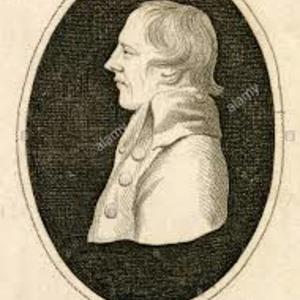
The first person to use the death of Gen. Simon Fraser at Saratoga in art might have been the young poet Richard Polwhele (1760–1838, shown here).

His first tiny splash in the British literary world was as the youngest of the admirers writing odes to Catherine Macaulay for her birthday in 1777, mentioned back here.

Through the same printer the teenager soon published The Fate of Lewellyn; or, the Druid’s Sacrifice. A Legendary Tale. In Two Parts. To which is added CarnbrĂ©, a Poem. Agnes Repplier later wrote of that book:
The title-page stated modestly that the writer was “a young gentleman of Truro School”; whereupon an ill-disposed critic in the “Monthly Review” intimated that the master of Truro School would do well to keep his young gentlemen out of print. Dr. [Cornelius] Cardew, the said master, retorted hotly that the book had been published without his knowledge
Undaunted, in 1778 Polwhele enrolled at Oxford and put out yet another volume: The Spirit of Frazer, to General Burgoyne. An ode. To which is added, The Death of Hilda; an American Tale. Inscribed to Mrs. Macaulay. In fact, according to a 1798 profile, he wrote those poems before leaving school.

I haven’t found any online texts, and for that most people would be grateful. However, Dafydd Moore quoted and analyzed The Spirit of Frazer in his monograph Richard Polwhele and Romantic Culture: The Politics of Reaction and the Poetics of Place. So you’re not getting off that easily.

As Polwhele spins his tale, a few days after his death Fraser appears to Gen. John Burgoyne and poetically urges surrender to the American army. The brigadier’s ghost argues that this is the most honorable course because the war in America is both unjust and unwinnable.
Reason’s voice commands thee, yield:
Ev’n Frenzy’s self would scarce oppose!
Tempt not the horrors of the field,
Nor brave surrounding foes!
Nor Slavery’s dungeon be thy meed!
For Honour would disclaim the deed!
Yet stamps the Roll that bids the battle cease!
Burgoyne, the ghost says, should return to Britain and advocate for peace.
Go! and bid her spread no more
Her thunders o’er the Atlantic wave,
While glooms destruction’s threatning power,
Pointing to the yawning grave!
No more let War his flaming brand
Wide wave o’er Freedom’s ravag’d land,
Where soon a glorious Empire shall arise!
Polwhele thus had Fraser echo how Britain’s most radical anti-war Whigs were responding to news of Saratoga.

TOMORROW: The reviews roll in.

Monday, August 15, 2022

The Memory of Gen. Simon Fraser

Brigadier general Simon Fraser had a long career in the British army before dying in the Battle of Saratoga.

Even so, it appears that Gen. John Burgoyne’s description of his funeral, quoted back here, made Fraser into a British icon of sorts.

Burgoyne’s efforts were helped along by another narrative of that event in Lt. Thomas Anburey’s Travels Through the Interior Parts of America, published in 1789. Anburey wrote:
About sun-set, the corpse was carried up the hill; the procession was in view of both armies; as it passed by Generals Burgoyne, [William] Phillips and Riedesel, they were struck at the plain simplicity of the parade, being only attended by the officers of his suite…and urged by a natural wish to pay the last honors to him, in the eyes of the whole army, they joined the procession.

The enemy, with an inhumanity peculiar to Americans, cannonaded the procession as it passed, and during the service over the grave. The account given me by your friend Lieut. [Quin John] Freeman was, that there appeared an expressive mixture of sensibility and indignation upon every countenance—the scene must have been affecting.
Anburey spent years as a prisoner of war with the Convention Army—that was how he traveled through the interior parts of America. He didn’t come away with any fondness for the host nation.

In the same year Anburey’s account was published, a print appeared on the London market titled “View of the West Bank of the Hudson’s River, 3 Miles above Still Water, Upon which is the Army under the Command of Lt. Gen. Burgoyne (Showing General Frazer’s Funeral).”

Follow this link to a digitized image of this print from the Yale University Art Gallery. On the rightmost of the three hills is a line of tiny figures following two coffins. Some experts interpret the second one as representing Burgoyne’s aide-de-camp Sir Francis Clarke, also killed in the battle though not in any account buried with Fraser.

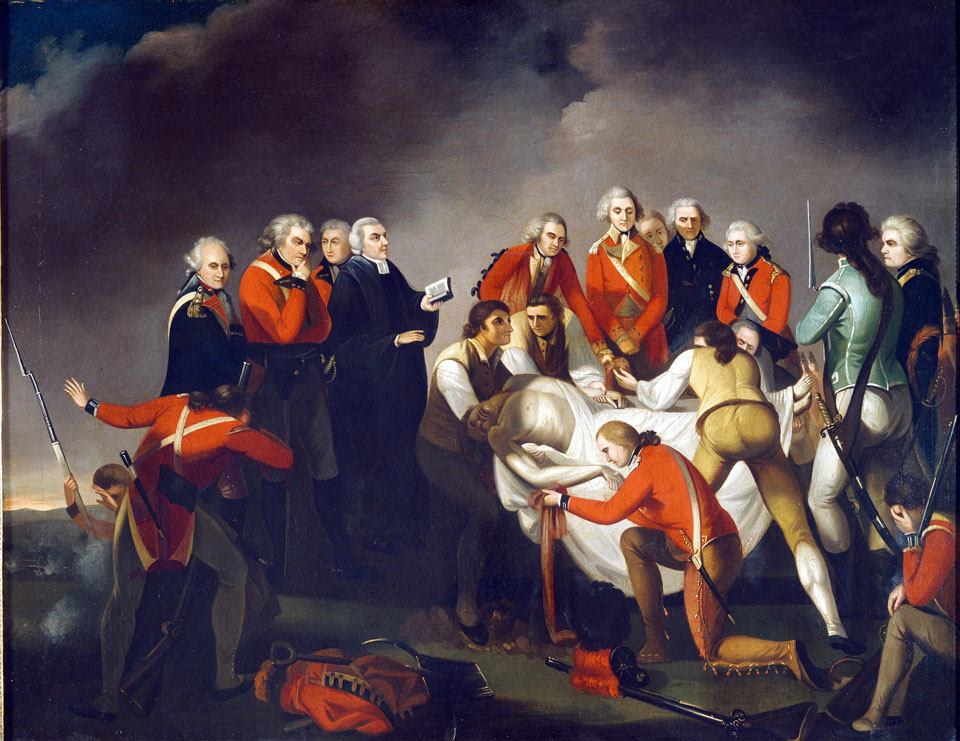
Finally in 1791 the Scottish artist John Graham (1754–1817) exhibited a painting of Fraser’s funeral. Graham was influenced by Benjamin West’s picture of the death of Gen. James Wolfe in 1759. So much so, in fact, that one critic of the time reviewed The Funeral of General Fraser by saying: “We should have been more pleased with the picture if we had not seen The Death of General Wolfe by West.”

As West had done before him (and as other West acolytes like John Singleton Copley and John Trumbull did), Graham sought out the officers who had been at the event he was depicting. He made studies of those men and portrayed them as individuals in his scene. That painting was made into a print in 1794, and the print was issued with a key to the figures.

(I can’t find Graham’s original on the web; the image above shows a copy in the collection of the National Army Museum.)

Burgoyne, Anburey, and Graham thus crafted Fraser’s funeral into an emblem of British fortitude and propriety even in defeat. This stuff-upper-lip behavior could easily, as Don Carleton commented last week, tip into Monty Python–style satire. Still, it was effective.

American chroniclers of the Battle of Saratoga felt a need to quote Riedesel and Burgoyne on Fraser’s death and metal—those sources are just too full of drama to ignore. But the same historians often added a protest that if only the British commanders had told the Americans that the generals were gathering for a funeral there would have been no artillery fire. I’m not entirely convinced.

Friday, August 12, 2022

The Funeral of Gen. Simon Fraser

Yesterday I quoted Frederika von Massow Riedesel on the death of Gen. Simon Fraser at Saratoga.

Wounded at Bemis Heights on 7 Oct 1777, Fraser died the following morning. By then the Crown forces had pulled back to their fortified camp, and the Continentals were attacking them.

Riedesel's memoir, in the 1827 translation, continued:
After he had been washed, he was wrapped in a sheet, and laid out. We then returned into the room, and had this melancholy spectacle before us the whole day. . . .

We were informed, that general [John] Burgoyne intended to comply with general Fraser’s last request, and to have him buried at 6 o’clock, in the place which he had designated. This occasioned an useless delay, and contributed to our military misfortunes. At 6 o’clock, the corpse was removed, and we saw all the generals, with their retinues, on the hill, assisting at the funeral ceremony.
Among those generals was Riedesel’s own husband, making what followed particularly unnerving for her. Especially since she obviously felt the army should be moving to a place of greater safety rather than going through this ceremony.

The chaplain who presided was the Rev. Edward Brudenell.

Gen. Burgoyne devoted space in his report to the House of Commons on the failed campaign to Fraser’s funeral:
The incessant cannonade during the solemnity; the steady attitude and unaltered voice with which the chaplain officiated, though frequently covered with dust, which the shot threw up on all sides of him; the mute but expressive mixture of sensibility and indignation upon every countenance: these objects will remain to the last of life upon the minds of every man who was present. The growing duskiness added to the scenery, and the whole marked a character of that juncture that would make one of the finest subjects for the pencil of a master that the field ever exhibited—

To the canvas and to the faithful page of a more important historian, gallant friend! I consign thy memory. There may thy talents, thy manly virtues, their progress and their period, find due distinction; and long may they survive;—long after the frail record of my pen shall be forgotten.
Can you tell that Burgoyne (shown above) was a dramatist?

COMING UP: A scene of British fortitude.

Thursday, August 11, 2022

The Death of Gen. Simon Fraser

During the fight at Bemis Heights, the second act of the Battle of Saratoga, an American rifleman picked off Simon Fraser, brigadier general and commander of His Majesty’s 24th Regiment of Foot.

Frederika von Massow Riedesel left a dramatic account of Fraser’s last hours. Wife of the officer commanding the Crown’s German-speaking hired regiments, she had traveled to North America with their young children.

This is from the 1827 translation of Riedesel’s memoir of the war:
About 3 o’clock in the afternoon, instead of the guests whom I expected, I saw one of them, poor general Fraser, brought upon a hand-barrow, mortally wounded. The table, which was already prepared for dinner, was immediately removed, and a bed placed in its stead for the general. I sat terrified and trembling in a corner. The noise grew more alarming, and I was in a continual agony and tremour, while thinking that my husband might soon also be brought in, wounded like general Fraser.

That poor general said to the surgeon, “tell me the truth: is there no hope?” . . . the ball had passed through his body, but unhappily for the general, he had that morning eaten a full breakfast, by which the stomach was distended, and the ball, as the surgeon remarked, passed directly through it. I heard often amidst his groans, such words as these, “O bad ambition! poor general Burgoyne! poor Mistress Fraser.” Prayers were read, after which he desired that general [John] Burgoyne should be requested to have him buried on the next day at 6 o’clock in the evening, on a hill where a breastwork had been constructed.

I knew not what to do: the entrance and all the rooms were full of sick, in consequence of the dysentery which prevailed in the camp. At length, towards evening, my husband came, and from that moment my affection was much soothed, and I breathed thanks to God. He dined with me and the aids-de-camp in great haste, in an open space in the rear of the house. We poor females had been told, that our troops had been victorious; but I well saw, by the melancholy countenance of my husband, that it was quite the contrary. On going away, he took me aside, to tell me every went badly, and that I should prepare myself to depart, but without saying any thing to any body. Under the pretence of removing the next day to my new lodgings, I ordered the baggage to be packed up. . . .

my children…were asleep, but…, I feared, might disturb the poor dying general. He sent me several messages to beg my pardon for the trouble he thought he gave me. About 3 o’clock, I was informed that he could not hold out much longer, and as I did not wish to be present at his last struggle, I wrapped my children in blankets, and retired into the entrance hall. About 8 o’clock in the morning he expired.
The 1827 translation says that the words in boldface above appeared in English in the original German publication of Riedesel’s memoir. In other words, they were supposedly the general’s exact words. Nonetheless, a later translation presented Fraser’s words as, “Oh, fatal ambition! Poor General Burgoyne! My poor wife!” 

TOMORROW: A memorable burial.