J. L. BELL is a Massachusetts writer who specializes in (among other things) the start of the American Revolution in and around Boston. He is particularly interested in the experiences of children in 1765-75. He has published scholarly papers and popular articles for both children and adults. He was consultant for an episode of History Detectives, and contributed to a display at Minute Man National Historic Park.

Subscribe thru Follow.it


•••••••••••••••••


Showing posts with label language. Show all posts

Monday, July 20, 2026

“At the French lines on Prospect Hill”

In 2019 Ric Detwiller published an excellent article at the Journal of the American Revolution about a Frenchman recruited as a provincial engineer early in the siege of Boston.

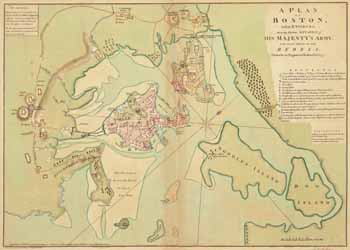
Though “Monsieur Dubuque” (Jean-Baptiste du Buq?) lasted only a short time before defecting to the British, he left behind a fortification near Prospect Hill labeled “French Redoubt” on Henry Pelham’s map of the siege, as shown in this posting.

In a comment to the Detwiller article, Les Haskell added a pertinent entry from the diary of his relative, Caleb Haskell, on 26 July 1775:

This morning our regiment was ordered out of the great Fort [on Prospect Hill] to man the French lines — where we are for the future to repair in an alarm. A grenadier, belonging to the enemy’s side when on sentry, quitted his post, came over to us and delivered himself a prisoner to our guards.
In addition, the Massachusetts archives has a return of Capt. Edward Crafts’s artillery company dated 12 Oct 1775 from the “French lines.”

While preparing yesterday’s talk on the Convention Army, the prisoners of war held at Prospect and Winter Hills in 1777–78, I spotted how the label “French lines” lasted past the siege of Boston.

In 1894 the Maine Historical Society published the “Military Journal of Col. Ichabod Goodwin,” an orderly book for a militia contingent detailed to help guard those prisoners. That document shows that the three main positions where the Continental forces posted guards included “french lines.”
The editor of this volume guessed that term “probably refers to Hessians, no French troops having been present.”

However, the German-speaking prisoners (actually Brunswickers) were housed on Winter Hill. Pelham’s map locates the “French Redoubt” much closer to Prospect Hill. And the transcript of the early 1778 inquiry into Col. David Henley’s treatment of the British prisoners shows Col. Jacob Gerrish speaking of “the guard at the French lines on Prospect Hill.”

Thus, nearly three years after “Monsieur Dubuque” slipped away from his job with the Americans, military men in New England still referred to the fortifications he oversaw as the “French lines.”

Thursday, July 09, 2026

“Im Congress, den 4ten July, 1776.”

On 9 July 1776, 250 years ago today, Heinrich Miller’s Pennsylvanischer Staatsbote newspaper printed the first translation of the Declaration of Independence into another language.

Miller’s paper served the colony’s substantial German population. He supported independence, so he was happy to spread this news.

At some point two more German printers, Melchior Steiner and Charles Cist, issued a broadside with the same translation. Emily Sneff reports that only two copies are known to survive.
Miller’s printing filled the entire first page of his newspaper below the masthead and about half of page 2. Steiner and Cist fit more type into each column and thus got the whole text onto one side of a broadsheet.

Both printings rendered the Continental Congress’s president as “John Hancock” and its secretary as “Carl Thomson.”

Saturday, July 04, 2026

“Avoid becoming the draughtsman of papers to be reviewed by a public body”

Two hundred fifty years ago today, the Continental Congress finished polishing the Declaration of Independence and voted to approve the final text.

True to his character, Thomas Jefferson chose to be “a passive auditor” as his colleagues hashed over the words he’d drafted. But, he admitted to James Madison, the debate affected him:
during the debate I was sitting by Dr [Benjamin] Franklin, and he observed that I was writhing a little under the acrimonious criticisms on some of it’s parts; and it was on that occasion that, by way of comfort, he told me the story of John Thompson the Hatter, and his new sign. 
Jefferson didn’t explain that allusion in his letter to Madison, but he put it into his notes on Franklin:
When the Declaration of Independance was under the consideration of Congress, there were two or three unlucky expressions in it which gave offence to some members.

the words ‘Scotch and other foreign auxiliaries’ excited the ire of a gentleman or two of that country.
(Yes, suggesting that the Scottish were foreigners from outside the British Empire would have prompted complaints.)
severe strictures on the conduct of the British king, in negativing our repeated repeals of the law which permitted the importation of slaves, were disapproved by some Southern gentlemen, whose reflections were not yet matured to the full abhorrence of that traffic. altho’ the offensive expressions were immediately yielded, these gentlemen continued their depredations on other parts of the instrument.

I was sitting by Dr Franklin who percieved that I was not insensible to these mutilations. ‘I have made it a rule, said he, whenever in my power, to avoid becoming the draughtsman of papers to be reviewed by a public body. I took my lesson from an incident which I will relate to you.

when I was a journeyman printer, one of my companions, an apprentice Hatter, having served out his time, was about to open shop for himself. his first concern was to have a handsome sign-board, with a proper inscription. he composed it in these words ‘John Thompson, Hatter, makes and sells hats. for ready money,’ with a figure of a hat subjoined. but he thought he would submit it to his friends for their amendments.

the first he shewed it to thought the word ‘Hatter,’ tautologous, because followed by the words ‘makes hats’ which shew he was a Hatter. it was struck out.

the next observed that the word ‘makes’ might as well be omitted, because his customers would not care who made the hats. if good & to their mind, they would buy, by whomsoever made. he struck it out.

a third said he thought the words ‘for ready money,’ were useless as it was not the custom of the place to sell on credit. every one who purchased expected to pay. they were parted with, and the inscription now stood ‘John Thomson sells hats.’

‘sells hats’ says his next friend? why nobody will expect you to give them away. what then is the use of that word? it was stricken out, and ‘hats’ followed it, the rather, as there was one painted on the board.

so his inscription was reduced ultimately to ‘John Thomson’ with the figure of a hat subjoined.’
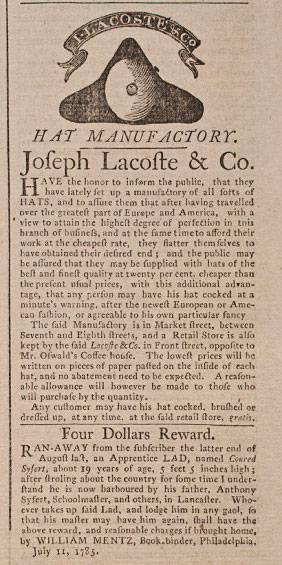
I don’t know any examples of authentic eighteenth-century hatters’ shop signs in the British Empire, but Colonial Williamsburg and the Adverts 250 Project have shared images of hatters’ wordy newspaper advertisements.

TOMORROW: Spreading the word.

Tuesday, June 23, 2026

The Significance of Breed’s Hill Instead of Bunker’s

For one last posting on the label “Breed’s Hill,” I’ll share some thoughts on whether that label matters.

These days, it’s mostly useful as a fact that people (mostly of the male variety, to be frank) deploy to show they know more than average: ‘Well, actually, the Battle of Bunker Hill was fought on Breed’s Hill.”

Which is true, though:
Even more trenchant, what difference did that name make to the outcome of the battle? How did the “Breed’s Hill” label affect the seizure of the Charlestown peninsula? Or the deaths or wounding of nearly 1,500 men?

Well, actually, there’s an argument that Col. William Prescott’s insistence on fortifying Breed’s Hill before Bunker’s Hill, as he understood his orders to specify, did shape the outcome of the battle. Could the provincials have prevailed if they’d had a strong fallback position?

I’m dubious. The goal of the Massachusetts command—the committee of safety, Gen. Artemas Ward, and his council of war—was to keep the British army from seizing the Charlestown and Dorchester peninsulas, as intelligence said the Crown would soon try to do. The New England army’s countermeasure was to seize those positions first.

The real challenge, as Gen. John Thomas indicated from Roxbury, was holding those positions against a British counter-countermeasure. Thomas didn’t think that was feasible and declined to go onto Dorchester Heights that June.

The geography of Charlestown was more welcoming for such an advance from the mainland, but it doesn’t look like the New England army was truly prepared to hold that ground. With only a couple of days to get organized, the provincials didn’t have all the tools, artillery, and reinforcements lined up to fortify and stay on those high points. We see that from the limited support the front-line troops got during the battle.

Even beyond that, the crucial problem for the New England army turned out to be gunpowder. That would have been a problem no matter which hill they fortified.

To be fair to Gen. Ward, he was worried about a possible second British advance in Roxbury or elsewhere along the siege lines. He couldn’t throw all the provincial resources into Charlestown. But the Continental operation to fortify Dorchester Heights in March 1776 shows how effective preparation could overcome adverse conditions.

I even wonder if fortifying Bunker’s Hill might have changed the British commanders’ thinking in a way that would have produced a worse outcome for the provincials. Gen. William Howe saw a small redoubt on a relatively short hill that was close enough for cannon to reach Boston and thus worth cleaning out. He focused on that spot, with disastrous results.

If Howe had seen fortifications on Bunker’s Hill also or instead, he might have decided on a more cautious strategy, focused on cutting the provincials off at the neck. That might have produced many more rebel casualties and fewer British ones. The New Englanders could have ended the day more dismayed, the regulars more chuffed, with a consequent effect on the larger siege.

Monday, June 22, 2026

“Orders to march to Breeds Hill in Charlestown”

As I quoted yesterday, in July 1775 the Massachusetts Provincial Congress officially deemed the provincial fortification of Breed’s Hill in Charlestown to have been done “by some Mistake.”

Nine months later, Dr. Cotton Tufts echoed that assessment in a letter to John Adams: “Could a greater Blunder have been committed than that of Breeds Hill. Yet it finally has operated to our Advantage and trust will continue to do so.”

By then, New Englanders had decided that the Battle of Bunker Hill had worked out well because, even though they’d suffered hundreds of casualties and lost territory, the cost for the British army was catastrophic.

Who had made that fateful mistake? The report used the passive voice to avoid naming names, but everyone knew the battlefield commanders who’d overseen the building of the redoubt were Col. William Prescott, Connecticut general Israel Putnam, and Massachusetts colonel Richard Gridley of the artillery.

And the rumor I quoted here absolved Gridley, saying one of the top two infantry officers had insisted on Breed’s Hill. Or, to be exact, either Prescott or Putnam had insisted on digging the redoubt there before fortifying a fallback position on Bunker’s Hill, as the other two men thought wise.

Adams followed up the report from Massachusetts with some questions from Philadelphia. On 25 August, Prescott wrote back: “On the 16 June in the Evening I received Orders to march to Breeds Hill in Charlestown. . . . We arrived at the Spot, the Lines were drawn by the Enginier and we began the Intrenchmant…”

No written orders survive. If Gen. Artemas Ward and his council of war did indeed use the name “Breed’s Hill,” that would be our earliest confirmed example of that label, before the newspapers accounts I quoted here. But it’s also possible Prescott wrote “Breed’s Hill” in hindsight to reflect his understanding of those orders.

Prescott’s letter criticized some other officers. Gridley “the Enginier forsook me.” His “Field Officers being indisposed could render me but Little Service.” That makes it notable that Prescott didn’t complain about Putnam overruling his judgment and insisting on fortifying Breed’s Hill first. It thus seems clear that Prescott had been the officer sticking to that course.

Prescott didn’t take that position (figuratively and literally) because he deemed it more strategic for attacking Boston, as some analysts have argued. He declared that he was following instructions from his superiors. Perhaps those orders included some ambiguous term like “Charlestown Hill.” The memory of such a command probably empowered Prescott to convince Gridley to draw the entrenchment lines despite his and Putnam’s concerns—because that’s what they understood the council of war had told them to do.

TOMORROW: Why that mattered.

Sunday, June 21, 2026

“The detachment marched upon this design to Breed’s hill”

After the British army drove provincial troops off the Charlestown peninsula on 17 June 1775, the Massachusetts committee of safety proposed an inquiry into what happened.

Nominally the committee wanted to respond to statements from Gen. Thomas Gage. But I’m pretty sure those politicians were also wondering what factors led to losing the Battle of Bunker Hill.

On 6 July the committee urged the Massachusetts Provincial Congress to form a committee to write this report. The next day, the congress handed that responsibility back to the committee of safety.

The committee then commissioned three Patriot clergymen—the Rev. Peter Thacher (1752–1802, shown here), William Gordon, and Samuel Cooper—to produce the report. Thacher’s draft was published by the American Antiquarian Society. The final report, dated 25 July, appears in the Adams Papers.

The report says that the New England commanders’ plan was to fortify Bunker’s Hill, near the Charlestown neck:
Genl. Gage had issued Orders for a Party of Troops under his Command, to post themselves on Bunkers Hill, a Promontory just at the Entrance of the Peninsula of Charlestown; upon which it was determined, with the Advice of this Committee, to send a Party who might erect some Fortifications upon said Hill and defeat this Design of our Enemies.
But that’s not what happened.

Thacher’s draft is transcribed as:
about 9 o clock in the evening the detachment marched upon this design to Breed’s hill situated on the further part of the peninsula next to Boston, for by a mistake of orders this hill was marked out for the entrenchment instead of the other hill.
Thacher initially finished that sentence to “the hill behind, Bunkers,” a perspective that conflicted with his earlier “the further part of the peninsula.” And should “next to” be “west of,” as in the final report?

After editing for clarity and brevity, the final language was:
just before 9 oClock they left Cambridge, and proceeded to Breeds Hill, situated on the further Part of the Peninsula West of Boston, for by some Mistake this Hill was marked out for the Entrenchment instead of the other…
That report thus officially distinguished between Bunker’s Hill and Breed’s Hill. As laid out in previous postings, the term “Breed’s Hill” hadn’t appeared in print until shortly after the battle. This report deemed that distinction significant—indeed, a matter of life and death.

Thus, the name “Breed’s Hill” for that part of Charlestown’s geography was solidified by the battle fought there and the need to discuss it. Before June 1775, that might have been the local name, or one of the local names, but it wasn’t on any map, any official document, or any known letter. By the end of July, the “mistake” about Breed’s Hill was on its way to being notorious.

TOMORROW: What difference does it make? 

Friday, June 19, 2026

“Intrenched on the southerly part of Charlestown Hill”

In his History of the Siege of Boston, Richard Frothingham published a letter about the Battle of Bunker Hill written by Samuel Gray in Roxbury on 12 July 1775.

That letter was addressed to a “Mr. Dyer.” I agree with Bernard Knollenberg’s guess that Samuel Gray was from Windham, Connecticut, probably the man born in 1751 who served as a Continental Army commissary, and “Mr. Dyer” was his uncle Eliphalet Dyer, or another maternal relation.

Gray provided an account of the battle that gives us a different name for where the provincials dug their redoubt:
Friday night, after the 16th of June, a large part of the Continental army intrenched on the southerly part of Charlestown Hill, on the height toward Charles River. North of this hill lies Bunker Hill, adjoining East or Mystic River. Between these two is a valley. North of Bunker Hill is a low, flat, narrow neck of land, the only avenue to the hill and town. The low neck and the valley (both which must be passed in advancing to or retreating from the intrenchment) are exposed to a cross fire from the ships and floating batteries on each side, and the valley to the fire of the battery on Copps Hill, in Boston.

About sunrise, the 17th, our intrenchment was discovered, and a heavy fire immediately began from the ships and batteries, which continued with very little cessation till about one o’clock, when a large party of the ministerial troops landed on a point of land S. E. from the intrenchment, about 4 o’clock. The savages set fire to the town, beginning with the meeting-house. A heavy fire from the cannon and musketry was kept up on both sides till about five o’clock, when our men retreated:…
Gray thus referred the high spot above the Charlestown waterfront as “Charlestown Hill,” different from “Bunker Hill” to the north. And he apparently thought Dyer would recognize those designations.

I haven’t found “Charlestown Hill” in any newspaper, but some other eighteenth-century sources use the term:
  • Isaac Winslow, 10 July: “We were alarmed by the firing of guns the morning of the seventeenth of last month and found the country people had erected a work on Charlestown Hill.”
  • James Jeffry, 7 July, in Québec: “This day four or five topsail vessels arrived, a transport or two from Boston. The report off the Capt. of one of the transports is that the battle was at Charlestown hill; that a party of Provincials were on the evg. of the 17th. entrenching themselves there & a party of the Regulars were sent out to dislodge them.”
  • William Cooper, 3 Jan 1776 letter: “an attested Copy of the account of the Battle on Charlestown Hill”
But of course that nomenclature isn’t entirely clear for us. Decades earlier, Judge Samuel Sewall wrote in his diary on 5 Oct 1709, “As came homeward went over Charlestown Hill on the Neck of Land; and came into the Rode again by Mr Emerson’s.” That appears to use the same term to refer to Bunker’s Hill.

And in a 26 Jan 1776 letter from Boston, Lt. William Carter twice used “Charles-Town Hill” to mean Bunker’s Hill since he was writing about the promontory that the British army had fortified against the Continentals.

At the very least, these sources offer more evidence that “Breed’s Hill” hadn’t yet solidified as the name of the place where the provincials built their redoubt.

TOMORROW: The choice.

Thursday, June 18, 2026

“Breed’s Hill, about half a mile from the ferry”

Yesterday I started to dig into a recent social-media post by the City of Boston Archaeology Department about when the term “Breed’s Hill” arose.

The department has used claims from Charlestown residents seeking compensation for their damaged property in 1776 to produce a terrific website about the town one year earlier, just before it was destroyed in battle.

It looks like those locals didn’t label the height where the provincials dug their redoubt as “Breed’s Hill.”

The social-media posting went on to say: “It’s possible some may have called it Breed's at the time, but deeds & other official documents do not start using that name until the 1790s, long after the battle.”

Outside of legal documents, however, we do have examples of people describing the provincial redoubt as having been on “Breed’s Hill” very soon after the battle on 17 June 1775. Examples include:
  • Letter from Isaac Lothrop, delegate to the Massachusetts Provincial Congress from Plymouth, 22 June 1775, copied by Thaddeus Burr and published in Rivington’s New-York Gazetteer on 29 June: “took possession of Breed’s hill, about half a mile from the ferry”
  • Extract of a letter from Hartford, 23 June 1775, printed in the 28 June Pennsylvania Journal: “The Provincials were entrenched at Breed’s Hill, & were there first attacked;…the Regulars are entrenched at Bunker’s Hill”
  • Extract of a letter from Cambridge dated 12 or 21 or 22 July 1775 [the scan is blurry], printed in John Pinkney’s Virginia Gazette on 3 August: “The Enemy are situated on Bunker’s and Breed’s hills, both on the peninsula . . . every man in Boston, and at Bunker’s and Breed’s Hill must fall”
Thus, by the summer of 1775 some people were making a distinction between Breed’s Hill, center of the fighting on 17 June, and Bunker’s Hill, fortified afterward by the British army. None of those correspondents were from Charlestown, though. 

It’s notable that no newspaper in Boston or elsewhere mentioned Breed’s Hill by that name before the battle. There are some mentions of the Breed family of Charlestown, and of Samuel Swan, who owned part of the hill, sold wine, and hired out a horse. But the hill didn’t attract journalistic attention.

For that matter, neither did Bunker’s Hill. Not until war broke out and the British column ended their march there on the night of 19 Apr 1775. Then the newspapers referred to “Bunker’s Hill.”

But as to whether everyone agreed that that label did or didn’t also include what people would soon write about as “Breed’s Hill” is foggy.

TOMORROW: An alternative name.

Wednesday, June 17, 2026

“Ye pasture where ye fight was in June”

On this anniversary of the Battle of Bunker Hill, I’m taking note of a document the City of Boston Archaeology Department recently highlighted which touches on the term “Breed’s Hill.”

The department’s social media stated:
Samuel Swan, who owned the pasture where the battle took place, wrote in his claim for damages, “the Pasture where the fight was in June & pasture on Bunker’s Hill, breastwork on it & the ground almost all cut up within the breastwork.” The actual owner of the hill calls it Bunker’s Hill.
I was excited by this finding and was planning to simply pass on the news. But on digging down to the documents I’m not convinced.

The problem is that Samuel Swan owned three pastures on the Charlestown peninsula, according to his claim in March 1776. One was on the hill where the provincials built their redoubt, the focus of the 17 June battle. Swan’s larger tracts were to the west, near the neck. We can see all three on the map of 1775 Charlestown real estate that the department has created.

The department has shared a scan of Samuel Swan’s document about his pastures. I wish the wording, punctuation, and difference between “ye” and “&” were clearer, but I think it says:
Swans Act. of Trees Apple, Loacust, Button wood Pair [pear] in my 3 pastures. 250 at Least my son sett 200 Loacust & Aple trees—

Stone Walls [of ye?] 3 pastures Great part took away. all ye Rales Gone. ye Ground Cutt Great part of it ye pasture where ye fight was in June. ye pasture on Bunker hill Brest work on it & ye Ground almost all Cutt up within ye Brest work ye Loer part ye other Pasture Cutt up not much ye Well wholly Filled up—
It looks to me like Swan was distinguishing between “ye pasture where ye fight was in June” and “ye pasture on Bunker hill Brest work on it.” I think the latter phrase referred to the large fortification that the Royal Engineers built on Bunker’s Hill rather than to the provincials’ redoubt.

(As for Swan’s “other Pasture,” that sustained less damage because it was on lower ground, so neither the provincials nor the regulars built works there.)

By my reading of his claim, Swan referred to the promontory near the neck as “Bunker hill” and didn’t name the hill where the monument now stands at all.

TOMORROW: Words, not deeds.

Friday, June 05, 2026

“I know that our way will bring us there”

Yesterday’s posting mentioned the Rev. Samuel Ashbow, a Baptist minister from the Mohegan community in Connecticut.

A lot of information about Ashbow comes from Samson Occom and the Christian Indians of New England by W. DeLoss Love (1899). Both Ashbow and Occom studied with the Rev. Eleazer Wheelock and worked on his conversion missions before breaking with him theologically and organizationally.

The Rev. David McClure (1748–1820, shown here) also left a glimpse of Ashbow in his diary. This passage comes from the summer of 1768 when McClure was an undergraduate at Yale College. He “took a ride to the Sea Shore & in company with Mr. Chester Bingham tarried a few days at Narraganset,” the Native community in what’s now Charlestown, Rhode Island.
Sabbath, attended the Indian meeting, at their meeting house, which was small & about the size of a common school house. About 50 Indians were present. They were mostly elderly people. They sung, prayed & exhorted. There were 4 or 5 who exhorted. The principal speaker was called Sam’l Ashpo.

They were all very earnest in voice & gesture, so much so that some of them foamed at the mouth & seemed transported with a kind of enthusiasm. When they prayed, all spake audibly, some in english & some in Indian. It was indeed a confused noise. . . .

I stood near to Ashpo, and noticed the following expressions in his prayer er in confession of sins. We must allow for grossness of the style, from his imperfect knowledge. “Lord, thou knowest what a poor vile sinner I have been; how I have been a vile drunkard, and like a beast have lain drunk in my own spue, all night at taverns and on the road; but O Lord, thou has forgiven me my sins, for the sake of our blessed Saviour Jesus Christ, who can save the vilest sinner” &c.— . . .

As a sample of their ready wit even in serious things, among other instances, after meeting passing the house of one of the speakers, standing in his door, He said to me, “How do you like our way of worship?[”] I replied some things are very good; but would it not be more edifying, in prayer for one to pray & the congregation to join?—He replied “that will never do. Must make ’em all pray. Plaguy apt to cheat.”

When in the Meeting, one of the Exhorters addressed me & my companion, & said “this is the way that we Indians have to get to Heaven. You white people have another way. I don't know but your way will bring you there, but I know that our way will bring us there.”
Though McClure was contemptuous about the worshippers’ “simple and vulgar” way of expressing their understanding, I thought the metaphors he recorded them using were actually quite evocative.
One of the exhorters said, “I have been up the North ward in the french war, and when cold weather come on orders come—Go into winter quarters. This was dreadful news, to stay there all winter in cold & hunger; but soon word come again, strike your tents & home boys home. Then was all glad, and so it is with a christian going to Heaven.”

Another said, “I have been to New Port & down the wharf, & seen a ship just going to sea. There friends shake hands, and cry farewell, soon the sails are up & the wind comes & she goes, & all hands huzza, (hurraw) so it is with a christian going to Heaven.”
Three or four of Ashbow’s sons died fighting for the Continental cause, starting with Samuel, Jr., at Bunker Hill. He remained in Connecticut after the war while many other Christian Natives in the northeast, including Occom, were pushed to the Brotherton community in upstate New York and then on to Wisconsin. 

Tuesday, June 02, 2026

Cutting Remarks

Here’s another data point on the phrase “Tarleton’s quarter(s)” in the early American republic.

This item that appeared in the Centinel of Freedom newspaper, published in Newark, New Jersey, on 4 Dec 1798.

Original and True.

AFTER the battle of Cowpens, in which [Banastre] Tarleton’s dragoons were so roughly handled by the Americans, he drew up his men, and riding in front of the line, communicated to them strict order to give no quarter thereafter.

A short time after, in an action where the American militia threw down their arms and begged for their lives, one of them answered, “aye, aye! we’ll give you quarter; but as we are in something of a hurry, we’ll only halve you now, and quarter you as we come back:” and so hewed them down with their sabres.

“This naivete passed from mouth to mouth, and excited laughter in the midst of carnage! Were these men or fiends?”
This anecdote reflected the American memory of Tarleton and his men as monsters. There’s no evidence from the British side that the lieutenant colonel gave such an order, nor any evidence from wartime for this remark by one dragoon.

Notably, this tale was set after the Battle of Cowpens in January 1781. David Ramsay’s history, quoted yesterday, stated that the phrase “Tarleton’s quarters” arose after the Battle of Waxhaws more than six months earlier.

This article used an older sense of “naïveté,” meaning not the quality of being naïve but an action or remark arising from that quality. Not that I picture those dragoons as naïve.

Monday, June 01, 2026

When Did People Start Talking about “Tarleton’s Quarter”?

Last week saw the anniversary of the Battle of Waxhaws in South Carolina on 29 May 1780. That was a lopsided bloody victory for the British.

Todd Braisted, the historian of Loyalists, noted that many anniversary descriptions of that battle were stating that it gave rise to the sarcastic term “Tarleton’s quarter” for attacking foes trying to surrender, and that that phrase became a rallying-cry for Americans later in the war.

He asked on Facebook whether there is any contemporaneous evidence for that claim. The phrase doesn’t appear in American newspapers of the 1780s. No one was able to point to a letter using the term. If a phrase was really so widespread, why doesn’t it appear more often?

Steve Rayner found what might be the earliest print use of the phrase in Charleston author David Ramsay’s History of the Revolution of South-Carolina, vol. 2 (Trenton: 1785):
Lord Cornwallis bestowed on lieutenant colonel [Banastre] Tarleton the highest encomiums for this enterprize, and recommended him in a special manner to royal favour. This barbarous massacre gave a more sanguinary turn to the war. Tarleton’s quarters became proverbial, and in the subsequent battles a spirit of revenge gave a keener edge to military resentments.
At that time Ramsay was representing his state at the Confederation Congress, which was meeting in Trenton. That’s why this history of South Carolina wasn’t published in Charleston.

Three years later, the Rev. William Gordon (or his ghostwriter) lifted Ramsay’s sentences with minimal rewriting into The History of the Rise, Progress, and Establishment of the Independence of the United States of America, vol. 3 (London: 1788):
Lord Cornwallis bestowed on Tarleton the highest encomiums for this enterprise, and recommended him in a special manner to royal favor. Tarleton’s quarters is become proverbial; and in subsequent battles a spirit of revenge will give a keener edge to military resentments.
British supporters of the American republic picked up the phrase. The Scottish pamphleteer James Thomson Callender issued The Political Progress of Britain anonymously in Edinburgh in 1792. He started to revise and expand that text for a second edition but was arrested on 2 Jan 1793.

Callendar “with some difficulty made his escape” first to Ireland, then to America. Encouraged by Thomas Jefferson, he reprinted The Political Progress of Britain in Philadelphia in 1795. Later that year Callendar published a much expanded third edition, which on page 119 reels off a list of British government atrocities:
The peninsula within the Ganges, is the grand scene, where the genius of British supremacy displays its meridian splendour. Culloden, Glencoe, and Darien, the British famine of four years, Burgoyne’s tomahawks, Tarleton’s quarters, the Jersey prison-ship, and the extirpation of six hundred and fifteen thousand Irish men, women and children, dwindle from a comparison.
Callender evidently expected his readers (now primarily Americans) to recognize all those events without needing explanations. “Tarleton’s quarters” had indeed become proverbial, he believed.

That same year, back in London, William Belsham published his Memoirs of the Reign of George III, discussing the fight at Waxhaws in vol. 2:
This movement caused an immediate retreat of such corps as had been there collected for the relief of Charlestown. One of these was unexpectedly attacked and surrounded by Tarleton’s legion, which had marched one hundred and five miles in fifty-four hours. A very feeble resistance was made, and by far the greater part immediately threw down their arms, and begged for quarter: but a few continuing to fire, the British cavalry were ordered to charge, and a terrible slaughter was made amongst the unarmed and unresisting Americans; and from this time Tarleton’s quarter became proverbial.
That seems to be the first appearance of the phrase in a singular form, which became standard in American books in the next century.

The way Gordon and Belcham echoed Ramsay’s “became proverbial” wording shows that those authors, who had no ties to South Carolina, relied on Ramsay’s book. All traces of the phrase lead back to him.

Back in early 1780, Ramsay had been a military surgeon serving with the South Carolina militia. He was captured in the fall of Charleston and then held as a prisoner of war in Florida for nearly a year. Ramsay therefore didn’t have first-hand experience of how Patriots in the countryside reacted to the Battle of Waxhaws, but he undoubtedly knew people who were there.

It would be nice if we could find examples of people referring to “Tarleton’s quarter(s)” during the war, especially if we claim that phrase spread widely and inspired American fighters. It’s possible that Ramsay coined or refined the phrase to express how people had felt a few years before, or that he overstated how many people repeated it at that time. But we can be sure this phrase didn’t arise in the 1800s, unlike other oft-repeated tropes of the Revolution. 

Wednesday, May 20, 2026

“Entirely useless by breaking off the Trunnions”

Yesterday I started quoting a 29 Apr 1776 letter from the Rev. Dr. Samuel Cooper to Samuel Adams about Boston’s defenses soon after the British military left.

That letter goes on to say:

The Enemy employ’d no little Time in…destroying the Guns: The Trunnions of all of which, except 8 or so, they entirely knock’d off, besides spiking up the Touch holes in the most effectual Manner.
“Trunnions” was a term technical enough not to appear in Dr. Samuel Johnson’s dictionary. Merriam-Webster now defines them as the pivots on which something can be rotated or tilted, particularly the “two opposite gudgeons on which a cannon is swiveled.” (And it defines “gudgeons” as pivots.)

This overhead view of a cannon might convey the information better.
A gun carriage held a cannon by the two horizontal trunnions. They provided the fulcrum that allowed gunners to point the cannon up or down. A cannon without its trunnions was a heavy metal tube, very hard to mount and impossible to aim. Or, as Gen. George Washington deemed the broken guns left behind in Boston, “entirely useless.”

British artillerists broke trunnions to keep the rebels from having useful weapons. In Concord on 19 Apr 1775, Ens. Henry DeBerniere reported, “Capt. [Mundy] Pole of 10th regiment…knock’d the trunnions off three iron 24 pound cannon and burnt their carriages.”

With little other choice, the Continental Army still tried to use such damaged artillery pieces. Dr. James Thacher reported that the army started out with “a few old honey-comb iron pieces, with their trunnions broken off.” The doctor was pleased when Capt. John Manley and Col. Henry Knox brought in some intact guns.

Given that expertise, and necessity, on 24 March Washington expressed hope that Boston’s broken and spiked cannon “may be made serviceable again.” But how?

TOMORROW: A genius appears.

Wednesday, May 13, 2026

“Stimuli to induce him to be useful to this Country”

One of the questions asked after yesterday’s talk on young Benjamin Thompson’s life in America was whether he interacted with any representatives of the U.S. of A. during his European career.

For example, did the former Woburn farmboy, royal government undersecretary, and British cavalry officer cross paths with John Adams, minister to Britain in the 1780s?

It appears that the two men never met since the first letters they exchanged, in 1796, show no personal acquaintance. By then Thompson had become the celebrated Count Rumford, and he was sending Adams a volume of his scientific papers and a large sum to endow a prize through the American Academy of Arts and Sciences. Rumford continued sending volumes to Adams through the Rev. William Walter.

In 1799, Abigail Adams wrote of “Rumfording our Chimney’s, which I shall be for trying. I am persuaded half the expence of fuel may be saved, and Rooms kept equally warm.” The Woburn native had become famous enough to be a verb.

In 1820, John Adams sent off multiple letters pursuing the theory that “the late learned ingenious scientific public Spirited and benevolent Count Rumford” was a descendant of “the well known Rev. William Tompson of Braintree.” (He was not.)

But the most striking intersection between Rumford and Adams arose in June 1799, when Adams’s secretary of war, James McHenry, wrote about inducing the count to offer his talents to the U.S. Army:
I think it was mentioned to you, some time last winter, by the Secretary of State [Timothy Pickering], in consequence of a letter he had just received from Mr. [Rufus] King [minister to Britain 1796–1803 and 1825–26], that Count Rumford intended to visit his native country, at which you seemed pleased, and expressed yourself favourably of his talents.

Mr. King has renewed the subject to the Secretary of State, and in a letter to me, which I have the honour to inclose. As the reference of the subject to me, can only be meant so far as it respects the military department, I beg leave to submit for your consideration, whether it would not be to the advantage of the United States to make such a proposal to the Count, which if accepted, would ensure to the army the full benefits of his skill and experience.

There is still a vacancy of Lt. Colonel, to be filled for one of the Regiments of Artillerists & Engineers. . . .

1. He may be offered the vacant commission of Lt. Colonel and be made also Inspector of Artillery. Or if he prefers it. 2d. He may be invited to accept of the office of Engineer…

As I consider him to be less of an Engineer than an Artillerist, altho in this I may be mistaken I should think it most adviseable to give a preference to the first proposition. If he accepts of it, he can also superintend the establishment of a military academy which the laws so far contemplate, as to have made provision for books, instruments, and teachers.

At any rate, if the Count should refuse himself to either office, the offer cannot be otherwise than grateful, and if he wanted any stimuli to induce him to be useful to this Country, to the extent of his talents, it might have its effect.
Adams had no idea that back in 1775 Thompson had been slipping secret intelligence to Gen. Thomas Gage—a fact that would probably have changed his admiration for the man.

As for Rumford, it’s hard to imagine that a man who had administered an entire country in Europe could be swayed by the prospect of being a lieutenant colonel in America. He never did come back.

Wednesday, February 25, 2026

“Boston is environed on all sides”

Having shared his version of the Battle of Lexington and Concord, as quoted over the last two days, the new Cambridge postmaster Jonathan Hastings, Jr., turned to the current situation.

His 11 June 1775 letter described the siege this way:
Boston is environed on all sides. 7000 Men at Camb. 6000 at Roxbury, exclusive of smaller Numbers wch. guard the Coasts both Eastward & Southward. [Thomas] Gage acknowleges our Superiority in Number, but says we have neither Government, Discipline nor Powder. The two first Charges are false; and I hope the other Colonies will not be backward to Supply us with the last, to let him see he is mistaken in that likewise.—

Indeed we are determined to defend ourselves in the best manner at all Events, rather than submit to Slavery.—Our Motto is the same which Caesar engraved on his Breast Plate—“Nil actum reputans si quid superesset agendum.”
That was a standard eighteenth-century British rendering of a line from Lucan’s Civil War, appearing in the Spectator and Lord Chesterfield’s letters. It translates more or less as “As long as there’s anything left to do, we don’t consider anything done.” Curiously, that Latin line appears differently in modern editions of Lucan. I can’t explain the discrepancy.
Should Massachusetts be conquered, your Halcyon Days will soon be at an end. God grant our union may be like that of a Band of Brothers, wch. can never be broken. The Light Troops in Boston we are informed have not done Duty for 4 Days. An Attack is expected soon, for every Delay on their part is a Strengthening to us.

It was not the Butler who fell in Battle, but a Samuel Cooke from Danvers the largest Man in the Colony, I suppose
A Danvers man named Samuel Cook, Jr., was indeed among the provincial casualties on 19 April, killed at the Jason Russell House. I haven’t found any other reference to his size. I’ll discuss why Hastings mentioned him tomorrow.
You must excuse my not being more particular, as John intends to write to your Brother, and my Business call me away: therefore would just acquaint you that an half a whole Sheet with your Name alone will afford a particular Pleasure to your sincere Friend & very humble Servant

Jonathan Hastings Junr.

P.S.—My Father & mother desire to be remembered to you & your Friends, & would inform you that our Papers are removed into the Country, & we know not where to look for any Receipts, therefore beg you will make yourself easy with regard to us—&c
JH
That looks like a very familiar closing for an eighteenth-century letter, begging more time to pay bills. Or maybe Hastings was replying to a correspondent who had begged more time.

Of course, there was a war on. The Hastings house had become the headquarters of both the Massachusetts committee of safety and Gen. Artemas Ward, so it’s understandable that the family had moved their records out.

TOMORROW: Clues to the crowd.

Tuesday, February 03, 2026

Rhymes with Memes

The corporal arrested after the Boston Massacre is recorded in Massachusetts legal papers as William Wemms.

The soldiers’ trial was therefore designated as Rex v. Wemms et al., with the corporal always listed first as a matter of rank. (Ironically, he was most likely the one man who didn’t fire his gun that night.)

We know from the case of Edward Montgomery that those legal records can err. Both the army’s muster rolls and Boston town records establish that that private’s first name was Edward, but his indictment and conviction came under the name of Hugh Montgomery.

In Cpl. Wemms’s case, the army muster rolls consistently spell his name as Wemys, a name which these days is more often rendered as Wemyss.

It wasn’t till this year that I got curious about how that name was pronounced.

Turns out it’s a Gaelic name pronounced “Weems,” like the parson.

So now I have to retrain my brain and mouth around how to say Rex v. Wemms.

Thursday, January 01, 2026

“Time turns his Glass, and round the Pole Another Year begins to roll”

In 1775 the British artist John Hamilton Mortimer issued a series of prints titled Twelve Characters from Shakespeare.

One of those portraits showed Edgar from King Lear, in his guise as Poor Tom the madman, as shown here.

Among that character’s lines was “Poor Tom’s a-cold.”

Two hundred fifty years ago today, the young carriers of the Pennsylvania Evening Post quoted that line as they regaled their customers with this poem.
New-Year’s Verses,
Addressed to the CUSTOMERS of
The PENNSYLVANIA EVENING POST,
By the PRINTER’s LADS who carry it.

MONDAY, JANUARY 1, 1776.

“POOR TOM’s a cold”---God bless you, Masters,
And save you all from all Disasters!
Time turns his Glass, and round the Pole
Another Year begins to roll:
Welcome the new, adieu the old,
For every Year Poor Tom’s a-cold.

Sages have said, and Bards have sung,
That long ago, when Time was young,
The World enjoy’d a golden Age:
No Dog-Star kindled then to Rage;
No Summer’s Drought, nor Winter’s Snow,
Forbade the limpid Stream to flow:
No Torrents of descending Rain
With Desolation spread the Plain:
No languid Air, with sickly Breath,
Diffused the pois’nous Seeds of Death:
No Comet’s Blaze, of horrid Light,
Shot thro’ the Curtain of the Night;
No chilling Blast flew howling by,
No Lightnings rent the burning Sky,
Nor Thunder shook the rolling Sphere.
One genial SPRING was all the Year.
Then were the Hills and Vallies seen
Forever blooming, ever green;
And, like the Season, mild and gay,
Man liv’d a Stranger to dismay;
For smiling Peace, with Plenty crown’d,
Gave Health and Joy to all around.
No Din of War, no civil Hate,
Were then the chastening Rods of Fate.
O had I seen those Days of old!
But now, alas! Poor Tom’s a-cold:
But you, who live with Hearts at Ease,
Will surely never let him freeze.
Sweet Madam, Gentle Sir, Good-morrow;
God keep you free from Pain and Sorrow,
And let me hope, ere long, to boast
Good News!----Good News!----in the EVENING POST.
This example of carriers’ verse is interesting in how little it says about current affairs. The American colonies were at war with the London government, but the only possible allusion to that was the mention of “civil Hate.”

Earlier American examples of these verses reveled in the patriotism that the newspaper employees and their customers supposedly shared, heaping disdain on foreign enemies like France and Spain. But in a time of civil war, loyalties were more problematic. Better to talk about the weather.

That wasn’t because the printer of the Pennsylvania Evening Post, Benjamin Towne, kept away from politics. He supported the colonial resistance and independence, and a year later his 1777 carriers’ verse celebrated, “Shout, George is King no more.”

Of course, the British army occupied Philadelphia late that year. In 1778 Towne’s carriers offered lines praising Gen. Sir William Howe to the skies.

Sunday, December 28, 2025

“Under the hieroglyphical similitude of tropes and figures?”

As a prominent gentleman in Connecticut, Israel Putnam couldn’t ignore what “A New-York Freeholder” wrote about him in the New-York Gazette, as quoted yesterday.

However, Putnam faced a couple of challenges in replying. First, if he appeared to be flying off the handle, that would simply validate what the “Freeholder” had written.

Second, Putnam wasn’t a highly educated man, and in particular his spelling and punctuation were even more irregular than the eighteenth-century norm.

Even Putnam’s biographers acknowledge that he probably had help in shaping his reply in the 7 October 1774 Connecticut Gazette of New London, either from a friend or from printer Timothy Green. Because it doesn’t look like his usual writing.

The preface reads:
Mr. GREEN,

As my letter to Capt. [Aaron] Cleveland, wrote in consequence of the late alarm, has circulated far and wide, and made unfavourable impressions on the minds of some, ’tis desired that you and the several printers in the other colonies upon the continent, would give the following piece a place in your paper, and you will oblige
Your humble Servant,
ISRAEL PUTNAM.

POMFRET, 3d. October 1774.
The first line of the ensuing essay makes clear what it was really responding to: “In Mr. [Hugh] Gaine’s New-York Gazette of the 12th of September…”

Putnam described how the rumor of a British military attack on Boston had reached him through “Capt. Keyes”—most likely Stephen Keyes (1717–1788, gravestone shown above courtesy of Find a Grave). Keyes had heard the news from “Capt. Clarke of Woodstock,” who heard from his son in Dudley, Massachusetts, who heard from an Oxford man named Wilcot, who heard from his father and also found confirmation in Grafton.

With “only four gentlemen,” Putnam rode toward Boston, traveling “about thirty miles from my house.” In Douglas, Massachusetts, the party met the local militia captain, probably Caleb Hill (1716–1788), who with his company had just returned from their own march to “within about thirty miles of Boston.” Having thus learned that the earlier report was false, Putnam returned home, spreading the new word.

Putnam posited that the false alarm started with Customs Commissioner Benjamin Hallowell having “informed the army that he had killed one man and wounded another” while escaping from Cambridge. Hallowell’s own account of the “Powder Alarm” said nothing of the sort.

As for presenting himself as a gentleman in prose, Putnam acknowledged that he’d written his letter passing on that misinformation in haste and not in high style; he said he “aimed at nothing but plain matters of fact, as they were delivered to him.”

But Putnam also showed himself capable of deploying complex sentences and classical allusions in response to the “New-York Freeholder”:
Paying all due defference to this author’s learning, and his undoubted acquaintance with the rules of grammar and criticism, I would beg leave to ask him, whether he does not betray a total want of the feelings of humanity, if he supposes in the midst of confusion, when the passions are agitated with a real belief of thousands of their fellow countrymen being slain, & the inhabitants of a whole city just upon the eve of being made a sacrifice by the rapine and fury of a merciless soldiery, and their city laid in ashes by the fire of ships of war, he or any one else could set down under the possession of a calmness of soul becoming a Roman senator, and attend to all the rules of composition, in writing a letter, to make a representation of plain matters of facts, under the hieroglyphical similitude of tropes and figures? . . .

Now I submit it to the determination of every candid unprejudiced reader, whether my conduct in writing the aforementioned letter, merits the imputation of imprudence asserted by said writer; or whether they would have had me tamely set down, and been a spectator to the unhuman sacrifice of my friends and fellow-countrymen, or (in other words) Nero like, have set down and fiddled, while I really supposed Boston was in flames, or exerted myself for their relief?
Well, when he put it that way…

TOMORROW: Who was the “New-York Freeholder”?

Friday, December 26, 2025

“The Powder Alarm” in Essex, Connecticut, on 4 Jan.

I’ll start off the Sestercentennial year with a talk in the America 250 Winter Lecture Series of the historical society in Essex, Connecticut.

My topic on the afternoon of Sunday, 4 Jan 2026, will be “The Powder Alarm: The Breakdown of Royal Rule in New England, September 1774.”

Here’s our event description:
Before dawn on September 1, 1774, the royal governor of Massachusetts ordered some of the colony’s gunpowder moved into army-occupied Boston. That action put thousands of militiamen on the march. As rumors spread, they grew more dire. People in Connecticut heard that the king’s army and navy had attacked Boston. In Milford, a 13-year-old boy went to bed fearing he would “be dead or a captive before to-morrow morning.” But the real result of this event, dubbed the “Powder Alarm” by later historians, was that almost all of New England was free of royal rule—almost two years before the Declaration of Independence.
I’ve spoken about the “Powder Alarm” before, and this time I’ll emphasize Connecticut’s experience through figures like Israel Putnam, Silas Deane, and Joseph Plumb Martin.

Here’s an account of the colony’s reaction from the 8 Sept 1774 Massachusetts Spy:
By letters from Connecticut, and by several credible gentlemen arrived from thence, we are informed that there were not less than 40,000 men, in motion, and under arms, on their way to Boston, on Saturday, Sunday, and Monday last [3–5 September], having heard a false report that the troops had fired upon Boston, and killed several of the inhabitants: Twelve hundred arrived at Hartford from Farmington, and other places forty miles beyond Hartford, on Sunday last, on their way to this place, so rapidly did the news fly. But being informed by expresses that it was a false report, they returned home, declaring themselves ready at a minute’s warning to arm again, and fight for their country, and distressed brethren of Boston.
That report from printer Isaiah Thomas was no doubt exaggerated. In 1774 Connecticut’s total population was just under 200,000. More than half of those people were under the age of sixteen, and half the adults were women, so “no less than 40,000 men” would be virtually the entire adult male population.

Nonetheless, it’s clear the alarm was widespread, reflecting the urgency that people had come to feel about what was happening in Massachusetts. Several other newspaper articles about the “Powder Alarm” also included the phrase “a minute’s warning,” popularizing it just as citizens were discussing how to improve their militia system.

This talk is scheduled to run from 3:30 to 4:30 P.M. in Hamilton Hall at Essex Meadows, 30 Bokum Road in Essex, Connecticut. It’s free and open to the public. The society asks people to register through this page. Doors will open at 3 P.M., and seating will be on a first-come, first-served basis.

(The modern town of Essex appears on the map above as “Putty Pogue” on the Connecticut River.)

Tuesday, December 23, 2025

“In free countries, the law ought to be king”

Next month sees the Sestercentennial of Thomas Paine’s Common Sense, printed by Robert Bell in Philadelphia on 9 January (to judge by the first newspaper advertisement the next day) and then reprinted at the end of the month because of popular demand.

The New York Times has observed the occasion by publishing an appreciation by Boston University professor Joseph Rezek, “The Pamphlet That Has Roused Americans to Action for 250 Years.”

Rezek’s a literature scholar, so he pays particular attention to Paine’s rhetorical style. Here’s a taste:
The first section of “Common Sense” narrates the origins of government with a classic Enlightenment experiment, asking: What was it like in the state of nature, before governments were instituted among people? “Let us suppose a small number of persons settled in some sequestered part of the earth” in a “state of natural liberty,” Paine wrote, sounding like a schoolteacher. Then kings arrive, like snakes in the garden.

“Mankind being originally equals,” Paine went on, their “equality could only be destroyed by some subsequent circumstance.” Look at the “present race of kings,” he declared, and “we should find the first of them nothing better than the principal ruffian of some restless gang.” Eager to make his ideas intelligible to readers who had never philosophized before, Paine used imagery he thought they could relate to.

Ripping up monarchy by the roots, he asserted that William the Conqueror did not establish an “honorable” origin for English kings when he invaded in 1066. “A French bastard landing with an armed banditti, and establishing himself king of England against the consent of the natives, is in plain terms a very paltry rascally original. It certainly hath no divinity in it.” This frank and gritty language is from the tavern, not the library.
Of course, it’s not just the lèse-majesté insults that made Common Sense powerful, as shocking as they probably were to some British colonists. It was how Paine wielded them in service of compelling political ideas, urging Americans to put their principles of liberty into practice. A monarchist could toss around epithets and still have no better argument than “Because the king said so.”
In 1776, Paine looked toward the future. Today, many Americans are looking to the past to help navigate what really does feel like “a new era for politics.” Right after Paine declared “the law is king,” he also qualified that statement: “In free countries, the law ought to be king.” Laws in the United States have often been unjust, and just laws have often been unequally enforced. Perhaps Paine understood that the idealistic political experiment he hoped to help launch would always be a work in progress.
Because there will always be snakes. Most of us know damn well they’re snakes, and most don’t get taken in.

Here’s the link.