J. L. BELL is a Massachusetts writer who specializes in (among other things) the start of the American Revolution in and around Boston. He is particularly interested in the experiences of children in 1765-75. He has published scholarly papers and popular articles for both children and adults. He was consultant for an episode of History Detectives, and contributed to a display at Minute Man National Historic Park.

Subscribe thru Follow.it


•••••••••••••••••


Showing posts with label Leicester. Show all posts

Monday, September 02, 2024

”Marched 8 Miles towards Boston on the late Alarm”

The third of Boston’s politically active physicians, Dr. Benjamin Church, Jr., also wrote to Samuel Adams on 4 Sept 1774.

Church hadn’t been among the Whig leaders who went out to Cambridge in an attempt to calm the militia men who responded to the “Powder Alarm” before the situation became violent.

Instead, he passed on information from central Massachusetts:
Mr. Stearns just arrived from Paxton informs me that the Inhabitants of Springfield, Leicester, Paxton, Spencer and the Towns adjacent had risen in one body armed & equipped and had proceeded on their March as far as Shrewsbury on their way to Boston to the Number of Twenty Thousand, and were with difficulty perswaded to return, and would not till from many Passengers from this way they were convinced that there was no necessity for their Assistance at this time.
Church’s informant was likely Dr. Samuel Stearns (1741–1809), a physician and almanac-maker who lived in Paxton in this period. During the war he was accused of being a Tory and jailed for passing counterfeit bills, and then he fled to British-occupied New York.

The number of 20,000 militia men is clearly an exaggeration. A few days later, a head count of the turnout to close the Worcester County court session totaled 4,722 men, including 180 from Leicester, 80 from Paxton, and 164 from Spencer—and that was deemed a large number.

Other Boston Whigs told similar stories of rural companies feeling disappointed that they didn’t reach the scene of action in Cambridge on 2 September.

For some people, that emotion lasted a while longer. On 6 November, John Adams was coming back from the First Continental Congress when he stopped in Palmer, Massachusetts (not yet incorporated and therefore still referred to as “Kingsfield” or “Kingston” after an early settler, John King).

New England laws forbade travel from one town to another on the Sabbath except in emergencies. Adams and his colleagues therefore had to spend that whole day in Palmer. In his diary he wrote:
We walked to Meeting above 2 Miles at Noon. We walked 1/4 of a Mile and staid at one Quintouns an old Irishman, and a friendly cordial Reception we had. The old Man was so rejoiced to see us he could hardly speak—more glad to see Us he said than he should to see [Thomas] Gage and all his Train.—

I saw a Gun. The young Man said that Gun marched 8 Miles towards Boston on the late Alarm. Almost the whole Parish marched off, and the People seemed really disappointed, when the News was contradicted.
Adams’s host appears to have been Duncan Quinton, born in Ireland in 1694 and dying in 1776. He and his wife Eunice had sons John (1743–) and Thomas (1746—), who married a month apart in 1771 (Thomas because his son Robert arrived seven months later). One of those young Quintons probably told Adams about the gun.

Given the spirit evident in the fall of 1774, it’s disappointing that there are few if any first-hand accounts from men who marched in the Powder Alarm. One factor is that those same men probably marched at the news from Lexington, and perhaps when Gen. John Burgoyne approached from the north. Therefore, the memory of a march that didn’t go anywhere or end in any fighting could easily be overshadowed.

Wednesday, July 24, 2024

“The enclosed covenant is by no means inconsistent”

Having returned from a busy convention in California, I’m going back to the Solemn League and Covenant of June 1774.

Or, more accurately, the multiple overlapping boycott covenants that appeared in print that month, first in broadsides and then in the 22 June Pennsylvania Journal and the 23 June Boston News-Letter.

Albert Matthews discussed two texts in 1915, calling them Form B and Form A, respectively.

He briefly mentioned a third variation, which I’ll call Form C. This was a revision of Form B created and distributed by the committee of correspondence in Portsmouth, New Hampshire, by the end of June 1774. The Library of Congress displays a copy here.

Another copy of Form C survives in the papers of the Rev. Jeremy Belknap at the Massachusetts Historical Society; he cautioned his parishioners in Dover, New Hampshire, against signing on until they’d heard from what would be the Continental Congress.

According to Frederick Chase’s History of Dartmouth College and the Town of Hanover, the voters of Plainfield, New Hampshire, did adopt the text of Form C on 28 July. Town histories of Mason and Wilton, New Hampshire, show those towns adopted Form C while adding a proviso that signers could vote to revise its terms.

We can thus think of Form C as the New Hampshire variation on a document that originated in Massachusetts. But the big question remains: Which of Form A and Form B was the Boston original?

In early June, as the Boston committee of correspondence finalized its text, Whigs in Worcester County were also thinking about a boycott. In a footnote, Matthews shared evidence that William Henshaw (1735-1820, shown above) of Leicester and Timothy Bigelow (1739–1790) of Worcester privately circulated a draft non-consumption agreement. At the bottom of a copy at the American Antiquarian Society, Henshaw wrote: “It is thought best not to sign any agreement yet, as it is expected we shall have the plan of a General one from Boston very soon.”

We thus know that there was a text in Worcester before the town received the Boston committee’s Solemn League and Covenant broadsides, mailed on 8 June. Furthermore, Matthews deemed that draft text to be “still more drastic” in wording than either Form A or Form B.

On 10 June, as I discussed back here, the Boston committee sent out a second circular letter saying they didn’t mean to suggest that all towns adopt their language. Some organizers must have asked to use other language—but we don’t know if those people wanted the pledge to be more strident or less.

Three days later, Worcester’s committee of correspondence issued its own printed letter, signed by chairman William Young. The state archives shares a copy received by the selectmen in Southboro. The Worcester committee noted how “the committee of Boston in their last letter have informed us that they do not mean to dictate to us,” and concluded “the enclosed covenant is by no means inconsistent with the spirit or intention of the form sent out by them.”

Thus, on 18 June Worcester sent out its own text, different in some respects from Boston’s. A week later, the town formally adopted that language.

But was that Form A or Form B?

TOMORROW: Who’s pushing who?

Saturday, February 13, 2021

Who Should Pay for Mr. Molineux’s Cannon?

I’m at last getting to the original purpose of the 3 Feb 1775 petition to the Massachusetts Provincial Congress’s committee of safety that I’ve been discussing.

All four men who signed the petition were delegates to the provincial congress that started meeting in Cambridge on 1 February. After explaining that their towns had undertaken to mount and equip eight iron cannon obtained by William Molineux inside Boston in the fall of 1774, they wrote:
Since which the late Congress held [in] Cambridge have Agreed to to [sic] provide Warlike Stores, &c, at the Expence of the province

Wherefore the Inhabitants of Said towns think it Reasonable that the Expence of equiping Said Cannon for Service Should be borne in the Same manner as other Supplys and Desire yould Consider the matter & act thereon [as] you Shall think proper
In other words, this petition is rather similar to what sometimes seems like the majority of correspondence among towns and other governmental bodies in colonial New England—trying to get someone else to pay for something.

This example wasn’t about poor people needing relief or roads having to be mended, but about preparation for war. Yet the principle was the same. As long as the provincial congress was going to spend money on weapons, shouldn’t it also cover “the Expence of equiping Said Cannon for Service”?

The committee of safety actually met at Ebenezer Stedman’s tavern in Cambridge that day and came to some decisions about the provincial artillery. However, the only specific actions placed on the committee’s records involve the four brass cannon hidden at Lemuel Robinson’s tavern in Dorchester. (Yes, those are the Four Stolen Cannon at the center of The Road to Concord.)

The men of Watertown were hoping for a positive response to the petition. On 6 February, the town meeting voted “that the Committe appointed to mount ye great Guns do not Compleat the Same till after the Congress Rises.” On 11 February the congress took up the question of how its committees should handle military supplies, but four days later it decided to defer that decision until the next session at Concord in late March. On 20 February, the Watertown voters gave up waiting and decided “that the Committe appointed to mount the Great Guns Compleat the Same as Soon as may be.”

The delay and uncertainty had consequences. As of 21 February, committee of safety member Dr. Benjamin Church secretly reported to Gen. Thomas Gage, “Gun Carriages are making at Water Town by McCurtain—an Irishman, who has fallen out with the Select Men there, as he will not permit them to be taken away untill the Cash is forthcoming.”

It’s not clear to me who came up with the necessary cash. But starting on 23 February, the joint committee of safety and supplies became more involved in managing the nascent artillery force. It appointed officers and divvied out guns.

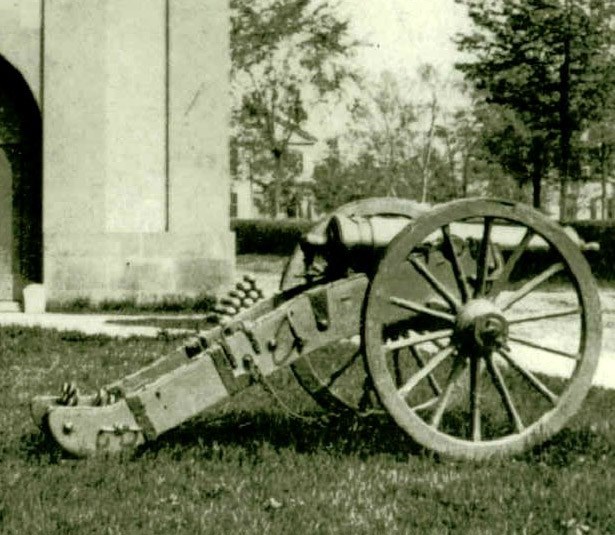
Among other things, the committee directed “That eight field pieces, with the shot and cartridges, and two brass morters with their bombs, be deposited at Leicester,” just west of Worcester, with militia colonel Joseph Henshaw. Those might be the same eight cannon that the towns of Watertown, Concord, Lexington, and Weston had been working on, or they might be eight other cannon. There were dozens being quietly moved around Massachusetts in those months.

TOMORROW: Ready for war?

Tuesday, July 10, 2018

Rehabbing Colonial Massachusetts’s Granite Positioning System

The Massachusetts Department of Transportation recently announced the completion of its project to preserve the remaining milestones along the old Upper Boston Post Road.

Those stones were initially put in place as early as 1729 by rich men vying for political acclaim, such as justice Paul Dudley (1675-1751), soon to be chief justice. In 1767 the Massachusetts Council ordered more markers. Traffic, urban growth, and highway projects have moved or removed a lot of the stones so that by 1971 only forty were still around to be listed in the National Register.

In 2011, a marker in Brighton was damaged by a truck. That prompted the Transportation Department to explore conserving all the known remaining milestones. In 2014, the Watertown firm Daedalus Inc. was contracted to survey and preserve the markers. The company identified twenty-nine stones that needed repairs, cleaning, cracks filled, resetting, and/or moving back to their original locations. That work is now complete.

The department’s blog post contains a complete list of the surviving markers and their locations. As an example, here’s a stretch of stones in central Massachusetts:
  • Milestone Marker #35 is located at Dean Park on Main Street in Shrewsbury. This granite marker is inscribed with “Boston 35 Springfield 65 Albany 165”.
  • Milestone Marker #43 is located on Main Street at the I-290 ramp in Shrewsbury. This granite marker is carved with the inscription “43 Mile to Boston”. Marker #43 has been moved to a more accessible location on the Shrewsbury Town Common adjacent to Main Street.
  • Milestone Marker #47 is located on Lincoln Street in Worcester. This brownstone marker is carved with the inscription “47 Miles from Boston 50 Springfield”.
  • Milestone Marker #48 was formerly located at the Worcester Historical Society, but, as part of the project, has been reset at Wheaton Square Park on Salisbury Street in Worcester. This brownstone marker is carved with the inscription “48 Miles from Boston”.
  • Milestone Marker #53 is located on Main Street in Leicester. This brownstone marker is carved with the inscription “53 Mile from Boston”.
  • Milestone Marker #54 was formerly located inside the Leicester Public Library, but has been relocated to Washburn Square in Leicester, which is within the vicinity of its original site. This brownstone marker is carved with the inscription “54 Miles from Boston”.
Markers 56 to 74 (the numbers indicating the miles to Boston) have all survived. In contrast, only one marker to the west of that stretch remains, and it was moved into the Springfield Armory Museum.

For more about Massachusetts milestones, see this guest blogger post from Charles Bahne.

Friday, April 07, 2017

Cannon Moved from Salem to Concord

In early March 1775, soon after “Leslie’s Retreat” in Salem, Gen. Thomas Gage started to receive solid information about the Massachusetts Provincial Congress’s effort to build a military force out in rural Massachusetts.

An anonymous informant who sometimes wrote in French for added security sent Gage multiple messages on 8 and 9 March. Those messages offered details about where cannon and other military supplies were hidden in Concord.

What’s more, that spy hinted that much of that ordnance came from Salem, and were thus probably the same guns that Lt.-Col. Alexander Leslie had been blocked from seizing there.

The informant wrote:
Eight more pieces of Iron Ordnance were this day (Le 8 de Mois de Mars) convey’d to Concord from L[eicester?] (where they had been deposited a few days preceeding their Last removal;[)]—Two of the Eight appeard to be Smaller than the rest & about three or four pounders—These last mentioned were met at a small distance from C[oncord] in three Carts there were no appurtenances, but it was said that carriages were made or making at Salem & soon to follow.—

It is conjectured & reported that a Large quantity of Cartridges are now preparing at Ch[arlestow]n; of Different Sizes, & numbered in order to distribute & distinguish properly.
The Massachusetts Provincial Congress was consolidating guns, carriages, and gunpowder cartridges in Concord, prepping those artillery pieces for battle. Gage knew similar work was under way in Worcester. In addition, several towns were forming artillery companies on their own.

The same informant out in Concord told Gage that there were:
Four brass Cannon, & Two Cohorns or Mortars (so call’d by the Peasantry) Conceal’d at Mr: B, (Lately chose or appointed Minute Colo.) Suppos’d to be deposited in his Cellar.
“Mr: B” was James Barrett, colonel in the Middlesex County militia. (His house appears above.) Documents from both sides of the conflict indicate that Barrett was in contact with David Mason, the man who had collected the cannon at Salem. They were both working for the Provincial Congress.

Gage must have been struck by the mention of “Four brass Cannon.” Brass (or bronze) cannon were rare in Massachusetts—most were secure in the hands of the British military. But four small brass guns had disappeared from Boston’s militia gunhouses the previous September. And Gage wanted them back. For the next month, he focused his intelligence efforts on finding out more about those cannon in Concord.

Wednesday, February 11, 2009

Identifying the Soldier Named “Salem”

In 1819, Samuel Swett identified the American soldier who shot Maj. John Pitcairn of the British Marines as “a black soldier named Salem.” It didn’t take long for a local historian to claim that man for his town.

Gov. Emory Washburn (shown here) wrote this in his Topographical and Historical Sketches of the Town of Leicester, published in the Worcester Magazine in 1826:

There was residing here, till within a few years, a black man, who, we have good reason to believe, was the one who shot Maj. Pitcairn, whose death forms so affecting an incident in that bloody affray. History relates that he was shot by a negro, and from the story of the one we allude to, and many corroborating circumstances, we are led to conclude that he was the person who did the deed.

The person to whom we refer was named Peter Salem; he was a servant of Gen. [John] Nixon during the revolution, was a native of Framingham, and removed here a few years since, where he died. Major Pitcairn was shot as he was mounting the redoubt, and fell into the arms of his son.
William Barry followed up that lead with more information in his A History of Framingham, Massachusetts, published in 1847. He wrote:
Peter Salem—alias Salem Middlesex—was originally the slave of Capt. Jeremiah Belknap, and was sold by him to Maj. Lawson Buckminster. He married in 1783, Katy Benson, a grand daughter of Nero [Benson], and lived for a time, where is now a cellar hole on the farm of the late Mr. Richard Fiske, near the pond. He served in the war of the Revolution as waiter to Col. Thomas Nixon, of Framingham; and at the opening of the war was present at the battle of Bunker Hill.
Barry then quoted Washburn’s passage and concluded: “Peter died in Fram., Aug. 16, 1816.” Other sources say he died in Framingham’s poorhouse, having been forced to return to his native town when he could no longer support himself.

Washburn and Barry disagreed about which of the Nixon brothers Salem worked for—Gen. John of Sudbury or Col. Thomas of Framingham. But he could have worked for each in turn. More troubling about Washburn’s identification of Peter Salem as the soldier who shot Pitcairn is that he didn’t describe any of his evidence: no remarks about people having heard Salem describe the battle, for example. Washburn wrote at length about Salem as an older man in his 1860 Historical Sketches of the Town of Leicester, describing how he’d told his “stories of the war”—but again the only clear link from him to shooting Pitcairn is the name “Salem.”

A Sketch of the History of Framingham, published in 1827, says nothing about Peter Salem/Salem Middlesex being at Bunker Hill, though it does list the name of at least one other black private, Cato Hart. Salem is on the rolls of the Nixon regiment, and that unit was in the battle, so there’s no reason to doubt he was there. But somehow those earlier Framingham chroniclers didn’t find him significant enough to name.

By a strange coincidence, Peter Salem had been owned in youth by the father of the Rev. Dr. Jeremy Belknap, the historian who first recorded that Maj. Pitcairn had been shot by a black man. But Belknap didn’t write down anything about such a family connection, which he surely would have mentioned if he knew. He also believed the shooter had come from Groton. So either he and his sources didn’t know about Peter Salem’s past, or they were discussing another man named Salem.

TOMORROW: Another man named Salem.