J. L. BELL is a Massachusetts writer who specializes in (among other things) the start of the American Revolution in and around Boston. He is particularly interested in the experiences of children in 1765-75. He has published scholarly papers and popular articles for both children and adults. He was consultant for an episode of History Detectives, and contributed to a display at Minute Man National Historic Park.

Subscribe thru Follow.it


•••••••••••••••••


Showing posts with label John Carnes. Show all posts

Tuesday, May 05, 2026

Upcoming Talks in Woburn and Stoneham

As April started, I planned to spend just a few days on the capture of the Elizabeth, one of the Loyalist evacuation fleet.

I expected to focus on that brig’s two most prominent passengers, Crean Brush and William Jackson, and then sail on.

But then other passengers—the Wheatons, the Hills—turned out to have their own stories, which hit some of my prime interests: espionage, mythmaking, and other suspect behavior.

So here it is early May, and I haven’t even gotten to the legal wrangling around the Elizabeth and its cargo, which took months to settle in 1776 and could take many days to recount.

But I’ll break off from that topic to announce a couple of public talks next week (speaking of espionage, mythmaking, and other suspect behavior).

Tuesday, 12 May, 6:30 to 8 P.M.
Before He Was Count Rumford: Benjamin Thompson’s American Youth
Woburn Public Library, Fireplace South Gallery

Even as a teenager and young man, Woburn’s own Benjamin Thompson was intelligent, ambitious, and full of trouble. This talk tracks the future count through his failed apprenticeships (he blew himself up only once) to his youthful marriage, dealings with royal governors, and first known affair. The outbreak of war in Massachusetts presented young Thompson with bigger dangers—and opportunities.

This talk is free to the public. Register for a seat here. There are no plans to record this talk.

Thursday, 14 May, 7 to 8:30 P.M.
George Washington’s Spy—and Stoneham’s Minister?
Stoneham Historical Society and Museum

Twelve days after arriving in Massachusetts as the new commander-in-chief of the Continental Army, George Washington paid a man to go into Boston and secretly report on British “movements & designs.” For two centuries that person’s name remained hidden. Recent research reveals that he was John Carnes, a grocer with an unusual past: he had started his career in the 1750s as Stoneham’s minister. This talk uncovers Carnes’s background, his role in the first Continental spy network, and what happened to him when the British commander had his own spy among the Massachusetts Patriots.

This event is free, with donations welcome. Doors will open at 6:45 P.M. for museum viewing, and there will be a brief historical society business meeting at 7:15 before the presentation at 7:30. Again, I don’t think this talk will be recorded. [UPDATE: There are now plans to record this talk for sharing later on StonehamTV.]

Monday, November 10, 2025

“Writing this has employed a day”

Dr. Benjamin Church, Jr., used a variety of ways to send messages into Boston after the start of the war, including:
  • crossing the siege lines himself in April 1775 and pretending to have been placed under arrest.
  • having a letter “sewed in the waist of [a paid confederate’s] breeches.” That unnamed man was stopped and “confined a few days,” but the letter wasn’t found.
  • possibly piggybacking on a letter from Gen. Charles Lee that Church arranged to be sent into Boston in early July.
  • meeting a Crown agent in Salem. William Warden told the Loyalists Commission “he was sent by General [Thomas] Gage to Salem and Marblehead to receive intelligence from Dr. Benjamin Church, but failed to execute his business.” Church wrote in July, “I have been to Salem to reconnoitre, but I could not escape the geese of the capitol.”
  • asking Gen. George Washington’s staff to send in a letter through the channel they established to communicate to their agent, John Carnes. That document was sent through the hands of military secretary Joseph Reed, Lt. Col. Loammi Baldwin, a man named Tewksbury raising sheep what’s now Winthrop, and a waterman going into Boston.
  • And of course asking his mistress, Mary (Butler) Wenwood, to arrange for someone she knew in Newport, Rhode Island, to deliver a letter to a royal official there to pass into Boston. Unluckily for them, she chose her ex-husband, Godfrey Wenwood.
Of those communications, only the last letter survives and can be connected with a transmission route because it was intercepted, proving to be Church’s undoing.

For that letter through Newport, Dr. Church used a cipher for added security. One of the many fine questions asked after yesterday’s presentation on Dr. Church was if there were any other ciphered letters from him in Gen. Gage’s papers. I don’t think there are others. And in fact, since the one that incriminated Dr. Church was never delivered, there aren’t any at all.

As part of his defense Dr. Church displayed and translated a letter from his brother-in-law, John Fleeming, written using the same cipher. The doctor said Fleeming had asked him to use the cipher. That letter survives only in printed translations. Earlier Church told Washington that he had received and destroyed another ciphered letter from Fleeming, but that might have been the same one he later displayed.

In General Gage’s Informants, Allen French identified other letters from Dr. Church in the general’s papers on the basis of internal detail (the writer was about to leave for Philadelphia) or handwriting. Those were all in plain English.

As is the long letter written on 24 Sept 1775 and published in Henry Belcher’s The First American Civil War, which I identified in this post as probably Church’s last report to his royal handlers.

It appears, therefore, that Church used the cipher only in exchanges with Fleeming. Why not all the time?

One reason is that having a cipher and sending lots of coded letters might have raised questions. In one of those letters in Gage’s files Church said that an encounter with an angry man named Timothy had prompted him to destroy his cipher lest people suspect him.

Another factor may simply have been time. It took extra effort to copy each letter symbol by symbol. In the intercepted letter the doctor complained, “Writing this has employed a day.”

We might say that using every means to conceal a spy letter would be time well spent. But in Church’s case, the cipher roused Godfrey Wenwood’s suspicions and was soon broken, but the letters the doctor sent in other ways remained secret for over a century.

Saturday, February 18, 2023

“Find out the Officer that gives intelligence to this Camp”

One of the most intriguing parts of Dr. Benjamin Church’s espionage letter on 24 Sept 1775 was his discussion of a possible American spy inside Boston.

The doctor’s contact, Maj. Edward Cane, had hunted such spies back in June, when he was involved in the arrest of schoolteachers James Lovell and John Leach.

In September Church wrote to him:
It has not yet been in my power to find out the Officer that gives intelligence to this Camp, and you must think me much Mistaken, that there is no such Man, but I am as Certain you have such a person as I am of my Existance, when ever there is an opportunity some one that is well knowing how things are like to go Convay it to General Washington by some person that is coming out of town, there was a letter came out last Saterday in a private manner that was instantainusly sent of to the General, the intimations given by one of the Communitty [committee?] concieved how, and from what Quarter it came, remember I now inform you of what you may know.
Evidently Dr. Church suspected an “Officer” in the British military was slipping useful information to Gen. George Washington, but Maj. Cane was skeptical. Was the doctor feeling a little paranoid, given his own situation as an informant? Was the major too quick to trust his fellow officers?

In fact, Gen. Washington had sent a secret informant into Boston in July. That was John Carnes, a former minister who had been running a store in the South End for a few years.

Church had even taken advantage of the communication channel to Carnes to slip his own note to his handlers. But he hadn’t used that message to expose the courier or spy; he probably just asked for money.

Carnes was still in Boston and sending out information as of mid-August. Perhaps he was also the source of the letter that “came out last Saterday in a private manner,” as Church wrote. Or perhaps Washington had other sources of information. Or perhaps that letter wasn’t what Church thought.

Carnes family tradition held that he came to be “suspected by General Gage” and expelled from Boston. Thomas Gage sailed for Britain in early October. If that tradition is true, therefore, Carnes’s espionage career was nearly over.

But so was Dr. Church’s.

TOMORROW: Final words.

Sunday, August 20, 2017

The Stoneham Meeting and the Rev. John Carnes

The Congregational Library recently announced that it had added the church records of two more Massachusetts towns—Brockton and Stoneham—to its “Hidden Histories” digital collection.

The description of the Stoneham materials says:
The town of Stoneham, previously known as Charlestown End, was incorporated in 1725. A vote in 1726 provided for the building of a 1,440-square-foot meetinghouse. First Church itself was not founded until July 1729. Their first pastor was Rev. James Osgood who was called in October 1728, and ordained and installed in September 1729. Osgood served until his death in 1746 and was replaced by Rev. John Carnes, who was dismissed from his position in 1757.

John Searl succeeded John Carnes in 1758/59, followed by the ordination of John Cleaveland in 1785. Cleaveland’s ministry began amicably and he continued in the town and church's favor until the death of his wife in 1793. After his wife’s death, Cleaveland married Elizabeth Evans, his housekeeper, which created tensions in the town. While the church chose to support Cleaveland, the town did not, and both Cleaveland and the church building itself were targets of the town’s ire. An ecclesiastical council called late September 1794 dissolved Cleaveland’s relationship with the town and church.
Despite distractions, my eye was caught by the name of the Rev. John Carnes. A few years back, I named him as Gen. George Washington’s first paid spy. However, that was nearly twenty years after Carnes’s contentious tenure at Stoneham.

Alas, the early volume of church records digitized in this collection—the one document that covers Carnes’s period as minister—doesn’t appear to mention his conflict with the congregation at all. Nor the decision to build a parsonage for him, shown above.

William B. Stevens’s 1891 town history quotes a letter from Carnes to the meeting on 17 May 1750:
I have year after year desired you to consider me with regard to my Salary, but notwithstanding this, and notwithstanding I have sunk by ye fall several Hundred Pounds, I have never had since my ordination but a poor pitiful consideration of £50 Old Ternor.

Whatever you think of it, gentlemen, you have been guilty of great Injustice & oppression and have withheld from your minister more than is meet, not considering what you read, Prov. 11, 24, 25, which Verses run thus. There is that scattereth and yet Increaseth, and there is yt witholdeth more than is meet but it tendeth to poverty. The liberal soul shall be made fat; and he yt watereth shall be watered also himself.

You have never made good your contract with your minister, and was it not for some of his good Friends in this Town and other Places, he must have suffered. Time has been when I have had no corn nor meal in my House & when I have wanted many other necessaries and havent had one Forty shillings in ye World, nor yet Thirty shillings, and when I have been obliged to live by borrowing; and this is ye case now.

But I shall say no more about my circumstances and your Injustice and oppression. What I desire of you now is that you would at this meeting act like honest men and make good your contract that you would make such an addition to my Salary for the present year as that I may be able to subsist. I desire nothing that is unreasonable, make good what you first voted me and I shall be easy. I remain your friend and servant, John Carnes.

P. S. Gentlemen—Please to send me word before your meeting is over what you have done, yt I may send you a Line or two in order to let you know I am easy with what you done or not; for if I cant get a Support by the ministry I must pursue something else; must betake myself to some other business and will immediately do it.
Carnes lasted seven more years at Stoneham before asking to be dismissed. He published a newspaper essay about the conflict, prompting a town meeting vote to respond. Despite that friction, Carnes secured another pulpit at Rehoboth—but that lasted even less time. Finally he opened a shop in Boston, his last career before becoming a spy.

Monday, January 19, 2015

“Made by Hand” at Old South

The Old South Meeting House is hosting a series of midday events on the theme of “Made by Hand in Boston: The Crafts of Everyday Life,” cosponsored by Artists Crossing Gallery. These sessions explore the cross between artistry and commerce in the pre-industrial economy.

This Friday, 23 January, the historian of science and technology Robert Martello will speak about “Benjamin Franklin, Tradesman.” The event announcement says:
Follow Franklin’s footsteps from the time he ran his brother’s press as a young apprentice, through the many life adventures that shaped his life as a wordsmith, statesman, and printer. Printing was a tricky business in the 18th century, and Franklin’s combination of business acumen and intellectual prowess contributed to his success and versatility in the trade. Don’t miss this chance to learn how Franklin changed printing, and how printing changed Franklin.
On Friday, 6 February, Boston City Archaeologist Joe Bagley will speak on “From Pewter to Pottery: The Archaeology of Boston's Colonial Craftspeople”:
[Bagley] will offer an overview of the city’s archaeological collections as a rich source of data, then explore in depth what archaeological research has revealed about two mid-18th-century Boston professional craftspeople—Grace Parker, who had a redware ceramic business, and John Carnes, who ran a pewter workshop.
That was the father of the Rev. John Carnes who spied during the siege.

On Friday, 13 February, historical tailor Henry M. Cooke (shown above) will speak about “William Waine: Tailor to the Common Man”:
With a shop in Boston's South End, Waine tailored to working-class Bostonians—including longshoremen, and perhaps some participants in the Boston Tea Party! This illustrated talk will open your eyes to the tailor’s craft as a window into economy, social stratification, and everyday life in 1770s Boston.
These sessions will all take place from 12:15 to 1:00 P.M., with guests welcome at noon. They are free to Old South members, $6 for others. To make reservations, use this webpage.

Sunday, January 29, 2012

My “Marital Infidelity and Espionage” at the M.H.S., 7 February

On Tuesday, 7 February, the Boston Area Early American History Seminar will meet at the Massachusetts Historical Society to discuss my paper “Marital Infidelity and Espionage in the Siege of Boston.”

The description:
This paper will examine patterns in the popular linkage between marital and political infidelities over a range of espionage cases from the start of the Revolutionary War. Drawing on new findings about such spies as Dr. Benjamin Church, Benjamin Thompson, and the Rev. John Carnes, it will address the topic from multiple perspectives, including actual cases, the use of marital disloyalty as a metaphor for political disloyalty, and how stories of family splits were hidden, preserved, or retold.

Each side of the political conflict tried to portray the other’s leaders, up to and including Thomas Gage and George Washington, as unfaithful husbands. Betrayal in the home, such reports suggested, led to betrayal of the public. Some men involved in espionage did indeed make a habit of extramarital affairs, but others appear to have undertaken their risky ventures to support their wives and children. Both at the time and in later generations, Americans have been selective about which family splits they recorded, and thus which side’s agents appeared most treacherous.
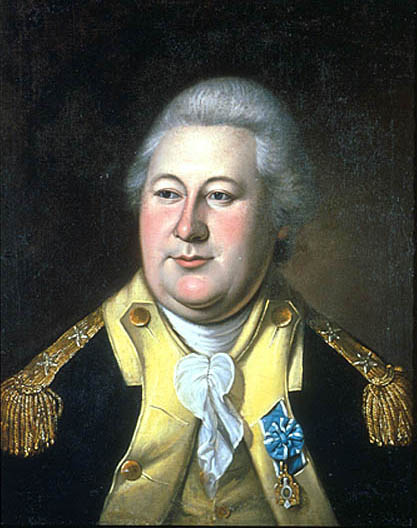
In addition to the names dropped above, the paper discusses Henry Knox (shown above) and his in-laws and the shadowy past of the American artillerist Thomas Machin. And in the final version I focused just on people secretly providing intelligence for the American side, so Benjamin Thompson, always a slippery fellow, escaped into a footnote.

As usual in this seminar series, the paper will be available at the M.H.S. for reading in advance. The seminar begins at 5:15 P.M. with Prof. Robert Allison of Suffolk University commenting on my draft. Then there will be a more general discussion with everyone invited to participate, followed by sandwiches. The society asks people to email if you plan to attend so they know approximately how many sandwich fixings to put out. I look forward to chatting with folks there!

Monday, March 14, 2011

Washington’s Secrets Revealed (well, some of them)

As I’ve previously announced, at 6:00 P.M. on Thursday, 17 March, I’ll deliver an Evacuation Day lecture at Longfellow House–Washington’s Headquarters National Historic Site on the topic “Washington’s First Spy Ring: Intelligence and Counterintelligence in the Siege of Boston.”

This talk grows out of research I’ve contracted to do for that site as it expands its interpretation of Revolutionary history. So far I’ve discovered some new facts about Gen. George Washington’s use of the mansion John Vassall built, established the basis for some traditions, and realized how much more there is to put on paper.

Because I’ve become a government contractor, late last year I received a letter warning me not to look at any documents on WikiLeaks. Those materials remain legally classified, and letting such files get onto my computer would put me in violation of my contract.

It seems highly unlikely that WikiLeaks contains any secret information about the American Revolution. But for the record I’ll say that when I identified the Rev. John Carnes as Gen. Washington’s secret informer inside Boston starting in July 1775, that was not based on WikiLeaks documents.

I’ve read news stories about the WikiLeaks disclosures, and even commented on how they could actually benefit the U.S. of A. by showing our diplomats to be perceptive and sincere in wishing for more democracy. Fortunately, the letter said reading such news articles wasn’t a problem.

In my Thursday talk I’ll name the redcoat who deserted in late July 1775, bringing with him detailed plans of the British fortifications. I’ll trace that man’s career in the American army, and debunk the elaborate cover story he or his family created to explain his background—the story that appears in American National Biography and other history books. But I promise that information didn’t come from WikiLeaks.

I’m also going to put forward the likely name of Dr. Benjamin Church’s mistress, the woman whom he asked to carry a ciphered letter to royal officials in Rhode Island. After she cooperated with his inquiry, Gen. Washington kept her identity secret in his report to the Continental Congress. I can’t say for sure, of course, but I think that fact isn’t even in WikiLeaks.

This lecture is free and open to the public, but reservations are necessary because of the limited space in the Longfellow carriage house. Call the site at 617-876-4491 or use this webpage to reserve seats. Due to digging in the driveway, to reach the carriage house you’ll have to go in the front gate and follow the paths around the east side of the mansion and through the colonial-revival garden.

Preceding my talk, National Park Service rangers will offer free guided tours of the mansion focusing on Washington and the siege of Boston at at 1:00, 2:00, 3:00, and 4:00 P.M. Those last about an hour.

Tuesday, September 21, 2010

A Shock for Gen. Washington

If Gen. George Washington’s arrangement to receive intelligence about the British forces from the Rev. John Carnes had been secure, I wouldn’t be able to write much about it.

I wouldn’t be able to quote the 28 July 1775 letter from Washington’s secretary Joseph Reed laying out the communication network. I wouldn’t be able to cite Lt. Col. Loammi Baldwin’s notes from mid-August that reports were about to arrive from Carnes. I wouldn’t be able to document rumors circulating out of Cambridge that confirm news from “Parson Carnes” in Boston.

But the security for Washington’s first espionage effort was as full of holes as one of the sieves that steward Timothy Austin bought for the headquarters kitchen. The general took care not to write in his expense notebook the name of the man who had agreed “to go into the Town of Boston; to establish a secret correspondence for the purpose of conveying intelligence of the Enemy’s movements & designs.”

However, Reed put that man’s name into the letter to Baldwin, who did not need to know it. Baldwin’s only job in this network was to give a letter to a local man named Tewksbury, and to send any reply to headquarters as quickly as possible.

Furthermore, the wording of Reed’s letter suggests that he contacted Baldwin out of the blue simply because he was the American officer in command at Chelsea. There’s no hint of any preceding discussion in person about intelligence matters, either for Washington and Reed to evaluate Baldwin’s reliability and discretion, or for those officers to establish understandings so they wouldn’t have to put all their crucial information in writing.

Furthermore, Ezekiel Price’s diary makes clear that the intelligence John Carnes sent out of Boston spread quickly, with the man’s name still attached: “this morning a woman got out of Boston, who brought a letter from Parson Carnes…” British agents wouldn’t have needed to infiltrate the little American spy network to learn Carnes’s name. They could simply have kept their ears open. Indeed, on 26 August a Customs official at Newport sent “intelligence of much importance…from the Rebel Camp” to Gen. Thomas Gage.

And, as I noted yesterday, Dr. Benjamin Church had already inserted himself into the communications chain. It’s not certain he ever told his British handlers about Carnes, but the royal authorities did apparently learn that the man was writing to Washington and told him to leave Boston.

In early October 1775, Washington and Reed learned that Dr. Church had been sending secret messages to people inside Boston through a different route. That revelation came as a huge surprise to everyone in the American forces. The Massachusetts Whigs were shocked because they had worked closely with Church for years. Washington and Reed must have been shaken to realize that their trust in the doctor had left their agent Carnes completely vulnerable.

Back at the start of this series of postings, I quoted Washington papers editor John C. Fitzpatrick on how the general chided a later intelligence chief, Col. Benjamin Tallmadge, for mentioning an informer in a letter. But Washington and his staff weren’t nearly so careful in 1775. Washington apparently learned about the need for strict security from the nearly disastrous failure of his first spy network.

Monday, September 20, 2010

A Spy Network Doomed from the Start

When I said yesterday that the Washington-Carnes spy network had been infiltrated from the start, I wasn’t even talking about how one link in the communications chain, Lt. Col. Loammi Baldwin, was best friends with a secret British agent.

For years Baldwin had traded scientific knowledge with Benjamin Thompson, later known as Count Rumford (shown here). Thompson went over to the British on 13 Oct 1775, became Lord Germain’s favorite and secretary, and eventually commanded dragoons on Long Island near the end of the war.

Nevertheless, Baldwin continued to see Thompson as a friend. He probably influenced the early American portrayals of Rumford as a talented man who would gladly have worked for the cause of liberty if only his New Hampshire neighbors hadn’t been too suspicious to give him a chance.

Twentieth-century scholars found that in early May 1775 Thompson sent Gen. Thomas Gage a secret report about the New England army written in invisible ink. Thompson’s neighbors were right to be suspicious.

In his diary, Baldwin recorded that Thompson had visited him in Chelsea on 4 June, and went home to Woburn on 13 June. Sometime after 23 July Thompson sent Baldwin designs for epaulettes to distinguish the American sergeants and corporals, so the two friends were in touch that summer. Of course, Baldwin may never have told Thompson about the intelligence assignments he received at the end of that month.

But there’s clear documentary evidence of infiltration by another British agent. The letter that Joseph Reed sent to Baldwin to pass on to a Mr. Tewksbury to give to a waterman to deliver to the Rev. John Carnes inside Boston was written by Dr. Benjamin Church, Jr.

As a Massachusetts official in early 1775, Dr. Church gave inside information to Gen. Gage. By the summer he was medical director of the American army, and still sending messages to the royal authorities. In late July, maybe slightly before this letter, Church tried to send a letter into Boston through his mistress, who had contacts in Rhode Island.

Even if Reed and Gen. George Washington never told Church who their man inside Boston was, the doctor could have used his letter to expose that agent to his British army contacts, or done other mischief. Or he could simply have piggybacked on the Washington-Carnes communications chain; it seems to have worked better than his Rhode Island channel.

Given that situation, it’s not really a surprise that the British military detected Carnes corresponding with Gen. Washington, as the minister’s family recalled.

TOMORROW: In fact, the whole enterprise was riddled with security breaches.

Sunday, September 19, 2010

“Suspected by Gen. Gage”

Yesterday I quoted Ezekiel Price recording a rumor of information slipped out of besieged Boston in August 1775 by John Carnes, a retired clergyman and grocer who was working for Gen. George Washington.

On 13 November, Ezekiel Price recorded another tidbit of information that may have come by the same route:

Mr. Carnes (a son of the parson’s) was here this afternoon: he says that it is reported at Cambridge, &c., and believed, that twenty-five hundred Regulars have lately arrived at Boston; he also says that the Regulars, last Saturday, intended to land a number of them at Chelsea,—having their boats, &c., ready,—but the wind blowing fresh against them prevented their setting off.
That rumor might not have come from the parson inside Boston, however. A Carnes family tradition that appears to have hit print first in an 1898 volume of American Ancestry says:
lived in Boston during the siege 1775. corresponded with Gen. Washington, was suspected by Gen. [Thomas] Gage, had his house and papers searched, and was ordered to leave, which he did
Gage sailed away from Boston on 11 Oct 1775, leaving the command to Gen. William Howe. If the family lore is correct about Gage ordering Carnes to leave, that must have happened before October, and Price’s November rumor had a different source. Alternatively, the family might not have remembered the right general’s name.

John Carnes was definitely outside the besieged town by 1 Mar 1776 when he took the job of chaplain to a regiment in the Continental Army. He didn’t remain in Boston throughout the siege.

The entry on Carnes in Sibley’s Harvard Graduates calls the lore “an unsubstantiated family tradition,” but I think the man’s name in Washington’s papers and Ezekiel Price’s August diary offers a fair amount of substantiation for his espionage work. I wonder if there’s more to be found in the papers of Gen. Gage or Gen. Howe.

After serving several months as a chaplain, at one point taking over his colonel’s correspondence with Gen. Horatio Gates, Carnes returned to Massachusetts. By the late 1770s he had settled in Lynn, his wife’s home town. The Rev. William Bentley wrote that “by the prosperity of his children [Carnes] rose to competence, was in the General Court & became justice of the peace.” He was also part of the Massachusetts convention to ratify the U.S. Constitution.

And apparently no one outside of the Carnes family suspected the man of having been a spy. In fact, he appears to have come across as an easy mark, which might be why he had so much trouble as a minister. After Carnes died, Bentley wrote:
His talents were small & his manners displeasing but his simplicity had no vice in it. . . . His poverty returned again towards the close of life tho’ not in extreme. We used often to laugh at Carnes, but there was many a worse man in our wicked world.
That harmless impression might have saved Carnes from imprisonment—because his little spy network had been infiltrated from the start.

TOMORROW: The British army’s moles behind the American lines.

Saturday, September 18, 2010

“A Letter from the Mr. J— C— the Grocer”

On 15 August 1775 Lt. Col. Loammi Baldwin sent Gen. George Washington some intriguing news from Chelsea:

I hope to be able tomorrow to forward to your Excellency a letter from the Mr. J— C— the Grocer

I heard from him yesterday Informing that he Expected to git further Information by tomorrow if it comes to hand shall forward it with all Convenient Speed
And the next day Baldwin wrote:
I have received a Letter which I supose came from Mr. J. C. by the Hand of the Gentleman Expected who says he is going to Headquarters in the morning to see about the sheep that was brought off from Puding Point which I have wrote to the adjutant General about
At the time Baldwin was dealing with the puzzle of what to do with sheep that his troops had driven out of reach of British raising parties, but which then had nowhere to graze. The people of Point Shirley, evidently including the man named Tewksbury who was part of the communication chain to “Mr. J. C.,” wanted to keep some of that livestock. Baldwin was writing not only to Gen. Horatio Gates, the adjutant general, but also quartermaster general Joseph Trumbull.

Baldwin referred to the American agent inside Boston only by his initials, but the letter he had received from Joseph Reed a couple of weeks before spells out the man’s full name: John Carnes. And as a confirmation that this was the same John Carnes who had been a minister, four days later a refugee from Boston named Ezekiel Price recorded a rumor in his diary:
in the afternoon, Mr. Hill, of Providence, was here, who left Cambridge this forenoon, and says, that this morning a woman got out of Boston, who brought a letter from Parson Carnes, which mentioned that the Regulars in Boston intended to come out this night or tomorrow night,—in consequence of which, preparations were making in the several American encampments to receive them
I’m not sure who “Mr. Hill” from Rhode Island was. Price had been a court clerk, registrar of deeds, notary, and insurance broker in Boston before the war, and was plugged into a lot of information networks.

Richard Frothingham’s History of the Siege of Boston states, “On the 20th, the British, it was thought, were about to sally out of Charlestown, when the camp was alarmed, and the men ordered to lie on their arms,” in order to be ready for any attack. Nothing happened, and at the end of that week the American forces preemptively attacked Ploughed Hill, as described back here.

TOMORROW: Another message from John Carnes inside Boston?

Friday, September 17, 2010

The Mysterious Mr. Carnes

I’ve been digging for information about John Carnes’s ideological or economic situation in 1775, and coming up empty. While the problems in his ministerial career are well documented, his life for the next decade is misty. He wasn’t rich enough to be prominent, or poor enough to come to the attention of the authorities.

Aside from the episodes I described here and here, all I’ve found is that Carnes bought shoes from the newly arrived merchant John Short, and sold goods to the Box and Austin ropewalk or its proprietors. And in November 1770, he joined the Old South Meeting.

Which leaves a lot of room for speculation. For example, his brother Edward (1730-1782) owned a house that got the name “Carnes College,” but no one knows why. Was “Carnes College” where John Carnes tutored young men for Harvard right after leaving the pulpit? If so, the property kept that name even after John set up his shop on Orange Street. (In the 1790s Harrison Gray Otis bought the “Carnes College” property and built a new house there, now owned by Historic New England.)

Who was the Carnes who announced the opening of a new shop with Nathaniel Seaver in the Boston Evening-Post on 17 May 1773? The next March, Seaver advertised in the Boston Post-Boy that he was carrying on that business alone.

Did John Carnes test business in New York in October 1765, when a man of that name registered as a freeman of the city? In June 1774 a John Carnes was in New York advertising “a quantity of dry goods…exposed to sale at vendue,” or auction. In October the sheriff advertised a different auction of “the four years leases of two houses and lots of ground, situate in Murray’s street, back of the College, late the property of John Carnes.” So if that was the John Carnes of Boston, looking for better prospects, the move didn’t go so well.

But maybe John Carnes was in the South End of Boston the whole time, quietly carrying on his little business, not advertising and not getting into trouble.

A “Reminiscence of Gen. Warren” in the New England Historical & Genealogical Register for 1858 said:

Dr. David Townsend, June 17, 1775, in the morning, went to Brighton to see Mr. Carnes’s family of Boston. About one in the afternoon, Mr. Carnes came and reported that there was hot work. The British at Boston, with their shipping, were firing very heavy on our men at Bunker Hill. Dr. Townsend said he must go and work for Dr. Warren.
Was this John Carnes, having moved from the army-occupied town? Or was it a relative?

In any event, since John Carnes referred to himself in 1770 as being “in the grocery-way,” he’s almost certainly the “John Carnes a Grocer” who had agreed to send information on the British military out to Gen. George Washington in July 1775. Did he do that because he was committed to the cause of liberty? In need of money? In the grip of a grand idea? I have no clue.

TOMORROW: But I know that the Rev. John Carnes sent information.

Wednesday, September 15, 2010

John Carnes: “in the grocery-way”

As I described yesterday, in 1764 the Rev. John Carnes finished his second unhappy stretch in a pulpit and came home to Boston. He gave a few more sermons, but apparently gave up the idea of trying to find another minister’s post. Instead, Carnes decided to go into business.

Carnes opened a shop on Orange Street (now Washington Street) in the South End of Boston. He applied for a license to sell liquor, which the Boston selectmen didn’t grant until 1766. I haven’t found any advertisements from him in the newspapers announcing what he had for sale, but he did advertise after a robbery at his store in 1769. The notice indicates that Carnes sold cloth, shoes and stockings, penknives, notions, and other goods.

Carnes stayed out of Boston’s pre-Revolutionary politics, except for one odd moment. On 25 Jan 1770 Christopher Prince published an open letter in the Boston News-Letter asking Edes and Gill, the printers of the rival Boston Gazette:

in what Manner I am to obtain Satisfaction of two Person in this Town, who have attempted without the least Foundation to blacken my Character, in an artful Piece in your Paper of last Monday.

One of which Persons I strongly suspect is a quondam Parson, and twice separated from this People, for Reasons best known to himself, and from a Preacher of the Gospel now follows the laudable Calling of retailing Rum to the Soldiers at the South Part of the Town.
The horrible act that the Gazette writer had accused Prince of doing was recommending that a man from Leicester buy from Nathaniel Rogers, a nephew of Lt. Gov. Thomas Hutchinson who had at first refused to sign the non-importation agreement, then agreed to do so, then backed out again. Prince insisted that at the time he hadn’t known about that last part.

In the 29 January Gazette Carnes responded with a long letter denying that he had written the earlier essay, and then accusing Prince of doing exactly what it said. As to the sneers against himself, Carnes wrote:
In respect to my being in the laudable Business of Retailing, it is the Fruit of Necessity, and very usual with all persons who are in the grocery-way in the south part of the town where I live.—But how low? how false the suggestion of my selling Rum to the soldiers? Tis true when I first sold liquors, I sold them indiscriminately to all customers; but as soon as I was convinced of the impropriety of supplying the soldiers with that article, I refused to let them have any; and Mr. Prince being a neighbor, must I think have known, that for near eight months past, I have declined selling to them.
Carnes went on to accuse Prince of behaving “like a true Italian, hugging a man in his arms, while that moment he determines to stab him.” (Carnes had probably never met an Italian in his life.) And he concluded about his neighbor’s remarks:
I need no public vindication, other than that has been given me by such their superiors, and consequently am compell’d to despise the little attempt made to injure my character, by a dirty Fellow, remarkable for his want of Education, and may I not add, remarkable for Profanity and Impudence?
Things must have been pleasant along Orange Street that winter.

COMING UP: John Carnes in the siege of Boston.

Tuesday, September 14, 2010

The Unhappy Ministerial Career of the Rev. John Carnes

John Carnes was born in Boston in 1723. His father was a pewterer who improved his social position through militia service. During the Big Dig, archeologists explored his land in the North End and discovered wine bottles personalized with the man’s name in the wax seals. Carnes had many children, but only young John was apparently interested in becoming a minister, so his father sent him off to Harvard, paying the tuition in pewter tableware.

While John was at college in 1740, the Rev. George Whitefield (shown here) made his first visit to Cambridge, reportedly preaching under an elm on the common. John felt inspired by this “New Light” religious revival, though the professors and tutors were more suspicious.

John Carnes graduated in 1742, earned his master’s degree, and was ordained as the new minister at Stoneham in December 1746. The following July, he married Mary Lewis of Lynn, three years his senior and from a comfortably wealthy family. John and Mary Carnes looked like they were in for a typical rural Massachusetts minister’s career: many uneventful years in the pulpit, children every two or three years, &c.

But the Stoneham congregation came to dislike and disrespect Carnes. They never raised his salary, and didn’t pay what they promised in a timely way, and finally drove him to resign in July 1757. He published his side of the dispute in the Boston Gazette the next month.

Carnes and his family moved back to his wife’s home town of Lynn. After preaching in various meetings, he accepted the job of minister at Rehoboth’s Seekonk parish in April 1759. Almost immediately some congregants started to complain. Their objections may not have been about Carnes so much as how people were taxed for his salary. The grousers appear to have been a minority of the congregation, but a loud one.

In 1763 a council of men from eight other churches met to arbitrate the dispute. They questioned Carnes and his opponents and concluded:

nothing has appeared inconsistent with either his christian or ministerial character. We have reason to conclude that he hath been uncommonly supported under his continued trials and temptations, discovered a serious spirit, and endeavoured in the midst of numberless discouragements, to carry on the great design of his ministry.
But his opponents still weren’t satisfied, and asked the Massachusetts General Court to intervene. A committee of the legislature investigated the situation in Reheboth and decided once again that Carnes had done nothing wrong. But they found “an unhappy alienation of affection in his people to him, and incurable.”

In December 1764, at the Rev. John Carnes’s request, the Seekonk congregation dismissed him from their pulpit. He was forty-one years old, had a wife and five children to maintain, and had failed twice at the only profession he was trained for.

TOMORROW: John Carnes comes home to Boston.

Saturday, September 11, 2010

“To Obtain Constant & Authentick Intelligence from Boston”

On 28 July 1775, Gen. George Washington’s secretary, Joseph Reed (shown here, courtesy of the University of Pennsylvania), wrote a confidential letter to Lt. Col. Loammi Baldwin, who was commanding the American forces maintaining the siege lines at Chelsea, on the north side of Boston harbor.

Reed was trying to set up an intelligence-gathering operation within besieged Boston, which he helpfully laid out for Baldwin in his letter:

In full Confidence of your prudence & Secrecy as a Soldier, a Man of Honour & a Friend to your Country, the General has directed me to communicate to you a Scheme he is about to put in Execution to obtain constant & authentick Intelligence from Boston.

The Plan is this. The inclosed Letter will be delivered by you to one Dewksbury who lives about 4 Miles from you towards Shirly Point—He will deliver it to a Waterman whom he can depend on who will convey it to one John Carnes a Grocer in the South Part of Boston. The Answers & such Intelligence as he can procure will be forwarded to you thro the same Channell: which you are to transmit to his Excell’y by Express immed’y—

As the Success of the Project & the life of the Man in Boston may depend upon your Conduct let it not escape you to the nearest Friend on Earth & for fear of Accident destroy this Letter as soon as you are sufficiently Master of its Contents—

When you see Dewksbury give him the above Caution in the strongest Terms: And so to pass from him to the other—Your good Conduct & Discretion in this Matter will not fail to be duly noticed.
Reed sent his letter thirteen days after Gen. Washington recorded paying an unnamed man £100 “to go into the Town of Boston [and] to establish a secret correspondence for the purpose of conveying intelligence.” It’s not certain that man was “John Carnes a Grocer,” but he’s the most likely candidate.

Some historians of American espionage, such as John Bakeless, have cited “Carnes” as the first American undercover agent who can be identified as using “cut outs,” or intermediaries, to transmit their messages while avoiding suspicion themselves.

TOMORROW: “One Dewksbury who lives about 4 Miles from you.”

Sunday, September 03, 2006

John Moies, British private and prisoner

In May 1769, John Moies was about twenty-nine years old, a private in His Majesty's 14th Regiment of Foot, stationed in Boston. He was also one of six soldiers brought up on charges for (as I described yesterday) robbing the shop of John Carnes. The indictment listed these stolen goods:

  • 40 shillings in coins
  • 22 pairs of men's shoes
  • 36 woolen stockings
  • 3 pairs of black mitts
  • 20 watch seals
  • various amounts of fabric, ranging from "25 yards of holland" worth £6 to "one yard of cambric" worth 8 shillings
The editors of The Legal Papers of John Adams point out that "the minutes [of the case] contain no direct evidence of theft, only the circumstantial evidence of possession of the stolen goods." Since the list above differs from what Carnes advertised as missing, however, I think the indictment probably described what goods the prosecution could prove thieves had taken—i.e., what people had recovered or testified to.

In any event, there was enough evidence for the Boston jury to convict Moies of theft. (Of the other five soldiers, four were never tried and the last acquitted.) Moies was sentenced to a whipping of "20 stripes on the naked back" and ordered to pay Carnes triple damages—a whopping sum of £78.13s.6d.

Since Moies couldn't possibly pay that amount, the court quickly ruled under an old Massachusetts law that Carnes was "fully authorized and impowered to sell and dispose of said John Moyse to any of His Majesty's subjects for the space and term of three years." British commanders fumed about a soldier being sold into servitude this way. From New York, Gen. Thomas Gage suggested that a soldier in that situation should be rescued by force and hidden on a navy warship, writing:
Such an infamous piece of Tyranny, savours more of the Meridian of Turkey than a British Province. It is a trite Remark, that these Bawlers against Government under the pretense of Liberty, are always the greatest Tyrants. It is not Tyranny they dislike, they only Squabble for the Power to become Tyrants.

Back in Boston, Gen. Alexander Mackay tried to arrange a settlement between Moies and Carnes, as he had managed to do for another soldier convicted of theft. But his talk with this private shocked him: Moies didn't want to be redeemed. He was apparently glad to go into some sort of servitude. It was "a connivance," Mackay wrote Gage, "in order to secure him his Discharge, or in other words a sort of Legall Dismission from the Regiment." Mackay declared Moies was "a Rascall."

I must add that the muster rolls of the 14th Regiment, which I examined in Britain's National Archives, show that officers continued to list John Moies as in "Prison" until at least May 1772. And during those years the War Office in London continued to send his pay to the regiment's colonel.

The trial of Pvt. Moies is discussed in the second volume of The Legal Papers of John Adams, the commanders' response in The Boston Massacre. I thank Hiller B. Zobel, co-editor of the first and author of the second, for bringing those sources to my attention last year.

TOMORROW: Whatever happened to John Moies?

Saturday, September 02, 2006

Cloth Robbery in the South End

On 20 March 1769, the Boston Gazette ran an advertisement from a dry-goods merchant. It listed many different items—types of cloth, ribbons, shoes, stockings, sewing supplies—but the merchant wasn't advertising those for sale. Rather, he was reporting

A THEFT,
ON Thursday Night the 16th Instant, the Shop of me the Subscriber was broke open, and robbed of the following Articles, viz.—2 Bundles of Mens Worsted Stockings—1 Bundle of fine Cotton ditto—1 Bundle of Womens Worsted ditto—Several Remnants of Irish Linnens, some of them containing from 12 to 20 Yards—About 20 Pair of Mens Shoes and Pumps—A Number of crooked Combs—Several Pieces of Padusoy, Sattin and other Ribbons—Crown Soap—Bundles of Penknives and Jack-knives—Part of two Pieces of coloured Silk Handkerchiefs—Dark and other coloured Threads—Womens Shoes—A Book of Needles of different Sorts—A Receipt Book—And about Forty Shillings Lawful Money in Cash.

Whoever shall apprehend or detect the Thief or Thieves so that he or they may be brought to Justice, shall have the Sum of TEN DOLLARS Reward, and all necessary Charges, by me
JOHN CARNES.
Boston, March 18, 1769.
The same ad appeared in the 3 April issue.

On 23 March, the Boston News-Letter reported that in addition to "the Shop of Mr. Carnes at the South Part of the Town,...Several other Shops and Stores in Town have lately been broke open and Goods stollen.”

Since the previous December, Boston's Whigs had been complaining about a crime wave. After describing a mugging, one newspaper essayist added:
This is not the only instance of a street robbery, since the arrival of the troops, which before was a crime unknown in this town, and serves more and more to convince us, how much beholden we are to some persons among us, not only for the introduction of such a set of men into the province, but for influencing to their being quartered in the midst of us, which gives them a still greater opportunity to injure and distress the inhabitants.

"Street robbery" is one thing, but by today's standards it seems very odd for thieves to break into a shop to steal a large quantity of cloth. Before mechanical spinning wheels and looms, however, making cloth required so much skilled labor that it was an expensive product—and top-quality cloth even more so.

When the authorities filed charges in the Carnes robbery, they estimated that "25 yards of holland" linen alone was worth £6. That was enough to rent a small house in Boston for a whole year, according to the town's 1771 tax evaluations. A 1775 pamphlet about the British army complained that privates received only 8 pence a day after all their expenses had been deducted, so "25 yards of holland" was worth half a year's pay to a soldier.

Not to mention all the other cloth, the cash, the shoes and stockings, and the "Book of Needles of different Sorts."

TOMORROW: The rascal revealed.