J. L. BELL is a Massachusetts writer who specializes in (among other things) the start of the American Revolution in and around Boston. He is particularly interested in the experiences of children in 1765-75. He has published scholarly papers and popular articles for both children and adults. He was consultant for an episode of History Detectives, and contributed to a display at Minute Man National Historic Park.

Subscribe thru Follow.it


•••••••••••••••••


Showing posts with label Dr. James Hawes. Show all posts

Monday, July 29, 2024

“Instead of the Agreement which the people have signed”

By the first week of July 1774, people in Westboro had started to sign the Solemn League and Covenant, promising not only not to buy goods from Britain but not to do business with anyone who did.

The town’s minister, the Rev. Ebenezer Parkman, had shown that he didn’t think that was a good idea. He wasn’t coming out and condemning this latest boycott, either, though. He just wanted to avoid controversy.

Supporters of the non-consumption movement kept up pressure on Parkman, presumably because if he came out on their side it would be even easier to sign up everyone else in town. Members of Westboro’s committee of correspondence visited Parkman again on 7 July, as he recorded in his diary:
Messrs. Daniel Hardy, Edwards Whipple etc. here. The former is disturbed that I would not so much as read, at the late Town-Meeting, what their Committee had prepared to be signed. I gave him some Reason for my refusing: namely that I was aware that if I heard it, I must either approve or condemn it — but do which I will, I must of necessity be blamed.

If I approved of their Draught, I must have exposed my Self to the resentments of Authority which I must teach all Men to avoid: for I must teach and injoin that “every soul be subject to the higher powers” — “to obey Magistrates” — as Rom. 13.1 and Tit. 3.1. If I Should dislike it, I was aware that they would not be easily turned aside notwithstanding from what they had done. I was not o’ mind to render my Self Obnoxious either way.
Soon Parkman received word from his son that “at Boston and other Towns, they did not conform to the Governors late proclamation etc.” Gov. Thomas Gage’s threats were having little effect.

Rather than openly oppose the boycott, some people suggested that communities shouldn’t commit to any action until they heard what the upcoming Continental Congress recommended. But that body wouldn’t meet for another two months. Some towns instead added clauses to their Solemn League and Covenant votes saying that they could revisit the details based on that congress’s resolves.

Parkman continued to try his own delaying tactics on 18 July:
The Town Met again on the Article of Signing the Engagement to break off the Commercial Dealings with Great Britain. They Send their Committee to Me to let me see what they have drawn up; and if I pleased in Order to my Signing it. I sent my Regards to the Town, with my Request, that it might be suffered in my Hands a little while for my Review, and I will make them Some Return before or at their next Meeting.
Nine days later, Dr. James Hawes of the town committee and his wife visited the minister in the afternoon. Avoiding another political sore spot, Parkman offered chocolate instead of tea. Hawes left a copy of Westboro’s agreement.

The next day, Parkman wrote:
Transcribed the Towns Agreement for my own use. I cannot, as it is, like it: It is ill draughted.
Ah, there was the problem! The prose. (Not.)

On 1 August, the minister once again recorded a gathering “on the Affair of Subscribing the Agreement” that didn’t make it onto the official record of town meetings. His own son Breck “found it necessary to subscribe,” he wrote.

By this point Parkman had come up with his own form of the pledge (which I don’t think survives). But the men of Westboro no longer cared about what their minister thought. “I went to the Meeting House with a paper fit to be subscribed and read it to a Number of persons,” he wrote; “but the Town were busy and did not call for it.”

At that same meeting, Westboro agreed to help pay for the Massachusetts delegates’ expenses going to Philadelphia; that money was being collected outside the province’s regular taxation process to avoid the governor’s veto. Ministers were usually exempt from taxation, but Parkman wrote: “I sent my Quota thereto.” He was willing to avoid this extralegal equivalent of tax to avoid controversy. (This was also the day Calvin Piper got badly hurt falling from a horse.)

Finally Parkman recognized he wouldn’t convince anyone but himself about the boycott. On 4 August he wrote:
N.B. Instead of the Agreement which the people have signed, I have drawn up what I think may be more Safe for me, if I shall be obliged to Sign any thing.
The town had yet another unrecorded meeting “upon some of their Liberty Affairs” on 8 August. Four days later, Parkman stated that he had received an issue of the Boston Gazette with news of the Massachusetts Government Act.

For years the province’s Whigs had been warning people that there was a conspiracy to take away people’s legal rights. This new law curbed town meetings, eliminated the elected Council, increased the royal governor’s appointive powers, and limited jury pools. The radicals’ dire warnings, which moderates like Parkman had thought overblown, appeared to be coming true. In his diary he wrote: “May God Sanctifie to us this heavy stroke! and help us rightly to improve such privilege and Libertys as remain!”

Friday, July 26, 2024

“They came to hear my Sentiments of the Covenant”

The town of Westboro provides a good look at how one rural community responded to the invitations from Boston and Worcester to join the Solemn League and Covenant boycott in the summer of 1774.

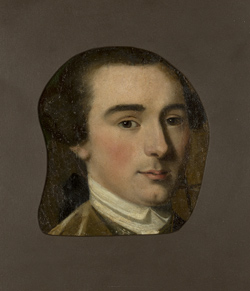
The Boston committee of correspondence sent out its call on 8 June. Five days later, the Rev. Ebenezer Parkman (shown here) wrote in his diary:
Town Meeting to consider a Letter from the Town Clerk of Boston and there is come also a printed Covenant for them to Sign, in which they are to join with Others, and Solemnly bind themselves to renounce all Trade with Great Britain till the Bill for blocking up the Harbour of Boston Shall be repealed.

N.B. Little is said about supplicating the Throne of Grace on this Great Occasion. But they Chose a Committee to consider what is best to be done, and report to the Town.
The town meeting record for that day shows that Westboro set up a committee of correspondence. Legally, the warrant for that meeting didn’t mention the proposed non-consumption agreement, only Boston’s 12 May plea for support. But Parkman’s diary shows the Solemn League and Covenant was part of the discussion.

It’s notable that most of that 13 June meeting addressed military preparation, approving the purchase of a “4 Pounder and 4 Hundred Wt of Ball,” a carriage for that artillery piece, and gunpowder, and generally getting ready for “an allarum.” In “this dark and distressing Time of Perplexity,” the town majority already saw armed defense as worth spending money on.

Westboro didn’t record another town meeting until October, when men chose representatives to the Massachusetts Provincial Congress. But Parkman’s diary shows how his parishioners continued to discuss the non-consumption agreement—two committee members visited him the next day. 

On 17 June, the minister wrote that six of the town’s committee came to him:
They came to hear my Sentiments of the Covenant which they had received from Boston and another from Worcester, which I, in part gave them. It was Said from among the Committee that they Should be glad I would be at the Town meeting, when they were to report.
Parkman then stated—and underscored—that on the afternoon of 20 June “The Town Meet on the Affair of Signing a Covenant of Non-importation etc.” That gathering didn’t make it into the official record. Perhaps it was deemed a committee meeting, or perhaps conversations without votes weren’t thought to need an official record.

Jonathan Bond, the first man designated for the town’s committee of correspondence, visited Parkman on 27 June:
Deacon Bond came and delivered me 4 Papers of the public affairs relative to Signing a Covenant etc. I copyed the Covenant with alterations.
Parkman probably diluted the text, given his reluctance for confrontation. The next day, the deacon’s son came by:
Thomas Bond here about the Boston papers, Covenant etc. Read him my Draughts: he Seems to fall in with them. He carrys back those I borrowed.
With Parkman’s blessing Westboro observed a fast on Thursday, 30 June. The Rev. Nathan Stone came from Southborough to preach. Parkman wrote:
Mr. Stone preached a.m. on Deut. 29.24.25. [Even all nations shall say, Wherefore hath the Lord done thus unto this land? what meaneth the heat of this great anger? Then men shall say, Because they have forsaken the covenant of the Lord God of their fathers, which he made with them when he brought them forth out of the land of Egypt]

N.B. At the End of the Sermon he delivered his Mind concerning the Covenant that is going about the Country to be Signed in all places by all persons, on highest Penalty. May God add His Blessing!
Discussions continued on 1 July:
N.B. Mr. Daniel Forbes one of the Committee of Correspondence here. Shewed him my Remarks on the Covenant etc. He desires me to let Dr. [James] Hawes (who is another) See some of my papers concerning those Matters.
But then another voice entered the conversation.

TOMORROW: Here comes the general.

Saturday, June 18, 2022

Calvin Piper in Sickness, War, and Peace

Yesterday we left eleven-year-old Calvin Piper of Westborough in bed after falling off a colt and banging his head in August 1774.

Dr. James Hawes gave the boy a poor prognosis. The Rev. Ebenezer Parkman came to pray with him.

After a few days, Hawes gathered some medical colleagues to consult and perhaps perform surgery to relieve pressure in Calvin’s skull.

But on that morning of 6 August, Calvin woke up feeling much better than before. He was no longer delirious or babbling. The surgeons reconsidered.

The Rev. Mr. Parkman wrote in his diary:
It was feared the Trepan must be used: but it was first determined to take off part of his scalp and examine his Head. We began with prayer. Dr. [Charles] Russel [shown here] performed the Operation, and finding the grumous Blood, and that there was no Fracture, desisted from any thing further.
So Calvin was sewn up and allowed to keep recovering on his own. Parkman visited him again a couple of days later, and then Calvin drops out of the minister’s diary, presumably going back to normal farm boy behavior.

Nearly two years later, as the British military was preparing to leave Boston, Parkman had to visit the Piper family again. On Sunday, 10 Mar 1776, he wrote:
At Even went to see Mrs. Piper, newly brought to bed, and is very low; prayed with her in her Distresses.
The next day, Parkman added, “She is in a dangerous state.” And on Tuesday:
Capt. Wheelock early, Suddenly, hastily calls me to Visit Mrs. Piper as being near her End. I rode speedily (before Breakfast — nay before Family Prayer), found her groaning as in very great Distress. Prayed with her, Commending her Case to God, most gracious and compassionate. . . .

Mrs. Piper dyed about noon, about 42 and an half.
The funeral was on Thursday, 14 March. The minister noted, “her Father Whitcomb and one of her Brothers were there.”

The Parkman diary thus contains some clues to the Piper family history. The mention of “Father Whitcomb” might indicate Mary Piper’s surname at birth. There were Mary Whitcombs born in Bolton and its parent town, Lancaster, in the 1730s. However, none was born in 1733 and thus “about 42 and an half” in 1776. It’s also possible that “Father Whitcomb” was a stepfather.

In addition, Parkman’s record confirms that this Mary Piper died in 1776. John Piper remarried the next year to a woman from Templeton named Mary White. That means there were two wives named Mary Piper having John’s children in quick succession, and some genealogies don’t recognize they were separate women.

Back to Calvin Piper: As he reached his late teens, he had a new stepmother. Did that push him to leave the house? Or did he want some adventure, or just need money? Whatever the combination of reasons, on 1 July 1780 Calvin enlisted among the “men raised to reinforce the Continental Army for the term of 6 months.” When he reported to the camp at Springfield, Calvin was recorded as seventeen years old, 5'4" tall, with a ruddy complexion.

Pvt. Piper served a little more than five months at West Point, New York, before being discharged. He liked the experience enough to reenlist the following June. By now he was an inch taller and had been trained as a tanner, perhaps in a family shop. This time there was a dispute about whether he was counted in the quota for Lancaster or Templeton—not that it mattered to him. Piper agreed to serve three years, but the war ended before that term was up.

The twenty-year-old veteran moved to Norridgewock in the district of Maine. In April 1785 he married Zeriah Parker there. Five years later, however, Mrs. Zeriah Piper remarried, indicating that Calvin Piper had died in his late twenties—about fifteen years after he escaped having a hole drilled in his skull.

Friday, June 17, 2022

“The Case of the poor Boy, Calvin Piper”

In 1758, a young man named John Piper bought farmland in Bolton. He married around the same time, and from 1759 to 1765 Mary Piper had four children in Bolton. The third was a boy named Calvin, born 11 Apr 1763.

In 1764 John Piper, alongside his brothers and several neighbors, started buying farmland to the west in the town of Templeton. The next year, John moved his family onto sixty acres there.

After another few years, the Piper family moved again, this time back east to Westborough. A family genealogist found no evidence John Piper bought land in that town and guessed he “had decided to rely on his work as a tanner to support the family.” It’s also possible that the Pipers were now poor enough they had to work on other people’s land.

On 29 Apr 1774, Westborough’s minister, the Rev. Ebenezer Parkman, wrote in his diary:
At Eve came Mr. John Piper who is newly come to live among us, and asks the privilege to communicate with us, as also that his Wife Mary, may; they being Members of the Church in Templeton.
The Pipers were trying to fit into the Westborough community and congregation.

That summer, many Massachusetts towns became even more roiled in imperial politics than they were already. On 1 August, Westborough had a town meeting about “Subscribing the Agreement” and “bearing of the Charge of the Congress.” 

On that same Monday, Parkman wrote:
Martin Piper, a Lad in his 12th Year, was thrown by a Colt, and his Head came down on a Rock, nigh Mr. Newtons. He was carryed in there. It was feared to be a mortal Blow. Mr. Newton came in haste for me. I went. He was delirious. Dr. [James] Hawes soon blooded him. He bled well. Vomited Several Times — inclined to sleep; when any thing was given him, he cryed out bitterly, but could not speak. I prayed with him. What a Warning! Especially to Youth! But how great the Mercy he was not killed! His parents much distressed.
As subsequent journal entries make clear, this was Calvin Piper. In his distress, and not knowing the family well, the minister mistakenly called him “Martin” (after another Protestant leader?).

Delirium, vomiting, sleepiness—those are all symptoms of a serious head injury. Parkman was not optimistic (but then he rarely seems to have been). The next day, the minister visited the house of militia lieutenant Joseph Baker “to see young Piper”—despite his injury, the boy had been moved. Parkman wrote, “He is no better. Prayed with him.”

On Saturday morning, a coterie of rural surgeons came to Baker’s house. In addition to the local Dr. Hawes, Parkman also listed Charles Russell of Lincoln (politically a Loyalist, but still valued as a doctor), Edward Flynt of Shrewsbury, and “a Number of Doctors besides being there on the Case of the poor Boy, Calvin Piper.”

Fortunately, there were now good signs. The minister reported that the boy “last Evening began to recover his senses and to Speak—and is this morning composed and utters himself pertinently.”

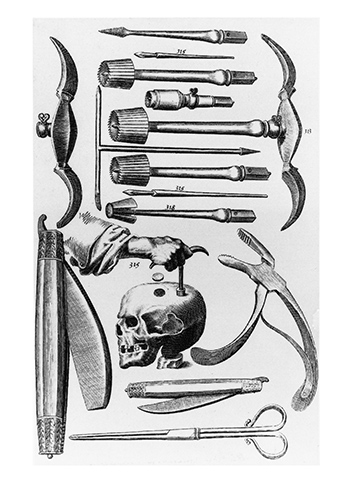
Still, those doctors had come prepared to trepan the kid—to drill a hole in Calvin’s skull to remove fluids and relieve pressure on his brain. They had no doubt brought their drills and other tools. It would have been a shame not to use any of that equipment.

TOMORROW: The operation and the aftermath.