J. L. BELL is a Massachusetts writer who specializes in (among other things) the start of the American Revolution in and around Boston. He is particularly interested in the experiences of children in 1765-75. He has published scholarly papers and popular articles for both children and adults. He was consultant for an episode of History Detectives, and contributed to a display at Minute Man National Historic Park.

Subscribe thru Follow.it


•••••••••••••••••


Showing posts with label Oliver Wolcott. Show all posts

Friday, December 17, 2021

“An alledged libel against Julius Deming”

While researching the life of Elisha Horton, as I laid out yesterday, I came across newspaper articles about a local political controversy in the early 1800s.

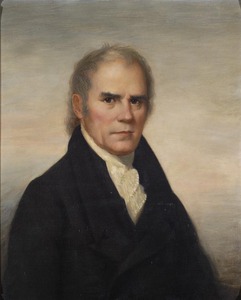
The other main figure in this story is Julius Deming (1755–1838, shown here). Born in Lyme, Connecticut, Deming became a captain of cavalry under his cousin Col. Henry Champion and then, also under cousin Henry, an army commissary at Litchfield.

As the war ended, Deming remained in Litchfield and set himself up as a merchant. He married Dorothy Champion, cousin Henry’s daughter. (Another daughter was Deborah Champion, and I wrote about her legend back in 2014.)

For business Deming traveled to London, traded with China, and formed partnerships with prominent men like Benjamin Tallmadge and Oliver Wolcott. He grew richer. He became the local magistrate and served in some state and county offices, though his family understood him not to enjoy politics. (This story suggests he had strong feelings about politics nonetheless.)

Among the businesses Deming invested in was a paper mill, where he hired Elisha Horton as his manager. One source tells me Horton started work at the Litchfield paper mill in the early 1790s, the other that he started work for Deming in the early 1800s. Maybe there were two mills, or maybe Deming bought a mill where Horton was already working for the previous owner.

The 1790s and 1800s of course saw the rise of party politics in the U.S. of A. New England Federalists like Julius Deming were shocked when Thomas Jefferson won the Presidency in 1800 and his allies made inroads in their region. Litchfield had two newspapers keeping an eye on each other: the Litchfield Monitor (Federalist) and the Witness (Republican).

By September 1805, if not before, Deming was in a feud with Selleck Osborn (1783–1826), the young publisher of the Witness. There was a dispute over coverage of a lawsuit involving Tallmadge and Wolcott. Then on 9 October the Witness published an article headlined “Reign of Terror” reporting that on the recent Election Day Deming had tried to intimidate a Republican voter.

On 11 December the Witness’s last piece of local news, festooned with a pointing hand, was:
Yesterday the Editor and Printer of the WITNESS, were indicted by the State’s attorney, for an alledged libel against Julius Deming, Esq.
That case hinged on Deming’s political methods. And when it went to court, a key witness was Elisha Horton.

TOMORROW: What Elisha Horton wanted to say.

Tuesday, December 06, 2016

Oney Judge and “the President’s Wishes”

As I reported yesterday, George Washington has been our richest President so far. Most of his property consisted of land, both plantations in Virginia and unsettled claims to the west, and slaves. A lot of those slaves had come to his wife Martha or her children, inherited from her first husband’s family, and George felt obliged to preserve that wealth.

When the federal government moved to Pennsylvania in 1791, that state’s law gradually ending slavery posed a problem for the Washingtons. If they brought their household servants to Philadelphia—and how could a rich couple live without their household servants?—then those people were entitled to be free after six months in the state.

On 24 April Washington’s plantation manager, Tobias Lear, wrote to him about what the U.S. Attorney General, Edmund Randolph, had said about that law:
But he observed, that if, before the expiration of six months, they could, upon any pretence whatever, be carried or sent out of the State, but for a single day, a new era would commence on their return, from whence the six months must be dated for it requires an entire six months for them to claim that right.
Lear then discussed the specific situations of several enslaved people, including: “Mrs Washington proposes in a short time to make an excursion as far as Trenton, and of course, she will take with her Oney & Christopher, which will carry them out of the State; so that in this way I think the matter may be managed very well.”

Oney Judge was Martha Washington’s personal maid. She had been born at Mount Vernon around 1774. Judge was part of Martha’s property, and the First Lady planned to bequeath her to a granddaughter. So the Washingtons made sure that she was never in Pennsylvania for six months at a stretch.

Five years after Lear’s letter, on 21 May 1796, Judge slipped away from the Presidential mansion. She later told an interviewer, “I had friends among the colored people of Philadelphia, had my things carried there beforehand, and left Washington’s house while they were eating dinner.” Frederick Kitt, the President’s steward in Philadelphia, placed an advertisement seeking Judge in the 24 May Philadelphia Gazette.

At the end of June, Thomas Lee, Jr., wrote from New York to President Washington in response to, as he wrote, “the desire you expressed that I should make enquiry about your runaway Woman.” Lee reported a cook saying that Judge had gone north to Boston, and he planned to make inquiries there. Washington knew multiple men named Thomas Lee, and I’m not sure which one this was, but he appears to have been pursuing Judge as a private favor.

Later that summer Elizabeth Langdon, daughter of Sen. John Langdon, recognized Oney Judge on the street in Portsmouth, New Hampshire. Slavery was already unenforceable in that state. According to Washington’s understanding, Langdon “was about to stop and speak to her, but she brushed quickly by, to avoid it.”

The President moved to track Judge down—but instead of continuing his efforts through private channels, he began to use the resources of the federal government. On 1 Sept 1796 he wrote to his Secretary of the Treasury, Oliver Wolcott:
Enclosed is the name, and description of the Girl I mentioned to you last night. She has been the particular attendent on Mrs Washington since she was ten years old; and was handy & useful to her, being perfect a Mistress of her needle. . . .

Whether she is Stationary at Portsmouth, or was there en passant only, is uncertain; but as it is the last we have heard of her, I would thank you for writing to the Collector of that Port, & him for his endeavours to recover, & send her back: What will be the best method to effect it, is difficult for me to say. If enquiries are made openly, her Seducer (for she is simple and inoffensive herself) would take the alarm, & adopt instant measures (if he is not tired of her) to secrete or remove her. To sieze, and put her on board a Vessel bound immediately to this place, or to Alexandria which I should like better, seems at first view to be the safest & least expensive. But if she is discovered, the Collector, I am persuaded, will pursue such measures as to him shall appear best, to effect those ends; and the cost shall be re-embursed & with thanks.
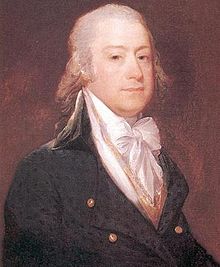
The “Collector” was Joseph Whipple (1738-1816, shown above), the head of the Customs service in Portsmouth and thus a federal employee who answered to Wolcott. He had held the same position for the state of New Hampshire until 1789, and the new President had reappointed him on John Langdon’s recommendation.

Whipple wrote back to the Treasury Secretary on 10 September, “I shall with great pleasure execute the President’s wishes in the matter.” The next month, on 4 October, he wrote again, telling Wolcott that Judge had expressed “a thirst for compleat freedom” as well as “great affection & reverence for her Master & Mistress”; she was (at least initially) willing to return to Mount Vernon if the Washingtons guaranteed her freedom on their deaths.

The President replied directly to Whipple on 28 November, rejecting those terms. He also told the Collector:
…you would oblige me, by pursuing such measures as are proper, to put her on board a Vessel bound either to Alexandria or the Federal City; Directed in either case, to my Manager at Mount Vernon, by the door of which the Vessel must pass; or to the care of Mr Lear at the last mentioned place, if it should not stop before it arrives at that Port.

I do not mean however, by this request, that such violent measures should be used as would excite a mob or riot, which might be the case if she has adherents, or even uneasy sensations in the minds of well disposed Citizens. rather than either of these shd happen, I would forego her services altogether; and the example also, which is of infinite more importance. The less is said before hand, and the more celerity is used in the act of Shipping her, when an opportunity presents, the better chance Mrs Washington (who is desirous of receiving her again) will have to be gratified.
Again, this wasn’t government business. Washington was asking Whipple to do him a big favor, one gentleman for another. But Whipple was a federal government employee, and he owed his position to Washington. Today that would strike us as a clear conflict of interest.

There’s more to Oney Judge’s story, and the Washingtons’ pursuit of her. Today I’m just looking at how having the resources of government presents a great temptation to a President with private interests.


Friday, October 28, 2016

Mr. Jefferson’s Respects on the President’s Birthday

Amid the controversy over the birthday ball for George Washington in Philadelphia in 1798, Abigail Adams wrote home to a relative:
I have heard that there is a design to shift this matter off upon the Vice President, but in Justice to him, he had no hand in it further than to subscribe to it, being told that the President would certainly attend. when he found that he would not go, he refused also, this I am sure of so that let no more be laid upon him than he deserves.
Thomas Jefferson had indeed bought a ticket to support the ball on 2 February. That suggests the Vice President had early word of the event. The organizers didn’t send an invitation to President John Adams for another ten days.

Furthermore, on 15 February Jefferson wrote to his friend James Madison from Philadelphia about the celebration and its political implications:
A great ball is to be given here on the 22d. and in other great towns of the Union. This is at least very indelicate, & probably excites uneasy sensations in some. I see in it however this useful deduction, that the birthdays which have been kept have been, not those of the President, but of the General.
As a republican, Jefferson viewed balls honoring officeholders on their birthdays as monarchical. But he was ready to make an exception for one that tweaked his rival.

By the day of the ball, it had blown up into a big controversy of both politics and politesse. Jefferson ducked out of attending with a note to one of the organizers:
Th: Jefferson presents his respects to mr Willing, and other gentlemen managers of the ball of this evening. he hopes his non-attendance will not be misconstrued. he has not been at a ball these twenty years, nor for a long time permitted himself to go to any entertainments of the evening, from motives of attention to health. on these grounds he excused to Genl. Washington when living in the city his not going to his birthnights, to mrs Washington not attending her evenings, to mrs Adams the same, and to all his friends who have been so good as to invite him to tea- & card parties, the declining to go to them. it is an indulgence which his age and habits will he hopes obtain and continue to him. he has always testified his homage to the occasion by his subscription to it.
From his safe distance, Jefferson seems to have rather enjoyed the turmoil. He wrote again to Madison on 2 March:
The late birthnight has certainly sown tares among the exclusive federals. It has winnowed the grain from the chaff. The sincerely Adamites did not go. The Washingtonians went religiously, & took the secession of the others in high dudgeon. The one sex threaten to desert the levees, the other the evening-parties. The whigs went in number, to encourage the idea that the birthnights hitherto kept had been for the General & not the President, and of course that time would bring an end to them. [Benjamin] Goodhue, [Nathaniel?] Tracy, [Theodore] Sedgwick &c did not attend: but the three Secretaries & Attorney General [Charles Lee] did.
Abigail Adams’s assessment of the event was based on the small number of ladies she heard had attended. Jefferson gave more attention to how President Adams’s Cabinet—which included Secretary of State Timothy Pickering, Secretary of War James McHenry, and Secretary of the Treasury Oliver Wolcott, Jr.—was acting more loyal to Washington than to him. Which was indeed a problem.

Sunday, October 23, 2016

President Adams’s Birthday Celebrated—in Lisbon

Though there was no public observation of President John Adams’s birthday in Philadelphia in 1797, one branch of the small U.S. government definitely celebrated it.

William Loughton Smith was a fervent Federalist from Charleston, South Carolina. I was going to say he was one of the few men named William Smith in early America not related to Abigail Adams, but then I found that they were distant cousins; Abigail’s first patrilineal ancestor in America was William Loughton Smith’s great-great-grandfather.

During the election of 1796, Smith wrote (or perhaps collaborated with Oliver Wolcott, Jr., in writing) an attack on Thomas Jefferson signed “Phocion.” (Lately that has been ascribed to Alexander Hamilton, but contemporaries seem largely agreed that Smith was responsible; Jefferson and his circle even referred to him as “Phocion Smith.”)

As a reward for Smith, President Adams made him the U.S. minister to Portugal. On 21 Oct 1797 Smith wrote back from his new posting to James McHenry, the Secretary of War:
I wrote you since my return to Lisbon, & have therefore nothing to communicate but the account of the Dinner I gave on the 19th. to the Americans here to celebrate the President’s birth-day: I was not perfectly prepared for such an occasion having been only a fortnight in my house; thinking however that it was best to do the thing even imperfectly than to let the Day pass unnoticed, I exerted myself, & made out tolerably well. I enclose you an account of the Celebration which Fenno will publish I am sure with pleasure; the Toasts are on a Separate paper for your information; you will think them not worth publishing.

Among my Guests was a Captain Israel who informed me that he was the Son of the famous Israel Israel:—we were the best friends in the world; I have been told that there were two or three Jacobins [Democratic-Republicans?] present, but they all behaved extremely well; they joined in the Toasts with great zeal & we sang & were very merry; at first they were bashful, but when I set them the example of singing, they threw aside reserve & were very convivial.
The item that Smith wanted McHenry to give to John Fenno, the Boston-born editor of the Federalist Gazette of the United States, reported:
Thursday the 19th. October being the Anniversary of the President’s Birth, was celebrated at Lisbon by Mr. Smith, the Minister of the United States at that Court, who gave on the Occasion an Entertainment at his Hotel at Buenos-Ayres to a numerous and respectable Company of American Captains & Citizens. After sixteen patriotic Toasts intermixed with convivial songs, the Company, having spent the day with great good humor and festivity, broke up at nine o’clock, much pleased with the occasion, which had collected together so many Americans at such a distance from home. All the American vessels in the Harbour were gayly decorated during the day & at twelve o’clock a federal salute of sixteen guns was fired by some of them in honor of the day, and at five in the afternoon was repeated. This Anniversary occurring on a day, highly distinguished in the Annals of the American Revolution by the Surrender of York-town, the recollection of so auspicious an event could not fail to increase the happiness of the Company.
Of course, Smith was celebrating the 19th of October while Adams had long before adopted 30 October as his Gregorian-calendar birthday.

(Smith’s letter was undated when published in the Sewanee Review, but he must have written it in 1797 because that’s the only year in Adams’s administration when “the 19th. October” was a Thursday.)