J. L. BELL is a Massachusetts writer who specializes in (among other things) the start of the American Revolution in and around Boston. He is particularly interested in the experiences of children in 1765-75. He has published scholarly papers and popular articles for both children and adults. He was consultant for an episode of History Detectives, and contributed to a display at Minute Man National Historic Park.

Subscribe thru Follow.it


•••••••••••••••••


Showing posts with label riots. Show all posts

Saturday, April 25, 2026

“That the said Hill be immediately apprehended”

John Hill was yet another of the Loyalists captured aboard the brig Elizabeth.

[I feel like I’m never getting away! Then again, that’s probably how those passengers felt when they were brought back to New England after trying to evacuate.]

According to recent research shared in the Loyalist Directory, John Hill was born in Ireland about 1737. He moved to New York City in the early 1770s and ran an inn.

In March 1775, Hill came to the aid of William Cunningham during a fight near New York’s Liberty Pole (shown here). Hill later told the Loyalists Commission that “a Mob…beat us with Clubs, and stoned us.” The two men were thrown into prison and put on trial in April. But the foreman of the jury, John Wetherhead (another future Loyalist), kept them from being convicted and punished.

Cunningham and Hill “escaped to Boston,” reaching the besieged town by 5 May. They enlisted in the militia company of James Forrest, another man from Ireland. Hill said he was “appointed Quarter Master to the same Company.”

In March 1776, Gen. William Howe decided to evacuate the town. He ordered Crean Brush to confiscate all cloth that could be useful to the Continental Army. Brush enlisted Richard Hill, formerly sheriff in his county of northeastern New York (which would become Vermont), as an assistant. Richard presumably brought his younger brother, John Hill, onto that team.

As ships pushed off from Boston’s wharves, John Hill and his family squeezed onto the Elizabeth along with Brush, most of the confiscated goods, a squad of British soldiers, and other Loyalists. In Hill’s words, “on the 17th of March 1776, he left Boston, with the Royal Army; but was taken at Sea, by the Rebels.”

The brig, its property, and its wealthiest passengers were sent to Portsmouth, New Hampshire. The Hill family and several others were landed on Cape Ann by 7 April. The Massachusetts authorities summoned John Hill to Watertown for questioning.

On 19 April, the Massachusetts Council reported:
The Committee appointed to examine sundry Persons taken on board the Brigt Sally [sic] bound to Hallifax, & sent to the Council by the Committee of Marblehead…examined [John] Hill who informs your Committee that he is a native of Ireland that he came to New York three or four years since that he came to Boston about ten months ago on the removal of the troops from New York to Boston for the recovery of monies due to him from them and that for the same purpose he was going to Hallifax having acted as a Sutler among the troops.
Sailing off to Canada out of political loyalty was suspect. Sailing there just to collect debts from soldiers seemed more reasonable to these office-holders.

The Council agreed that Hill should be allowed to go free after providing a “written parole not to bear arms against the United Colonies, nor in any way aid or assist the Enemies of the said Colonies.” He probably headed back to Cape Ann to find his wife and at least one child.

In Boston, however, some merchants were still seething at how Brush and his assistants had taken their property. That property itself was up in Portsmouth, being sorted by Continental agent Joshua Wentworth. More information filtered back to Watertown.

On 25 April, 250 years ago today, the whole Massachusetts General Court passed a new resolve:
WHEREAS a certain John Hill, lately taken Prisoner by Commodore [John] Manly, in a Vessell bound from Boston to Hallifax, and brought into Portsmouth, was examined before the Council; and no Evidence then appearing against him, he was discharged & set at Liberty;

And whereas it hath since been made to appear to this Court; that the said Hill, at the time he was taken, as aforesaid, had in his possession Chests, Trunks & Packages of Goods and Merchandizes to the value of three hundred pounds Sterlg. supposed to have been stolen from the distressed Inhabitants of the Town of Boston; and was an Assistant to Crean Brush in his late unwarrantable and highhanded Thefts & Robberies
Therefore

Resolved, That the said Hill be immediately apprehended, wherever to be found, & brought before this Court for Examination, touching the Premises, and all Sheriffs, Constables & other executive Officers, and all the good People of this Colony, are hereby directed & impowered to apprehend the said Hill, wherever he may be found, and bring him forthwith before this Court, in order that he may be dealt with for his aforesaid highhanded Crimes, as to Law & Justice appertains.
TOMORROW: The manhunt was on!

[Boston also had a justice of the peace named John Hill, very involved in events surrounding the Boston Massacre. Unfortunately, the same tag applies to both men, but I think context will make it easy to sort out their stories.]

Wednesday, April 22, 2026

“They were much insulted by the people”

Yesterday we left William Jackson on the road from Portsmouth, New Hampshire, to Boston, having reached the town of Newburyport on 11 April 1776.

Jackson and dozens of fellow Loyalists had been captured aboard the brig Elizabeth while trying to sail to Halifax with the rest of the British evacuation fleet.

Most of the king’s army, and most of the Loyalists inside Boston, had managed to get away. Which meant popular anger about those people focused on the prominent few remaining—like Jackson.

In Newburyport, an angry crowd surrounded the tavern where the captives were eating, objecting to how they were riding in carriages. Carriages that Jackson, ship captain Peter Ramsey, and the others had hired.

Jackson later recounted:
we sent for the Committe of safety to Appease them, but all to no purpose, finding our selves in such a situation we comply’d, the Committe not thinking it safe they Appointed a Guard of five Men and Obliged us to pay the Expence the rest of the Journey,

as soon as we came out of the Inn we received Blow’s, mud, stones, Eggs, and every other abuse and proceeded to Boston being 40 miles on foot
In Salem, the lawyer William Pynchon (1723–1789) wrote in his diary:
Wm. Jackson, merchant, and others, with some regular soldiers, went thro’ Salem on foot for Boston, under guard; ’t is said they were much insulted by the people (it must be presumed to be the rabble) at Newburyport, in their way hither; that Jackson was stopped and obliged to leave his carriage, and walk on foot from Newbury to Salem, and thence to Boston
Pynchon then said: “in Newbury street he was stopped again and obliged, after his hat was knocked off, to fall on his knees and beg pardon of the mob and of the Country, and to say whatever was required of him.” At first I thought that might be a reference back to the streets of Newbury, but the placement suggests this story described when Jackson reached Newbury Street in Boston’s South End. Jackson himself didn’t specify such an incident.

Fellow gentlemen—merchants, professionals, landowners—sympathized with Jackson for coming under fire from crowds of poorer citizens. On 16 April, Isaac Smith, Sr., wrote to John Adams from Salem:
You have heard of Bill Jackson’s being taken. He received some Insult on the road which am sorry for and lamented by all, persons of any consequence. He is in Boston goal, but I dont learn he has behavd any way Ill att Boston dureing the seige.
Indeed, Jackson’s letter complained that after reaching Boston:
we was again carried to Wartertown 9 miles before the late Councill and being each seperately ask’d a few Question’s and not properly Examined was sent back to Boston and committed on a supposed Crime of being concern’d with Crean Brush denied the Use of pen Ink and paper and Candle light not suffer’d to speak to any one but in presence of the keeper whare we have been ever since 13th April
That accusation must have been especially galling to Jackson since one month before he’d been trying to stop Crean Brush from taking away Cyrus Baldwin’s goods.

TOMORROW: In the Boston jail.

Tuesday, April 07, 2026

Crean Brush’s Team

To help him collect goods from Bostonians, loyal and otherwise, Crean Brush hired four men.

I can’t tell whether Brush assembled this team in late 1775, when Gen. Thomas Gage first gave him a commission, or in March 1776, in the busy days after Gen. William Howe led an evacuation, as discussed yesterday.

In March, Brush gave Gen. James Robertson the names of four assistants: Charles Blasquet, Richard Hill, John Hill, and David Cunningham.

According to John J. Duffy and H. Nicholas Muller III’s Inventing Ethan Allen, the Hills were Brush’s cousins who came from Ireland to farm on his New York land grants in what would become Vermont.

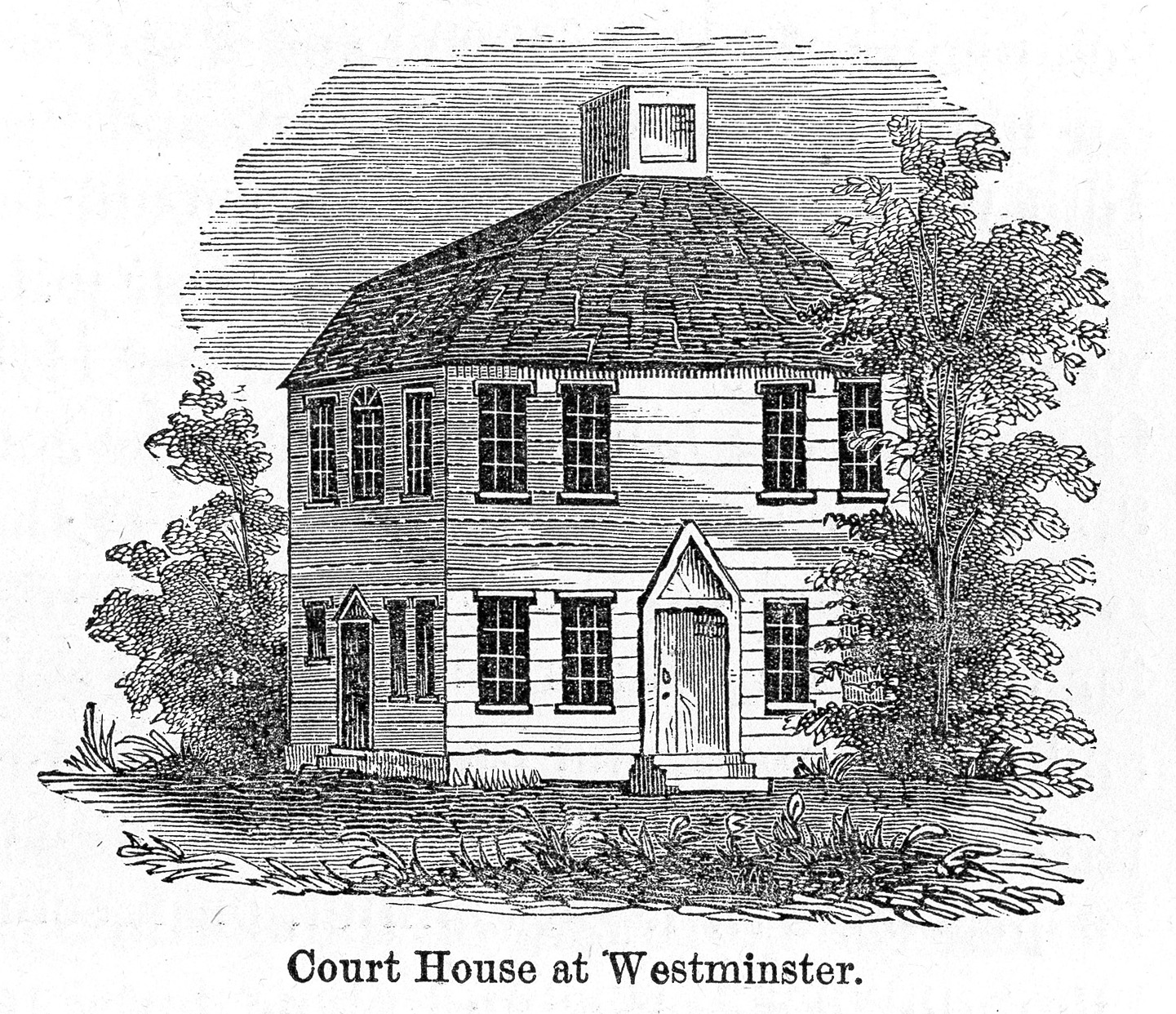
During the March 1775 fighting around the Westminster courthouse (shown above), Richard Hill aided the New York sheriff before being grabbed by the Green Mountain Boys. A Northampton committee set him free, and he hot-footed it to Boston.

As for John Hill, historians identify him as the man who was in New York City with William Cunningham on 6 March when they got into a fight with Patriots under the Liberty Pole. After being roughed up, Hill and Cunningham headed for Boston with their families. William Cunningham served as provost marshal there and later back in New York, becoming notorious among American prisoners of war.

In American Migrations, 1765-1799 Peter Wilson Coldham reports that David Cunningham was a baker in New York (earning £5 sterling per month, he said) who in 1775 was “forced to shelter at Westminster, a remote part of the country, with Mr. Richard Hill.” He may have been related to William Cunningham, but I found no indicators of that.

Charles Blasquet eludes me altogether. But it looks like Crean Brush hired men who had been his protégés in Westminster and/or his poorer relatives, and who had reasons to resent the Patriots.

TOMORROW: Search and seizure.

Saturday, February 28, 2026

“Acts of government could be resisted when they threatened the essential rights”

Jack Rakove is the William Robertson Coe Professor of History and American Studies emeritus at Stanford University, with parallel appointments in political science and law.

He’s the author of respected books of Revolutionary-era history, including Original Meanings: Politics and Ideas in the Making of the Constitution (winner of the Pulitzer Prize for History in 1997), James Madison and the Creation of the American Republic, and Revolutionaries: A New History of the Invention of America.

In other words, Rakove has worked largely in political history and how the Framers translated ideas into laws and policies for the new nation. When he uses the term radical, as in his 2020 book Beyond Belief, Beyond Conscience: The Radical Significance of the Free Exercise of Religion, he’s talking about the ideas of the Founders in their eighteenth-century context, not about the importance of now noting how hierarchical those men’s lifestyles were.

That’s something to bear in mind while reading Rakove’s essay for the Washington Monthly earlier this month, “Playing the Grinch at America’s 250th Birthday Party.”

In that essay Rakove writes:
Last June, I attended a conference on The American Revolution and the Constitution held at the American Enterprise Institute in Washington. It was the seventh of eight conferences that AEI has been holding on the 250th anniversary of independence. Given its conservative orientation, any conference sponsored by AEI would predictably take a celebratory turn, and so did this one. My own paper on “The Invention of American Constitutionalism” fits well within that framework. . . .

Yet at the conference dinner that followed, I became the grinch who wanted to rob the other happy campers of their semiquincentennial joy. Yuval Levin, our gracious host and convenor, started our post-dessert conversation by asking me, “What do you think the celebration of the 250th anniversary of independence will be like?”

“I think it is going to be a complete disaster,” I replied, and offered a few reasons to support that view. The most important one, directly relevant to our subject, was that the constitutional system is lurching toward collapse and outright failure.
That link leads to Rakove’s article from last June, “It’s Not Just a Constitutional Crisis in the Trump Era. It’s Constitutional Failure.” Having spent a career studying how the Constitution was supposed to work, he’s watching it not work that way at all.

Rakove discerns some hope in what his graduate-school colleague Pauline Maier described as “extra-legal resistance” in her excellent book From Resistance to Revolution:
In the colonies as in Britain, communities believed that certain acts of government could be resisted when they threatened the essential rights and interests of the king’s subjects. Various kinds of uprisings, riotous events, and militant protests did occur during the colonial era of our history. From the perspective of imperial officials representing the British crown, these protests were illegal acts to be repressed or punished. Ship captains in the Royal Navy believed they were acting legally when they forcefully impressed sailors for their warships. Merchant seamen, shipyard workers, or ordinary individuals innocently strolling the streets thought otherwise. When anti-impressment riots occurred, they enjoyed the community’s full support.

This tradition was well established before the Stamp Act Crisis of 1765 disrupted imperial politics. Some of the earliest protests against the Stamp Act were indeed too violent. It was one thing to intimidate individuals who thought they had received lucrative appointments as stamp collectors into resigning their commissions. That was the easiest way to halt the enforcement of the Stamp Act. It was another matter entirely to ransack the residences of royal officials, notably including the Boston mansion of Thomas Hutchinson, lieutenant governor and chief justice of Massachusetts. . . .

In the past few weeks, Minneapolis has become our Boston, and its citizens have become modern Sons of Liberty. Far more important, they and their counterparts in other communities have unknowingly revived the strategy of resistance that American communities deployed between the Stamp Act Crisis of 1765 and the crisis of independence. Blowing whistles, tailing ICE and Border Patrol vehicles, blaring airhorns outside the hotels where their agents are hopefully spending sleepless nights—these are modern versions of the extra-legal resistance that Maier described.
The protesters aren’t the only people behaving outside the law, however. The Trump administration continues to put unconstitutional pressure on Minneapolis, this past week announcing a freeze on paying for medical benefits for anyone in the state of Minnesota. It’s tried that tactic before through the Department of Agriculture, and been stopped by federal courts, repeatedly. That sort of tyrannical action naturally prompts protests.

Monday, December 29, 2025

Wartime with “A New-York Freeholder”

“A New-York Freeholder” didn’t continue his newspaper debate with Israel Putnam, quoted over the last two days.

Hugh Gaine had published long essays from the “Freeholder” addressed “To the Inhabitants of North-America” in five successive issues of the New-York Gazette from 12 September to 10 October. One of those essays even crowded out other items.

The main target of the “Freeholder” was the Continental Congress and the ideology that led to it. His last essay criticized military preparations in New England and calls for non-importation. He treated Putnam’s letter about the “Powder Alarm” as simply a symptom of a deeper problem.

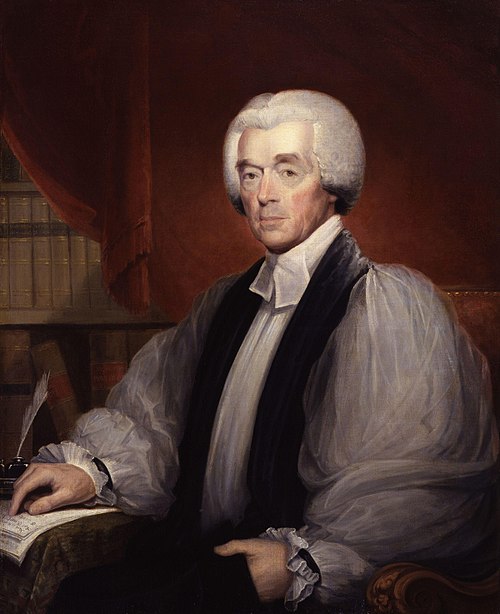
The “New-York Freeholder” was the Rev. Charles Inglis (1734–1816), recently made the senior curate at Trinity Church in New York. He was a native of Ireland but attached to the Anglican Church, even arguing for the unpopular idea of bishops in North America.

(This was not the Charles Inglis who commanded H.M.S. Lizard in 1770–71, H.M.S. Salisbury in 1778–80, and H.M.S. St. Albans in 1780–83, and who made one previous appearance on Boston 1775.)

According to the Rev. Mr. Inglis, he ceased his “Freeholder” essays after deciding that the Congress was hopelessly committed to “revolt and independency,” based on its adoption of the Suffolk Resolves and the proclamations it issued in mid-October 1774. So he never responded to Putnam.

After Thomas Paine issued Common Sense in early 1775, Inglis composed a reply titled The Deceiver Unmasked, printed by Samuel Loudon. Soon after copies were advertised for sale, Patriots broke into Loudon’s shop, seized all the copies, and burned them. Inglis was able to have the pamphlet reprinted in Philadelphia under the title The True Interest of America Impartially Stated.

In mid-1776, Gen. George Washington attended Trinity Church. As the minister told it, a lesser American general asked him to omit the usual prayers for the king from the service. Inglis defiantly refused. A few months later, the British military kicked the Continentals out of the city.

Inglis spent the rest of the war inside British-occupied New York, having become the rector of Trinity Church. In June–July 1782 he pulled out the “New-York Freeholder” name again for six essays in Rivington’s New-York Gazette.

The next year Inglis and his family moved to Britain, though most of the Trinity Church congregation went to Halifax. In 1787 the Crown sent him back across the Atlantic to be bishop of Nova Scotia—the first Anglican bishop in North America.

Saturday, October 25, 2025

“Mr. Bass was conducted into his deviations”

The Rev. Edward Bass of Newburyport was under pressure from both sides during the Revolutionary War.

As a minister in the Church of England, still feeling personal loyalty to the Crown, he tried to avoid complying with the independent governments’ demands.

But that exposed him to attacks from the Patriot populace. On 4 May 1782 the Rev. Jacob Bailey (1731–1808, profile shown here), an Anglican minister who moved around the New England frontier, wrote to the Society for the Propagation of the Gospel in Foreign Parts (S.P.G.) in London:
I am very confident, both from the repeated assertions of Mr. Bass himself, and other circumstances, that he refused to read the Declaration of Independency, and he became, on that account, extremely obnoxious to the violent party.

I am certain that he was publicly reported for a Tory, and I was, one evening just upon my arrival at his house, witness to a scene equally ludicrous and indecent, for as he was returning from an entertainment with his wife, he was pursued along the street by near two hundred persons, who pelted him with dirt and stones, and treated him with the most indelicate language.
Meanwhile, Anglican ministers who had fled New England complained that Bass was too compliant toward the Patriot authorities. The Rev. Joshua Wingate Weeks of Marblehead reported that Bass had preached in support of American soldiers—and he said he’d heard that from Bailey.

Bailey wrote his 1782 letter to refute that charge. He recalled:
being compelled to leave my family to avoid confinement on board a guard ship, I wandered through the country, and about the middle of November came to Newburyport, and was at Church on a day of public thanksgiving appointed by the Congress. Mr. Bass desired me to preach, but I refused, assuring him that I would never deliver a charity sermon to collect money for clothing the rebel soldiers.

This I repeated soon after to Mr. Weeks, but, as nearly as I can remember, Mr. Bass gave us a general discourse, without descending to particulars, or even mentioning the occasion of the solemnity. After sermon, the collection was made. Many refused to contribute, and a lady of some distinction declared with a spirited voice, “I will never give a single penny towards the support of rebels.” This bold declaration was perhaps the occasion of my retaining the above in my memory.

On the whole, I am persuaded that Mr. Bass was conducted into his deviations, not from even the least inclination to the cause of the revolters, but from a mistaken zeal for the Church, which, he imagined, in some measure, would justify his compliance.
As noted yesterday, by 1776 Bass had stopped receiving the half of his salary paid by the S.P.G. Later in the war he realized his situation was even worse: the organization had marked the St. Paul’s pulpit as empty, no longer recognizing his existence as a minister.

TOMORROW: Routes to reinstatement?

Tuesday, October 14, 2025

Lt. Browne “hearing the drum beat to arms”

Yesterday I finally noted that Capt. William Browne, who was in the thick of the action in early 1775 as a spy and an army officer, had also been in Boston from 1768 to 1770. He was then a lieutenant in the 14th Regiment.

In fact, we might have Capt. Browne’s description of the night of the Boston Massacre.

After that confrontation, the army and the Loyalist justice of the peace James Murray compiled testimony from soldiers and officers about their side of the conflict. Customs Commissioner John Robinson carried those depositions to London, where they were published in a book titled A Fair Account of the Late Unhappy Disturbance at Boston.

One of those depositions, dated 13 March, reads:
I William Brown, junior, lieutenant in the 14th regiment of foot, do swear, that on the evening of Monday the 5th of March, 1770, being in company with lieutenant [Daniel] Mattear, ensigns [William] Napier and [Henry] Hallwood, in the quarters appropriated for part of the officers of the 14th regiment, between the hours of nine and ten o’clock, I was alarmed with an extraordinary ringing of bells, and the words “Turn out,” which continued some time, and then ceased a little; but on the bells beginning to ring again, and hearing the drum beat to arms, I prepared to go to the barracks;

at this time, captain lieutenant [John] Goldfinch coming in, the gentlemen then ready went along with him, leaving lieutenant [Alexander] Ross and myself, who presently followed. All along Queen’s-street, and King-street, we were pursued by a number of people with clubs and sticks, calling out, “Here goes two more; kill them, kill them;”

on turning into Quakers-lane, I received a blow across the neck with a stick thrown at me, another being aimed, passed with great violence, and numbers rushing in, I was separated from lieutenant Ross, and followed with the cries, “Down with him, kill him, kill him,” and other opprobrious language, to the middle of Green’s-lane, where they left me; from thence I got safe to the barracks.

WILLIAM BROWN, junior,
Lieutenant of the 14th regiment.
I say this might be the same officer as the man who was later Capt. Browne of the 52nd because the Army Lists for 1767 and 1771 show there were two lieutenants named William Browne in the 14th during its time in Boston.

When I first saw “William Brown, junior,” I thought that might indicate this man’s father was also named William Brown, offering another (thin) clue to his identity. But it’s also possible that the deponent used “junior” to distinguish himself from the older Lt. Browne in the same regiment.

All of the officers Browne named, plus Ens. Andrew Lawrie, provided similar testimony. Capt. Goldfinch also described breaking up a fight earlier that night, and Ens. Napier said a woman told him the bell-ringing “war to raise the inhabitants against the soldiers.” All that could easily be read as evidence of Bostonians being hostile and violent toward British army officers for no reason.

Closer reading shows, however, that Lt. Browne and his colleagues went out into the street after the Massacre. They heard a long stretch of bells, shouting, and other cacophony. Then the noise “ceased a little” as the crowd absorbed the effect of the shots. Finally, the officers heard more bells along with the army drums summoning all the soldiers to their barracks. Browne and his fellows in the 14th headed for those buildings, running into townspeople upset that soldiers had shot a dozen of their neighbors.

TOMORROW: The frustrating Capt. Goldfinch.

Wednesday, October 01, 2025

Bell-Ringing on Special Occasions

Yesterday I looked at the daily schedule for ringing the bells of Boston’s meeting-houses in the 1740s.

I presume those bells also rang for their primary purpose, summoning congregants for services on Sunday.

Beyond that weekly routine, church sextons rang (or arranged for someone else to ring) the bells on various special occasions.

Bells were supposed to signal town meetings, for example. In September 1747 many North Enders complained that no bell had sounded in their neighborhood that morning, so the citizens agreed to postpone that day’s meeting until 3 P.M. The selectmen gave orders “that the Bells be rung throughout the Town.”

The selectmen also ordered sextons to ring their bells for celebrations: on imperial holidays, in response to news of military victories against the French, and when a high-ranking dignitary came to town.

Church bells rang in mourning, as when Boston received word that George II had died. And each meetinghouse’s bell was rung for a funeral, though on 12 May 1747 the town government moved to regulate that practice:
That for the Burial of any Person within the Town of Boston there shall not be more than the Bells of two Churches toll’d and that but twice at each Church on Penalty of Twenty shillings for each Bell more that shall be Toled at one and the same Funeral to be paid by him that shall order Procure or Tole the same.——

The second or Passing Bell not to exceed one hour and half after the first on Penalty aforesaid.——

That any Person demanding or Receiving any more than the Selectmen shall allow for twice Tolling said Bell at one Funeral shall forfeit the Sum of Twenty shillings.
Boston’s Whigs made a sonorous point on the second anniversary of the Boston Massacre, as the Boston Gazette reported: “the Bells muffled toll’d ’till Ten.”

Of course, church bells had also played a role in that 1770 event. After Pvt. Hugh White clubbed barber’s apprentice Edward Garrick, some of the boy’s friends got into the Old Brick Meeting-House to ring its bell. An unscheduled ringing was a fire alarm, but could also be useful in bringing out a crowd for a riot.

You can find more sources on public bells in eighteenth-century Boston in this article from the Colonial Society of Massachusetts.

TOMORROW: A new sound in Boston.

Tuesday, September 02, 2025

“This Hawkshaw drew his sword upon us”?

Last week I wrote about some letters entrusted to Dr. Benjamin Church on 21–22 Apr 1775 which ended up in the files of Gen. Thomas Gage.

We have evidence that Gage or his staff actually read those letters for the intelligence they contained—because they got someone in trouble.

Thomas Hawkshaw was a lieutenant in the 5th Regiment of Foot, having served at that rank since 1771. He was involved in or witness to several conflicts in the first months of 1775.

In late January, Don Hagist reminded me, Lt. Col. George Maddison presided over an army court of inquiry into the actions of Lt. William Myers of the 38th. Myers testified that on 20 January two local men had baited him by calling, “The General was a Rascal” and even “The King was a Rascal.” After Myers “knocked down the man who had spoke in this manner,” the town watch showed up, bringing on a bigger confrontation.

Lt. Hawkshaw was among the witnesses in that inquiry. So, however, were more than twenty other army officers, a former army officer, seven enlisted men, two watchmen, and two civilians. That inquiry ended without apparent action on 28 January.

Four days later, on 1 February, Benjamin Alline and Philip Bass filed a complaint to Lt. Col. William Walcott of the 5th about Lt. Hawkshaw. According to Bass, he was escorting a young woman south of Liberty Tree about 9:30 P.M. the previous night, and Hawkshaw and another officer accosted them. After that confrontation, Bass went to an apothecary for a cut on his arm.

Lt. John Barker wrote in his diary for that day: “Lieut. H–ks–w of the 5th put under Arrest for having been concerned in a Riot yesterday evening, in which an Inhabitant was much wounded by him; it is supposed He will be brought to a Court Martial.”

Hawkshaw insisted, however, that he’d been in bed by 9:00 P.M. There’s no record of a formal army inquiry, so perhaps he found witnesses to confirm that and the locals had to let the matter drop.

Years back Prof. Gene Tucker of Temple University sent me transcriptions from the reminiscences of a Revolutionary War veteran named Samuel Cooper (1757-1840). He recounted several anecdotes about conflicts in Boston, but the details don’t match contemporaneous accounts, suggesting that Cooper was working with secondhand knowledge and faulty memory.

One incident stands out because Cooper said he was personally involved in it:
A party of young men, consisting of Benj. Eustis, his brother Geo[rge]., Jno. Cathcart, Ben Hazzard, Tim Green, Jim Otis, & myself had assembled about 9 o[’]cl[oc]k in the even[in]g at the corner of one of the streets, when we were approached by several officers, among them was a Lt. Hawkshaw of the 5th. We were comm[an]d[ed]. to disperse & go home & on our declining to do so this Hawkshaw drew his sword upon us but he had hardly time to raise it before he was disarmed by some of our party & the sword broken over his head; the rest of his associates withdrew.
Cooper didn’t specify when this happened, and frankly I doubted it happened as he described. In some of these fights an officer might lose his sword, as Ens. Henry King did in the January fracas. But this quick Yankee triumph sounds too good to be true, and no other report matches it.

Lt. Hawkshaw seems to have been very visible during those months in Boston. People complained about him by name while not identifying other officers who were with him. Or possibly Hawkshaw had become unpopular with the locals because of his testimony in the Myers inquiry, so people were eager to cast blame on him. But he was never brought to a court-martial.

In early April the lieutenant testified in the army inquiry about the dispute between his regimental commander, Lt. Col. Walcott, and Ens. Robert Patrick, discussed here.

And then came the Battle of Lexington and Concord.

TOMORROW: Shot in the face.

Monday, May 12, 2025

Thomas Newell and “that Detestable Tea”

Thomas Newell’s diary makes clear that he opposed Parliament’s tea tax in 1773, as most Bostonians did. On 2 December, for instance, he wrote about James Bruce bringing in the Eleanor with “116 Chest of that Detestable Tea.”

But what did Newell do to support that stance?

On 17 November the young man made clear he didn’t participate in the attack on the Clarke family’s warehouse, discussed back here: “This evening a number of persons assembled before Richard Clarke’s, Esq., one of the consignees of tea; they broke the windows, and did other damage. (I was at fire meeting this evening.)”

On 2 December, the same day Capt. Bruce arrived, Newell’s diary contains one of the longer bits of cipher in the diary. The word “Junr” is legible among the little symbols, and a squiggle that doesn’t fit the cipher turns out to be “St.” What was Newell hiding?

Not a whole lot, it turns out. Once deciphered, the line reads: “This Eving. was at St. Andrew’s Lodge, I was chosen Junr Deacon of said Lodge.” Well, good for Thomas Newell.

Some people credit that lodge of Freemasons with being at the heart of the anti-tea operation. (None give it more credit than the lodge itself.) And indeed Newell got more involved the next night.

On 3 December, Newell recorded: “This evening I was one of the watch on board of Captain Bruce (with twenty-four more), that has tea for the Clarkes & Co.” That patrol was to keep the tea from being landed so the tax could be collected.

Finally, here’s Thomas Newell’s account of 16 December:
Town and country sons mustered according to adjournment. The people ordered Mr. [Francis] Rotch, owner of Captain [James] Hall’s ship, to make a demand for a clearance of Mr. [Joseph] Harrison, the collector of the custom house (and he was refused a clearance for his ship). The body desired Mr. Rotch to protest against the custom-house, and apply to the governor for his pass for the castle. He applied accordingly, and the governor refused to give him one. The people, finding all their efforts to preserve the East India Company’s tea, at night dissolved the meeting. But behold what followed the same evening: a number of brave men (some say Indians), in less than three hours emptied every chest of tea on board the three ships, commanded by Captains Hall, Bruce, and [Hezekiah] Coffin (amounting to 342 chests), into the sea.
Was Newell among those “brave men”? I’d guess not. But he surely knew some of them.

A couple of details struck me Newell’s writing about the Boston tea protesters. First, he consistently referred to the people meeting in Old South Meeting-House as ”sons of liberty.” He didn’t worry about calling them the “body of the people.”

Second, in Newell’s telling the crowd that afternoon was trying “to preserve the East India Company’s tea.” By having it shipped back to Britain, that is. Would be a shame if anything else happened to it.

TOMORROW: A mystery name.

Wednesday, April 23, 2025

“Putting all matters of politicks out of view”?

Esther Quincy married Jonathan Sewall in January 1764, after a courtship of more than four years.

She was the daughter of the Boston merchant and magistrate Edmund Quincy, who had come back from bankruptcy a couple of years before.

He was a young lawyer of sharp wit and moderate means trying to establish himself, building up from the position of justice of the peace.

Jonathan Sewall didn’t enter the political debate over the Stamp Act, but in December 1766 he came out swinging on behalf of Gov. Francis Bernard and royal policy in newspaper essays signed “Philantrop.”

The governor rewarded Sewall with appointments as the province’s solicitor general and then attorney general. He later got to be a judge in the Vice Admiralty Court as well.

Esther’s father was on the other side of the political divide. He was one of the justices the Boston Whigs called on when they had a complaint about a royal official or soldier. He joined other magistrates in resisting Gov. Bernard’s call for barracks in 1768. He took the (conflicting) testimony of Charles Bourgate after the Boston Massacre. He issued the warrant to arrest John Malcolm for assault.

Most of Esther Sewall’s other male relatives were also Whigs. Uncle Josiah Quincy, Sr., in Braintree was on the Council, one of several thorns in the royal governors’ sides. Cousin Josiah, Jr., practiced law in Boston, wrote newspaper essays, counseled local activists, and traveled to meet fellow Whigs in the southern colonies and London. The major exception within the Quincy family was cousin Samuel Quincy, who followed in Jonathan’s wake as the province’s solicitor general.

Many of Jonathan’s old friends were Whigs, including John Adams, and that produced some awkward social moments. Jonathan prosecuted John Hancock on smuggling charges (eventually dropping the case for lack of solid evidence). But in 1772 the merchant wrote to him expressing
my inclination and wish (putting all matters of politicks out of view) that a perfect harmony and friendship may be kept up between us, and wish rather more familiarity than the common shew of friendship expresses, considering the connection I have formed with the sister of your Lady.
That was Esther’s sister Dorothy. She became Hancock’s fiancée, their engagement almost as long as the Sewalls’ had been.

By 1774 the Sewalls were living in Cambridge in a country mansion bought from Richard Lechmere. Their household included three small children, three young men studying the law, and at least one enslaved young man.

Early on 1 September, Gen. Thomas Gage’s soldiers seized militia gunpowder in Charlestown and cannon in Cambridge. Around noon, Jonathan Sewall suddenly left home and headed to Boston. The governor might have sent for him, or he might have feared how the neighbors would react to the army operation. Or he might have had a whim.

After dark, those neighbors came to the Sewalls’ house. They refused to take Esther’s word that Jonathan was out. Some men pushed into the house, and the young men inside beat them back. One of those boarders, Ward Chipman, fired a pistol inside the house—some sources say accidentally, some not. Either way, that noise got everyone’s attention. The two groups of men agreed not to do further violence as long as they could enjoy some of the Sewalls’ wine.

Soon afterward, Esther took the children into Boston to be with Jonathan. That might have been as early as 2 September when the “Powder Alarm” brought thousands of militiamen into the street outside.

Unlike some people threatened by crowd violence, Esther Sewall never renounced Massachusetts. Her family ties were too strong. In 1778 she wrote to her father: “I had not forgot my own Country, and Friends no, my D[ea]r Father, I should as soon forget myself.” But as of September 1774 she was stuck inside Boston with her unpopular husband.

TOMORROW: Can this marriage be saved?

Wednesday, April 09, 2025

Richard Draper’s “Report of these Images”

As long as I’m discussing nomenclature for Boston’s political groups in the 1760s, I’ll tackle “the Union Club.”

America’s first public, outdoor demonstration against the Stamp Act took place along Boston’s main road on Wednesday, 14 Aug 1765. The big elm where the protesters hung effigies hadn’t yet been named Liberty Tree.

The next day, Richard Draper published his Boston News-Letter newspaper with a two-page supplement. It didn’t report on the protest, however—that sheet was entirely devoted to foreign news.

The News-Letter did print Gov. Francis Bernard’s 15 August proclamation of a reward for the rioters who had torn down stamp agent Andrew Oliver’s building the night before. That was the paper’s only description of the event.

Boston’s Whigs complained that Draper was tilting his coverage to please the royal government. In his 22 August issue the printer objected to the News-Letter being called “a Court-Paper…under the Controul of higher Powers.” He insisted:
IN regard to the Occurrences of last Week, we would observe, that it was out of our Power to give a perfect Account thereof, as the Transactions were not finished, and a partial one would perhaps have drawn down the Resentment of many of the true Sons of Liberty, and caused us to be more in Fear, than it is said were of publishing any Thing relating thereto:—

Had the Gentleman who furnished one of the Papers with a decent Account of the Affair, been so kind as to have sent us something of the same Nature, he would have saved himself the Trouble (if he really took the Trouble) to inform the Public that we filled an extraordinary Half Sheet with immaterial Foreign Articles.
The News-Letter’s account of the anti-Stamp Act protest, “as concise and true…as it is in our Power,” followed. In the details it agreed with the Monday newspapers, but it also included several sarcastic zings at the protest.
VERY early on Wednesday Morning, the 14th Instant, were discovered hanging on a Limb of the Great Trees, so called, at the South Part of this Town, two Effigies, one of which by the Labels appeared to be designed to represent a Stamp-Officer, the other a Jack-boot, with a Head and Horns peeping out of the Top. said by some of the Printers, to be the Devil or his Imp; but, as we are not acquainted with that Species of Gentlemen, we cannot so well determine whether it was an exact Resemblance or not:

The Report of these Images soon spread thro’ the Town, brought a vast Number of Spectators, and had such an Effect on them that they were immediately inspired with a Spirit of Patriotism, which diffus’d itself through the whole Concourse: So much were they affected with a Sense of Liberty, that scarce any could attend to the Task of Day-Labour; but all seemed on the Wing for Freedom.

About Dusk the Images were taken down, placed on a Bier, (not covered with a Sheet, except the Sheet of Paper which bore the Inscription) supported in Procession by six Men, followed by a great Concourse of People, some of the highest Reputation, and in the greatest Order, ecchoing forth, Liberty and Property! No Stamp! &c—

Having passed through the Town-House, they proceeded with their Pageantry down Kingstreet, and it is said intended for the North Part of the Town; but Orders being given, they turned their Course thro’ Kilbystreet, where an Edifice had been lately erected, which was suppos’d to be designed for a Stamp-Office.

Here they halted, and went to work to demolish that Building, which they soon effected, without receiving any Hurt, except one of the Spectators, who happened to be rather too nigh the Brick Wall when it fell: This being finished many of them loaded themselves with the wooden Trophies, and proceeded (bearing the two Effigies) to the Top of Fort-Hill; where a Fire was soon kindled, in which one of them was burnt; we can’t learn whether they committed the other to the Flames, or if they did whether it did not survive the Conflagration, being its said like the Salamander conversant in that Element.—

The Populace after this went to work on the Barn, Fence, Garden, and Dwelling-House, of the Gentleman against whom their Resentment was chiefly levelled, and which were contiguous to said Hill; and here entering the House they bravely showed their Loyalty, Courage, and Zeal, to defend the Rights and Liberties of Englishmen:——

Here, it is said, by some good Men that were present, they established their Society by the name of The Union Club.—

Their Business being finished, they retired, and proceeded to the Province-House, which was at about 11 o’Clock, gave three Huzzas, and all went quietly home.
The report went on to events of 15 August: Oliver’s resignation and an aborted action against Lt. Gov. Thomas Hutchinson’s house.

The 19 August Boston Gazette offered a detailed and favorable description of the protest in its own two-page supplement. The same day’s Boston Evening-Post printed a positive report from “A.Z.,” who also got in the dig at Draper’s paper. The Boston Post-Boy, friendly to the royal government, ran nothing. None of the three Monday papers reprinted Gov. Bernard’s proclamation.

TOMORROW: The long and short of “The Union Club.”

Saturday, March 08, 2025

“Westminster Massacre” Sestercentennial Commemorations, 13–15 Mar.

This month, the town of Westminster, Vermont, is celebrating the Sestercentennial of the “Westminster Massacre,” a clash that began over land titles and ended in the death of two men.

In the 1760s both New York and New Hampshire claimed the land between Lake Champlain and the Connecticut River. Gov. Benning Wentworth of New Hampshire granted lots of real estate in six-mile-square town lots between 1749 and 1764. Meanwhile, the New York government issued larger, irregular land patents to wealthy landlords. Each set of claimants complained about the other.

In July 1764 the British government declared all that territory belonged to New York. By this time, a fair number of farmers from New England, particularly Connecticut, had moved into the region. The New York patentees demanded those settlers buy that land, pay rent, or leave. In 1770 the top court in New York confirmed that the New Hampshire land titles were invalid.

For the next few years, there were lots of disputes between settlers with New Hampshire titles and “Yorkers,” rent collectors or farmers arriving from New York with solid legal claims. The Green Mountain Boys formed as an unofficial militia to intimidate Yorkers. Settlers held conventions modeled after those in the rebellious colonies, but they focused their ire on New York, not the imperial government.

On 14 Mar 1775 a court session was scheduled to take place in the town of Westminster. Judge Thomas Chandler held a commission from New York, and his docket included evictions of men with old titles from New Hampshire as well as a murder. Probably inspired by the shutdown of courts in Massachusetts in late 1774, about a hundred local men surrounded the courthouse on the evening of 13 March.

Sheriff William Patterson declared that assembly a riot and ordered the men to disperse. When they refused, the sheriff went to Brattleboro, where New York law had more support, and recruited a posse of 60 to 70 men.

By the time Patterson and his force returned, the protesters were holding the Westminster courthouse and jail. Once again, the sheriff ordered them to leave. Night fell, and the courthouse was still occupied. Patterson told his Yorker posse to open fire on the courthouse. Some men inside fired back, wounding a magistrate.

Sheriff Patterson and his men stormed the building, shooting and clubbing those inside when they resisted. During that melee, twenty-two-year-old William French was shot five times; he died before dawn. Another man, Daniel Houghton, was beaten and died from his injuries nine days later. Seven rioters were arrested and locked into the jail.

On 14 March, a crowd of “upwards of 500” men came into Westminster from nearby towns. They freed the seven prisoners and locked up Patterson and his Yorkers. This mob then proceeded to Brattleboro, breaking into other Yorkers’ homes to arrest more men and bring them to the Westminster jail.

Benjamin Bellows, a militia captain from Walpole, New Hampshire, arrived with his company to restore order, but for local authorities, not New York. The Yorker leaders accused of killing French were taken to Northampton, Massachusetts.

Ultimately, the outbreak of the Revolutionary War overshadowed all these events. Between the overlapping jurisdictions, the end of royal rule, and more immediately pressing matters, no one was ever tried for the actions in Westminster.

Some local historians cast the “Westminster Massacre” as the first fatal battle of the Revolutionary War. I view it, like the 1766–1771 Regulator movement in North Carolina, as a parallel conflict, but not one that involved the core dispute of the Revolution between the royal government and colonists resisting new taxes. The lines weren’t tightly drawn: while Patterson became a Loyalist, Chandler and Bellows supported American independence.

The Westminster Historical Society has created an exhibit on the conflict 250 years ago in the Town Hall museum, and it will host three commemorative gatherings.

Thursday, 13 March, 3:30 P.M.
Walk from the Azariah Wright house site (corner of Sand Hill Road and Route 5) to the town cemetery. Wright’s house was one of the gathering-places for the men who closed the court. This walk is about fifteen minutes. The event is all outdoors with no bathroom.

Friday, 14 March, about 4:00 P.M.
Gathering at the D.A.R. Courthouse Marker on Shattuck Road, celebrating how the crowd took back the courthouse. Ray Boas of the Walpole Historical Society will deliver remarks about Col. Bellows and his militia company preventing further bloodshed.

Saturday, 15 March, 6 P.M.
The museum will open to share the exhibit, remarks by public officials, refreshments, and bathrooms. At 7:00 there will be a twilight vigil at William French’s grave site on the anniversary of his burial. This is the event designed for visitors from outside the region. There will be parking behind the Post Office on the other side of the road.

For more about Westminster history, see Jessie Haas’s books Revolutionary Westminster and Westminster, Vermont, 1735–2000: Township Number One.

Monday, January 13, 2025

“Growing Up in the Gore Family” in Waltham, 19 Jan.

On Sunday, 19 January, I’ll speak at Gore Place in Waltham on “Growing Up in the Gore Family: Class and Conflict in Revolutionary Boston.”

That estate was built by Christopher and Rebecca-Payne Gore in the early republic after they returned from a diplomatic mission. Christopher had made his fortune as an early corporate lawyer, setting up some of the region’s first large industrial companies.

Among those companies was a glass factory co-owned by Christopher’s older brother Samuel and their twice-over brother-in-law Jonathan Hunewell. That factory supplied the glass for the mansion’s first windows.

But I’m going to talk about the American Revolution before America’s Industrial Revolution. As the event description says:
Christopher Gore grew up in a family on the verge of entering Boston’s genteel class. The Gores were active in the Revolutionary resistance—organizing protests at Liberty Tree, hosting spinning bees for Daughters of Liberty, and even being hurt in a riot before the Boston Massacre. But as that conflict heated up, Christopher’s father chose to side with the royal government and left America in 1776. This talk explores the difficult choices that one family worked through.
If that sounds staid, rest assured there’s bloodshed, bigamy, effigies, and weapons theft along the way.

This event is scheduled to start at 3:00 P.M. After we’re done with questions, attendees will have a chance to walk through the mansion. The cost is $10, free to Gore Place members and through Card to Culture. Reserve tickets through this link.

Tuesday, December 17, 2024

“Best to remove farther off in the country”

On 3 Feb 1787, Sarah Cochran appeared before the Loyalists Commission in Saint John, New Brunswick.

She described how her husband John “went to Boston with Govr. [John] Wentworth” in late August 1775, as recounted here.

At the time, she and at least some of her children were living on the family farm in Londonderry. According to the Loyalist leader Abijah Willard, another commission witness, the Cochrans’ “Land was in a very good part of the Town, near the meeting house.“

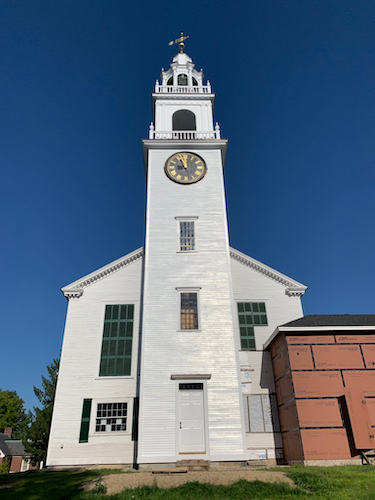
(The picture here shows the First Parish Meetinghouse in Derry, New Hampshire, which might be the building Willard referred to. The oldest part of this church dates to 1769. It’s been significantly enlarged, and the impressive tower went up in 1822.)

Sarah Cochran testified that around October:
about 2 months after he went, she was ordered to quit the Premises, which she did & was moving her goods, on which a Mob rose & took every thing she had, calling them ye goods of a Tory. She got part back, but lost to amount of £150 lawful.
Unfortunately for us, Sarah didn’t recount where she went. Possibly she took refuge with her own family, or even with other members of the Cochran clan who were siding with the rebels.

We know Sarah didn’t follow her husband into Boston that fall, or to Halifax and then New York the following year. Instead, the next sign of her appears in the 29 May 1777 Independent Chronicle of Boston, publishing an “Extract of a letter from John Cochran, on Long-Island, to his wife in New-Hampshire, intercepted with others sent by the late Governor Winthrop to his sister”:
My Dear,

I would willingly advise, but know not how or what to advise you to at this distance. I shall leave it intirely to your judgment what you think best to be done in these unhappy days, for I am so puzzled about giving my advice what to do, that I am almost crasy.

However, I think upon the whole, it would be best to remove farther off in the country, as I am afraid you will suffer where you are, before it will be in my power to protect you, as there will be nothing but destruction of property without any reserve. In that case, I would have you send off the most valuable effects you have left to some place, if you know of any.

I shall either hope to find you at the Isle Shoals, or up at Londonderry—If you intend to tarry where you are, I pray for God’s sake that there be no CLERGYMAN in the house; if their is, your life is not worth a farthing as the whole race of that tribe will be spilt.

If you see any prospect of the affairs being given up without bloodshed, I had rather find you at Hampton than any where else…
I don’t know why Cochran was so anxious about his wife giving refuge to a minister. It’s possible that the family was Presbyterian and feared their ministers would be suspected of disloyalty by New England Congregationalists.

In June 1779 the New Hampshire legislature moved to confiscate the property of men away from the state and “residing with the enemys thereof.” Its new law listed individual names starting with former governor Wentworth, Surveyor General Samuel Holland, and one-time Stamp Act administrator George Meserve. The fourth name was John Cochran.

TOMORROW: Serving the Crown.

Monday, November 25, 2024

“Admiral Renegado, came to anchor in Port Despair”

At the start of February 1770, the big news in Boston was the non-importation movement, and particularly the weekly demonstrations by schoolboys in support of it.

That is to say, every Thursday when the schools let out early, gangs of boys would converge on the shop of someone who hadn’t signed the non-importation agreement, set up a picket line, and shout insults at that shopkeeper and his or her customers. If the kids were feeling feisty, they’d throw snowballs and mud as well.

The Boston Chronicle, which opposed the movement, responded on 1 February with a fictional advertisement:
Intended speedily to be acted,
By a Company of young Tragedians,
A TRAGEDY
(Not acted here these seventy-eight years,)
called the
W I T C H E S,
With many Alterations and Improvements.
(The full item is quoted back here.)

That slammed the Whigs’ boycott, tweaked the town’s ban on theater, and poked at the sore spot of the Salem witchcraft trials all in one. It was masterful trolling before that term was invented.

Four days later, the Boston Chronicle fictionalized another common newspaper item with this start:
S H I P   N E W S.
January 25, 1770.
Last Tuesday Evening the “Well disposed” [i.e., Whiggish] fleet, under the command of ADMIRAL RENEGADO, came to anchor in Port Despair, having left their stations that morning in great confusion on the appearance of an English VICE ADMIRAL, with the British STANDARD flying at the mast head.
This was commentary on how William Molineux led a crowd to confront Lt. Gov. Thomas Hutchinson’s two importer sons at his house—an action that even Josiah Quincy, Jr., had warned could be treated as treason—and how that action had fizzled out.

Exactly one month after the second article, the Boston Massacre occurred. To defuse tensions in the streets, Hutchinson decided to have the 29th and then the 14th Regiments moved to Castle William.

As a result, in the following months there was no governmental force in the streets of Boston strong enough to deter the Whigs and their supporters. Crowds tarred and feathered Customs officer Owen Richards in May and threatened Scottish merchant Patrick McMaster with the same punishment in June.

In that atmosphere, I suspect, the printing staff of the Boston Chronicle didn’t feel safe publishing another item lampooning and lambasting the local Whigs. Somebody in that shop—or perhaps more than one somebody—composed a long article that built on three items the paper had already run:
  • Caricatures of prominent Whigs like “Tommy Trifle” and “Johnny Dupe” from October 1769’s “Outlines of the characters of…the Well-Disposed.”
  • The fake theatrical announcement.
  • The name “Admiral Renegado.”
Instead of publishing that piece in their own newspaper, however, they sent it to Anthony Henry in Halifax. Obviously, disguised gossip about Bostonians had less meaning for readers in Nova Scotia. But after he ran the piece on 8 May, it could filter back to its targets without sparking a riot. Not that any Boston printer dared to reprint it.

The October 1769 “Outlines of the characters of…the Well-Disposed” is always attributed to John Mein, publisher of the Boston Chronicle. He left a written key confirming the targets, so he was obviously involved in the production. But someone at the Boston Chronicle must have carried on in the same mode after Mein was driven away the next month. That person most likely wrote the piece published in Halifax.

TOMORROW: The most likely author.

Wednesday, October 23, 2024

“Another Mob to search for Ebenezer Richardson”

Ebenezer Richardson reportedly went into hiding in Philadephia in mid-October 1773, just as the tea crisis heated up.

For the next several weeks the biggest American ports were focused on the East India Company tea.

Richardson’s employers and protectors, the Customs Commissioners, took shelter at Castle William in Boston harbor, and probably others in the department were also lying low.

On 25 Jan 1774, a Boston mob attacked another Customs officer, John Malcom. He had threatened a boy and then clubbed the small shoemaker George Robert Twelves Hewes.

When local authorities tried to convince the crowd to release Malcom, men answered “that in case they let him go they might expect a like satisfaction as they had received in the cases of Richardson and the soldiers, and the other friends of government.” People resented Richardson’s royal pardon and didn’t want a repeat, just as they didn’t like the acquittals after the Boston Massacre.

The attack on John Malcom continued and became one of the most vicious and infamous of the pre-war years.

Two days later, someone reported seeing Richardson himself in Boston. Richard Draper’s 28 January Boston News-Letter said:
It having been reported that the noted Ebenezer Richardson, was seen in Town, a Number of People were in Pursuit of him last Evening, but could not find him.
That same day, Gov. Thomas Hutchinson wrote to the Secretary of State, Lord Dartmouth, about the attack on Malcom and added:
there was an Attempt made to raise another Mob to search for Ebenezer Richardson, lately found guilty for Murder, but Judgment being suspended, His Majesty’s Pardon was applied for & obtained. He is now in some very inferior Employment in the Service of the Customs in Pensilvania, and it is thought a Report of his being in Town was spread for the sake of raising a Mob. Some of the more considerate People appeared & opposed the Leaders in the beginning of the Affair and put a Stop to it.
Hutchinson obviously believed Richardson was still in Philadelphia.

Richardson’s own statement to Dartmouth in January 1775 was skimpy on dates and other specifics about his movements:
after your petitioner was dischargd the Commissioners of the Customs Perocured for your Petitioner a place in Pennaslavania but the peopel of boston sent after and [???] the mob in Pennaslavania so that your petitioner could not shew his head there.
At some point in late 1773 or early 1774, Ebenezer Richardson did make his way back to Massachusetts.

TOMORROW: Meeting with the governor.

Tuesday, October 22, 2024

“Discovered skulking at the North-end of this city”

According to the Massachusetts Spy, when the Pennsylvania Journal printed its incendiary item about Ebenezer Richardson (quoted yesterday), people were already hunting for the man.

On 4 Nov 1773, Isaiah Thomas’s newspaper ran an “Extract of a Letter from a Gentleman in Philadelphia, to his correspondent in Boston, dated the 13th of October, 1773.” That was the same day that William and Thomas Bradford’s Pennsylvania paper published its alert.

The first paragraph of that letter was about the new Tea Act, Philadelphia merchants’ plans to respond, and concern about a report that “the duties on Tea have been regularly paid” in Boston.

The next extract said:
Your infamous Richardson, who has been concealed from public view until very lately, was yesterday haunted about, and very narrowly escaped. But a certain A. T———— who was supposed to have been his associate and patron here, was turned out of the Coffee-house in a very ignominious manner.—I pity him:—He always appeared to be decent and very civil; but to be subjected to a Murderer convict, is so injurious and unsafe, that his appointment here by the Commissioners could be only with a view to provoke to a riot: And if T——— made him his friend it could not be expected that the populace could well distinguish between them.
The Pennsylvania Journal had singled out this “A. T————” as “a Tide-Waiter” who’d said he’d work with Richardson if the Customs Commissioners ordered him to. I can’t identify him further, but folks who know the Philadelphia sources might. Clearly people in 1773 knew exactly whom the newspaper was referring to.

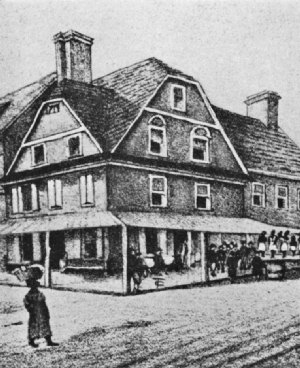
As for “the Coffee-house” that refused this man service, that was probably the London Coffee House (shown above, as drawn from William H. Ukers’s All About Coffee). The proprietor of that enterprise was none other than newspaper printer William Bradford.

A week later, the Bradfords’ 20 October Pennsylvania Journal proudly reported:
The description given in our last paper of the phiz of the Villain, EBENEZER RICHARDSON, being very accurate, he was last Monday [18 October] discovered skulking at the North-end of this city: and being closely pursued by many well-wishers to peace and good order, very narrowly escaped (by means of a wood) the TAR AND FEATHERS, which had several days before been prepared for HIM.—

As the city of Philadelphia is now, and forever must be too hot, to hold this Parracide, he will, in all probability, try his fortune in New-York; and if, contrary to expectation, he should not there meet his reward, but should experience another hair-breadth escape, he may probably, as a dernier Resorte, fly to the arms of his dear, dear P———, the surest and safest asylum for complicated Villainy, on this side the Atlantic.
“P———” was most likely Charles Paxton, Richardson’s longtime employer and one of the those Customs Commissioners in Boston.

TOMORROW: Back home in Massachusetts?

Monday, October 21, 2024

“Lurks about the wharves of this city”

Page 3 of William and Thomas Bradford’s Pennsylvania Journal for 13 Oct 1773 included a notice of a meeting of the American Philosophical Society and a proclamation from Gov. John Penn that the Crown had approved two bills the colonial assembly had passed back in March 1772 (a divorce and a naturalization).

In between those items was this announcement:
WHEREAS the infamous EBENEZER RICHARDSON, convicted of PERJURY and MURDER, has, at the instance of his special friend, Charles Paxton, been sent to this city as a pensioner to the —honorable Commissioners at Boston; and in consideration of his many special Services, has by them been rewarded with a quarterly payment, out of the money levied on the Americans, by an Act of Parliament, without their consent:

And whereas the said RICHARDSON, rioting in the spoils of his country, lurks about the wharves of this city, seeking an opportunity to distress the Trade of Philadelphia, and enslave America: And, in order more effectually to answer his vile purpose, has intimately connected himself with a certain T———, a Tide-Waiter here, who publicly declared “he would not only associate with the VILLAIN, EBENEZER, but with the DEVIL himself, if so ordered by the COMMISSIONERS,”

Now it is expected, that all Lovers of Liberty, in this Province, will make diligent search after the said RICHARDSON, and having found this Bird of Darkness, will produce him, tarred and feathered, at the Coffee-House, there to expiate his sins against his country, by a public recantation.

TAR AND FEATHERS.

N.B. The above RICHARDSON appears to be a man of 40 years of age, is about 5 feet 4 or 5 inches high, pretty thick and broad a-cross the shoulders, has a very ill countenance, and down look, [Cain’s Phyz,] mostly wears a flopped hat, a piss burnt cut wig, and a blue surtout coat, with metal buttons.
That’s quite a display of rhetoric. It makes something sinister from Richardson’s job in the Customs service: he “lurks about the wharves,” aims to “distress the Trade,” receives “a quarterly payment” (i.e., his salary). The item links him to “the DEVIL,” “Cain,” and a “Bird of Darkness.” It also contains the only physical description of the man that I’ve seen, not at all flattering. 

This article appears to have been written in Philadelphia by someone not fully familiar with Richardson’s long history in Massachusetts, picking up cues from Boston newspapers. The man was never “convicted of PERJURY,” to my knowledge. Bostonians called him a perjurer, including at the start of the riot at his house, because he’d deceived the public about his child with Kezia Hincher for several crucial months, and because painting him as a habitual liar let them cast doubt on his reports about smuggling and other activity.

The invocation of “TAR AND FEATHERS” is also striking because that public punishment hadn’t shown up in Philadelphia yet. Indeed, many Americans, even Whigs, viewed those incidents as New Englanders going too far. But the next month a broadside warning river pilots against bringing tea into Philadelphia would be issued by “THE COMMITTEE FOR TARRING AND FEATHERING.” (Or “Committee of Taring and Feathering,” as the next paragraph put it, showing the locals behind this threat were still working out details.)

Lastly, this newspaper notice overtly confronts the royal Customs service. It names one of the agency heads in Boston, verges on calling those men “[dis]honorable,” and refers to a local tide waiter by an initial everyone on the Philadelphia waterfront would recognize. That last seems like a clear threat.

TOMORROW: Results.