J. L. BELL is a Massachusetts writer who specializes in (among other things) the start of the American Revolution in and around Boston. He is particularly interested in the experiences of children in 1765-75. He has published scholarly papers and popular articles for both children and adults. He was consultant for an episode of History Detectives, and contributed to a display at Minute Man National Historic Park.

Subscribe thru Follow.it


•••••••••••••••••


Showing posts with label Amesbury. Show all posts

Sunday, February 11, 2024

The Families of Sylvanus Lowell
Looking at the vital records from various Massachusetts towns helps to fill in the details of the life of Sylvanus Lowell, the ship’s captain maimed by a cannon in December 1773.

But those records also show some gaps and mysteries.

The vital records of Amesbury show the future mariner born to Moses and Francis (usually spelled Frances) Lowell on 2 May 1746. His name was apparently spelled as “Salvenas,” which looks more like church Latin than classical. He had siblings named Sarah, Thomas, Moses, Affea, Daniel, and Willebe (Willoughby). Their mother died when Sylvanus was two.

The vital records of Bradford say that on 2 Aug 1770 “Silvanus Lowell of Amesbury” married Hannah Hopkinson, daughter of Ens. Solomon Hopkinson of Bradford. That marriage is also noted, without an exact date, in the Amesbury records.

The Bradford records add that Hannah Lowell died on 20 Sept 1771, or possibly 26 September, “in her 26th year.” Thus, Sylvanus Lowell quickly became a widower.

There’s no child listed of that marriage in Amesbury or Bradford. However, the Bradford records are notably sparse if you weren’t named Kimball. The next sign of the family appears in the vital records of Newburyport, which say that Hannah Lowell, daughter of Sylvanus and Hannah, was baptized there on 20 June 1775. Was this a daughter of the captain’s first marriage, baptized at about age four? There’s no answer.

Likewise, I’ve found no answer about Sylvanus Lowell’s second marriage to a woman named Elisabeth. She pops up in the Newburyport records as mother of several children by him:
  • Elisabeth, baptized 6 Oct 1776 and buried 3 Sept 1777.
  • Elisabeth, baptized 12 Apr 1778.
  • Harrison, baptized 30 Jan 1780, probably died young.
  • Sylvanus, baptized 12 Aug 1781.
  • Sally, baptized 2 Feb 1783.
  • Thomas, baptized 11 Sept 1785 and buried 3 Sept 1786.
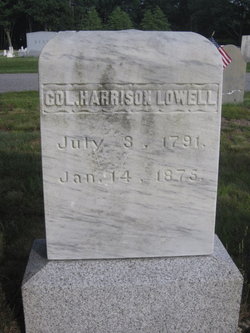
Newburyport also recorded the baptism of Harrison Lowell, son of Capt. Sylvanus and Elisabeth, on 29 Jan 1799. This may be the Maine legislator Harrison Lowell whose gravestone (shown above) gives his birthdate as 3 July 1791—though, again, that baptism would have been delayed.

Even more mysteriously, on 9 Mar 1791, Newburyport’s Essex Journal reported: “Died, Mrs. Lowell, wife of Capt. Silvanus Lowell of this town.” The vital records say that Elizabeth Lowell was buried that day. Obviously, she couldn’t have given birth to a son in July. Maybe the second Harrison was actually born in 1789 or 1790, and both the baptismal record and gravestone are off?

On 10 Oct 1791, just a few months after being widowed for the second time, Capt. Sylvanus Lowell married a widow about thirty-six years old named Elizabeth (McCard) Barriere or Berryer. She had a daughter, Fannie, from her first marriage.

I haven’t found any sign of Sylvanus having children by his second wife named Elizabeth. Each brought young children to the marriage to raise. Several of those children grew up, married, and had long lives. Both parents lived into their eighties.

This genealogical data shows Capt. Sylvanus Lowell having a fairly typical life for a New England patriarch of his time. Looking just at his three marriages and possibly eight children over more than a decade, one wouldn’t know that he’d come close to dying and lost significant portions of his body just before the Revolutionary War.

TOMORROW: What did you do in the war, Papa?

Sunday, September 04, 2022

How Massachusetts Militia Companies Trained for War

At Historical Nerdery, Alexander Cain shared some findings on the question of how often Massachusetts militiamen drilled in the charged months leading up to the outbreak of war.

Provincial law already required most men aged sixteen to sixty to drill with militia units four times a year. But with royal troops in Boston, Patriots saw a need to increase their preparedness—to demonstrate their determination to resist in order to make the government back down in the best case, to fight those redcoats in the worst.

Cain wrote:
Following the October 1774 orders of the Massachusetts Provincial Congress, provincial towns scrambled to put themselves onto a wartime footing. As part of the effort, many militia and minute companies passed resolutions or entered into covenants clearly outlining the expectations of military service. . . .

Amesbury resolved that its minute men would engage in “exercising four hours in a fortnight.” Two weeks later, the town modified its order and instructed its minute men to “[exercise] four hours in a week.” The residents of Boxford voted on March 14, 1775, “that the minute-men shall train one-half day in a week, for four weeks after this week is ended.”
Note that towns didn’t follow uniform standards on how much their minute companies would train. Because the Provincial Congress was a creation of the towns, without strict constitutional authority, it could recommend that men devote more time to military training, but it didn’t have the authority to require that. 

Each town could choose whether to form a minute company, what training schedule its militia companies would follow, and how men would be paid for their time—or if they were to be paid at all. As I wrote back here, Westborough’s town meeting debated at least twice whether to pay the minute men more than other militiamen and decided not to. Furthermore, as volunteers the men themselves had a lot of say in how much time they put in.

In Haverhill, Cain has noted, the meeting first decided its minute men should “be duly disciplined in Squads three half days in a Week, three hours in each half day.” (Did the reference to “squads” mean only parts of the whole company?) That schedule was replaced a week later with one requiring a full day of training once a week.

Cain also shared the transcription of a document from Haverhill prepared by Sgt. Mitchel Whittier, listing the men who belonged to the minute company and how often each had come to drills in March and April 1775.

The number of days men attended ranged from six down to one—or, if a horizontal line didn’t mean “ditto,” none. Only one of four sergeants and one of three corporals (“Coprel”) came on six days. Neither Capt. James Sawyer nor his two lieutenants showed up for all six drills. (Or perhaps there were more than six drills, and nobody showed up for all of them.)

The fact that so few men attended every drill strongly suggests that the community didn’t expect perfect attendance. As neighbors, they understood that illness, family responsibilities, bad weather, the farming workload, or other factors might keep a man from every training day. Nonetheless, the prevailing goal in rural Massachusetts in the early months of 1775 was to get more prepared for war.

Saturday, September 07, 2019

Fortifying Newburyport Harbor

Last month Alexander Cain laid out some new research about how Newburyport and nearby towns worked quickly at the start of the Revolutionary War to fortify that small harbor against the Royal Navy:
It appears two possible events triggered the move to fortify the Merrimack River in 1775. The first was the Ipswich Fright which occured in the days after Lexington and Concord. This particular event was the result of a false rumor that British soldiers had landed in Ipswich and had killed the local populace. As the rumor spread, widespread panic set in among the residents of several North Shore Massachusetts towns and many, including those from Newburyport, fled to New Hampshire.

The second event transpired the following month when a detachment of British sailors and officers from the HMS Scarborough entered Newburyport Harbor under the cover of darkness to scout the town’s defensive capabilities. According to the Essex Journal, “last Tuesday evening (May 23) a barge belonging to the man of war lying at Portsmouth, rowing up and down the river to make discoveries with two small officers and six seamen.” Unfortunately, the mission was an utter failure as the “tars not liking the employ, tied their commanders, then run the boat ashore, and were so impolite as to wish the prisoners good night, and came off.” Upon entering Newburyport, the deserters alerted the town of the mission and the location of the officers. However, “the officers soon got loose and rowed themselves back to the ship” before they were apprehended.

The two events rattled Newburyport. Many residents realized that if a Royal Navy warship entered the Merrimack, it could easily sail down the river and not only bombard the town, wharves and shipyards, but it could also raze Salisbury and Amesbury. As a result, officials from the three towns and Newbury agreed that the mouth or the river, as well as the harbor itself, needed to be fortified.
The result, Alex Cain writes, was “an early warning network and at least three defensive lines that included coastal fortifications, physical obstructions, floating batteries, interior redoubts and two companies of militia that were on a constant state of alert.” This made Newburyport a refuge for merchant ships sympathetic to the American cause and a base for American privateers. At least for a couple of years. When the war moved south, the port and its protection became less important.

Tuesday, March 13, 2018

Newburyport Newspapers

Through Alexander Cain of Untapped History, I learned about this database of digitized documents from Newburyport, Massachusetts.

At the top are the links to (as of today) 646 pages from the 1770s and 1,131 from the 1780s. Those are mostly pages from Newburyport’s only newspaper at the time, the Essex Journal. Or, to give it the full original name, the Essex Journal and Merrimack Packet: Or, the Massachusetts and New-Hampshire General Advertiser.

The format of this newspaper database is different from any I’ve seen before. Clicking on each page opens up first a terrible O.C.R. transcription, then a full page image. The images are quite readable, so thumbing through is a fine way to immerse oneself in the life of a small New England port during the Revolutionary period.

The story of the Essex Journal starts with Isaiah Thomas and his ambition to franchise his Massachusetts Spy operation the way that Benjamin Franklin had sponsored and profited from other newspapers two generations before. Newspaper printers could benefit by building networks to share news, mail, advertising, and bookselling. Often those networks were built along family lines. Thomas was at a disadvantage without many relations, but he did have apprentices.

According to Thomas himself, he launched the Essex Journal in 1773 “At the request of several gentlemen, particularly the late rev. Jonathan Parsons [1705-1776].” Which is to say, Thomas supplied the printing equipment but stayed in Boston looking after his own newspaper and Royal American Magazine.

The actual printer in Newburyport was a young man named Henry-Walter Tinges. Facts about him are hard to come by. According to Thomas, he was “born in Boston” but “his parents were Hollanders,” or Dutch. Suffolk County probate records show that a Henry Tinges was assigned a guardian in 1767. He apprenticed first with John Fleeming and then, perhaps after the Boston Chronicle folded, with Thomas. Presumably he came of age in 1773 and was ready to manage his own shop.

Thomas and Tinges started collecting subscriptions for the Essex Journal in December 1773, distributing a sample issue for free. A lot of the early advertisers were Boston merchants—perhaps Thomas had given them a deal to advertise in both the Massachusetts Spy and the Essex Journal. The initial plan was to publish on Saturdays, but in response to public feedback the newspaper appeared on Wednesdays.

In August 1774, with Boston under army occupation for the second time, Thomas “sold the printing materials to Ezra Lunt, the proprietor of a stage” between Newburyport and Boston who thus had an interest in promoting local business. Lunt was a Newburyport native, thirty-one years old. Tinges remained the junior partner.

That arrangement lasted until May 1775, when Lunt became a captain in Col. Moses Little’s regiment of the Massachusetts army. According to local lore, “a stirring discourse from Rev. Jonathan Parsons” had prompted Lunt and his men to volunteer. The company saw action at the end of the Battle of Bunker Hill, acting as a rear guard during the provincial retreat off the Charlestown peninsula. After the war, Lunt joined the Yankee exodus to the Ohio Territory and died in the town of Marietta.

Meanwhile, back in Newburyport, Tinges had a new senior partner: John Mycall (1750-1833). According to Thomas, Mycall was “born at Worcester, in England; and was a schoolmaster at Almsbury”—Amesbury, where he had married in 1772. A “man of great ingenuity,” within a year he was able to manage the press himself and publish the Essex Journal under his own name. Probably during this time he took on his nephew William Hoyt (1759-1812) as an apprentice.

Henry-Walter Tinges remained in Newburyport at least into January 1777, when his intention to marry Eunice Knight was announced. According to his old master Thomas, at some point he went “to Baltimore, and from thence to sea, but never returned.”

In February 1777, Mycall had to stop publishing the Essex Journal, apparently due to paper shortages and business uncertainty. The Newburyport database therefore has no local material from 1778 until 1784, when Mycall restarted the newspaper. It continued for another ten years, published by either Mycall or Holt, until Mycall finally retired in 1794, first to rural Harvard and then to bustling Cambridge. And that was the end of the Essex Journal.

But the Newburyport database continues uninterrupted with the town’s new newspaper, the Morning Star.