J. L. BELL is a Massachusetts writer who specializes in (among other things) the start of the American Revolution in and around Boston. He is particularly interested in the experiences of children in 1765-75. He has published scholarly papers and popular articles for both children and adults. He was consultant for an episode of History Detectives, and contributed to a display at Minute Man National Historic Park.

Subscribe thru Follow.it


•••••••••••••••••


Showing posts with label John Mein. Show all posts

Sunday, August 03, 2025

John Hancock Sees a Chance to Do a Favor for Thomas Longman

My ears perked up at this announcement from the Colonial Society of Massachusetts:
The Colonial Society is publishing the Papers of John Hancock—which remarkably have never been published! Editor Jeffrey Griffith has been scouring archives and libraries to find copies of Hancock’s letters, and not only will the Colonial Society publish fully annotated editions of Hancock's letters, and make them available on our web-site, Jeffrey Griffith has created this collection of transcriptions, identifying each library which holds the originals.
For example, here’s a letter that the London publisher Thomas Longman sent to Hancock in July 1769:
Mr John Mein of Boston (Bookseller) is Indebted to me a very considerable sum of Money, the greatest part of which has been due near three Years, which upon my remonstrating to Him He has several times promised to make such Remittances as wld be satisfactory, but this He has yet neglected to do, nor now even so much as writes to me by way of appology.

I should therefore be greatly obliged to you if you could recommend a proper Person to me to whom it would be safe to send a power of Attorney & to Act for me in the most adviseable manner in this unfortunate affair. I know your time and attention is at present much taken up in Public Affairs, but as the recovery of this Debt is of great consequence to me, hope you will not deny my request but favour me with your answer by the first opportunity
At the time, Mein was using his Boston Chronicle to shame the Boston Whigs for bringing in goods they’d promised to boycott because of the Townshend duties. While merchants offered different excuses for their shipments (e.g., I didn’t import glass, I imported medicines in glass bottles), that coverage weakened support for non-importation and made Boston look bad to other American ports.

When Hancock received this letter asking who could be a local agent for the Longmans, sue Mein, and seize his property, he must have at least figuratively rubbed his hands in pleasure. He proceeded to do just that, using legal means to shut down the Boston Chronicle while other merchants physically chased Mein out of town.

Tuesday, November 26, 2024

“What says the psalm-singer and Johnny Dupe”?

I’ve been working through my thoughts on a page from the 8 May 1770 Nova Scotia Chronicle, lampooning the Boston Whigs in much the same way that John Mein’s Boston Chronicle had done the preceding October.

Mein got assailed on the street and then chased out of Boston for that, so he couldn’t have written similar items in the Boston Chronicle in early 1770 or this article published in Halifax.

The obvious candidate for carrying on Mein’s work in 1770 is his printing partner, John Fleeming.

Of course, Fleeming might have helped to compose the original character profiles in October 1769. But I sense a little more sloppiness in May 1770: references to characters never introduced, aliases too similar to each other.

One possible pointer to Fleeming is how in October 1769 the Boston Chronicle dubbed Dr. Benjamin Church, Jr., the “Lean Apothecary,” and Mein described him privately as:
One of the greatest miscreants that walks on the face of the Earth who has cheated & back bitten every Person with whom he ever had the least Connection—Father Mother & friend & more than once foxed his Wife &c &c &c.
In contrast, I can’t identify any of the characters in the May 1770 article as Church.

Three months after the Nova Scotia Chronicle publication, John Fleeming married Dr. Church’s sister Alice. Might the printer have held off on lambasting Dr. Church for the sake of his future wife?

Fleeming and Church joined the same new Freemason’s lodge in 1772. They were on friendly terms in 1775, corresponding across the siege lines (which was too friendly for the Patriot authorities). And in the letter that Church introduced as evidence at his inquiry before the Massachusetts General Court, Fleeming wrote:
What says the psalm-singer and Johnny Dupe to fighting British Troops now?
Those terms referred to Samuel Adams and John Hancock, and “John(ny) Dupe” appeared in both the October 1769 and May 1770 character profiles. While not proof that Fleeming created the Nova Scotia Chronicle item, that certainly points in his direction.

Back in the spring of 1770, Fleeming was under threat from the crowd and from Mein’s creditors, represented in Boston by Hancock. In June, the printer shut down the Boston Chronicle and took refuge in Castle William.

Monday, November 25, 2024

“Admiral Renegado, came to anchor in Port Despair”

At the start of February 1770, the big news in Boston was the non-importation movement, and particularly the weekly demonstrations by schoolboys in support of it.

That is to say, every Thursday when the schools let out early, gangs of boys would converge on the shop of someone who hadn’t signed the non-importation agreement, set up a picket line, and shout insults at that shopkeeper and his or her customers. If the kids were feeling feisty, they’d throw snowballs and mud as well.

The Boston Chronicle, which opposed the movement, responded on 1 February with a fictional advertisement:
Intended speedily to be acted,
By a Company of young Tragedians,
A TRAGEDY
(Not acted here these seventy-eight years,)
called the
W I T C H E S,
With many Alterations and Improvements.
(The full item is quoted back here.)

That slammed the Whigs’ boycott, tweaked the town’s ban on theater, and poked at the sore spot of the Salem witchcraft trials all in one. It was masterful trolling before that term was invented.

Four days later, the Boston Chronicle fictionalized another common newspaper item with this start:
S H I P   N E W S.
January 25, 1770.
Last Tuesday Evening the “Well disposed” [i.e., Whiggish] fleet, under the command of ADMIRAL RENEGADO, came to anchor in Port Despair, having left their stations that morning in great confusion on the appearance of an English VICE ADMIRAL, with the British STANDARD flying at the mast head.
This was commentary on how William Molineux led a crowd to confront Lt. Gov. Thomas Hutchinson’s two importer sons at his house—an action that even Josiah Quincy, Jr., had warned could be treated as treason—and how that action had fizzled out.

Exactly one month after the second article, the Boston Massacre occurred. To defuse tensions in the streets, Hutchinson decided to have the 29th and then the 14th Regiments moved to Castle William.

As a result, in the following months there was no governmental force in the streets of Boston strong enough to deter the Whigs and their supporters. Crowds tarred and feathered Customs officer Owen Richards in May and threatened Scottish merchant Patrick McMaster with the same punishment in June.

In that atmosphere, I suspect, the printing staff of the Boston Chronicle didn’t feel safe publishing another item lampooning and lambasting the local Whigs. Somebody in that shop—or perhaps more than one somebody—composed a long article that built on three items the paper had already run:
  • Caricatures of prominent Whigs like “Tommy Trifle” and “Johnny Dupe” from October 1769’s “Outlines of the characters of…the Well-Disposed.”
  • The fake theatrical announcement.
  • The name “Admiral Renegado.”
Instead of publishing that piece in their own newspaper, however, they sent it to Anthony Henry in Halifax. Obviously, disguised gossip about Bostonians had less meaning for readers in Nova Scotia. But after he ran the piece on 8 May, it could filter back to its targets without sparking a riot. Not that any Boston printer dared to reprint it.

The October 1769 “Outlines of the characters of…the Well-Disposed” is always attributed to John Mein, publisher of the Boston Chronicle. He left a written key confirming the targets, so he was obviously involved in the production. But someone at the Boston Chronicle must have carried on in the same mode after Mein was driven away the next month. That person most likely wrote the piece published in Halifax.

TOMORROW: The most likely author.

Sunday, November 24, 2024

“Rescued from the Tyrants by the real Friends of Liberty”

Most of the “Characters in high Life, some in lowin the 8 May 1770 Nova Scotia Chronicle were derogatory.

Even when I’m not sure what this newspaper item said about someone (“Private Inspector of Glass and Shoes for a neighbouring Province, and grand Inspector of the original Curiosities in Noah’s Ark”), the tone seems negative.

But three personas stand out for being sympathetic.

I’ve mentioned two already: “Maria—…a worthy virtuous good Woman,” almost certainly points to Ruth Otis, wife of James Otis.

“John Plain Dealer, a Bookseller flying the Country,” was Boston Chronicle publisher John Mein, driven out of Boston by a gang of merchants.

And right after that entry appears:
John Dipe, persecuted by his Enemies for the glorious Liberty of the Press, rescued from the Tyrants by the real Friends of Liberty.
That was most likely Mein’s printing-house partner, John Fleeming. At the time of this publication he was still putting out the Boston Chronicle, but he had to give up in June as John Hancock took legal action to seize Mein’s goods.

These character profiles echo those John Mein had published in October 1769 as “Outlines of the characters of…the Well-Disposed.” Mein explicated those in a document filed in the papers of Customs official Joseph Harrison and now at Harvard’s Houghton Library.

In early 1774 the Public Ledger in London published dozens of essays signed “Sagittarius” sprinkled with similar gossip about the Boston Whigs. Those letters have long been credited to John Mein.

These profiles are also like the brief, catty identifications of the Boston Patriots chosen to promote the Continental Association in late 1774 published by the Massachusetts Historical Society in 1898. There’s no evidence about who wrote those, but Mein is certainly a candidate.

So my first instinct on seeing this page in the Nova Scotia Chronicle was that John Mein wrote it, too. But the timing doesn’t work.

According to John E. Alden’s article ”John Mein: Scourge of Patriots”:
Mein sailed from Boston on November 17 [1769] aboard the schooner Hope, on which he had first taken refuge. The vessel arrived at Halifax the following Friday, November 21, and was reported off Spithead about the middle of the following month.
Letters from London in January 1770 confirm that he was there. In fact, the book publisher Thomas Longman arranged for him to be confined in that city because of a debt.

The Nova Scotia Chronicle article appears to refer to Henderson Inches’s marriage to Sarah Jackson on 22 Feb 1770, as discussed yesterday. Mein couldn’t have written about that and left the article with printer Anthony Henry as he passed through Nova Scotia the previous November.

But equally, since a typical Atlantic crossing was six weeks, Mein couldn’t have received that news from Boston, incorporated it into an article in London, and sent that paper to Henry in Halifax in time to be printed in early May.

The “Characters in high Life” must have been composed in North America.

TOMORROW: A string of articles.

Friday, November 22, 2024

“Weak in Arms Void of Virtue, Honor, or Honesty”

Here are some more of the slashing character sketches published in the 8 May 1770 Nova Scotia Chronicle in the guise of detailing a “Tragi-comic Farce” about to the published.
John Dupe, Esq; A Senator, a Man of Fortune, but not of his own acquiring---A Man of weak Capacity and like tainted Meat devoured by the Vermin about them, who drew his Money out of the Cashiers Hands Not trusting to the Loyalty of his Country Men—He is remarkably melancholy on his Loss of Lady Beaver.

Poor Iammy, a Senator, who was the Leading Man in Politicks, but disappointed in Offices of Profit—He stands now ready arm’d to kill any Person who may be mader than himself.

Maria—His Wife, a worthy virtuous good Woman, comforting her Children, and bemoaning his unhappy Fate.

Thomas Wister, an Man weak in Arms Void of Virtue, Honor, or Honesty, whose compounds has poison’d his own Body and Soul, since that he has been finding out an Art to poison the Minds—Private Confessor to Admiral Renegado.

William Town, Regulating Clerk to the Parish—Procurer of Knights of the Post, and Secretary to Admiral Renegado, and Justice Gutts; also Secretary to the Caulkers Club, and chief Compiler of the Country Parish Resolves.
I think these are allusions to merchant John Hancock, lawyer James Otis, his wife Ruth Otis, most likely Dr. Thomas Young, and Boston town clerk William Cooper, respectively.

John Mein identified Hancock as “John Dupe” in his “Key to a certain Publication,” now at the Houghton Library, so that’s an easy one.

Back in October, Mein called Otis “Counsellor Muddlehead,” but by this time people recognized that he was mentally ill. Otis’s wife was indeed known as a Loyalist.

I’m guessing the references to “compounds” and “poison” were hints that “Thomas Wister” was a physician, hence the radical Dr. Young. This page never introduced “Admiral Renegado” at all despite these two allusions to that character. But the 5 Feb 1770 Boston Chronicle had used “Admiral Renegado” as another name for William Molineux, already introduced in the Nova Scotian item as “William the Knave.”

The paragraph on “William Town” contains several pointers to William Cooper, plus a reference to the “Caulkers Club” or caucus. This might be the first publication connecting that mysterious word for a political group to the profession of caulking, and it appears to be a joke.

The article offers no explanation of “Justice Gutts,” and I can’t find the Boston Chronicle using that name anywhere. Perhaps that was an alternate name for the next entry in the article: “Richard Glutton, Esq; a regulating Magistrate.” But I’m not sure who that’s meant to be.

TOMORROW: Mysteries and questions.

Thursday, November 21, 2024

“A Tragi-comic Farce, Called the present Times!”

Page 7 of the 8 May 1770 issue of Anthony Henry’s Nova Scotia Chronicle was nearly entirely taken up with what looks like an extraordinarily detailed advertisement for a play.

It began:
Just ready for the PRESS,
A Tragi-comic Farce,

Called the present Times! Some of the Characters in high Life, some in low. It is proposed to be acted by a Set of Comedians shortly expected; at a new Theatre in the enchanted Castle, at the Palace of the Sons of Liberty. Those who subscribe for Six Copies, will have the Seventh gratis; each stitched and bound, with a Variety of elegant Cuts, done by a masterly Hand! As there are already 5000 subscribed for, those who hereafter may be desirous to be out of that Number are requested to direct their Letters, (Post paid) to Don Joseph Azevedo at the Pontac Coffee House, HALIFAX, where Subscriptions are taken in.
The one mention of this newspaper item that I’ve found in books appears to treat it as authentic evidence of theater in Canada. But its real nature is revealed by the paragraphs that follow.
The Characters chiefly attempted are as follows.

William the Knave, introducing the Spinning Wheels, &c., &c. with a Bill of Taxation in his Hand (in order to support Home Manufactures) of Six Pence L[egal] M[oney] per Head on the whole P[rovince] of M[assachusetts] B[a]y; a great Procurer of Affidavits.

Thomas Trifle, Esq; Leading a drunking Man with a Glass of New-England Rum in his Hand, as a Cordial Specifick against all Disorders, lately chosen a great Officer for Indian Affairs.

Simple John, Lieut. Mandarin, demanding Audience of the Heads of the Junto, exclaiming against his Brother Commissioners of the Tribute Money to be collected—Treating the Rabble with good Chear in Hopes of reigning once more alone.
Back in October 1769 the Boston printer and bookstore owner John Mein had printed “Outlines of the characters of…the Well-Disposed” in his Boston Chronicle, lampooning leaders of the non-importation movement in highly personal terms.

That article used “William the Knave” as its label for William Molineux, an insult repeated in the 12 Feb 1770 Boston Chronicle. “Spinning Wheels” and public money “to support Home Manufactures” were allusions to Molineux’s publicly-funded scheme to employ women to make cloth in Boston. The merchant had also been busy helping to promulgate the depositions about the Boston Massacre.

The same “Outlines” article called Thomas Cushing, chairman of the merchants’ committee for non-importation and speaker of the Massachusetts House, “Tommy Trifle, Esq.”

“Simple John” must mean John Temple, the one Customs Commissioner to side with Boston’s merchants against the rest.

One of the few characters presented in a positive light was “John Plain Dealer, a Bookseller flying the Country.” A later entry mentions “Lieut. Col. Thomas Shears, his Valour is well known by his formal Attack on John Plain Dealer…”

Soon after that “Outlines” article appeared, a group of Boston merchants threatened Mein in the street. When the printer pulled out a pistol, Thomas Marshall, a tailor and militia officer not involved in the initial confrontation, swung at him with a shovel. Mein went into hiding and soon fled Boston.

“John Plain Dealer” obviously meant John Mein himself, and “Lieut. Col. Thomas Shears” meant Thomas Marshall.

This whole page in the Nova-Scotia Chronicle was a continuation of an argument that had started in Boston more than half a year before.

TOMORROW: More characters.

Tuesday, September 13, 2022

William Dennie, Merchant and Bachelor

On the list of political troublemakers in Boston published in the New-York Gazetteer in September 1774, the last name is William Denning.

There was no one in Boston with that name. In their analysis of this list, Dan and Leslie Landrigan of the New England Historical Society guessed that meant William Denning (1740–1819), a New York Whig who went on to serve one term in the U.S. House.

That makes no sense, or, as the Landrigans put it, “William Denning stands out” on a list of men from Boston because he wasn’t from Boston.

I think whoever wrote the list must have been thinking of William Dennie (1726–1783), a merchant whom the Boston Whigs pulled onto committees when they wanted more representation from the business community.

Writing in 1898, H. W. Small characterized Dennie as “a wealthy Scot.” His family roots were in Scotland, but Dennie was born in Fairfield, Connecticut, the seventh child of a large established family.

Dennie was working as a merchant in Boston by his early twenties, according to a 1752 lawsuit against William Vassall. In 1755 he joined many other businessmen in signing a petition to abate Boston’s taxes. In the next decade his shop was “at the lower End of King Street,” near the Long Wharf. Among many other goods he sold tea, some shown by John W. Tyler as coming from Holland. By 1771, the town tax list found he owned a house, a warehouse, one slave, 280 tons of shipping, and £1,500 worth of merchandise.

William’s older brother John Dennie was also a prominent Boston merchant in the 1750s, building an estate in the part of Cambridge that became Brighton. He went bankrupt in the wake of Nathaniel Wheelwright’s default in early 1765. Politically, John Dennie was a Loyalist; he remained in Massachusetts but died in 1777.

John and William’s brother Joseph Dennie also came to live in Boston. He married into the Green family who staffed many American print shops and the Boston Customs office. He went insane around 1776. Joseph’s namesake son worked in James Swan’s mercantile house as a teenager before becoming one of the early republic’s leading essayists.

Another of William Dennie’s nephews was William Hooper, who moved to North Carolina and represented that colony at the Continental Congress, signing the Declaration of Independence.

Unlike William Molineux, John Bradford, and Nathaniel Barber, three other businessmen on the 1774 list, Dennie was not prominent at many Boston protests. He was more the type to sign petitions and join clubs.

In fact, in 1768 Dennie declined to sign the town’s first non-importation agreement to oppose the Townshend duties. By early 1770, however, the Whigs had won him over, and he served on committees to remonstrate with the remaining holdouts, particularly the Hutchinson brothers.

In November 1772 Dennie agreed to be part of Boston’s new committee of correspondence while other prominent merchants, including John Hancock and Thomas Cushing, declined.

On 27 May 1774, John Rowe wrote in his diary that Dennie was one of the loudest voices booing the Customs Commissioners when they gathered for a dinner, along with Molineux and Paul Revere. Later that year Dennie was one of Molineux’s pallbearers.

That was as radical as Dennie got, it appears. He didn’t become part of the large committee to enforce the First Continental Congress’s boycott of goods from Britain. In August 1776 he begged out of serving on Boston’s wartime committee of safety. Three years later he was criticized for charging too much for duck cloth and tea, and had to go before a town committee and promise not to do that again.

William Dennie never married. According to John Mein, he “kept Mr. Barnabas Clark’s Wife [Hepzibah] many years. & employs her Husband abroad while he is getting Children for him at home.” The 1771 tax list does say Dennie was hosting Barnabas Clark (1722–1772) at his house. He later employed the Clarks’ son Samuel as a shipmaster.

In 1773 there was a dispute in Barnstable over whether that town should appoint a committee of correspondence to communicate with Boston’s. Joseph Otis recalled that a neighbor named Edward Bacon objected to the character of the Boston committee men, specifically
Mr. Mollineaux Mr. Dennie & Dr. [Thomas] Young as men of very bad Characters (as near as I can Remember), Intimating one was an Atheist, one Never Went to Meeting, and the Other was Incontinent
Molineux and Young were known for their religious skepticism, which leaves Dennie as “Incontinent”; Dr. Samuel Johnson defined that word as meaning “Unchaste; indulging unlawful pleasure.”

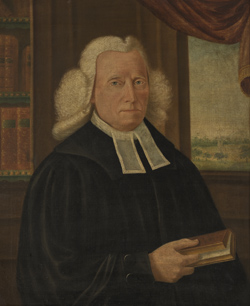
When Dennie died in 1783, he left legacies to many relatives, but the biggest bequest was to Hepzibah Swan (1757–1825, shown above), wife of James Swan, his executor. She was also the daughter of Barnabas and Hepzibah Clark.

Monday, September 12, 2022

“Remarkable for bullying and rioting”?

On Saturday, I traced the life of Boston insurance broker Nathaniel Barber up until October 1772, when Gov. Thomas Hutchinson made him captain of the militia company staffing the North Battery, with the rank of major.

Before then, Barber had been publicly noted for his adherence to the Whig cause, commissioning the Sons of Liberty bowl and naming his children after John Wilkes, Oliver Cromwell, and Catharine Macaulay.

So how did a favor from the royal governor change Barber’s politics? Not at all.

The very next month, in November 1772, Barber agreed to serve on Boston’s committee of correspondence. That group, with official status as a standing committee of the town meeting, became the main organ for resistance in Massachusetts.

In the same period, Barber was active in the North End Caucus—moderating meetings, communicating with the South End Caucus, writing out lists of candidates for voters to support.

At the end of 1773, the tea crisis arose. One 3 November, “a large body of people” visited the warehouse of the Clarke family, where the East India Company’s consignees and their supporters had gathered. Barber was one of the committee of nine men, led by William Molineux, who went in to remonstrate with the tea importers. Later that confrontation became violent, but it’s not clear what role Barber played at that stage.

According to Francis S. Drake’s Tea Laves (1884), Barber’s family preserved a tradition that he was part of the Boston Tea Party. No other details provided, but that belief is bolstered by what Benjamin Bussey Thatcher reported in Traits of the Tea Party (1835) about how the event wrapped up:
Pitts, who was quite a military man, as well as a mighty Son of Liberty, was appointed commander-in-chief of the forces then and there assembled; they were formed in rank and file by his direction, with the aid of Barber, Proctor, and some others; and “shouldering” their arms, such as they had—tomahawks included—they marched up the wharf to the music of a fife, to what is now the termination of Pearl Street, back into town, and there separated in a short time, and went quietly home.
According to this tradition, Lendell Pitts, Edward Procter, and Barber drew on their authority as militia officers to organize the men of the Tea Party so they could demonstrate order and discipline (and not do any more damage that night).

Thus, Nathaniel Barber was definitely among the Boston Whig organizers. He didn’t hold public office or write essays, but he served on committees, led marches, and talked up the ideology in his everyday business and social dealings. If you wanted to foment political resistance in town, he was someone to have on your side.

Of course, that behavior looked quite different from the other side. Writing from London in 1775, John Mein said Barber was “remarkable for bullying and rioting.”

TOMORROW: The mysterious Mr. Denning.

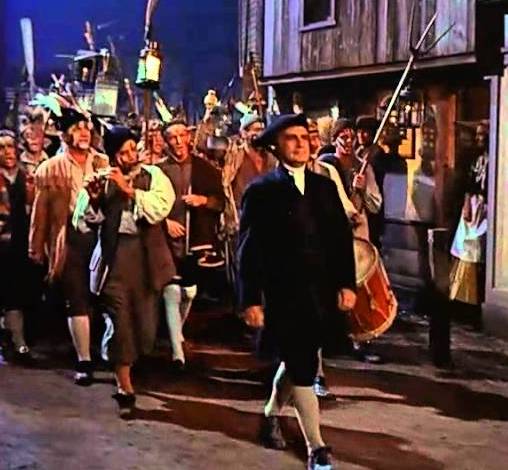
(The picture above is an image from Disney’s Johnny Tremain, showing men marching home from the Tea Party. In the movie that’s a musical number, and I’m not convinced about the costuming, but thematically it seemed to fit.)

Friday, September 09, 2022

“A brave and valiant sea-commander, only a little bashful”

When James Rivington’s New-York Gazetteer ran what it said was a letter alerting British army officers in Boston to the men behind the town’s political troubles, its list of fifteen names included two we don’t usually read among Revolutionary leaders:
Both those men do already have tags here on Boston 1775, but you know this is an unusual place.

Neither Bradford nor Barber were elected to major political offices or wrote significant newspaper essays (that we know about). They weren’t in the top tier of Boston organizers, nor in my view in the next tier, either. They were too old to fight in the war, serving in civil offices instead, and neither survived the 1780s to help construct the federal government, two ways people got remembered.

Nonetheless, as their titles suggest, Bradford and Barber commanded respect in colonial Boston. Both were staunch Whig businessmen, the sort who spoke out in town meetings, signed protests, and served on committees. Indeed, both Bradford and Barber were part of Boston’s first committee of correspondence in 1772 and then the larger committee to enforce the Association boycott in 1774.

John Bradford (1735–84) was a merchant captain, sailing ships to London and Jamaica. In his study Smugglers and Patriots, John Tyler reported evidence that Bradford belonged in both categories. In 1775 the printer John Mein would call Bradford “a brave and valiant sea-commander, only a little bashful, which is well known to the underwriters in London.” Unfortunately, it’s not well known to us what Mein was referring to, probably sarcastically.

In the 1760s Bradford stopped commanding the ships himself, settled into his North End home, and focused on managing imports through his shop in Boston. He was elected an Overseer of the Poor in 1768 and a warden in 1772.

Bradford was also a slave-owner. Among his servants was a teenager born in Africa and renamed Chloe Spear, subject of a biography published in 1832 by Rebecca Warren Brown, daughter of Dr. John Warren. According to that book, Spear sought to learn to read by studying a psalter:
She kept the book secreted in her pocket, and whenever she had a few moments leisure, she would take it out and try to spell a word. While thus engaged one day, her master discovered the book in her hand, and inquired what she was doing. She told the truth, and this led to a full disclosure of the case. He angrily forbade her going again to the schoolmistress for instruction, even under penalty of being suspended by her two thumbs, and severely whipped; he said it made negroes saucy to know how to read, &c.
Nonetheless, Bradford joined the crusade to preserve political liberty for men like him.

In 1769–70 Bradford was among several Boston merchants who enforced the non-importation agreement—walking aboard ships, demanding Customs documents, leaning on merchants who defied the boycott. After James Otis, Jr., and Customs Commissioner John Robinson brawled in the British Coffee-House, Bradford was seen “looking for Mr. Otis’s Hat & Wig.” He was also on the town committee to hire a ship to carry the town’s report on the Boston Massacre to London, though cost worries scuttled that plan.

On 2 Sept 1774, a week before the New York newspaper item appeared, Capt. John Bradford was among the Boston Whigs who went out to Cambridge to calm the militiamen gathered in the “Powder Alarm.” After two colleagues, William Cooper and William Molineux, told the crowd that the gunpowder the royal authorities had seized was probably old and worthless anyway, Bradford had the boldness to publicly disagree. (The next month, Bradford was a pallbearer at Molineux’s funeral.)

The Bradford household appears to have escaped from the siege of Boston as refugees in Andover, boarding with a family named Adams. Their host helped Chloe Spear learn to read and converted her to a fervent Christianity.

In April 1776 the Continental Congress appointed Capt. Bradford its prize agent for all British ships captured and brought into Boston harbor—which some historians estimate amounted to half of all the prizes that Americans captured during the war. Bradford also became an agent for the Congress’s marine committee, purchasing ships and supplies. Those responsibilities reflect both his nautical knowledge and how the Boston Whigs believed Bradford deserved trust and rewards.

According to the Chloe Spear biography:
As a reward of her integrity, her master gave her a certificate of manumission, (freedom) which was to take effect at a specified period not very distant. But shortly after, by a law of the Commonwealth, all the slaves in the State were made free.
That would have been in 1783. John Bradford died in May 1784 “after a lingering illness.”

TOMORROW: Major Barber.

Tuesday, October 26, 2021

“A large Collection of interesting Papers”

In 1843, the London bookselling firm of Thomas Thorpe issued its catalogue of manuscripts for sale, “Upon Papyrus, Vellum, and Paper, in Various Languages.”

Among those items was “A large Collection of interesting Papers, formed by the late George Chalmers, Esq., relating to New England, from 1635 to 1780, in 4 vols. folio, neatly bound in calf, £21.”

Chalmers (1742-1825, shown here) was born in Scotland and at age twenty-one settled in Maryland as a young lawyer. In early 1776 he published Plain Truth, a point-by-point riposte to Thomas Paine’s Common Sense. That went over so well that Chalmers soon moved back to Britain.

In 1780 Chalmers published Political Annals of the Present United Colonies from Their Settlement to the Peace of 1763. Or rather, he published the first volume of documents about the colonial governments, tracing the history up to 1688, but never produced the second.

In 1786 Chalmers became a secretary to Britain’s privy council, and he kept that postion for decades. It provided him with the income and access he needed to collect manuscripts and write books and pamphlets about the history of Scotland, Shakespeare, other authors, controversial issues of the day, and much more.

In 1796, as Britain fought Revolutionary France, the government paid Chalmers to write a critical biography of Paine. He issued that under the pseudonym of Francis Oldys, supposedly a graduate of the University of Pennsylvania. Otherwise, he focused mainly on British topics, particularly the long history of Scotland.

Nevertheless, Chalmers’s manuscript collection shows that he never gave up on accumulating material about the old North American colonies. After his death, his papers went to a nephew, and two years after that man died in 1841, they were on the market.

Here’s a sample of what the collection included from the Revolutionary years, according to the bookseller’s catalogue:
  • Various papers relating to the paper currency in the colonies, 1740-60.
  • Account of the dispute at New London, at the burial of a corpse, 1764.
  • List of graduates in Harvard College, who have made any figure in the world.
  • Part of Mr. Otes’s speech in the general assembly at Boston, in 1768.
  • Autograph letter from W. Molineux, relating to the riots at Boston, 1768.
  • Letters relating to the seizure of the sloop Liberty, 1768, very curious.
  • Information of Richard Silvester, of the speeches of the Boston leaders, 1769.
  • Declaration of Nathaniel Coffin to Governor J. [sic] Bernard, on the designs to drive off the Governor and Lieutenant Governor, 1769.
  • Key to the characters published in the Boston Chronicle of Oct. 26, 1769, (The Boston patriots characterized.)
  • Autograph letter from George Mason, containing an account of the riot and attack of Mr. Mein’s house, 1769.
  • Copy of a curious letter from Boston, relating to Franklin’s duplicity, &c. 1769.
  • Autograph letters from John Mein and George Mason to Joseph Harrison, concerning the riot at Boston, 1769.
  • Papers relating to the outrage on Owen Richards, an officer of the customs at Boston, 1770.
  • Copy of a letter from Lord Dartmouth to Dr. Benjamin Franklin, about presenting a remonstrance of the court to the king, 1773.
  • Account of the proceedings of Governor Hutchinson, relating to Massachusetts, &c., 52 pages, 1774.
  • Account of an attack that happened on His Majesty’s troops, by a number of the people of the province of Massachusetts Bay, 1775.
It looks like Chalmers obtained many of those documents from Joseph Harrison, a Boston-based Customs official, or his estate.

Prof. Jared Sparks (1799-1866) of Harvard College must have seen the bookseller’s listing. He apparently arranged for the college library to buy some of Chalmers’s papers in 1847 while he bought others for himself, leaving them to the library on his death. Thus, the papers listed above are now at the Houghton Library and digitized as part of the university’s Colonial North America project.

Saturday, August 08, 2020

The Marriage of John Fleeming and Alice Church

The 17 Aug 1770 issue of the New Hampshire Gazette of Portsmouth included this announcement:
Last Week was Married in this Town, by the Rev. Dr. HAVEN, Mr. JOHN FLEMING, of Boston, Printer, to Miss. ALICE CHURCH, Daughter of Mr BENJAMIN CHURCH, of the same Place, Merchant,----an agreeable young Lady, adorn’d with the Qualifications requisite to render that honorable State happy.
Records of the Rev. Samuel Haven’s meetinghouse specify that the couple were married on 8 August—250 years ago today.

Boston newspapers reprinted that news in the following week, with the 21 August Massachusetts Spy (cramped for space) leaving off the encomium to the bride but identifying her father as an “Auctioneer.”

Alice’s father, Benjamin Church, Sr., was indeed well known in Boston for his vendue-house. He wasn’t a native of the town but had been born in Bristol, Rhode Island, in 1704. His father died when he was two, and he grew up mostly in the household of his paternal grandfather, also named Benjamin Church, famous in New England for leading guerrilla war against Native nations in the late 1600s.

After graduating from Harvard College in 1727, the younger Benjamin Church went into business in Newport. He married Elizabeth Viall that October, and they had two children before she died in 1730. Church married again in 1732, to Hannah Dyer of Boston. He continued to develop his auction house in Newport.

Around 1740, Church moved his business and family to Boston. He owned various real estate, invested in the Land Bank, and established a new vendue-house in the South End. He specialized in selling cloth and other goods just off the ships. Church also served in public posts: as a minor town official and a deacon in the Rev. Mather Byles’s Hollis Street Meetinghouse. He penned Latin poems and a biography of his grandfather.

Benjamin and Hannah Church had eight children. Benjamin, Jr., was the first boy, born in 1734 and graduating from Harvard twenty years later. He became a physician and, by the late 1760s, one of the leaders among Boston’s Whigs, known for his genteel manners and satirical verse. In March 1770 Dr. Church performed an autopsy on the body of Crispus Attucks.

Alice Church was one of Benjamin and Hannah’s younger girls, baptized at the Hollis Street Meetinghouse in 1749. That meant she was around twenty-one years old when she married printer John Fleeming. He was older, but we don’t know by how much, only that he had been in business since arriving in Boston from Scotland in August 1764.

There are some mysterious aspects of this wedding. First, John Fleeming had been partner to John Mein in printing the Boston Chronicle. In that newspaper and subsequent political pamphlets, Mein sneered at Dr. Church the “Lean Apothecary.” Some have interpreted that to mean Dr. Joseph Warren, but Mein’s own handwritten “Key” to the pamphlet (now in the Sparks Manuscripts at Harvard) states he meant Church and further described him as:
One of the greatest miscreants that walks on the face of the Earth who has cheated & back bitten every Person with whom he ever had the least Connection—Father Mother & friend & more than once foxed his Wife &c &c &c
So right away we can ask how John Fleeming and Alice Church ever became friendly.

The next big question is why did they get married in New Hampshire. Massachusetts couples went over the border if they were eloping or needed to marry quickly because a baby was on the way. There’s no evidence to confirm either of those possibilities, but we know little about the Fleemings.

Church researcher E. J. Witek noted a possible third factor. John Fleeming had taken refuge on Castle Island at the end of June after shutting down the Chronicle, so he might not have felt safe going to a church in Boston. Still, I think he could have found a minister closer to home than Portsmouth.

John Fleeming was connected to the Sandemanian sect while Alice Church had been raised in the Congregationalist faith. They were married by a Congregationalist minister. But the Fleemings had a daughter named Alicia baptized at King’s Chapel, an Anglican church, on 17 July 1772 (and Dr. Benjamin Church was one of the baby’s sponsors). Again, questions but no answers.

The family link between John Fleeming and Dr. Benjamin Church became an issue of state in 1775 when Gen. George Washington and his staff realized that Church had tried to send a ciphered letter into Boston via his mistress, Mary (Brown) Wenwood. Deciphered, that letter turned out to be to Fleeming. In his defense, Church turned over a letter he had received from his brother-in-law. It said things like:
Ally joins me in begging you to come to Boston. . . . your sister is unhappy under the apprehension of your being taken and hanged for a rebel . . . If you cannot pass the lines, you may come in Capt. [James] Wallace, via Rhode Island, and if you do not come immediately, write me in this character, and direct your letter to Major [Edward] Cane on his Majesty’s service, and deliver it to Capt. Wallace, and it will come safe. . . . Your sister has been for running away; Kitty has been very sick, we wished you to see her; she is now picking up. I remain your sincere friend and brother…
That reads like a genuine familial friendship even though the men were on opposite sides of the war. And the link was forged 250 years ago today.

(While researching the Church genealogy, I realized that Dr. Church’s older half-sister Martha was stepmother to the teen-aged assistant teacher at the South Writing School in 1774, Andrew Cunningham. Both Dr. Church and young Cunningham, his step-half-nephew, are players in The Road to Concord, one helping to conceal the Boston militia train’s stolen cannon and the other helping Gen. Thomas Gage hunt for them.)

Thursday, June 25, 2020

The Last of the Boston Chronicle

On 25 June 1770, 250 years ago today, this announcement appeared in the Boston Chronicle:
The Printers of the Boston Chronicle return thanks to the Gentlemen, who have so long favoured them with their Subscriptions, and now inform them that, as the Chronicle, in the present state of affairs, cannot be carried on, either for their entertainment or the emolument of the Printers, it will be discontinued for some time.
Printer John Mein had left for England the previous fall. His partner John Fleeming had carried on publishing the newspaper, still including documents from the Customs office. Each issue started with a list of the leaders of the non-importation committee, formatted like the Boston Gazette’s accusatory list of the remaining importers. But Fleeming no longer carried political essays from local authors, instead reprinting news from Europe and the letters of Junius.

Financial pressure was mounting on Fleeming. John Hancock was still pursuing his lawsuit against Mein as an agent of London creditors, seizing printing equipment and supplies. The only people still advertising in the Boston Chronicle were friends of the royal government. The 21 June issue contained only two ads: one by John Bernard, the departed governor’s son, announcing that he was leaving Massachusetts, and one for an auction in Nova Scotia.

When most of the Customs Commissioners and their administrators moved to Castle William after the 19 June attack on Henry Hulton’s home, that probably deprived Fleeming of another form of financial support.

Finally, Fleeming faced physical threats. He had been with Mein when angry merchants confronted him back in October. And then there’s this item from the 8 Jan 1770 Newport Mercury, also reprinted in some other American newspapers:
From Boston we hear, that on the Evening of the 29th Ult. [i.e., December 1769] Mr. —— Fleeming, Printer of the Boston Chronicle, was attacked in one of the Streets of that Town, by a Number of Ruffians, who abused him very much; and, ’tis thought, he would have died of his Wounds on the Spot, had not a humane Negro, who knew him, taken him up and helped him to his Home.
Boston 1775 reader John Navin set me on the path to this article through Facebook. As far as I can tell, the news was never printed in Boston, not even in Fleeming’s own paper.

E. J. Witek quoted Fleeming as telling Lord North in 1773 that his “life was threatened and finding the power of Government too weak to protect him against the fury of a lawless mob, he fled to Castle William.” Witek dated the time of Fleeming’s move to the Castle to the end of June 1770, just after closing the Chronicle.

So I might have been wrong when I wrote back in 2011 that, unlike Mein, Fleeming “never had mobs on his tail.” I’m still not certain whether he was actually attacked or merely threatened. The Newport news item came from someone who didn’t even know Fleeming’s given name and thus might not have heard all the facts straight, and his own petition doesn’t appear to have mentioned an actual assault. But he had reason to flee.

Whatever the exact circumstance, Fleeming shut down the Boston Chronicle two and a half centuries ago today, silencing Boston’s most aggressive newspaper support for the royal government.

Monday, May 18, 2020

When Hancock Moved on Mein

John Mein arrived in Boston from Scotland in 1764. He first set up a shop with Robert Sandeman, though he wasn’t a member of the Sandemanian sect.

The next year, Mein took over the London Book Store on King Street, formerly co-owned by James Rivington. Later he became partners with printer John Fleeming, another Scotsman, to publish books.

Finally, in 1767 Mein and Fleeming launched a new newspaper, the Boston Chronicle. It soon became the voice of the royal government in Massachusetts. The Customs office gave Mein and Fleeming its printing business, providing them with financial support.

At the same time, Mein owed a lot of money to his London suppliers, the publisher and book dealer Thomas Longman (d. 1797) and the stationery firm Wright & Gill. He ordered more than £2,000 worth of books and paid off only £419. In that respect, Mein was a lot like other North American merchants.

Then came the non-importation controversy of 1768 and 1769. The Boston Chronicle published Customs documents showing that many of the town’s merchants, including several involved in enforcing the boycott, were still having goods shipped to them from Britain. Mein added some choice insults.

Meanwhile, in July 1769 Thomas Longman wrote to John Hancock, asking if he was willing to be the firm’s Boston agent in collecting the money Mein owed. To sue John Mein for debt? To seize his goods? To potentially send him to debtors’ prison? Why yes, Hancock was happy to.

It took a while for Hancock and Longman finalize their arrangement. Other Boston merchants acted more directly, threatening Mein and Fleeming in the middle of town on 28 Oct 1769, as described here. Mein went into hiding on Castle Island and sailed for home the next month.

Once in London, Mein called on Longman and told him how he’d had to shut down his Boston business. He promised to pay off his debt, no doubt asking for more time. But Longman was already moving against him.

On 1 Mar 1770, Hancock received legal powers of attorney from Longman and Wright & Gill. That same day, Hancock’s lawyer John Adams filed the paperwork to have deputy sheriffs seize Mein’s property in Boston—his stock of books and his printing equipment.

The Loyalist magistrate James Murray negotiated with Hancock and Sheriff Stephen Greenleaf. He appears to have wanted the suit to be handled in London courts, far from Boston juries. Those discussions were going on in the same week as the Boston Massacre.

Murray’s action allowed Fleeming to continue the Boston Chronicle, “much to the Surprize and Disappointment of Mr. H—— and his party,” he wrote.

But Hancock took all he could. On 18 May, 250 years ago today, he wrote to Longman:
Your favours of Dec. 2d. 1769, & Jany 3d. 1770 are now before me, & duly note the Contents. In Consequence of the Rect. of the former, as Mr. Mein was absent, I immediately attached everything I could find of his Effects for the benefit of you & Wright & Gill & the matter is now in the Law.

The Effects are in the Hands of the Sheriff, and as soon as it has gone thro’ the Law, & the Effects turn’d into money, the neat proceeds shall be remitted you, and you will determine the settlement between you and Messrs. Wright & Gill. Tho’ I fear even the Whole of his Effects will fall vastly short of the Debts, but I have got all & could have no more.

You will please, as I am now greatly hurried, to present my respects to Mess Wright & Gill & acquaint them. I will render them every service in my power & will write them by next opportunity. Cannot You get further Security of Mr. Mein in London. You may rely I will do all in my power for your Interest in this or any other matter.
Around the same time, across the Atlantic, Longman had Mein arrested.

COMING UP: Wending through the courts.

Wednesday, April 01, 2020

“A TRAGEDY (Not acted here these seventy-eight years)”


On 1 Feb 1770, a curious notice appeared in the Boston Chronicle, the twice-weekly newspaper published by Scottish immigrants John Mein and John Fleeming.

It read:

Intended speedily to be acted
By a Company of young Tragedians,
A TRAGEDY
(Not acted here these seventy-eight years,)
called the
W I T C H E S,
With many Alterations and Improvements.

The scenery, decorations, &c. for the exhibition to be entirely new, and supplied by Messieurs J——n, L——, B——d and Company.

N.B. Notice will be given for the Rehersal, by ringing of the Town bells, when the Actors are desired to meet at FUNNY-HALL.—But as the young Gentlemen have lately been interrupted at some of their Rehearsals by the intrusion of Improper persons, it is desired that NONE but such as are to be REAL Actors will attend, and that NO ONE will presume to go behind the scenes without a TICKET from the Managers.

The names of the Managers, to whom Gentlemen may apply, with the Dramatis Personae, will be in a future Advertisement.
This announcement was fake news, which is one reason I’m discussing it on 1 April. But the item also carried a serious political message that genteel Boston readers of the day would have recognized immediately.

The item used phrasing for theatrical entertainments that often appeared in newspapers from outside New England. Since theater was illegal in Massachusetts, right away this ad had an edge.

The title of the putative play, “the WITCHES,” and the reference to “seventy-eight years” ago were a clear allusion to the witch trials of 1792, an embarrassing episode in Massachusetts history.

The gentlemen said to be furnishing the sets, “Messieurs J——n, L——, B——d and Company,” were William Jackson, Theophilus Lillie, John Bernard, and the other shopkeepers defying the non-importation committee that winter.

“Funny Hall” was clearly a disdainful reference to Faneuil Hall, seat of the town government. The “Town bells” referred to the customary way of gathering a crowd—either to fight a fire or, as this item hints, to start a riot.

In sum, this item in the form of a theatrical advertisement was satirizing the town’s non-importation committee and its attempts to put pressure on the merchants who were refusing to cooperate. The last line, promising to name the managers of this enterprise, echoed how the Boston Chronicle published a lot of embarrassing and insulting material about the Whigs in 1769.

When I first read this item, I interpreted the “company of young Tragedians” as a reference to the schoolboy picketers outside importers’ shops. But it actually appeared a week before the first picket line was reported at Jackson’s Sign of the Brazen Head.

It seems unlikely that Mein and Fleeming were privy to the Whigs’ plans for those picket lines. And I read the evidence to say the schoolboys’ participation developed over time and was largely self-directed. That means the “young Tragedians” referred to the crowd meeting at Faneuil Hall in January—which would have gotten the Whigs even angrier.

Sunday, February 16, 2020

“The Effects of Junius’ Letter”?

Throughout 1769, British politics was roiled by a series of public letters signed “Junius,” attacking the ministry of the Duke of Grafton and promoting William Pitt, by then the Earl of Chatham.

The letters combined erudite arguments, apparently inside knowledge of British politics, and personal attacks. The author’s identity has never been confirmed, but most evidence points to the Irish bureaucrat and politician Philip Francis, shown here.

The “Junius” letters made their way across the Atlantic to Boston, where the Whigs were already fans of Pitt and trying to form alliances with reformers in London.

In May 1769, Boston newspapers started to reprint letters from the “Junius” debate. Curiously, the first and, for a long time, only newspapers to do so were those closest to the royal authorities: Richard Draper’s Boston News-Letter and John Mein and John Fleeming’s Boston Chronicle. Other newspapers reported on the debate in London, passing on the occasional speculation about who “Junius” was.

On 16 October, the Boston Gazette joined in the fun by reprinting a letter from “Junius Americanus,” a pseudonym of the Virginia-born Arthur Lee. He wrote about issues that affected North American colonists directly.

In the 16 December London Evening-Post, “Junius” published a letter addressing George III. Such a direct public message to the king was a breach of traditional etiquette, arguably even illegal. The author presented this letter as a hypothetical letter written if the monarch had asked for frank and honest advice—and who could complain about that?

“Junius” expressed what the British Whigs saw as wrong with current London politics. There were several slaps at Scotsmen for supposedly being less loyal than Englishmen. There was a long defense of John Wilkes for attacking Scotsmen. There was support for the printers then taking the radical action of making the proceedings of Parliament available to the public. (Later in 1770 the first printer of the “Junius” letters was himself prosecuted, but the government lost that and similar cases.)

Toward the end of his letter to the king, “Junius” wrote: “The same pretended Power which robs an English Subject of his Birthright, may rob an English K[ing] of his C[rown].” That was as obvious a warning of justified rebellion as the British press could handle in those days.

Customs Collector Joseph Harrison’s anonymous informant reported that on 7 Feb 1770 “Capt. [Isaac] Cazneau arrived from London and brought with him Junius Letter to the K--g, which was published the next day in Drapers paper,” the Boston News-Letter. Draper also printed a much shorter reply from a “Junius” opponent signing himself “Modestus.”

Edes and Gill then reprinted the “Junius” and “Modestus” essays as a two-page supplement to their 12 February issue of the Boston Gazette, the same that included the expanded list of importers that I showed yesterday.

Three days later, the anonymous informant wrote: “Between the 8th & this date, most of the Importers had their Windows broke their Signs defaced, and many other marks of Resentment—in short the Effects of Junius’ Letter was Visible which way so ever you turned yourself.”

This was a top-down view of politics, all too typical of upper-class Loyalists. According to this perspective, a verbose, educated, well connected but unaccountably radical gentleman in London wrote a provocative letter. Once reprinted in Boston, it provoked common subjects who would otherwise be peaceful and content into violent attacks on supporters of Parliament’s new taxes.

Of course, Boston’s non-importation movement was over a year old by the time the “Letter to the King” came to town. The “Body of the Trade” meetings and the decision to call importers public enemies took place in January, before that letter arrived. Is it really believable that a long essay published in the News-Letter on 8 February prompted the “Importer” sign that went up at William Jackson’s shop that morning (possibly even before the newspaper came out)?

Both the Boston Whigs and the Boston Loyalists saw their cause as parallel, or even part of, the political conflicts in Britain. They were eager to draw connections between their struggles and the imperial capital. But in this case the cause-and-effect is more than tenuous.

It’s conceivable that the “Junius” letter and its reprint in the 11 February Boston Gazette, the town’s most popular Whig newspaper, fueled the larger demonstration four days later. But I think the energy was really coming from the bottom up.

TOMORROW: The shrill voices of the voiceless.

Friday, January 31, 2020

“Voted to proceed to the Business of the Meeting”

On 23 Jan 1770, as described yesterday, the Bostonians meeting about non-importation in Faneuil Hall received a letter from acting governor Thomas Hutchinson declaring their gathering to be illegal and ordering them to disperse.

In response, those men “unanimously voted to proceed to the Business of the Meeting.” Sheriff Stephen Greenleaf asked moderator William Phillips for a written message to take back to the governor. The meeting came up with this note, addressed to the sheriff:
It is the unanimous Desire of this Body, that you inform his Honor the Lieutenant-Governor, that his Address to this Body has been read and attended to, with all that Deference and Solemnity which the Message and the Times demand; and it is the unanimous Opinion of this Body, after serious Consideration and Debate, that this Meeting is warranted by Law: And they desire you to inform his Honor, that they had determined to keep Consciences void of just Offence towards God and towards Man.
In Smugglers and Patriots, John W. Tyler stated that letter was written in the fine hand of John Hancock (shown above). The previous week, he shied from leading a crowd to the governor’s house. Now Hancock was ready to stand at the front of the movement.

Before leaving, Greenleaf made sure to tell the people he wanted “to be considered in the Light only of the Bearer of his Honor’s Letter.” In other words, Hutchinson stood alone, his show of authority ending in a resounding defeat.

The “Body of the Trade” then proceeded through a series of votes. In response to accusations that someone had tried to burn down the store of importer William Jackson, the meeting offered a £100 reward for the arsonist. A further resolution suggested that an enemy of the community—Harbottle Dorr suggested it was Jackson himself—had planted the evidence of that crime.

Another resolution asked people “totally to abstain from the use of Tea upon any pretence whatever” since tea accounted for “the greatest Part of the Revenue” from the Townshend duties.

But the main business of the meeting was about naming and shaming the shopkeepers who were still defying the non-importation committee.

The first group was the merchants Jackson, Theophilus Lillie, John Taylor, and Nathaniel Rogers. The meeting deemed them “obstinate and inveterate Enemies of their Country, and Subverters of the Rights and Liberties of this Continent.” It declared that people should respond by “withholding not only all commercial Dealing; but every Act and Office of common Civility” from them. The resolution went on for a long time. You can read it here in the Boston Gazette.

Then the meeting turned to a second group of defiant businesspeople:
Most of those people were “strangers in this Country,” the meeting declared. They had “in the most insolent manner too long affronted this people, and endeavoured to undermine the liberties of this country.” Invoking Biblical language (Isaiah 51:1), the gathering declared “that they deserve to be driven into that obscurity, from which they originated, and to the hole of the pit from whence they were digged.”

The next day, Lt. Gov. Hutchinson wrote to Lord Hillsborough, the Secretary of State, about his attempt to stop the meeting. He said he’d spoken with Phillips, his Council, and the town’s justices of the peace about how such meetings would lead to “high treason,” but no one had agreed with him. He acknowledged his letter had failed to disperse the crowd. But Hutchinson insisted that “it made them more anxious to restrain all disorders.”

In the coming weeks, we’ll see how that worked out.

Thursday, December 05, 2019

The Career of Captain Dundas

Once I saw that “Captain Dundas” had come up in the dispute between James Otis, Jr., and John Robinson, I had to figure out who that was and what role he played in the coming of the Revolution.

In September 1769, Otis called Dundas “a well known petty commander of an armed schooner,” meaning he was in the Royal Navy. (The Customs service had just lost its one and only armed schooner, the Liberty.)

Fortunately, the Royal Navy keeps good records, and websites like Three Decks make that information available as long as one keeps running searches. So here’s what I’ve put together.

Ralph Dundas was born on 12 Oct 1732, the eldest son of Ralph and Mary Dundas of Manour, Scotland. He was serving in the Royal Navy by 1748, when he was in his mid-teens, and passed the exam to be a lieutenant in October 1757.

Lt. Dundas received his first command in 1764: H.M.S. St. Lawrence (also spelled St. Laurence). In British Warships in the Age of Sail 1714-1792 Rif Winfield writes that this schooner was “purchased on stocks at Boston [or Marblehead?],” though J. J. Colledge and Ben Warlow’s Ships of the Royal Navy says the Royal Navy bought it in Halifax, Nova Scotia.

It carried thirty men, six three-pounder cannon, and twelve swivel guns—by no means a fearsome warship but powerful enough for peacetime patrols, carrying messages, and supporting larger vessels as a “tender.” Among the crew was master’s mate John Whitehouse, who later sailed under Capt. James Cook.

On 28 July 1766, the Boston Evening-Post reported:
Friday last arrived a Schooner from Louisbourg, by whom we learn, that some time before he sail’d fro thence, his Majesty’s armed Schooner the St. Laurence, commanded by Lieut. Dundas, was struck by Lightning as she lay at Anchor there, which set Fire to the Powder Magazine in the Fore Part of the Vessel and blew her up, by which Accident three Men were instantly killed, and several others terribly wounded, two of whom died the next Day:

We hear that the Officers on board, being in the Cabin, escaped unhurt; and that the Bows of the Vessel being carried away by the Explosion, she sunk in a few Minutes after.
The Boston Post-Boy of the same date said the explosion happened “between two and three Weeks ago.” The Narrative of American Voyages and Travels of Captain William Owen, R.N. names the site of the wreck as Neganishe, now probably called Ingonish.

Commodore Samuel Hood then bought a merchant’s sloop called the Sally, renamed it St. Lawrence, and assigned it to Lt. Dundas.

In the spring of 1768, the St. Lawrence accompanied H.M.S. Romney from Halifax to Boston. On 23 May, the Boston Chronicle carried Lt. Dundas’s advertisement for four deserters. Keeping the sloop fully manned was a challenge. Within a month the town was upset about a “man pressed by Capt. Dundas, and carried down to Halifax.” Capt. John Corner of the Romney and Councilor Royall Tyler sat down to discuss that issue and others, according to the 27 June Boston Chronicle.

The Boston News-Letter and Post-Boy show that over the next several months the St. Lawrence sailed back and forth along the northeast coast: off to Halifax in August, back to Boston in November and then heading off to Halifax again, collecting military stores at Canso and Louisburg over the winter, then back to Halifax. The St. Lawrence returned to Boston again in August 1769.

That put Lt. Dundas in town for the busy fall of 1769. He probably wasn’t in the British Coffee-House when Robinson and Otis started hitting each other with their canes on 5 September. Otis hinted that he participated in the fight, but Robinson denied that. Otis also said rumor had it Dundas “swore last year that the whole Continent was in open Rebellion.” However, the lieutenant’s name doesn’t appear to have come up again in this or other political disputes, which suggests that Otis’s Whig allies didn’t think they could make a case against him, even to their own followers.

The next month brought the Neck Riot on 24 October, followed four days later by the attacks on printer John Mein and sailor George Gailer. In the next couple of weeks, Royal Navy captains helped to hide Mein from the crowd. On 11 November, provincial secretary Andrew Oliver reported to Gov. Francis Bernard that Mein “thinking it unsafe for him to continue in Tow has taken his passage for England with Capn. Dundass.” In fact, it looks like Mein sailed away on another ship, but Oliver’s letter indicates that Dundas left Boston early in the month.

In April 1770, the sailmaker Ashley Bowen wrote in his diary that Dundas’s schooner had come into Marblehead harbor. However, the diary’s annotations suggest he mistook that ship for the Magdalen under Lt. Henry Colins. That suggests how common it was for New Englanders to see Dundas’s schooner. The 16 July 1772 Massachusetts Spy stated that Dundas had sailed the St. Lawrence to the Bahamas, and the 17 June 1773 Boston News-Letter reported that it had come back from the Bahamas to Boston.

As of June 1774, the Royal Navy listed the St. Lawrence, with six guns and thirty men, at Boston. It was small part of the big fleet under Vice-Admiral Samuel Graves sent to enforce the Boston Port Bill. In November Lt. Dundas sailed for London; part of a letter he carried was forwarded to Lord North as useful intelligence in January 1775.

That was the last voyage of that St. Lawrence, at least as a naval schooner. In May 1775, immediately after the war began, Graves reported that he had bought and armed two schooners at Halifax and planned to call one the St. Lawrence. He assigned it to a new commander. Lt. Dundas’s ship was sold off in London the next year.

Ralph Dundas became commander of the new fourteen-gun sloop Bonetta in April 1779, then the new sixteen-gun sloop Calypso (shown above) in December 1782. He served in that post until 1787. Dundas died that year at age fifty-four, having spent about four decades in the Royal Navy. He was buried at St. Clement Danes in Middlesex County. He left no known wife or children.

Commander Dundas served during two wars, but his naval career was overshadowed by his little brother George (1756-1814), who rose to be a rear admiral—having presumably joined the navy with Ralph as inspiration. An intervening brother, David (1749-1826), became a doctor to George III and a baronet.