J. L. BELL is a Massachusetts writer who specializes in (among other things) the start of the American Revolution in and around Boston. He is particularly interested in the experiences of children in 1765-75. He has published scholarly papers and popular articles for both children and adults. He was consultant for an episode of History Detectives, and contributed to a display at Minute Man National Historic Park.

Subscribe thru Follow.it


•••••••••••••••••


Showing posts with label Massachusetts Council. Show all posts

Saturday, July 18, 2026

“To hear the proclamation for independance read and proclamed”
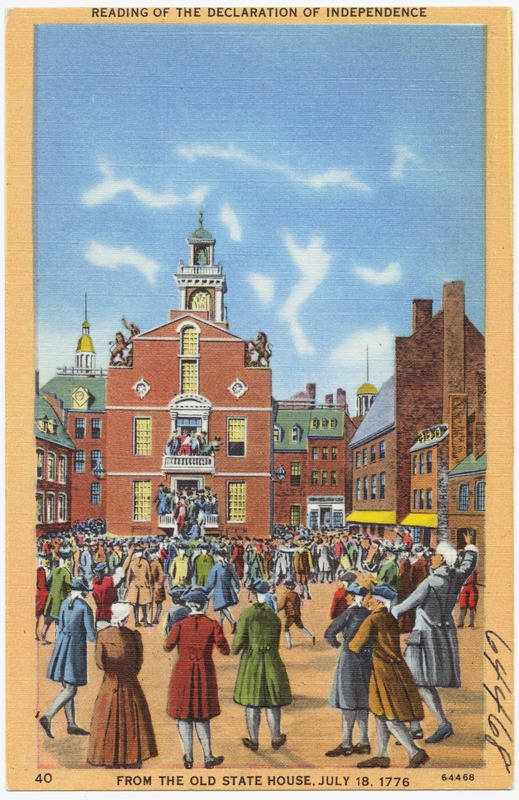
On 18 July 1776, 250 years ago today, the Declaration of Independence was officially proclaimed in Massachusetts.

People had already heard about the Continental Congress’s vote, and many had probably read the Declaration in newspapers. But this was a governmental ceremony. It happened in two places, and on two levels.

With no governor, the highest executive authority in Massachusetts was the Council. Most of its members were meeting in the Edmund Fowle house in Watertown.

Therefore, one part of the official reading was performed by Council secretary Perez Morton, reading the Declaration to the Council and to a crowd gathered outside. Also present were delegates from the Mi’kmaq and St. John’s/Maliseet communities, ready to sign a treaty of friendship with this new United States.

In Boston, there was a parallel, larger ceremony. Inside the Council’s chamber in what was now the State House, Suffolk County sheriff William Greenleaf read the Declaration to some Council members and other officials.

Col. Thomas Crafts of the Massachusetts artillery regiment, who had a bellowing voice, then “deaconed” or repeated the text phrase by phrase from the balcony of the Council chamber to the crowd gathered on the street below.

Thus, most Bostonians at the event heard Col. Crafts’s reading, but the official proclamation in Boston came from Sheriff Greenleaf. The ceremony was meant for both government officials and the “people out of doors.”

On 21 July, Abigail Adams reported to her husband:
Last Thursday after hearing a very Good Sermon I went with the Multitude into Kings Street to hear the proclamation for independance read and proclamed. Some Field peices with the Train were brought there, the troops appeard under Arms and all the inhabitants assembled there (the small pox prevented many thousand from the Country).

When Col. Crafts read from the Belcona of the State House the Proclamation, great attention was given to every word. As soon as he ended, the cry from the Belcona, was God Save our American States and then 3 cheers which rended the air, the Bells rang, the privateers fired, the forts and Batteries, the cannon were discharged, the platoons followed and every face appeard joyfull.

Mr. [James] Bowdoin [a senior member of the Council] then gave a Sentiment, Stability and perpetuity to American independance.

After dinner the kings arms were taken down from the State House and every vestage of him from every place in which it appeard and burnt in King Street. Thus ends royall Authority in this State, and all the people shall say Amen.
Not everyone was entirely pleased. Merchant John Rowe characterized the celebration as “a Great Confusion in Town.”

Pulling the royal emblems of the lion and unicorn down from the State House roof was probably inspired by reports of New Yorkers toppling the statue of King George III after that city’s reading of the Declaration on 9 July. But the street was still called King Street until 1784.

Monday, May 11, 2026

“Not playing cards but fondling and kissing each other”

In preparation for tomorrow’s talk about Benjamin Thompson’s early years, I’ve been reviewing the evidence of his affair with Mary (Dill) Thomas, wife of printer Isaiah Thomas.

When Isaiah moved to divorce Mary in 1777 by petitioning the Massachusetts Council, he submitted testimony from several people who had seen his wife traveling with the militia major from New Hampshire in February 1775, behaving like man and wife.

The printer’s file also offered an affidavit from Mary Fowle of Londonderry, New Hampshire, who had stayed with the Thomases in Boston from 20 Sept 1774 to 16 April 1775.

In Sex and the Scientist, Jane Merrill quotes Fowle describing how “Major Thompson [was] then a refugee in Boston who borded in a house opposite.” Mary Thomas started visiting him several times a day even though (or because) she had two children under the age of three.

One Saturday the printer’s wife “dressed herself, shifting her Linen, which I knew was not her custom,” said her house guest. Mary Thomas came home with “a small piece of parchment, on which a Lady’s face had been drawn with a black lead pencil. . . . the Major had taken much pains with it.”

Soon Mary Thomas visited Thompson’s ”bed-chamber, where they staid the whole afternoon and part of the evening.” Fowle stated, “I could not but think there was more intimacy between them than I before tho’t of.” She observed the couple “kissing each other, laying in each others laps, speaking fondly of each without regarding me.”

One day Isaiah came home from business after his wife had gone to play cards with Maj. Thompson. Mary Fowle and a household servant went across to fetch her. They found the couple “not playing cards but fondling and kissing each other, she often laying her head on the Major’s shoulder, and their arms round each other.”

As if that wasn’t clear enough, in February 1775 Mary Thomas insisted on taking that trip to Newbury with Maj. Thompson, first having her hair “in the greatest taste much powdered.” Later the printer gathered testimony from several innkeepers about that journey. At the time, however, he just seems to have felt trapped.

On one Sunday, Isaiah Thomas and Mary Fowle went to church. When they came home, his daughter Mary Ann, who turned three years old that March, showed them a “copper” that Maj. Thompson had given her to go into another room. Fowle stated the little girl said, “The major kissed her Mama and felt her bosom.” In response, little Mary Ann’s mother told her she was lying and threatened to whip her.

Isaiah finally demanded that Mary admit to what was going on. She acknowledged having a sexual affair. And when did it start? True to Benjamin Thompson’s character, he first got into Mary Thomas’s bed right after writing a letter to his own wife back in Concord, New Hampshire.

I won’t bother asking if these marriages can be saved.

TOMORROW: Who was Mary Fowle?

Saturday, April 25, 2026

“That the said Hill be immediately apprehended”

John Hill was yet another of the Loyalists captured aboard the brig Elizabeth.

[I feel like I’m never getting away! Then again, that’s probably how those passengers felt when they were brought back to New England after trying to evacuate.]

According to recent research shared in the Loyalist Directory, John Hill was born in Ireland about 1737. He moved to New York City in the early 1770s and ran an inn.

In March 1775, Hill came to the aid of William Cunningham during a fight near New York’s Liberty Pole (shown here). Hill later told the Loyalists Commission that “a Mob…beat us with Clubs, and stoned us.” The two men were thrown into prison and put on trial in April. But the foreman of the jury, John Wetherhead (another future Loyalist), kept them from being convicted and punished.

Cunningham and Hill “escaped to Boston,” reaching the besieged town by 5 May. They enlisted in the militia company of James Forrest, another man from Ireland. Hill said he was “appointed Quarter Master to the same Company.”

In March 1776, Gen. William Howe decided to evacuate the town. He ordered Crean Brush to confiscate all cloth that could be useful to the Continental Army. Brush enlisted Richard Hill, formerly sheriff in his county of northeastern New York (which would become Vermont), as an assistant. Richard presumably brought his younger brother, John Hill, onto that team.

As ships pushed off from Boston’s wharves, John Hill and his family squeezed onto the Elizabeth along with Brush, most of the confiscated goods, a squad of British soldiers, and other Loyalists. In Hill’s words, “on the 17th of March 1776, he left Boston, with the Royal Army; but was taken at Sea, by the Rebels.”

The brig, its property, and its wealthiest passengers were sent to Portsmouth, New Hampshire. The Hill family and several others were landed on Cape Ann by 7 April. The Massachusetts authorities summoned John Hill to Watertown for questioning.

On 19 April, the Massachusetts Council reported:
The Committee appointed to examine sundry Persons taken on board the Brigt Sally [sic] bound to Hallifax, & sent to the Council by the Committee of Marblehead…examined [John] Hill who informs your Committee that he is a native of Ireland that he came to New York three or four years since that he came to Boston about ten months ago on the removal of the troops from New York to Boston for the recovery of monies due to him from them and that for the same purpose he was going to Hallifax having acted as a Sutler among the troops.
Sailing off to Canada out of political loyalty was suspect. Sailing there just to collect debts from soldiers seemed more reasonable to these office-holders.

The Council agreed that Hill should be allowed to go free after providing a “written parole not to bear arms against the United Colonies, nor in any way aid or assist the Enemies of the said Colonies.” He probably headed back to Cape Ann to find his wife and at least one child.

In Boston, however, some merchants were still seething at how Brush and his assistants had taken their property. That property itself was up in Portsmouth, being sorted by Continental agent Joshua Wentworth. More information filtered back to Watertown.

On 25 April, 250 years ago today, the whole Massachusetts General Court passed a new resolve:
WHEREAS a certain John Hill, lately taken Prisoner by Commodore [John] Manly, in a Vessell bound from Boston to Hallifax, and brought into Portsmouth, was examined before the Council; and no Evidence then appearing against him, he was discharged & set at Liberty;

And whereas it hath since been made to appear to this Court; that the said Hill, at the time he was taken, as aforesaid, had in his possession Chests, Trunks & Packages of Goods and Merchandizes to the value of three hundred pounds Sterlg. supposed to have been stolen from the distressed Inhabitants of the Town of Boston; and was an Assistant to Crean Brush in his late unwarrantable and highhanded Thefts & Robberies
Therefore

Resolved, That the said Hill be immediately apprehended, wherever to be found, & brought before this Court for Examination, touching the Premises, and all Sheriffs, Constables & other executive Officers, and all the good People of this Colony, are hereby directed & impowered to apprehend the said Hill, wherever he may be found, and bring him forthwith before this Court, in order that he may be dealt with for his aforesaid highhanded Crimes, as to Law & Justice appertains.
TOMORROW: The manhunt was on!

[Boston also had a justice of the peace named John Hill, very involved in events surrounding the Boston Massacre. Unfortunately, the same tag applies to both men, but I think context will make it easy to sort out their stories.]

Friday, April 24, 2026

William Jackson in and out of the Boston Jail

One month after he’d decided to sail out of Boston with his goods, the brazier William Jackson was locked up in the town jail, suspected of stealing from his fellow merchants.

Cdre. John Manley had captured him on the Elizabeth. Crowds in Newburyport, Salem, and Boston had jeered him. The Massachusetts Council had ordered him into prison.

Bostonians already had some reasons to dislike Jackson. The great fire of 1760 started in his shop. He defied the non-importation movement in 1770, and on top of that he hosted Capt. Thomas Preston before the Massacre.

Then in 1774 Jackson signed the complimentary Addresses to Govs. Thomas Hutchinson and Thomas Gage. He stayed in town when war broke out. He joined the Associators, the Loyalist militia formed in Boston during the siege, though he tried to explain that away:
General [William] How…isued a Proclamation for the Inhabitants to Associate themselves and bear Arm’s in defence of the Town, being what I did not thing [think] was my duty I did not sing [sign],

sometime After he Isued another recommending to the Inhabitants to Associate themselves for preserving the peace and good Order of the Town by preventing any Riotous doings by the Soldier’s or other’s which I thought Incumbent with every good Citizen to comply
The Patriot government naturally looked askance at any “associators” who fell into its hands.

At the same time, William Jackson had some local support. Unlike Crean Brush and the other merchants locked up alongside him, Jackson had grown up in Boston. His mother Mary and older brother James still lived there. His shop sign, the Brazen Head, was a long-time landmark for locals and visitors.

The jailers had been ordered not to let Jackson have pen and paper, but he could ask his family for help. He stated, “after my Committment my brother wrote Mr [Joshua] Wentworth for my Baggage.”

More surprisingly, other members of Boston’s business community spoke up for him. I already quoted Isaac Smith, Sr.’s comment that he hadn’t really done anything bad. A few years back, Chris Hurley told me that Jackson garnered letters of support from selectmen John Scollay and Samuel Austin, printer John Gill, and other Patriots. (Among those names is John Peters, who could be the future husband of Phillis Wheatley.)

Later William Jackson would tell the Loyalists Commission that he was let out of jail after 126 days, or in August 1776. Some of his fellow prisoners would be locked up for much longer.

TOMORROW: Back to Cape Ann.

Thursday, April 23, 2026

“Without the Privelege of Pen, Ink, Paper or Candle”

In April 1776, Watertown was the seat of Massachusetts’s government.

Though people could now go into Boston, that town was still reeling from the siege. Plus, there was smallpox.

So the Massachusetts General Court stayed in Watertown—the assembly in the town’s meeting-house and the Council in an upper chamber of Edmund Fowle’s house (now headquarters of the Historical Society of Watertown, shown here).

Under the provincial charter, because the governor and lieutenant governor were absent (both driven away by the war), the Council exercised executive power.

That’s why, on 12 April, James Otis, Sr., as senior member of the Massachusetts Council, signed this order to imprison five genteel Loyalists captured aboard the brig Elizabeth:
To the Keeper of the Goal at Boston, in the County of Suffolk—Greeting—

You are hereby directed and commanded to take into your Custody Crean Brush, William Jackson, Peter Ramsey, Edward [K]eighley, and Richard Newton, lately taken in their flight from Boston in attempting to carry away from thence under the protection of the British fleet, large Quantities of Goods Wares & Merchandizes, the Rightful Property of the Inhabitants of that town, and having joined themselves with the Fleet & army employed against the united Colonies of America—

and you are commanded to confine the said Crean Brush William Jackson & Peter Ramsen [sic], each in an apartment by himself, without the Privelege of Pen, Ink, Paper or Candle, and not suffer them, or either of them to converse with any person whatever, unless in your hearing, and for the better Security of the said Crean Brush you are further ordered & commanded to put him into Handcufts immediately—

And them and each of them safely keep, ’till the further Order of the Major part of the Council, or they be otherwise discharged by due Course of Law—Hereof fail not at your Peril.
Two days later, Maj. John Grizzage Frazer, as assistant quartermaster for the Continental Army, wrote to Gen. George Washington to say that those men were now locked up. Brush was “in Irons.”

Frazer also passed on the news that on 12 April “8 british seamen” had made off with the cutter from H.M.S. Renown, one of the Royal Navy ships still hovering in the outer harbor, and got into Boston. Those defectors were much more welcome than the Loyalists who had tried to leave.

TOMORROW: Free William Jackson!

Wednesday, April 22, 2026

“They were much insulted by the people”

Yesterday we left William Jackson on the road from Portsmouth, New Hampshire, to Boston, having reached the town of Newburyport on 11 April 1776.

Jackson and dozens of fellow Loyalists had been captured aboard the brig Elizabeth while trying to sail to Halifax with the rest of the British evacuation fleet.

Most of the king’s army, and most of the Loyalists inside Boston, had managed to get away. Which meant popular anger about those people focused on the prominent few remaining—like Jackson.

In Newburyport, an angry crowd surrounded the tavern where the captives were eating, objecting to how they were riding in carriages. Carriages that Jackson, ship captain Peter Ramsey, and the others had hired.

Jackson later recounted:
we sent for the Committe of safety to Appease them, but all to no purpose, finding our selves in such a situation we comply’d, the Committe not thinking it safe they Appointed a Guard of five Men and Obliged us to pay the Expence the rest of the Journey,

as soon as we came out of the Inn we received Blow’s, mud, stones, Eggs, and every other abuse and proceeded to Boston being 40 miles on foot
In Salem, the lawyer William Pynchon (1723–1789) wrote in his diary:
Wm. Jackson, merchant, and others, with some regular soldiers, went thro’ Salem on foot for Boston, under guard; ’t is said they were much insulted by the people (it must be presumed to be the rabble) at Newburyport, in their way hither; that Jackson was stopped and obliged to leave his carriage, and walk on foot from Newbury to Salem, and thence to Boston
Pynchon then said: “in Newbury street he was stopped again and obliged, after his hat was knocked off, to fall on his knees and beg pardon of the mob and of the Country, and to say whatever was required of him.” At first I thought that might be a reference back to the streets of Newbury, but the placement suggests this story described when Jackson reached Newbury Street in Boston’s South End. Jackson himself didn’t specify such an incident.

Fellow gentlemen—merchants, professionals, landowners—sympathized with Jackson for coming under fire from crowds of poorer citizens. On 16 April, Isaac Smith, Sr., wrote to John Adams from Salem:
You have heard of Bill Jackson’s being taken. He received some Insult on the road which am sorry for and lamented by all, persons of any consequence. He is in Boston goal, but I dont learn he has behavd any way Ill att Boston dureing the seige.
Indeed, Jackson’s letter complained that after reaching Boston:
we was again carried to Wartertown 9 miles before the late Councill and being each seperately ask’d a few Question’s and not properly Examined was sent back to Boston and committed on a supposed Crime of being concern’d with Crean Brush denied the Use of pen Ink and paper and Candle light not suffer’d to speak to any one but in presence of the keeper whare we have been ever since 13th April
That accusation must have been especially galling to Jackson since one month before he’d been trying to stop Crean Brush from taking away Cyrus Baldwin’s goods.

TOMORROW: In the Boston jail.

Monday, April 20, 2026

“Such Cost and Charge as hath arisen by their being brought before the General Court”

On 13 Apr 1776, the Massachusetts General Court decided that “Caleb Wheaton and others [well, other men], who were taken aboard the brig,” should be brought to its meeting-place in Watertown ”for Examination.”

Four days later, as quoted yesterday, the Marblehead committee of correspondence wrote to say they now thought two of Wheaton’s sons—Joseph and Caleb, Jr.—had stolen a local man’s boat about six weeks before. That apparently focused the legislators’ attention on the family.

On 19 April the Council and the House named members to a joint committee to question the Wheatons.

Four days later, those members determined that Caleb Wheaton, Sr., had been “an Associator”—a member of the Loyalist militia—inside besieged Boston. Furthermore, he had been “in other Instances unfriendly to American Liberty,” perhaps a reference to his work as a Customs officer in Maine, or his statements supporting Parliament back in early 1775.

But the two legislative houses disagreed about what to do with the Wheatons. The published record of the Massachusetts House, readable here, says simply that the Council approved the first recommendation from the committee and the assembly didn’t concur.

Peter Force’s American Archives, evidently based on more complete manuscript records from the Council, revealed more details. The committee recommended
that the said Caleb Wheaton give bond to the Treasurer of this Colony for the sum of three hundred Pounds, with sufficient surety for his future good behaviour, or be confined in some Jail within this Colony until he shall find such surety; or if the said Wheaton shall think proper, and shall procure his passage for himself and family to Nova-Scotia, he may have liberty to remove there on his own expense, provided he will give his promise in writing, not to bear arms against the United Colonies.

And that the said Caleb Wheaton, Jun., and Joseph Wheaton, upon their giving their written paroles not to bear arms against the United Colonies, nor any way to aid or assist the enemies of said Colonies, and they paying the expense of being brought before this Court, may be discharged.
After the lower house said that wasn’t good enough, two more legislators were added to the joint committee, and they went back to rethink their recommendation.

The next day the Council approved a revised proposal:
  • All three Wheatons would be responsible for a £500 bond.
  • They not only had to promise not to fight the colonies, but also “not correspond with any of the Enemies of America.”
  • They had to “pay such Cost and Charge as hath arisen by their being brought before the General Court.” 
  • If any of those conditions weren’t met, they would be “committed to close confinement.”
There was no more mention of letting the Wheaton family resume their trip to Nova Scotia.

On 25 April the House considered those strictures and agreed. (Its journal says “close Imprisonment” instead of “close confinement,” if that matters.)

The committee report on that measure, signed off by Caleb Cushing of Salisbury for the Council, Perez Morton as Council secretary, and James Warren as speaker of the house, went up for auction last year.

Caleb Wheaton came back on 4 May with a petition to the House
setting forth that he has been apprehended as inimical to his Country, that he is released by giving Bonds, and is now in low Circumstance; and praying therefore that he may be enabled to recover his Household Furniture, Provisions, &c. on board the Brig Elizabeth, at Portsmouth; whereby he may support himself and Family.
The assembly gave Wheaton “Leave to withdraw his Petition.” In other words, it said no.

The Massachusetts legislature, especially the lower house, was in no mood to do any favors to Loyalists. In fact, the Wheatons even had to pay the costs of being transported to the General Court. And it appears Caleb, Sr., later told the British government that he was locked up for three months. The Wheatons’ case reflects a popular mood in the spring of 1776 that affected other Loyalists as well.

TOMORROW: William Jackson returns to Boston.

Sunday, April 12, 2026

“What I am to dow whith the Prisoners for I have Thirtey hear now upon Expences”

A lot of the correspondence that followed the Continental capture of the Elizabeth in April 1776 involved money.

First, there was the cost of housing the prisoners taken on that brig.

Eleven men were sent to Gloucester, including four British soldiers and Caleb Wheaton, the Customs officer from Maine. Their families came along.

Winthrop Sargent, Sr. (1727–1793), the Continental Army’s agent at that port, wrote to Gen. George Washington on 7 April:
The Bayer [bearer] of this has under his Gard a Number of Prisoners & Toreys tachen by Comodor [John] Manley & Capt. [Daniel] Warters the Prise is sent to Portsmouth I mack Know doubt you have had Acount of before this Reaches your Excellence thar nams you have below

thare is two Women & Sum Children Left hear which is not Abel to Travel Should be glad your Excellence would Send me Answor to what I Roat you Last about Capt. Watt:s Goods and what I am to dow whith the Prisoners for I have Thirtey hear now upon Expences.

I Rem[ai]n You[r] Hume Sarv.
Winthrop Sargent, Agent

P.S. Sence I rote the above Capt. [Samuel] Tucker here Carres the Prisners to Marvelhead ware thay well be sent to head Quartr will not Carrey the women & Children for fear of the Small Pox so I am fors to porvide for them hear Should be glad of your Order in Regard to the afore
Capt. Tucker on the armed schooner Franklin carried twenty-two people, including the Wheatons, to Marblehead on 9 April. That town’s committee of correspondence sent Azor Orne to ask the Massachusetts Council what to do with them.

On 13 April, the legislature “Resolved that the Soldiers belonging to the British Army, with their Wives and Children, be sent to General [Artemas] Ward.” Apparently they would be treated like other prisoners of war.

The Marblehead committee would be responsible for maintaining all the civilian women and children, tracking the expenses so the town could “endeavour to have the same discharged out of the Monies arising on the Sales of the Cargo and effects found on Board the said Vessel.”

And that was where the big money was. John Rowe heard that the Elizabeth had “Twenty five Thousand pound Sterling On board—in English Goods & Other Merchandise.” The Boston Gazette reported, “she is estimated to be worth about 35,000l. sterling.”

Cdre. Manley had sent the brig into Portsmouth, New Hampshire, where Continental agent Joshua Wentworth would go through the legal process of ”condemning” the ship and its contents and putting them up for auction. Manley, his captains, and his crews were no doubt anticipating a good payday.

TOMORROW: What to do with the Wheatons.

Thursday, March 12, 2026

“Without the leave of the Governor”

Earlier this month the Journal of the American Revolution ran an article by Ray Raphael about colonial Massachusetts’s constitution and how the royal government tried to curtail it.

Here’s a taste:
Of the four punitive acts passed in response to the Boston Tea Party, closing the port of Boston receives most attention in textbooks today—but at the time, with 95 percent of the colony’s population living outside Boston, it was “An Act for the Better Regulating the Government of the Province of the Massachusetts Bay”—known today as the Massachusetts Government Act—that sparked the people’s fury and led them to cast off British rule.

Under the 1691 Charter, “freeholders” could call a town meeting whenever they saw fit—but no longer: “Whereas a great abuse has been made of the power of calling such meetings, and the inhabitants have, contrary to the design of their institution, been misled to treat upon matters of the most general concern, and to pass many dangerous and unwarrantable resolves,” the 1774 act declared, “no meeting shall be called by the Selectmen, or at the request of any number of freeholders of any township, district, or precinct, without the leave of the Governor, or, in his absence, of the Lieutenant Governor, in writing, expressing the special business of the said meeting.”

Likewise, on the provincial level, power was wrested from the people. No longer would the incoming “general court or assembly” choose the Governor’s Council:
Whereas the said method of electing such counsellors or assistants. . . hath been so far from contributing to the attainment of the good ends and purposes thereby intended, and to the promoting of the internal welfare, peace, and good government of the said province, or to the maintenance of the just subordination to, and conformity with, the laws of Great Britain, . . . the said method of annually electing the counsellors or assistants . . . should no longer be suffered to continue . . .

Be it therefore enacted . . . that the council, or court of assistants, shall be composed of such of the inhabitants or proprietors of lands within the same as shall be thereunto nominated and appointed by his Majesty.
All other officers would also be appointed by the governor, who could remove them at will…
The voters of Massachusetts didn’t like to see Gov. Thomas Gage implement the new law. Soon they were protesting against it—and shutting down the colonial government to do so.
The next courts were scheduled for Springfield, shiretown of Hampshire County, two weeks later, on August 30—but some 1,500 citizens made sure they did not sit. One eyewitness, Joseph Clarke of Northampton, gave a vivid account: “The people of each town being drawn into separate companies marched with staves & musick . . . The trumpets sounding, drums beating, fifes playing and Colours flying, struck the passions of the soul into a proper tone, and inspired martial courage into each.”

The judges and justices of the peace offered no resistance to “the body of the county,” as Clarke called the men who marched with their town’s militia companies. When a committee asked them “whether they meant to hold their commissions and exercise their authority according to the new act of parliament for altering the constitution of the province,” they all said they would not.
One corrective for the article: The Boston Port Bill went into effect on 1 June 1774. The Massachusetts Government Act may have been drafted to start at the same time, but the final language said it took effect on 1 August. And then the text didn’t arrive in Salem until a few days after that.

In other words, it took only about two weeks from the start of the law for people in western Massachusetts to organize major protests and shut down a branch of the royal government. That’s how much people wanted to maintain their constitution.

Monday, February 16, 2026

“An Order to try one Basil Bouderot, Accused of Murther”

According to the New-York Journal article I quoted yesterday, on 10 July 1776 Basile Boudrot was sent from New York to Newburyport to stand trial for murdering Thomas Parsons and his crew in Nova Scotia four years earlier.

But it appears that rendition wasn’t official; it may never have happened at all. Although newspapers in Massachusetts reprinted the New York article, none confirmed that Boudrot actually arrived in the commonwealth.

Instead, the next document in this case is a letter from Thomas Parsons’s brother, Samuel Holden Parsons, to John Adams. The two men had been at Harvard College together. Parsons was now a respected colonel in the Connecticut Line of the Continental Army.

On 24 July, Col. Parsons wrote to Adams from New York:
The Unhappy Fate of my Brother about 4 Years ago occasioned my prefering a Memorial to Congress for an Order to try one Basil Bouderot, Accused of Murther and Robbery, in the Province of the Massachusetts Bay; The Propriety of the Application I am in some Doubt of; whither it should be to Congress or to your Provincial Legislature. I beg you Sir to take the Memorial, make such Alterations as you think proper, or if not proper to be Preferd to Congress advise me in what Way to proceed to Avenge my Brother’s Death.
That memorandum has been lost, alas. All we have in the Continental Congress’s records is that the file was referred to a committee of Thomas Jefferson, James Wilson, and Roger Sherman the next day.

On 3 August, Adams wrote back: “Your Memorial has been duely attended to, and is under Consideration of a Committee. It is a difficult Case.” But for several days, nothing happened except that Parsons was promoted to brigadier general.

On 16 August, Adams got himself “added to the Committee to whom were referred the Letters and Papers respecting the murder of Mr. Parsons.” Five days later, that committee offered its recommendation, which the Congress adopted:
Resolved, That Bazil Bouderot…be sent to the state of Massachusetts bay, and there delivered to the council of the said state, and that it be recommended to the said council to proceed against the said Bazil Bouderot according to the laws of their state; but, if they have no law by which crimes committed out of their state may be tried within the same, that then they confine the said Bazil Bouderot, until the situation of public affairs will admit his being removed to Nova Scotia, where the crime is alleged to have been committed, and there submitted to a fair trial, according to the ancient laws of that province.
That wording suggests that Boudrot had not actually been sent from New York in July, but would be now. Or maybe this resolve made an earlier action official, legally turning over the case, and the prisoner, to one of the new states. The Congress record thus offers another place to look for more documents, in the archive of the Massachusetts Council.

Because that’s where the trail ends. The Congress never took up the case again. The editors of the Washington Papers found no more traces. The editors of the Adams Papers wrote:
This episode remains a mystery. . . . The full story was in a memorial Parsons sent to Congress, but this has not been found, and the ponderous Life and Letters of Samuel Holden Parsons by Charles S. Hall, Binghamton, 1905, does not even mention the matter.
TOMORROW: A change of venue?

Saturday, November 15, 2025

The Coroners of Suffolk County, 1747–1774

Early this month I started to discuss the office of coroner in pre-Revolutionary Boston. Then came Pope Night, followed by postings about the espionage of Dr. Benjamin Church, Jr. Now I’m going back to pick up the coroners’ thread.

Coroners were royal appointees: chosen by the governor, who was chosen by the ministry in London, who was chosen with the approval and authority of the king.

As such, their commissions lapsed six months after the death of the king in whose name they were appointed. The new monarch could remove them before that date or authorize new appointments.

The same rule applied to many other legal documents issued in the king’s name, such as the writs of assistance that granted Customs officials the power to search buildings for smuggled goods.

The death of King George II on 25 October 1760 started that clock ticking. In January 1761 sixty-three Boston merchants with James Otis, Jr., as their attorney sued to challenge the validity of new writs of assistance under Massachusetts law. Customs official Charles Paxton responded with his own filing, and the case was argued before Massachusetts judges in February and November 1761.

The merchants lost. But John Adams’s memory of the case (and his wish to put Massachusetts ahead of Virginia in challenging Crown policies) made the Writs of Assistance Case a milestone on the way to independence and eventually the Fourth Amendment.

When it came to the coroners, there was much less trouble. With the advice and consent of the Council, Gov. Francis Bernard simply issued new appointments in the name of King George III for what appear to have been all the existing coroners, and perhaps some new ones, on 5 Nov 1761.

In 1870, William H. Whitmore went through government records, compiled a list of every man elected or appointed to Massachusetts offices before independence, and published The Massachusetts Civil List for the Colonial and Provincial Periods, 1630-1774. You can read it here, though it’s not that sort of book.

Here are scraps of The Massachusetts Civil List’s section on Suffolk County coroners. Recall that Suffolk County then included all of today’s Norfolk County, so this list includes men who examined unexpected deaths in rural towns well outside Boston.

That list doesn’t say when a coroner left office, usually by becoming a potential subject for a coroner’s inquiry. But it should include the names of the Boston coroners in 1770, the year of the Massacre, and 1774, the year of William Molineux’s death.

That’s why I started to worry I’d tripped into a Boston 1775 emergency.

TOMORROW: A chill of doubt.

Tuesday, November 04, 2025

“So soon as any coroner shall be certified of the dead body”

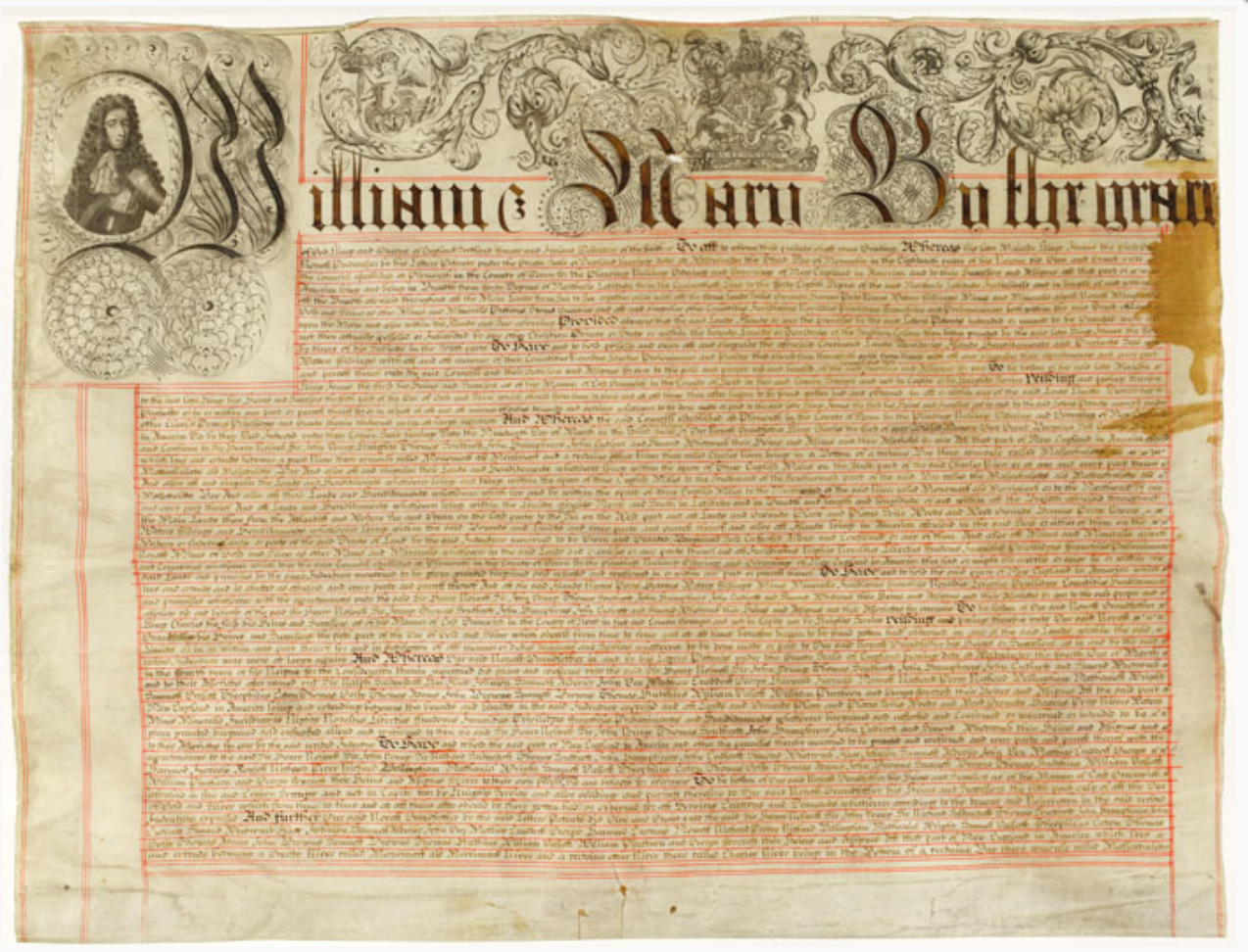
The Pilgrims of the Plymouth Colony established coroners as an elected office in 1636. By the end of the century, however, that colony had been absorbed into the province of Massachusetts Bay, and the monarchs William and Mary had issued a new charter for the province (shown above).

That 1691 charter stipulated:
it shall and may be lawfull for the said Governour with the advice and consent of the Councill or Assistants from time to time to nominate and appoint Judges Commissioners of Oyer and Terminer Sheriffs Provosts Marshalls Justices of the Peace and other Officers to Our Councill and Courts of Justice belonging…
The charter didn’t mention coroners, but everyone probably assumed they fell within the “other Officers” category. Such officials had presided over inquests in England for centuries, and in Massachusetts for decades. The big difference was that now the royal governor of Massachusetts, appointed by the ministry in London, would name coroners in every county, subject to the consent of the Council.

In 1700 the Massachusetts General Court got around to passing an act on “the office and duty of a coroner.” It stated:
every coroner, within the county for which he is appointed, shall be, and hereby is empowered to take inquests of felonies, and other violent and casual deaths committed, or happening within his precinct.
The law then devoted many more words to spelling out the oath that coroners would swear.

The next section said:
when and so soon as any coroner shall be certified of the dead body of any person supposed to have come to a violent and untimely death, found or lying within his county or precinct, he shall make out his warrant directed unto the constables of the same town where such dead body lies, or of three or four of the next adjacent towns, if need be, requiring them forthwith to summon a jury of good and lawful men of the same town, or such number as shall be sufficient, with those sent for from the neighbouring towns to make up eighteen in all, to appear before him at the time and place in the said warrant expressed
Then the law specified the language of the summons, the oath for the jury foreman chosen by the coroner, the oath for those jurors, and the fines to be levied if the constables or prospective jurors didn’t do their duties. I’m pleased to report that the law let the coroner swear in jurors “by three or four at once,” or else we’d still be waiting.

Out of the pool of eighteen men called, the coroner would choose “fourteen or more” for a jury and give them this charge:
You shall diligently inquire, and true presentment make, on the behalf of our sovereign lord the king, how and in what manner A. B. here lying dead, came to his death; and you shall deliver up to me, his majesty’s coroner, a true verdict thereof, according to such evidence as shall be given to you, and according to your knowledge. . . .

to declare of the death of the person, whether he died of felony, or by mischance and accident? and if of felony, whether of his own or of another’s? and if by mischance or misfortune, whether by the act of God or of man? and if he died of another’s felony, who were principals and who accessaries? who threatened him of his life or members? with what instrument he was struck or wounded? and so of all prevailing circumstances that can come by presumption.

And if by mischance or accident, by the act of God or man, whether by hurt, fall, stroke, drowning, or otherwise, to inquire of the persons that were present, the finders of the body, his relations or neighbours, whether he was killed in the same place, or elsewhere? and if elsewhere, by whom and how he was thence brought? and of all other circumstances.

And if he died of his own felony, then to inquire of the manner, means or instrument, and circumstances concurring.
Coroners could also summon witnesses, and of course they had their own oaths to swear.

The jury findings were specified in such detail that coroners came to use printed forms, filling in the blanks with information about the dead person, the date, the jurors, and so on.

The 1700 law said coroners could collect 10s. per day for travel and expenses, plus 2s. per day for each juror, to be collected from the dead person’s estate (or a dead child’s parents). If not enough money was available, the county treasurer would pay out what was needed.

In 1726 a new law allowed coroners to appoint deputies. In 1739 the legislature decided “some of the coroners within this province have of late greatly multiplied their deputies, and under colour of such deputation persons have pretended to be exempted from duties,” so it made such deputies a temporary appointment.

In contrast, coroners, like justices of the peace, kept their jobs for life—but that meant either their own lifespan, or the lifespan of the monarch under whom they were appointed.

COMING UP: Up for renewal.

Friday, October 24, 2025

“In Lieu of that Part of his Salary received annually from England”

New England’s Puritan heritage made those colonies less than welcoming for the Church of England.

There was an Anglican missionary organization called the Society for the Propagation of the Gospel in Foreign Parts (S.P.G.). It paid for ministers to visit Native American communities.

It also supplemented the salaries of ministers in New England on the assumption that their congregations were small and their work difficult.

The Rev. Edward Bass was one of those ministers. He was born in 1726 in Dorchester into a family that had arrived early in the English settlement of Massachusetts. He studied at Harvard College and spent a couple of years teaching and preaching in Congregationalist meetings.

But by 1752 Bass decided that he really belonged in the Church of England. He sailed to Britain to be ordained, returning to take up the pulpit of St. Paul’s church in Newburyport.

Twenty years later came the war. As quoted yesterday, news of the Declaration of Independence prompted the wardens and vestrymen of St. Paul’s to ask their minister to leave prayers for King George III and his family out of their services for the sake of the church. On 16 July 1776 the Rev. Mr. Bass agreed: “I think it incumbent on me for so important an end to comply with this request during the present state of our political affairs.”

Bass tried to walk a narrow line. He dropped the public prayers for the king but continued to support the Crown personally. When the Massachusetts Council ordered all ministers to read the Declaration of Independence to their congregations, he declined to declaim it from the St. Paul’s church pulpit but evidently allowed a lower church official to do so.

But already other Anglican ministers were complaining about Bass’s conduct. On 15 July 1775 the Rev. Dr. Henry Caner of King’s Chapel in Boston had written to the S.P.G.: “Mr. Bass has complied perhaps too far with the orders of the Rebels.”

The war stopped the S.P.G.’s regular payment to Bass. On 25 Nov 1776, nine Newburyport men signed this pledge:
We the Subscribers of St. Paul’s Church in this town being truly sensible of the Distress which our worthy minister must suffer without some Relief in Lieu of that Part of his Salary received annually from England, and which the present unhappy Times prevent his obtaining, do promise to pay on Demand to Mr. John Vinal the several sums affixed to our Names to be by him delivered to the Rev. Mr. Bass.
The promised amounts ranged between £10 from Tristram Dalton and John Tracy to 18 shillings from Abram Gallisham. As for Vinal the schoolteacher and church warden, his signature doesn’t appear on this document. Perhaps he chipped in on his own, or perhaps his contribution lay in wrangling the contributions of others.

TOMORROW: Did that settle matters?

Monday, August 04, 2025

“The most profitable Business he could at present Employ himself about”

Here’s another transcribed letter from the Papers of John Hancock.

Thomas Cushing, having been replaced as a Massachusetts delegate to the Continental Congress in favor of Elbridge Gerry, was back home in Massachusetts as a member of the Council.

On 4 Apr 1776, less than a month after the British military evacuated Boston, Cushing wrote to Hancock:
Some time before you wrote to me concerning Your Brother [Ebenezer Hancock], I had not been unmindful of him, I saw him at Watertown & he told me he should like to be Employed if possible in that town in writing for the Council or House, as he should in that Care be near his family & could often Visit them, I accordingly made Enquiry after some Employ of this Sort for him & sspoke to divers Members of the Council & it appeared to me that there would soon be an opening for him –

a few days ago I saw him at Boston and told him what you hard wrote me concerning him & what prospect I thought there was of his being Employed, he told me he was oblidged to me, but it would not suit him & tarry at Watertown now as the Town of Boston was again retured to its Inhabitants, that he had found all his goods & merchandize were safe and in good Condition, that he determined to return to Boston & that he apprehended that the most profitable Business he could at present Employ himself about was in attending to the Sale of his Goods, in which I think he judged wisely. I give you joy that his Goods are Safe
John eventually got Ebenezer the job of a deputy paymaster of the Continental Army. As a result, Ebenezer sometimes had huge sums of silver money from France under guard in his Boston home.

Ebenezer Hancock’s house in downtown Boston is now on the market. It’s being promoted as John Hancock’s house because the older brother owned it, but he’d inherited a lot of property in Boston. Ebenezer, who had received a smaller bequest from their uncle, ran into business reverses and went bankrupt in 1769. According to W. T. Baxter’s article on Ebenezer’s bankruptcy, John helped him out with “rent-free premises.”

Eventually, Baxter noted, the property flowed the other way. Gov. Hancock died intestate, so Ebenezer inherited a third of his fortune, including the stone mansion on Beacon Hill.

Thursday, June 12, 2025

“The Continental Barracks on Noddle’s Island”

As soon as the siege of Boston ended, the Massachusetts government moved to fortify Noddle’s Island and other spots in Boston harbor.

On 6 Apr 1776, the lower house of the General Court formed a “Committee for fortifying the Harbour of Boston” and told those members
immediately to take a View of Noddle’s-Island, and report to this Court what Time it will probably take a Regiment, consisting of Seven Hundred and Twenty-eight Men, to perform the Business of Fortifying said Harbour.
Twelve days later the house empowered that committee
To purchase on the best Terms they may be had, eight Hundred Feet of the Continental Barracks (provided their Cost, with the Expence of removing and rebuilding them, shall in the Opinion of the Committee, be less than the Value of new ones) and cause them to be removed to, and re-built on Noddle’s-Island
The Council approved that plan the next day. Until John Hancock took office as an elected governor in 1780, the Council would serve as both the upper house of the legislature and the executive branch of the state government, carrying out legislative policies.

The barracks were assembled on Jeffries’s Point, the southwestern corner of the island. It looks like that building housed provincial soldiers while they built the harbor fortifications, but not year-round.

Those barracks were put to another use in 1780, after French warships started arriving in Boston harbor. That summer Thomas Chase, the state’s deputy quartermaster general, wrote to the Council:
The Commanding Officer of the French Troops has applyed to me for a Hospital for the sick, and as there is Continental Barrack on Noddles Island, suitable for that purpose, and as Mr. [Henry Howell] Williams owns the Soil, and I suppose he will make Objection to their going into Barracks, I pray your Honors would be pleased to give Orders that they shall not be molested in said Barracks.
Chase’s colleague from the “Loyall Nine” fifteen years earlier, John Avery (shown above), had become the state secretary. He reported this action by the Council on 15 July:
Read & Ordered — that Col. Thomas Chace, D.Q.M.G., be, and hereby is directed to take Possession of the Continental Barracks on Noddle’s Island for the Use of the sick Soldiers on Board the Ship Le isle de France, arrived this morning from France, belonging to his most Christian Majesty.
The local historian William H. Sumner, having accepted family lore that Gen. George Washington had given Henry H. Williams barracks from Cambridge before leaving New England in April 1776, concluded that these barracks converted into a hospital must have been a second building. But, as I wrote yesterday, there’s no evidence for such a grant. Nor any mention of multiple barracks on Noddle’s Island.

Furthermore, Chase didn’t write about Williams as having a home on the island, only as protective of his “Soil” there. Chase clearly expected Williams to interfere with turning the barracks into a hospital for the French, so the state explicitly approved his plan. That action suggests the Patriot government still didn’t trust Williams to cooperate with the war effort.

TOMORROW: Where was Henry Howell Williams during the war?

Thursday, December 12, 2024

“You found the money and Sam Adams the brains”

For the first years of the Revolutionary War, Massachusetts continued to operate on the basis of its provincial charter.

The General Court was elected each year, starting in the summer of 1775, when it took over from the Provincial Congress. Its members chose a Council.

That Council exercised executive power, as the charter had specified for times when the royally-appointed governor and lieutenant governor were absent from the province. Which they were, for obvious reasons.

It took years, and two tries, before the towns of Massachusetts ratified a new constitution in 1780. That provided for a governor again—to be elected by the people rather than appointed.

On 19 October, the Rev. William Gordon of Roxbury wrote to John Adams, then on a diplomatic mission in Europe, about that choice:
Mr. [John] Hancock will be governour, unless Death should prevent it. I was employed by a Boston representative under the rose, to plead with Mr. [James] Bowdoin that pro bono publico [for the good of the public] he would condescend to serve as Lt. Govr.: I urged that plea, and encourage the expectation from his not declaring off, that, if the Genl. Ct. are pritty well agreed, he will not decline. He will be a good poize, and prevent undue influence and eccentric motions.

Some time back several persons dined together with the above mentioned, the conversation turned upon old matters, a country booby of a representative said, “ay I remember we used to say that you found the money and Sam Adams the brains.” A pause commenced for some minutes before the conversation was renewed. The poor mortal, upon being afterwards spoken to upon the impropriety of his remark, apologized by pleading, it was the truth and he thought there could be no hurt in speaking it.
This was during a rift between Hancock and Samuel Adams, with Gordon on Adams’s side and relishing anecdotes that made Hancock look foolish.

Hancock did indeed become governor less than a week later, but his lieutenant governor was Thomas Cushing. Bowdoin was the next elected governor, serving two difficult terms before losing to Hancock, who had decided he was healthy again. Eventually Samuel Adams became lieutenant governor under Hancock, and then succeeded him in 1793.

Wednesday, November 13, 2024

“You justly observe that he has a difficult card to play”

Yesterday I started quoting from Loyalist merchant Richard Lechmere’s 22 May 1775 letter about the beginning of the Revolutionary War, as transcribed and shared a few years ago at Heritage Auctions.

Lechmere was notably ambivalent about the performance of Thomas Gage as both commander of the British army in North America and royal governor of Massachusetts.

On the one hand, he thought the ministry in London was hamstringing Gage by not sending him enough troops and limiting his autonomy:
The fine friends of Government that are hear [sic] impatiently long, for the Arrival of the Troops from Ireland, The Marines and recruits are arriv’d about 1100 in all, when the others arrive we hope, the Rebels may be drove to some distance from the town, tho’ we have our fears that the General has not and will not have Sufficient power from the Minister to act offensively, we form this Opinion from what has (or rather has not) been done, ’tis a pity he had not discretionary powers, the want of this, has, and I fear will again produce some bad Consequences.
On the other hand, Lechmere suspected that Gage was holding his forces back. After describing the previous day’s fighting over Grape Island, the merchant wrote:
in the Hay Expedition ’tis said both the Troops and Schooners had orders not to Fire, this seems very strange, indeed there has been several instances of their firing upon Boats and their not returning it, these little attempts and not succeeding in them, give the Rebels great sprit, and I wish it may not have the opposite Effect upon the Troops, the General is one of the most humane good men that lives, and I wish his tenderness may not in the end hurt him, and the Cause, he feels and Pitys the distresses of the Country
In particular, Lechmere thought Gage had erred in not calling on his Council—a body that Lechmere himself had been appointed to.
As to the Council we have not been call’d together since I wrote you, nor it is it I believe the wish of any one member so to be, but I can’t help saying, the Gov.r miss’d the best Opportunity of having them recogniz’d by the People the day after the 19 April,

town Meeting was call’d with a design to choose a Committee to wait upon the Gov.r to Ask his Leave that the Inhabitants might remove out of town with their Effects, this Committee was [composed?] of the Select Men with the Addition of Mr [James] Bowdin as their Chairman, they went to the Governor towards Evening, and after being with him some time, he Consented that they might remove with their Effects, whenever they pleas’d,

it woul’d have been a lucky circumstance if he had said, he should as it was a matter of a civil nature consult his council, and in the Next day give his answer but unluckily he was in my poor opinion a little to precipitate, in giving his Answer immediately, and they have been constantly moving out every day since I really believe he has done this from good principles, because he could not render us more obnoxious than we were before but in this once instance, I think he was wrong.

you justly observe that he has a difficult card to play, but when he is invested with powers, I hope he will convince the Rebels that he does not want [courage?] to execute them
Gage did cancel permission for people to leave Boston and then negotiated an agreement that they would deposit their firearms with the selectmen at Faneuil Hall before reopening the gates. Naturally, people criticized him for both decisions.

TOMORROW: News from outside.

Tuesday, November 12, 2024

“I fear Great Brittain will find it difficult to subdue an extensive Continent”

Back in 2008, Heritage Auctions sold a letter from Richard Lechmere (1727–1814) commenting on the first month of the Revolutionary War.

Lechmere was a wealthy merchant, a King’s Chapel vestryman, and a steady supporter of the royal government. The ministers in London had named him to the mandamus Council in 1774. He took that office even though it meant leaving his estate in east Cambridge and moving into Boston.

It’s interesting, therefore, that Lechmere’s letter surfaced in a collection of papers owned by Henry Seymour Conway (1721–1795), a British Member of Parliament and sometime minister who usually opposed stringent measures against the colonies. While Lechmere was a clear “Tory” by Massachusetts standards, in London he might have been among the moderate Whigs who agreed that something had to be done about the colonial resistance but didn’t want the response to be too harsh.

Of course, the outbreak of war has a way of changing people’s outlooks. In this letter Lechmere wrote:
Blood must be shed, before the Colonies can be brought [to s]ubmission is sufficiently prov’d by the Event of 19 April, [it is] my opinion that large quantities must be spilt before the Continent can be reduc’d and indeed I think it a doubtfull matter, whether it can be ever be effected[.]

the Corsicans without resources gave the french a great deal of trouble by retiring into the Interior Country[.] if they were able to do there under those disadvantages, I fear Great Brittain will find it difficult to subdue an extensive Continent, full of people United in the same cause and abounding with every necessary to defend themselves, if they pursue the same method, as the Corsicans, which I believe to be their plan, and especially while Government move[s] so slow, as to give them time, from discipline, to become good soldiers,

we still remain Blockaded and the Rebels are fortifying every pass and Defile in the neighbourhood of the Town, they have strong and extensive lines at Cambridge and Batteries upon the Hills about Charelstown that command the Roads there[.]
Later Lechmere discussed the British military’s attempts to raid the countryside, starting in September 1774 with the “Powder Alarm”:
The Troops have been unsuccessful in a very late Attempt they have made (except removing the powder at Charlestown) by some means or other, the Rebels got intelligence of their intentions, as soon as the scheme is laid, and with their usual industry find means to prevent their Executing it, 250 Troops were sent to [Salem] to secure some Cannon, they got intellig[ence]…Revmo’d the Cannon, and pulled up the Drawbridge...

Yesterday they [the troops] went to Hingham with an Arm’d s[ch]ooner several Sloops and a number of Boats with thirty…Soldiers) to fetch away about 90 Tons of Hay, from an Island about 500 yards form the shore, the Rebels came down to the shore, fired upon them, wounded one or two men, and oblig’d them to return without the Hay...
That description of actions in the harbor matches the skirmish over Grape Island on 21 May. Together with other mentions of things that had happened, and lack of mentions of things that would happen later, that allowed Heritage to date this letter on 22 May 1775.

TOMORROW: Lechmere’s thoughts on Gov. Gage.

(The photo above shows, courtesy of Find a Grave, the memorial plaque for Richard and Mary Lechmere in Bristol Cathedral, where they are buried.)

Saturday, September 07, 2024

Gunshots in the Countryside

On 7 Sept 1774, 250 years ago today, Henry Vassall was riding in Lincoln when he heard a gunshot.

The only Henry Vassall I was able to find on the family tree at this time was a nineteen-year-old son of William Vassall, discussed yesterday.

Henry was either visiting or staying with his cousin Elizabeth, wife of Dr. Charles Russell (1739–1780, shown here). I wonder if he was studying medicine.

Later that month Henry Vassall told the Charlestown committee of correspondence about his experience. He then wrote out an account for two Middlesex County magistrates, Henry Gardner of Stow and Dr. John Cuming of Concord:
Passing between the House of Mrs. Rebecca Barons [?] & Doct. Russell’s between the Hours of 7 & 9 in the Evening of the 7 instant [i.e., this month] & to the best of my Knowledge as I rose [?] a little Hill a little a past the first Canopy [?] I heard the report of a Gun saw the light and a Ball Enter’d the Carriage which I was in being Doct. Russells.

I immediately step’d out of the Carriage & stood about five or six Minutes & then stepp’d into the Carriage Again & road in haste to the Doctor when I had gone a small Distance from the Place where the Gun was discharged I met a person on Horse back

when I had past a small Distance further I met several Persons riding on two Horses,

whether the Ball was aim’d at the Carriage I can’t say I further declare I do not know or even suspect who the Person was that Discharg’d the Gun as above mentioned . . .

NB. The above affair I declar’d to no person in Lincoln but the Revd. Mr. [William] Lawrence & desired him to keep it secret—Till the Friday Following.
Gardner and Cuming also gathered statements from a local man named Joseph Peirce and Luck, enslaved to Dr. Russell. Both declared that they had been traveling near young Vassall and had heard no gunshot.

Three members of the Lincoln committee of correspondence then wrote back to Charlestown agreeing that they detested “the Crime of Assassination” but casting doubt on Vassall’s complaint:
We shall only add that as the evening on which this event was said to have happened was very calm it is the general opinion here that it is very improbable if not utterly impossible that a gun should be Discharged at that time & place without being heard by many persons, you have Doubtless seen the impression in the Carriage & are able to judge & Declare whether it is the efect of a Bullet Discharged from a Gun or Not as well as any person in this town
This incident provided yet another reason for members of the Vassall family to seek safety surrounded by the king’s soldiers. (And on the same day that the magistrates wrapped up their investigation, people in Bristol, Rhode Island, threw stones at the chaise of Henry’s father and stepmother, William and Margaret Vassall. Newspapers reported that “next morning [they] set out for Boston.”)

This shot in Lincoln is only the second example I’ve found of someone in Massachusetts firing a gun at a supporter of the royal government. The first had occurred a couple of weeks earlier in Taunton.

According to Daniel Leonard, a veteran of the last war named Job Williams came to his house with a warning that “the People were to assemble” to protest how he had joined the mandamus Council. Leonard left, thinking that would head off the problem. Instead, on 22 August , or perhaps make it clear he wouldn’t be welcomed back. That crowd did arrive. Leonard wrote:
about five hundred persons assembled, many of them Freeholders and some of them Officers in the Militia, and formed themselves into a Battalion before my house; they had then no Fire-arms, but generally had clubs. . . .

My Family supposing all would remain quiet, went to bed at their usual hour; at 11 o’Clock in the evening a Party fixed upon the house with small arms and run off; how many they consisted of is uncertain, I suppose not many; four bullets and some Swan-shot entered the house at the windows, part in a lower room and part in the chamber above, where one Capt. Job Williams lodged. The balls that were fired into the lower room were in a direction to his bed, but were obstructed by the Chamber floor. . . . I conclude it possible that the attack upon the house was principally designed for him.
Back in 1769–1770, there had been three increasingly notorious incidents of government supporters shooting at crowds of protestors: the “Neck Riot,” Ebenezer Richardson killing Christopher Seider, and of course the Boston Massacre. But even in that period Massachusetts protestors had never shot at royal officials or their supporters.

These untraceable gunshots in the late summer of 1774 show that some people in Massachusetts were starting to think it was acceptable to use that level of violence against Loyalists.