J. L. BELL is a Massachusetts writer who specializes in (among other things) the start of the American Revolution in and around Boston. He is particularly interested in the experiences of children in 1765-75. He has published scholarly papers and popular articles for both children and adults. He was consultant for an episode of History Detectives, and contributed to a display at Minute Man National Historic Park.

Subscribe thru Follow.it


•••••••••••••••••


Showing posts with label Thomas Boylston Adams. Show all posts

Monday, September 08, 2025

“Our House is an hospital in every part”

On 8 Sept 1775, 250 years ago today, Abigail Adams had serious news for her husband John, who was heading back to the Continental Congress:
Since you left me I have passed thro great distress both of Body and mind; and whether greater is to be my portion Heaven only knows. You may remember [hired boy] Isaac [Copeland] was unwell when you went from home. His Disorder increasd till a voilent Dysentery was the consequence of his complaints, there was no resting place in the House for his terible Groans. He continued in this state near a week when his Disorder abated, and we have now hopes of his recovery.

Two days after he was sick, I was seaz’d with the same disorder in a voilent manner. Had I known you was at Watertown I should have sent Bracket [a farm hand] for you. I sufferd greatly betwen my inclination to have you return, and my fear of sending least you should be a partaker of the common calamity. After 3 day[s] an abatement of my disease relieved me from that anxiety.

The next person in the same week was [servant girl] Susy. She we carried home, hope she will not be very bad.

Our Little Tommy [Thomas Boylston Adams] was the next, and he lies very ill now—there is no abatement at present of his disorder. I hope he is not dangerous.

Yesterday [servant girl] Patty was seazd and took a puke. Our House is an hospital in every part, and what with my own weakness and distress of mind for my family I have been unhappy enough.
The Adams Papers editors noted: “Patty, who was probably a relative of JA or AA and had lived four years in the Adams household, died after a protracted and grisly illness early in October.”

The letter went on to list other neighbors who were ill. Abigail and John also both knew that his brother Elihu had died of the same disease in early August.

Two days later, Abigail resumed her letter:
As to my own Health I mend but very slowly—have been fearful of a return of my disorder to day but feel rather better now. Hope it is only oweing to my having been fatigued with looking after Tommy as he is unwilling any body but Mamma should do for him, and if he was I could not find any body that is worth having but what are taken up already with the sick. Tommy I hope is mending, his fever has abated, his Bowels are better, but was you to look in upon him you would not know him, from a hearty hale corn fed Boy, he is become pale lean and wan.

Isaac is getting better, but very slowly. Patty is very bad. We cannot keep any thing down that she takes, her situation is very dangerous. Mr. Trot and one of his children are taken with the disorder.
As discussed back here, George Trott was a politically active jeweler from Boston, and Abigail had taken in the Trott family as refugees.

The epidemic that Abigail’s letter described was “camp fever,” a bacterial dysentery. It spread among provincial soldiers and then to their families and neighbors because, basically, people didn’t yet realize they had to wash their hands and clothing thoroughly to avoid spreading germs. Women and servants caring for the sick thus became vectors for the disease to themselves or others.

All this time, Abigail was also worrying about smallpox, a viral disease that spread more slowly but was more deadly. She wrote:
The small pox in the natural way was never more mortal than this Distemper has proved in this and many neighbouring Towns. 18 have been buried since you left us in Mr. [Ezra] Welds parish [of Braintree]. 4, 3 and 2 funerals in a day for many days. Heitherto our family has been greatly favourd.
Looking ahead, Abigail asked John to send her medical supplies:
By the first safe conveyance be kind eno to send me 1 oz. of turkey Rhubub, the root, and to procure me 1 quarter lb. of nutmegs for which here I used to give 2.8 Lawful, 1 oz. cloves, 2 of cinnamon. You may send me only a few of the nutmegs till Bass [another family servant] returns. I should be glad of 1 oz. of Indian root. So much sickness has occasiond a scarcity of Medicine.
Many modern American parents can easily sympathize with Abigail having to care for a child like Tommy. But the number of sick people in the household and the neighborhood, and the specters of serious illness and death, are worries we’ve usually been spared. This sort of document is a reminder of the danger of rolling back proven health measures.

Wednesday, December 28, 2022

Thomas Boylston Adams and His Relations

In 1772, John and Abigail Adams had a third son, whom they named Thomas Boylston Adams (shown here, some years later).

The following August, John Adams explained this baby’s name this way:
Sept. 15. 1772 Thomas Boylston Adams was born at Braintree and Christened the next Sunday by Mr. [Anthony] Wibert. The childs great, great Grandfather was of the name of Thomas Boylston and built the Old house at Brooklyne where my mother was born; My mother had also an Uncle of the same name The father of the late Nich. Boylston Esq. and the present Thomas Boylston. Merchant.
As discussed the last couple of days, Adams personally knew the brothers Nicholas and Thomas Boylston.

He also knew—heck, everyone knew—that Nicholas had died in 1771 without any children. He had left most of his huge fortune to a nephew, born Ward Nicholas Hallowell (1749–1828). In return, that young man had legally changed his name to Ward Nicholas Boylston in 1770.

Nicholas’s brother Thomas also had a large fortune. He also had no children. Was he also looking for an heir?

And might knowing there was a little boy in the extended family who already bore his name (albeit from a common ancestor) have caught Thomas’s attention? Did the Adamses consider the prospect of an inheritance, even a little bit? After all, “Thomas Boylston. Merchant” did get a mention in this genealogical note about the baby, despite being only a first cousin twice removed.

As it turned out, Thomas Boylston lost his money in the failure of a London mercantile firm in 1793. He even spent time in a British debtors’ prison before dying in 1798. So there was no fortune to inherit.

Friday, July 16, 2021

Charles Adams’s Wish

On 16 July 1775, Abigail Adams had an urgent message to pass on to her husband John, then at the Continental Congress in Philadelphia:
Our little ones send Duty to pappa. You would smile to see them all gather round mamma upon the reception of a letter to hear from pappa, and Charls with open mouth, What does par say—did not he write no more. And little Tom says I wish I could see par.

Upon Mr. Rice’s going into the army he asked Charls if he should get him a place, he catchd at it with great eagerness and insisted upon going. We could not put him of, he cryed and beged, no obstical we could raise was sufficent to satisfy him, till I told him he must first obtain your consent. Then he insisted that I must write about it, and has been every day these 3 weeks insisting upon my asking your consent.

At last I have promised to write to you, and am obliged to be as good as my word.
Charles Adams was then five years old. His father did not use his influence to land him a spot in the Continental Army. But later in the war Charles did accompany his father and older brother John Quincy on a diplomatic mission to Europe.

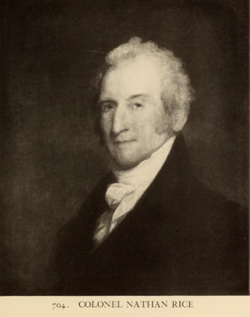
The “Mr. Rice” who started all this heartache with an offhand joke to little Charles was Nathan Rice (1754–1834, shown above later in life), son of a Sturbridge minister who graduated from Harvard College in 1773. By then his widowed mother had married a man in Hingham, bringing the family to the South Shore.

In August 1774 Rice joined the Adams household as one of John’s law clerks alongside John Thaxter. Because their arrival coincided with the shutdown of the Massachusetts courts and Adams’s service at the First Continental Congress, those young men didn’t get to see much lawyering.

Thaxter transitioned into being the Adams family’s live-in tutor, also going on that mission to Europe. Rice joined the army in May 1775, serving in staff positions for most of the war, including as aide de camp to Gen. Benjamin Lincoln.

Rice settled in Hingham, having married Sophia Blake. He returned to the army during the Adams administration’s Quasi-War, retiring as a lieutenant colonel. In the 1810s, after raising their children, Nathan and Sophia Rice moved up to Winooski, Vermont. The house they built in 1818, remodeled extensively, became known as the “Mansion House”; there was a local dispute over removing it to build apartments in 2019, and I don’t know how that turned out.

Monday, September 23, 2019

“I have many anxious hours for Charles”

In early 1789, as I’ve been chronicling, Charles Adams had a couple more run-ins with the authorities of Harvard College.

Even though those incidents didn’t appear on the official faculty minutes or Charles’s permanent record, word got back to his family. That prompted a new set of conversations and correspondence. Again, we have only hints of what they knew.

On 2 May 1789, John Quincy Adams’s diary says: “Wrote to my brother Charles.” That letter doesn’t survive, but on 27 May he told their cousin William Cranch:
[With respect?] to Charles the tender solicitude, which you feel in regard to his conduct is only an additional evidence of a disposition, which I have long known to be peculiarly yours. it adds to the number of obligations for which I feel myself indebted to you, but it cannot add any thing to the settled opinion which I have of the excellency of your heart.—

I wrote him a very serious Letter three weeks ago and conversed with him at Haverhill upon the subject in such a manner as must I think lead him to be more cautious. However I depend much more upon the alteration which is soon to take place in his situation, than upon any advice or counsel, that I can ever give him. I am well convinced that if any thing can keep him within the limits of regularity, it will be his knowlege of my fathers being [near him and the?] fear of being discovered by him.—
The “alteration” John Q. wrote about was Charles’s impending graduation that summer. The family had already planned for Charles to move to New York, where his father was serving as Vice President, and study the law there.

We might marvel at the idea that New York City would offer fewer temptations than Cambridge, but the Adams family consensus was clear—the problem wasn’t Charles so much as Charles’s companions at college.

Abigail Adams expressed her feelings to John Q. on 30 May:
I have many anxious hours for Charles, and not the fewer, for the new scene of life into which he is going, tho I think it will be of great service to have him with his Father, & more to take him intirely away from his acquaintance. I have written to him upon some late reports which have been circulated concerning him. I hope they are without foundation, but such is the company in which he is seen that he cannot fail to bear a part of the reproach even if he is innocent.
The letter that Abigail wrote to Charles doesn’t survive, either.

Abigail actually opened that topic by expressing concern for her youngest son, Thomas Boylston Adams. As I’ve written, his college disciplinary record was even cleaner than John Quincy’s—he hadn’t done anything! But still a mother worried:
I must request you in my absence to attend to your Brother Tom, to watch over his conduct & prevent by your advice & kind admonitions, his falling a prey to vicious Company. at present he seems desirious of persueing his studies preserving a character and avoiding dissipation, but no youth is secure whilst temptations surround him, and no age of Life but is influenced by habits & example, even when they think their Characters formed.
Even as Charles’s relatives wrote to him, however, he was getting in trouble again at the Blue Anchor Tavern.

TOMORROW: Naked in Harvard Yard.

Thursday, September 19, 2019

“Perswaded that Charles did not deserve the suspicions”

The Harvard College Thanksgiving banquet in November 1787 ended badly. By the evening, window glass and wooden benches were lying on the ground outside the hall. That might have had something to do with how every student had brought a bottle of wine.

The Harvard faculty levied a ten-shilling fine on each student who had gone to that dinner and couldn’t prove he'd left before the destruction started. The administration then relented in the case of the sophomores, but not the seniors or juniors—including Charles Adams, class of 1789.

The fines went out in the quarterly bills at the start of 1788. So there was no way Charles could keep the bad news from his family (as he would try to do with financial reverses in the late 1790s).

At the time, Charles’s parents, John and Abigail, were still on a diplomatic mission in Britain. The task of looking after their sons had fallen to relatives: Abigail’s older sister Mary Cranch in Braintree; her younger sister Elizabeth Shaw and her husband John in Haverhill; and John’s cousin Dr. Cotton Tufts of Medford, who managed the family money.

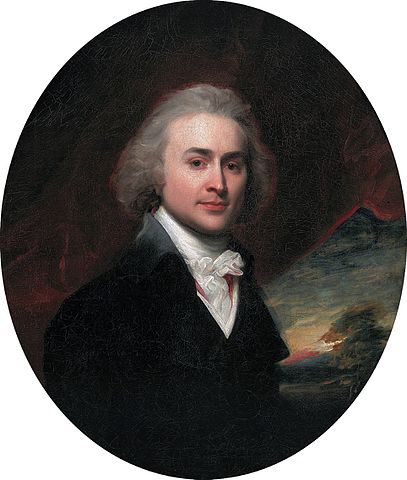
Eldest son John Quincy Adams (shown above) had graduated from Harvard the year before and gone to Newburyport to study law. On breaks he got together with both younger brothers. On 2 Feb 1788, after one such visit, John Q. wrote in his diary:

I had with Mr. Shaw some conversation upon the subject of the disorders which happened at College, in the course of the last quarter: his fears for my brothers are greater than mine: I am perswaded that Charles did not deserve the suspicions which were raised against him: and I have great hopes that his future conduct, will convince the governors of the University, that he was innocent.
The Rev. John Shaw had tutored both Charles and Thomas Boylston Adams to prepare them for college, as well as other boys. (Including Charles’s first roommate or “chum,” who’d gotten into worse trouble—but I’ll talk about that some other time.) Shaw was clearly worried about Charles’s behavior while John Q. tried to stand up for him.

Two weeks later John wrote to Dr. Tufts for some spending money, noting that he’d asked Charles to pass on the request but, well, “I am apprehensive he forgot to deliver my message.” Like many oldest sons, he seems to have felt both protective of his little brothers and convinced they were incurable idiots.

John Q. went on with more hopeful comments about the situation:
The riotous ungovernable spirit, which appeared among the students at the university in the course of the last quarter gave me great anxiety; particularly as I understood, that one of my brothers, was suspected of having been active in exciting disturbances; but from his own declarations and from the opinion I have of his disposition, I hope those suspicions, were without foundation—I conversed with him largely upon the subject, and hope, his conduct in future, will be such as to remove, every unfavourable impression.
Others in the family were adding their voices, perhaps less optimistically. The next day, 17 February, Aunt Elizabeth wrote to Aunt Mary:
I long to hear from Charles & Thomas I charged them to write to me— I do not know that Mr Shaw & I could have given them better advice if they had been our own Sons— I hope they will conduct agreeable to it—& be wiser than they have been, & more cautious of abusing Government, for what they from choice suffer—the Ten shillings penalty, I mean—
As I wrote a couple of days ago, I think the record shows that only Charles had been fined the ten shillings and Tommy still had a near-spotless record at college. But he was the little brother, and the family didn’t want Charles to lead him astray.

Unfortunately, all those admonitions didn’t keep Charles out of trouble in his senior year.

TOMORROW: A rough winter in Cambridge.

Wednesday, September 18, 2019

“Charles has been guilty of a trick”

On 26 May 1786, John Adams wrote from London to his eldest son, congratulating John Quincy Adams on getting into Harvard College:
Give me leave to congratulate you on your Admission into the Seat of the Muses, our dear Alma Mater, where I hope you will find a Pleasure and Improvements equal to your Expectations. You are now among Magistrates and Ministers, Legislators and Heroes, Ambassadors and Generals, I mean among Persons who will live to Act in all these Characters.

If you pursue your Studies and preserve your Health you will have as good a Chance as most of them, and I hope you will take Care to do nothing now which you will in any future Period have reason to recollect with shame or Pain.
In the same letter, the U.S. of A.’s minister to Great Britain urged John Quincy to continue to be an example and mentor for his two younger brothers:
If your Brother Thomas is fitted, I hope he will enter, this Summer: because, he will have an Advantage in being one Year with you. My love to Charles. I hope he loves his Book. I have great dependence on you to advise your younger Brothers, and assist them in their Studies. You talk french I hope, with Charles, and give him a taste for french Poetry: not however to the neglect of Greek and Roman, nor yet of English.
Charles Adams was just finishing his first year at Harvard, and Thomas Boylston Adams was preparing to take the entrance examination.

Around the same time John Quincy received that letter, he caught his brother Charles snooping in his private papers. It’s not clear what Charles saw. John Q. had written about some potentially sensitive subjects in his diary that month:
  • On 12 July he criticized the freshman class—Charles’s class—for feuding with the sophomores.
  • He made multiple comments about the beauty of a young lady the brothers had met in Braintree.
  • On 26 July he wrote crankily about not getting the dorm room he expected, blaming the change on a couple of other collegians. (John Q. went back to his diary and added a note, for himself and posterity, that those classmates weren’t to blame.)
Most likely Charles commented about one of those matters, and that alerted his older brother to his snooping.

On 27 July, John Q. started his diary entry this way:
I perceive Charles has been guilty of a trick which I thought he would despise; that of prying into, and meddling with things which are nothing to him: and ungenerously looking into Papers, (which he knew I wished to keep private,) because I could not keep them under lock and key. If he looks here, he will feel how contemptible a spy is to himself, and to others.
It looks like John Quincy never directly confronted his brother about the invasion of privacy. Instead, he left this passive-aggressive note for Charles to find the next time he went looking in the diary. That approach might suggest that John Quincy’s later admonitions to his brother about behaving better weren’t actually that direct.

John Adams returned to Massachusetts in 1788. On 16 July of that year, he wrote to his eldest child, Abigail Adams Smith:
I am happy to hear from all quarters a good character of all your brothers. The oldest has given decided proofs of great talents, and there is not a youth of his age whose reputation is higher for abilities, or whose character is fairer in point of morals or conduct. The youngest is as fine a youth as either of the three, if a spice of fun in his composition should not lead him astray. Charles wins the heart, as usual, and is the most of a gentleman of them all.
The returning diplomat wrote this letter after the Harvard Thanksgiving banquet of 1787, which ended with Charles being fined ten shillings. As we’ll see tomorrow, other members of the family had been discussing that event in person and in letters for months. Yet it appears John Adams didn’t know anything about it since he still heard “from all quarters a good character” of every son.

No one was telling Papa.

TOMORROW: “The riotous ungovernable spirit.”

Tuesday, September 17, 2019

Sorting Out the Adams Boys at Harvard

I started my look at Charles Adams’s experience at Harvard College with a posting on how his aunts clustered around and made sure he had furniture for his dorm room. (His parents were far off in Britain.)

It’s only natural then to wonder how Charles’s extended family responded to his disciplinary problems at college, especially the ten-shilling fine levied at the end of 1787 after some disturbance at Thanksgiving dinner. (Windows were broken. Benches were thrown.)

In order to discuss that topic, I have to lay out how my reading of the Harvard University sources differs from the interpretation of the editors of the Adams Family Papers.

As I wrote back here, the college documents usually refer to undergraduates by last names. When there were two or more students with the same surname, they would be designated as Smith 1, Smith 2, and so on, in order of seniority.

In 1787 there were no fewer than five undergraduates named Adams at Harvard—the three sons of John and Abigail Adams of Braintree and then two more unrelated boys in the class of 1788, Solomon and Thomas. Just to make things more confusing, John Quincy Adams entered Harvard after Charles Adams, but he was admitted straight into the junior class and graduated before the middle brother in a little over a year.

I believe that means Charles was called “Adams 3d” as an entering freshman, “Adams 4th” as a sophomore (the year he hosted a noisy gathering in his dorm), “Adams 3d” again as a junior (when he was at that Thanksgiving banquet), and finally “Adams 1st” as a senior in 1788-89. That appears to be Bertha Illsey Tolman’s interpretation when she indexed the college documents.

The editors of the Adams papers read the record of that Thanksgiving disturbance to say that Charles Adams was “Adams 1st” and his little brother Thomas Boylston Adams (shown above) was “Adams 3d,” both fined ten shillings.

Since “Adams 1st” was a waiter in the senior class in 1787-88, I think that student had to be either Solomon or Thomas Adams. “Adams 3d” was a junior, thus Charles Adams (and not a waiter). Tommy B. Adams wasn’t there at all.

As noted back here, Thomas Boylston Adams’s disciplinary record shows only one minor infraction over four years—the same number that his brother John Q. amassed in a much shorter period. Nevertheless, the family worried about Tommy. I think that reflects their fear that Charles and other college boys would be a bad influence on him, not anything Tommy himself did.

If there’s one thing I can add to the Adams family historiography, it’s clearing Thomas Boylston Adams of accusations of serious misbehavior. He was just pulled into an eddy of family concern about his brother Charles.

TOMORROW: Serious talks with Charles.

Monday, September 09, 2019

The Adams Brothers at Harvard College

For a year in the late 1780s, all three sons of John and Abigail Adams were students at Harvard College.

The first to enter was the middle son, Charles, born in 1770. I described the many little challenges of equipping him for dormitory life in the summer of 1785 back here. (Though I missed the family buying him “a Hat and Cravats” in July.)

John Quincy Adams took his entrance examination the following March, as discussed here. He was older and more experienced than the average new student. (He had been secretary and translator for the U.S. of A.’s first minister to the court of Russia, for goodness’s sake.) The college admitted John Quincy straight into the junior class, and he graduated in 1787.

Finally, Thomas Boylston Adams arrived later in 1786 and studied at Harvard through 1790. Tommy was two years younger than Charles but only a year behind him, his education not interrupted by traveling to Europe with their father.

The Harvard College records of this time designate students by their surnames. When there was more than one student with the same surname, they were called Smith 1, Smith 2, and so on. The case of the Adams brothers was further confounded by the presence of at least one unrelated boy named Adams—Thomas Adams, class of 1788. Thus, when one sees a record of, say, “Adams 2,” one has to know which other Adamses were at Harvard at that exact time and what seniority they had.

Fortunately, in the early 1900s Bertha Illsley Tolman compiled a card index for the Faculty Records, and Harvard recently digitized it. (And Dr. Caitlin G. DeAngelis kindly pointed me to this resource.) I’m going to trust the way Tolman sorted out the Adams brothers rather than retracing each path.

The index records when the faculty officially disciplined all Harvard students. Comparing Tolman’s entries for the three Adams brothers offers a study in contrast. In reverse order of their admission—

Thomas Boylston Adams, punished for absence from prayers, V:296.

John Quincy Adams, punished for absence from prayers, V:252.

Charles Adams, punished for absence from reciting, V:236, 240, 245, 253, 267, 282, 295, 305, 317. VI:19, 26.
punished for absence from prayers, V:346, 253, 267, 282, 295, 317. VI:7, 19, 26.
punished for tardiness from prayers, VI:26.
fined and publicly admonished, V:249-250.
charged for damage done in the Hall, V:278.
fined, V:279.
punished for absence from public lectures, VI:26.
punished for going to a tavern, VI:30.

And that wasn’t even all the trouble Charles got into in four years.

TOMORROW: Unabashed gossip.

Saturday, October 29, 2016

“The birthday of our beloved President John Adams”

After the controversy over celebrating George Washington’s birthday in February 1798, President John Adams reconciled himself to such ceremonies. Indeed, we’re still celebrating the first President’s birthday today, in a way.

But Adams’s Federalist supporters also appear to have stepped up their efforts to celebrate his own birthday, so long as he was in office. (This whole series of postings started with me wondering whether the U.S. of A. celebrated President Adams’s birthday the way it celebrated President Washington’s, and before him King George’s. And the answer is yes, in a way.)

Balls and banquets weren’t to Adams’s taste, of course. The preferred method of honoring him, particularly during the Quasi-War of the late 1790s, became a militia parade. The Columbian Mirror and Alexandria Gazette reported on a ceremony in Alexandria, Virginia, on 30 Oct 1798:
Tuesday last, being the anniversary of the birthday of our beloved President John Adams, was observed in this town with military honors. The uniform companies of Militia, and the company of Silver Grays, went through a variety of maneuvers and evolutions, under the command of George Deneale. After firing several rounds in evidence of their attachment to this good man, as well as to shew that they approbated his conduct towards the insidious French Directory, they retired in the evening with the utmost decorum and harmony.
Even then, however, Adams’s predecessor hovered over the ceremony. Martha Washington presented a banner (regrettably incomplete) to the company. On it, “The Golden Eagle of America has a portrait of General Washington suspended from its beak.”

And of course Washington’s birthday balls continued. On 20 February 1799, Abigail Adams wrote from Quincy:
I have received an invitation to the Ball in honour of Gen’ll. Washington but my health is so precarious, and sufferd such a Shock last Summer, that I am obliged to be very circumspect and cautious in all my movements. Thomas will go, and that will be sufficient.
Thomas was the couple’s son Thomas Boylston Adams. He liked balls. In fact, one day after he had arrived in Philadelphia following years in Europe, the President reported to his wife, “This Evening he goes with me to the Ball. I had rather spend it with him at home.”

But now President Adams knew what he had to do to maintain party unity. On 22 Feb 1799, Washington’s birthday, he wrote home to Abigail:
To night I must go to the Ball: where I Suppose I shall get a cold, and have to eat Gruel for Breakfast for a Week afterwards. This will be no Punishment.
Adams enjoyed gruel more than balls, it seems.

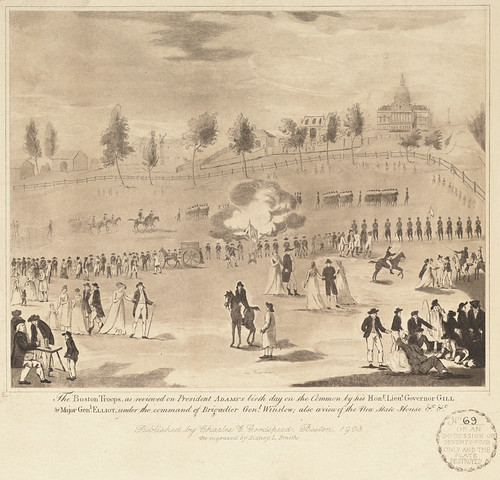
The picture above shows Boston’s celebration of the President’s birthday in October 1799: “The Boston troops, as reviewed on President Adams’s birth day on the Common by his Honr. Lieut. Governor [Moses] Gill & Major Genl. [Simon] Elliot, under the command of Brigadier Genl. [John] Winslow. Also a view of the new State House.” In fact, this is said to be the earliest printed picture of the new Massachusetts State House designed by Charles Bulfinch.

TOMORROW: Mrs. Rowson’s reprise.

Friday, July 18, 2014

A Request to John Adams

In the same long letter from Abigail Adams that I quoted yesterday, she included these personal messages from the children to their father:
Our little ones send Duty to pappa. You would smile to see them all gather round mamma upon the reception of a letter to hear from pappa, and Charls with open mouth, What does par say—did not he write no more. And little Tom says I wish I could see par.

Upon Mr. [Nathan] Rice’s going into the army he asked Charls if he should get him a place, he catchd at it with great eagerness and insisted upon going. We could not put him of, he cryed and beged, no obstical we could raise was sufficent to satisfy him, till I told him he must first obtain your consent. Then he insisted that I must write about it, and has been every day these 3 weeks insisting upon my asking your consent. At last I have promised to write to you, and am obliged to be as good as my word.
At this time, Charles was five. (He’s shown above, considerably older though still in his youth.)

John Adams sent “Love to the children” in some of his letters home that month, but never specifically addressed this request.