J. L. BELL is a Massachusetts writer who specializes in (among other things) the start of the American Revolution in and around Boston. He is particularly interested in the experiences of children in 1765-75. He has published scholarly papers and popular articles for both children and adults. He was consultant for an episode of History Detectives, and contributed to a display at Minute Man National Historic Park.

Subscribe thru Follow.it


•••••••••••••••••


Showing posts with label John Brooks. Show all posts

Monday, January 11, 2021

Tracking Ebenezer Dumaresque

When Dr. Nathaniel Martyn “absconded” in 1770, leaving his wife and two children with her family, he left behind another child as well.

Three years earlier, the Boston Overseers of the Poor had indentured a boy named Ebenezer Dumaresque to Martyn. That contract was due to end when the boy came of age on 25 Nov 1781, meaning he was about to turn seven when he left Boston for the rural town of Harvard.

The Boston Overseers’ file on Ebenezer, visible at Digital Commonwealth, also includes this note: “Ebenr. Dumaresque bound to John Gleason of Woburn.” Gleason’s name doesn’t appear in the Overseers’ indentures ledger, published by the Colonial Society of Massachusetts; only Nathaniel Martyn’s does. I take that paper trail to mean that the Overseers got Ebenezer back from the Martyns and then sent him out again, adding the note in his file.

I’m guessing that the boy’s new master was the John Gleason who was born in Brookline in 1720 and married in Watertown in 1740. He and his wife had children in Woburn from 1747 to 1755, and he died there after 1786.

Dr. Martyn had probably brought Ebenezer out to help around the house in 1767 as his wife was busy raising their newborn daughter. The Gleasons, in contrast, were at the end of their period of having children and might have needed farm labor to replace grown sons. But we don’t have hard evidence one way or another.

The name Ebenezer was common in eighteenth-century New England—the tenth most common male given name according to Daniel Scott Smith’s study of records from Hingham. But the name Dumaresque was quite uncommon. As long as we can keep up with the creative ways locals misspelled that surname, we can follow Ebenezer’s trail through the war years.

Massachusetts Soldiers and Sailors has several entries for Ebenezer Dumaresque (Dumarsque, Dumasque, Damasque, Demasque) from Western (now Warren) in Worcester County. All those entries indicate the soldier was born about 1760, as our Ebenezer was. All but one describe him as a little over five feet tall with a dark complexion and dark hair. (One anomalous entry says he was 5'10".)

According to those state records, Ebenezer Dumaresque first served six months in late 1780 in Lt. Col. John Brooks’s regiment, then reenlisted in the spring of 1781 for three years “for bounty paid said Dumaresque by John Patrick and others, in behalf of a class of the town of Western.” He spent most of that time at West Point in New York. On 11 Nov 1782 Pvt. Dumaresque was tried by regimental court-martial for being absent without leave, but his commander pardoned him.

As of the 1790 U.S. Census, “Ebenr. Dumask” headed a household in Palmer, Massachusetts. In addition to himself, the house contained a white male aged 16 or more, a white male under age 16, and two white females.

On 23 Apr 1818, Ebenezer Dumaresque applied for a pension from the federal government as a Revolutionary War veteran. He declared under oath that in early 1781 he had signed up for three years in the 7th Massachusetts Regiment. During his service “he was engaged in no battles.” When the army shrank ”after the Restoration of Peace,” he was shuffled into another unit “under the command of Majors Porter and Preston (he thinks there was no Colonel).”

At the very end of 1783, Dumaresque stated, he was “regularly discharged under the Hand of Major General [Henry] Knox at West Point.” He kept that paperwork for more than a quarter-century until around 1810 “when under an expectation of obtaining a Soldier’s bounty land he sent his discharge to the State of Ohio by an agent” and never saw it again.

By the time he applied for a pension, Dumaresque had left Massachusetts and was living in Kingsbury, New York. He couldn’t supply testimony from any neighbors confirming his military service. All he could send with his application was a short inventory of movable property and a description of his poor health, indications of poverty as the law then required for a pension.

However, Dumaresque’s federal file also contains a July 1819 note from Alden Bradford, secretary of the commonwealth of Massachusetts. It stated:
The records in this office, relating to revolutionary services, are not later than 1780—

But, happily, for you, the Govr, who commanded 7th Regt, has a list of his men, & has furnished a certificate which is herewith forwarded
Lt. Col. John Brooks (shown above) had become the governor of Massachusetts. He personally wrote out a statement certifying that Ebenezer Dumaresque had indeed served under him in the Continental Army from early 1781 to mid-1783.

Dumaresque received his pension. At some point he moved from Kingsbury to the nearby town of Queensbury. Federal records indicate that he continued to receive his money, and to head his own household, past the 1840 census, in the year he turned eighty.

Tuesday, November 26, 2019

William Eustis Returning to Roxbury

At the start of the Revolutionary War, William Eustis (1753-1825) was a medical student of Dr. Joseph Warren. A son of Dr. Benjamin Eustis, the young man was going into the family business.

Eustis’s training was cut short in 1775 for obvious reasons. He joined the New England army as a surgeon for the artillery regiment, treating the wounded after Bunker Hill and the battles of the New York and New Jersey campaign. In 1777 Eustis shifted to overseeing a military hospital north of New York City.

At the end of the war, William Eustis returned to Boston and began a private practice. He entered politics after the Shays Rebellion, serving several years in the Massachusetts House and Governor’s Council. In 1800 he ran for Congress as a Jeffersonian, beating the future mayor Josiah Quincy; in 1804 those two men competed again, and this time Quincy won. Around 1806, William Eustis sat for a portrait by Gilbert Stuart, shown above.

President James Madison appointed Eustis to be his first Secretary of War, hoping to win over New Englanders. With neither the military experience nor the bureaucratic finesse necessary for the job, the doctor lasted right up until there actually was a war in 1812. A couple of years later, Madison made Eustis the U.S. minister to the Netherlands. At least that wasn’t a disaster.

Back in the U.S. of A., Dr. Eustis bought the mansion originally built on a Roxbury hilltop for Gov. William Shirley. He and his wife Caroline, who was also his sister-in-law, lived there for more than forty-five years until her death.

Eustis once again ran for Congress in 1820. Meanwhile, he was also the Jeffersonians’ candidate for Massachusetts governor, losing to a fellow doctor and Revolutionary War veteran, John Brooks. In 1822 Brooks chose not to run again, and the Federalists nominated the archconservative Harrison Gray Otis. That let the Jeffersonians portray Eustis as the moderate, experienced elder statesman. He won the race, and the Federalist Party was wiped out of power in the legislature the following year. Gov. Eustis died in office in 1825.

The Shirley-Eustis House, as the Roxbury mansion is now called, became a pioneering preservation project and museum in the twentieth century. Meanwhile, Stuart’s portrait of Dr. Eustis went into the collection of the Metropolitan Museum of Art—but that institution had so many Stuarts it was hardly ever on display. This year the Met decided to deaccession the painting. Members of the Shirley-Eustis House Association raised the money to bid for it at auction.

Dr. Eustis’s portrait will therefore be welcoming visitors to Dr. Eustis’s house starting in 2020.

Wednesday, November 20, 2019

The Legends of Sarah Bradlee Fulton

Helping her husband and brothers prepare for the Boston Tea Party wasn’t the only patriotic activity that descendants credited Sarah Bradlee Fulton with doing.

In addition, her grandson John A. Fulton, her brother’s great-grandson Samuel Bradlee Doggett, and local hsitorians told these stories about her:
  • She “heard the alarm of Paul Revere” from her house in Medford “on the east side of Main street about one hundred and fifty feet south of the bridge, on the south side of what is now [1897] Tufts place.”
  • The Fultons’ house then “became the headquarters of General [John] Stark’s New Hampshire regiment.”
  • After the Battle of Bunker Hill, “At sunset the wounded were brought into town, and the large open space by Wade’s Tavern between the bridge and South street was turned into a field hospital. Surgeons were few, but the women did their best as nurses. Among them, the steady nerves of Sarah Fulton made her a leader. One poor fellow had a bullet in his cheek, and she removed it; she almost forgot the circumstance until, years after, he came to thank her for her service.”
  • “During the siege of Boston detachments of British soldiers often came across the river under protection of their ships, searching for fuel in Medford.” These redcoats seized a wagon load of wood from her husband John Fulton, and Sarah “flung on a shawl and went in pursuit. Overtaking the party, she took the oxen by the horns and turned them round. The men threatened to shoot her, but she shouted defiantly as she started her team, ‘Shoot away!’ Astonishment, admiration, and amusement were too much for the regulars, and they unconditionally surrendered.”
  • Gen. George Washington gave Maj. John Brooks, later a Massachusetts governor, dispatches to deliver “inside the enemy’s lines.” Because John Fulton was too sick to do that, Sarah walked alone “to the water-side in Charlestown” and “rowed across the river,” returning home at dawn.
  • Washington visited the Fultons in thanks for this mission, and they served him punch from a “new punch-bowl” with a “little silver-mounted ladle.” Descendants saved the bowl, ladle, and chair Washington sat in.
  • The Marquis de Lafayette visited the Fultons decades later.
As with the lore about the Tea Party, no one has offered contemporaneous or documentary evidence to support any of these stories.

To be sure, we wouldn’t expect formal documentation on some of these events, but the historical record offers reasons for doubt. For example, what records survive put Col. Stark at the Admiral Vernon tavern and the Isaac Royall House in Medford. The idea that squads of British soldiers were landing in that town, full of Continental troops, to seize wagonloads of wood is outlandish even before we get to Fulton cowing an armed squad into giving up.

Nonetheless, the legend of Sarah Bradlee Fulton had a lot of appeal in the late nineteenth century. This was the period of Colonial Revival, when dramatic and sentimental stories of the Revolution were popular. It was also a time of growing activism by women, whether or not tied to suffrage. A story about a woman taking an active role in the resistance to the Crown, while remaining within the feminine sphere, served a cultural need.

The Daughters of the American Revolution was founded in 1890. A few years later, women in Medford formed a chapter they named after Sarah Bradlee Fulton. All the quotations above come from the speech of Helen Tilden Wild at that chapter’s formal inauguration in January 1897, as published in the D.A.R.’s American Monthly Magazine.

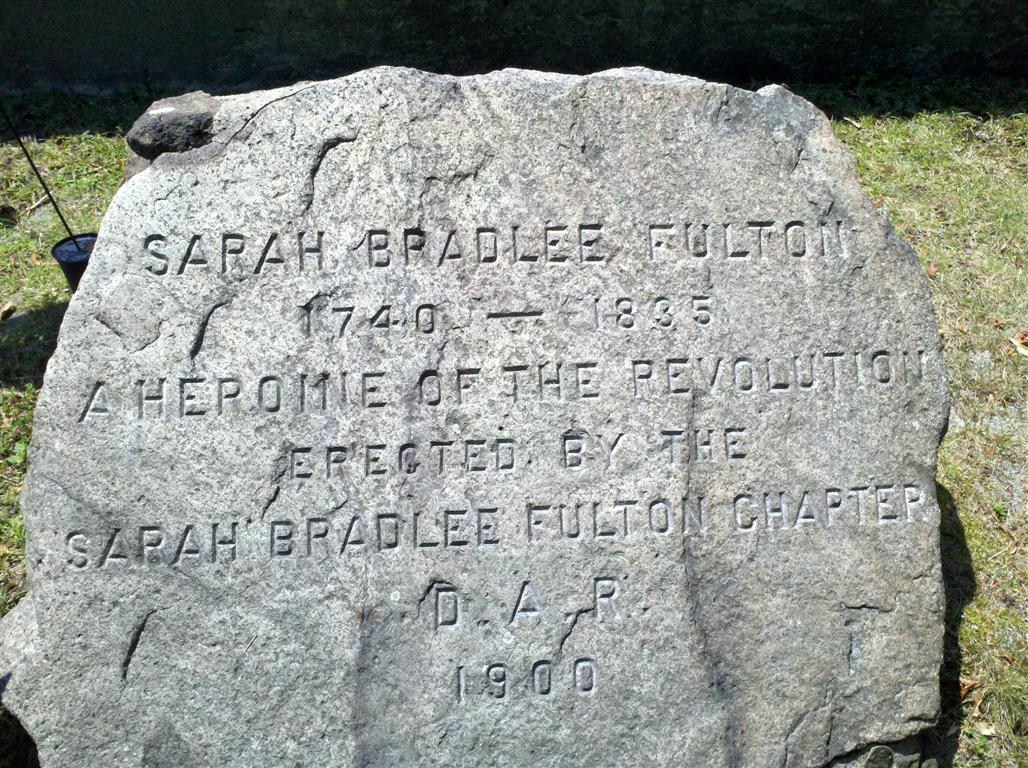
That ensured that Fulton had a constituency to keep her legend alive. In 1900 the Medford D.A.R. chapter graced the town cemetery with the stone marker shown above, calling Fulton “A Heroine of the Revolution.” She was also dubbed “Mother of the Boston Tea Party.” In 1919 the Bloomington, Indiana, D.A.R. chapter produced a three-act play about Sarah Bradlee Fulton to benefit wounded soldiers and sailors.

Monuments to Sarah Bradlee Fulton remain today. In addition to that stone marker, Fulton Street in Medford is named for her. Since 2006, the punchbowl she supposedly used when Washington visited has been in the collection at Mount Vernon. Fulton has her own Wikipedia page, and many other webpages hold her up as an exemplary female Patriot.

And it’s all based on family lore published a century or more after the events.

TOMORROW: Assessing the Bradlees.

Friday, September 01, 2017

Solomon Davis and the Fatal Plum Cake

John and Dolly Hancock were known for hosting dinner parties in their mansion on Beacon Hill (shown here shortly before it was torn down).

According to James Spear Loring’s Hundred Boston Orators (which cribbed freely from older sources), they even built “a lofty and spacious hall on the northern wing of his mansion, extending sixty feet, devoted to festive parties, and built of wood.” That wing was removed in the early 1800s, so it’s not in this photo.

On 6 June 1791, the Ancient and Honorable Artillery Company had its annual election and dinner at Faneuil Hall, a major social occasion for Boston’s elite men. That evening, Hancock hosted a supper party. Loring wrote:
Among the company present, were Col. Azor Orne, and Solomon Davis, Esq., a merchant who resided in Tremont-street, opposite the Savings Bank. He was very facetious.

A superb plum-cake graced the centre of the table. It was noticed by the guests that Mr. Davis partook very freely of this cake; and, moreover, that the silver tankard of punch was greatly lightened of its liquid, by liberal draughts through his lips. As was the natural habit of Mr. Davis, he set the table in a roar; and in one of his puns being specially felicitous, Col. Orne remarked, “Go home, Davis, and die;—you can never beat that!”

Mr. Davis, on his way home, fell dead, in a fit of apoplexy, near King’s Chapel, and his pockets were found filled with plum-cake.
Davis was a couple of weeks shy of turning seventy-seven.

Loring tended to print the most dramatic version of a story, and not always accurately. In this case, we have different details from the letters of Davis’s widow as Barrett Wendell summarized them in his article “A Gentlewoman of Boston” in the American Antiquarian Society Proceedings.

Catherine (Wendell) Davis stayed home that evening because she had received a letter from a relation “with particulars of his melancholy disaster.” So her husband went to the Hancock supper alone.
Freed from conjugal observation, Mr. Davis appears to have supped imprudently; what he drank is not mentioned, but he ate more plum-cake and fruit than was good for him. On his way home, he was seized with a fit in the street. Carried to his house, and there helped by the doctor, he so far recovered himself as to go cheerfully up stairs; but once in his chamber he was again overcome by sickness, and instantly expired. 
In addition, Amos Otis’s Genealogical Notes of Barnstable Families (1888) said of Davis, “On his way home he was taken suddenly ill, and sat down on the steps of King’s Chapel, from whence he was removed to his house in the vicinity, where he shortly after died.” So there’s the King’s Chapel detail.

Finally, one of Hancock’s successors as governor, John Brooks, used to counsel another, William Eustis, about his diet by saying, “Don’t you remember that Solomon Davis died after eating plum cake?” So even if we have no confirmation for the plum cake in Davis’s pockets, people definitely remembered that dessert as why he died.

Sunday, June 11, 2017

Moses Parker, “the most prominent military character”

Moses Parker was born on 13 May 1731 in Chelmsford. Seven years earlier, his father Joseph had served as a “Lieutenant of a company of snowshoe-men” in what would be called Dummer’s War. Once back home, Joseph Parker served on committees and boards for both his meetinghouse and his town.

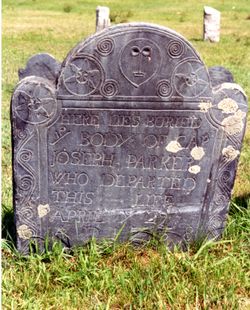
In 1738, when Moses was seven years old, Joseph Parker died. According to a Parker family genealogy he “perished, with his whole command, in a terrible battle with the Oneidas.” However, I can’t find any other mention of such an event. And his body was buried in Chelmsford, not a frontier battlefield. Joseph Parker’s gravestone appears here, courtesy of Find a Grave.

As an adult, Moses Parker followed his father into the provincial military service. A Chelmsford company set out for northern New York in March 1755 and stayed until January. Moses Parker went out as a sergeant and evidently came back as an ensign.

Wilkes Allen’s 1820 History of Chelmsford then says of Parker:
In 1758, he was honored with a lieutenant’s commission in a company commanded by Capt. Jona. Butterfield, and raised for the express purpose of a general invasion of Canada. He was promoted to a captain in the succeeding year, and in 1760, commanded a company at Fort Frederick, St. John’s. In this expedition he distinguished himself as a brave soldier, and as an intrepid and dauntless officer, he was endeared to those under his care by his assidiuous [sic] attention to their wants and constant endeavors to render their situation as pleasant as circumstances would permit.

Such was his reputation that when Governour [Francis] Bernard in 1761, was selecting from a multitude of applicants, thirty captains for that year’s service, Capt. Parker stood forth the most prominent military character on the list. Col. [Nathaniel] Thwing [1703-1768] and Col. [William] Arbuthnot [1726-1765] declared, that “they would not go without him, that he was the only Captain they had insisted upon.” So great was his popularity, that his friends assured him, that if he would accept of a captainship, “fifty men might be immediately raised to serve under him.” [Footnote citation: “M.S. Letter of Oliver Fletcher, Esq.”]
According to the Rev. Wilson Waters’s 1917 history of Chelmsford, Parker’s farm was 150 rods south of where “the Middlesex turnpike [now Turnpike Road]…crosses River Meadow brook.”

In May 1774, Moses Parker was named as one of Chelmsford’s committee of correspondence. In April 1775, he commanded a company that responded to the Lexington Alarm. And on 19 May 1775 he accepted a commission from the Massachusetts Provincial Congress, with Dr. Joseph Warren presiding and signing the paperwork, as a lieutenant colonel.

Parker was in the regiment of Col. Ebenezer Bridge, a thirty-one-year-old Harvard graduate and son of Chelmsford’s minister. The major was twenty-three-year-old Dr. John Brooks of Reading. At age forty-four, with four military campaigns under his belt, Lt. Col. Parker was the regiment’s veteran officer.

On the night of 16 June 1775, Col. Bridge’s regiment was ordered to march onto the Charlestown peninsula under Col. William Prescott and fortify Bunker’s Hill.

TOMORROW: In the redoubt.

Wednesday, January 14, 2015

Washington’s Return to the Vassall Estate in Cambridge

Yesterday I quoted President George Washington’s description of his return visit to Cambridge on 24 Oct 1789, when he viewed Middlesex County militia troops under the command of militia general John Brooks (shown here later in life). Washington noted that those troops formed up late but “made however an excellent appearance.”

But let’s explore what the President reportedly didn’t see. In the 26 July 1862 Boston Transcript a correspondent using the initial “C.” shared this tale:
The late Judge Joseph Hall and his cousin, the late Col. Fitch Hall, were the aids of Gen. John Brooks, when Washington visited New England. The former was despatched to Worcester…; and the latter stated to the writer that he (then being quite a young man), was struck with awe when he went to Washington’s headquarters, now occupied by Prof. Longfellow, and after being ushered into his presence, asked at what time it would be his pleasure to pass the troops in review. Washington, taking him by the hand, replied, in five minutes. The aid mounted and ran his horse at full speed to Cambridge common, and the troops were barely in line, before Washington, with his suite, appeared, having kept his word, and evidencing the promptness which characterized all his movements.
That passage was quoted in the New England Historical and Genealogical Register in 1862.

Two years before, the same periodical had printed William H. Sumner’s reminiscences of the day, which offered even more detail, reportedly also based on conversations with Fitch Hall:
…an arrangement was made that on his way to the capitol, Washington should stop at Cambridge and receive a salute from the militia under General Brooks, then commander of the third division, the cavalry, artillery and light infantry of which he had ordered to parade on the common, to present arms to the General as he passed their lines. The house provided for his reception at Cambridge was the same old Vassal House which had been his headquarters while the army was encamped in that town at the commencement of the Revolutionary War. . . .

The time appointed for the review was 12 o’clock, and this hour having arrived, Gen. Brooks’s aid, Colonel Hall, who was stationed at that house to receive General Washington, knowing the punctuality of his commander, but without special orders at the moment, informed Washington as he was dismounting that the hour of twelve had arrived and that the line was formed. Taken somewhat by surprise that time had passed so rapidly, and still unwilling to be outdone in punctuality, a prominent trait in his own character, the General, without alighting, immediately threw his leg back again across the saddle, and directed Colonel Hall to conduct him to the field.

Fearing he had been too precipitate in telling Washington that the line was actually formed and ready to receive him, and seeing him remount, Colonel Hall left his co-aid, Major Joseph Hall (who had accompanied the General from Marlborough) to perform the remainder of his duty, and putting spurs to his horse galloped with the greatest rapidity to the common, and informed Gen. Brooks that Washington was on his way and close at hand. Col. Hall had ventured to tell Washington that the line was formed, as he saw him actually dismounting, and naturally supposed that the General would occupy a few minutes in refreshing himself after his morning’s long ride.

Nothing could have surprised Gen. Brooks more than Col. Hall’s announcement. His troops were scattered over the field; but glancing at his watch, and finding that the appointed time had in truth arrived, although noted for his great deliberation in times of great moment, he lost no time in bringing his troops into line, which was done while the artillery was firing the national salute.

This was scarcely accomplished when Washington appeared on the right of the line, and immediately heard from the lips of his old friend and companion in arms all through the war, the command never before so thrillingly given, “Present arms.” . . . Gen. Brooks, who was an elegant horseman and sat as proudly erect as a martinet, rode down the line in company with Washington, who most particularly noticed its beautiful appearance. Riding back with rapidity in the rear, and observing that not a single man looked around, but that all (although excited with the greatest possible curiosity) kept their faces steadily to the front, he remarked to Gen. Brooks, in allusion to the seven years’ war in which they had both been engaged, “Ah, General, if we had had such troops as these, we should have made short work of it!”
To which Brooks might well have replied, “Phew!”

There are some discrepancies among those three accounts—Washington’s written on that day, and the two stories based on what people had heard from Fitch Hall years later. According to Washington, the troops were supposed to be ready at ten o’clock and didn’t form up until eleven—not ready and formed just at twelve, as Sumner wrote. And the President was obviously not fooled that the troops were drawn up when he arrived. Indeed, it looks like Fitch Hall improved on what likely happened when he told the story years later, giving himself a central role in a last-minute saving of the day.

Another question, especially burning for me, is whether on this visit Washington went into the mansion confiscated from John Vassall that he’d used as his headquarters in 1775 and 1776. According to Sumner’s retelling, he never even got off his horse. But the account from “C.” suggests that Fitch Hall met him inside that house. Washington’s own diary makes no mention of the house or who was living in it then—another mystery, not answered by property records.

TOMORROW: Boston schoolboys and President Washington.

Tuesday, January 13, 2015

On the Road with President Washington

As I announced yesterday, on 21 January Prof. T. H. Breen will speak at the Cambridge Forum about President George Washington’s visit to New England in the fall of 1789, and the political issues it raised.

As newly elected President of a new nation, Washington was trying to thank the American people and also to bind them together. On his trip through the northern states he avoided entering Rhode Island since it hadn’t yet ratified the Constitution or sent representatives to Congress.

In some ways I think the President’s visit was like a royal progress, full of pomp and celebration. But Washington was trying not to appear too kingly. Even though as President he was the commander-in-chief of the federal forces, and had also commanded the nation’s army during the war for independence, he didn’t want to be seen as claiming any power over state militia troops.

And yet, as his diary entry for 23 October shows, those state militia troops kept coming out to show off to him:
Here [in Worcester] we were received by a handsome Company of Militia Artillery in Uniform who saluted with 13 Guns on our Entry & departure. At this place also we met a Committee from the Town of Boston, and an Aid of Majr. Genl. [John] Brooke of the Middlesex Militia who had proceeded to this place in order to make some arrangements of Military & other Parade on my way to, and in the Town of, Boston; and to fix with me on the hours at which I should pass through Cambridge, and enter Boston.

Finding this ceremony was not to be avoided though I had made every effort to do it, I named the hour of ten to pass the Militia of the above County at Cambridge and the hour of 12 for my entrance into Boston desiring Major [Joseph] Hall, however, to inform Genl. Brookes that as I conceived there was an impropriety in my reviewing the Militia, or seeing them perform Manoeuvres otherwise than as a private Man I could do no more than pass along the line; which, if he thought proper might be under arms to receive me at that time.

These matters being settled the Committee and the Aid (Colo. Hall) set forward on their return and after breakfast I followed; The same Gentlemen who had escorted me into, conducting me out of Town.
At the border of Worcester and Middlesex Counties a militia troop of light horsemen awaited the President.

Then came Jonathan Jackson, the state’s first U.S. marshal (shown above), who insisted on accompanying the President throughout the state. Jackson was a federal employee, so Washington could have told him to get back to his job—but who’s to say that the U.S. marshal’s job was not to escort a visiting President?

Washington slept that night in Weston before pressing on. He had lived in Cambridge for nine months during the siege of Boston, so he was probably interested in seeing it again. In a letter dated 21 October, Brooks had promised “a body of about 800 men, will be under arms at Cambridge on the day of your entering into Boston. The troops will occupy the ground on which the continental army was formed for your reception in the year 1775.” (Memories of that “reception” in 1775 were probably the seed of the “Washington Elm” legend in the next century.)

Here’s how Washington described the next morning in his diary:
Dressed by Seven o’clock, and set out at eight—at ten we arrived in Cambridge, according to appointment; but most of the Militia having a distance to come, were not in line till after eleven; they made however an excellent appearance, with Genl. [John] Brooks at their Head. At this place the Lieut. Govr. Mr. Saml. Adams, with the Executive Council, met me and preceeded my entrance into town—which was in every degree flattering and honorable.
President Washington was probably not happy about the hour’s wait between his arrival in Cambridge and the militia parade he hadn’t wanted in the first place. But at least those troops made “an excellent appearance.”

TOMORROW: What the President didn’t see?

Friday, July 06, 2012

“Great but fruitless interest for the commission in the artillery”

Yesterday I quoted a few phrases from Alexander H. Everett’s address on the sixtieth anniversary of the Battle of Bunker Hill. He spoke in Charlestown “at the request of the young men, without distinction of Party,” according to his lecture’s title page. (Makes you wonder what political dispute had disrupted previous years.)

Here’s a choice passage from Everett about the American artillery, comparing its performance to the fabled British failure:

But where in the mean time are the reinforcements of artillery? Where is Major [Scarborough] Gridley with his battallion? Is he too slumbering in the lap of some beauteous Delilah? Ah, gallant, learned Rumford! could your thorough science, your vigorous and energetic action have done justice to the orders of the veteran hero of Louisburg, there would have been no want of amunition: powder enough would have found its way to the redoubt, and the day might still have been ours. But America must pay the penalty of Col. [Richard] Gridley’s parental partiality, as Britain does of Gen. [Samuel] Cleveland’s superannuated gallantry.—
Col. Richard Gridley, commander of the Massachusetts artillery, had insisted that the Massachusetts Provincial Congress make his youngest son, Scarborough, a major in the regiment. But, as Everett hinted, Scar Gridley wasn’t up to the challenge of the Battle of Bunker Hill. (I’ll discuss that tomorrow.)

Who did Everett think would have done a better job? “Gallant, learned Rumford!” Everett relied on Samuel Swett’s History of Bunker Hill Battle, published about a decade before. Swett in turn appears to have talked to Massachusetts governor John Brooks (1752-1825, shown above), who reported that he’d been on Breed’s Hill on the morning of 17 June 1775 and was sent back to Gen. Artemas Ward’s headquarters ask for reinforcements. Swett wrote:
Maj. Brooks was retained at Cambridge by Ward, till the last reinforcements were sent to Charlestown, when he marched with the two remaining companies of his regiment, and met at the neck the Americans retreating. Benjamin Thompson, better known as Count Rumford, attended him as a volunteer. He was assisting the army by his mathematical learning, his estimates and surveys, but had solicited an appointment in vain, and had made great but fruitless interest for the commission in the artillery which was bestowed on Maj. Gridley.
Some authors later wrote that Brooks and Thompson (1753-1814) were schoolmates, others that they were both teen-aged medical trainees under Dr. Simon Tufts. Thompson did briefly go to school in Medford (Brooks’s home town), but he studied medicine under Dr. John Hay of Woburn, not Tufts. Supposedly Brooks and Thompson maintained a friendly correspondence all their lives, but I’ve never seen a citation for any of those letters.

According to modern biographer Sanborn C. Brown, there’s evidence that Thompson was in Woburn on 15 June, and thus less likely to be in Cambridge two days later. Still, authors of the nineteenth century accepted Brooks’s statement that Thompson was tagging along during the Battle of Bunker Hill, having fruitlessly offered to help the American artillery corps.

By the 1800s, Thompson had become famous and respected in Europe as Count Rumford, government administrator and scientist. Why hadn’t the Massachusetts army accepted his services? Why had his home town’s committee of correspondence kept him confined on suspicion of being a Tory? “America must pay the penalty” for that stubbornness, Everett said.

Neither Thompson’s contemporaries behind the American lines nor the nineteenth-century authors knew that in early May Thompson had sent Gen. Thomas Gage a spy report written in invisible ink. Was Thompson really angling for a high rank in the provincial artillery at the same time? Was he hanging around Gen. Ward’s headquarters and accompanying Maj. Brook to the front lines? If so, that wouldn’t have been good for the Americans.