J. L. BELL is a Massachusetts writer who specializes in (among other things) the start of the American Revolution in and around Boston. He is particularly interested in the experiences of children in 1765-75. He has published scholarly papers and popular articles for both children and adults. He was consultant for an episode of History Detectives, and contributed to a display at Minute Man National Historic Park.

Subscribe thru Follow.it


•••••••••••••••••


Showing posts with label Richard Devens. Show all posts

Tuesday, August 01, 2023

“With respect to the liberation of our friends in Boston”
Last month I left off a discussion of Boston’s first town meetings during the war with the agreement that Bostonians reached with Gen. Thomas Gage.

In exchange for lodging all privately owned firearms with the selectmen, the military authorities promised to let people leave the besieged town with their other goods.

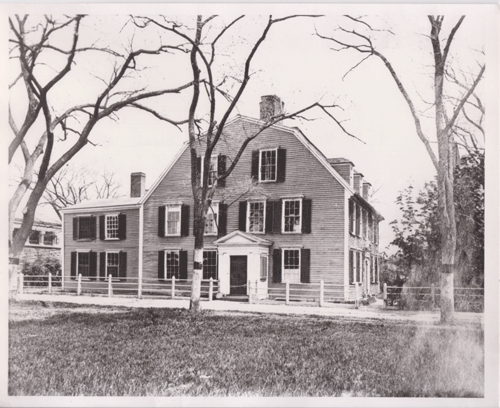
Henderson Inches, a merchant and former selectman who had helped to negotiate that pact, brought news of the general’s approval to the Patriot committee of safety on 28 April. That group, chaired by Dr. Joseph Warren, was headquartered in Jonathan Hastings’s house in Cambridge (shown above).

That committee answered to the Massachusetts Provincial Congress, which was out in the Watertown meetinghouse. Its president, John Hancock, was away at the Second Continental Congress, and other men were serving as president pro tempore. On 24 April that job had fallen on the Rev. John Murray (1742–1793) of Townsend/Boothbay, Maine, who had previously filled in as secretary.

The congress responded to the news out of Boston that afternoon with this resolve:
Ordered, That the committee appointed to introduce the honorable delegates from the convention at Exeter, in New Hampshire, to the committee of safety, apply to said committee for an authentic account of what transactions have certainly taken place, with respect to the liberation of our friends in Boston, and report as soon as may be.
The next morning, the committee reported they had delivered the message and “brought from the committee of safety a number of papers, which contain the proceedings of the town of Boston with general Gage, in respect to moving the inhabitants and their effects.” The committee asked that the larger legislature not take any action until they had come up with a recommendation.

On 29 April, the committee of safety appointed a subcommittee to draft that recommendation. The delegates named were Azor Orne of Marblehead, Richard Devens of Charlestown, and Benjamin White of Brookline—men from two communities neighboring Boston and the province’s second-largest port. Their towns would be among the first to receive refugees.

However, the committee of safety was managing many martial and political efforts, such as reorganizing the militia companies that had turned out on 19 April into an army enlisted till the end of the year and propagating the Patriot version of the fighting so far. Those subcommittee members were handling other tasks. They didn’t produce a quick plan.

The provincial congress in Watertown got antsy. On the morning of 30 April that body sent delegate John Grout of Petersham to ask for the committee of safety’s result. Delegates also discussed “an addition to the committee of safety”—i.e., adding more members so as to spread out the work.

There was still no response from Cambridge after the midday dinner break. The congress then sent John Mosely of Westfield “to procure their result with respect to moving out the inhabitants of Boston” with a letter that demanded a response:
IN PROVINCIAL CONGRESS, April 30, 1775.

SIR— I am directed to inform you, that it is with regret, this Congress find themselves obliged to send to the committee of safety a third messenger, to request their immediate report on the subject of the removal of the poor inhabitants of Boston.

To wait for that report, the Congress have suspended all proceedings on that matter, and sat in almost impatient expectation, by several adjournments, since seven o’clock this morning. I am obliged to request your answer by this express, without loss of time, that the Congress may then see what it is their duty to conclude on.

I have the honor to be, with great respect, Sir,
Your most obedient humble servant,
JOHN MURRAY.
TOMORROW: Resolutions at last.

Friday, April 21, 2023

The Real Third Rider on the 18th of April

Dr. Samuel Prescott is usually described as the third alarm rider to carry Dr. Joseph Warren’s alert on 18–19 Apr 1775, but that label should really apply to another man. There was an earlier alarm rider completely lost to history.

The first rider was William Dawes, Jr., adjutant of the Boston militia regiment. Following Dr. Warren's instructions, he rode out through the town gates in the early evening of 18 April.

Warren then turned to his Plan B. He passed the same alert to Paul Revere, who put into motion an arrangement he had made with Richard Devens and other Patriots in Charlestown.

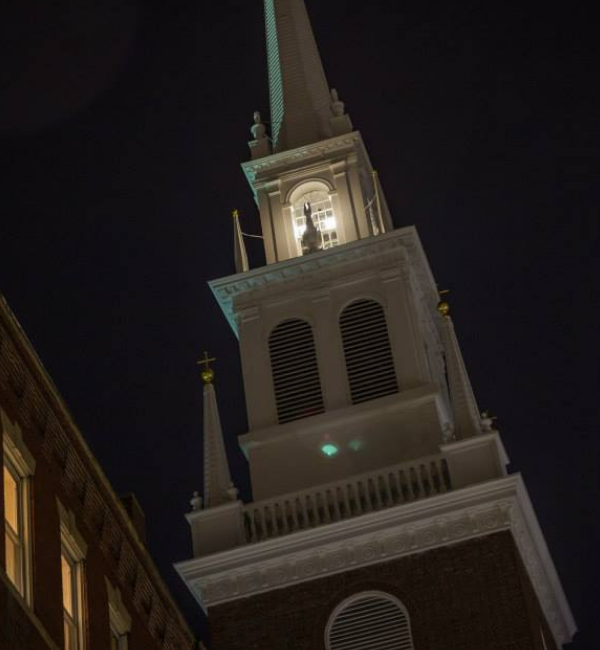
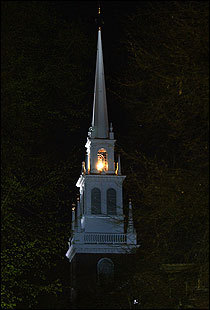
Revere in turn informed John Pulling, a vestryman of Christ Church in the North End, now better known as the Old North Church. Pulling summoned Robert Newman, sexton of that church. Around 10:00 P.M. those men hung two lanterns in the church’s tall steeple, a signal that the British army was starting their expedition by boat across the Charles River.

That launch for the British march hinted at where they were headed: west-northwest toward Cambridge, Lexington, and Concord rather than west-southwest toward Worcester. The committee of safety had just met in west Cambridge, with some delegates staying overnight, and top officials John Hancock and Samuel Adams were in Lexington. Both Concord and Worcester were storing multiple cannon and other military supplies.

The Patriots seem to have had good intelligence about the British government’s priorities. Lord Dartmouth, the secretary of state, had told Gen. Thomas Gage to start arresting leaders of the Massachusetts rebellion. Dr. Warren’s mission for Dawes, therefore, was to warn Hancock and Adams that troops were moving toward them. The Patriots didn’t know that Gage’s real focus was Concord, where his spies had located cannon spirited out of Boston armories back in September.

Old North’s two lanterns shone across the Charles River. Those lights were in the steeple only a short time. Newman and Pulling didn’t wait to be caught in the tower. Still, the signal lasted long enough for the Charlestown Patriots to spot it and take the next step in Plan B. On their side of the river, a man mounted a horse and started riding west toward Lexington.

And then that guy disappeared.

Not only do we not know what happened to that second rider, none of the people involved in sending him out preserved his name in their papers or reminiscences. I suspect that if British patrols had detained the man, or if he had betrayed the cause, the Patriots would have told the story in some way. Instead, there’s complete silence about the man’s identity in the record. That strikes me as likely a result of profound disappointment in the man rather than worry or anger.

Paul Revere made himself Plan C, a backup courier of Dr. Warren’s message to Hancock and Adams. He arranged for colleagues to row him across the Charles River to Charlestown. Arriving after 10:30, Revere consulted with Devens and other locals, got another horse, and started riding west, following the same route as the second rider.

After crossing the Charlestown neck into the west part of town, Revere almost fell into the hands of British army patrols. He had to wheel his horse and ride north, coming back onto the main road to Lexington after a few miles. Nevertheless, with a shorter route and a faster steed, Revere arrived in Lexington about half an hour before Dawes.

Presumably those same mounted British officers in west Charlestown stopped the second rider. Perhaps they detained him, as other officers would later detain Revere in Lincoln. Perhaps they simply scared him into abandoning his ride.

Either way, the third alarm rider that night was Paul Revere. And the second rider, the one who apparently never made it out of Charlestown, is completely forgotten.

Tuesday, January 25, 2022

“The attempt had for several weeks been expected”

In the first half of the nineteenth century, American historians continued to write about the start of the Revolutionary War, of course.

But those authors didn’t dig into the question of whether someone close to Gen. Thomas Gage had leaked his plan for a march to Concord, as hinted by the passage from Charles Stedman’s book that I quoted yesterday.

Around the fiftieth anniversary of the event, there was a back-and-forth between Elias Phinney of Lexington and Ezra Ripley of Concord over where militiamen returned the first significant fire at the redcoats. That dispute produced eyewitness testimony from aged veterans, revealing that both towns were on alert well before the Patriot alarm riders from Boston arrived because of previous reports about British activity and the sight of army officers on horseback.

Likewise, James T. Austin’s Life of Elbridge Gerry (1828) offered evidence that members of the committee of safety were watching for Gage to act. It included documents confirming how the British army officers that Gage sent out to stop alarm riders actually provoked an alarm.

In his History of the Siege of Boston (1849), the Charlestown historian Richard Frothingham published Richard Devens’s description of the committee’s activity and of the lights in Old North Church as seen from the opposite shore. That account lined up well with Revere’s.

Frothingham quoted Stedman’s story but not the detail of Gen. Gage telling only one other person besides Col. Percy about his plan. Instead, he emphasized how Massachusetts Patriots had gathered multiple signs that the army was about to act even as the general considered his planning secret.

As a result, the most authoritative American historian of the time, George Bancroft (shown above), presented events this way in his 1860 History of the United States from the Discovery of the American Continent:
On the afternoon of the day on which the provincial congress of Massachusetts adjourned, Gage took the light infantry and grenadiers off duty, and secretly prepared an expedition to destroy the colony’s stores at Concord. But the attempt had for several weeks been expected; a strict watch had been kept; and signals were concerted to announce the first movement of troops for the country. Samuel Adams and [John] Hancock, who had not yet left Lexington for Philadelphia, received a timely message from [Dr. Joseph] Warren, and in consequence, the committee of safety removed a part of the public stores and secreted the cannon.

On Tuesday the eighteenth, ten or more sergeants in disguise dispersed themselves through Cambridge and further west, to intercept all communication. In the following night, the grenadiers and light infantry, not less than eight hundred in number, the flower of the army at Boston, commanded by the incompetent Lieutenant Colonel [Francis] Smith, crossed in the boats of the transport ships from the foot of the common to East Cambridge. There they received a day’s provisions, and near midnight, after wading through wet marshes, that are now covered by a stately town, they took the road through West Cambridge to Concord.

“They will miss their aim,” said one of a party who observed their departure. “What aim?” asked Lord Percy, who overheard the remark. “Why, the cannon at Concord,” was the answer. Percy hastened to Gage, who instantly directed that no one should be suffered to leave the town. But Warren had already, at ten o’clock, despatched William Dawes through Roxbury to Lexington, and at the same time desired Paul Revere to set off by way of Charlestown.

Revere stopped only to engage a friend to raise the concerted signals, and five minutes before the sentinels received the order to prevent it, two friends rowed him past the Somerset man of war across Charles river. All was still, as suited the hour. The ship was winding with the young flood; the waning moon just peered above a clear horizon; while from a couple of lanterns in the tower of the North Church, the beacon streamed to the neighboring towns, as fast as light could travel.
Quite dramatically rendered, and Bancroft skipped right over the question of whether anyone leaked Gage’s orders.

TOMORROW: New sources and new suspicions.

Wednesday, June 17, 2020

Bringing Back a Source on the Bunker Hill Battle

Samuel Swett was one of the early historians of the Battle of Bunker Hill. He published a long essay titled “Historical and Topographical Sketch of Bunker Hill Battle” as an appendix to an 1818 reprint of David Humphreys’s biography of Gen. Israel Putnam.

The battle’s 50th anniversary came in 1825, bringing more interest from the public and more accounts from veterans. Some of those old men came to Charlestown for a public ceremony. Swett used interviews with them and his earlier research to publish Notes to the Sketch of Bunker Hill Battle at the end of 1825, quoting the sources he had used for the earlier essay and more.

Unfortunately for us, Swett didn’t tailor his publications and particularly his quotations around providing a comprehensive picture of the battle. Rather, in his own words, he wrote “for the defence of Gen. Putnam, did he need any.” In 1818 Gen. Henry Dearborn had published an article in The Port Folio basically saying that Putnam had been useless during the battle. This set off years of historiographical (and political) debate. Swett published a lot of evidence favoring Putnam, but he left out other testimony that later historians would have liked to see.

This spring I stumbled across two affidavits that Swett sent to the Boston Daily Advertiser for publication at the end of 1825. He had quoted parts of both in his Notes, and those quotations have been cited by many historians since. But as far as I can tell, scholars haven’t used the other parts of these documents, which offer more details about the battle. So I’m going to quote them in full. (As usual, I’ve added paragraph breaks for easier online reading.)

The first affidavit appeared in the Boston Daily Advertiser on 20 Dec 1825, and in a few other newspapers after that. This was how Swett introduced the source:
Col. JOS[eph]. WHITMORE, of Newburyport, a native of Charlestown, brought up there as an apprentice by Richard Devens, Esq., well known in both those places as a witness of the highest respectability, Aug. 6, 1818, stated before a magistrate, Hon. Eben. Moseley, “that he was a Lieutenant in a company from Newburyport, commanded by Capt. Benj. Perkins, and which was raised and marched to Cambridge soon after Lexington battle.”
Capt. Perkins’s company was evidently assigned to Abraham Watson’s house in Cambridge. Lt. Whitmore’s account:
While their company were at their quarters at ’Squire Watson’s, about a mile from the Colleges, an alarm was given on the 17th, [June] 1775. The company immediately formed, marched to Cambridge, and received orders from Gen. [Artemas] Ward to march to Charlestown. Col. Whitmore thinks the company arrived upon Breed’s Hill between 2 and 3 o’clock.

Soon after the company reached the hill, the British reinforcement landed, formed into columns, and marched up the hill. Col. Whitmore with a part of his company went down to the left of the redoubt, near some trees which were standing, and there received an attack. The British were twice repulsed, but the third time they made the attack with great fury, and drove the Americans from their works.

On the retreat, Col. Whitmore was wounded in his thigh. The Colonel states, that at the very moment he was wounded, Gen. [Joseph] Warren fell, and was within six feet of him.

As it respects Gen. Putnam, Col. Whitmore states, that he knew Gen. Putnam perfectly well, that he was well acquainted with him in the old French war—that he saw General Putnam on Breed’s Hill, when he went on with his company, and also on the retreat, soon after he was wounded, on the side of the hill.

He says, that well knowing Gen. Putnam, and the General knowing him, he said to him, “General, sha’nt we rally again?”

Gen. Putnam said, “yes, as soon as we can—are you wounded?”

Col. Whitmore answered that he was, but thought he should get over it.
Swett quoted Whitmore’s words starting at “with a part of his company…” and ending with “…are you wounded?”

A petition to the Massachusetts government printed in John J. Currier’s 1906 History of Newburyport shows that to “get over it” Whitmore had to go home and receive medical care until 8 August. In March 1776 he asked the General Court to reimburse him for that cost since he hadn’t taken a bed in an army hospital.

TOMORROW: Another voice from Newburyport.

Friday, April 13, 2018

How the Signal Lanterns Started to Glow in American Culture

For most of the nineteenth century, Americans didn’t care who hung the lanterns in the steeple of Old North Church on 18 Apr 1775. That’s because very few Americans had ever heard about that signal.

Paul Revere had mentioned the lanterns in the account he gave to the Massachusetts Historical Society around 1798, published in the society’s Collections series. He wrote:
I agreed with a Col. [William] Conant, & some other Gentlemen, in Charleston, that if the British went out by Water, we would shew two Lanthorns in the North Church Steeple; & if by Land, one, as a Signal; for we were aprehensive it would be dificult to Cross the Charles River, or git over Boston neck. I left Dr. [Joseph] Warrens, called upon a friend, and desired him to make the Signals.

I then went Home, took my Boots and Surtout, and went to the North part of the Town, where I had kept a Boat; two friends rowed me across Charles River, a little to the eastward where the Somerset Man of War lay. It was then young flood, the Ship was winding, & the moon was Rising. They landed me on Charlestown side. When I got into Town, I met Col. Conant, & several others; they said they had seen our signals.
However, Revere’s story didn’t get very wide circulation. It was reprinted in the New-England Magazine in 1832, but historians and textbook writers didn’t pick up on it. Revere’s name appeared in just a few books published in the first half of the 1800s, all discussing him as an engraver or as a leader in Boston manufacturing after the war.

That started to change in 1849 when Richard Frothingham published the first edition of his History of the Siege of Boston. In addition to drawing on Revere’s account, he published a corroborating document, a memorandum written by Richard Devens of Charlestown:
I soon received intelligence from Boston, that the enemy were all in motion, and were certainly preparing to come out into the country. Soon afterward, the signal agreed upon was given; this was a lanthorn hung out in the upper window of the tower of the N[orth]. Ch[urch]., towards Charlestown. I then sent off an express to inform Messrs. [Elbridge] Gerry, &c., and Messrs. [John] Hancock and [Samuel] A[dams]., who I knew were at the Rev. Mr. ——— [Jonas Clarke’s] at Lexington, that the enemy were certainly coming out. I kept watch at the ferry to watch for the boats till about eleven o’clock, when Paul Revere came over and informed that the T[roops]. were actually in the boats.
Over the next decade, several more authors mentioned the signals.

But what really made those lanterns famous was Henry W. Longfellow’s poem “Paul Revere’s Ride,” published in The Atlantic in 1860. Longfellow used Revere’s account as his main source, but he indulged in a lot of poetic and narrative license. He made Revere the rider on “the opposite shore” awaiting those signals rather than the Boston organizer who’d arranged to send that information before crossing the river as a backup messenger.

Longfellow wrote of the silversmith:
He said to his friend, “If the British march
By land or sea from the town to-night,
Hang a lantern aloft in the belfry-arch
Of the North-Church-tower, as a signal-light,—
One if by land, and two if by sea;
And I on the opposite shore will be,
Ready to ride and spread the alarm
Through every Middlesex village and farm,
For the country-folk to be up and to arm.”
Longfellow’s poem made the lantern signal into a big deal, and not just because he provided the easily remembered “One if by land, and two if by sea” phrasing. Six of the poem’s fourteen stanzas describe Revere arranging for this signal, his friend gathering intelligence, his friend climbing the tower, Revere waiting for the signal, until finally “A second lamp in the belfry burns!” Revere’s actual ride goes by in a relative blur, even including the extra miles out to Concord that Revere didn’t get to travel.

Longfellow was one of America’s favorite poets at a time when poetry was part of pop culture. “Paul Revere’s Ride” became one of his greatest hits. Starting in 1861, therefore, the lanterns in the Old North Church steeple were embedded in America’s national origin myth.

Which made the identity of the “friend” Revere had asked to “make the Signals” a topic of great public interest.

COMING UP: Rival claimants.

Thursday, July 13, 2017

John Pigeon’s Petulance and Property

I was tracing the political career of John Pigeon, a Boston merchant who retired to Newton a few years before the Revolution. In the early months of 1775 he went from clerk of the Massachusetts Provincial Congress’s committee of safety to commissary of stores to commissary general of the Massachusetts army.

And within two months Pigeon decided that job was too much for him. On 20 June he petitioned to be allowed to resign. The congress instead adopted this recommendation from a committee:
Resolved, That Mr. John Pigeon, commissary general, requesting a dismission from his said office, being under a mistake, have liberty to withdraw his petition; that the conduct of said commissary general in his office, has been such as to merit the approbation of this Congress, and of the public in general; and that said John Pigeon be desired to attend his business as commissary general in the service of this province.
The legislature agreed to assist Pigeon by appointing a deputy commissary for every regiment, adding considerably to its payroll. On 25 June Pigeon told the committee of safety that he also needed a “supervisor” near each of the main camps of the American army, in Cambridge and Roxbury. Men
whose duty it shall severally be, constantly to attend said camps and examine into the supplies of each Regiment, to see that such supplies are properly delivered out in time, quantity, and quality, and timeously to advise the Commissary-General when and what articles of supplies are wanted at the respective camps, and also to take care that the empty casks are saved and returned to the Commissary-General’s office for further service.
Gotta collect those empties.

Three days later, at Pigeon’s request, the congress appointed a committee to examine his account books. This was a common way to respond to accusations of malfeasance or other criticism.

And Pigeon was getting criticism. After the Battle of Bunker Hill the army had spread out, putting more men on Prospect and Winter Hills to prevent any redcoats from charging off the Charlestown peninsula. That made it harder to supply every regiment. On 30 June Gen. Artemas Ward wrote to Pigeon:
There, are now on Prospect Hill nearly four thousand men, who at present are obliged to come to the store in [Harvard] college, for all the provisions they stand in need of. If they can be supplied with provisions at the hill, it will tend much to the safety of the lines there, for a great number of the men are now obliged daily to leave the lines that they may convey provisions to others upon the hill; and the milk especially, when it is conveyed from the store in college to the hill, is unfit for any person in camp to eat; therefore, if possible, it must be altered.
The next day, the commissary general gave the congress a list of twenty-six men he wanted appointed deputies.

But by then, apparently, Pigeon had damaged his reputation with his colleagues. On 9 August James Warren, president of the congress, told John Adams, “his temper is so petulant, that he has been desirous of quitting for some time, and, indeed, I have wished it.”

The Continental Congress’s takeover of the New England army offered a way to resolve this situation. On 19 July the Congress in Philadelphia appointed Joseph Trumbull, politically well connected and already in camp as commissary for the Connecticut troops, to be commissary general of the whole army. On 12 August the Massachusetts General Court responded by passing this resolve:
all Contracts made by our Committee of Supplies, for Victualling said Massachusetts Army, are terminated; and the Commissary General of said Continental Army, is to be considered at Liberty to purchase Supplies for Victualling said Army, of such Persons, and in such Way and Manner as he shall see fit.
Pigeon might have stayed on as Trumbull’s deputy or the Massachusetts government’s liaison to his office. Members of his staff continued to work for the army. But his accounts for the Cambridge and Roxbury stores and his ledger stop abruptly in early August, even before the legislature’s vote. (Thanks to Stephanie Dyson at the Massachusetts Archives for sending those links.)

By November 1775 the Massachusetts government was treating Richard Devens, a reliable member of the committee of safety from Charlestown, as its head commissary. No one’s found a date for his official commission; Devens seems to have slid into the office after working on other assignments, but by the end of the year he had the title.

And on 9 December, the legislature had to resolve:
Whereas, John Pigeon, the late Commissary of the Forces raised by this Colony, keeps his books at some distance from the Army, by reason whereof the Officers of the Army are prevented from settling their Rolls as ordered by this Court:

Therefore, Resolved, That the said Pigeon be, and he hereby is directed to furnish the Officers of said forces with such Accounts as said Pigeon is possessed of, necessary to the making up their Rolls at Cambridge, and that he be desired to attend there, to settle said Accounts, as long as his presence there may be necessary.
That order might be why the state archives now contains some of Pigeon’s accounts. Then again, a couple of later resolutions suggest that the legislature had to guess about what to pay men for work in the commissary department, so Pigeon may not have turned over all his records.

John and Jane Pigeon’s only daughter, Patience, died in Newton in 1777 at age twenty-four. Their sons John, Jr., and Henry both married in 1790 and started having children. Then Henry died in 1799; John, Sr., in 1800; and John, Jr., in 1801. Widow Jane Pigeon passed away in 1808.

Pigeon’s estates in Newton became the town’s poor farm for a while. But one grandson born in 1799, the Rev. Charles Dumaresq Pigeon, remembered that property fondly. He bought land in the “Riverside” area in 1846, convinced a railroad to build a stop there, and recruited other clergymen to retire nearby. The result was the genteel suburb that the Rev. Mr. Pigeon dubbed Auburndale.

Saturday, April 18, 2015

Jeremiah Lee’s Very Bad Night

Jeremiah Lee was a non-battlefield casualty of the fight on 18-19 Apr 1775. On the one hand, that’s appropriate because he was central to the Massachusetts Provincial Congress’s effort to build up an artillery force, which prompted the British army march tp Concord. On the other hand, Lee’s death was probably unnecessary.

Lee was a Marblehead merchant, militia commander, and member of the congress’s Committee on Supplies. He was the conduit for its payments to the Salem painter David Mason as he collected and mounted cannons.

On 18 April, Lee attended a joint meeting of the Committee on Supplies and the Committee of Safety at a tavern in Menotomy, the western village of Cambridge that’s now Arlington. When the meeting broke up, he and two other men from Marblehead, Elbridge Gerry and Azor Orne, decided to stay the night. Richard Devens of Charlestown later wrote:
After we had finished the business of the day, we adjourned to meet at Woburn on the morrow,—left to lodge at Newell’s [the tavern], Gerry, Orne, and Lee. Mr. [Abraham] Watson and myself came off in my chaise at sunset.

On the road we met a great number of B[ritish]. O[fficers]. and their servants on horseback, who had dined that day at Cambridge. We rode some way after we met them, and then turned back and rode through them, went and informed our friends at Newell’s. We stopped there till they [the officers] came up and rode by. We then left our friends, and I came home, after leaving Mr. Watson at his house.
Likewise, Gen. William Heath wrote of himself in the third person: “on his return home, soon after he left the committee, and about sun-setting, he met eight or nine British officers on horseback, with their swords and pistols, riding up the road towards Lexington.”

The province was abuzz with rumors that the London government had ordered Gen. Thomas Gage to arrest leaders of the rebellion—and those rumors were pretty much true. The committee men were naturally nervous. Gerry sent a warning west to John Hancock and Samuel Adams, then staying at Lexington. Nonetheless, Devens and Watson had passed through the British officers twice with no trouble.

Later that evening, a long column of British troops passed by the tavern on the way to Concord. Lee, Gerry, and Orne got out of bed to watch. Suddenly they perceived some soldiers from that column coming toward the front door. Half-dressed, the three men dashed out the back and threw themselves down in a field, hoping the stalks of the previous year’s crop would hide them. Heath wrote that he heard they suffered “some injury from obstacles in the way, in their undressed state.”

The three men remained on the ground for about an hour before they decided it was safe to return to the building. Lee, who had just turned fifty-four, took sick from the cold and stress. He died on 10 May, his family and friends blaming the events of that night.

Here’s the sad irony: those British troops weren’t seeking to arrest anyone on the Committee on Supplies. Gen. Thomas Gage’s orders for that march say nothing about arresting Provincial Congress members or searching buildings before the column reached Concord. None of the several British officers who left detailed accounts of the night wrote about such a search on the way west. Heath wrote that he’d heard the troops “halted” outside the tavern, which they might have done just to get water from a well, but he didn’t say they went inside.

In his 1828 biography of Gerry, James T. Austin wrote that British troops had searched Newell’s tavern on the night of 18 April. Of course, saying that made Gerry’s decision to hide outside in the fields seem more smart than scared. And although Austin claimed, “even the beds in which they had lain were examined,” he had to acknowledge that nothing, not even “a valuable watch of Mr. Gerry’s, which was under his pillow,” had been disturbed. No eyewitness accounts from 1775 said troops had gone into the tavern, and the Massachusetts Patriots hadn’t shied from complaining about British actions that day.

I therefore suspect that Lee, Gerry, and Orne could have stayed inside their bedroom the whole night without being disturbed. And Lee might have lived for many more years.

Tuesday, July 10, 2012

“Sam Trevett under an arrest. For what?”

Shortly after the Battle of Bunker Hill, Gen. Israel Putnam demanded that the army court-martial the artillery officer he had met pulling back from the fight. The general even threatened to resign if he didn’t get his way. Based on Putnam’s identification, the authorities detained Capt. Samuel Russell Trevett of Marblehead.

Unfortunately, as a committee from the Massachusetts Provincial Congress reported on 23 June, “by a mistake in the name, the wrong officer was confined.” Putnam, a Connecticut general, didn’t know the artillery officers from the other colonies. Trevett was actually the only commander of a provincial artillery company to keep fighting to the end.

Trevett’s arrest caused some consternation, particularly among his Marblehead matrosses, who had stuck out the battle with him. Back in their home town, the mariner Ashley Bowen wrote in his diary for 19 June:
A grand muster with our Regiment. We cannot hear the particular at Charlestown. Some rain. Captain Sam Trevett under an arrest. For what?
Within a couple of days the army brass had discovered the mistake. The congress’s committee reported on who really pulled back: “These Officers' names are, Captain [Samuel] Gridley and Captain John Kallander.” Callender was set up for court-martial instead.

But by then it was too late. Trevett and his men had gone home to Marblehead. On 29 June, the Massachusetts Committee of Safety tried to catch up to events through this resolution:
Mr. [Richard] Devens and Colonel [Azor] Orne, appointed to draw up a Vote relative to Captain Trevet and Company, reported the following, which was accepted, viz;

Whereas, from a mistake made by one of the General Officers, Capt. Samuel Russell Trevet has been put under arrest, which mistake is set forth in a Certificate by order of the General [Artemas Ward]; and upon examination it appears that said Trevet has approved himself a good officer, but said mistake has unhappily operated to the dispersion of his Company; therefore

Resolved, That said Captain Trevet be directed to collect his said Company as soon as possible, and then apply to this Committee in order to be commissioned.
Trevett declined the invitation and never rejoined the American army. Some of his men did, including his first sergeant and brother-in-law, Robert Wormsted. But Trevett had apparently had enough.

What happened to Callender, Gridley, and Gridley’s relatives in the regiment after Gen. George Washington arrived will be part of my talk tonight at Anderson House, the national headquarters of the Society of the Cincinnati. Come on by if you’re in the neighborhood!

Thursday, April 23, 2009

One Last Look at Lexington and Concord for the Month

Folks interested in military strategy and tactics might enjoy Graphic Firing Table’s long article on what went wrong for the British military in the Battle of Lexington and Concord. There’s more than a little modern military jargon in the article, but the conclusions are crystal clear:

Once he was informed that the security of the mission and, particularly, the objective, had been compromised, [Gen. Thomas] Gage should have known that sending 700 troops unsupported by cavalry or artillery into a hostile country meant that, at the very least, the operation had little or no chance of success at that point. Gage should have either reinforced [Lt. Col. Francis] Smith massively or recalled him.
That critical moment was on the evening of 18 Apr 1775, when Col. Percy told Gage that he’d overheard Bostonians discussing the mission and its goal: “the cannon at Concord.” This account was first published in England in 1794, so it seems quite reliable.

Why did Gage proceed? I can think of three reasons:
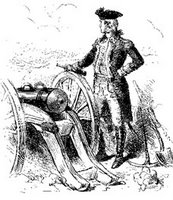
  • Bureaucratic and individual inertia. Smith (shown above) and his troops were already moving out, crossing the Charles River from the base of Boston Common. It would have been a pain and an embarrassment to pull those men back.
  • Pressure from above. Gage had received orders from London four days before, telling him to do something about the political resistance. The government ministers were obviously becoming impatient. So Gage was deciding among the options for action, not deciding whether to take action or not.
  • Hope that everything could still work out. Gage had ordered the guard on Boston Neck not to let anyone out of town. He also had twenty officers patrolling the road to Concord on horseback, stopping messengers. He might have thought that, even though people in Boston had guessed the purpose of the mission, he could bottle up that knowledge in town.
And those precautions almost worked. Paul Revere arranged for a signal from the Old North Church to his fellow Whigs in Charlestown, but their rider never made it through Cambridge, probably stopped by those mounted officers. Revere and William Dawes, Jr., each got out of Boston and carried the news west, but another patrol stopped them before they reached Concord.

But that wasn’t enough. Gage needed nearly complete secrecy. The provincial resistance needed only one man to get through. And the Boston messengers—especially Revere—were telling many people about the approaching soldiers, so militia companies were gathering even as Smith’s column marched west. And before those officers stopped Revere and Dawes, they had shared their news with Dr. Samuel Prescott, who outrode the patrols and brought the warning to Concord.

Furthermore, the very measures that Gage took to preserve his secret—sending out those mounted officers—actually attracted attention and raised suspicions. Richard Devens of Charlestown knew that something was up even before Revere made it across the river; he warned the silversmith about those horseback patrols. When Revere and Dawes arrived in Lexington, they found militiamen on alert and riders already sent toward Concord, again because people had seen those officers come through. Gage’s hopes for secrecy were never realistic.

Monday, December 10, 2007

Founding Fathers in Houses and Taverns

On Friday evening I went to George Washington’s Cambridge headquarters for a book talk by Hugh Howard, author of Houses of the Founding Fathers, which also features many color photographs by Roger Straus III. This oversize illustrated (i.e., “coffee table”) book offers a tour of surviving Georgian and Federal mansions connected to the first generation of Americans.

How do we define “Founding Fathers”? There are the men at the Second Continental Congress, of course, and the Constitutional Convention. And important generals, such as Henry Knox. But that still didn’t produce enough buildings to fill a book. Howard and Straus’s challenge was not just to find the houses of historically significant people, but houses that were still photogenic.

From his towering perspective (he’s very tall), Howard cast a wider net. He included the houses where Gen. George Washington slept for a significant time, such as Longfellow House or the Ford Mansion in Morristown. And then there are the mansions of regional Patriot leaders. For instance, the cover shows wonderful Drayton Hall in Charleston, South Carolina; it was home to William Henry Drayton, president of the South Carolina Provincial Congress and Continental Congress delegate for a year.

Among the Massachusetts houses that Howard featured in the book and in his talk is the Marblehead mansion of Col. Jeremiah Lee. The Marblehead Museum & Historical Society offers an online slide show of the house and actual tours from June through October. It’s an unusually large North American Georgian mansion, with seven windows across its front.

Like Drayton, Col. Lee was notable within his province but had limited influence elsewhere, dying during the war. Lee was a Marblehead merchant, militia commander, and member of the Massachusetts Provincial Congress’s Committee on Supplies, which before April 1775 was gathering military equipment for the militia in case there would be war. David Mason, the Salem painter chosen by the Provincial Congress in November 1774 to collect ordnance, recorded receiving money from Lee twice.

On 18 Apr 1775, Lee attended a joint meeting of the Committee on Supplies and the Committee of Safety at a tavern in Menotomy, now Arlington. When the meeting broke up, he and two other men from Marblehead, Elbridge Gerry and Azor Orne, decided to stay the night. Richard Devens of Charlestown later wrote:

After we had finished the business of the day, we adjourned to meet at Woburn on the morrow,—left to lodge at Newell’s [the tavern], Gerry, Orne, and Lee. Mr. [Abraham] Watson and myself came off in my chaise at sunset.

On the road we met a great number of B[ritish]. O[fficers]. and their servants on horseback, who had dined that day at Cambridge. We rode some way after we met them, and then turned back and rode through them, went and informed our friends at Newell’s. We stopped there till they [the officers] came up and rode by. We then left our friends, and I came home, after leaving Mr. Watson at his house.
The province was abuzz with rumors that the London government had ordered Gen. Thomas Gage to arrest leaders of the rebellion—and those rumors were pretty much true. Even though Devens and Watson had passed through the British officers twice with no trouble, the committee men were nervous about being detained. Gerry sent a warning to John Hancock and Samuel Adams, then staying at Lexington.

Later that evening, a long column of British troops passed the tavern. Lee, Gerry, and Orne got out of bed to watch. Suddenly they perceived some soldiers from that column coming toward the tavern. Half-dressed, the three men dashed out the back door and threw themselves down in a field, hoping the stalks of the previous year’s crop would hide them. They remained on the ground for about an hour before they decided it was safe to return to the building.

Lee, who had just turned 54, took sick and died on 10 May. His family and friends blamed the fright, exertion, and cold of that night.

Here’s the sad irony: the British troops weren’t seeking to arrest anyone on the Committee on Supplies. An 1828 biography of Gerry, who became a controversial governor of Massachusetts, claimed:
Every apartment of the house was searched for the members of the rebel congress; even the beds in which they had lain were examined. But their property, and among other things a valuable watch of Mr. Gerry’s, which was under his pillow, was not disturbed.
But Gage’s orders for that march say nothing about arresting Provincial Congress members or searching buildings before the column reached Concord. None of the several British officers who left accounts of the night wrote anything about such a search on the way west. I don’t know of any contemporary evidence to support that biography’s statement.

I rather suspect that if any British soldiers came to that tavern door on 18 April, they wanted nothing more than a drink of water or other refreshment, and that they never searched the building or the committee men’s room. I think that Lee, Gerry, and Orne could have stayed inside the whole night without being disturbed, and Lee might have lived in his Marblehead mansion for many more years.

Thursday, June 07, 2007

Where Was Paul Revere's "North Church"?

Yesterday I had a chat with Cambridge historical tour guide Donna “Mistress Elizabeth” La Rue about which Boston steeple Paul Revere used to send his lantern signal to Patriots in Charlestown. He told the founder of the Massachusetts Historical Society that he’d arranged “if the British went out by Water, we would shew two Lanthorns in the North Church Steeple; and if by Land, one, as a Signal.”

Did “the North Church” mean the Old North Meeting-House in North Square, near Revere’s home, or Christ Church on Salem Street, a couple of blocks away and now called Old North Church? Congregationalist meeting-houses weren’t usually called “churches”—though sometimes they were. Anglican churches weren’t usually designated by geographic location—though sometimes they were. (Earlier discussion on that nomenclature here.)

Revere named the building in 1798, so he probably used the term that prevailed in that decade. If he meant the Old North Meeting-House, it’s notable that he didn’t mention that the British military had pulled it down more than twenty years before. But would Bostonians of that decade have understood the term “North Church” to mean Christ Church? That’s what Donna and I discussed yesterday.

Here’s an advertisement in the 20 May 1794 Salem Gazette:

John Wilson,
NEXT door to the Rev. Doctor Stillman, opposite to the North Church, Salem Street, Boston—respectfully informs the Ladies of Salem and its vicinity, that he has erected a machine for the Glazing of Linen and Calico Gowns...
And a passage from the diary of the Rev. William Bentley of Salem, 3 Nov 1797:
We took leave of Mr. Freeman & then passed to the North End. At the head of Hancock’s Wharf we saw the Frigate & received the kind attentions of Col. Claghorn. We then left the town, passing the North Church in Salem Street & over Charlestown & Malden Bridges continued our route towards Salem.
Quotes like these show that in the 1790s people were using the term “North Church” to refer to a building on Salem Street—which could only be Christ Church. Old North Meeting-House was not only gone, but it had been a couple of blocks away.

A helpful architectural clue appears in the account of Richard Devens, the Charlestown Patriot to whom Revere arranged to send the signal. As quoted in History of the Siege of Boston, by Richard Frothingham (ironically, the first author to promote the Old North Meeting-House theory), Devens wrote:
Soon afterward, the signal agreed upon was given; this was a lanthorn hung out in the upper window of the tower of the N. Ch., towards Charlestown.
Below is part of a northwest-looking image of Boston’s 1768 skyline engraved by none other than Paul Revere from a drawing by Christian Remick. It’s not an exact picture—it’s more like one of those tourist maps that enlarges all the businesses that have sponsored the map and shrinks all the rest. In this case, the town’s places of worship stand out, not just because they were the tallest buildings in town but also because Remick and Revere were making a point about Boston being a godly town.

Fortunately, for this question we simply need to compare the Old North Meeting-House steeple on the left to the Christ Church spire on the right. They were both drawn to stand out. But which has an “upper window”?

We do have to ask why Revere and his confederates would signal from an Anglican church, one whose minister and congregants (by and large) supported the Crown. Again, the picture hints at a likely answer. Christ Church was high on Copp’s Hill and had the tallest spire in Boston. A signal from its tower would be more visible than the same signal from the Old North Meeting-House. Furthermore, once the military authorities spotted those lanterns, it would take a longer time for men to climb up there and snuff them out.

Thursday, April 12, 2007

Who Got the Message from Old North Church?

At a members’ event at Old South Meeting-House last month, one of Susan Wilson’s trivia questions was something like: “In ‘One if by land and two if by sea,’ what does ‘sea’ refer to?” The assembled body decided that the answer is:

the Charles River estuary,
also known as the Back Bay
before it was filled in
But that’s much harder to rhyme than “sea,” even for a writer of verse as skilled as Henry W. Longfellow.

Longfellow’s poem depicts Paul Revere going on to say, “And I on the opposite shore will be.” That’s not historically accurate. Revere arranged to send the signal about Gen. Thomas Gage’s plan across the water to Charlestown. He didn’t need to watch for the lights in the steeple of Old North Church since he already knew the information they transmitted.

In Revere’s own words:
The Sunday before, by desire of Dr. [Joseph] Warren, I had been to Lexington, to Mess. [John] Hancock and [Samuel] Adams, who were at the Rev. Mr. [Jonas] Clark’s [the minister at Lexington]. I returned at Night thro Charlestown; there I agreed with a Col. [William] Conant, and some other Gentlemen, that if the British went out by Water, we would shew two Lanthorns in the North Church Steeple; and if by Land, one, as a Signal; for we were aprehensive it would be dificult to Cross the Charles River, or git over Boston neck.
As a backup plan, Revere later crossed the river to Charlestown himself. He wrote:
two friends rowed me across Charles River, a little to the eastward where the Somerset Man of War lay. It was then young flood, the Ship was winding, and the moon was Rising. They landed me on Charlestown side. When I got into Town, I met Col. Conant, and several others; they said they had seen our signals. I told them what was Acting, and went to git me a Horse; I got a Horse of Deacon [John] Larkin.
It’s significant that there was no horse waiting at the shore or wharf for Revere. Instead, the Charlestown Patriots had sent off a different rider as soon as they saw the signal from Boston. Spreading the word that way was the whole point of the warning: it wasn’t much good to alert Charlestown that the army was about to land in Cambridge and march west.

According to an undated memorandum later written by Richard Devens, a leading Charlestown Patriot, after seeing the lantern signal:
I then sent off an express to inform Messrs. [Elbridge] Gerry, &c., and Messrs. Hancock and A.,...that the enemy were certainly coming out.
Gerry and his colleagues from the Provincial Congress’s Committee of Safety and Supplies were at an inn in Cambridge. (D. H. Fischer’s Paul Revere’s Ride offers a different wording of this memorandum, which doesn’t match the cited source: Richard Frothingham’s 1872 History of the Siege of Boston. So I’m quoting Frothingham.)

So who was that Charlestown express rider? And what happened to him? (The rider was almost certainly a “him,” the legend of Sybil Ludington notwithstanding.) That’s another mystery about the Battle of Lexington and Concord.

We have a partial answer for the second question, but little for the first. That rider was probably stopped by British officers along the way. Revere encountered the same obstacle:
While the Horse was preparing, Richard Devens, Esq. who was one of the Committee of Safty, came to me, and told me, that he came down the Road from Lexington, after Sundown, that evening; that He met ten British Officers, all well mounted, and armed, going up the Road.

I set off upon a very good Horse; it was then about 11 o’Clock, and very pleasant. After I had passed Charlestown Neck, and got nearly opposite where Mark [a man executed for a murder in 1755] was hung in chains, I saw two men on Horse back, under a Tree. When I got near them, I discovered they were British officers. One tryed to git a head of Me, and the other to take me. I turned my Horse very quick, and Galloped towards Charlestown neck, and then pushed for the Medford Road.
By changing his route and taking a more northern road west, Revere skirted the patrols and made it through to Lexington. Here’s a map of his ride, showing where he first spotted British officers and turned back.

The Charlestown rider probably hadn’t been so quick. Those same officers probably “pulled him over.” And what did they do with him then? When other officers captured Revere later in the night, they held him at gunpoint in a field (along with three riders from Lexington and a disabled peddler named Allen), took away Deacon Larkin’s horse, and finally let him go so they could move more quickly. The Charlestown rider probably also had to walk back home, having accomplished nothing, and no one seems to have recorded his name.