


J. L. BELL is a Massachusetts writer who specializes in (among other things) the start of the American Revolution in and around Boston. He is particularly interested in the experiences of children in 1765-75. He has published scholarly papers and popular articles for both children and adults. He was consultant for an episode of History Detectives, and contributed to a display at Minute Man National Historic Park.

Subscribe thru Follow.it


•••••••••••••••••


Showing posts with label Samuel Woodward. Show all posts

Tuesday, November 09, 2021

Sorting Out Samuel Hobbs
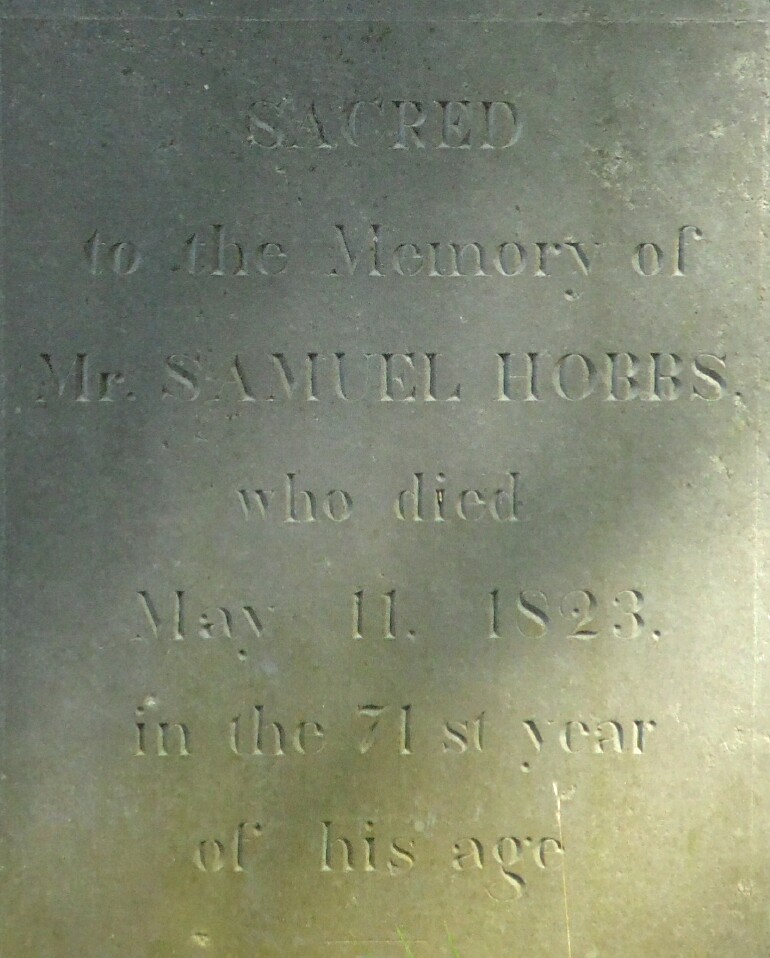
This morning folks from the Boston Tea Party Ships & Museum have arranged a ceremony in Sturbridge to mark the grave of Samuel Hobbs, remembered as a participant in the Boston Tea Party.

The announcement I received from the museum says, “Samuel Hobbs was born in 1750 in Sturbridge,” and I think that’s an error, but there’s a lot of slightly conflicting information about this man.

When Hobbs died in May 1823, the Independent Chronicle and Boston Patriot newspaper ran this death notice:
In Sturbridge, 10th inst. Mr. Samuel Hobbs, aged 70—a valuable citizen.
The vital records of Sturbridge contain multiple entries, saying Hobbs died on 11 or 12 May in his 71st year or at age 71. His gravestone says he died “May 11, 1823 / in the 71st year / of his age,” so I’m sticking with that.

There’s no mention of this Samuel Hobbs’s birth in the Sturbridge records. Nor in the published vital records of Lincoln, which I checked because Samuel F. Drake’s Tea Leaves stated that Hobbs was born in that town in 1750.

But Hobbs’s reported age at death matches an entry in the vital records of Weston, saying that Ebenezer and Eunice Hobbs had a son named Samuel born on 3 July 1752 and baptized on 12 July. Furthermore, George Davis’s A Historical Sketch of Sturbridge and Stockbridge, published in 1856, stated, “Mr. Hobbs was a native of Weston.”

The printed vital records of Weston also say this Samuel died in 1756, which would make authors wary of saying he survived to the Tea Party and beyond. But that entry has been corrected in the American Ancestors database to say that a sister Susanna died and Samuel survived.

The Rev. Samuel Woodward of Weston married Samuel Hobbs to Lucy Munroe of Lexington in November 1774. In October 1776 they had a son named Cyrus in Sturbridge.

Massachusetts Soldiers and Sailors of the Revolutionary War doesn’t list this Samuel Hobbs as serving in the army in the intervening months or later. His older brother Isaac, born in 1735, led Weston’s militia company later in the war, and his older brother Matthew served several years in the Continentals.

Samuel Hobbs prospered in Sturbridge, building a large house that lasted well into the twentieth century. He served in town offices. As the death notice above says, he was considered “a valuable citizen.” However, that notice didn’t say anything about the destruction of the tea.

In 1855 the New England Historical and Genealogical Register published a genealogy of the Hobbs family. The compiler, George Hobbs of Maine, wasn’t sure about Samuel’s birthdate (“1750 or 52”), but he stated:
He was a farmer, but the business of a tanner and currier he also followed with some success. He was an ardent patriot, and, in 1773, while a journeyman in the employ of Simeon Pratt, of Roxbury, joined the famous party, who, in disguise, threw overboard the tea in Boston. He used to say that the whole chests of bohea, weighing 360 lbs., were rather heavy to lift. He settled in Sturbridge, where his four sons remained. He was a most excellent man, and ever held an elevated position in society. He died in May 1823, aged 72 years.
Again, Hobbs was seventy years old when he died.

That published genealogy was enough for Samuel Hobbs’s Tea Party connection to be mentioned by local historians like George Davis. Francis S. Drake listed him among the participants in the Tea Party “derived principally from family tradition.”

Thursday, May 19, 2011

Groton Seeks a New Minister

By April 1775, as described yesterday, the Patriot majority in Groton and their Loyalist minister, the Rev. Samuel Dana, were at a stalemate. Dana refused to call a meeting of the church members, where they could dismiss him. The congregation apparently felt they couldn’t call a meeting on their own authority, at least in part because Dana said he wouldn’t show up.

According to historian Caleb Butler, local tradition held that at some point, probably after war began at Lexington and Concord, “the inhabitants were so enraged, that they shot bullets into Mr. Dana’s house, to the great danger of his life and the lives of his family.” Nevertheless, the minister didn’t leave town and seek the protection of the British army in Boston.

Groton’s town leaders sought a replacement. On 5 May, the Rev. Dr. Samuel Cooper (shown here), a Patriot who had slipped out of Boston to Weston just before the war, received a visit from Dr. Oliver Prescott of Groton. The physician “propos’d my Supplying their Pulpit.”

Cooper was apparently reluctant, perhaps because Groton was far from the political action in Watertown and Cambridge. He suggested that his host, the Rev. Samuel Woodward, should handle the Groton job while he filled in for Woodward. But the Weston minister didn’t agree.

As I discussed back here, on Saturday, 13 May, Cooper heard that Concord’s minister, the Rev. William Emerson, “was to supply Groton,” so he promised to preach the next day at Concord, no doubt happy to escape the long trip. Instead, both men showed up at Concord’s meeting-house, and the Groton congregation was presumably left waiting.

On 21 May, Cooper wrote that he preached at Concord and “Mr. Emerson for me at Groton,” indicating that he felt some responsibility to serve that town. On Saturday, 27 May, he finally set out “in my Chaise for Groton,” stopping along the way at Acton, Littleton, and the house of a man named Rogers for coffee. The next day, Cooper wrote, he:
Pch’d all day at Groton; spoke with Mr. Dana after Service a.m. din’d at Dr. Prescot’s baptiz’d a child P. M. Slept and Horse kept at Dr. Prescot’s.
The Groton church record notes that Cooper did something else as well:
Rev. Dr. Cooper, of Boston, preached, and was desired by the deacons and some of the brethren of the church to appoint a church meeting, to be held at the public meeting-house on the next Monday.
Cooper issued that call for a meeting, breaking the stalemate. Between then and 18 October, he preached in Groton on six Sundays, and received £60 Old Tenor. The congregation might have thought that money well spent because they got to fix their Dana problem.

TOMORROW: Class conflict over dealing with Dana.