J. L. BELL is a Massachusetts writer who specializes in (among other things) the start of the American Revolution in and around Boston. He is particularly interested in the experiences of children in 1765-75. He has published scholarly papers and popular articles for both children and adults. He was consultant for an episode of History Detectives, and contributed to a display at Minute Man National Historic Park.

Subscribe thru Follow.it


•••••••••••••••••


Showing posts with label Edward Mitchell. Show all posts

Monday, May 05, 2025

“Opposite to the house occupied by the committee”

On 18 Apr 1775, the Massachusetts Provincial Congress’s committee of safety met “at Mr. [Ethan] Wetherby’s, at the Black Horse” tavern in west Cambridge.

Among other business that day, the committee promised “the two brass two pounders, and two brass three pounders” that had been stolen out of Boston to Lemuel Robinson’s Suffolk County artillery company. Robinson had hidden those cannon at his tavern in Dorchester earlier in the year, before they were moved out to Concord.

The committee decided to continue meeting in the same tavern at 10 A.M. the next morning. Three important members from MarbleheadElbridge Gerry, Jeremiah Lee, and Azor Orne—chose to stay overnight since they were far from their own beds. Other members went home to Charlestown, Newton, and elsewhere. 

On the afternoon of the 18th people spotted Maj. Edward Mitchell and other army officers riding by that tavern on horseback. Gerry sent a warning note to John Hancock in Lexington, and Hancock replied. There was a widespread worry that troops might arrest leaders of the resistance. Of course, neither man’s message indicated that he was worried for himself, certainly not.

In 1828 James T. Austin published a two-volume Life of Elbridge Gerry, his father-in-law, which offered this story about what happened in the night that followed:
Mr. Gerry and colonel Orne retired to rest without taking the least precaution against personal exposure, and they remained quietly in their beds until the British advance were within view of the dwelling house. It was a fine moonlight night, and they quietly marked the glittering of its beams on the polished arms of the soldiers as the troops moved with the silence and regularity of accomplished discipline. The front passed on.

When the centre were opposite to the house occupied by the committee, an officer and file of men were detached by signal, and marched towards it. It was not until this moment they entertained any apprehension of danger.

While the officer was posting his files the gentlemen found means by their better knowledge of the premises to escape, half dressed as they were, into an adjoining corn-field, where they remained concealed for more than an hour, until the troops were withdrawn. Every apartment of the house was searched “for the members of the rebel congress”; even the beds in which they had lain were examined.

But their property, and among other things a valuable watch of Mr. Gerry’s, which was under his pillow, was not disturbed.
I can’t identify the source of the phrase in quotation marks, either in earlier books, period newspapers, or Gen. Thomas Gage’s orders. 

TOMORROW: Another family source.

Thursday, April 17, 2025

Counterfactual 2: If Capt. Parker Hadn’t Assembled His Company

Picking up the “what if” thread from yesterday, I turn to this question: What would have happened if neither Paul Revere nor William Dawes had arrived in Lexington in the wee hours of 19 Apr 1775?

The town would still have been at a heightened level of military alert. That afternoon a young local named Solomon Brown had ridden out from Boston—not as a messenger, but just coming home from business.

On the road Brown had spotted a bunch of other men on horseback. They looked or sounded British. When their cloaks flapped back, he saw they were carrying pistols. Brown began to suspect they were British army officers.

Everyone in Lexington knew two important politicians from Boston were staying in the Rev. Jonas Clarke’s house: John Hancock, president of the Massachusetts Provincial Congress, and Samuel Adams, delegate to the Continental Congress. Were those army officers coming out to arrest those men?

In fact, Maj. Edward Mitchell was leading about a dozen mounted officers out into the countryside to keep alarm riders from getting to Concord. That town was the only goal of Gen. Thomas Gage’s mission. Lexington was just along the way.

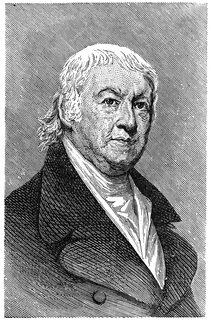
Not knowing that, Solomon Brown went to his militia sergeant, William Munroe (shown above). Munroe gathered “a guard of eight men, with their arms,” at the parsonage. So some Lexington militiamen were already on the alert well before hearing from Revere or Dawes.

In real life, after receiving the Bostonians’ post-midnight warning, Capt. John Parker assembled the rest of the Lexington militia company on the town common. Nothing happened, so he let the men disperse to nearby houses and taverns to catch some sleep.

But let’s imagine that Revere and Dawes never arrived. The town picked up news of the approaching column hours later from a few travelers, from hearing bells and warning shots from towns to the east.

In that case, the Lexington men might have assembled more hastily. They might have headed for where they thought they might be most needed: at the parsonage, strengthening Sgt. Munroe’s guard.

Hancock and Adams might not have had time to leave town—or Hancock might have refused to do so with more men watching. So an armed crowd would have gathered on what’s now Hancock Street, determined to prevent the troops from arresting those political leaders.

The expedition’s light infantry companies were the first to march into town. But in this scenario the men of the 10th Regiment wouldn’t have seen a body of armed men lined up on the common. They wouldn’t have felt any need to veer off to confront those men. They would have kept marching swiftly along the road to Concord, half a mile from the Hancock-Clarke house.

The two bodies of armed men might have spotted each other in the early dawn light. But they would have been too far apart for either to present any threat. The army column would probably have passed through Lexington without any incident.

Contrary to the scenario Jim Piecuch found described in Kostya Kennedy’s The Ride, Hancock and Adams would not ”have been captured or killed” because the regulars weren’t looking for them.

(Well, if Hancock had insisted on rushing to the common to confront the regulars, he might have been captured or killed. But even he wasn’t that reckless.)

TOMORROW: Alternative scenarios for Concord.

Sunday, April 13, 2025

Sestercentennial Talks in Boston on the 18th of April

Friday, 18 April, will be the 250th anniversary of the day when Maj. Edward Mitchell led over a dozen British army officers on horseback out into Middlesex County to tamp down alarms (and thus caused alarms).

The 250th anniversary of the day when William Dawes and Paul Revere rode out into the same countryside to do all they could to spread the alarm as far as Lexington, at least.

And finally the 250th anniversary of the day when more than 700 British light infantrymen and grenadiers embarked across the Charles River to begin their alarming march to Concord.

Some of those events will be reenacted that evening in various places, and there will also be talks in the city of Boston on both sides of the Charles River.

The U.S.S. Constitution Museum and Paul Revere House are sponsoring “The Messenger and the Maker,” a free evening of activities at the Constitution Museum in the Charlestown Navy Yard. From 5 to 9 P.M. families can explore the galleries and make their own lanterns to help escort Revere on his journey from the Navy Yard through Charlestown.

At 8:00 P.M. I’ll speak in the museum on “The Reasons for Revere’s Ride.” The organizers asked me to lay out the background for the events on 18 Apr 1775, and they said I had twenty minutes. Later they revised that to thirty. I’m preparing a whirlwind tour through history up to that fateful evening. And I can’t speak too long because the audience will go out to meet Mr. Revere.

At City Square Park in Charlestown, two events are scheduled at 8:45 P.M. Revere will arrive at Deacon John Larkin’s House and emerge to mount his borrowed horse. Around that event Joe Bagley, Boston’s Chief Archaeologist, will speak on “Unearthing the Untold Stories of Charlestown’s Sacrifice.” Drawing on recent discoveries and study, he will introduce the inhabitants of Charlestown, enduring the frightening end of one battle and the destruction caused by another.

Meanwhile, over in Boston’s North End, the Old North Church will offer a free costumed reading of Revolution’s Edge from 6:30 to 8 P.M. on Paul Revere Mall (or, in case of rain, inside St. Stephen’s Church). This play by Patrick Gabridge dramatizes the choices that the Rev. Mather Byles, Jr.; Capt. John Pulling; and Cato, the minister’s enslaved servant, faced in April 1775.

Starting at 7 P.M., the church will also host its traditional Lantern Service. This year’s keynote address will be offered by Heather Cox Richardson, professor of American history at Boston College and author of Democracy Awakening: Notes on the State of America. This commemoration will also include inspirational music, Revere’s recollection of his ride, prayers for the nation, and the lighting of the lanterns in the belfry at about 8:15 P.M. (This event is currently at capacity.)

Friday, April 29, 2016

Reviewing Thomas Nichols’s Case

In late February 1775 a Massachusetts magistrate had Thomas Nichols of Natick, labeled variously a “free Negro” or “mulatto,” locked up for “enticing divers Servants [slaves] to desert the Service of their Masters.”

Nichols was still in the jail at Concord when the Revolutionary War broke out. He must have witnessed the British troops under Maj. John Pitcairn force their way into the jailyard to disable three large cannon that belonged to the town.

On 13 May, the Massachusetts Committee of Safety took up Nichols’s case. Its records say:
One Thomas Nicholas, a negro, brought before this committee on account of his suspicious behavior for some time past, having been examined, Resolved, that it be recommended to the council of war to commit said negro, until there be further inquiry into his conduct. . . .

Ordered, That Mr. Isaac Bradish, keeper of the jail in Cambridge, be directed and empowered to confine one Thomas Nicholas, negro, till further orders.
A week later the committee voted:
That Capt. Edward How, Ebenezer Cutler, and Nicholas, a black fellow, now under guard, be sent up to Congress for examination and trial, and Capt. White is appointed to attend Congress, with the above named persons.

Voted, That the general [Artemas Ward] be desired to furnish a guard for the occasion.
On that same day the Committee of Safety recommended against enlisting anyone but “freemen” into the Massachusetts army. There were multiple reasons behind that decision: ideological distaste for forcing slaves to fight in the name of liberty, potential complaints from slaveowners, and a lingering fear of unreliable troops. (The Massachusetts government didn’t decide to bar free black men from the ranks until shortly after Gen. George Washington’s arrival in July.)

On 22 May, a committee of the full Massachusetts Provincial Congress in Watertown, chaired by Edward Mitchell of Bridgewater, considered the evidence against those three jailed men. The decision on Thomas Nichols came last, and it was recorded this way:
Whereas Thomas Nicols, a negro man, hath been brought before this Congress, and there being no evidence to prove any matters or things alleged against him: therefore,

Resolved, That the said Thomas be sent to the Town or District where he belongs, and that the Committee of Correspondence, or Selectmen of said Town or District, take such care of the said Thomas, that he may be dealt with as they, in their judgment, shall think proper.

Ordered, That Captain [Caleb] Kingsbury be directed to appoint some persons to conduct the above-mentioned negro to Natick, agreeably to the foregoing Resolve.
So that was it. The slave conspiracy that had made the papers as far away as Norwich, Connecticut, and resulted in Nichols being jailed for almost three months had “no evidence” to back it up.

And even after that, according to Natick historian Horace Mann, the town “confined” Nichols at the tavern of Pelatiah Morse (shown above courtesy of the Historic Buildings of Massachusetts blog). Morse’s bill for the food he supplied to Nichols and his guard is the evidence for that, but I don’t know how long the confinement lasted.

TOMORROW: Nichols’s in-laws.

Sunday, June 12, 2011

Sarah Palin’s Last Word on Paul Revere

For several days last week, much of America seemed consumed by the vital issue of whether former half-term governor Sarah Palin misspoke about the history of Paul Revere, or whether her comments referred to one particular moment in the early hours of 19 April 1775.

As we recall, during her visit to Boston’s North End, Palin told television cameras that Revere was: “He who warned, uh, the…the British that they weren’t gonna be takin’ away our arms, uh, by ringin’ those bells…”

Law professor William A. Jacobson, who started a blog in large part because he dislikes criticism of Palin, then pointed out that when Maj. Edward Mitchell detained Revere at pistol point in Lincoln, the silversmith told him all about alarming the countryside. (Boston artist Dan Mazur has shared a comic-book version of this episode drawn by Alex Toth.)

That episode could be interpreted, historians conceded, as warning the British. It wasn’t the purpose or most important moment of Revere’s ride, however. And he certainly didn’t warn Mitchell “by ringin’ those bells.”

So did Palin share a correct and uncommonly knowledgeable interpretation of Revere’s ride? Or was she correct only in the way that a stopped clock is correct if you look at it in exactly the right way and ignore it a second later?

That argument might have raged forever, but then someone came along and made it impossible to maintain that Palin enjoys a detailed, accurate understanding of the start of the Revolutionary War. That person was Sarah Palin.

Within the friendly confines of her employer, Palin made a follow-up statement that—even with cramming and preparation—contained so many errors that it confirmed her historical ignorance. She said:

I didn’t mess up about Paul Revere. Here is what Paul Revere did. He warned the Americans that the British were coming, the British were coming, and they were going to try to take our arms and we got to make sure that we were protecting ourselves and shoring up all of our ammunitions and our firearms so that they couldn’t take it. But remember that the British had already been there, many soldiers for seven years in that area. And part of Paul Revere’s ride — and it wasn’t just one ride — he was a courier, he was a messenger — part of his ride was to warn the British that were already there. That, hey, you’re not going to succeed. You’re not going to take American arms. You are not going to beat our own well-armed persons, individual, private militia that we have. He did warn the British. And in a shout-out, gotcha type of question that was asked of me, I answered candidly. And I know my American history.
Let’s take those points one by one.

“He warned the Americans that the British were coming, the British were coming…”

Previously, we recall, Palin said the opposite: “He who warned, uh, the…the British…” But this elaboration started with acknowledging Americans’ basic shared understanding of what Revere did.

In doing so, Palin echoed the cliché phrase, “The British are coming!” Historians have pointed out for years that the American colonists of 1775 still thought of themselves as British subjects fighting for British rights. Therefore, Revere wouldn’t have used that language. In retrospect, however, it’s useful to write about “the British government” or “the British army” to distinguish those from the provincial or American equivalents. And perhaps that’s what Palin was doing here.

(Back here Boston 1775 discussed what might be the earliest appearance of the phrase “The British are coming” in stories of that event.)

“…and they were going to try to take our arms and we got to make sure that we were protecting ourselves and shoring up all of our ammunitions and our firearms so that they couldn’t take it.”

Palin probably meant “storing up” instead of “shoring up,” which is what one does with the levee. The plural of “ammunition” is usually just “ammunition.” The antecedent of “it” should be singular, not two plurals.

But the historical issue here is the word “firearms,” which refers especially to rifles, pistols, and other weapons people carry. Gen. Thomas Gage sent soldiers to Concord to look for cannon. The most advanced battlefield weapons of the day.

“But remember that the British had already been there, many soldiers for seven years in that area.”

What might Palin have meant by “that area”? There were never British soldiers stationed in Lincoln, where Revere was detained. British regiments did come to Boston in 1768, seven years before Revere’s ride. But then they pulled out of the town in 1770. One regiment remained in a fort on an island in the harbor. If we charitably concede that Palin’s “that area” could mean anywhere in eastern Massachusetts, then this would be technically correct. But historically Bostonians experienced a significant decrease in the military presence from 1770 to 1774.

“And part of Paul Revere’s ride — and it wasn’t just one ride — he was a courier, he was a messenger.”

It’s hard to see how Revere’s other rides support Palin’s point, or indeed are relevant. Is it possible that she just threw out that fact because it was something she remembered hearing about Paul Revere and thought might sound impressive?

“part of his ride was to warn the British that were already there. That, hey, you’re not going to succeed. You’re not going to take American arms.”

For most English speakers, the phrase “was to” indicates purpose—i.e., that Revere undertook his ride in order to warn the British. But Revere worked very hard at avoiding British military personnel on the night of 18-19 April.

If Revere had intended to pass a message to a British officer, he could have done so back in Boston. He could have caught the attention of sailors on the Somerset. He could have stopped to chat with the mounted officers who chased him toward Medford. But he didn’t, because the last thing he wanted to do was talk to the royal authorities.

Only after Revere had been captured—an event he didn’t want to happen—did he speak to a British officer. At that point, his ride was over. He wasn’t operating according to his original intent. Palin’s second statement about Revere’s warning to the British was thus more erroneous than her first.

“You are not going to beat our own well-armed persons, individual, private militia that we have.”

Here Palin showed her true colors, badly misstating history as she blew a dog whistle to America’s far right. The colonial militia was not an “individual, private militia.” It was an arm of the government, and of society. Militia service was required and regulated by law, and militia units were organized on a provincial, county, and town basis.

Capt. John Parker was not in an “individual, private militia.” Timothy McVeigh was. It’s an important distinction.

“And in a shout-out, gotcha type of question that was asked of me, I answered candidly.”

The “gotcha type of question” was: “What have you seen so far today, and what are you going to take away from your visit?” Palin misstated the history of a few days before, let alone centuries back.

As for “candidly,” it would have been candid for Palin to say, “I misspoke. I should have said that ‘Paul Revere warned about the British,’ or that ‘Paul Revere’s ride is a warning to anyone who wants to take away Americans’ right to defend ourselves.’” But that would have required admitting a minor error.

“And I know my American history.”

No, she really doesn’t. And worse than that, she doesn’t know how to admit to being even a little wrong.


Sunday, April 24, 2011

Solomon Brown Stays Out Late

In April 1775, Solomon Brown was an eighteen-year-old growing up in Lexington, Massachusetts, the son of a local deacon. He was also crucial in at least one way the momentous confrontation between the town’s militia company and the British military on the 19th of that month.

On the 18th, Solomon visited Boston, and early in the evening he stopped into William Munroe’s tavern (shown above) to tell Munroe, a sergeant in the Lexington militia, that on the way home:
he had seen nine British officers on the road, travelling leisurely, sometimes before and sometimes behind him; that he had discovered, by the occasional blowing aside of their top coats, that they were armed.
That quotation comes from Munroe’s testimony decades later. He said that he immediately assembled a small squad to guard the parsonage where John Hancock and Samuel Adams were staying because Patriots widely (but wrongly) thought the royal authorities intended to arrest those men.

Meanwhile, Solomon went on to Buckman’s tavern near the center of town and repeated what he had seen. Elijah Sanderson recalled:
After some conversation among the citizens assembled there, an old gentleman advised, that some one should follow those officers, and endeavour to ascertain their object. I then observed, that, if any one would let me have a horse, I would go in pursuit. Thaddeus Harrington told me, I might take his, which was there. I took his, and Solomon Brown proposed to accompany me on his own horse. Jonathan Loring also went with us. We started, probably, about nine o’clock…
According to an 1891 profile of Solomon Brown by his son, the teenager at first objected that he had “had his horse in use through the day, when Minister [Jonas] Clark replied to him that he would be provided for, and soon led out his own horse saddled and bridled for his use.” That profile conflicts with contemporaneous sources on some points, but this seems like an odd detail for the family to make up.

In any event, the three Lexington men set off to the west. After about an hour they saw the British officers. Unfortunately for them, those officers saw them first. According to Sanderson, “One rode up and seized my bridle, and another my arm, and one put his pistol to my breast, and told me, if I resisted, I was a dead man.”

The officers, under the command of Maj. Edward Mitchell, made the three men dismount in a wooded area of Lincoln. They held Solomon and his companions for hours, questioning them repeatedly. In 1775 the men complained that their captors “searched and greatly abused them,” but decades later Sanderson recalled the questioning as persistent but civil. It was a pleasant night, but still not a pleasant experience.

By 2:15 A.M., according to Sanderson, the officers had added two more detainees: “Allen, a one-handed pedlar,” and Paul Revere. However, the British failed to stop Dr. Samuel Prescott from getting past the patrol on the back trails to Concord.

The Lexington men heard Revere tell Mitchell that the provincial militia had already been alerted to their army’s march. This was apparently a last-ditch attempt to make the British field commanders call off the mission, and it had some effect. The officers decided to rendezvous with the column marching west.

Mitchell ordered Solomon and the other detainees back on their horses, and they all rode east “at considerable speed.” As they approached Lexington, there was a burst of gunfire up ahead—perhaps militiamen discharging their guns before going into Buckman’s tavern for a late-night refreshment or nap. The officers stopped to confer—was the column being attacked?

Maj. Mitchell decided to let all their prisoners go. The Lexington men testified in 1775 that the officers “cut the horses’ bridles, and girths, turned them loose, and then left us,” heading for Lexington. Now it was the locals’ turn to worry about an attack—what would those officers do when they got to the center of town? Sanderson recalled:
We then turned off to pass through the swamp, through the mud and water, intending to arrive at the meeting-house before they could pass, to give information to our people.
The men saw the officers arrive at the town meeting-house, but then ride on to the east. Solomon Brown and his companions went into Buckman’s tavern to describe their experiences.

TOMORROW: Shooting and being shot at.