J. L. BELL is a Massachusetts writer who specializes in (among other things) the start of the American Revolution in and around Boston. He is particularly interested in the experiences of children in 1765-75. He has published scholarly papers and popular articles for both children and adults. He was consultant for an episode of History Detectives, and contributed to a display at Minute Man National Historic Park.

Subscribe thru Follow.it


•••••••••••••••••


Showing posts with label James Murray. Show all posts

Tuesday, October 14, 2025

Lt. Browne “hearing the drum beat to arms”

Yesterday I finally noted that Capt. William Browne, who was in the thick of the action in early 1775 as a spy and an army officer, had also been in Boston from 1768 to 1770. He was then a lieutenant in the 14th Regiment.

In fact, we might have Capt. Browne’s description of the night of the Boston Massacre.

After that confrontation, the army and the Loyalist justice of the peace James Murray compiled testimony from soldiers and officers about their side of the conflict. Customs Commissioner John Robinson carried those depositions to London, where they were published in a book titled A Fair Account of the Late Unhappy Disturbance at Boston.

One of those depositions, dated 13 March, reads:
I William Brown, junior, lieutenant in the 14th regiment of foot, do swear, that on the evening of Monday the 5th of March, 1770, being in company with lieutenant [Daniel] Mattear, ensigns [William] Napier and [Henry] Hallwood, in the quarters appropriated for part of the officers of the 14th regiment, between the hours of nine and ten o’clock, I was alarmed with an extraordinary ringing of bells, and the words “Turn out,” which continued some time, and then ceased a little; but on the bells beginning to ring again, and hearing the drum beat to arms, I prepared to go to the barracks;

at this time, captain lieutenant [John] Goldfinch coming in, the gentlemen then ready went along with him, leaving lieutenant [Alexander] Ross and myself, who presently followed. All along Queen’s-street, and King-street, we were pursued by a number of people with clubs and sticks, calling out, “Here goes two more; kill them, kill them;”

on turning into Quakers-lane, I received a blow across the neck with a stick thrown at me, another being aimed, passed with great violence, and numbers rushing in, I was separated from lieutenant Ross, and followed with the cries, “Down with him, kill him, kill him,” and other opprobrious language, to the middle of Green’s-lane, where they left me; from thence I got safe to the barracks.

WILLIAM BROWN, junior,
Lieutenant of the 14th regiment.
I say this might be the same officer as the man who was later Capt. Browne of the 52nd because the Army Lists for 1767 and 1771 show there were two lieutenants named William Browne in the 14th during its time in Boston.

When I first saw “William Brown, junior,” I thought that might indicate this man’s father was also named William Brown, offering another (thin) clue to his identity. But it’s also possible that the deponent used “junior” to distinguish himself from the older Lt. Browne in the same regiment.

All of the officers Browne named, plus Ens. Andrew Lawrie, provided similar testimony. Capt. Goldfinch also described breaking up a fight earlier that night, and Ens. Napier said a woman told him the bell-ringing “war to raise the inhabitants against the soldiers.” All that could easily be read as evidence of Bostonians being hostile and violent toward British army officers for no reason.

Closer reading shows, however, that Lt. Browne and his colleagues went out into the street after the Massacre. They heard a long stretch of bells, shouting, and other cacophony. Then the noise “ceased a little” as the crowd absorbed the effect of the shots. Finally, the officers heard more bells along with the army drums summoning all the soldiers to their barracks. Browne and his fellows in the 14th headed for those buildings, running into townspeople upset that soldiers had shot a dozen of their neighbors.

TOMORROW: The frustrating Capt. Goldfinch.

Thursday, August 12, 2021

“Opportunity of hearing NANCY DAWSON”

As I described yesterday, in late 1768 Boston officials became concerned about the army regiments in town playing music on Sundays.

That music was a normal aspect of changing the guard. The garrison’s main guard was at the center of town, near the Old Brick Meeting-House.

By early December, that dispute nearly led to violence as soldiers chased away local youths who “behaved so as to displease the officer” in charge.

At the end of the year, the town’s highest elected officials complained directly to the officer commanding the four regiments:
Yesterday the Selectmen, waited upon General [John] Pomeroy, to acquaint him that the music of the fife, &c. on the Sabbath, was very disagreeable to the inhabitants, and might have an ill effect upon the younger and more thoughtless part of the community, with respect to the observance of that day; and as they apprehended it contrary to law, they expressed their hopes and desires that it might be omitted for the future, as they had taken notice it had sometimes been in stormy weather…
The selectmen also used the occasion to complain about sentries challenging civilians who passed their guardhouses and stations, as soldiers were ordered to do. Why did a British town at peace need sentries? Mostly to stop men from deserting from the army.  

The selectmen’s request had no effect according to the Whigs’ “Journal of the Times” dispatch for 1 Jan 1769.
The soldiery are obliged, the Lord’s day not excepted, to attend twice or thrice a day at the calling of the rolls. . . . The noise of the fife was this day more general and offensive than it has been upon any Sabbath, since the troops came among us.
But then the “Journal of the Times” didn’t mention military music again for over four months. (Or rather, the writers confined their complaints to a reportedly violent officers’ ball and the 29th Regiment’s black drummers.)

The issue of music on Sundays returned on 15 May:
Yesterday, but before divine service began, part of the town had opportunity of hearing NANCY DAWSON from a most elegant band of music, the French horns certainly were inimitable.—

It is some time since we have had such a Sunday morning’s regale, the drums and fife, being the common entertainment, and ‘tis uncertain to whose taste we owe this: Some think it the fancy of Madam G——m, while others think that the Justice himself conceived it might be an agreeable relief to the wardens under the burthen of their duty.
While fifes and drums were standard instruments for military musicians, many regimental bands had indeed expanded into French horns and oboes.

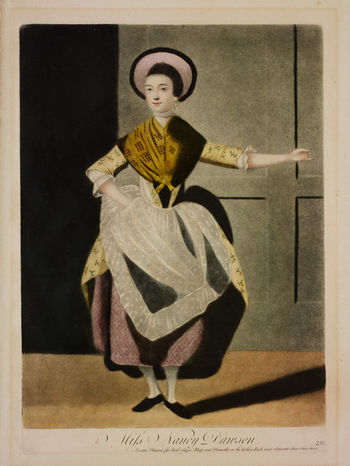
As for the allusions in that passage, Nancy Dawson (shown above) was a British actress and dancer who died in 1767. The hornpipe titled “The Ballad of Nancy Dawson” became very popular in the British Empire. That melody was also known as “Piss on the Grass,” and is now most easily identified as “Here We Go Round the Mulberry Bush.” (Boston’s youth also referred to the boys who dressed in women’s gowns and danced around the effigies during Pope Night processions as “Nancy Dawsons.”)

Finally we come to “Madam G——m” and “the Justice himself.” Dr. Samuel Gillam was a justice of the peace in Surrey, England. In May 1768 he authorized soldiers to disperse a crowd gathered to support John Wilkes, killing six or seven people. Whigs across the Empire viewed that “Massacre at St. George’s Fields” as an example of tyranny. Gillam was even tried for murder, but acquitted.

Earlier in their “Journal of the Times” the Boston Whigs had reported that ”the G——r had nominated and appointed the J—s M——y already noticed in this Journal, as one of his Majesty’s justices of the peace.” That is, Gov. Francis Bernard had made the Scottish-born merchant James Murray a magistrate. The Whigs warned, “the G——r will not now want a Justice Gillam.” In other words, Bernard now had an appointee willing to read the Riot Act and unleash troops on civilians.

The Whigs’ reference to “Madam G——m” and “the Justice himself” thus meant James Murray and his second wife, the former Margaret (Mackay) Thompson. According to Patricia Cleary’s biography of James’s sister, Margaret Murray was known in the family for enjoying the social whirl. That might be why the Whigs dragged her into this little controversy.

TOMORROW: Confrontation in June.

Friday, July 10, 2020

A Meeting to Protect the Town’s Reputation

Back in late March 1770, the Boston town meeting had commissioned Capt. Andrew Gardner to carry its official report on the Boston Massacre and other documents to London.

Gardner arrived in the imperial capital in early May. That was a couple of weeks after Londoners had read the first newspaper reports about the shooting on King Street.

Furthermore, the captain discovered, Customs Commissioner John Robinson had reached London before him, carrying documents that reflected poorly on Boston. That material included:
  • Capt. Thomas Preston’s “Case,” describing how hostile the town had been to the army, and how people had provoked his soldiers into firing.
  • Several depositions collected by Loyalist magistrate James Murray in mid-March backing up that picture of the shooting.
  • Province secretary Andrew Oliver’s description of the Council meetings after the Massacre, accusing members such as Royall Tyler of almost openly threatening unrest if acting governor Thomas Hutchinson didn’t withdraw troops from town.
Most of Preston’s “Case” was printed in London newspapers by the end of April. The depositions and Oliver’s account went into the pamphlet titled A Fair Account of the Late Unhappy Disturbance at Boston.

Those publications offset the effect of Boston’s Short Narrative of the Horrid Massacre. In fact, the Fair Account was a direct response to the Short Narrative; its depositions were numbered starting with 97, where the first edition of the Short Narrative ended.

To be sure, London’s Whiggish printers quickly set about reprinting Boston’s report (as well as the Rev. John Lathrop’s sermon, Innocent Blood Crying to God from the Streets of Boston). But after all the Boston Whigs’ effort to present their town as innocently attacked, they had been scooped.

(My talk “Reporting the Battle of Lexington” discusses how Massachusetts Patriots were determined not to let that happen again in 1775. After the Battle of Lexington and Concord, the Provincial Congress rushed to collect depositions and spared no expense sending them to London. There was none of the delay and debate we see in the town meetings of 1770.)

Capt. James Hall brought the first news of trouble in London back to Boston on 18 June, as I discussed here. Capt. Gardner returned with confirmation on the evening of 6 July.

Bostonians seem to have felt particularly betrayed by Capt. Preston’s “Case” since he’d sent a short note to the Boston Gazette back in March to say he was being treated fairly. At the very same time, people now knew, he’d written this long message to London, warning that he might be lynched. When Preston’s “Case” became public, people worried about that danger even more—at least according to officials and friends of the royal government.

The Boston Whigs therefore had to respond, but only in the most legal, least violent way. Which meant calling a town meeting. At 9:00 A.M. on 10 July 1770, 250 years ago today, qualified white men assembled in Faneuil Hall to discuss “Sundry Letters received by Capt. Gardner Master of the Packet taken up by the Town, in answer to those by him to our Friends in England.”

The meeting took action by, of course, forming a committee. It consisted of Thomas Cushing (also moderator of that meeting), Samuel Adams, John Hancock, Richard Dana, William Phillips, William Molineux, Dr. Joseph Warren, Ebenezer Storer, and William Greenleaf. They were delegated to “draw up a true state of the Town, and the conduct of the [Customs] Commissioners.”

The news from London prompted another agenda item as well: “A Motion made that the printed Narratives of the late horred Massacre, which has been retained by order of the Town in the hands of the Committee; may now be sold by the Printers.” Benjamin Edes and John Gill had gone to the trouble and expense of printing copies of the Short Narrative, but the town had forbidden them to sell any copies locally to avoid complaints about tainting the jury pool.

Now that the Short Narrative was being reprinted in London, Edes and Gill no doubt argued, copies of that edition were coming into Boston. So there was no longer any point in forbidding them to sell their stock, right?

The town meeting disagreed. Town clerk William Cooper wrote that the question “Passed in the Narrative”—a psychological slip for “in the negative.” Edes and Gill were told to keep sitting on their copies.

The meeting then adjourned until Friday the 13th, when they would hear from the new committee. In practical terms, that probably meant Samuel Adams got busy writing the town’s response, if he hadn’t already drafted it.

Saturday, June 27, 2020

Trouble for Henry Barnes, “an Infamous importer”

Yesterday I started to describe how the town of Marlborough started to pressure Henry Barnes (shown here, in a portrait by his former slave Prince Demah) to stop importing goods from Britain.

The men of Marlborough adopted some of the same measures as the non-importation activists in Boston, just a year or more later. They held a town meeting to formally condemn importers. They appointed a committee to inspect goods and customers. They even called a meeting that didn’t have a property requirement so more young men could participate. And some folks started to make their disapproval even clearer by damaging Barnes’s property.

Henry Barnes’s wife Christian heard rumors that this activity was being guided from Boston:
It is said that a young gentleman who has formilly headed the mob in Boston and now resides with us is the perpetrator of all this mischief, but I will not believe it until I have further profe.
Alas, I haven’t found a clue about which young gentleman that might be.

In her letter to her friend Elizabeth Smith, Christian Barnes described how Bostonians themselves had attacked her husband’s property while it was in transport:
The greatest loss we have as yet met with was by a Mob in Boston who a few Nights ago atack’d a wagon load of goods which belongs to us they abused the Driver and cut a Bag of Peppur which contain’d three hundred [pounds?] leting it all into the street then gather’d it up in their Hand’fs & Hatts and caried it off the rest of the load they ordered back into the Publick Store of which the well disposed Commity Keeps the Key

Mr. Barnes has apply’d to the Lefnt. Govener [Thomas Hutchinson] for advice and he advised him to put in a petition to the General Court he then repaired to Mr. [James] Murray [a justice of the peace who was also Smith’s brother] and beg’d his assistance in the drawing of it up he complyed with his request and it is lade before the House next week, as I have entered so largly into the affair I will send you a Coppy of the Petition, we expect no Satisfaction or redress from the General Court but only as it is a legal Method and praparatory (in case of further insults) to the appealing to Higher Powers

You would be pleased to see with what moderation Mr. Barnes behaves in his present distresses at the same time I am well assured his resolution will carry him through all difficultys without swerving from his first principles

The Merchants in Boston are now intirely out of the question in all debates at their Town Meeting, which is caried on by a mob of the lowest sort of people leaded by one [John] Balard and Doct. [Thomas] Young Persons that I never before heard off
Dr. Thomas Young had led a crowd to the McMaster brothers’ store in early June to press them to stop importing. After another crowd carted Patrick McMaster around with a tar barrel on 19 June, John Ballard administered the oath by which the Scotsman swore not to return to Boston. Barnes heard from either Ame or Elizabeth Cumings that “the other two [McMaster] brothers had fled for their lives” as well.

And the people of Marlborough were still ramping up pressure on Henry Barnes. His wife wrote:
on the 10 of June the unqualified Voters had a meeting and enter’d into the same resolves the others had done before and the next day an Effigy was Hung upon a Hill in sight of the House with a paper Pin’d to the Breast, wheron was wrote Henry Barnes an Infamous importer this Hung up all Day and at Night they Burn’d it
In the five years since the Stamp Act, only the society’s worst political enemies had the honor of being hanged and burned in effigy.

COMING UP: Another effigy, this one on horseback.

Saturday, May 30, 2020

“On Election Day a Sermon will be preached”

Election Day was a holiday in colonial Massachusetts. Not the day that people voted for their General Court representatives—that happened in town meetings, and each town could choose its own date.

Rather, Election Day was when the new legislature assembled for the first time and elected the new Council, as well as the speaker and clerk of the lower house.

That day usually involved a banquet for the legislators and guests, a procession, and an “Election Sermon” by a prominent clergyman. Did New Englanders know how to party or what?

On 30 May 1770, 250 years ago today, acting governor Thomas Hutchinson convened the General Court across the Charles River in Cambridge. All the official events would be taking place there. What was Boston to do?

The Whigs decided to arrange their own unofficial observations instead. On 29 May, they paraded an ox through town, “to be roasted whole” the next day. That meat was designated “to be given to the Poor and Prisoners.”

The 28 May Boston Gazette announced:
A Number of Gentlemen, Friends to the Rights of America and Mankind, taking into Consideration the unprecedented Removal of the General Election of Counsellors for this Province from its Ancient Seat, and being desirous of celebrating the usual Festivity of said Election, request the Favour of the Company of the Gentlemen of the Clergy of all Denominations who may be in Town, to dine with them at FANEUIL HALL on Wednesday next, the 30th Instant, at Two o’Clock precisely.
According to young printer John Boyle, the ox was taken over to Faneuil Hall after roasting. Probably the gentlemen and clergy dined inside, the populace outside (and, we hope, some meat was sent to the jail).

Before that hour, Edes and Gill also promised, “On Election Day a Sermon will be preached at the Old Brick Meeting House, by the Rev. Dr. [Charles] CHAUNCY.” That was the church right beside the Town House, where the legislature usually met, and Chauncy was its highly respected minister.

Edward M. Griffin’s biography reports that Chauncy created a thirty-five-page sermon titled Trust in God, the Duty of a People in a Day of Trouble, based on a verse from the 22nd Psalm. He directly addressed the governor’s choice to move the legislature to Cambridge, but he wound up on the most anticipated event of the time, the upcoming trials for the Boston Massacre.

Chauncy preached:
If there should have been, in any measure, a failure in this respect, since the King’s troops were stationed in this town, from whatever cause, it is now hoped that “justice and judgment will run down our streets as a stream”: And I the rather mention this, because the opened earth in one of our streets, in the month of march last, received the streaming blood of many slaughtered, and wounded innocents. So shocking a tragady was never before acted in this part of the world; and GOD forbid it should ever be again!

Who the sheders of this blood were may possibly appear, upon the tryal of those who are under confinement, as being supposed to be the guilty persons. We wish them as fair and equal a tryal as they themselves can desire. And should they all, or any of them, be found guilty, though their sin be as “scarlet, and red like crimson”, we heartily wish their repentance, that, of the mercy of GOD in Jesus Christ, they may escape the second death; though our eye is restrained from pitying them so as to wish their deliverance from the first death. For the supreme legislator has said, “whoso sheddeth man’s blood, by man shall his blood be shed”—“life shall go for life”—“No satisfaction shall be taken for the life of a murderer—He shall surely be put to death.

SOME have whispered a suspicion, as though a reprieve from death would be granted, should the guilt of blood be fastned upon some who are supposed to have been actors in this horrid wickedness—But it is an high indignity offered to him, who has the power of giving a reprieve, so much as to suspect he would do it in the case of BLOOD GUILTINESS, clearly proved upon any, in consequence of a fair and impartial tryal.

Surely, he would not counter-act the operation of the law both of GOD and man. Surely, he would not suffer the Town and Land, to lie under the defilement of blood! Surely, he would not make himself a partaker in the guilt of murder, by putting a stop to the shedding of their blood, who have murderously spilt the blood of others! All such suspicions should be suppressed. They are virtually a scandalous reproach reflected on him, of whose integrity, and regard to public justice, we should entertain a more honorable opinion.
Justice of the peace James Murray referred to this sermon as “the pains taken by the Revd. Doctr. Chauncey and others to prejudice the People of Boston against Capt. [Thomas] Preston.” But it was equally a warning to Hutchinson not to pardon that officer.

TOMORROW: Meanwhile, over in Cambridge.

Monday, May 18, 2020

When Hancock Moved on Mein

John Mein arrived in Boston from Scotland in 1764. He first set up a shop with Robert Sandeman, though he wasn’t a member of the Sandemanian sect.

The next year, Mein took over the London Book Store on King Street, formerly co-owned by James Rivington. Later he became partners with printer John Fleeming, another Scotsman, to publish books.

Finally, in 1767 Mein and Fleeming launched a new newspaper, the Boston Chronicle. It soon became the voice of the royal government in Massachusetts. The Customs office gave Mein and Fleeming its printing business, providing them with financial support.

At the same time, Mein owed a lot of money to his London suppliers, the publisher and book dealer Thomas Longman (d. 1797) and the stationery firm Wright & Gill. He ordered more than £2,000 worth of books and paid off only £419. In that respect, Mein was a lot like other North American merchants.

Then came the non-importation controversy of 1768 and 1769. The Boston Chronicle published Customs documents showing that many of the town’s merchants, including several involved in enforcing the boycott, were still having goods shipped to them from Britain. Mein added some choice insults.

Meanwhile, in July 1769 Thomas Longman wrote to John Hancock, asking if he was willing to be the firm’s Boston agent in collecting the money Mein owed. To sue John Mein for debt? To seize his goods? To potentially send him to debtors’ prison? Why yes, Hancock was happy to.

It took a while for Hancock and Longman finalize their arrangement. Other Boston merchants acted more directly, threatening Mein and Fleeming in the middle of town on 28 Oct 1769, as described here. Mein went into hiding on Castle Island and sailed for home the next month.

Once in London, Mein called on Longman and told him how he’d had to shut down his Boston business. He promised to pay off his debt, no doubt asking for more time. But Longman was already moving against him.

On 1 Mar 1770, Hancock received legal powers of attorney from Longman and Wright & Gill. That same day, Hancock’s lawyer John Adams filed the paperwork to have deputy sheriffs seize Mein’s property in Boston—his stock of books and his printing equipment.

The Loyalist magistrate James Murray negotiated with Hancock and Sheriff Stephen Greenleaf. He appears to have wanted the suit to be handled in London courts, far from Boston juries. Those discussions were going on in the same week as the Boston Massacre.

Murray’s action allowed Fleeming to continue the Boston Chronicle, “much to the Surprize and Disappointment of Mr. H—— and his party,” he wrote.

But Hancock took all he could. On 18 May, 250 years ago today, he wrote to Longman:
Your favours of Dec. 2d. 1769, & Jany 3d. 1770 are now before me, & duly note the Contents. In Consequence of the Rect. of the former, as Mr. Mein was absent, I immediately attached everything I could find of his Effects for the benefit of you & Wright & Gill & the matter is now in the Law.

The Effects are in the Hands of the Sheriff, and as soon as it has gone thro’ the Law, & the Effects turn’d into money, the neat proceeds shall be remitted you, and you will determine the settlement between you and Messrs. Wright & Gill. Tho’ I fear even the Whole of his Effects will fall vastly short of the Debts, but I have got all & could have no more.

You will please, as I am now greatly hurried, to present my respects to Mess Wright & Gill & acquaint them. I will render them every service in my power & will write them by next opportunity. Cannot You get further Security of Mr. Mein in London. You may rely I will do all in my power for your Interest in this or any other matter.
Around the same time, across the Atlantic, Longman had Mein arrested.

COMING UP: Wending through the courts.

Saturday, March 28, 2020

The Departure of Commissioner John Robinson

Although the Boston Whigs indicted the Customs officer for the port of Gaspé; a passing notary; and a couple of bottom-level Customs employees for the Boston Massacre, those men weren’t their real targets.

The anonymous person reporting on events for Customs Commissioner Joseph Harrison wrote:
This affair has struck every friend of Government with Horror and amasement, not Knowing but that it may be their case tomorrow . . . almost Every person in the Province are made to believe, that the Commissioners, and principal Officers of the Revenue were aiders & abettors, in the fireing on the 5th Inst.
In his role as historian, and thus referring to himself in the third person, Lt. Gov. Thomas Hutchinson later recounted:
Another witness, having sworn that he saw a tall man in the Custom house or in the balcony; it was insinuated to the Lt. Governor in Council that this was one of the Commissioners, who soon after left the Province and went to England.—There is no judging, in such times, where the credulity of the People will stop.
Who was this “tall man,…one of the Commissioners”? That was John Robinson.

Back in September 1769, Robinson had gotten into a coffee-house brawl with James Otis, Jr., seriously injuring the leader of the Massachusetts Whigs. That popped him to the top of the Least Popular Customs Commissioner list, beating out perennial Charles Paxton.

In February 1770, after land waiter Ebenezer Richardson killed Christopher Seider, some people whispered that superiors in the Customs service had encouraged him to use violence. Perhaps the Customs sloop sailor George Wilmot, who joined Richardson in defending his house, was acting under agency orders?

Clearly all these events were connected! Obviously Robinson and his colleagues were engaged in a secret transatlantic conspiracy to slowly press Massachusetts into political slavery!

Did anyone question how this conspiracy would benefit from killing an eleven-year-old? Or how a well-known tall man in hiding after the Otis brawl got into the Customs House in the center of town without anyone seeing him? Or why his method of attacking the crowd outside that building was by loading a musket, thrusting it into the hands of a teen-aged servant boy, and ordering him to shoot? (Charles Bourgate insisted he had shot over the crowd’s heads.)

Presumably the Boston activists believed that an investigation in the courts would answer those questions. Or, if we take the more cynical approach, they believed that they simply had to keep the questions alive until they achieved some sort of political victory over the Customs bureaucracy.

Meanwhile, what was John Robinson really up to? He had, as Hutchinson wrote, “left the Province and went to England.” The 22 March Boston News-Letter reported:
Friday last [i.e., 16 March] sailed for London the Captains Robson and Miller; in the former went the Hon. John Robinson, Esq; one of the Commissioners of the Board of Customs.
Robinson carried an important cargo: documents telling the army’s side of the story. Lt. Col. William Dalrymple wrote to his commander on 19 March:
I have sent to England States of the affairs here, as well as of Captain [Thomas] Preston’s case. You will pardon my doing so by any other channel than yours, when you consider that the first impression is always the strongest in such cases, an opportunity offered and I presumed to use it.
“Captain Preston’s case” meant a 2,200-word narrative by the imprisoned captain dated 14 March. Robinson also carried affidavits from twenty-one other army officers and several local eyewitnesses dated 12-15 March. They were all certified by James Murray, the Scottish-born justice of the peace appointed by Gov. Francis Bernard in 1768.

By comparison, Boston town officials started to collect testimony about the Massacre on the morning after—at the town meeting and for coroners’ inquests. But it wasn’t until 13 March that the town voted to commission a report on the event to send to Britain.

Whig magistrates took down depositions over the following week, particularly on 16, 17, and 19 March. Then they collected more. They deposed Charles Bourgate on 23 March. They interviewed three Customs service employees who refuted him on 24 March. Meanwhile, there was a debate in the town meeting about how best to send a fast ship to London with the report. The Short Narrative was finally printed on 30 March, and Capt. Andrew Gardner sailed with it on 1 April.

By that point, John Robinson and his documents already had a two-week head start for the imperial capital.

I think the Massachusetts Whigs learned a valuable lesson from this episode. The next time British soldiers shot and killed locals—at Lexington and Concord in April 1775—the Patriots were much more efficient about gathering testimony, printing it, and speeding it to London. In 1775, Capt. John Derby sailed from Salem on 29 April, ten days after the battle—or about as quickly as it took John Robinson to embark after the Massacre.

Tuesday, December 03, 2019

“Treading the reforming justice out of me”

Yesterday we bravely accompanied James Murray, a justice of the peace known to be friendly to the royal government, into Faneuil Hall as two Whig magistrates heard a charge against William Burnet Brown for helping to assault James Otis, Jr., in September 1769.

According to a letter Murray wrote at the end of the month, selectman Jonathan Mason chided the crowd for jostling him, even if everyone knew he was no fan of Otis.

Then, lending me his hand, [Mason] helped me over the door into the selectmen’s seat. Before I got down from the seat I was hiss’d. I bowed. I was hiss’d again, and bowed around a second time. Then a small clap ensued. Compliments over, I sat down.

The justices asked me up to the bench. I declined.
The justices of the peace presiding at this session were Richard Dana and Samuel Pemberton. Murray had the status to sit beside them and render judgment—but of course he knew he would be outvoted.
The examination of some evidence [i.e., witness] was continued, and, being finished, the justices thought fit to bind over Mr. Brown. He lookt about for bail. No one offered but I.
According to Dr. Thomas Young, the printer John Mein also offered to be one of Brown’s “sureties.” That of course didn’t make Mein any more popular with the crowd. (This was several weeks before he was driven into hiding, as discussed here.)

Murray insisted that his offer to put up bail for Brown didn’t mean he supported one side of the the British Coffee-House brawl:
Here I desired the justices to take notice that I did not mean by this offer to vindicate what Mr. Brown had done, but only to stand by him now the torrent was against him. The recognizance taken, the justices desired the people to disperse, for that Mr. Brown had complied with the law; but the crowd, intending more sport, still remained.

As I was pressing out next to Mr. Dana, my wig was pulled off, and a pate, clean shaved by time and the barber, was left exposed. This was thought a signal and prelude to further insult, which would probably have taken place but for hurting the cause.

Going along in this plight, surrounded by the crowd, in the dark, Lewis Gray took hold of my right arm and Mr. William Taylor of my left, and supported me, while somebody behind kept nibbling at my sides and endeavoring to trip me; for the pleasure, as may be supposed, of treading the reforming justice out of me by the multitude.

Mr. [Gilbert or Louis] Deblois threw himself in my rear, and suffered not a little in my defence. Mr. G. Hooper went before, and my wig, disheveled, as I was told, was borne on a staff behind.

The gentlemen, my friends and supporters, offer’d to house me near the Hall, but I insisted on going home in the present trim, and was by them landed in safety, Mr. Gray and others having continually thus admonished my retinue in the way, “No violence, or you’ll hurt the cause.”
Gray, Taylor, and the Debois brothers were all Boston merchants who became Loyalists during the war. Taylor eventually moved back to Massachusetts.

I’m guessing that “Mr. G. Hooper” was George Hooper (1747-1821), a son of the late Rev. William Hooper of Trinity Church. Murray promised to look after that family when the minister died in 1767.

Murray had lived for decades in North Carolina, and he probably helped the Hooper brothers set themselves up in that colony. Oldest surviving brother William, having studied law under Otis, started a practice in Wilmington. He became politically active and eventually signed the Declaration of Independence.

George Hooper followed William to the Wilmington area by the 1770s, worked as a merchant, and held some local offices. In 1780 he was suspected of having Loyalist sympathies and left for Charleston, South Carolina. Since that city had fallen into British hands, that looks like the sort of thing a Loyalist would do. But Hooper’s brother and father-in-law, both active Patriots, advocated for him and he managed to come back to Wilmington after the war. Eventually he was the first president of the Bank of Cape Fear.

Murray’s experience on 6 Sept 1769 might have been the inspiration for this engraving, which appeared in James S. Loring’s Loyalists of Massachusetts. Having tried to describe the situation with detached wit, the justice wouldn’t have appreciated this depiction.

Monday, December 02, 2019

“For being accessory in beating Mr. Otis”

Back in September, before other Sestercentennial anniversaries came along, I started to explore the 5 Sept 1769 brawl in the British Coffee-House between James Otis, Jr., leader of the Boston Whigs, and John Robinson, one of His Majesty’s Commissioners of Customs.

As those two gentlemen were going at each other with canes and fists, other men intervened. The most energetic on Otis’s side was young John Gridley, identified here. On 6 September, Dr. Thomas Young wrote to John Wilkes that Gridley “had the ulna of his right arm fractured in the fray.”

The Whigs complained that several officers of the British army, navy, or Customs took Robinson’s side, but the one they named was William Burnet Brown, a native of Salem who had married and moved to Virginia. As I discussed here, he was probably visiting Boston to finish selling his New England property.

Interestingly, several recent authors credit Benjamin Hallowell, Jr., comptroller of the Boston Customs office, for breaking up the fight. I’ve read more anecdotes about Hallowell getting into disputes than stopping them, so this offers a novel perspective on him. Unfortunately, I haven’t been able to find the contemporaneous source for that detail.

Robinson went into hiding after the brawl, probably moving out to Castle William, the Customs officers’ usual refuge, which was now in army hands. That kept him beyond the reach of Whig magistrates or writs. Otis’s supporters therefore focused their legal efforts on William Burnet Brown. In fact, some people accused Brown of having attacked Otis himself.

On 6 September the merchant John Rowe wrote in his diary: “this afternoon the sheriff took Mr. Brown, Esq., formerly of Salem, for being accessory in beating Mr. Otis; he was carried to Faneuil Hall.” Sheriff Stephen Greenleaf was acting on a legal complaint sworn out by John Gridley, not making an arrest on his own authority the way police do now.

The magistrates overseeing the hearing at Faneuil Hall that evening were justices of the peace Richard Dana and Samuel Pemberton. Dana was a highly respected member of the Boston judiciary. Pemberton was a magistrate of long standing and a selectman. However, they were also both known for challenging Crown decrees and ignoring complaints from British officers. They were the Whig activists’ go-to magistrates, as the cases of Capt. John Willson, Ens. John Ness, and John Mein show.

In an attempt to counterbalance such magistrates, Gov. Francis Bernard had appointed James Murray (1713-1781) as a justice of the peace in the previous year. Murray was a Scottish gentleman who had settled in North Carolina in 1735, becoming a member of the governor’s council there. However, he didn’t do nearly so well financially as his little sister Elizabeth did in Boston, so in 1765 Murray moved north to join her.

In 1769 Elizabeth (Murray Campbell) Smith was widowed for a second time and decided to visit family in Britain, leaving her brother to manage her extensive property. They had already rented one large building to the British army; locals called that “Smith’s barracks” or “Murray’s barracks.” The public knew Justice James Murray supported the Crown in other ways.

On the evening of the 6th, Murray was taking a walk around the Town House when a gentleman named Perkins told him that Brown had been taken to Faneuil Hall. At the end of the month Murray wrote:
consulting my feelings for another's distress more than my own safety, [I] went directly to the Hall to attend the proceedings. Soon as the multitude perceived me among them, they attempted repeatedly to thrust me out, but were prevented by Mr. [Jonathan] Mason, one of the selectmen, calling out, “For shame, gentlemen, do not behave so rudely.”
What had started as a personal fight between two gentlemen had grown into a legal case. And now it was threatening to become a public fight that would make Boston look like a lawless place.

TOMORROW: Inside and outside Faneuil Hall.

Wednesday, November 07, 2018

“No appointment of this sort could have been more unpopular”

As described last week, on 26 Oct 1768 Gov. Francis Bernard told his Council that the royal army had started renting buildings around the center of Boston to convert into barracks.

That news couldn’t have come as a surprise to the Boston Whigs. Three weeks before, they had reported just such a rumor in their “Journal of Occurrences”:
Report, that James Murray, Esq; from Scotland, since 1745, had let his dwelling house and sugar houses, for the quartering of troops, at £15 sterling per month
But soon the Whigs found something new to complain about besides Murray being Scottish. They suggested that he and the governor had agreed on a corrupt quid pro quo.

As you recall, Gov. Bernard had started to press Boston’s justices of the peace to provide legal authorization for taking over the Manufactory or other buildings in Boston. A magistrate could empower government employees to carry out some legal actions, conceivably with the help of the troops themselves. Boston’s established magistrates threw up the same obstacles as the Council. Then on 27 October the Boston Whigs reported:
The people were this morning filled with astonishment on hearing that the G——r had nominated and appointed the J——s M——y already noticed in this Journal, as one of his Majesty’s justices of the peace for the county of Suffolk; no appointment of this sort could have been more unpopular, or have raised a more general indignation.

The inhabitants being fully persuaded that by means of the steady conduct of our bench of justices in refusing to quarter and billet troops in this town contrary as they apprehend to an act of Parliament, this gentleman was added to their number, and that the G——r will not now want a Justice Gillam, or a more fit instrument to carry his purposes into the utmost execution.

It is given out that when this nomination was made [in the Massachusetts Council], there was silence for a space of time, and such signs of disgust as raised the passions and voice of this G——r, who afterwards condescended to use arguments and intreaties with his C——l in favour of his said friend, which finally prevailed to obtain the consent of a majority of two only.
Murray had been a member of the appointed governor’s council in North Carolina before joining his little sister, Elizabeth (Murray Campbell) Smith, in Boston. He wasn’t as wealthy as his sister and elderly brother-in-law, despite his efforts, but he was the sort of mature, genteel merchant who often got picked for political posts in the British Empire. As a native of Britain with family and business ties back there, Murray was a natural Loyalist. That was no problem for Bernard, of course.

In “Justice Gillam,” the Whigs alluded to Samuel Gillam, a magistrate in Surrey, England. On 10 May he had read the Riot Act twice to a crowd showing support for John Wilkes, then held in the King’s Bench Prison near St. George’s Field. After that warning had no effect, Gillam authorized soldiers guarding the prison to fire on the increasingly violent crowd. About six people were killed, more than a dozen wounded. A grand jury indicted Gillam for his part in the “St. George’s Field Massacre,” but in July the court acquitted him on the grounds that he had acted within the law. The Boston Whigs feared a similar outcome locally, and used that prospect to link themselves to the London Whigs.

The day after reporting Murray’s appointment, the “Journal of Occurrences” went back to the question of barracks:
In the morning it was known that the troops which lately occupied Fanueil-Hall, had been placed, or had quartered themselves in the buildings, which had been hired of James Murray, Esq; but owned by James Smith, Esq; of Brush-Hill, [in Milton.]

such a procedure in the face of an act of Parliament, may well surprise the inhabitants, and lead them to think that some gentlemen of the civil or military order have concluded that they have a right for certain purposes, of dispensing with those acts at their pleasure:

However this may be, it is hoped that the people will soon have the satisfaction of knowing whether such steps can be taken by any with impunity; or whether every order and person among us is not equally held to the due observance of law.
Murray was acting as agent for his ailing brother-in-law and sister. The buildings he rented, formerly used to distill molasses into sugar or rum, became known as “Smith’s barracks” or “Murray’s barracks.”

The Boston Whigs were still arguing that the Quartering Act required regiments to go into the barracks on Castle Island, far from central Boston. They had objected to the army taking over publicly owned buildings. But at this point those activists were also objecting to the army renting private properties from their legal owners.

COMING UP: A less likely landlord.

Sunday, October 07, 2018

Renting Property “for the quartering of troops”

The longer the 14th Regiment of Foot bunked inside Faneuil Hall and the Town House, the harder Boston’s selectmen found it to get those soldiers out again.

The Whigs kept making that an issue. On 5 October, for example, their “Journal of Occurrences” complained: “The Council now met, and were obliged to pass the guards placed in the passage way, entering their chamber.” And the next day they added:
This day, by order of Governor [Francis] Bernard, the south battery was delivered up to Col. [William] Dalrymple. If this people had not more patience and loyalty, than some others have tenderness and sound policy; what a scene would soon open!
At the same time, the Whigs objected to any hint that supporters of the royal government might solve that problem by providing other places for the soldiers to stay. Back on 4 October their “Journal” had sneered:
Report, that James Murray, Esq; from Scotland, since 1745, had let his dwelling house and sugar houses, for the quartering of troops, at £15 sterling per month, and that Mr. [James] Forrest from Ireland had let them a house lately purchased for about £50 sterling, at the rate of £60 sterling per annum.
Murray (shown above) was Scottish by birth. The reference to “since 1745” was a reminder of that year’s Jacobite rebellion—no matter that Murray had settled in North Carolina ten years before that. Forrest was likewise not a New England native and known for Loyalist politics.

As it worked out, Murray did rent a large sugar-distillery on Brattle Street to the army. It wasn’t actually his property, though. He was agent for his sister Elizabeth and her second husband, James Smith. That building thus became known as both Murray’s barracks and Smith’s barracks.

As for Forrest, there doesn’t appear to be any evidence that he rented a house out for barracks.

Meanwhile, another property owner who did rent to the army was selectman John Rowe. On 7 October, 250 years ago today, he wrote in his journal: “Let one of my houses to Capt. [Brabazon] Ohara yesterday & the other this day to Major [Jonathan] Furlong—both at £20 Ster’g per annum.”

Capt. O’Hara of the 14th was a witness to the fight between James Otis, Jr., and Customs Commissioner John Robinson in 1769. According to one document, he testified about the Boston Massacre in 1770. The regiment was transferred to the West Indies after that, and he died on the island of Saint Vincent in 1773.

Maj. Furlong of the 14th had a less eventful time in Boston. The start of the war found him in St. Augustine, Florida, commanding a small garrison there. He died in 1782, having attained the rank of colonel.

Back in October 1768, O’Hara and Furlong weren’t looking for homes for their men. They were renting genteel accommodations for themselves, paying out of their own money. After all, we shouldn’t expect British military gentlemen to share quarters with ordinary soldiers. Many Bostonian householders rented rooms to officers like that, and it wasn’t as controversial as supplying buildings for barracks.

That said, the Boston Massacre trial testimony refers to “Rowe's Barracks,” otherwise unidentified. So it’s likely that Selectman Rowe did rent a large building to the army as well.

Friday, March 03, 2017

Pvt. Joseph Whitehouse’s Story about Capt. Goldfinch

Yesterday I described how Jane Crothers, an eyewitness to the Boston Massacre, married Pvt. Joseph Whitehouse of the 14th Regiment later in March 1770.

Whitehouse also went to Christ Church (Old North) that month for the baptism of a child of another 14th Regiment soldier, George Simpson, on 14 March. Christ Church was one of Boston’s three Anglican churches, preferred by the soldiers from Britain and Ireland.

By the end of that month, the 14th Regiment had moved to Castle Island in Boston harbor, thus no longer inside the town of Boston and in daily contact with its civilians. They were still there in August, and Pvt. Whitehouse was one of the soldiers who lined up to give testimony to justice of the peace James Murray (shown here) about how badly the locals had treated them.

On 25 August, Whitehouse stated:
That about the latter end of February 1769, he was assaulted in the Streets of Boston by a mob of the townsmen, throwing pieces of Ice and snow-balls at him, calling him Scoundrel, Lobster, bloody back’d dog and much more abusive language, to all which he made no reply.

And further deposeth, that on the 5th. March last in the Evening as he was going to the barracks, he saw a number of the inhabitants striking Capt. Goldfinch who was lying on the ground, his sword taken away, and his face very much bruised, on his attempting to assist him, the mob immediately fell on him, and beat him in such a manner, that it was with much difficulty he reached the barracks.
Capt.-Lt. John Goldfinch of the 14th also played a major role in the events that led up to the Massacre. According to George R. T. Hewes, an apprentice at John Piemont’s shop dressed the officer’s hair in December, and the barber promised that apprentice that he could have the payment for that job. But then Goldfinch didn’t pay immediately, nor, it seems, as soon as the bill came due in three months.

So as Capt. Goldfinch passed by the Customs house on King Street on the evening of 5 March, apprentice Edward Garrick heckled him about the bill. He “owed my fellow Prentice,” Edward called. In fact, by that evening Goldfinch had paid the bill—so recently he still had the receipt in his pocket. But he disdained haggling on the street with an apprentice, leaving Pvt. Hugh White to put an end to the topic by clonking Edward on the head.

Goldfinch was one of the many people who testified about what happened that night. He gave a deposition for A Fair Account of the Late Unhappy Disturbance at Boston, published in London. He testified at the soldiers’ trial. He had every reason to describe the Boston crowd as violent.

Yet Goldfinch never described being personally assaulted, knocked to the ground, “his face very much bruised.” He never described his sword being taken away. Instead, his story was about finding a brawl going on outside the barracks rented from Justice Murray, reestablishing order there, and then hearing the shots from King Street.

Was Pvt. Whitehouse mistaken about which British officer he saw “lying on the ground” and tried to help? That seems unlikely. And if that were so, we would expect to see Goldfinch or another officer complain about that assault on a colleague. The whole point of the Fair Account pamphlet and the depositions collected at Castle William was to paint the townspeople as violent. But there’s no complaint about such an incident on 5 March.

I suspect Pvt. Whitehouse correctly suspected what his superiors wanted to hear about the locals, and knew that Goldfinch was somehow involved in the King Street incident. So he came up with this story of the captain under attack. Whitehouse’s tale is one reason I’m as skeptical about the soldiers’ depositions as I am about the Bostonians’ testimony to their own friendly magistrates.

COMING UP: Don Hagist traces Pvt. Whitehouse’s military career.

Friday, January 01, 2016

“Happy Years to the Sons of LIBERTY”

Since there’s no better time to quote carrier verses about the Stamp Act than now, the sestercentennial of the period when that law remained a hot topic in North American politics, here’s another example.

This one comes from New York and is credited to a well known newspaper seller there—Lawrence Sweeny, not a young apprentice but a grown man from Ireland.
New Year’s
ODE
For the YEAR 1766,
Being actually dictated,
BY
LAWRENCE SWINNEY,
Carrier of News, Enemy to Stamps, a Friend to the Constitution, and an Englishman every Inch.

I AM against the Stamp Act;
If it takes Place, I’m ruined for ever.
C———’s Coach and J———’s House!
Lord Colvil, General Murray!
I’m in Debt to the Doctors,
And never a Farthing to pay.
The Weather is severely cold.
I have the Rheumatism in my Leg,
And but little Hay for my little Horse,
And if Famine should stamp him to Death,
More than half my Fortune in gone!
What shall I say for the Boys of New-York?
Happy Years to the Sons of LIBERTY.

Ding Dong.
Ding Dong.
Long live the KING,
The KING live long.
But the DEVIL may Shoot,
Wicked G————l and B——.
Well, that certainly has the sound of something someone might dictate, especially late at night in a tavern. But what’s it all about?

At the bottom “G————l and B———” are clearly George Grenville and Lord Bute, the prime minister who proposed the Stamp Act and his predecessor who didn’t but still got blamed for it all over North America.

“C———’s Coach” refers to Lt. Gov. Cadwallader Colden’s coach, fed to a bonfire during New York’s anti-Stamp Act protest on 1 Nov 1765. “J———’s House” refers to the house rented by Maj. Thomas James and torn apart by rioters that night.

“Lord Colvil” must be Adm. Lord Colville, the man in charge of the Royal Navy in North America at that time. He was based in Halifax, not New York, but as the new year began he was threatening to have the navy seize any ship trying to leave harbor without the correct papers.

“General Murray” was Gen. James Murray, governor of Quebec. He doesn’t seem to have had anything to do with the Stamp Act in New York. But his accommodation of the French Canadians—the vast majority of the people he governed—was making him unpopular with the English settlers up in Canada.

The names of Colville and Murray would have been especially resonant for Sweeny since they were both commanders during the recent Seven Years’ War. According to an article in the Magazine of American History in 1877, the news carrier became known as “Bloody News” Sweeny for his habit of shouting out that phrase to sell newspapers during the war.

Finally, Sweeny is studied today as an early example of Irish-American humor and pride. For example, the American Antiquarian Society has featured the New Year’s verse he distributed in 1769, which is proudly and loudly Irish. That makes the 1766 handbill’s phrase “an Englishman every Inch” somewhat problematic. I take that as Sweeny’s claim to all the rights of Englishmen, including not having a Stamp Tax foisted upon you (even though by that year Englishmen had been paying a Stamp Tax for decades).

TOMORROW: Sweeny against the Stamp Act.

Saturday, March 06, 2010

“Among the mob near the town-house in Boston”

Tonight there will be a reenactment of the Boston Massacre, taking place on the actual site of the shooting on 5 Mar 1770. As preparation, here’s an account of that evening from Edward Hill.

I was among the mob near the town-house in Boston, on Monday the 5th of March instant [i.e., this year], about nine o’clock at night, when the bells were set a ringing by order of the towns men (as I do believe) in order to bring the people together. I saw some of them armed with sticks, and heard some of them say they would go down to the custom-house, where there was a centry placed, and they would take him off his place.

Hearing this, I went to the main-guard, and acquainted the soldiers with what I heard. I heard the serjeant of the guard order a party of men to conduct the officer of the guard to his post; I staid thereabout till I saw Capt. [Thomas] Preston and another officer join the guard; then I saw Capt. Preston with a party of men go towards the custom-house; then, as I went towards the post-office, I heard the report of two muskets, fired as if from the custom-house; upon this I returned and went towards the custom-house with a number of towns-men;

while I was one the way thither, I heard the report of three or four muskets more; when I went down, I saw the people carrying off for dead one or two men; and then I saw a man lying on his back with a gore of blood by him, who, as I afterwards learned, was a Mulatto, upon which I heard the towns-people cry out to the soldiers who stood at the custom-house, “Fire, damn you, we defy you to fire;” whereon one of the soldiers of that party, thus provoked, turned out of the ranks a little, took up his musket, and was going to fire, when Capt. Preston took him by the arm and hindered him from firing.

It was after the firing beforementioned was over, according to the best of my knowledge, that I heard the drum beating to arms. I saw several officers of the 14th regiment running towards their barracks, and some of the towns-people running after them, crying, “Knock them down, sons of bitches.”

As I was running after some of these officers; I had in my hand a small stick, which somebody pursuing the officers asked me to let him have. I refused, saying, I wanted it myself. He took hold of the stick, and endeavoured in vain to take it from me; a crowd of people coming up, and walking faster than I did, threw me down.

As I got up again, some of them asked, “Who son of a bitch was that?” and one of them made a thrust at me with a blade, which I took to be a cut and thrust sword, and by the thrust cut through my jacket on the left breast about six inches; then I run down to the barracks of the 14th regiment, where I remained all night.
This deposition was taken down on 15 Mar 1770 by justice James Murray, a fervent supporter of the royal government. Customs Commissioner John Robinson, who had laid low since his coffee-house brawl with James Otis, Jr., carried it to London, and it was published with others in a pamphlet titled A Fair Account of the Late Unhappy Disturbance at Boston in New England.

Capt. Preston’s defense team, which consisted of John Adams, Robert Auchmuty, and Josiah Quincy, Jr., called Hill as their second defense witness. The notes on his testimony add a few details to this account. Hill was “in a house by Mr. Deblois” before going out. The other officer at the main guard with Preston was “Mr. Bassett”—twenty-year-old Lt. James Bassett, officer of the guard that night. And the soldier whom Preston stopped from shooting had “Attempted to fire at a Boy.” Hill did not clarify exactly why he had been running after army officers with a stick in his hand.

Hill’s deposition identified him as “late servant to Mr. George Spooner, merchant, of Boston.” Usually Bostonians used “servant” to mean “slave,” but that meaning doesn’t seem to fit this context. As for Spooner, he had attended the Sons of Liberty dinner in Dorchester in August 1769, but five years later he was a Loyalist and left town with the British military.

(Photo of the Old State House at night by Wally Gobetz, via Flickr under a Creative Commons license.)

Saturday, February 06, 2010

The For Liberty Bias

For Liberty is an ironic title for Timothy Decker’s picture book about the Boston Massacre, published last year by Calkins Creek. It portrays that historic event almost entirely from the perspective of supporters of the royal government, who felt Bostonians were taking too much liberty.

This perspective begins on the front cover, drawn from behind a British soldier and thus making us share his view of the crowd. One youth yells a taunt while another is about to throw a snowball at close range. The single soldier holds his bayonet away from the boys, not defending himself. This picture makes a clear statement about who were aggressors and who was a victim.

The pattern extends to the historical figures that the book presents as individuals rather than part of a group. For Liberty doesn’t name any of the eleven men and boys killed or wounded by gunfire on 5 Mar 1770. One picture shows a black man being shot, clearly meant to be Crispus Attucks, but no text on that page identifies him.

The book doesn’t name Edward Garrick, the barber’s apprentice who got clubbed in the head by Pvt. Hugh White, beginning the spiral of violence on King Street. Instead, the text says, “At the Customs House, Private White found himself harassed by apprentices and street toughs,” as if people had spontaneously decided to bother an armed sentry.

In contrast, For Liberty supplies last names for Capt. Thomas Preston and all eight of the enlisted men tried for the shootings on 5 Mar 1770. It gives full names for two people, both gentlemen who supported those soldiers: defense attorney John Adams and magistrate James Murray. And the latter may not even have been there. (I’ll discuss that later.)

The book doesn’t name any of Adams’s colleagues on the defense team, nor either of the prosecuting attorneys, nor any of Boston’s political leaders (though it says they “planned” riots).

Decker’s text actually erases some people from the scene when it says: “The mob swelled. The reasonable men went home.” Up until the shots, several men at the Customs House were trying to speak to Capt. Preston or separate the soldiers and the crowd, including merchant Richard Palmes, young bookseller Henry Knox, and town watchman Benjamin Burdick. Decker’s line allows no possibility that anyone in the crowd was acting reasonably.

For Liberty doesn’t mention Christopher Seider, a boy shot dead eleven days before the Massacre by an unpopular Customs employee, and undoubtedly on Bostonians’ minds when they heard about White hitting Garrick. Instead, the book shows an effigy of an army officer hung on a rope (no such incident is documented) and says: “By March 5, 1770, it was dangerous to be a soldier in Boston.”

Soldiers in Boston suffered in street fights with locals, and didn’t receive equal justice from the local magistrates. Customs employees were tarred and feathered in 1769 and later in 1770. But of the six people killed in political clashes in Boston in that period, all were civilians who died “for liberty,” and none were soldiers.

TOMORROW: Details large and small in For Liberty.