J. L. BELL is a Massachusetts writer who specializes in (among other things) the start of the American Revolution in and around Boston. He is particularly interested in the experiences of children in 1765-75. He has published scholarly papers and popular articles for both children and adults. He was consultant for an episode of History Detectives, and contributed to a display at Minute Man National Historic Park.

Subscribe thru Follow.it


•••••••••••••••••


Showing posts with label economy. Show all posts

Wednesday, September 09, 2026

Forsaken and Lost Founders at the Athenaeum

This month the Boston Athenaeum will host two presentations about Founders less known to the public than the big six. To forget one Founder may be a misfortune, but to lose memory of two would be sheer carelessness.

16 September, 6 to 7 P.M.
The Forsaken Founder
Scott S. Greenberger

When George Washington and the Continental Army faced starvation, he turned to Gouverneur Morris to help devise a plan to provision the troops. When the fledgling nation needed a financial system to sustain the Revolution, Morris again was called upon to help design its first national bank and currency.

When the compromises between North and South, large states and small, had to be stitched into a single governing document, the task of shaping the Constitution’s final language fell largely to him. At the Constitutional Convention, Morris spoke more often than any delegate save James Madison—and more forcefully against slavery. When Alexander Hamilton died in a tragic duel, his widow insisted that Hamilton’s closest friend, Gouverneur Morris, deliver the eulogy.

Morris continued to serve the republic after its founding as envoy to France during the Revolution and Reign of Terror, and as an early visionary who grasped that New York, not Philadelphia, could become the nation’s economic capital if a canal opened the interior to the sea.

In this deeply researched biography, The Forsaken Founder, Scott Greenberger restores this indispensable figure to history and asks why one of the most prescient and principled founders faded from memory. Was it his uncompromising opposition to slavery? His unapologetic aristocratic style? His belief that liberty required structure as well as passion?

Scott S. Greenberger is coauthor of the New York Times bestseller Critical: What We Can Do About the Health-Care Crisis and author of The Unexpected President: The Life and Times of Chester A. Arthur. Currently the executive editor of Stateline, he has been a newspaper reporter at the Austin American-Statesman and the Boston Globe. Greenberger has a bachelor’s degree in history from Yale University and a master’s degree in international relations from George Washington University.

Tickets are required for this event. Athenaeum members can attend with up to three guests at no cost. Visitor tickets are $20.
28 September, 6 to 7 P.M.
The Lost Founder
Jesse Wegman

As a young lawyer, James Wilson made a celebrated case for American independence in an essay that inspired the famous words “We hold these truths to be self-evident, that all men are created equal.” He wrote the first draft of the Constitution and, along with the more famous James Madison, played perhaps the essential role in its ultimate creation.

Wilson believed that the people are the ultimate source of all power. He argued successfully for a strong central government and a powerful presidency, and fought unsuccessfully for a direct vote for the President and the Senate. Appointed as a justice to the first Supreme Court, he was later brought down by reckless land speculation and died of malaria in the back room of a North Carolina tavern while hiding from his creditors.

Instead of being remembered as one of the nation’s great political thinkers, Wilson was virtually written out of history. But in The Lost Founder, Wegman brings to life the most prescient of the earliest patriots and makes a convincing argument that scandal should not diminish the life and impact of a brilliant, complicated man whose vision for his country could not be more relevant today.

Jesse Wegman is a senior fellow at the Brennan Center for Justice, where he works with the Kohlberg Center on the U.S. Supreme Court and the Future of the Constitution Advisory Committee. From 2013 through 2025, Wegman was a member of the New York Times editorial board. His work was part of a package that won the Pulitzer Prize for Public Service in 2018. Wegman is the author of Let the People Pick the President: The Case for Abolishing the Electoral College.

Tickets are required for this event. Athenaeum members can attend with up to three guests at no cost. Visitor tickets are $20.

Saturday, August 29, 2026

“15,000 people over 4,000 days”

Robert Parkinson is the author of The Common Cause: Creating Race and Nation in the American Revolution, its distillation as Thirteen Clocks: How Race United the Colonies and Made the Declaration of Independence, and Heart of American Darkness: Bewilderment and Horror on the Early Frontier.

John Fea at the Way of Improvement Leads Home site interviewed Parkinson on the publication of his 2026 book, Tyrants and Rogues: Understanding the Declaration of Independence, looking at the grievances of the Declaration of Independence and the British officials blamed for them.

But the parts of the conversation that interested me most looked back and ahead:
JF: When and why did you decide to become an American historian?

RP: At a very impressionable age, I lived halfway between Lexington Green and Plymouth Rock. Each weekend I tried to convince my parents to take me to one or the other. Early American history seeped into my bones from these public history sites in the years after the Bicentennial. (Hopefully, a similar process is happening among little boys and girls in these days after the 250th, too…)

JF: What is your next project?

RP: I am embracing that original thrill. Boston in the years before the Revolution was my first love. I’ve decided to return to that place in those years. Boston in the middle years of the 18th century was a very small place. And in just a few years a few among them recognized they had a political emergency on their hands and took steps to organize and craft an effective resistance campaign. How 15,000 people over 4,000 days faced (and refaced) a decision to either embrace resistance – or not – is a fascinating story. No one yet has tried to encompass the whole story of Boston’s Revolution. If you can explain Boston, you can learn a lot about the causes of the Revolution. By featuring the rivalry between the families fighting for control of the city’s politics – the Adams/Otis and the Hutchinson/Olivers – I propose to do just that in Boston’s Revolution, 1754-1774.
Four thousand days is just less than eleven years, not twenty, but the preceding nine will probably serve to establish the situation most Boston politicians viewed as better and wanted to get back to.

In 1755 William Shirley was not only governor of Massachusetts but commander-in-chief of the British forces on the continent. I think that let Bostonians think they still lived at the center of British North America, despite Philadelphia and New York growing larger and richer. That status changed during the war.

In the late 1750s the royal governor was Thomas Pownall, a Whig willing to cooperate with the local legislature. Pownall departed for his own career reasons in 1760. Lots of Massachusetts politicians viewed his brief administration as the way the province ought to be run.

Tuesday, August 04, 2026

Back to Philadelphia for “The Road to Independence” in September

In April, I went to Philadelphia to help lead the Pursuit of History Weekend on “The Road to Independence,” nearly three full days of exploring the city and the Continental Congress’s move to breaking from Britain.

That was so much fun that we’re offering a similar program on 18–20 September. The anniversary of the Declaration of Independence has passed, of course, but we can dig deeper into its history in this Sestercentennial year. In fact, we have the chance to take in new material and historic spaces not available in the spring.

This time our base will be the Arch Street Meetinghouse, commissioned by Quakers in 1803–04 and shown above. We’ll also visit Carpenters’ Hall, Independence Hall, the controversial Presidents’ House site, the Arch Street Burying-Ground, the Museum of the American Revolution, the American Philosophical Society Museum, and other places in scenic Philadelphia.

One addition to this session is the First Bank of the United States, which just reopened after a major refurbishment. We’ll visit that on Sunday, our “extra” day when we go outside the period of our main focus.

Our speakers this time around will be:
  • Jane E. Calvert, Ph.D., author of Penman of the Founding and founding director of the John Dickinson Writings Project.
  • Christina R. Carrick and James P. McClure, Ph.D., editors at the Papers of Thomas Jefferson.
  • Shawn David McGhee, Ph.D., author of No Longer Subjects of the British King: The Political Transformation of Royal Subjects to Republican Citizens, 1774–1776.
  • Samuel A. Forman, M.D., M.P.H., author of Joseph Warren and Ill-Fated Frontier, and a native of Philadelphia.
  • Richard Vague, author of The Banker Who Made America: Thomas Willing and The Rise of the American Financial Aristocracy, 1731–1821.
  • J. L. Bell, program director and author of The Road to Concord.
We’re expecting this session to be smaller than the one in the spring, but still looking for two to three dozen folks interested in Revolutionary history.

For more information about what’s included, costs, and registration for “The Road to Independence,” please visit the Pursuit of History website.

(Meanwhile, I’m also working on the program for a new Pursuit of History Weekend in November.)

Wednesday, June 10, 2026

Three Podcast Episodes

Producing a podcast strikes me as a lot of work, but speaking about Boston history on other folks’ podcasts is always fun.

Here are three episodes I’ve recorded in the last few months. Enjoy all you can.

“The Spark: How Boston Ignited the American Revolution” on The Object of History from the Massachusetts Historical Society

We ask several historians for their thoughts on why Boston helped light the spark of the American Revolution. Was there something unique about Boston's community or geography that made it prone to a rebellious spirit? We sit down with J. L. Bell, Historian of the Revolutionary Era in Massachusetts, Garrett Dash Nelson, President & Head Curator at the Leventhal Map & Education Center at the Boston Public Library, and Kathryn Lasdow, Assistant Professor of History and Director of Public History at Suffolk University, to answer this question.
I’d already been mulling about “Why did the Revolutionary conflict flare up in Boston?” when the invitation to explore that question arrived. Hear my threefold answer and more.

“Boston” on History’s Greatest Cities from History Extra
As one of the oldest cities in the United States, Boston played a pivotal role in the outbreak of the American Revolutionary War, as well as the signing of the Declaration of Independence that followed. In this episode of History’s Greatest Cities, Paul Bloomfield is joined by writer John Bell to explore the storied history of the capital of Massachusetts. Together, they wander through Boston’s oldest neighbourhoods, tracing the story of this harbour city from its pre-colonial roots, through Puritan settlement, to its rise as a major port and administrative centre of the British Atlantic world.
This podcast asks its guests to answer a series of questions, from major events to foods a visitor mustn’t miss.

“Not What You Hurd” on Antiques Roadshow Detours from GBH
In the world of rare silver, American Colonial silver is the stuff collectors dream of. So, when a pair of drinking vessels or “canns,” complete with intricate engraving by a master Boston craftsman, were discovered during ROADSHOW’s visit to Akron in 2023, expert Nick Dawes examined the cups’ clues to reveal both the silver’s early-American history and extraordinary value. But does Nick’s tale of the tankards hold water? Join host Adam Monahan as he searches for the untarnished truth, picking through the many stories, half-truths, and wishful legends in a quest for what may or may not have been lost to history forever.
My voice pops up occasionally on this episode, leaving more time for the fine local historians Joel Bohy and Caitlin DeAngelis.

Saturday, June 06, 2026

“The wider transatlantic workers’ struggle that helped make the American Revolution”?

Jacobin just published Tom Cutterham’s essay “Class Struggle Was a Crucial Part of the American Revolution,” reflecting his upcoming book, Empire Ablaze: The American Revolution and the Atlantic Working Class.

The article begins:
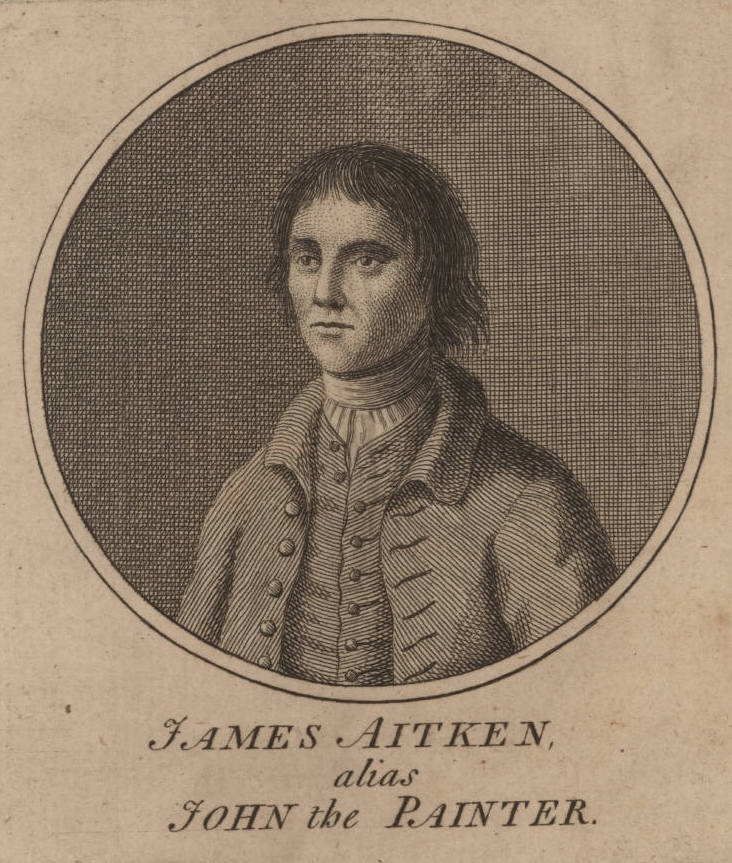
Late in 1776, with the War of Independence underway in the American colonies, a twenty-four-year-old housepainter named James Aitken walked into Britain’s most important naval dockyard and set it on fire. The damage was significant: estimates for repairs were twice the value of the tea destroyed at Boston harbor three years earlier.

The sense of threat experienced by Britain’s ruling elite was also profound. Few people today remember Aitken’s acts of sabotage against the British war machine. But they deserve recognition as part of the wider transatlantic workers’ struggle that helped make the American Revolution.
Aitken is the subject of one of my favorite books on the Revolution, Jessica Warner’s The Incendiary. But I’m not convinced he’s good evidence of a transatlantic political movement, even though he did start his life in working-class Scotland, was in Pennsylvania during the first years of the Continental Congress, and then returned to Britain to support the American cause. Aitken didn’t connect with other activists, except for Silas Deane in Paris. He seems to have been socially inept. Aitken was a movement of one.

Likewise, something seems to be missing from the article’s description of the Gordon Riots:
In London too, the long-standing collaboration between laborers, artisans, and the commercial middle class proved a point of fracture as the possibility of revolution grew too close for comfort. When huge crowds took to the streets in the summer of 1780, burning the home of the Lord Chief Justice, throwing open prison gates, and attacking centers of imperial power like the East India Company offices, it seemed as though the “general effort” [Catharine] Macaulay had called for might finally be at hand.
Those riots were spurred by support for a rather mad aristocrat’s protest against a new British law granting more political rights to Catholics. Though the violence threatened the political establishment, was it really for the benefit of the working class?

I expect Cutterham’s longer book addresses the details of these cases. And I don’t disagree that economic friction between the working class and their employers (still called “masters” in many fields) was part of the Revolutionary era. But so were a bunch of other factors that may have driven events more and certainly muddy the waters. Cutterham’s points are worth considering with care.

Saturday, January 24, 2026

Talking about “The Spark” on The Object of History

Last April I spoke at the U.S.S. Constitution Museum by invitation of the Paul Revere House on the topic “The Reasons for Revere’s Ride.”

I decided not to stick to the events of 1774–75, or even 1765–75. I dug further back into why Boston, of all the parts of the British Empire, was the epicenter of resistance to the Crown’s new revenue measures.

My first reason was: Puritanism, and its effects. Later came: General Economic Anxiety. And a crucial ingredient for heightening the crisis: Crown Crackdowns.

That talk wasn’t recorded, and I started thinking about turning it into an article. But before I could get around to that, folks at the Massachusetts Historical Society invited me to speak about the same question for their podcast, The Object of History.

Here’s what the M.H.S. has just announced for “The Spark: How Boston Ignited the American Revolution”:
Season 5 of The Object of History is dedicated to topics related to the American Revolution. On this first episode, we ask several historians for their thoughts on why Boston helped light the spark of the American Revolution. Was there something unique about Boston's community or geography that made it prone to a rebellious spirit?

We sit down with J. L. Bell, Historian of the Revolutionary Era in Massachusetts, Garrett Dash Nelson, President & Head Curator at the Leventhal Map & Education Center at the Boston Public Library, and Kathryn Lasdow, Assistant Professor of History and Director of Public History at Suffolk University, to answer this question.
And here’s the link.

Thursday, November 27, 2025

A Tight Squeeze for the 1780–81 School Year

When we left the Boston selectmen yesterday, a town meeting committee had just told them that they’d heard the widow Rebecca Holbrook might have a room in her house suitable for teaching handwriting and arithmetic to 70–80 boys.

Since Widow Holbrook’s late husband and his brother had both been masters of the South Writing School, she would surely be willing to host scholars from that school while it was repaired after a fire, right?

The selectmen delegated two of their number, Gustavus Fellows and Tuthill Hubbard, to confer with Rebecca Holbrook. On 12 April they reported back “that Mr. [Samuel? Mrs.?] Holbrook was out of Town & they were of opinion that said Room would not accommodate the Schoolars of the South part of the Town, without very great expence.”

“Very great“ was the same level of expense that had prompted the selectmen to reject refitting the laboratory building as a school. With the war and wartime inflation both raging, the selectmen very much wanted to avoid spending a lot.

So the selectmen and town came to a decision about what to do with the South Writing School: nothing.

At least that’s how I interpret the record, which doesn’t include any moment of decision but shows the results. The boys appear to have been crowded into the town’s two other Writing Schools, on Queen Street and in the North End. The charred building was apparently left alone.

Normally in early July the selectmen led a big committee of officials and eminent male citizens on a visit to each of the schools. This was an end-of-school-year ritual, an occasion for the Writing School boys to show off their skills and for the Latin School boys to recite. The parents of the Latin School boys who were graduating after the full course of study (only about a third of those who had entered seven years before) joined the town notables for a dinner in Faneuil Hall.

I see no record of that ceremony in 1780—another likely sign of wartime austerity. The selectmen’s records say they visited the schools on 6 July, but there’s no list of invitees. That page left space for the count of boys in the South Latin School, North Latin School, Writing School on Queen Street, and North Writing School—but those spaces are blank. And the South Writing School wasn’t mentioned at all.

On 11 July 1781 the custom was back on, and the count was:
  • South Latin School: 91 scholars
  • North Latin School: 39
  • Queen Street Writing School: 270
  • North Writing School: 271
Back in 1773, the three Writing Schools held 674 students. Evidently Boston’s population was still low enough that all the Writing School boys could squeeze into two buildings.

But that population was growing. Inflation leveled off with the arrival of hard money from France. Bostonians wanted to go back to normal—even if that might cost a bit.

In May 1781 the town meeting authorized paying “Three hundred Pounds old Currency towards purchasing Repairs for South Writing School.” The next month, the selectmen reached an agreement with an experienced writing master to reopen that school, sixteen months after the fire.

John Vinal was moving back from Newburyport.

COMING UP: Vinal in the new republic.

Wednesday, November 26, 2025

“To accommodate the Youth of the South part of the Town with a School House”

As March 1780 began, the selectmen of Boston were looking for two new schoolmasters and one temporary schoolhouse.

Before the war, men tended to serve as schoolmasters for many years. There was more churn among the ushers, or assistant teachers—they probably had so little chance of advancement that they took jobs in other towns.

By 1780 the wartime economy was causing problems for everyone, but especially men who provided services in return for set salaries. The town provided extra grants (of paper money), but it also paid late, so the teachers were struggling.

William Bentley had taught at the North Latin School for three years, starting as usher in 1777 and becoming master in 1779. But on 23 Feb 1780 parents told the selectmen that he would leave “next Satturday.” A couple of years later Bentley became a minister in Salem, a job more to his liking. (He kept it for more than thirty-five years.)

Fortunately, the North Latin School usher, Aaron Smith, could keep the lessons going there. He and two other men immediately applied for the job of master. Furthermore, that public school was the smallest in Boston—only 39 boys attended as of July 1781.

On 8 March, Smith promised the selectmen that as master he would stay for at least twelve months, so the selectmen gave him the job. One problem solved! (Smith did serve through the end of the 1780–81 school year before leaving.)

The South Writing School presented a bigger difficulty. The night before the selectmen heard about Bentley’s departure, that schoolhouse had caught fire. Then Master Samuel Holbrook resigned, as described yesterday. I can’t be sure, but it looks like he took his usher with him.

There were probably over 150 boys attending the South Writing School—a drop from before the war, when the town routinely counted over 200, but still too many to let loose unsupervised on the town.

At the time, a schoolhouse was a large room with long desks and benches for all those boys. The master and usher needed their own desks, and the room needed a stove and a firewood supply, but that was about it. No chalkboards, bookshelves, or other special pedagogical equipment. The town just need to find a big room unoccupied during the day.

On the morning after the fire, the selectmen delegated two of their number, Nathan Frazier and Harbottle Dorr, “to apply to the Overseers of the Poor, for the use of the Workhouse Hall for Mr. Holbrooks Scholars.” At best that might have been a short-term remedy.

On 1 March, the selectmen added John Preston to that committee and sent them to ask whether the “Labretory” could become the new Writing School. After all, it was right next to the fire-damaged building.

A week later those selectmen reported:
That Colo. [William] Burbeck has the care of it at present for the use of the State—that he came in possession of it under Colo. [Thomas] Crafts

that the Land on which it is built belongs to the Town, Major [Adino] Paddock building on it first—

That it will answer for a School, tho not without a very great expense to the Town in fitting it up in a proper manner.
So the town could demand the property back, kick out the artillerists in the middle of a war, and refit the building with a lot of money—which it didn’t have. Not a practical solution. 

On 13 March, Boston embarked on its annual town meeting to elect new officials. One item on that meeting’s agenda was “what is necessary to be done to accommodate the Youth of the South part of the Town with a School House.” Eventually, on 21 March, the meeting chose a committee to tackle that problem, headed by militia colonel Josiah Waters. John Preston wasn’t reelected as a selectman, but he was put on that committee, so he couldn’t escape the problem.

The schoolhouse committee submitted their first report on 24 March. It was “Recommitted,” or rejected, and the town meeting record doesn’t even say what they suggested. On 4 April they told the meeting:
That upon enquirey they had found that the Widow Holbrook had a Room which would accomodate about Seventy or Eighty Scholars, and that they were of Opinion that if this Room could be obtained it would be best to hire it for a School
This was Rebecca Holbrook, widow of the late Abiah Holbrook and sister-in-law of Samuel Holbrook. So she knew what a writing master needed in order to teach.

The town meeting quickly approved that idea and directed the selectmen “to agree with Mrs. Holbrook for said Room as they shall Judge for the Interest of the Town.”

TOMORROW: The cheapest solution.

Sunday, November 23, 2025

Back to the Scene of the Crime

A significant portion of The Road to Concord focuses on one spot in Boston: the corner of West Street and Tremont Street. There, across from the Common, stood the South Writing School and the newer gunhouse of the militia train of artillery.

(Now that space is occupied by a Suffolk University dormitory, a Sal’s Pizza, and a Blue Bikes rack.)

In September 1774, as I wrote in the book, the artillery company dissolved amid political recriminations. Soon their four small brass cannon disappeared, two from that corner.

In April 1775, war broke out, in some immediate sense because of those cannon, and all of Boston’s public schools shut down.

The following March, the British military left Boston. Patriot authorities gained control. After tending to the most dire problems, the selectmen looked ahead to a new school year, which would ordinarily begin in July.

In June the selectmen ordered the South Writing School to reopen. However, Master Samuel Holbrook was still out of town. So were a lot of families—Boston’s population was only a fraction of what it had been.

The selectmen therefore said that James Carter, the master of the Queen Street Writing School, would fill in for Master Holbrook. In effect, I think, that was consolidating the two schools for at least a few months until enough pupils returned to justify reopening both schoolhouses.

In October 1777 the town looked into repairing the South Writing School, possibly from damage during the siege. Two months later, Master Holbrook asked for an assistant, to be paid £34 plus £16 “on Accot. of the rise of Provisions”—i.e., the price of food had inflated. 

Ordinarily a schoolmaster had an adult assistant called an “usher,” paid about half of the master’s salary. Holbrook asking for an “assistant” with a smaller salary suggests that he was seeking to hire a teenager, as he had employed Andrew Cunningham in 1774–75. Perhaps he had in mind his own son Abiah, then fourteen years old.

We can see the effects of inflation in how the town meeting voted to pay Holbrook over the next few years:
  • March 1778: £100 salary plus £100 “on Account of the present high Price of Provisions &c.” in the next six months.
  • November 1778: £140 more to cover the remaining six months of the year.
  • March 1779: a town committee recommended £600 for Holbrook himself plus £100 for his usher and £30 house rent. The meeting approved even more: £640 for the master, £300 for the usher.
  • November 1779: and another supplemental grant, £1,500 for September through March.
Master Holbrook’s usher arriving in October 1778 was named Abiah Holbrook. The master’s son would still have been too young to command that title and salary. But Holbrook also had a nephew named Abiah Holbrook. A man of that name advertised a school in Portsmouth, New Hampshire, from 1775 to 1777. So perhaps that man moved to Boston to work for his uncle, taking the place of his young cousin. Running writing schools was a family business; Master Holbrook had started out working as usher under his own brother—named, of course, Abiah.

Thus, as the 1770s ended, the South Writing School was back in operation under Master Samuel Holbrook, just as it had been at the start of the decade. But it was costing a lot more to operate, at least in inflated wartime currency.

TOMORROW: Changes at the gunhouse.

Tuesday, September 30, 2025

Bell-Ringing in 1740s Boston

In my research into Thomas Williston, sexton of the Old Brick Meeting-House from the 1740s to the early 1770s, I came across a petition in the town meeting records that gives a taste of daily life in Boston.

On 14 Mar 1744 Williston and four fellow “Sextons & Bellringers” laid out how they rang their churches’ bells each day.

They weren’t ringing every hour—after all, it would be tough to get any big project done if you had to break off each hour to go to the belfry. Instead, they rang at certain hours only.

The town paid Williston to wind the Old Brick clock since telling the time was more of a secular function than a religious one. By the same rule, the town paid the sextons to ring them bells. But those men were paid at different rates.

Specifically:
  • Isaac Peirce, Old North Meeting-House – 1 P.M., 9 P.M., 5 A.M. – £4.10s for each quarter of the year.
  • Nathaniel Band, New South Meeting-House – 9 P.M., 5 A.M. – 50s. (£2.10s).
  • Joseph Simpson, Hollis Street Meeting-House – 9 P.M., 5 A.M., 1 P.M. – £3.15s.
  • John Roulstone, Old South Meeting-House – 1 P.M. – 30s. (£1.10s).
  • Thomas Williston, Old Brick Meeting-House – 5 A.M., 11 A.M., 9 P.M. – £4.10s.
If I were Simpson, I’d ask why I’m being paid less than Peirce and Williston for ringing the same number of times a day. Not being Simpson, I can imagine some reasons for that difference: an easier bell, less seniority, the church being in a less densely populated part of town and thus serving fewer people. But I’d still ask.

Instead of quibbling among themselves, those five men presented a united front and all together asked the town for more money:
the Petitioners would Represent to the Town that the aforesaid Allowance for the Service aforesaid is so very small, being but about Three pence Old Tenor for each Ringing, that the Petitioners Apprehend they are not by any means Recompenced for their Time & Service and as the Petitioners Allowance is no greater now than has been for about Thirty Years past and Provisions & all Necessarys of Life more than twice as Dear as they were Thirty Years since, they Apprehended the Town would think it reasonable to Increase their Allowance
The meeting empowered the selectmen “to Consider…the Ringing of the Bells, and of the Allowance to be made to the Sextons.” That year’s selectmen included Thomas Hutchinson, Thomas Hancock, and Samuel Adams’s namesake father.

In May 1744 some citizens asked for “the Bell at the New Brick Church at the North End” to be rung at 11 A.M. as well, with its sexton paid. The selectmen took up that question, too. But I can’t find any record of their answer. In May 1745 the town “Voted, that the Bell ringers within the Town be paid for the same as formerly,” so it doesn’t look good for the sextons.

March 1745 had brought the news that “the Old Brick Church Bell…is now broke.” Joseph Marion proposed that the Old South Meeting-House bell be rung more often to fill in the broken bell’s times. The meeting “after some debate” approved that plan. But two days later the town reconsidered and decided the bell at Faneuil Hall, normally rung to signal the start and end of business hours, should be used instead. In May Middlecott Cooke proposed that Boston contribute to the cost of fixing or replacing the Old Brick bell “which was lately broke as he apprehends in the Service of the Town.”

In 1746 Samuel Hunstable asked to be paid for ringing “the Bell of the Meeting house at the westerly part of the Town.” The town meeting put him on the same basis as the other bellringers, but also specified that he increase the number of times a day he rang that bell: 5 and 11 A.M., 1 and 9 P.M.

Finally, in July 1747 the town approved a new payment schedule:
  • Ten Pounds old tenor p. Annum, for once a Day.
  • Twenty Pounds—p. Ditto for twice a Day and
  • Thirty Pounds—p. Ditto for three times a Day.
That was a considerable raise for the sextons, and evidently put them all on the same rate.

TOMORROW: Bell-ringing on occasion.

Wednesday, September 10, 2025

Call for Papers on “Finance and the American Revolution”

The Program in Early American Economy and Society at the Library Company of Philadelphia is planning a symposium on the topic “Finance and the American Revolution, 1763-1794,” to take place in Philadelphia on 24–25 September 2026.

Organizers are now inviting scholars to propose papers for that symposium, to be circulated to attendees and then discussed in panels. They say, “We are broadly interested in papers that speak to public and private finance, credit, trade, and exchange in political and social contexts.”

The call for papers continues:
We are interested in thinking capaciously about finance and the American Revolution. To give a sense of some, but by no means all, possible topics:
  • British fiscal policy in the coming of and prosecution of the war
  • US diplomatic efforts on behalf of trade, credit, and financial assistance
  • Free trade, free ports, smuggling, privateering, and the role of merchants
  • Monetary policies and institutions, including currency, credit, banks, and insurance
  • Trade, gift-giving, and plunder relating to Native nations
  • Dispossession, speculation, and landownership
  • Taxation and populist resistance
  • Inflation, scarcity and price-fixing, price-gouging
  • Slavery, the slave trade, and their relationships with finance
  • Women and finance on the homefront and after the war
  • Loyalists, property seizures, and post-war claims
To propose a paper, researchers should submit a 300-word abstract and a two-page CV to peaes@librarycompany.org with the subject line “Finance and the American Revolution Workshop” by 25 October 2025. The papers should be about 25 pages long, and drafts will be due in August 2026. Eventually the University of Pennsylvania Press will publish a volume of articles developed from this event.

Monday, August 04, 2025

“The most profitable Business he could at present Employ himself about”

Here’s another transcribed letter from the Papers of John Hancock.

Thomas Cushing, having been replaced as a Massachusetts delegate to the Continental Congress in favor of Elbridge Gerry, was back home in Massachusetts as a member of the Council.

On 4 Apr 1776, less than a month after the British military evacuated Boston, Cushing wrote to Hancock:
Some time before you wrote to me concerning Your Brother [Ebenezer Hancock], I had not been unmindful of him, I saw him at Watertown & he told me he should like to be Employed if possible in that town in writing for the Council or House, as he should in that Care be near his family & could often Visit them, I accordingly made Enquiry after some Employ of this Sort for him & sspoke to divers Members of the Council & it appeared to me that there would soon be an opening for him –

a few days ago I saw him at Boston and told him what you hard wrote me concerning him & what prospect I thought there was of his being Employed, he told me he was oblidged to me, but it would not suit him & tarry at Watertown now as the Town of Boston was again retured to its Inhabitants, that he had found all his goods & merchandize were safe and in good Condition, that he determined to return to Boston & that he apprehended that the most profitable Business he could at present Employ himself about was in attending to the Sale of his Goods, in which I think he judged wisely. I give you joy that his Goods are Safe
John eventually got Ebenezer the job of a deputy paymaster of the Continental Army. As a result, Ebenezer sometimes had huge sums of silver money from France under guard in his Boston home.

Ebenezer Hancock’s house in downtown Boston is now on the market. It’s being promoted as John Hancock’s house because the older brother owned it, but he’d inherited a lot of property in Boston. Ebenezer, who had received a smaller bequest from their uncle, ran into business reverses and went bankrupt in 1769. According to W. T. Baxter’s article on Ebenezer’s bankruptcy, John helped him out with “rent-free premises.”

Eventually, Baxter noted, the property flowed the other way. Gov. Hancock died intestate, so Ebenezer inherited a third of his fortune, including the stone mansion on Beacon Hill.

Sunday, July 20, 2025

“There are always joys while going through manuscripts”

Last month, Commonplace published Jayne Ptolemy’s “The Record Scratch: Uncovering Documents Relating to William Ansah Sessarakoo,” and I recommend reading the whole article.

Ptolemy, who’s on the staff of the William L. Clements Library in Ann Arbor, wrote:
The Clements holds the papers of Charles Townshend (1725-1767), who served as Secretary of War during the Seven Years’ War and the Chancellor of the Exchequer in the decades leading up to the American Revolution. These days, he is mostly known as the straw man for incendiary British taxation policies due to his role in sponsoring the infamous Townshend Acts.

Internally at the library, however, we mostly grumbled about him under our breath because his papers were in a complicated arrangement, the finding aid was difficult to navigate, and the boxes even harder to pull for researchers. It needed someone to puzzle out what was in each box and add descriptive information to the finding aid to make it more manageable. Unfortunately, I don’t have a penchant for economic history, so figuring out how to describe the contents of “Miscellaneous Treasury Papers” meant trying to disambiguate a great many reports on tariffs, duties, and excises.

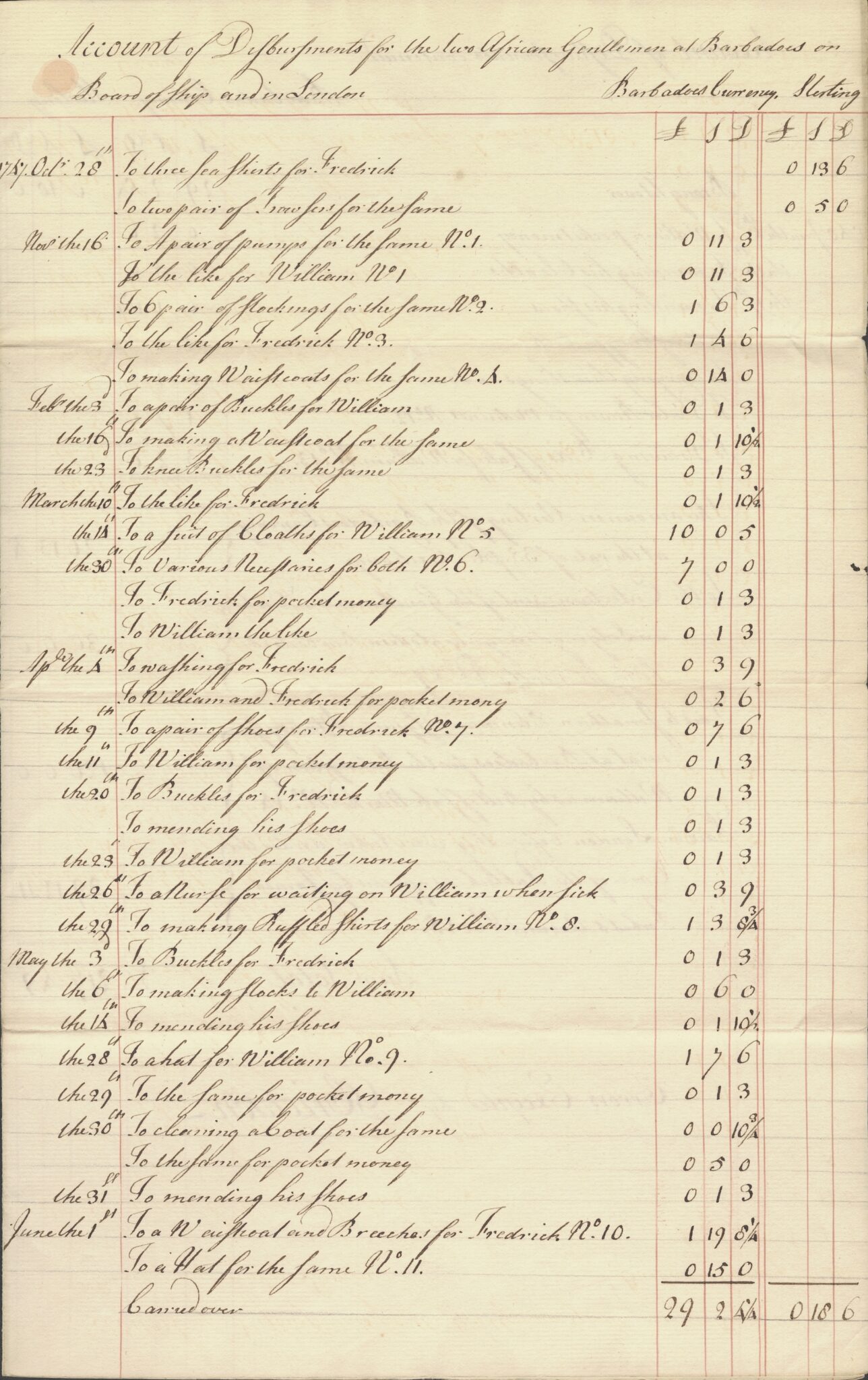
There are always joys while going through manuscripts—an unexpected doodle, a funny quote, beautiful papers—but most of what I was encountering was financial document after financial document–Until one stopped me right in my tracks. It referred to expenses “for the two African Gentlemen at Barbadoes.” Written in 1747, the use of “Gentlemen” to describe African peoples was eye-catching enough, but glancing down at the accounts, the entries for making waistcoats, providing pocket money, buying ruffled shirts, and more signaled something extraordinary. . . .

And then, a document written from Bridgetown, Barbados, laid it all out:
Whereas John Corrantee and the Caboceers of Annamabo are at present exceedingly well disposed towards the British Nation, and beg the resettlement of that place by the English, and the fort to be rebuilt

And whereas a Son of John Corrantee’s Named Ansah was sold here by Captain Hamilton who he (Corrantee) is very anxious to have redeemed

We hereby give it as our Opinion that the Redemption of the said Ansah will be very acceptable to John Corrantee (who is the leading man at Annamabo) . . . and will be a means to conciliate Corrantee to, and rivet him in the Interest of the British Nation in opposition to the French, who have been aiming for some Years past at the aforesaid settlement.
OH.

OH NO.
“The Record Scratch” is a fine metaphor for that moment, though I don’t think it gives a good sense of the rest of this article.

Saturday, May 17, 2025

“Commemoration of the 135th anniversary of the battle of Lexington”

grayscale photographic portrait of a man apparently in his late thirties with thick dark hair and a dark moustache
As a sort of “guest blogger” entry today I’m running an article that appeared in the 19 Apr 1910 Boston Herald reporting on an anniversary oration in Lexington by Rabbi Charles Fleischer (1871–1942), then of Temple Adath Israel of Boston.

Exercises Begin at Lexington

Rabbi Fleischer Delivers Address on “Americanizing America” and Criticises Conditions Prevailing at Present Here.

“Is America American? Are we as a people, and as individuals, democratic? Are our institutions democratic? Have we made any serious effort to organize our national life on the basis of democracy?” These were the questions asked, and answered in the negative, by Rabbi Charles Fleischer in an address at Lexington last night.

The occasion was the commemoration of the 135th anniversary of the battle of Lexington, at the town hall, by the Lexington Historical Society. Rabbi Fleischer’s address was on “Americanizing Americans.” He said in part:

“Let us see what this process of Americanizing and democratizing America implies. In politics it means, not only war on the machine and on boss rule, but it means an end to discrimination against sex, the actual institution of universal suffrage, female as well as male, this being implied in a political democracy, in which the ballot is the symbol of social status.

“Also it means the elimination of business from politics, the cutting away of that cancerous growth, the corruption of corporate influence, which threatens the integrity of our political democracy. We don’t want the business man as such in politics. Nor, on the other hand, is the tariff to be considered a political question, but an industrial problem.

“The Americanization of America further involves the democratization of industry to the end of distributing more equably (not equally, of course), the fruits of the co-operation between capital and labor. This is demanded by the situation, not only to promote economic justice, but still more is it needed in order to prevent our degenerating into the most corroding type of human society, a soulless plutocracy—already prefigured in our worship of the almighty dollar.[”]

I share this not because it offers information about the Revolutionary War but because it shows what at least some Americans of 115 years ago thought that American history pointed toward.

Charles Fleischer was a Reform rabbi—radical Reform, some might say. He left Temple Adath Israel the year following this address in order to start a non-sectarian movement he called “Sunday Commons.” Here’s a Commentary article about Fleischer written by Arthur Mann in 1954.

Friday, May 09, 2025

“Remarkably susceptible to the spread of fake news”

The H-Net journal Remembering the American Revolution at 250 recently shared a new paper by Jonathan Bayer of the University of Toronto.

The abstract begins:
On April 8, 1780, a copy of a letter titled “Private No. 15” appeared in the Pennsylvania Packet of Philadelphia, Pennsylvania.

Purportedly sent from British General Sir Henry Clinton to Lord George Germain, the letter painted a dismally dim picture of the British war effort and admitted to the use of underhanded tactics such as the counterfeiting of the Continental Dollar, subsequently buoying American spirits. The letter, however, was a fake.

This paper explores the ways in which the structures of the early American press proved remarkably susceptible to the spread of fake news, such as this forged letter.

The paper also explores the ways in which the fake news that appeared in early American newspapers continues to influence the American historiography. The letter has been taken as genuine by every secondary source that has addressed it, significantly influencing the study of the counterfeiting of the Continental Dollar.
Bayer’s paper is titled “‘Private No. 15’: Fake News in the Early American Press and the Influence of a Forged Letter on the Historiography of the American Revolution.” It’s available for anyone to download in P.D.F. form.

Wednesday, March 05, 2025

Valuing the Philip Mortimer Estate’s Human Property

After Philip Mortimer’s death, his executors began to work through his substantial estate in Middletown, Connecticut.

As quoted yesterday, executors Elihu Starr and George Phillips advertised for creditors and debtors to come settle their accounts with George Starr, acting as their attorney. And also for people to bring back any borrowed books.

In August 1795 the executors submitted Mortimer’s will and codicil to the probate court. The man’s estate was appraised at almost £5,000.

That legal paperwork included another list of the people Mortimer had enslaved, most of whom his will freed according to one schedule or another:
  • Briston, aged 60, called Bristol in the will
  • Jack
  • Dublin, not mentioned in the will
  • Prince, “sick with the yaws”
  • Peter, “on board man of war and likely dead”
  • Sophy, labeled a “girl” like the following two but old enough to have three sons; the Barbour collection says she was born in 1752 
  • Silvy, born 1773 
  • Peg, born 1777 as Margaret—though other documents estimate her to have been about 20 years old in 1794
  • Lester, born 1787, first of three sons of Jack and Sophy
  • Dick, born 1789 as Richard 
  • John, born 1790
  • Rachel, a “girl child,” born 1793, perhaps the daughter of Hagar, mentioned in the will, or Amarillas, born 1770
As property, all these people were assigned a monetary value. But those low values reflected how Connecticut was turning away from slavery. Mortimer was the state’s biggest single slaveholder in 1790, but his human property comprised less than .1% of his estate.

Jack was valued at £10, Sophy and the three boys at £5 each. The women Silvy and Peg were each valued at £1. The other four men and the little girl were assigned a market value of zero. That makes sense for Peter, who was out of reach in at least one way, but those prices suggest the appraisers thought any purchaser would have a hard time compelling most of the other people to work, or getting more value out of them than the cost of maintaining them.

In contrast, back in 1740 the inventory of Daniel Jones of Colchester valued a “young man” and a “negro wench” at £150 each, “an old negro man” at £40, and a boy at £25. Two years later, Samuel Allyn of Windsor priced his “servants, Cyrus and William,” at £100 apiece.

Almost all of the people listed in Philip Mortimer’s inventory appear to have still been living on his estate or nearby, continuing their work in his ropewalk or fields or house. Indeed, Jack and Sophy had another baby, Charles, in 1795; the local vital records assigned him to the Mortimer household even though the patriarch was dead.

The one exception among those workers was Peter. Mortimer mentioned him in the 1792 will and 1794 codicil, meaning he was still in Middletown then. Had he left for the sea after the old man’s death? If so, he was exercising the freedom Mortimer promised, but the appraisers didn’t think that had turned out well for him.

The probate court accepted Philip Mortimer’s will. It even accepted his codicils, one unsigned and the other unwitnessed. Though he was in his tomb, the man’s wishes still carried some authority in Middlesex County, Connecticut.

But there was one wrinkle: George Starr asked the court to relieve him of his job as executor.

TOMORROW: That freed Starr to contest the will.

Sunday, February 02, 2025

“The seller is nothing less than a collector of the tax”

Here are some paragraphs from the seventh Letter from a Farmer in Pennsylvania, John Dickinson’s 1767–68 essays arguing against the Townshend duties:
There are two ways of laying taxes. One is, by imposing a certain sum on particular kinds of property, to be paid by the user or consumer, or by rating the person at a certain sum. The other is, by imposing a certain sum on particular kinds of property, to be paid by the seller.

When a man pays the first sort of tax, he knows with certainty that he pays so much money for a tax. The consideration for which he pays it, is remote, and, it may be, does not occur to him. He is sensible too, that he is commanded and obliged to pay it as a tax; and therefore people are apt to be displeased with this sort of tax.

The other sort of tax is submitted to in a very different manner. The purchaser of any article, very seldom reflects that the seller raises his price, so as to indemnify himself for the tax he has paid. He knows that the prices of things are continually fluctuating, and if he thinks about the tax, he thinks at the same time, in all probability, that he might have paid as much, if the article he buys had not been taxed. . . .

The merchant or importer, who pays the duty at first, will not consent to be so much money out of pocket. He therefore proportionably raises the price of his goods. It may then be said to be a contest between him and the person offering to buy, who shall lose the duty.

This must be decided by the nature of the commodities, and the purchaser’s demand for them. If they are mere luxuries, he is at liberty to do as he pleases, and if he buys, he does it voluntarily: But if they are absolute necessaries or conveniences, which use and custom have made requisite for the comfort of life, and which he is not permitted, by the power imposing the duty, to get elsewhere, there the seller has a plain advantage, and the buyer must pay the duty.

In fact, the seller is nothing less than a collector of the tax for the power that imposed it. If these duties then are extended to the necessaries and conveniences of life in general, and enormously encreased, the people must at length become indeed “most exquisitely sensible of their slavish situation.”
That quoted phrase came from Montesquieu’s The Spirit of the Laws.

This letter concluded:
These duties, which will inevitably be levied upon us---which are now levying upon us---are expresly laid FOR THE SOLE PURPOSE OF TAKING MONEY. This is the true definition of “taxes.” They are therefore taxes. This money is to be taken from us. We are therefore taxed.

Those who are taxed without their own consent, expressed by themselves or their representatives, are slaves. We are taxed without our own consent, expressed by ourselves of our representatives. We are therefore---SLAVES.
Dickinson thus put himself among the American Whigs who equated a lack of full political rights for white men of property with a state of slavery while keeping actual chattel slaves. Unlike most of his countrymen, however, Dickinson did something about that. In 1786 he finished manumitting everyone he had claimed as property.

Tuesday, September 24, 2024

“Brushes with the law reshaped rural time consciousness”

The topic of this seminar at the David Center for the American Revolution in Philadelphia caught my eye: “The Triumph of Bank Time in the Early Republic.”

The scholar sharing that paper, Dr. Justin Clark, is Senior Lecturer in the History Department at Cornell University and formerly an Associate Professor of History at Nanyang Technological University in Singapore. His current projects include the anthology A Cultural History of Time in the Age of Empire and Industry (1789–1914) and his own book A Clockwork Republic.

Here’s the abstract that Clark probably wrote for the seminar series, probably months back, so it may or may not reflect his work as it’s coming out:
Historians have long believed that Americans relinquished more “natural” forms of time consciousness only with the industrial developments of the antebellum period: mass-produced clocks and watches, railroad timetables, and growing reliance on factory wage labor. Yet as this paper argues, rural republicans had already developed a more modern and abstract understanding of time by the 1790s.

Throughout the eighteenth century, an intermediate network of coastal merchants, wholesalers, and village shopkeepers connected manufacturers in the British Isles with rural producers in the colonies. By quietly pricing interest—the time value of money—into the cost of goods, inland shopkeepers protected the rural customer who paid by the harvest with the Liverpool merchant who charged interest by the day. The accommodation between these two financial cultures collapsed with the Revolution, as an examination of account books, commercial correspondence, newspapers, and other sources shows.

After 1783, as a condition for renewing commerce with their newly independent American counterparts, British merchants demanded the swift repayment of old debts with interest. These demands quickly travelled down the chain of debt from coastal importer to villager, such that rural debtors found themselves dragged not only into court, learning in the process what Franklin’s urban artisans already knew: “Time is money.” As one agricultural journal urged in 1799, “every minute thou hast ever spent in consulting Almanacks for the weather, has been entirely lost, or very foolishly employed”; time was better spent watching the financial calendar.

Long before the appearance of the steamboat, train, village clock or factory, these brushes with the law reshaped rural time consciousness. Ultimately, this paper argues, impersonal and inflexible demands for punctuality played an overlooked but significant role in contemporary episodes of agrarian resistance such as Shays’ Rebellion.
Time working as it does, I won’t be able to log into this seminar because I’ll be traveling. And since this seminar is a discussion of a work in progress, it won’t be recorded. We’ll have to wait until Clark publishes. But already the concepts are giving me something to think about on the plane.

For folks interested in the history of Boston, Justin Clark’s previous book is City of Second Sight: Nineteenth-Century Boston and the Making of American Visual Culture.

Wednesday, August 28, 2024

“To sell according to the tenor of the Covenant”?

John Andrews’s 22 July 1774 letter to his relative in Philadelphia offers an inside look at why he and some other merchants who generally supported the Whigs ended up signing protests against the Boston committee of correspondence.

According to Andrews, he had “countermanded my orders [from Britain] by the first opportunity after the Port Bill arriv’d, and of consequence acquiesced with a non-importation agreement when propos’d about three or four weeks after.”

But then Andrews heard that merchants in Newport, New York, Philadelphia, and points south hadn’t agreed to such an agreement. He figured that boycott wouldn’t take hold, and he’d lose money if he continued to abstain. So he “embrac’d the first opportunity and re-ordered about one fourth part of such goods as I thought would be most in demand.”

But a month or so later, Andrews saw rural towns signing onto the Solemn League and Covenant, a non-consumption agreement—people were promising not to buy those goods he had ordered. That’s why he felt the covenant “has serv’d rather to create dissentions among ourselves than to answer any valuable purpose.” It would cost him money!

Likewise, Andrews wrote, the merchant Samuel Elliot (shown above in later life) was
expecting a large quantity of goods which, should they arrive, he can’t possibly qualify himself to sell according to the tenor of the Covenant, having countermanded ’em no other ways than to have ’em shipped, provided your place, with New York. Rhode Island, &c., should have their goods as usual: and from the determination of those places, he has all the reason in the world to expect them.
Elliot had committed to non-importation only if the merchants in other ports did the same, and he’d told his contacts in Britain to keep shipping him goods if they didn’t. Therefore, he was now expecting to receive lots of stuff that more and more folks in New England were swearing not to buy.

Andrews reported that at the 27 June town meeting in Old South
Eliot display’d his eloquence in a long speech upon the subject, deliver’d in so masterly a stile and manner as to gain ye. plaudits of perhaps the largest assembly ever conven’d here, by an almost universal clap: wherein he deliver’d his sentiments with that freedom and manliness peculiar only to himself.
However, the formal vote at that town meeting was shaped by another set of gentlemen: those who had signed the complimentary addresses to departing governor Thomas Hutchinson and incoming governor Thomas Gage. They were upset by “hearing the letters read that were sent to your place [Philadelphia] and New York (the latter in particular) in regard to that part of their conduct.” Resenting that criticism, those merchants and professional men demanded a vote “to censure and dismiss ye. Committee.” And they lost big.

Andrews said he had expected a motion “to suspend ye. Covenant till ye. [Continental] Congress should meet.” He insisted, “We don’t mean to oppose any general measure that maybe adopted by the Congress, but are well dispos’d in the cause of Freedom as any of our opponents, and would equally oppose and detest Tyranny exerciz’d either in England or America.”

Likewise, some towns considering the Solemn League and Covenant decided to take no action until seeing what the Congress would do, or added clauses reserving the leeway to adjust the terms based on that Congress’s recommendations. But that didn’t make merchants like Elliot and Andrews any happier.

TOMORROW: One last detail.

Monday, August 26, 2024

“May not great Heats and Animosities from hence be justly feared?”

In addition to the two protests against the Solemn League and Covenant boycott that I’ve quoted over the past two days, three Boston newspapers also published a letter laying out the argument against it at more length.

That letter is written in the first person singular: “I beg Leave to lay before them the following Facts and Observations…”

However, in a 22 July private letter, John Andrews, a signatory of the milder protest, wrote that “our reasons for a dissent are given [in that essay] in a more explicit manner than in the protest.”

So even if this letter had a singular voice, and may have come from a single hand, a larger community of merchants felt it spoke for them.

That letter was sent to the printers of the Boston Evening-Post, Boston Post-Boy, and Boston News-Letter addressed to “Messirs. Fleets,” “Messieurs MILLS and HICKS,” and “Messi’rs PRINTERS,” respectively. Editors still like a sign of individual attention.

(Management of the News-Letter was in flux that summer. On 9 June Margaret Draper announced that she was continuing her late husband Richard’s partnership with John Boyle. But on 11 August she announced that she was taking over the newspaper herself.)

The letter ran through the terms of the Solemn League and Covenant, emphasizing the hardships and how signers were supposed to shun anyone who didn’t sign and continued to import goods from Britain. Then it argued:
Whoever attends to these Terms of the Covenant, wholly proscribing the Goods expected in the Fall and all those upon hand, unless an Oath is taken, must be greatly concerned lest from the Non-exception of Articles of necessity the people should be drawn into a dangerous Snare, and Perjury in many Cases fatally ensue. The multiplication of Oaths (tending to introduce a disregard of them) has been always carefully avoided by wise Legislators; it being well judged that Society cannot exist when Oaths shall cease to be religiously observed. When that dreadful Event happens among any People, their Lives, Liberties and Properties cannot be safe. . . .

It may also be observed, that if a Carpenter, a Taylor, or a Shoemaker shall refuse to sign, he is to be considered as a contumacious Importer.--Or should they sign the Covenant, they cannot serve those in the Way of their Occupation who shall not---What distress must this occasion at a Season when little or no Employ is to be procured among us without these Restrictions? . . . May not great Heats and Animosities from hence be justly feared?

Upon the whole, as I think this Covenant not adapted to procure that Relief we so greatly need, because I think it arbitrary and oppressive, subversive of our Rights and destructive of the Morals of the People, as also inconsistent with the true Spirit of Liberty and the Constitution, and not founded on the Principles of Honor and Honesty, I am led to offer these Observations to the Public, which appear to me to be founded on Reason.
Of course, the people promoting the boycott wanted it to be total. They wanted non-participants to be shunned. And one group, at least, wanted people to be bound to the movement by oath. That was the path to solidarity.

TOMORROW: The weight of an oath.