J. L. BELL is a Massachusetts writer who specializes in (among other things) the start of the American Revolution in and around Boston. He is particularly interested in the experiences of children in 1765-75. He has published scholarly papers and popular articles for both children and adults. He was consultant for an episode of History Detectives, and contributed to a display at Minute Man National Historic Park.

Subscribe thru Follow.it


•••••••••••••••••


Showing posts with label Henry Caner. Show all posts

Friday, October 24, 2025

“In Lieu of that Part of his Salary received annually from England”

New England’s Puritan heritage made those colonies less than welcoming for the Church of England.

There was an Anglican missionary organization called the Society for the Propagation of the Gospel in Foreign Parts (S.P.G.). It paid for ministers to visit Native American communities.

It also supplemented the salaries of ministers in New England on the assumption that their congregations were small and their work difficult.

The Rev. Edward Bass was one of those ministers. He was born in 1726 in Dorchester into a family that had arrived early in the English settlement of Massachusetts. He studied at Harvard College and spent a couple of years teaching and preaching in Congregationalist meetings.

But by 1752 Bass decided that he really belonged in the Church of England. He sailed to Britain to be ordained, returning to take up the pulpit of St. Paul’s church in Newburyport.

Twenty years later came the war. As quoted yesterday, news of the Declaration of Independence prompted the wardens and vestrymen of St. Paul’s to ask their minister to leave prayers for King George III and his family out of their services for the sake of the church. On 16 July 1776 the Rev. Mr. Bass agreed: “I think it incumbent on me for so important an end to comply with this request during the present state of our political affairs.”

Bass tried to walk a narrow line. He dropped the public prayers for the king but continued to support the Crown personally. When the Massachusetts Council ordered all ministers to read the Declaration of Independence to their congregations, he declined to declaim it from the St. Paul’s church pulpit but evidently allowed a lower church official to do so.

But already other Anglican ministers were complaining about Bass’s conduct. On 15 July 1775 the Rev. Dr. Henry Caner of King’s Chapel in Boston had written to the S.P.G.: “Mr. Bass has complied perhaps too far with the orders of the Rebels.”

The war stopped the S.P.G.’s regular payment to Bass. On 25 Nov 1776, nine Newburyport men signed this pledge:
We the Subscribers of St. Paul’s Church in this town being truly sensible of the Distress which our worthy minister must suffer without some Relief in Lieu of that Part of his Salary received annually from England, and which the present unhappy Times prevent his obtaining, do promise to pay on Demand to Mr. John Vinal the several sums affixed to our Names to be by him delivered to the Rev. Mr. Bass.
The promised amounts ranged between £10 from Tristram Dalton and John Tracy to 18 shillings from Abram Gallisham. As for Vinal the schoolteacher and church warden, his signature doesn’t appear on this document. Perhaps he chipped in on his own, or perhaps his contribution lay in wrangling the contributions of others.

TOMORROW: Did that settle matters?

Thursday, May 04, 2023

Where Did Lucy Flucker and Henry Knox Marry?

As I wrote yesterday, the marriage of Henry Knox and Lucy Flucker appears on the records of King’s Chapel, Boston’s most upper-class Anglican church, dated 23 June 1774.

The next week’s newspaper reports confirm that the rector of that church, the Rev. Dr. Henry Caner, presided at the wedding.

There’s another disagreement about that marriage, however: where it took place. Writers have come to different conclusions.

The most likely site would seem to be King’s Chapel itself. Nothing in its records suggests the Knoxes’ wedding was any different from others. Most biographers who describe the ceremony state that it happened in the chapel.

However, in The Revolutionary War Lives and Letters of Lucy and Henry Knox Phillip Hamilton wrote that the marriage took place in the building on Cornhill that Henry was renting as his house and shop. Lucy’s older sister Hannah Urquhart and “Aunt Waldo” attended, but her parents didn’t.

Hamilton appears to have relied on Henry Knox’s 29 August letter to his close friend Henry Jackson, which I haven’t seen in full. It’s now in the collection of the Gilder Lehrman Institute. Barring new discoveries, that’s the closest contemporaneous source about the young bookseller’s strained relationship to his new in-laws.

There are also a couple of memoirs written in the nineteenth century by members of the extended family that preserve their understandings about the marriage.

The Massachusetts Historical Society holds a manuscript called the “Winslow Family Memorial.” It was written by Isaac Winslow (1774–1856), a first cousin of Lucy Knox, and his daughter Margaret Catharine Winslow (1816–1890). The oh-so-handy transcript (P.D.F. download) offers this story of the marriage:
they were married at the house of her uncle Mr [Isaac] Winslow in Roxbury. I always understood, that he rather favor’d this union, and aided in its favorable issue. For this friendly disposition Gen Knox, as I have been led to think, from the little I know of the circumstances of the case, evinced more grateful feeling’s towards Mr Winslows family than his lady, who though not unkind to her cousins, yet when living in a good deal of style, after the peace in Boston, did not much notice her cousins, who were then in quite narrow circumstances
Hamilton’s citations show he looked at this manuscript, but he didn’t accept its statement that the Knox wedding took place in Roxbury.

Finally, the “Reminiscences” of the Knoxes’ longest lived daughter, Lucy Knox Thatcher (1776–1854, shown above), is held at the headquarters of the National Society of the Daughters of the American Revolution in Washington, D.C. Nancy Rubin Stuart quoted from it in Defiant Brides. It agrees that Lucy’s parents didn’t attend the wedding but says her sister Hannah and their half-sister Sallie did. Again, I’ve seen only a bit of this document and plan to check it out on a future trip.

(The portrait above shows Lucy Knox Fletcher in the mid-1800s. Because there’s no portrait of Lucy Knox, and because of the similarities of the mother’s and daughter’s names, websites often mistakenly present this as a picture of Henry Knox’s wife.)

Wednesday, March 22, 2023

“Plundering of Houses &c. Increasing”

By 12 Mar 1776, the British military’s evacuation of Boston was dissolving into chaos in the eyes of merchant John Rowe, and the cannon were going off again:
A Continual Fire from Both sides this night

They are hurrying off all their Provisions & destroying & Mangling all Navigation

also Large Quantitys of Salt & other things they heave into the Sea & Scuttle the stores

I din’d & spent the Evening at home with—
The Revd. Mr. [Samuel] Parker Mr. [Jonathan] Warner & Richd. Green also Mrs. Rowe & Jack Rowe—

The Inhabitants are greatly terrifyed and Alarm’d for Fear of Greater Evils when the Troops Leave this distressed Place

I got Crean Brush Rect. for the Goods taken from Mee, but dont expect much Good from it tho severall Gentlemen Say they will be my Friend in this affair
By “be my Friend” Rowe meant those gentlemen would testify about his losses—though now he had a receipt as well.

Rowe dated his next entry “13 March Wednesday,” getting the date wrong—a sign of his distress:
I have Staid at home most part of this day—

The Confusion still Continues & Plundering of Houses &c. Increasing

Genl. [James] Robinson paid Me a Visit & Eat a Morsell of Provisions together with Richd. Green Mrs Rowe & Jack Rowe

The Sailors from the Ships have Broke Open my Stores on my Wharff & plunderd them— this was done at Noon this day—

This morning A house was burnt at the North End, whether Set on Fire on Purpose or from Accident Seems Uncertain—

a Considerable Number of Cannon fir’d in the night from Both Sides—

The Country People throwing up more Entrenchments &c on Dorchester Neck—

(I dind at home with Genl. Robertson—Mr. Richd. Green Mrs. Rowe & Jack—) and spent the Evening at home with the Revd. Mr. Saml. Parker Mr. Warner Mr. Richd Greene & Mrs. Rowe
On Thursday, 14 March, Rowe realized he’d made the dating error and corrected himself. This day brought “Snow & Sleet” and a cold wind:
This night much damage has been done to Many houses & stores in this Town & many valuable Articles stolen & Destroyed—

Stole out of Wm. Perrys Store a Quantity of Tea Rum & Sugar to the value of £120 Sterling

Mr. Saml. Quincys house broke & great Destruction The Revd. Mr. Wm. Walters also the Revd. Dr. [Henry] Caners & many others
Samuel Quincy had left Boston months before, so his house was vulnerable. But the ministers had stayed out the siege and presumably didn’t have mercantile goods to carry away.

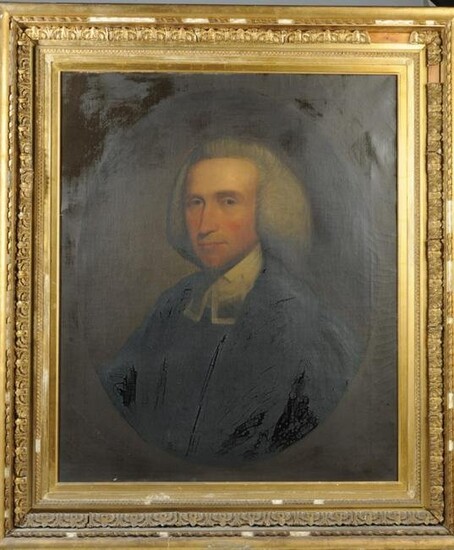
The picture above shows the Rev. William Walter, Anglican minister at Boston’s Trinity Church (1767–1776) and Christ Church (1791–1800). It was sold at auction in 2021.

TOMORROW: The expected departure date.

Saturday, July 03, 2021

“The Marriage was a nullity”

Yesterday I followed Sarah Gore and the uncle who raised her, the Rev. Henry Caner, from Boston to London after the end of the siege of Boston.

In April 1777 Caner gladly married the young woman to a Englishman named Richard Manser. The minister anticipating leaving her in Britain with her husband while he returned to America as soon as all the troubles were over.

However, by the summer Caner was referring to his niece once again by her first married name, as in his 5 August leter to Dr. John Jeffries: “Mrs. Gore & Nurse desire to be remembered in this.”

Finally on 10 Jan 1778 Caner broke the news to Sarah Gore’s father, deacon Thomas Foster of Boston:
By a Line from your Son Wm inclosing a Letter to our Dear Sally, I am inform’d of the Death of your Son John. I sincerely condole with you & Mrs. Foster on so melancholy an event. And am sorry that I must add to your affliction by acquainting you with an expected misfortune that had befallen your & our dear Child.

In a former Letter I acquainted you that Sally was married, & we thought happily to a Gentleman of very promising appearance, but to my grief has turn’d out a villain.

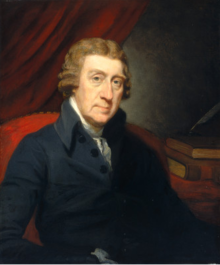
They had been married but 5 Weeks, when Lord Dartrey [an Irish baron, shown above as painted by Mather Brown] called upon me & acquainted me that Mr. Mansor had a Wife living in a remote part of London at the time when he was married to Sally. This you may believe was like a Thunder Clap to me.

However as soon as Mansor came home I acquainted him with it, & turnd him immediately out of Doors.

The same Evening I made the matter known to Sally in the tenderest manner I was able. She fainted & with much difficulty could we recover her. To be short it went very near to cost her her life. With great Care & Attention, & the Assistance of several kind Ladies of rank & quality, she has in some measure got the better of it. Her health & flesh & strength & spirits are return’d & she is now Sally Gore again.

The Marriage was a nullity, as he had a wife at the time of his marrying Sally, so she has reassumd the Name of Gore, by which she is now known to all her friends & Acquaintance.

The former Wife is since dead & the Villain has had the Assurance to write me several insolent Letters…demanding my Sally as his lawful Wife. A Number of worthy friends have offer’d their service to vindicate her against his impudent Claim. Among others Lord Percy, & particularly the Noble Lord & Lady Dartrey, are so exceedingly obliging that they have offer’d to foot [?] the whole Expence if Mrs. Gore finds it necessary to prosecute the vilain.

In short, I am greatly comforted under this misfortune to find that the dear Child is restor’d to her health & spirits again.
In the end, the Rev. Mr. Caner never returned to America. Though strapped for funds without a pulpit, he took a second wife and settled in Cardiff in 1778; she was notably younger, but then he was in his late seventies, so she almost had to be. Later he moved to a town near Bristol and died in 1792.

Sarah Gore and her young son John did return to Boston, as did her father-in-law, John Gore. The younger John grew up to be a merchant, factory investor, and Federalist. In 1805 he managed to get three volumes of King’s Chapel records back from Caner’s heirs. He died in 1817.

(Incidentally, the “Lady Dartrey” who offered help to Sarah Gore in her time of trouble was a granddaughter of William Penn with the given name of Philadelphia Hannah Freame.)

Friday, July 02, 2021

“My Daughter, which she really is, tho’ but an adopted one”

This story came up (in my head at least) during yesterday’s online presentation from King’s Chapel about how the Revolution affected members of that Anglican congregation. I realized I hadn’t shared it here before. 

The minister of that church was the Rev. Henry Caner. He raised a niece named Sarah Foster, whom he called Sally. I don’t know how that arrangement came about since Sarah’s father, a deacon of Boston’s First Meetinghouse named Thomas Foster, was alive. Perhaps he had remarried.

The minister was very fond and protective of his niece, telling Earl Percy that he “took the Liberty of introducing [her], as my Daughter, which she really is, tho’ but an adopted one.”

In March 1768 Sarah Foster married John Gore, Jr., a dry goods merchant. His father had risen from the trade of decorative painter to become a paint merchant, militia captain, and Overseer of the Poor—moving from the ranks of mechanics to the ranks of gentlemen.

John and Sarah Gore had a baby, also named John, in 1769. He was baptized at the West Meetinghouse, which the Gore family attended. Evidently being raised by an Anglican minister hadn’t made Sarah an Anglican.

In 1771 John, Jr., unexpectedly died. That left Sarah Gore as a young widow with a baby son. I don’t know if Sarah Gore moved back in with her uncle then, but the Caner household was undoubtedly less crowded than the Gore household.

Then came the Coercive Acts and the war. The Rev. Mr. Caner was always one of the strongest supporters of the royal government. When the lines were drawn in 1774, Capt. John Gore also declared himself loyal to the king while most of his family, including son Samuel and son-in-law Thomas Crafts, were not only Patriots but active Patriots.

In March 1776, the British military evacuated Boston. Among the Loyalists leaving at the same time were Henry Caner, John Gore, Sarah Gore, and her little boy. “I was crowded with my Daughter & an old Houskeeper on board a small Vessel with forty people,” the minister wrote.

That extended family then moved on to London. The letters of Henry Caner, which were collected and published in 1972, show that in London Sarah Gore lived with Caner and that “old Houskeeper.” John Gore shared space with his friend Adino Paddock.

Caner spent a lot of effort trying to find a new income for himself as an Anglican cleric. Sarah Gore explored high social circles, visiting Lady Rockingham, meeting the Duke and Duchess of Northumberland. Her uncle hoped these connections would lead to a living, but in July 1776 complained, “I meet with many ‘good Morrows’ & compassionable expressions, but that is all except a share of the Donations…for the suffering Clergy.”

On 22 Apr 1777, the Rev. Mr. Caner had big news for Deacon Thomas Foster:
Sally, who will write you by this Opportunity, has never been from me a Day since we left Boston. She had far’d as well as my Self, & has been fully attentive to me as to her Father, having never taken a step which I did not approve.

I have preserv’d her from a Connection with the Army, which I knew would be disagreeable to you, & in right of a Guardian or Father am about to dispose of her within a day or two to a Gentleman here in London, one Richard Manser, who appears to be a sober, well-bred young man, with whom I hope she will be happy.

They will live in the same house with me while I stay in England, & when we return to America I assure you I shall leave her behind me with regret.
A postscript to that letter reports the deed had been done: “Yesterday I parted with your Daughter, my dear Child & companion, Sarah Gore, having married her to Mr. Richard Manser, of London. I performed the Ceremony myself at St Martin’s Church, Westminster.”

That’s the famous church of St. Martin-in-the-Fields, rebuilt in the 1720s and shown above in a photo by Robert Cutts. [It has a lovely café in the crypt.]

However, by 30 June the Rev. Mr. Caner was once again referring to Sally as “Mrs. Gore.”

TOMORROW: Can this marriage be saved?

Thursday, November 12, 2020

Settling the Rev. Mr. Mosley in Pomfret

When the Rev. Richard Mosley arrived in Pomfret, Connecticut, in September 1771, asking about the need for an Anglican minister, Godfrey Malbone was cautious.

He certainly needed a minister for the little church he had designed and built himself. For over a year after forming his Anglican parish in northeast Connecticut, Malbone had presided over most of the services, reading from the Book of Common Prayer. But if he didn’t have a real minister soon, the town would deem his church to be nothing more than a tax dodge.

Malbone had asked the Society for the Propagation of the Gospel (S.P.G.) in London to send a missionary, but no Englishman was willing to emigrate for such a small salary. Malbone also asked the Anglican clergy in his home town of Newport and in Boston.

The Rev. John Troutbeck, assistant at King’s Chapel, had instead recommended that the former Newport merchant leave Pomfret altogether:
I shou’d certainly advise you not to spend the very best Part of your Days amongst the Savages, for the Rustics in this Part of the World are not much better than Indians. Of all the People that have left off Business in this Town, & retired to a Farm, I cannot recollect one that, has not suffered by it; & I cou’d mention several, who have died extremely poor. To have a thoro knowledge of the Business, & to be able to endure the Fatigue of a country Life, a Man shou’d begin in his Childhood.
As for the rector at King’s Chapel, the Rev. Dr. Henry Caner, he appears to have recommended David Fogg, a young man from New Hampshire who had graduated from Harvard College in 1764 with an unusual interest in the Church of England. After a few years as Caner’s protégé while he earned his master’s degree, Fogg had sailed for England in May 1770 to receive holy orders. That’s definitely not how Fogg’s Harvard professors had hoped things would go.

When Caner wrote back to Pomfret, the Rev. Mr. Fogg was serving at his first assignment at St. Thomas’s in Bath, North Carolina (shown above). Malbone duly sent off an invitation to the young man. But it was a long way from rural Connecticut to rural North Carolina, and there was no response.

Then Mosley arrived from Boston in September 1771, bringing recommendations from two prominent Anglicans. On first acquaintance, Malbone liked Mosley’s “agreeable private Behaviour & Conversation,” which was important because he would host the minister until he got around to building the man a separate home. After hearing Mosley deliver a sermon, Malbone felt sure “he would be a very popular Preacher.”

Still, the colonel wanted to be sure, so he wrote back to Caner and Troutbeck:
the Gentleman is a perfect stranger to me; and I never heard of nor saw him until this visit, and the Business is of too delicate and important a Nature for me to act upon of my own Head. . . . I must beg the Favour of You, provided You have discovered by a Residence of Eleven Months of Mr Mosely at Boston, that his moral Character and Qualifications perfectly correspond with the Rules established by the Society, that You will be pleased to recommend him to me in Form as a proper Person to fill up this Mission.
The Boston rectors declined to recommend Mosley, saying they didn’t know him well enough. Caner added: ”He had met with the Fate of all Strangers that came among us, to be censured for a Freedom and Openess which do not exactly correspond with our Manners or the Taste of the Country.”

But Malbone wasn’t a typical Yankee either, and he came to like this former naval chaplain. So did the people of the region, according to Mosley. Writing in May 1772, he said he had “preached and lectured this winter frequently, both at Plainfield and Canterbury, though the season has been remarkably severe, and had a great audience each time.”

In February 1772, Malbone fended off an inquiry by a Pomfret town committee seeking to inspect Mosley’s credentials, as I described over the past two days. That opportunity to get the better of his neighbors appears to have cemented Mosley in Malbone’s plans. The two men talked about Mosley becoming Trinity Church’s permanent minister. Meanwhile, a 24 January letter from the S.P.G. approving a £30 matching grant for a salary was on its way across the Atlantic.

On 22 April, Easter Sunday, Trinity Church had its first formal organizational meeting. Eighteen members signed bonds to pay the Rev. Mr. Mosley £28 per year, which they thought was close enough to the contribution they expected from London. Malbone and Dr. William Walton became church wardens. The congregation chose to save money by paying its clerk only twenty shillings a year and not hiring a sexton.

And then the Rev. Daniel Fogg arrived in Pomfret, ready to take the pulpit that had been promised to him by letter.

TOMORROW: Two men enter, one man leaves.

Thursday, November 05, 2020

Peeking in on Pope Night in 1770

Earlier this fall, Boston 1775 reader David Churchill Barrow asked me what Pope Night was like in Boston in 1770, 250 years ago today.

After all, that loud, political, and occasionally violent 5th of November holiday fell in between the first two trials for the Boston Massacre. The Whigs were offering people plenty of reasons to be angry at Lt. Gov. Thomas Hutchinson and the Customs Commissioners. There were no soldiers stationed in town to stamp out disorder (not that they’d stopped riots the previous fall).

Hutchinson himself acknowledged the likelihood of unrest when he wrote to his boss in the Colonial Office, the Earl of Hillsborough, on 26 October. Commenting on how Massachusetts had mostly calmed down, he said:
Even in Boston there is a more favorable appearance & I shall advise the Commissioners of the Customs to leave the Castle after the 5th of November when we must expect some degree of Riot and to hold their Board in Town or if they prefer it near the Town.
So what actually happened on Pope Night in 1770? Which hated figures were hanged in effigy? Who was the target of nasty slogans on the giant lanterns?

To judge by surviving sources, the 1770 holiday was mostly staid, and no one bothered to record details about the youths’ processions. Richard Draper’s 8 November Boston News-Letter reported:
Monday last being the Anniversary of the happy Deliverance of the English Nation from the Popish Plot,—Divine Service was performed at King’s Chappel, and a Semon on the Occasion was preached by the Rev’d Dr. [Henry] Caner.

At twelve o’clock the Guns were fired at the Batteries in this Town:—At one o’ clock those at Castle William were fired, and on board his Majesty’s Ships, Frigates, &c. in this Harbour.

Just as the Guns were firing at one o’clock a Ship newly built, belonging to John Hancock, Esq; was launched at Mr. [Moses] Tyler’s Yard at the North-End.

A Number of Pageants customary on the 5th of November, was carried through the principal Streets, by some of the young People of the Town, and in the Evening Bonfires were made of the Pageantry.
The Boston Gazette and Boston Evening-Post reprinted those remarks. The Massachusetts Spy said nothing.

Merchant John Rowe usually mentioned Pope Night in his diary, but not in 1770. Young printer John Boyle noted the death of Gov. Sir Francis Bernard’s son but not the holiday. Other diarists likewise wrote nothing of the celebrations that year.

All that suggests that Pope Night 1770 was peaceful. How did a date that had been raucous only a few years earlier appear so tame in a year with so many enemies to resent?

The explanation, I think, is precisely because those Massacre trials were still going on. They put the town on its best behavior. Politicians probably spread the word that inhabitants had to show the rest of the British Empire how they were patriotic and peaceful, not riotous zealots. Mobs could not be seen as undercutting the local court system, prejudicing jurymen, or threatening officials with violence.

Therefore, the processions were probably tame. There was no fight between the North End and South End gangs before the bonfires. The newspapers emphasized Boston’s patriotism and commerce, treating the customary “Pageants” as an afterthought.

For more about the roots of Pope Night and its role in Boston’s Revolution, especially in more interesting years, check out my online talk to Boston by Foot tonight.

Wednesday, November 27, 2019

Colonial Records of King’s Chapel to Be Published

On Thursday, 5 December, the Colonial Society of Massachusetts and King’s Chapel will celebrate the publication of The Colonial Records of King’s Chapel, 1686-1776, two volumes edited by James Bell and James Mooney.

King’s Chapel was the first Church of England parish in New England. The Rev. Robert Ratcliffe arrived in Boston on 15 May 1686 to lead the parish, and the first chapel building opened three years later. Most royal governors sent from London worshipped there.

Of course, the Puritan leaders of Boston were suspicious—of the Anglican establishment, rituals, and such innovations as New England’s first church organ in 1714. But as the town’s population grew and became a little more diverse, Congregationalist leaders had to accept not only King’s Chapel but also Christ Church (now better known as Old North) and Trinity Church.

In 1699 the congregation formed a vestry to represent the congregation and advise the church minister and wardens. After 1733, however, only people who owned pews could vote on church matters. That kept the society in the hands of some of Boston’s wealthiest families.

In the late 1740s those voting members of King’s Chapel decided to replace their wooden building with a larger stone structure. The first step was to make a deal with the town to build a new South Latin School so the chapel could take the land the old schoolhouse stood on. The Latin School thus moved across School Street from its original location, which is on the Freedom Trail.

Then came the construction of the new chapel following a plan of the Newport architect Peter Harrison. The builders actually constructed the present stone chapel around the old wooden walls, then dismantled the lumber and removed it through the windows. The wood was shipped up to Nova Scotia to be assembled into a new church. The whole process took five years, an investment reflecting the wealth of the congregation.

The Revolution caused major disruptions to King’s Chapel. Its last Anglican minister, the Rev. Henry Caner, embarked for Halifax in March 1776, carrying the communion silver, linen, and church records. The congregants who remained had to merge with Trinity Church while the members of Old South Meeting-House, which had been damaged by British dragoons, took over the stone building. For a while the church was called the Stone Chapel because mentioning the king was politically unpalatable.

Some Chapel members who had stayed in Boston tracked down Caner down in Britain by 1784 and asked him to return the church silver. He responded that, since the state of Massachusetts had confiscated his property, he felt no obligation to return anything to Boston. The church finally got the registers back from Caner’s heirs in 1805.

The Colonial Records of King’s Chapel, 1686-1776 is based on those records, including the church’s vestry minutes and lists of baptisms, marriages, and funerals. That information will interest not just church historians but genealogists and people studying other aspects of Boston’s history. Even as King’s Chapel was the wealthiest Anglican church in colonial Boston, it served many people without wealth and connections, including enslaved and free Africans, soldiers, and Irish and French arrivals seeking more familiar forms of worship.

This celebration will take place from 5:30 to 7:30 P.M. in the King’s Chapel Parish House at 64 Beacon Street. At 6:00 editors Bell and Mooney will speak about the publication process. There will be refreshments and books available for sale and signing. The public is invited.

Monday, April 02, 2018

Warren Funeral Commemoration at King’s Chapel, 5 Apr.

On Thursday, 5 April, King’s Chapel will host a talk by Samuel A. Forman on “Dr. Joseph Warren and King’s Chapel—242nd Anniversary of Warren’s Funeral.”

As Boston 1775 readers know, Dr. Joseph Warren was killed at the Battle of Bunker Hill and then buried several times. Not in pieces, though some rumors claimed that, but in different graves over the decades.

The first burying-place was on the battlefield itself. But after the British left Boston, Warren’s family and friends sought out his body and brought it across the Charles for a large funeral.

That event took place at King’s Chapel on 8 Apr 1776. Warren wasn’t a member of that Anglican congregation; he had been a congregant at the Brattle Street Meetinghouse instead. But Boston’s places of worship were in turmoil after the siege.

On Sunday, 10 March, the minister at King’s Chapel, the Rev. Henry Caner, had written in the church records:
An unnatural Rebellion of the Colonies against his Majesties Government obliged the Loyal Part of his subjects to evacuate their dwellings and substance, and to take refuge in Halifax, London, and elsewhere; By which means the public Worship at King’s Chapel became suspended, and is likely to remain so, till it shall please God in the Course of his Providence to change the hearts of the Rebels, or give success to his Majesties arms for suppressing the Rebellion.
Much of the upper-class Anglican congregation sailed away with the royal troops.

That left the big stone building available for Dr. Warren’s funeral less than a month later. A few weeks after that, the Old South Meeting-House congregation moved in for a few years until their own building was restored from being used as a riding stable by British dragoons.

Sam Forman’s talk will examine what Warren meant to Boston, the retrieval of his remains from Charlestown, and how young lawyer Perez Morton’s oration helped to define Warren’s legacy in the nascent republic. Forman is the author of Dr. Joseph Warren: The Boston Tea Party, Bunker Hill, and the Birth of American Liberty.

King’s Chapel is at 58 Tremont Street in Boston. This event will start at 6:30 P.M. It is free and open to the public, but King’s Chapel asks people who plan to attend to register here. There’s a suggested donation of $5 to support the church’s preservation efforts and history program.

Wednesday, July 13, 2016

Rev. Ebenezer Thompson, Minister to the Marshfield Loyalists

Ebenezer Thompson was born in West Haven, Connecticut, in 1712. He graduated from Yale College in 1733, married the following March, and then did what Yale graduates weren’t supposed to do: start worshipping in the Church of England. In fact, in 1743 Thompson took holy orders in England, becoming an ordained Anglican minister.

At that time the Church of England considered most of New England to be missionary territory, hostile or indifferent to the established denomination. The Society for the Propagation of the Gospel in Foreign Parts (seal shown here) paid ministers to take posts there since the congregations were too small to support them.

The S.P.G. sent Thompson to Scituate, Massachusetts, at the end of 1743 with a salary of £40 per year. His job was not only to serve Anglicans in that town, where St. Andrew’s Church had been built in 1731, but also to proselytize in the neighboring towns.

In November 1748 Thompson wrote back to his employer:
I beg leave to acquaint the Venerable Society that by the blessing of God on my sincere Endeavours, the Church of England continues to increase in these parts, and people in general begin to conceive a much better opinion of it than they had when I first came here. The good people of Marshfield have so far finished the new Church that on Sunday the 18th of September last, I preached in it to a large Congregation and administered the Sacrament of the Lord’s Supper to 18 regular Communicants. I hope the Honorable Society will be pleased to favour this new Church with a Bible and Prayer Book.
Thompson’s reports back to the S.P.G. appear to be almost the only records of Marshfield’s first Anglican church, called Trinity. The presence of that place of worship was a big change for the community. Marshfield was one of Massachusetts’s oldest settlements, its earliest English inhabitants defining themselves by not being Anglican. When Thompson reported performing a service in nearby Plymouth in 1755, he added, “although the town had been settled more than 120 years, the Liturgy of the Church of England had never before been used in public.”

By 1754 Thompson was preaching “once a Month to the New Church at Marshfield, where, and at his own Church of Scituate he has the Pleasure to see the neigbouring Indians come frequently to Church.” Four years later the S.P.G. understood his three churches “at Scituate, Marshfield, and Bridgewater” to be “in a flourishing and encreasing State.” He received a raise to £50 per year.

In March 1760 Thompson reported that his three congregations “live among themselves and with the Dissenters their Neighbours in Friendship and Love; some of whom, of various Denominations, observing the Order and Regularity of our Church, begin to have a much better Opinion thereof than heretofore.” As of 1763 he counted “700 Families of various Persuasions” in those towns, “50 of which profess themselves of the Church of England, and attend the publick Worship with Seriousness, Decency and Devotion.” He had forty-seven white communicants and three Indians, and preached once every five weeks in Marshfield.

Thompson’s Anglican community continued to grow through conversions. In 1771 the minister wrote, “there has been added to the Church four families of good reputation from among the Dissenters.” In 1774 the S.P.G. understood, “The Rev. Mr. Thompson's congregation at Scituate and Marshfield have received an addition of 8 families from the Dissenters.” The Anglican communicants were up to 57 people in 1774, the year that Marshfield had its open political split.

Clearly most of Thompson’s adherents were in Scituate, but it appears some of the most prominent were in Marshfield. Without surviving church records, I can’t say for sure which of Marshfield’s political leaders became Anglican. Cynthia Hagar Krusell’s 1976 pamphlet Of Tea and Tories says the White and Little families did, and Loyalist leader Nathaniel Ray Thomas was definitely C. of E. after he settled in Nova Scotia in 1776.

In the early 1770s the S.P.G. reported, “The Rev. Mr. Thompson Missionary at Scituate and Marshfield, informs the Society that there is more harmony than formerly between his People and the Dissenters.” But that denominational difference was probably significant in the split of 1774. The Anglican ministers of New England were among the strongest proponents of remaining loyal to the government of the king, who was also the head of their church. Thompson’s work was a likely factor in how Marshfield had more Loyalists, and more fervent Loyalists, than nearby towns—even Scituate.

The Rev. Mr. Thompson died on 2 Dec 1775, after the outbreak of the Revolutionary War. In reporting his death to the S.P.G. the following April, the Rev. Edward Winslow of Braintree said:
He continued firm to his principles to the last. In the support of them, and of his duty to the Church, he met with some harsh treatment, under which he gave substantial evidence of a truly Christian temper, as he also did under a long and painful exercise from bodily infirmities.
The Rev. Dr. Henry Caner of Boston’s King’s Chapel wrote, “It is said that his death was partly owing to bodily disorder, and partly to some uncivil treatment from the rebels in his neighbourhood.” An 1899 book went further: “Being a Royalist he felt it imperative upon him, during the Revolution, to continue praying for the King and was imprisoned therefor, dying from the accompanying exposure.” That was too far, in fact—there are no records of Thompson’s imprisonment. But political stress probably contributed to Thompson’s death at sixty-three.

Thompson’s widow stayed in Scituate and died there in 1813 at the age of ninety-nine. After 1775 the Anglican church in Marshfield lacked both a minister and enough parishioners to remain open. Not until decades later did Trinity Church have a significant presence in the town again.

TOMORROW: A child’s view of Marshfield’s Revolution.