J. L. BELL is a Massachusetts writer who specializes in (among other things) the start of the American Revolution in and around Boston. He is particularly interested in the experiences of children in 1765-75. He has published scholarly papers and popular articles for both children and adults. He was consultant for an episode of History Detectives, and contributed to a display at Minute Man National Historic Park.

Subscribe thru Follow.it


•••••••••••••••••


Showing posts with label Concord. Show all posts

Tuesday, August 25, 2026

New Website Sharing a Lifelong Interest

A new online resource of information about the start of the Revolutionary War launched last month: J. Bohy Historical Consulting.

This is the website of Joel Bohy, expert on military artifacts and battlefield relics, local speaker and televised antiques expert, participant in both living history and archeological studies.

Because Joel Bohy grew up in Concord and still lives in Massachusetts, he has a particular interest in the opening months of the Revolutionary War. Which is, of course, the most interesting part.

I especially appreciate the Publications section of the site, with P.D.F. files of many articles (and links to a few behind publishers’ paywalls). These range from grunt-level recountings of the Battle of Lexington and Concord for general readers to technical analyses of bullet strikes and metal detecting on battlefields.

I particularly recommend “Warlike Preparations of Every Sort: Stores in Concord, Massachusetts, on the Eve of the Revolution,” published in Man at Arms for the Gun and Sword Collector in October 2025.

There’s also a Media Appearances section of recorded lectures, podcast episodes, and news stories. With, no doubt, more to come.

Thursday, June 25, 2026

“From which patterns of everyday life and social change would emerge”

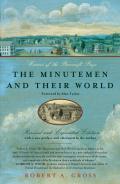
Back in April the Concord Bridge published a nice retrospective profile of Robert Gross, author of The Minutemen and Their World.

Published in 1976 and recently updated, that book has proved the most lasting of the New England community studies that came out in the middle of the twentieth century.

No doubt Minutemen gets a boost from its connection to the nation’s origin story, but it’s a really good book that offers both an early example of computer-aided data analysis and interesting new ideas about how generations interact.

Plus individual stories, as the article says:
Gross wanted to write about “men, women, free and slave, native and newcomer, patriot, neutral, and loyalist” — all of those who had been excluded from conventional accounts — recovering their voices. His approach would reflect his interest in social history, a method that was growing in popularity. It involved tapping overlooked sources such as tax lists, censuses, vital records, genealogies, and town meeting minutes, from which patterns of everyday life and social change would emerge, he says.

Among those who people “Minutemen” is John Jack, an enslaved man who worked for a cobbler, bought his freedom, built a cabin in Great Meadows, and paid his taxes, but was never allowed to vote. At the time of Jack’s death, he owned eight acres, a pair of oxen, and seven barrels of cider. “His was a marginal place in the community, but it was nonetheless a real place,” Gross writes.

And there is Lucy Barnes Hosmer, daughter of a prosperous farmer and town clerk. When Joseph Hosmer, a cabinet maker, asked for permission to marry 16-year-old Lucy, her father refused, wanting her to wed someone wealthy and important.

Though a father could not dictate his daughter’s choice of spouse, he could try to arrange unions and pressure her to agree, Gross says. Lucy rebelled, denying her father’s choice of a cousin for her, and acted on her own. When she married Hosmer at 19, she was two months pregnant.
Highlighting people like that reflects the appeal of such human detail in a study of a society, a balance that The Minutemen and Their World achieved.

Tuesday, June 09, 2026

“Paul Revere and Plan B” in Medford, 11 June

On Thursday, 11 June, I’ll speak to the Medford Historical Society on the topic of “Paul Revere and Plan B: Planning and Improvisation in the Lexington Alarm.”

Our event description says:
After the Battle of Lexington & Concord on April 19, 1775, Massachusetts resistance leaders portrayed the uprising as a mostly spontaneous response to the army’s incursion into a peaceful countryside. Decades later, Henry W. Longfellow presented “Paul Revere’s Ride” as nearly a one-man show.

In truth, the Massachusetts Patriots had prepared for months to resist the Crown military. Revere was part of a network of organizers, informants, and alarm riders. At the same time, Revere and his colleagues succeeded by being able to respond to contingencies by changing their plans.

Drawing on new research, this talk will shed light on one of independent America’s oldest stories—and how the day could have turned out differently.
I developed an earlier, short version of this talk for the 19th of April several years ago, and now I’m backloading it with more about Revere’s pre-war propaganda and espionage work.

The society will meet at the Charlotte and William Bloomberg Medford Public Library starting at 7 P.M. This event is free and open to the public.

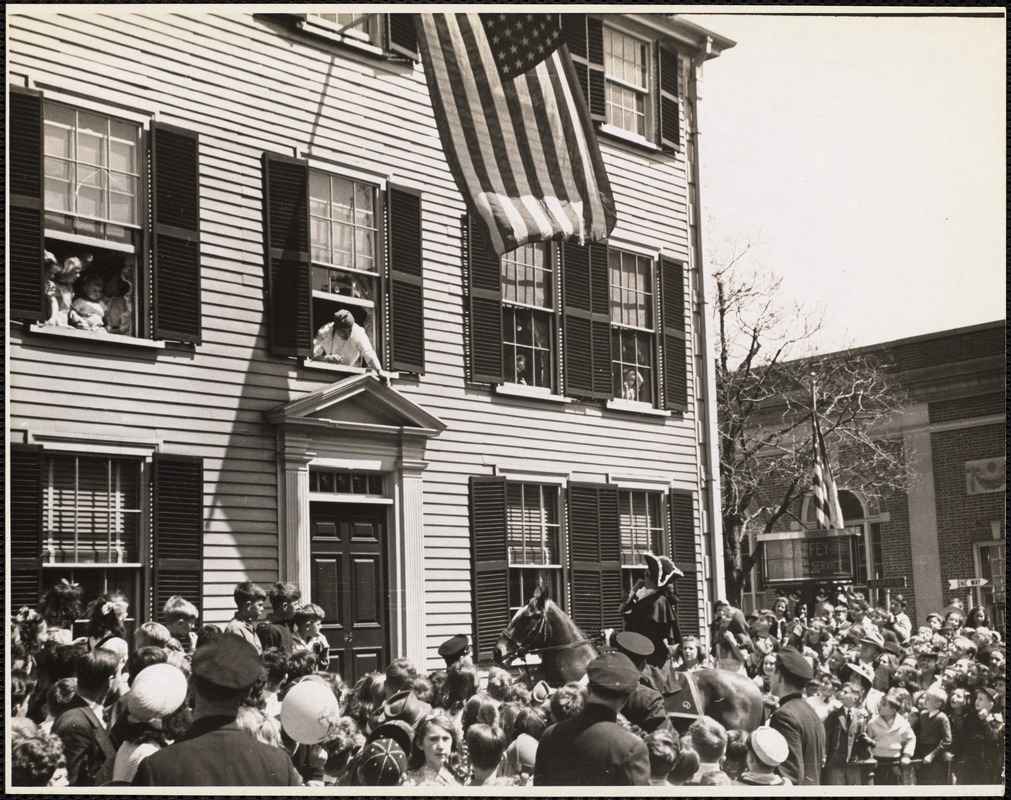
(The photograph above, which comes courtesy of Digital Commonwealth, shows the reenactment of Paul Revere’s stop at the Isaac Hall House in Medford sometime in the mid-1900s.)

Friday, May 29, 2026

Meeting the Real Samuel McClellan

Yesterday’s post introduced Samuel McClellan (1730–1807) of Woodstock, Connecticut, the captain of a militia troop of horse in 1774.

McClellan was a shopkeeper and landowner in his small town. After the Revolutionary War he became a brigadier general in the state militia.

The McClellans remained locally important, and one of his great-grandsons was Gen. George B. McClellan of the Union Army and the 1864 Presidential race.

As often happens in that situation, Samuel McClellan’s descendants were influential enough to get their understanding of his role in the Revolution into local histories and biographical profiles when primary sources were hard to consult. For example, the 1902 National Cyclopedia of American Biography said:
On Oct. 13, 1773, he was commissioned captain of a fine troop of horse, raised in the towns of Pomfret, Woodstock, and Killingly, and led it Boston on receipt of the news of the battle of Lexington. He passed through the battle of Bunker hill uninjured, and in commemoration of that his wife planted three elm trees in front of residence, which attained great size and were standing when Gen. George B. McClellan visited Woodstock in 1884.
Ellen Douglas Larned’s History of Windham County, Connecticut: 1760–1880 says there were originally four elms.

The latest version of that lore is Samuel McClellan’s Wikipedia page, which as of this week says:
In 1775 Major Samuel McClellan led 184 men at the Battles of Lexington and Concord. He played a prominent role in the Battle of Bunker Hill, and after achieving the rank of lieutenant colonel in 1776, colonel in 1777, and brigadier general of the 5th Brigade in 1779, his regiment of the Connecticut Militia was stationed near New Jersey. McClellan was solicited by General George Washington to join the Continental Army and was offered a commission, but his domestic and business affairs compelled him to refuse.
That overstates the facts in multiple ways, starting with how McClellan wasn’t commissioned a major in the militia until October 1775.

News of the outbreak of war in Massachusetts didn’t reach Woodstock until 20 April, after the fighting was over, so there was no way men from that town were “at the Battles of Lexington and Concord.” Col. Israel Putnam was one of the first men from Connecticut to respond. On 21 April he wrote from Concord to say that the Massachusetts Provincial Congress hoped that Connecticut would send 6,000 men for “a standing Army.”

Putnam added as a postscript: “The Troops of Horse are not expected to come until further notice.” But Capt. McClellan had already led his 184 mounted men north into Massachusetts. That’s shown by Connecticut records of militia service, as tabulated here.

However, those same records also show that McClellan was paid for only eight days of service. Like most of his neighbors, he went home when it was clear the emergency had passed. Some men stayed or returned and enlisted in what became the New England army. McClellan didn’t.

There’s no evidence putting McClellan at the Battle of Bunker Hill or on the siege lines around Boston at the time. That undercuts the claim he “played a prominent role” in the battle, but it does explain how he remained “uninjured.”

Later in the war McClellan did mobilize with his militia regiment for short assignments in the Northern Department. He also served in the Connecticut assembly and as a commissary. In that last capacity his name comes up in Washington’s papers, but there’s no direct written solicitation from the commander for McClellan to join the Continental Army.

McClellan apparently left a fowling-piece, made by the Massachusetts gunsmith Joel White, equipped with a bayonet mount and bearing the initials “SMC.” That’s been displayed as a weapon from the Battle of Bunker Hill. McClellan may well have carried it during the Revolutionary War, but not at that fight.

Monday, February 23, 2026

“At length we have had the Commencement of Hostilities begun”

Here’s an account of the start of the Revolutionary War that I don’t believe has been published before.

It’s a letter dated 11 June 1775 from Jonathan Hastings, Jr. (1751–1831), son of the steward of Harvard College, to a friend named Jacob.

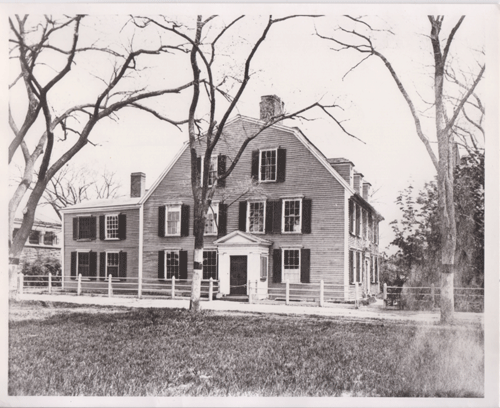
Hastings graduated from Harvard in 1768 and a few years later become one of Cambridge’s school teachers. He was living in his father’s house beside the common, shown here. On 8 June, three days before writing this letter, the young man took the job of town postmaster.

Ironically, his letter appears to have been intercepted by the Crown forces because it’s filed among Gov. Thomas Gage’s papers at the Clements Library. The library offers scans and an imperfect transcription.

Hastings wrote:
Your Brother’s Letter of 18th. May we received the 9 of June. Notwithstanding my many Avocations (our House being made Head Quarters) I cannot miss an Opportunity of sending you a Letter. Am happy you had so safe a Passage & found your Friends well.

At length we have had the Commencement of Hostilities begun by Gage’s Troops, at the Battle of Lexington, where 8 of our Men were killed, there being about 50 assembled on a Green.—

The Evening preceeding the 19 of April, I was met by 11 Officers equipt with Pistols & Cutlasses; when I got Home I acquainted several Gentlemen therewith; but they thought it was like to prove nothing but a false Alarm. They were mistaken. About 2 OClock the next Morning, we were roused out of Bed to pursue 1100 Grendadiers & Light Infantry being a Detachment from all the Regiments in Boston.—

They made their way to our Magazines at Concord, but affected nothing more than destroying 80 Barrels Flour, knocking of [sic] the Ears of 3 twenty four pounders & burning the Carriages. A Quantity of Bullets they threw into a pond, but have been got out since.

Coll. [Thomas] Gardner ordered our Regiment to parade at Watertown, not knowing but that Gage’s Reinforcement would take that Course. He was mistataken [sic], they marched thro’ Cambridge, wch. being known our Regiment took the nearest Way to meet the Detachment. Unluckily for us we had no sooner placed ourselves in an advantageous Post near Lexington Meeting House to give Battle to the Detachment, than we perceived the Brigade in the other Side of us. Our Situation was bad, being between both Armies.
Well, that seems like an exciting place to break, doesn’t it?

TOMORROW: Under fire.

Sunday, January 25, 2026

“How should patriotic Americans think about political violence”?

On 15 January, Prof. Johann Neem shared an essay titled “The Problem of Violence in Authoritarian America.” Here’s a sample:
No American should be shot so easily or blithely. In a country where, as Tom Paine put it, the law is king, we are entitled to due process. Instead, we have become victims of state violence encouraged by the Trump regime’s policies, statements, and values. Trump has permitted federal agents to use illegal amounts of force; ICE agents now regularly assault Americans on the streets, in their cars, and in their homes. . . .

As Trump expands his rule, we must ask ourselves unsettling—and unsettled—questions about the role of violence: How should patriotic Americans think about political violence, and what might we learn from our Revolutionary political tradition?

At first glance, the answers to these questions are easy: violence in a constitutional democratic republic is never permitted. Democracies require citizens to embrace disagreement and accept the outcome of free, fair elections.

But we are no longer living in a free state. Under Trump, the Constitution is no longer active. The rule of law has ended. Donald Trump has deployed lies, violence, and lawlessness to amass power. As I have written before, Trump’s violation of his oath of office means that he is no longer the constitutional president of the United States. We Americans are now subjects of an arbitrary regime ruled by a tyrant. Under Trump, the federal government has become the enemy of the American people. We are subject to force, not law. . . .

In our current context, conversations about violence are complicated because our political tradition recognizes the legitimacy of violence against tyrants but denies the legitimacy of violence by tyrants. Two and a half centuries ago, when the colonists found themselves in a similar situation, the leaders of the patriot cause had to explain why they had embraced violent resistance against their own government. They did so in Continental Congress’s 1775 “Declaration…[on] the Causes and Necessity of Taking Up Arms.”

The situation was fraught. America’s resistance leaders in Congress had hoped to resolve differences between the colonists and England peacefully through meetings, petitions, and boycotts. Yet as Americans faced an increasingly hostile British government, patience was running out and the people got ahead of the opposition’s leaders. In April 1775, patriotic Minutemen at Lexington and Concord showed up to prevent British soldiers, then occupying Boston, from seizing arms in the Massachusetts countryside. Soon after, Ethan Allen’s Green Mountain Boys and colonial militiamen stormed Fort Ticonderoga.

Similarly, today, we see incidents in which protestors are getting increasingly unwilling to stay out of ICE’s way as Trump’s agents cross line after line that protects Americans from arbitrary force, arrest, and imprisonment, as the Cato Institute recently concluded. Most protestors are peaceful and obeying the law—but deciding what counts as lawful becomes harder when federal agents act violently and unlawfully. . . .

As our patriotic forebears 250 years ago understood, we too have a responsibility to our children and future generations who deserve to live in a free country. Violence is always a last resort. But at some point, some people in some city may be pushed to cross a line that most of us never want to cross. Just as [the] Continental Congress struggled with how to respond, so will we. The answer of what to do next is not easy or simple. The question we must all start asking ourselves, then, is how we will respond if that time comes, hoping and acting all along to prevent it from arriving.
Over a week later, as I type this, we see multiple videos of how I.C.E. agents approached, shoved, tackled, beat, maced, and finally shot observer Alex Pretti several times, killing him on the street. Along with the shooting of Renée Good, that made I.C.E. agents responsible for 66% of all homicides in Minneapolis so far this year.

The day before those agents killed Pretti, tens of thousands of local citizens braved harsh winter weather to march peacefully against federal oppression (shown in the photo at top). As Neem says, it’s hard to see Americans remaining committed to such peaceful protest if the forces of trumpery try to maintain their tyranny. 

Friday, November 07, 2025

“The House being jealous of their Priviledges”

As recounted yesterday, on 4 Oct 1775 Gen. George Washington and his fellow generals realized that the Continental Congress’s articles of war weren’t strict enough about passing information to the enemy.

Which was a problem since they had just uncovered evidence that the head of the army’s hospitals, Dr. Benjamin Church, had been doing just that.

In reporting the situation to John Hancock as chairman of the Congress, Washington respectfully wrote that he was “suggesting to their Consideration, whether an Alteration of the 28th Article of War may not be necessary.”

Dr. Church didn’t just have a military appointment. He was also one of Boston’s four representatives in the Massachusetts General Court, elected back on 18 July. Of course, that town meeting hadn’t happened inside British-held Boston. Instead, the “dispersed” inhabitants had gathered in the meetinghouse at Concord.

Dr. Church was active in the first few days of the legislative session in Watertown’s meetinghouse. But in August he took up his new job overseeing the medical care of the army. Two of the other men chosen to represent Boston, Samuel Adams and John Hancock, were away in Philadelphia. That left John Pitts to speak for the town. But that assembly couldn’t do much to affect life in Boston then anyway.

Then in early October came the bombshell news that the army had put Church under arrest. People were soon hearing about why, but this was the house’s first formal response on 14 October:
ORDERED, That Mr. [James] Sullivan bring in a Resolve making a proper Application to General Washington, relative to the imprisonment of one of the members of this House, viz. Doctor Benjamin Church.
The resulting resolution said:
…the House being jealous of their Priviledges, and desirous to know the Cause of said Imprisonment:—— Therefore

Resolved, That the Speaker [James Warren], Mr. Sullivan and Major [John] Bliss, be a Committee to apply to is Excellency George Washington, Esq; requesting him as soon as may be to certify to this House the Cause of the Detention and Imprisonment of said Benjamin Church, Esq; that they may advise thereon.
On 17 October, Warren reported that he had received from Joseph Reed, Washington’s military secretary, “a Letter from Dr. Church to the Enemy, as decyphered by the Rev. Mr. [Samuel] West.” The house voted:
Resolved, That Dr. Church ought to be brought to the Bar of this House, to shew Cause, if any he has, why he should not be expell’d the same.
The next day, Gen. Washington sat down for a council with Benjamin Franklin, Benjamin Harrison, and Thomas Lynch from the Continental Congress and with officials from the New England governments. That meeting would run through 24 October and cover many topics. One item on the agenda was “What Steps are necessary to be pursued with Regard to Dr Church?”

The developments in Watertown offered an out: “Upon a Discussion of all Circumstances it was agreed to refer Doctor Church for Tryal & Punishment to the General Court of Massachusetts Bay.” As for what the army should do, given the articles of war, Washington would wait for the Congress’s guidance.

TOMORROW: Dr. Church makes his move.

Tuesday, October 07, 2025

“Breaking the Polarization Trap” in Concord, 11 Oct.

On Saturday, 11 October, the Wright Tavern in Concord will commemorate the Massachusetts Provincial Congress meeting nearby in 1774 by hosting a discussion program titled “Breaking the the Polarization Trap.”

This program will feature presentations by Dr. Danielle Allen, James Bryant Conant University Professor at Harvard University and Director of the Allen Lab for Democracy Renovation, and Dr. Robert A. Gross, Draper Professor of American History Emeritus at the University of Connecticut and author of foundational modern histories of Concord.

Just as the Wright Tavern was the site of committee meetings during the provincial congress, people at the gathering will be invited to break into small groups to discuss questions posed by the presenters. Then there will be dialogue with the presenters and all attendees. The plan is for two cycles of presentation, discussion, and open dialogue from 1 to 4:30 P.M.

The event description says:
The program will explore how loyalists and patriots co-existed through the turbulence of the American Revolution and will provide contrasts and context to today’s political turbulence. We will explore unique solutions to the root causes of polarization. Let’s learn from history and experiences to find solutions for today.
I have to say that a civil war which upended society and sent tens of thousands of people into exile might not be the best model of co-existence, but perhaps we can do better. American society did calm down afterward, welcoming back some Loyalists. Citizens developed a system for arguing out ideas that, while still not perfect, has generally evolved for the better until now.

Tickets to this event are $30, and the hall’s capacity limits the attendance to forty-five people. Light refreshments will be served. Purchase tickets through this page.

Monday, September 15, 2025

Revolutionary Talks This Week in Dedham and Westford

Here are a couple more Revolutionary lectures coming up this week.

Wednesday, 17 September, 7:00 P.M.
Bullet Strikes from the First Day of the American Revolution
Joel Bohy
Dedham Museum, 612 High Street

In 2013, Joel Bohy began a collaboration with conflict archaeologist Dr. Douglas Scott to better understand the ammunition found during archaeological investigations on former battlegrounds. This morphed into live-fire research and the study of the extant battle-damaged structures and objects from April 19, 1775.

From the Elisha Jones house in Concord, through Lexington and the Jason Russell house in Arlington, Massachusetts—where Dedham soldiers fought—the two carefully studied all the surviving bullet strikes and bullet-struck objects. Using modern forensic techniques adapted to historical studies and live-fire validation, Bohy and Scott tell the story of the brutality of the fighting on the first day of the American Revolution as British forces retreated to Boston.

Joel Bohy is the owner of J.Bohy Historical Consulting. He is an arms & militaria specialist at Blackstone Valley Auctions and an appraiser on the PBS TV series Antiques Roadshow.

Admission is $10, free to museum members. This event will be recorded by C-SPAN for its America 250 series and by DedhamTV.

Thursday, 18 September, 7:00 P.M.
The Plight of the Loyalist in Massachusetts
Larry Kerpelman
Westford Museum, 2 Boston Road

It’s been said that history is written by the victors, so it’s not surprising that the story of Loyalists to the Crown who lived in the American colonies is not as widely known as that of the Revolutionary War’s victors, the Patriots. As the drumbeat to independence grew louder, Loyalists faced their Patriot neighbors’ scorn and the agonizing decision of whether or not to flee their towns and homes. Various historians have estimated that between 60,000 and 100,000 people fled the colonies by the time “America’s first civil war” ended. Dr. Kerpelman will present a picture of how ordinary Massachusetts Loyalists and their Patriot neighbors interacted with one another during the fraught period between the 1750s and the 1790s.

Larry C. Kerpelman, Ph.D., is a freelance writer and communications professional from Acton, Massachusetts. Upon retiring as Vice president and Director of Corporate Communications after 30 years with the Cambridge public policy research and consulting firm Abt Global, he turned to researching, writing, and speaking on singular moments in American history. His work has appeared in American History, American Heritage, The Boston Globe, The Rochester Review, and The Chronicle of Higher Education, among other publications. He holds a B.A. from the Johns Hopkins University and a Ph.D. from the University of Rochester.

Suggested Donation for this lecture of $10 per person.

Saturday, August 09, 2025

“Lt. Coll. Walcott now excuses it”

As I’ve been discussing, a British army court-martial ordered Lt. Col. William Walcott to be reprimanded on the Common in front of the second brigade of British troops in Boston on 17 Apr 1775.

Part of that ceremonial punishment might have been for Ens. Robert Patrick, the young officer Walcott had yelled at and struck, to draw his hand across the regimental commander’s face, thus making things even.

Though a couple of other young officers, Lt. John Barker and Lt. Frederick Mackenzie, wrote the long court-martial verdict into their diaries, neither man described seeing that embarrassing punishment. And Mackenzie was in the second brigade, so he would have been on the Common.

Perhaps that detail was too small to mention. Or maybe it never happened, and the sources from the early 1800s are wrong.

We do know there was another wrinkle in Lt. Col. Walcott’s penalty. He was supposed to be “Suspended for the Space of three Months.” However, Gen. Thomas Gage’s orders for 18 April state:
The Commander in Chief is pleas’d to take off the Suspension ordered upon Lt. Coll. Walcott from this Day inclusive; It having Appeared thro’ the course of the tryal, that Ens. Patrick did behave disrespectfull to his Commanding Officer, but it not being inserted in the Crime, the Court did not proceed upon it, & Lt. Coll. Walcott now excuses it, And will not bring it to a Tryal; but the Commander in Chief thinks proper to Warn Ensign Patrick to behave with more respect for the future to his Commanding Officer.
Thus, although the court martial acquitted Ens. Patrick of “Quarrelling,” “giving a blow,” and “giving…a Challange to fight,” he could still have been brought up on charges of being “disrespectfull.”

But Lt. Col. Walcott decided to let that charge lie. Maybe the family relationship between the two men reported by Lt. Mackenzie was a factor. Maybe this forbearance let Walcott show he was behaving as a proper officer again.

As for Gen. Gage, he was about to send 700 or so soldiers to Concord that evening, with another 1,200 to follow them a few hours later. He needed all his regiments working as efficiently as possible, and that meant keeping Lt. Col. Walcott on the job.

The 5th Regiment took casualties on 19 April, and more at Bunker Hill. Ens. Patrick was promoted to lieutenant on 22 November. He was still at that rank in the 1778 Army List.

Lt. Col. Walcott continued to command the regiment as its official colonel, Earl Percy, handled higher responsibilities. In January 1777 Gen. Sir William Howe gave him responsibility for negotiating exchanges of prisoners of war with Gen. George Washington’s military secretary, Robert Hanson Harrison. In October, Walcott was wounded at the Battle of Germantown, and he died on 16 November.

Sunday, May 04, 2025

“It means exactly what it says, it’s a declaration”

Back in early March, following reports that Donald Trump was demanding a Declaration of Independence to hang in the Oval Office, I wrote:
Donald Trump doesn’t want the Declaration in his office to honor that text or its values. He wants a rare, beloved national asset brought to him to glorify himself.
Eventually Trump did get a printed Declaration behind a curtain in his heavily guarded workspace, an odd way for it to be “shared and put on display,” as a White House publicist had claimed.

This past week the television journalist Terry Moran visited the Oval Office and asked Trump what the Declaration meant to him. Trump confirmed my reading of his character by offering this ignorant blather:
Well, it means exactly what it says, it’s a declaration, it’s a declaration of unity and love and respect and it means a lot and it’s something very special to our country.
Trump couldn’t explain the meaning of the Declaration, its historical significance, or its relevance to today. His comments reveal his desperation to believe that a rare copy’s presence in his office shows the country feels “unity and love and respect” for him.

Last month the White House issued a proclamation on the 250th anniversary of the Battle of Lexington and Concord, as a Boston 1775 commenter alerted me. This document was obviously not written by Trump since it was focused on the historical event, coherent, and grammatical.

Much of that proclamation landed within the realm of common accuracy. In other words, it made the usual mistakes: that Paul Revere rode to Concord, that the “shot heard ’round the world” happened at Lexington, and so on. But a lot of other cursorily researched descriptions of the 19th of April make those same mistakes.

This White House document, however, made some mistakes all its own. It described the opening skirmish as “The British ambush at Lexington.” It said that at the North Bridge “the startled British opened fire, killing 49 Americans.” The correct number is 2. (The number 49 refers to the total number of provincial dead over the whole day.) Obviously the team drawing public salaries to prepare that proclamation for signature didn’t value fact-checking.

Incidents like these show how hollow the Trump administration’s claim to value American history really is. Behind the rhetorical trumpery, the White House is trying to defund our national parks, museums, libraries, universities, humanities research, public schools, and public television. The only forms of history its occupant shows any sign of valuing are statuary and birthday parades.

Tuesday, April 29, 2025

“Commitments to equality and democracy and an aversion to aristocratic rule”

Earlier this spring the History News Network published Eran Zelnik’s essay “The Dangerous Afterlives of Lexington and Concord.”

The article states:
According to legend, the Revolutionary War started suddenly, when an aggressive and conceited British regime based in Boston sent soldiers to seize arms stored in Concord. In response, roughhewn American farmers heeded the call to defend their homes and hearths from British tyranny. Miraculously, the underdogs succeeded. The tenacity and will of virile American farmers, it turned out, could vanquish a well-trained army of British Regulars, foreshadowing the ultimate success of the American Revolution as a monumental event in world history.

This mythology, however, is inaccurate. In reality, the Americans were initially overwhelmed by extensive British forces at Lexington.
The redcoats’ overwhelming attack on the Lexington militia companies has been a vital part of the story from the beginning, never denied by “mythology.” Patriot propagandists even played up that violence, insisting the British attack was unprovoked.

In the 1800s local chroniclers added some face-saving details of counterattacks, like some of the Lexington company firing back and Capt. John Parker leading his men to ambush the British as they came back into town in the afternoon. But no one ever claimed that Lexington was where American farmers “succeeded” in stopping the regulars.

Zelnik’s command of detail goes down from there:
But the larger force of fighters that engaged the Redcoats further along the road in the Battle of Concord led the British to retreat to Boston, so as not to be stranded so far from reinforcements.
The British plan was always to search Concord and then return as quickly as possible, meeting reinforcements on the way. The exchange of fire at Concord’s North Bridge alarmed the British commanders, but it didn’t really hurry them.
It was on the road back to Boston — not in Lexington and Concord — where most of the fighting took place, and that counterassault was largely led not by militia members, but rather by minutemen. These highly trained units, composed of thousands of the region’s hardiest gun-owning fighters, were accustomed to irregular guerilla warfare. During the Seven Years’ War (1754-63) many New Englanders had served in provincial regiments that proved crucial for turning the tide of war in favor of the British.
The minute companies were part of the militia system. Generally those men had more equipment and training than average, but how much more varied from town to town. Zelnik implies the minutemen were drawn from veterans of the war that had ended twelve years before. In fact, they were usually the younger militia members, less likely to have seen combat. (And few British officers in the Seven Years’ War would have agreed that the provincial troops were their crucial edge.)
Moreover, since the British had sent several expeditions into rural Massachusetts over previous months that turned out to be dry runs for April 19, the minutemen were already drilled and ready when the actual fighting began.
The minute companies started to form in the fall of 1774. There was only one British expedition after that season—to Marblehead and Salem, large coastal towns, in February 1775. The regulars also made a handful of practice marches that provoked militia alarms, but those went no farther than two towns outside of Boston. Few of the militiamen who marched on 19 April had seen redcoats in any numbers.

These misconceptions are a shame because Zelnik’s hypothesis is sound: “more than any other moment in the nation’s collective memory of the war, the myth of Lexington and Concord has for generations represented commitments to equality and democracy and an aversion to aristocratic rule.”

Furthermore, he’s right in warning that that national myth’s “commitments to equality and democracy” have at many times been hijacked by people who want “equality and democracy” only for part of American society—which isn’t equality and democracy at all.

Saturday, April 26, 2025

Panel on “Lexington and Concord” in D.C., 29 Apr.

On Tuesday, 29 April, the American Revolution Institute in Washington, D.C., will host a panel discussion on “The Battles of Lexington and Concord.”

This is the first of the institute’s planned eight years of “250th anniversary celebrations of the American Revolution.”

The institute has announced:
Historians on the panel include J. L. Bell discussing the prelude of the two events of April 19, 1775; Alexander Cain discussing the engagements through the perspectives of the battles’ participants and civilian eyewitnesses; and Jarrad Fuoss of Minute Man National Historical Park discussing recent archaeological studies and findings and how they have enhanced the interpretation of the battles.
Because of increased government restrictions on employee travel, Jarrad Fuoss will be speaking through a video hookup. Alex Cain and I will be roughing it inside Anderson House, the Society of the Cincinnati’s headquarters and research library in Washington.

Through this webpage, people can register to attend in person or online. The panel will be recorded for posting on the institute’s YouTube page.

The discussion is scheduled to start at 6:30 P.M. and run for an hour, though I’m sure the folks involved would be happy to keep talking about the start of the Revolutionary War as long as we can. 

Tuesday, April 22, 2025

“A daughter of liberty, unequally yoked in point of politics”?

In his 1788 history of the American Revolution, the Rev. William Gordon shared this anecdote about what led up to the British army march on Concord:
A daughter of liberty, unequally yoked in point of politics, sent word, by a trusty hand, to Mr. Samuel Adams, residing in company with Mr. [John] Hancock at Lexington, about thirteen miles from Charlestown, that the troops were coming out in a few days.
Gordon was close to Adams, as other stories in his book indicate. Adams clearly knew the identity of this “daughter of liberty,” and Gordon might have known as well, but the book kept her name secret. Presumably she was still expected to appear loyal to a husband whose politics she didn’t share.

Some authors have taken this early statement as evidence that Margaret Gage might have leaked her husband’s plan for the march on Concord to Dr. Joseph Warren just before he dispatched William Dawes to Lexington. I don’t think that holds up to scrutiny, from several angles.

First, this “daughter of liberty” provided information to Adams, not Warren, and “a few days” before the march, not the evening it began. There’s no reason to believe those two informants were the same person—nor any indication that Warren’s source was a woman. (Once again, I think the doctor got the dope from William Jasper.)

Second, this “daughter of liberty” was worried that Hancock and Adams would be arrested, as was Warren, but someone truly privy to Gen. Thomas Gage’s plan would have known he was focused on the military supplies in Concord.

Third, while Margaret Gage expressed sadness at the prospect of war between Britain and the American colonies, she never showed any affinity for the Patriot cause. In fact, there doesn’t appear to be any evidence she ever even met Patriot leaders.

I think there are many stronger candidates to be this “daughter of liberty, unequally yoked in point of politics.” (Gordon took that phrase “unequally yoked” from Paul’s second epistle to the Corinthians.)

In my talk to the Colonial Society of Massachusetts last week, now viewable online, I shared my current idea of the most likely candidate.

TOMORROW: Gosh, this is suspenseful, isn’t it?

Sunday, April 20, 2025

Yesterday’s Posts

I’m home from Battle Road 250, at which I watched the Parker’s Revenge tactical demonstration, said hello to several excellent local reenactors, heard a fine talk by Matthew Keagle of Fort Ticonderoga, and chatted with the Emerging Revolutionary War crew.

I capped that off with dinner with Lee Wright of The Pursuit of History, discussing different possible future projects, including upcoming weekend events.

During the day I was gratified to see two big newspapers air two of my pet theories about the start of the Revolutionary War.

The Washington Post published David Kindy’s article “Who really fired the shot that started the American Revolution?” in its Retropolis section. That delves into the mysterious first shot at Lexington.

(I suspect Kindy’s editor was responsible for the subhead referring to that as “the shot heard round the world,” which was Ralph Waldo Emerson’s term for the first return fire at Concord.)

Following up on a tip from me, Kindy focused on young Lexington militia man Solomon Brown.
“It’s not that I think he is definitely the man who fired first,” states historian and author J.L. Bell, who writes the daily blog Boston 1775 about the American Revolution. “But if I could go back in time, he’s the first person on my list that I would want to interrogate.”
The previous day, the same Washington Post section ran “Was a woman the informant who helped launch the American Revolution?” by Petula Dvorak. That article went over the theory advanced in the newspaper’s editorial a century ago (and circulating at least sixty years before that): that Margaret Gage leaked her husband’s plans for the Concord march to Patriot leaders.

That article prompted Dana Kennedy to write “Inside one of the biggest conspiracy theories of the American Revolution: That a woman may have kick-started the whole thing” for the New York Post.

Kennedy gave me a chance to spout off on weak points in the theory:
“I don’t think anybody actually leaked it,” Bell, who also runs the blog Boston 1775, told The Post. He believes that Joseph Warren and others had been gleaning information about British troop movements from a variety of sources and events.

“For one thing, Gage’s plan was to send troops to Concord, but Warren told them to just go to Lexington. Revere and Dawes went on to Concord on their own accord.”

If anything, Bell thinks the spy might have well been a pragmatic British-born knifemaker named William Jasper. He was renting a room to a British sergeant who may have unwittingly trusted him with the army’s plans.

“Unfortunately, that story is a lot less sexy and about a person we’ve never heard of,” Bell said.
Kennedy also quotes Alexander Cain of Historical Nerdery and Emily Murphy of the Salem Maritime National Historical Site. Sensible people who, of course, are on the same side of the debate as me.

[The photo above shows a British army reenacting unit in the Lexington town parade and comes from the Pursuit of History Twitter feed.]

Saturday, April 19, 2025

Counterfactual 4: If No One Had Died at Lexington or Concord

Building on my counterfactual of what might have happened if Paul Revere and William Dawes had never brought their warning to Lexington, I reached the moment when the militiamen of Concord saw smoke rising above their town.

Under the scenario so far, the lack of urgent alerts out of Boston had no effect on the safety of John Hancock and Samuel Adams (who were never in great danger, despite their worries) or the quantity of military supplies the redcoats found (since James Barrett and his crew had already moved most of that stuff).

But that counterfactual situation would have delayed the response from towns around Concord, meaning fewer militia companies would have joined the local men on the hill overlooking the North Bridge.

We know those men were of two minds about confronting the regulars. They stayed on that hill for about two hours, marching down only after thinking other soldiers had set fire to the center of town. Then, after a fatal exchange of fire had chased the company from the bridge, they pulled back for another couple of hours.

Given those real-life details, I posited yesterday that the militia men would have been more wary about marching down on the bridge if there had been fewer of them. And eventually the smoke from town would have stopped, lessening the urgency.

In real life, after the shooting the militia companies moved around the north side of Concord and then massed east of the town. At Meriam’s Corner, once the regulars had left the most populated area, the provincials started to shoot at the column. Would that have happened the same way in this what-if scenario?

The very big difference in this counterfactual is that no one has yet been killed. There was no shooting in Lexington or at the North Bridge. Neither side had seen deaths to avenge. As long as the two groups of armed men remained at a distance, neither would have felt themselves to be under imminent threat.

In that case, the afternoon might have proceeded like the end of Lt. Col. Alexander Leslie’s raid on Salem in February: with the regulars marching in order back to where they came from while the local militia regiments watched sullenly to be sure they left. Lt. Col. Francis Smith’s men would have met Col. Percy’s reinforcement column somewhere in west Cambridge, and they would all have returned to Boston.

As it happened in April 1775, the bloodshed along the Battle Road motivated a militia siege of Boston. The committee of safety and its generals didn’t have to choose that policy; it came about naturally as militia companies massed off the peninsulas of Boston and Charlestown. Without deaths, the provincials wouldn’t have felt so much fervency, so the situation might have remained as it was: no military siege, but the countryside beyond Boston outside of royal control.

In the ensuing days, the Patriot press would have made the most of the army incursion into people’s homes while also trumpeting how the raid had found so little. The newspapers would have celebrated the escape of Hancock and Adams. They would have lauded the strong unified response of the Massachusetts militia.

As for Gen. Thomas Gage, he would have been pleased not to lose any men but frustrated at not capturing all the artillery pieces and other weapons he wanted to destroy. And how would he explain the mission to his superiors in London after they’d advised him to do something else?

Of course, that scenario doesn’t include any of the near-random events that can ignite violence, like the first shot at Lexington. What if British troops and Massachusetts militia did bump into each other somewhere? What if military patrols stopping Revere or Dawes before they got to Lexington meant that one of those popular Bostonians had wound up dead?

And even if the 18–19 April expedition did end without bloodshed, the conflict and tensions in Massachusetts would have remained unresolved. Gen. Gage’s next mission could have started the war instead, just a few weeks later.


Friday, April 18, 2025

Counterfactual 3: If Prescott Hadn’t Alerted Concord

Continuing my speculation about what might have happened if Paul Revere and William Dawes hadn’t alerted Lexington about the regulars coming out, I’m now going to look at Concord.

This post was prompted by the suggestion in Kostya Kennedy’s book The Ride that if Revere hadn’t ridden out on 18 April “the munitions at Concord could have been seized.”

That’s mistaken because militia colonel James Barrett, his helpers, and his family had started moving the most valuable military supplies out of town days before the British army march. In part because Revere had brought a warning from Boston on an earlier ride. 

On 6 April, James Warren was in Concord for a meeting of the Massachusetts Provincial Congress, and he wrote to his wife Mercy: “This Town is full of Cannon, ammunition, stores, etc., and the Army long for them and they want nothing but strength to Induce an attempt on them.”

But when the redcoats arrived, Ens. Henry DeBerniere said, they “did not find so much as we expected.” Specifically, he reported:
Capt. [Mundy] Pole of 10th regiment…knock’d the trunnions off three iron 24 pound cannon and burnt their carriages; they also destroyed a quantity of flour, and some barrels of trenchers and spoons of wood for their camp.
At Barrett’s farm the soldiers burned some more carriage wheels. But the town was obviously no longer “full” of military stores. And that change had taken days, not a few hours.

If the British expedition hadn’t paused in Lexington but marched straight through, as I posited yesterday, the vanguard would probably have arrived in Concord less than half an hour earlier. Some of the local militia might have been on alert, but without Dr. Samuel Prescott’s warning, it probably wouldn’t have been at full force.

But would that have mattered at first? When the regulars approached the town, the Concord militia marched away and took a position on a hill west of the North Bridge. Other men and then other town companies joined them there while the redcoats searched both the town and Barrett’s farm.

Without the earlier alerts from Revere riding west from Medford to Lincoln and the Prescott brothers riding out of Concord, those militia companies from other towns wouldn’t have joined the Concord companies as quickly as they did. It’s thus possible there would have been significantly fewer men on that hill when smoke began to rise from the center of town, where redcoats were burning carriage wheels (and, briefly, the town house).

The Concord men might have been just as upset by the sight of that smoke, but might not have felt their numbers were strong enough to do anything about it. And eventually the smoke would have dissipated as people in town succeeded in dousing the fire. So the provincials might never have made their fatal march down to the bridge, with the Acton company in the lead.

TOMORROW: The battle that never was.

Monday, April 14, 2025

Revisiting the Spies of 1775

I recently spoke in the Acton 250 series of talks on the start of the Revolutionary War.

My topic was “The Spies of 1775,” reeling off stories of disparate people drawn into intelligence-gathering efforts on both sides of the siege lines around Boston.

Since I didn’t want to go back over the spies at the center of The Road to Concord, I talked about:
The Acton Exchange just reported on the event:
Speaking to a capacity audience in the Francis Falkner Hearing Room on March 31, author and historian John L. Bell related a fascinating story of the spies used by the commanders on both sides of the conflict. While many informants chose to provide information due to loyalty to their cause, others were primarily driven by money, property, revenge, or self-promotion.
Acton 250 television has now posted its video recording of the event, neatly edited to remove evidence of some technical difficulties.

And here’s a postscript to that evening. On Friday I participated in the conference “1775: A Society on the Brink of War and Revolution” hosted by the Concord Museum and organized by the David Center for the American Revolution at the American Philosophical Society and and the Massachusetts Historical Society.

That program included Iris de Rode from the University of Virginia presenting on “French Observers of Early American Unrest: How Lexington and Concord Shaped France’s Entry into the American Revolution.” Among other people she discussed Bonvouloir, one of the spies I’d described in Acton, so I gossiped with her afterwards.

Bonvouloir and his companion, the Chevalier d’Amboise, were in London in the late summer of 1775. A British government agent pumped them for information. The Frenchmen described witnessing “the Affair of Lexington, and the Affair of the 17th [Bunker Hill].” They claimed to have met “Putnam and Ward.”

But Dr. de Rode said that there’s no evidence of similar reports in French government sources. Even though Bonvouloir lobbied to become his government’s agent to the American rebels, which would make his experience with the war relevant, he doesn’t appear to have told those stories to the French ambassador to pass on to the Foreign Ministry. So she thinks he was just talking through his no doubt fashionable hat.

The British intelligence service was definitely shadowing Bonvouloir in London, and he was definitely involved in a secret mission to Philadelphia at the end of 1775. So he fits into a talk on spies. But whether he was in New England in 1775 is in question. I must consider the possibility that in London he engaged in a disinformation campaign—not to help the Americans or the French but to make himself look more important.

Saturday, April 12, 2025

Making Plans for Battle Road 250

If you hope to visit the reenactments on Lexington common or Minute Man National Historical Park on Saturday, 19 April, it’s not too early to make plans about how to get there.

Between the local parades and the out-of-town crowds, moving around will be a challenge.

Here are three overlapping websites with transport information:
Basically, unless you live nearby or drive in well before dawn, you should expect to park at a distance from the events and then catch one of the many shuttle buses to within walking distance of the action you want to see.

The M.B.T.A. will run extra commuter trains on the Boston-Fitchburg line, but it won’t let passengers bring bicycles on board. 

There’s no food service inside Minute Man National Historical Park, and for security reasons visitors shouldn’t bring coolers. There are drinking fountains at the visitor centers, Hartwell Tavern, and the Nathan Meriam House. In addition to those sites’ usual restrooms, there will be portable toilets at Lexington’s satellite parking lots.

I recommend choosing which events you want to enjoy, heading for those, and enjoying the details rather than trying to see everything everywhere. The Battle Road 250 event inside Minute Man Park promises to be the largest, most accurate historical portrayal yet! And of course, we should hope for good weather.

Friday, April 11, 2025

Afternoon Talks in Lexington and Boston

Next week I have two afternoon speaking engagements that will also be available online to people in the know.

Monday, 14 April, 1:15 P.M.
Secrets on the Road to Concord
Lexington Veterans Association

In April 1775, British general Thomas Gage drew up plans for his troops to march nineteen miles into unfriendly territory. The Massachusetts Patriots, meanwhile, prepared to thwart the general’s mission. There was one goal Gage and his enemies shared: for different reasons, they all wanted to keep secret just what those troops would look for in Concord.

This will be the latest variation of my talk on Gen. Gage’s fateful mission. I continue to investigate that event, particularly the identity of the spy in Concord who sent him very good intelligence in very bad French. Alas, I don’t have any new discoveries to debut here.

The Zoom link for this talk is on this page. Other speakers in this series appear here.

Thursday, 17 April, 3 P.M.
The Mystery of Joseph Warren’s Informants
Colonial Society of Massachusetts, 87 Mount Vernon Street, Boston

According to one early source, as the last step before sending William Dawes and Paul Revere off to Lexington, Dr. Joseph Warren consulted with one crucial informant. Was that Margaret Gage? William Jasper? Another individual? Or is that story simply unreliable?

I’ll retrace my thinking on those questions and discuss the historiography around that issue. When did historians begin to investigate that person? How did the campaign for women’s suffrage color the discussion? And what does it mean that Dr. Warren’s intelligence was wrong?

This talk can be watched online by following the instructions at the bottom of this page.