J. L. BELL is a Massachusetts writer who specializes in (among other things) the start of the American Revolution in and around Boston. He is particularly interested in the experiences of children in 1765-75. He has published scholarly papers and popular articles for both children and adults. He was consultant for an episode of History Detectives, and contributed to a display at Minute Man National Historic Park.

Subscribe thru Follow.it


•••••••••••••••••


Showing posts with label Robert Carr. Show all posts

Thursday, May 23, 2013

A Fort from 1779, a Redcoat from 1799

Here are a couple of eighteenth-century archeology stories from the past month.

The Associated Press reported on a dig in Georgia that located Carr’s Fort, site of a skirmish in February 1779. The article explains:
Robert Carr was a cattle farmer who settled with his wife, children and a single middle-aged female slave in Wilkes County after colonists started arriving there in 1773. Carr also served as captain of a militia company of roughly 100 men. Responsible for leading his militiamen and looking out for their families, Carr built a stockade wall to protect his farmhouse and surrounding property, which included shacks and crude shelters. . . .

In February 1779, about 80 British loyalists marched into Carr's Fort and took control, presumably while Carr and other patriot militiamen were away. Patriots responded quickly by sending 200 men from Georgia and South Carolina to retake the fort.
Dan Elliott’s archeological team found an area that contained old bullets, musket parts, buttons, horseshoes, hinges, and a “coin believed to a King George half-penny from the 1770s.” However, they haven’t found remains of the fort’s walls, and there’s still no evidence of where Carr himself was during the fight over his property.

Across the Atlantic, the B.B.C. reported on a body found in Dutch sand dunes that had been preserved under asphalt for a while before being uncovered again. The artifacts with the body allowed archeologists to connect the remains to a particular British army regiment and expedition:
In August 1799, Britain and Russia launched an invasion of northern Holland in an effort to topple the Batavian Republic and restore the House of Orange. The action formed part of the wars against revolutionary France, which supported the Dutch republic.

The British-Russian armies - including the 2nd Battalion Coldstream Guards, consisting of some 1,000 soldiers - arrived in Groote Keeten under the Duke of York. About 12,000 British soldiers were landed in total. [Archeologist Esther Poulus explains:] “In the Netherlands, they call it the forgotten war - it didn’t take very long, and was quite local.”

The soldier was buried in his uniform, along with several muskets, which may simply have been thrown in the grave to dispose of them, or may have been fashioned into some kind of makeshift stretcher to carry his body to its resting place.

“When we found the buttons he had worn on his tunic, we thought, ‘Wow - we can identify this soldier.’”
The webpage shows not only those buttons but also some of the bones, as shown above.

Sunday, June 20, 2010

“An Attack Was Expected” in Roxbury

Earlier this year I had a few ideas about that note from Lt. Col. Robert Carr that Richard Ketchum quoted in Decisive Day but couldn’t explain.

To start with, the only Capt. Farrington mentioned in British Officers Serving in the American Revolution, 1774-1783, is Capt. Anthony Farrington of the Royal Artillery (son of Maj. Charles Farrington of the same service). So he was the British officer whom Carr asked to dislodge some American field-pieces—with an artillery barrage rather than an infantry attack.

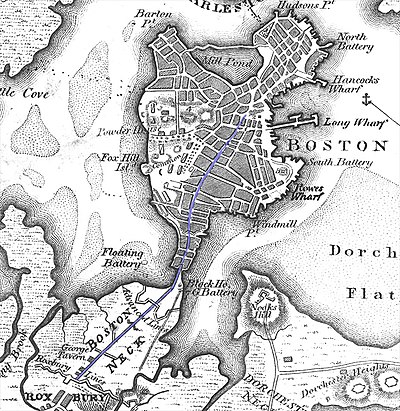
As for “Brownes House,” Enoch Brown’s tavern was a landmark on Boston Neck, sitting between the British fortifications and the provincial lines. Gen. John Burgoyne proposed a parley there to Gen. Charles Lee in July 1775, but the Americans burned it down. So could this note refer to something happening near there, on the other side of town from the Battle of Bunker Hill?

Throughout 17 June 1775, each commander worried that, while so much of his army was engaged in Charlestown, the enemy would open a second front by attacking across the Neck. That danger kept Gen. Artemas Ward at his Cambridge headquarters, monitoring news from both wings. Gen. Thomas Gage was probably in his official residence, the Province House, doing much the same. (More discussion of his location here.)

I therefore wondered if Lt. Col. Carr was the officer in charge of the fortifications on the Neck—the “lines”—and not with his regiment in Charlestown. The fact that he wrote to Gage and not to Gen. William Howe, the battlefield commander, strengthens that hypothesis.

But is there any evidence of the provincials advancing field pieces along the Neck, and the Royal Artillery trying to “make them remove,” as the note says? Indeed there is. Here’s an extract from the journal of Samuel Bixby of Sutton, Massachusetts, printed in volume 14 of the Massachusetts Historical Society Proceedings:

About noon we fired an alarm, & rung the bells in Roxbury; and every man was ordered to arms, as an attack was expected.

Col. [Ebenezer] Larned marched his Regt. up to the meeting house, & then to the burying yard, which was the alarm post, where we laid in ambush with two field pieces placed to give it to them unawares, should the regulars come.

About 6 o. c. [o’clock] the enemy drew in their sentries, & immediately a heavy fire was opened from the Fortification. The balls whistled over our heads, & through the houses, making the clap-boards and shingles fly in all directions.

Before the firing had begun, the Genl. [John Thomas] ordered some men down the street to fall some apple trees across the street, to hinder the approach of their Artillery.

Lieut [John] Hazeltine picked up a 12 lbs ball—we were anxious to get their balls as though they were gold balls.
If Carr was commanding on the Neck, the American field-pieces he wrote about weren’t any of the cannon left behind on the Bunker Hill battlefield, but the couple used as an ambush in the Roxbury burying-ground. There might still be a mystery in why Carr was separated from his regiment, and who was commanding those men back on the beach at Charlestown.

Bixby’s last line above is another example of Americans stationed in Roxbury “contending for cannon balls.” However, I still haven’t found an example of a man hurt by not waiting until a ball had stopped rolling to try to pick it up.

Saturday, June 19, 2010

Ketchum’s Mystery at 4:25

Two years after Thomas J. Fleming wrote Now We Are Enemies in 1960, another magazine journalist, Richard M. Ketchum, penned his own popular history of the Battle of Bunker Hill. It was published first as The Battle for Bunker Hill and then as Decisive Day: The Battle for Bunker Hill.

In his essay on sources at the back of the book, Ketchum quoted a document that puzzled him. It was a note sent to Gen. Thomas Gage by Lt. Col. Robert Carr from the “lines, [at] 25 minutes past 4 o’clock”:

Sir— The Rebels have advanced some Field Pieces on the rising ground to the left of Brownes House, I have given Capt. Farrington orders to endeavor to make them remove—I am Sir

Your Excelly. Most Obedt

Humble Sevt

Robert Carr

Lt Colo 35 Foot
Ketchum observed a couple of odd things about this missive:
  • Lt. Col. Carr signed the note so genteelly that his signature is half as long as the note itself.
  • Carr describes the New England artillery as advancing its cannons at 4:25. By that time, other sources agree, all the artillerists at Bunker Hill but Capt. Samuel Trevett and his Marblehead company had run away, or never went on the battlefield at all. Ketchum concluded, “it must be assumed these were guns abandoned by [Capts. Samuel] Gridley and [John] Callender, which were still being served by volunteers.”
  • Carr’s 35th Regiment was badly mauled in the fight along the beach, losing three captains and two lieutenants, but where on the Charlestown peninsula was “Brownes House”?
Ketchum didn’t use this source in his recreation of the battle because he couldn’t fit it in with the rest geographically. But in the spirit of completeness he shared it with his readers anyway.

TOMORROW: My theory—Carr was never in the battle.