J. L. BELL is a Massachusetts writer who specializes in (among other things) the start of the American Revolution in and around Boston. He is particularly interested in the experiences of children in 1765-75. He has published scholarly papers and popular articles for both children and adults. He was consultant for an episode of History Detectives, and contributed to a display at Minute Man National Historic Park.

Subscribe thru Follow.it


•••••••••••••••••


Showing posts with label blacks. Show all posts

Friday, July 17, 2026

A Boston Stone

This month the city of Boston announced a new finding about a stone in the Granary Burying Ground that reads:
HERE LYES Ye.
BODY OF BOSTON
AGED 70 YEARS
DECd. FEBy. Ye. 28
1 7 2 8
Kelly Thomas, director of the Historic Burying Grounds Initiative for the Boston Parks and Recreation Department, told WBZ: “I was reviewing the photos of headstones, and then I noticed that the stone only had one name.” A geographic name, at that. That hinted the person buried there had been an enslaved man.

Some documentary research turned up records of such a man. Indeed, Gloria McCahon Whiting discussed Sebastian’s marriage to Jane Lake at length in her 2024 book, Belonging: An Intimate History of Slavery and Family in Early New England. Judge Samuel Sewall helped to negotiate the terms of that union at the same time he was writing The Selling of Joseph, his pioneering but self-suppressed anti-slavery pamphlet.

On 13 Feb 1701, after protracted discussions between the couple’s two owners, the judge married the couple. Sebastian’s owner, John Waite, died the next year. Six years after that, when the Boston selectmen listed free black men in town they put to work mending roads (since those men were free/barred from militia training), one of those men was identified as “Bastion Waite.”

Interestingly, Sebastian’s wife came to be known as Jane Basteen and then Jane Boston, taking (or being assigned) her husband’s name while he was assigned his late owner’s surname. As Whiting pointed out, Sabastian would name his second son Joseph, echoing Sewall’s pamphlet. Meanwhile, Sebastian’s name evolved into “Boston.”

The issue of the New-England Weekly Journal dated 24 Feb 1729 included this death notice:
On the 14th. Instant [i.e., of this month] died here a Negro Freeman named Boston, in an advanced Age, and on the 17th, was very decently Buried. A long Train follow’d him to the Grave; it’s said about 150 Blacks, and about 50 Whites, several Magistrates, Ministers, Gentlemen, &c.——

He having borne the Character of a sober Virtuous Liver, and of a very trusty honest and faithful Servant to all that employ’d him, and having acquir’d to himself the general Love and Esteem of his Neighbours by a Readiness to do any good Offices in his power for every one; his Funeral was attended with uncommon Respects, and his Death much lamented.
The carved gravestone, whether paid for by Boston’s estate or by his friends, was another sign of his standing in the community. It is, Mayor Michelle Wu now notes, “one of the oldest gravestones of a free Black person in America.”

At first I was confused by the different death dates stated in the newspaper and on the gravestone. But then I realized the stone was written in the Old Style, Julian date system while the newspaper followed New Style, Gregorian dating decades before the British Empire adopted it officially.

Wednesday, May 27, 2026

Uncovering Boston Jersey

Earlier this month the Guardian reported on how researchers had unearthed new information about a figure in this portrait.
For hundreds of years, he was known only as “Jersey”, an enslaved boy of about 11 rendered in oil on canvas by the great 18th-century portrait painter Sir Joshua Reynolds. . . .

The painting, thought to have been completed around 1748, shows the boy and his “master”, the naval officer and MP Paul Henry Ourry. While Ourry looks out into the distance authoritatively, the enslaved child gazes up at the officer tentatively. . . .

Scouring admiralty records, letters, muster books (ships’ registers) and captains’ logs, [Mark] Brayshay and Katherine Gazzard, a curator at Royal Museums Greenwich, found him named as “Boston Jersey” on ships that Ourry was attached to.

They believe he may have been given the surname Jersey because Ourry was born in the Channel Islands. It is possible he had his first name because he once lived in Boston, Massachusetts.

The researchers discovered Jersey was baptised as George Walker (possibly a name he had been known by earlier in his life) on 30 July 1752, probably in a chapel in Westminster.
The article has a little more to say about George Walker and much more about the restoration of the painting.

This discovery led to the quick creation of a Wikipedia page about Boston Jersey/George Walker.

Saturday, May 16, 2026

“To Vax or Not to Vax” walking tour in Boston, 17 May

On Sunday, 17 May, the Partnership of Historic Bostons is offering a walking tour titled “To Vax or Not to Vax: Smallpox in Early Boston.”
The organization says:
The subject of our newly revised walking tour is smallpox, one of the great killers of the 17th century. This European disease found fertile ground in the growing colonies in New England, with the most devastating effects suffered by Native Americans who had no immunity. Up to 90% of the Massachusett Tribe, whose land included Boston and Charlestown, perished, their villages lying empty and providing English colonists with unoccupied land for reasons that Puritans saw as providential.

English colonists had some immunity but, even so, successive generations suffered wave after wave of deadly smallpox outbreaks. . . .

During the tour, we will investigate how the colonists saw smallpox and tried to contain it, and how smallpox roiled their society in a number of ways. Had God handed the Shawmut peninsula over to them by clearing out the Native population, or was he punishing them with the same pestilence for not sufficiently following His word? Could smallpox be successfully treated by medical methods practiced since the time of the Romans, or would new, more radical methods (some employed by Africans, including Cotton Mather’s enslaved African Onesimus, and Turks) prove more effective?
This tour is led by Michael Prochilo. It will start outside of Park Street Station at 2:30 P.M. and is scheduled to last 90 ninety minutes. Because of construction projects, the route is not wheelchair-friendly. Participants are reminded to bring water [Sunday might bring our first 80°F. days this year] and wear comfortable shoes.

Friday, May 08, 2026

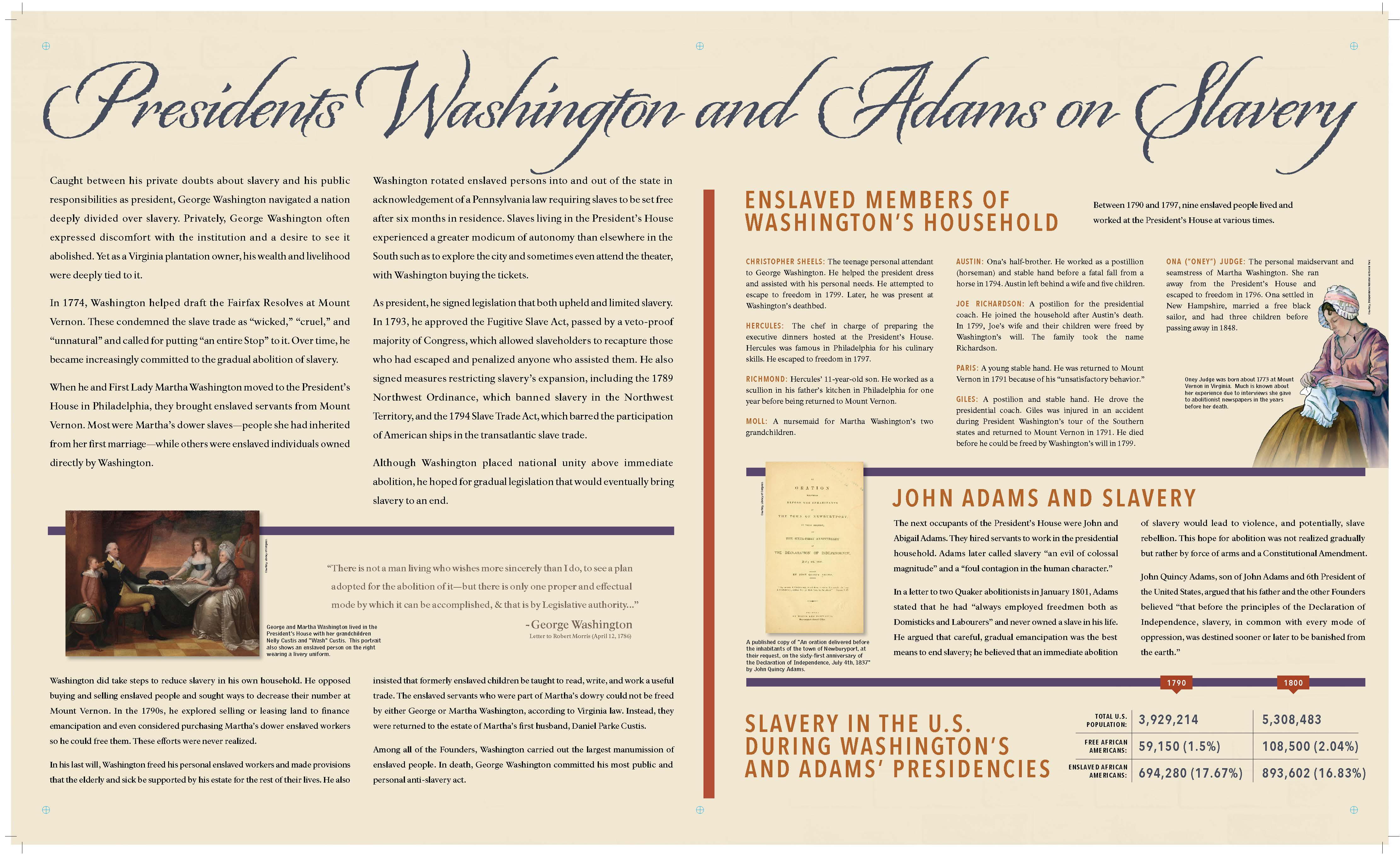
“The only ‘emancipation’ relevant to this site was Ona Judge’s own”

On 21 April, the Philadelphia Inquirer shared an opinion piece about the President’s House exhibit by Sharon Ann Holt, a public historian recently retired from Penn State Abington.

Holt was previously director of education and interpretation at the Historical Society of Pennsylvania and director at the Sandy Spring Museum in Maryland. She’s the author of Freedom Pay: North Carolina Freedpeople Working for Themselves, 1865–1900.

The web headline for Holt’s essay is “We can’t give in to the Trump administration’s attempts to make the history of slavery invisible in Philadelphia.” I don’t know if it appeared in the newspaper’s print edition, and the webpage now behind a paywall unless one has a guest link. So here’s an extended extract:
The digital images posted on the Park Service’s website make it clear that, under Donald Trump, the first priority of the Park Service seems to be to make enslaved people and slavery itself as invisible as possible. Panels that discussed the lives of urban enslaved people, Philadelphia’s free Black community, the Washingtons’ enslaved “family,” fugitives from enslavement (and the laws Washington signed to reclaim them) have all disappeared. The rich biographies of Christopher Sheels, Hercules, Richmond, Austin, Giles, Ona Judge, Joe Richardson, Moll, and Paris have shrunk to single sentences. . . .

So what stories are they telling? George and Martha’s determination to flout Pennsylvania’s six-month limit on holding people in slavery is reframed as a lovely gift of theatre tickets rather than their cynical move to get enslaved people across the river to New Jersey, thus restarting the six-month residential countdown. I’m surprised the Park Service left out the Washingtons’ “kind” willingness to let enslaved workers visit their families left behind in Virginia, which worked the same trick.

If Park Service bureaucrats value relevance, I challenge them to explain the transformation of the story about 18th-century slavery at the President’s House into a puzzling evocation of the Emancipation Proclamation of the 19th century and the Civil Rights Movement of the 20th century. Is it that, to them, all stories having to do with African Americans belong in the same place? They must think so, because they have randomly added completely irrelevant references to Frederick Douglass, the Civil War, the Rev. Dr. Martin Luther King Jr., the Underground Railroad, and Abraham Lincoln to the history of the President’s House.

Worse, the Park Service has embraced sentimental claims that Washington, Thomas Jefferson, and James Madison all “had their doubts” about slavery from the beginning.

None of those “doubts” persuaded the Founders to end slavery when they could have, either in our founding documents or in their own personal lives. None of the 19th- and 20th-century stories that the Park Service has shoehorned into their new panels ever involved the President’s House at all. The only “emancipation” relevant to this site was Ona Judge’s own self-liberation — the very story the Park Service has all but erased.

Speaking of irrelevance, the opening panels are even more laughable. Park Service interpreters have decided to feature discussions of the 1876 Centennial, the 1926 Sesquicentennial, and the 1976 Bicentennial, all of which happened long after the President’s House had been remodeled into oblivion or entirely demolished. . . .

If the judges choose these new panels to replace the ones taken down earlier this year, they will disparage millions of Americans who have struggled since 1776 to improve on the shaky foundations the founders laid. The President’s House should honor those struggles, alongside the nine people enslaved there by George and Martha Washington.
While Holt directs her critique at the National Park Service, which produced this revised signage, it’s clear that agency was working under directives from the White House. Based on what sort of historical presentations the White House has produced on its own, N.P.S. historians undoubtedly worked hard to drag this material into the realm of historical fact, even if it’s far from complete and relevant.

Sunday, February 08, 2026

Museum of African American History Events on the Revolution

The Museum of African American History in Boston has opened a new exhibit called “Black Voices of the Revolution: Liberty, Emancipation, and the Struggle for Independence.”

The museum website says:
What do you do when a country cries out for liberty—but won’t offer it to you? In the shadowed alleys and crowded docks of Revolutionary-era Boston, Black men and women—enslaved and free—listened as white colonists thundered about freedom. They heard the speeches. They read the broadsides. But they knew: the liberty being shouted from the rooftops was not meant for them. Still, they stepped forward.

Interact with AI-driven, holographic images of primary sources, and the men and women who represented the African American community in Massachusetts during the period from the 1620s to 1800. Ask questions of the interactive using a voice activated program or by simply typing your queries on a touchscreen.
Those personages include Lucy Terry Prince, Phillis Wheatley Peters, Chloe Spear, and more.

On Tuesday, 17 February, the museum will host an event called “Digging Deeper into Black Voices of the Revolution.” Chief Curator and Director of Collections Angela Tate and Prof. Nedra Lee will discuss the process of assembling that exhibit. That free event is due to run from 5 to 7 P.M. at the museum on 46 Joy Street. Register to attend here.

On Wednesday, 18 February, the Massachusetts Historical Society will host a panel discussion on the topic “Whose Independence: Black Experiences During the American Revolution.” The panelists will be:
  • Dr. Noelle Trent, Museum of African American History | Boston & Nantucket
  • Dr. Benjamin Remillard, Providence College
  • Dr. Chernoh Sesay Jr., DePaul University
  • Dr. Kyera Singleton, Royall House and Slave Quarters
The panel description says:
As cries for liberty and clashes with the British broke out in the American colonies, enslaved and free Black people fought for independence on the battlefield, in courtrooms, and their communities. In petitions and writings, they argued that there were contradictions in a fight for freedom that didn’t include a full abolishment of slavery. Following the promise of freedom advertised, many enslaved men enlisted as soldiers. Many joined the Patriot cause while others volunteered with British forces. Throughout the war and in the years following, free Black leaders built the African Lodge and African Meeting House and established spaces for religion and education in their communities.
That event will run 6 to 7 P.M. Register to attend in person or online starting at this page.

Back at the Museum of African American History, on Thursday, 26 February, it will host the first U.S. showing of “In Search of Phillis Wheatley Peters,” Leslie Askew’s thirty-five-minute documentary about the poet, her work, new discoveries about her life after marriage, and her cultural legacy. That event is scheduled from 6 to 8 P.M. It is free, with donations welcome. Reserve a space here.

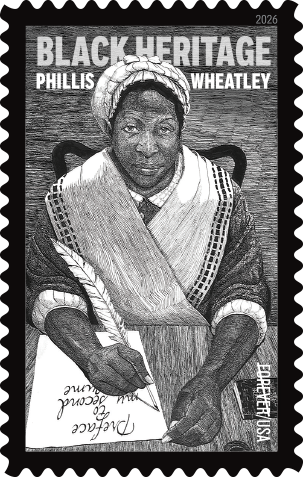
Shown above is the first-class stamp featuring Phillis Wheatley, just issued by the U.S. Postal Service.

Monday, January 26, 2026

Historical Signage Removed at Independence National Park

Back in September, I shared news reports of the Trump White House complaining about signs at the President’s House Site in Independence National Historical Park.

That mansion, now gone, was the home of Presidents George Washington and John Adams in the 1790s. During Washington’s time, it was a site of enslavement—and of self-liberation.

Two of the Washington’s staff, Oney Judge and Hercules Posey, escaped from bondage at that house and made their way to free lives in New Hampshire and New York, respectively. (Boston 1775 readers might recall this blog played a tiny part in documenting Posey’s presence in New York.)

In erecting brick walls to show the outline of the mansion, the National Park Service also developed detailed signage to interpret the history of that site for visitors. That’s standard N.P.S. procedure, with the material going through many reviews for accuracy.

Last week, the Philadelphia Inquirer reported that N.P.S. workers had acted under orders to remove all those signs. All that remains now is a list of the people documented as enslaved in President Washington’s household, etched in cement. (And I have no idea how long that list will remain visible.)

I first read complaints about commemorating slavery at Independence N.H.P. over twenty years ago on the Revlist discussion group. I pointed out that this was also a story of people gaining their liberty and independence, so what park could be more fitting?

The objector was unwilling to recognize that freedom for black Americans was more significant than comfort for white Americans. That same attitude is evident in the current trumpery from the White House.

This President’s respect for historical fact is evident in his June 2024 comment on Washington owning slaves: “Actually I think he probably didn’t.” Likewise his 4 July 2019 statement about how the Continental “Army manned the air, it rammed the ramparts, it took over the airports,…”

After years of complaints that any community’s removal or alteration of a statue or monument was tantamount to erasing history, this administration is literally erasing history from a public site. But only a particular sort of history. 

Monday, January 12, 2026

Online Lectures from the National Parks of Boston

The National Parks of Boston and the Boston Public Library are teaming up to offer some online lectures for the Sestercentennial.

The announcements of these events don’t names the speakers, but they’re usually N.P.S. rangers and other experts who have researched the topics thoroughly.

Wednesday, 14 January, 6 to 7:30 P.M.
Benedict Arnold: The Trials and Contributions of an Early Patriot
Register here

Before his name is booed across the land, Benedict Arnold was an avid supporter in the Patriot cause. In order for his name to be so reviled he first had to make an impact to the cause. This program will explore the contributions made by Benedict Arnold in the early stages of the Revolutionary War and shed light on the complexities of a man who has become synonymous with betrayal.

Wednesday, 28 January, 6 to 7:30 P.M.
In the Shadow of the Declaration: Boston’s Hidden Architects of American Freedom
Register here

Explore how the Declaration of Independence reshaped Boston by examining the experiences of communities often excluded from its promises. Look at how Black Bostonians organized and petitioned for freedom while women questioned their exclusion from political and social rights. Together, these perspectives reveal how independence sparked debates over who truly benefited from the Revolution, showing 1776 Boston as a place where the ideals of freedom were contested, expanded, and reimagined.

Wednesday, 25 February, 6 to 7:30 P.M.
“Donation People”: Refugees from the Siege of Boston
Register here

The talk will examine the experience of the poor and ill forced out of Boston during the 1775-1776 siege. The refugees, known as donation people, bore the brunt of the American Revolutionary war in Boston, yet their treatment by the people of Massachusetts represented a spirit of welfare in the new nation.

Wednesday, 11 March, 6 to 7:30 P.M.
The Siege of Boston: An Ending and Beginning
Register here

This talk will explore the Siege of Boston – its origins, impacts, and conclusion – and how the departure of the British Military from Boston would influence the pivotal year of 1776 and what became the Revolutionary War.

Wednesday, 25 March, 6 to 7:30 P.M.
Remembering Revolution: Protest and Celebration of the Bicentennial
Register here

This talk will explore how the Bicentennial was celebrated in Boston. Learn how through protest, reenactments, and celebrations, Bostonians claimed the legacy of the Revolution for themselves 50 years ago.

In addition, the central library’s exhibit “Revolution!: 250 Years of Art & Activism in Boston” is open to all in-person visitors through 21 April. “Featuring over 100 artworks and documentary materials from the Boston Public Library’s Special Collections…this exhibition brings to light both familiar and lesser-known stories about America’s ongoing struggle for freedom, civil rights, and belonging for all.”

Monday, October 13, 2025

On the Trail of Capt. William Browne

In the HUB History podcast episode “Drinker, Draftsman, Soldier, Spy,” Jake Sconyers quotes my remark on how difficult it is to track Capt. William Browne of the 52nd Regiment before 1775 because there were so many men named William Brown(e).

He also quoted a portion of Ens. Henry DeBerniere’s report on his spy missions with Capt. Browne that I’d read many times but hadn’t tumbled to how it’s helpful with that precise challenge.

One of my favorite moments in that narrative is when Browne, DeBerniere, and their manservant have reached Jonathan Brewer’s tavern in Waltham.

a little out of this town [Watertown] we went into a tavern, a Mr. Brewer’s, a whig, we called for dinner, which was brought in by a black woman, at first she was very civil, but afterwards began to eye us very attentively; she then went out and a little after returned, when we observed to her that it was a very fine country, upon which she answered so it is, and we have got brave fellows to defend it, and if you go up any higher you find it so,—

This disconcerted us a good deal, and we imagined she knew us from our papers which we took out before her, as the General had told us to pass for surveyors; however, we resolved not to sleep there that night, as we had intended, accordingly we paid our bill which amounted to two pounds odd shillings, but in [sic] was old tenor.

After we had left the house we enquired of John, our servant, what she had said, he told us that she knew Capt. Brown very well, that she had seen him five years before at Boston, and knew him to be an officer, and that she was sure I was one also, and told John that he was a regular—he denied it; but she said she knew our errant was to take a plan of the country; that she had seen the river and road through Charlestown on the paper; she also advised him to tell us not to go any higher, for if we did we should meet with very bad usage
That waitress didn’t just recognize Brown—she recognized him from “five years before at Boston.” That was in 1770, and there were only two British army regiments in Boston then: the 29th and the 14th. That narrows the field considerably.

Sure enough, the officers of the 14th included Lt. William Browne. On 12 July 1771, the War Office announced that “Lieut. William Brown, of the 14th regiment of Foot,” had purchased the rank of captain in the 52nd in the place of Archibald Williams. In the 14th, Ens. William Napier moved up to lieutenant’s rank.

One implication of that fact is that Gen. Thomas Gage might have chosen Capt. Browne to scout the countryside in 1775 because that officer was more familiar with Massachusetts than most of his colleagues, having spent about two years in Boston and on Castle Island back in 1768–1770.

Of course, that had the drawback of more people in Massachusetts being familiar with Browne, as the woman in Waltham showed.

For earlier information on Lt. Browne I hunted down the Army List for 1767. And I found this list of lieutenants in the 14th Regiment of Foot:
Goddammit!

Two men named William Browne became lieutenants in the 14th Regiment four days apart in June 1766. One of them had joined the army in 1762, the other at some unknown time. They were both still lieutenants in the 14th at the start of 1771. 

And during the same period when one or both of these lieutenants were serving in Boston:
And there were probably others.

TOMORROW: Capt. Browne’s own voice?

Saturday, October 11, 2025

Two Talks on Thursday, 16 Oct.

It used to be that when two historical organizations scheduled talks on the same night you had to choose between them.

Now, thanks to live-streaming, it’s may be possible to catch both events and not even leave the house to watch them.

Here are two interesting talks scheduled for this upcoming Thursday.

Thursday, 16 October, 6 P.M.
“Within the compass of good citizens”: Paul Revere’s Masonic Journey
Steven C. Bullock
Scottish Rite Masonic Museum, Lexington

From the son of an immigrant to speaking beside the governor on Beacon Hill, Paul Revere traveled far in his extraordinary life. His membership in the Freemasons played an important role in that journey. This talk will consider how the fraternal order fit into Revere’s life—and into the development of Boston and the new nation of which they were a part.

Bullock is a Professor of History at Worcester Polytechnic Institute and author of Revolutionary Brotherhood: Freemasonry and the Transformation of the American Social Order, 1730–1840. This lecture is produced in partnership with the Paul Revere House. It will take place in person at the museum and be livestreamed on YouTube by LexMedia.

Thursday, 16 October, 7 P.M.
I Am So Tired of Waiting, Aren’t You?: Revisiting Black Majority
Peter H. Wood
American Antiquarian Society, Worcester

Black Majority: Race, Rice, and Rebellion in South Carolina, 1670-1740, first published in 1974, marked a breakthrough in understanding of early American history. This landmark book chronicles the crucial formative years of North America’s wealthiest and most tormented British colony. It explores how West African familiarity with rice determined the Lowcountry economy and how a skilled but enslaved labor force formed its own distinctive language and culture.

In this annual Robert C. Baron Lecture, an A.A.S. member who has written a seminal work of history reflects on its impact since publication. The series was endowed to honor Robert C. Baron, founder of Fulcrum Publishing and chairman of the A.A.S. council for a decade. Wood will speak in person at the A.A.S., and people can register to watch online.

Sunday, September 28, 2025

A Last Word on Boston’s Sedan Chairs

Originally I flagged Alun Withey’s blog post about sedan chairs in Britain just because I thought it had interesting details about daily life in the eighteenth century.

But then I got interested in the question of whether those details also applied in Boston.

Looking for sedan chairs locally led me into the smallpox epidemic of 1764, and thus to the name “Williston” appearing over and over in the selectmen’s records. So I had to figure out who Thomas Williston was.

So, having spent nearly a week on what I’d thought was a one-day topic, I’m coming back around to complete this sedan chair trip with some familiar names.

In 1769 the smallpox virus flared up again in Boston, though not nearly as badly as five years before. On 21 June the selectmen’s minutes reported:
Mr. Thomas Cunningham living near Dr. [Jonathan] Mountforts gives information to the Selectmen, that one Joseph Hading who came to his House on Satturday last, from a Vessel which then arrived here from Philadelphia is suspected of having the Small Pox broke out upon him.

Dr. [Joseph] Warren was in consequence of the above information sent to the said Cunninghams house to examine into the same, who having done it, makes Report that the Person has got the Small Pox.

Whereupon the Sedan was sent to carry him to the Hospital at New Boston.
“Mountforts Corner” was the site of a well-known apothecary shop in the North End. The Jonathan Mountfort running it in 1769 was a son of the man with the same name who’d set it up. When he died in 1781, the business passed to his own son, also named Jonathan (born in 1746 and painted as a kid by the young John Singleton Copley, as shown above courtesy of the Detroit Institute of Arts). That third Jonathan Mountfort died only four years later, but the name survived for at least another decade.

In late July 1769 the selectmen sent the town sedan chair to carry more smallpox victims to the province hospital: “Mr. Jabez Searl,” “a Child a Daughter of Abijah Lewis,” and “Capt. Timothy Parker…between the Hours of Two & Three OClock in the morning.” (Others, such as “a Negro Woman Servant to Mr. William Wingfield,” were simply ordered to be removed to the hospital, and it’s not clear how that happened.)

These people were surprised to be catching smallpox. They must not have volunteered to be inoculated with what doctors believed was a mild strain. Health statistics stretching back decades showed that contracting the disease “in the natural way” was more deadly than being inoculated. And indeed, by 9 August, Searl and Parker had both died.

A few months later, the army drummer Thomas Walker was carried to the hospital in what he called “the Machine for the Conveniency of Removing the Sick.” He didn’t have the smallpox; instead, he’d been injured in the fight between soldiers and ropemakers on 2 Mar 1770. I wonder if that “Machine” was the town sedan chair or if the army had its own equipment.

My next milestone in the story of sedan chairs in Boston comes in 1799. In that year the town established its first board of health. Paul Revere was board president, the silversmith’s highest civic office. On 8 Apr 1800, the selectmen’s records say: “On application from the Board of Health, order’d that the Sedan Chairs belonging to the Town be delivered to them for their use”.

Thus, in eighteenth-century Boston, sedan chairs were ambulances. We can find a few individual sedan owners in the records, but they appear to have been in poor health. The appearance of a sedan chair on your street signified not luxury but illness.

Saturday, September 20, 2025

New Research on the Vassall Mansion in Cambridge

The Longfellow House–Washington’s Headquarters National Historic Site is unveiling a special history study researched over many years and in multiple countries. It adds tremendous detail to a dimension of that Cambridge mansion that people have long known about more generally.

That mansion in Cambridge was built in 1759 for John Vassall, heir to wealthy slave-labor plantations on Jamaica. It was not only erected with the profits of slavery, but it was staffed by enslaved workers for two decades.

While John Vassall took his family to England in the first year of the Revolutionary War, at least one family he had enslaved, led by Tony and Cuba Vassall, stayed behind to gain their freedom and found an African-American community nearby.

Black History at the Vassall Estate by Caitlin DeAngelis, Carla D. Martin, Rayshauna C. Gray, Aabid Allibhai, and Eshe Sherley digs into that story from every possible angle, using archives in the U.S. of A., Jamaica, Antigua, and Britain. The story it tells extends from the origins of the (white) Vassall family fortune through the political activity of the (black) Vassall family in the ante-bellum republic.

Two events in the next month will illuminate those findings for the public.

Thursday, 25 September, 6 to 7 P.M.
Black History at the Vassall Estate
Caitlin DeAngelis, Carla Martin, Rayshauna Gray, Aabid Allibhai, and Eshe Sherley
Online, free with registration

A new landmark study documents and analyzes the Black experience at 105 Brattle Street and in the wider Cambridge community from the mid-1700s to the mid-1800s. The authors will introduce the project, share key findings, and take you behind the scenes of their research and writing process.

This study is remarkable not only for the history it documents—much of it appearing in print for the first time—but also for the breadth of research behind it. In partnership with lineal descendants of the Black Vassalls, the authors consulted sources spanning New England, the United Kingdom, and the Caribbean over the course of more than three years. Research of this scale is rare, and even more rarely presented in a format accessible to all readers.

Everyone who registers for that event will receive a digital copy of the study, which is also available for downloading here.

Sunday, 12 October, 1 to 3 P.M.
In Search of Darby Vassall: Tour of Cambridge & Beyond
Denise Washington and Joel Mackall
Free with registration

Starting at Longfellow House–Washington’s Headquarters, travel by trolley in greater Cambridge between seven stops with a Vassall descendant and an educator. Each stop reflects a key location in the life of Darby Vassall (1769-1861), a lifelong community activist who endured slavery and seized freedom with his family in Revolutionary Cambridge. Early dinner provided after the tour.

Monday, September 01, 2025

Colonel Louis, Caesar Marion, and More

Here are a couple of new online resources exploring aspects of the first months of the Revolutionary War in New England.

The Longfellow House–Washington’s Headquarters National Historic Site has posted Dr. Benjamin Pokross’s article “General Washington in the Native Northeast.” It begins:
It had been ten days since the Caughnawaga Mohawk men had arrived at the camp in Cambridge with their wives and families, and George Washington was still not sure what he was going to do. This was the second time that one of their leaders, Atiatoharongwen (also known as Col. Louis Cook), had come to Cambridge, and he had again made it known that he could raise four or five hundred men to fight for the colonists if he was given a commission in the Continental Army. But Washington was unsure how he would pay for all these additional soldiers if Atiatoharongwen did what he said, and even more apprehensive about the idea of engaging Indigenous allies at all. At least it had stopped snowing on the clear, cold, morning of January 31, 1776; this was the day Washington had promised to meet the Mohawk delegation outside.

Washington’s “Out-Door’s Talk”, as he called the subsequent conversation in a letter to General Phillip Schuyler, would be the most extensive of several interactions with Indigenous people he had had while he lived in the Vassall House. These visits did not result in decisive alliances or enduring treaties. They matter, however, for two reasons. The first is that they emphasize how the Revolution—normally thought of as a conflict between American colonists and the British—occurred on Native land, in areas that had long been stewarded by Indigenous communities and where Native people continued to find ways to survive in spite of colonial upheaval. Secondly, these visits highlight the unsettled and transitional character of the very early days of the Revolution. For both Washington and the Native diplomats who came to visit him, this was a moment of experimentation, of exploring what a possible relationship between the Continental Army and Indigenous Nations could look like.
At the HUB History podcast, Jake Sconyers shared an episode on “The Well Known Caesar Marion.”
In this somewhat brief episode, we’re going to look at why Mr. Marion was thrown into Boston’s notorious jail 250 years ago this week, and then we’ll compare his treatment inside British-occupied Boston with the experience of Black volunteers in the Continental Army outside Boston, once Virginia enslaver George Washington took command.
Both Pokross and Sconyers explore moments when Washington was pushed out of his comfort zone by encounters with men of color. And in both cases, while he never stopped being a planter with aristocratic ambitions, Washington was able to shift his habits and show respect for allies.

(Hearing the podcast also reminded me that I broke off a short series about Marion, promising more was “COMING UP,” nine years ago. I won’t get back to that story this week, but it’s back on my to-do list.)

Sunday, August 24, 2025

“A beautiful tribute to so many American heroes”

After the White House issued its letter illegally demanding control over the Smithsonian Institution, Donald Trump weighed in through his preferred method of communication: a rant on his Truth Social microblogging network.

As usual, Trump’s presentation of the situation was more bombastic and expansive than actual policy, or actual facts:
The Museums throughout Washington, but all over the Country are, essentially, the last remaining segment of “WOKE.” The Smithsonian is OUT OF CONTROL, where everything discussed is how horrible our Country is, how bad Slavery was, and how unaccomplished the downtrodden have been — Nothing about Success, nothing about Brightness, nothing about the Future. We are not going to allow this to happen, and I have instructed my attorneys to go through the Museums, and start the exact same process that has been done with Colleges and Universities where tremendous progress has been made. This Country cannot be WOKE, because WOKE IS BROKE. We have the "HOTTEST" Country in the World, and we want people to talk about it, including in our Museums.
This produced a lot of responses, many pointing out how the complaint about museums portraying “how bad Slavery was” matches the Trump administration’s moves to honor Confederates, remove African-Americans from positions of authority, and roll back programs to remedy the effects of historic racism.

Others noted the ridiculousness of complaining that history museums should be more focused on “the Future” and less on the past.

Politifact rated Trump’s claim that the Smithsonian Institution museums include “nothing about success, nothing about brightness, nothing about the future” [capitalization corrected] as “Pants on Fire.” Its analysis said in part:
A walk through the [African-American history] museum’s six levels reveals its overwhelming focus on Black Americans’ resilience, strength and success. . . .

Smithsonian museums are also chock full of patriotic items and exhibits celebrating American culture. . . .

As for "brightness," it’s hard to ignore the nonpartisan pop culture icons at the American history museum, from Kermit the Frog to "Star Wars" droids and basketball legend Michael Jordan.
Author Jonathan M. Katz wrote on Bluesky:
The funny thing about this is that the Smithsonian African American History Museum is built around the exact "Success" narrative Trump claims to want. You climb through the Middle Passage, slave cabin, Jim Crow train, etc, and come out into Oprah's studio and Obama.
But we have to wonder if success for African-Americans counts as success for Trump.

The Civil War historian Kevin M. Levin offered further analysis on Substack:
The Smithsonian and National Park Service are not leaders in the direction of historical interpretation and trends in public history. They largely reflect changes that have already taken place. More broadly, these institutions reflect cultural and societal shifts that have already been established.

Another way to make this point is to say that if you are a young activist, committed to instilling Americans with radical leftist ideas, the last place you will want to work is at the Smithsonian or National Park Service. Such a career move promises a lifetime of disappointment and frustration.
Levin also noted that Trump visited the National African American History Museum around the time he first entered public office in 2017 and came out saying, “This museum is a beautiful tribute to so many American heroes.”

According to a Washington Post article from 2019, based on Smithsonian director Lonnie Bunch’s memoir, that visit was more fraught behind the scenes.
The incoming president wanted to come on the holiday commemorating the Rev. Martin Luther King Jr., according to the memoir. The administration also asked that the museum be closed to the public during the visit. “The notion that we could shut out visitors on the first King holiday since the opening of the museum was not something I could accept,” Bunch writes. Another day was chosen. . . .

Before the president-elect arrived, his aides told Bunch that Trump “was in a foul mood and that he did not want to see anything ‘difficult,’ ” Bunch writes. Nevertheless, Bunch started the tour in the history galleries, which begin with the global slave trade.

“It was not my job to make the rough edges of history smooth, even for the president,” he writes. . . .

“The president paused in front of the exhibit that discussed the role of the Dutch in the slave trade,” Bunch writes. “As he pondered the label I felt that maybe he was paying attention to the work of the museum. He quickly proved me wrong. As he turned from the display he said to me, ‘You know, they love me in the Netherlands.’ All I could say was let’s continue walking.”

“There is little I remember about the rest of the hour we spent together. I was so disappointed in his response to one of the greatest crimes against humanity in history,” he continues. “Here was a chance to broaden the views and the understanding of the incoming president and I had been less successful than I had expected.”
It looks like Trump now has no memory of that visit.

Also, for the record, the Dutch, like most people around the world, had a negative view of Donald Trump. In 2017 the Pew Research Group reported that Dutch confidence that the U.S. President would do the right thing had gone down 75 percentile points in the shift from Barack Obama (92%) to Trump (17%). As of June 2025, the same global survey reported that 63% of the people in the Netherlands have no confidence at all that Trump will do the right thing as President.

Wednesday, July 23, 2025

Call for Papers on “Freedom, Slavery, and Race in the American Revolution”

The Sons of the American Revolution is sponsoring a scholarly conference at Wake Forest University in Winston-Salem, North Carolina, on 29–31 May 2026 on the topic “Freedom, Slavery, and Race in the American Revolution.”

Here’s the call for papers:
The conference will examine the experiences of African American people and the ideologies of freedom, slavery, and race in the War for American Independence and the founding of the United States.

In his 1776 essay Liberty Further Extended, Lemuel Haynes denied that “Liberty is so contracted a principle as to be Confin’d to any nation under Heaven; nay, I think it not hyperbolical to affirm, that Even an African, has Equally as good a right to his Liberty in common with Englishmen.” This Black patriot and soldier connected freedom, citizenship, and nation. How actors in the American Revolution experienced, articulated, or contested these ideas is the question that drives this conference.

The conference intends to examine perspectives from Black and White men and women aligned with the Patriots or Loyalists. We also invite comparisons between the young United States and the broader revolutionary Atlantic World.

The S.A.R. invites proposals based on new research from graduate students, established scholars, and public history practitioners. Proposals should include a 250-word abstract introducing the author’s research and how their topic advances the field, and a two-page vita.

Submit proposals by October 1, 2025, to John Ruddiman, Department of History, Wake Forest University at Ruddimja@wfu.edu with the subject line “2026 SAR Conference.” Acceptances will be sent by early December 2025.

The S.A.R. anticipates publication of the accepted, revised papers in an edited volume. To facilitate that, participants will submit their papers (approximately 5,000–6,000 words) for pre-circulation by May 1, 2026.
The society will offer cover presenters’ travel and lodging expenses and pay each a $500 honorarium.

Tuesday, July 22, 2025

Anishanslin on The Painter’s Fire in Boston, 23 June

On Wednesday, 23 June, Zara Anishanslin will speak at the Massachusetts Historical Society on her new book, The Painter’s Fire: A Forgotten History of the Artists Who Championed the American Revolution.

Zara Anishanslin is a professor at the University of Delaware. Her last book was Portrait of a Woman in Silk: Hidden Histories of the British Atlantic World, winner of The Library Company of Philadelphia’s first Biennial Book Prize.

I got to hear Prof. Anishanslin speak about The Painter’s Fire at the Dublin Seminar for New England Folklife last month. Previous studies of American-born painters in the Revolutionary world have focused on men like John Singleton Copley, Benjamin West, and Ralph Earl—all important artists but also Loyalist in that conflict.

In contrast, Anishanslin looks at three artists who actively supported the new American republic in one way or another: Robert Edge Pine, Prince Demah, and Patience Wright. Pine was a British native, Demah was born enslaved, and Wright was a woman working in wax rather than portraiture, so their lives expand the traditional scope of artists’ studies in other ways as well. Their careers also intersected in interesting ways.

When I first wrote about Prince Demah back in 2006, all that I knew was his first name, that he was enslaved to Christian Barnes in Marlborough, and that she wanted to get him some training as a painter. Research by Paula Bagger and others revealed Demah’s transatlantic career, service in the Continental Army, and more. It’s exciting to see those facts come into the light.

The talk is the society’s Annual Jack Grinold Lecture in American Art and Architecture. It will begin with a reception for in-person attendees at 5:30 P.M. Prof. Anishanslin’s talk (and the online stream) will begin at 6:00. The event is free to society members and online attendees, $10 for others. Register here.

Sunday, July 20, 2025

“There are always joys while going through manuscripts”

Last month, Commonplace published Jayne Ptolemy’s “The Record Scratch: Uncovering Documents Relating to William Ansah Sessarakoo,” and I recommend reading the whole article.

Ptolemy, who’s on the staff of the William L. Clements Library in Ann Arbor, wrote:
The Clements holds the papers of Charles Townshend (1725-1767), who served as Secretary of War during the Seven Years’ War and the Chancellor of the Exchequer in the decades leading up to the American Revolution. These days, he is mostly known as the straw man for incendiary British taxation policies due to his role in sponsoring the infamous Townshend Acts.

Internally at the library, however, we mostly grumbled about him under our breath because his papers were in a complicated arrangement, the finding aid was difficult to navigate, and the boxes even harder to pull for researchers. It needed someone to puzzle out what was in each box and add descriptive information to the finding aid to make it more manageable. Unfortunately, I don’t have a penchant for economic history, so figuring out how to describe the contents of “Miscellaneous Treasury Papers” meant trying to disambiguate a great many reports on tariffs, duties, and excises.

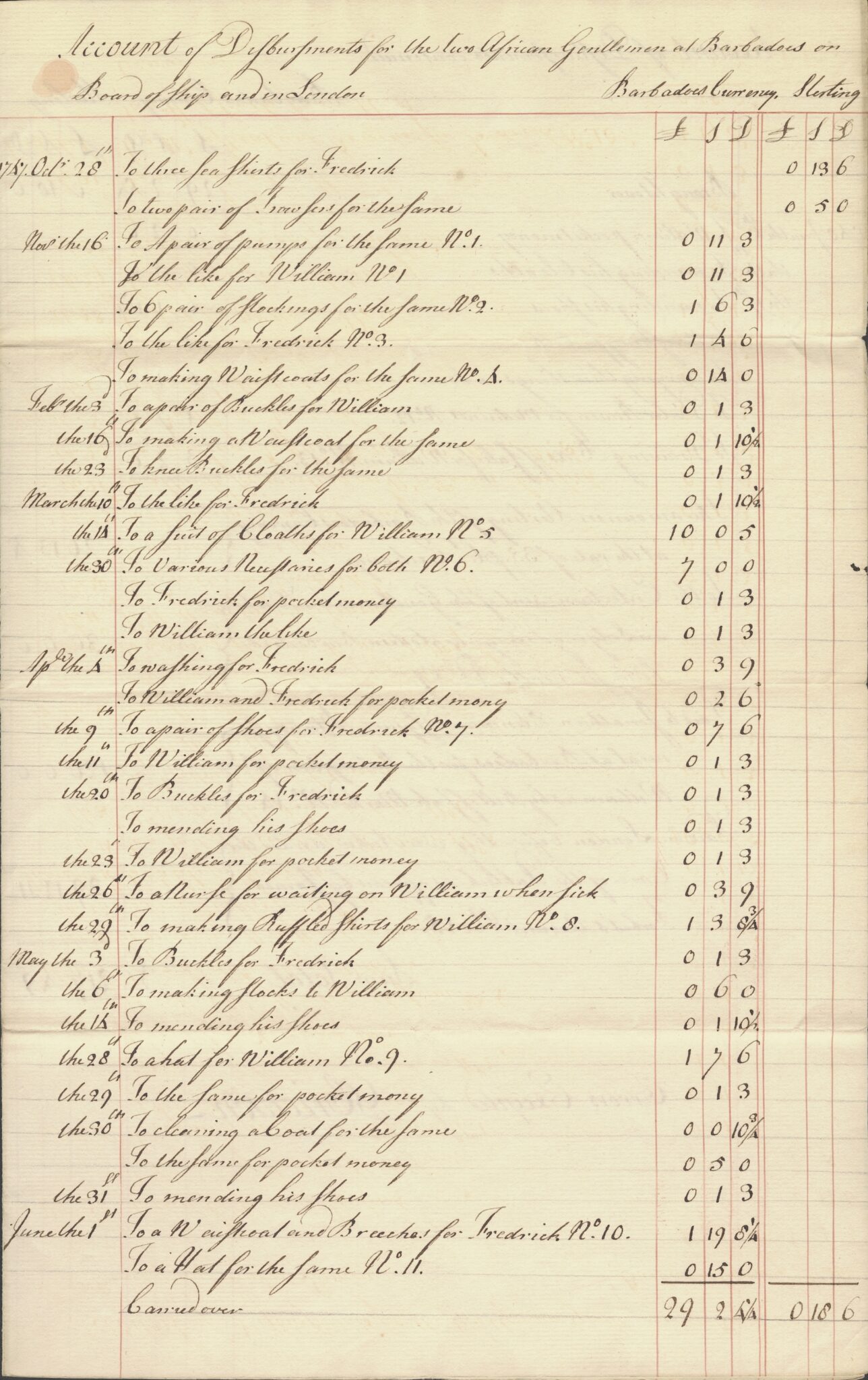
There are always joys while going through manuscripts—an unexpected doodle, a funny quote, beautiful papers—but most of what I was encountering was financial document after financial document–Until one stopped me right in my tracks. It referred to expenses “for the two African Gentlemen at Barbadoes.” Written in 1747, the use of “Gentlemen” to describe African peoples was eye-catching enough, but glancing down at the accounts, the entries for making waistcoats, providing pocket money, buying ruffled shirts, and more signaled something extraordinary. . . .

And then, a document written from Bridgetown, Barbados, laid it all out:
Whereas John Corrantee and the Caboceers of Annamabo are at present exceedingly well disposed towards the British Nation, and beg the resettlement of that place by the English, and the fort to be rebuilt

And whereas a Son of John Corrantee’s Named Ansah was sold here by Captain Hamilton who he (Corrantee) is very anxious to have redeemed

We hereby give it as our Opinion that the Redemption of the said Ansah will be very acceptable to John Corrantee (who is the leading man at Annamabo) . . . and will be a means to conciliate Corrantee to, and rivet him in the Interest of the British Nation in opposition to the French, who have been aiming for some Years past at the aforesaid settlement.
OH.

OH NO.
“The Record Scratch” is a fine metaphor for that moment, though I don’t think it gives a good sense of the rest of this article.

Friday, June 13, 2025

Going Back onto Noddle’s Island

The message from Thomas Chase quoted yesterday makes clear that in 1780 Henry Howell Williams still felt he had a claim to “the Soil” of Noddle’s Island.

Williams had leased and farmed the harbor island for years before the Revolutionary War—as his father-in-law had done before him.

But that letter doesn’t indicate Williams was living on that island again. Williams’s appearances in the Boston newspapers during the previous half-decade also suggest he wasn’t.

On 7 Sept 1775, during the siege, Thomas Bumstead put a notice in the New-England Chronicle about “a likely, well built black Mare, and a Colt by her Side,” that were “STRAYED or stolen from Mr. Henry Williams, of Roxbury.” Henry Howell Williams did raise horses on Noddle’s Island, and he may well have gone back to his father’s family in Roxbury during the siege. On the other hand, the lack of a middle name or initial might suggest this was one of his relatives with a similar name, also raising horses.

More telling, on 24 Mar 1777 James Bell advertised in the Boston Gazette for the return of a stout 28-year-old black man named Dick, who had freed himself from slavery. Bell was from Colrain, and he told readers they could deliver Dick “to Mr. Henry Howell Williams in Boston.”

On 7 Sept 1778, Henry Howell Williams himself advertised in the same newspaper for the return of an enslaved 23-year-old woman named Phillis. That notice was datelined in Boston.

Thus, in those two years Williams could be found living in Boston, not in Chelsea, as Noddle’s Island was designated. Meanwhile, the island was occupied by provincial troops and then sick French soldiers.

Then the war ended. On 11 June 1784, the Massachusetts house received “A petition from the Rev. Charles Chauncey [shown above] and others, owners of Noddle’s island, in Boston harbour, stating that said island had been greatly damaged by the troops stationed there, and praying for some compensation.” Chauncy’s third wife had inherited an interest in Noddle’s Island which passed to him on her death in 1783, and then to his heirs.

Williams and his family returned to Noddle’s Island around that time. Back in the early 1770s he had run regular ads complaining about hunters and other trespassers. He did so again in the 15 Aug 1784 Independent Ledger, saying that “Gunners” were endangering his livestock, his mowers, and his family. That notice was signed from “Noddle’s-Island.” Obviously, the farm was back in operation.

As Williams rebuilt his estate, he probably commandeered the barracks originally constructed for Continental troops in Cambridge and then moved to the island by the state in 1776. After all, no one was using that building anymore.

TOMORROW: Renewing the quest for compensation.

Monday, March 24, 2025

“This distortion of history renders the past unrecognizable”

Earlier this month, the nation’s two main associations of historians issued this statement condemning federal censorship of the nation’s history:

The American Historical Association (A.H.A.) and the Organization of American Historians (O.A.H.) condemn recent efforts to censor historical content on federal government websites, at many public museums, and across a wide swath of government resources that include essential data. New policies that purge words, phrases, and content that some officials deem suspect on ideological grounds constitute a systemic campaign to distort, manipulate, and erase significant parts of the historical record. Recent directives insidiously prioritize narrow ideology over historical research, historical accuracy, and the actual experiences of Americans.

As the institution chartered by the U.S. Congress for “the promotion of historical studies” and “in the interest of American history, and of history in America,” the American Historical Association must speak out when the nation’s leadership wreaks havoc with that history. So, too, must the O.A.H., as the organization committed to promoting “excellence in the scholarship, teaching, and presentation of American history.” It is bad enough to forget the past; it is even worse to intentionally deny the public access to what we remember, have documented, and have expended public resources to disseminate.

At this writing, the full range of historical distortions and deletions is yet to be discerned. Federal entities and institutions subject to federal oversight and funding are hastily implementing revisions to their resources in an attempt to comply with the “Dear Colleague” letter issued by the Department of Education’s Office of Civil Rights and executive orders such as “Defending Women from Gender Ideology Extremism and Restoring Biological Truth to the Federal Government.” These changes range from scrubbing words and acronyms from websites to papering over interpretive panels in museums. Some alterations, such as those related to topics like the Tuskegee Airmen and the internment of Japanese Americans during World War II, have been hurriedly reversed in response to public outcry. Others remain. The scrubbing of words and acronyms from the Stonewall National Monument webpage, for instance, distorts the site’s history by denying the roles of transgender and queer people in movements for rights and liberation. This distortion of history renders the past unrecognizable to the people who lived it and useless to those who seek to learn from the past.

It remains unclear whether federal agencies are preserving the original versions of these materials for future reference or research. Articles written by historians for the National Park Service, for example, have been altered, and in some instances deleted, because they examine history with references to gender or sexuality. These revisions were made without the authors’ knowledge or consent, and without public acknowledgment that the original articles had been revised. The A.H.A.’s Statement on Standards of Professional Conduct is clear: “Honoring the historical record also means leaving a clear trail for subsequent historians to follow. Any changes to a primary source or published secondary work, whether digital or print, should be noted.”

Words matter. Precision matters. Context matters. Expertise matters. Democracy matters. We can neither deny what happened nor invent things that did not happen. Recent executive orders and other federal directives alter the public record in ways that are contrary to historical evidence. They result in deceitful narratives of the past that violate the professional standards of our discipline. When government entities, or scholars themselves, censor the use of particular words, they in effect censor historical evidence. Censorship and distortion erase people and institutions from history.

The A.H.A.’s Statement on Standards of Professional Conduct makes clear that historians can neither misrepresent their sources nor omit evidence because it “runs counter” to their interpretations. The O.A.H. and A.H.A. condemn the rejection of these professional standards. Classifying collective historical scholarship as “toxic indoctrination” or “discriminatory equity ideology” dismisses the knowledge generated by the deep research of generations of historians. It violates the training, expertise, and purposes of historians as well as their responsibility to public audiences.

Our professional ethics require that “all historians believe in honoring the integrity of the historical record.” We expect our nation’s leadership to adhere to this same basic standard and we will continue to monitor, protest, and place in the historical record any censorship of American historical facts.
Several other societies affirmed their support for this statement: the Association of University Presses, Education for All, Labor and Working-Class History Association, National Council for the Social Studies, North American Conference on British Studies, PEN America, and the Society for U.S. Intellectual History.

The examples of suppressed information in this statement are all about twentieth-century history, but White House demands haven’t spared Revolutionary parks. For example, at the beginning of this year one park’s webpage on non-white people working for American independence included this question: “Why don’t we hear more about this part of the American Revolution?” The answer was historic racism. We’ve known that since William Cooper Nell’s work in the 1850s. But the current administration doesn’t like that answer, so it’s gone.

Fortunately, the rest of that webpage remains, as do many related articles and profiles on the same site. The hard-working staff of the N.P.S. is still dedicated to telling our national story, including the hard parts, as fully and accurately as they can.

And on that topic, the Sestercentennial events at Minute Man National Historical Park include:

Saturday, 19 April, 3 P.M.
A Fight for Freedom: Patriots of Color Walking Tour
start at the North Bridge Lower Parking Lot on Monument Street

Sunday, March 16, 2025

“Phebe Oliphant (a Black woman)”

At the Eleven Names Project, Wayne William Tucker shared a long essay about the preferred names of the black woman who helped to raise Abigail Adams and was part of her household later in life.

As Abigail grew up and married, that woman was enslaved to her father, the Rev. William Smith, probably coming from the family of her mother, formerly Elizabeth Quincy. The Quincy and Smith families referred to her by her first name only: Phoebe.

After becoming free in 1783, Phoebe married a man whom Abigail referred to as “Mr. Abdee.” Seeking to treat her in the same way as white women, the Adams Papers editors therefore referred to her as Phoebe Abdee.

Following that lead, I’ve tagged her under the name Phoebe Abdee. So did Woody Holton in one of the few articles written about her.

Tucker has found a more complex story in local records, however, indicating that Phoebe did adopt her husbands’ surnames—but Abdee wasn’t one of them.

First, Tucker brings up the possibility that Phoebe married and had children while enslaved to the Smiths, based on mentions of other people in the accounts settling the minister’s estate in 1784. That’s just a possibility, though.

In 1777, the Rev. Mr. Smith read out an intention to marry for his “Phebe” and “Brester Sternzey of Boston.” There’s no confirmation this union went through. (Boston’s town records don’t mention this intention. They state that the Rev. Joseph Eckley married Bristol Stenser and Deborah Foster on 16 Dec 1784.)

In 1784, Phoebe married a man Abigail Adams identified as “Mr. Abdee whom you know.” His name appears in town records as Abdi and Abda, elsewhere as Abdy. Tucker connects this man to “Abde Deacon Savil’s negro man,” who had married a woman enslaved to a Braintree minister back in 1754. It appears that Abdee (however spelled) was his given name, and that after emancipation (if not before) he used Savil as his surname. This man died in the first week of 1798, according to Abigail’s sister Mary Cranch.

On 19 Sept 1799, Quincy vital records show a woman named Phebe Savil marrying William Olifant. A month later, John Adams mentioned that Phoebe had remarried. In 1800, Abigail referred to Phoebe’s husband as William for the first time.

Finally, on 7 Oct 1812, weeks after Abigail referred to Phoebe as “sick and dying,” the Quincy records state that “Phebe Oliphant (a Black woman”) died at age eighty-three.

As Tucker says, the coincidences of the dates strongly suggest that the Adamses were referring to Phebe Savil/Oliphant, the woman Abigail had known all her life, without using her surnames.

Thus, it appears that “Phoebe Abdee” went by:
  • Phebe as an enslaved woman, not by choice—her choice of surname, if any, unknown.
  • Phebe Savil from 1784 to 1799, after her husband Abdee.
  • Phebe Oliphant from 1799 to 1812, after her husband William.
This is a nice piece of research, supported by clips of the documents themselves, which helps to fill out a life we’ve known only through the Adams family.

Wednesday, March 05, 2025

Valuing the Philip Mortimer Estate’s Human Property

After Philip Mortimer’s death, his executors began to work through his substantial estate in Middletown, Connecticut.

As quoted yesterday, executors Elihu Starr and George Phillips advertised for creditors and debtors to come settle their accounts with George Starr, acting as their attorney. And also for people to bring back any borrowed books.

In August 1795 the executors submitted Mortimer’s will and codicil to the probate court. The man’s estate was appraised at almost £5,000.

That legal paperwork included another list of the people Mortimer had enslaved, most of whom his will freed according to one schedule or another:
  • Briston, aged 60, called Bristol in the will
  • Jack
  • Dublin, not mentioned in the will
  • Prince, “sick with the yaws”
  • Peter, “on board man of war and likely dead”
  • Sophy, labeled a “girl” like the following two but old enough to have three sons; the Barbour collection says she was born in 1752 
  • Silvy, born 1773 
  • Peg, born 1777 as Margaret—though other documents estimate her to have been about 20 years old in 1794
  • Lester, born 1787, first of three sons of Jack and Sophy
  • Dick, born 1789 as Richard 
  • John, born 1790
  • Rachel, a “girl child,” born 1793, perhaps the daughter of Hagar, mentioned in the will, or Amarillas, born 1770
As property, all these people were assigned a monetary value. But those low values reflected how Connecticut was turning away from slavery. Mortimer was the state’s biggest single slaveholder in 1790, but his human property comprised less than .1% of his estate.

Jack was valued at £10, Sophy and the three boys at £5 each. The women Silvy and Peg were each valued at £1. The other four men and the little girl were assigned a market value of zero. That makes sense for Peter, who was out of reach in at least one way, but those prices suggest the appraisers thought any purchaser would have a hard time compelling most of the other people to work, or getting more value out of them than the cost of maintaining them.

In contrast, back in 1740 the inventory of Daniel Jones of Colchester valued a “young man” and a “negro wench” at £150 each, “an old negro man” at £40, and a boy at £25. Two years later, Samuel Allyn of Windsor priced his “servants, Cyrus and William,” at £100 apiece.

Almost all of the people listed in Philip Mortimer’s inventory appear to have still been living on his estate or nearby, continuing their work in his ropewalk or fields or house. Indeed, Jack and Sophy had another baby, Charles, in 1795; the local vital records assigned him to the Mortimer household even though the patriarch was dead.

The one exception among those workers was Peter. Mortimer mentioned him in the 1792 will and 1794 codicil, meaning he was still in Middletown then. Had he left for the sea after the old man’s death? If so, he was exercising the freedom Mortimer promised, but the appraisers didn’t think that had turned out well for him.

The probate court accepted Philip Mortimer’s will. It even accepted his codicils, one unsigned and the other unwitnessed. Though he was in his tomb, the man’s wishes still carried some authority in Middlesex County, Connecticut.

But there was one wrinkle: George Starr asked the court to relieve him of his job as executor.

TOMORROW: That freed Starr to contest the will.