


J. L. BELL is a Massachusetts writer who specializes in (among other things) the start of the American Revolution in and around Boston. He is particularly interested in the experiences of children in 1765-75. He has published scholarly papers and popular articles for both children and adults. He was consultant for an episode of History Detectives, and contributed to a display at Minute Man National Historic Park.

Subscribe thru Follow.it


•••••••••••••••••


Showing posts with label John Lovell. Show all posts

Sunday, December 25, 2022

A “Christmas eve” in John Adams’s Imagination

On 23 July 1813, John Adams wrote to his son-in-law, William Stephens Smith, then serving in the U.S. House of Representatives.

That letter was about political affairs, with the war going badly for the U.S. of A., but another big theme was how no one appreciated John Adams.

In making that case, the former President drew up a picture, possibly conjectural, of a Christmastime tradition among certain Boston gentlemen of the mid-1700s:
Remember the fate of Cassandra. The prophet of ill ’tho’ as true as a goose’s bow is always detested. I also have been now and then reckoned among the minor prophets. Not a bone of any Goose ever picked by Jo Green, Nick Boylston, & Master Lovel on a Christmas eve, tho’ they had Nat Gardner for a guest, and exhausted all their wit, Gibes, & Jokes upon it, ever foretold an approaching winter, with more certainty that I have foreseen two or three small events in the course of my Life, such as the American Independence, & the result of the french revolution for example. But I was always execrated for it; & persecuted worse than the hebrew prophets, when they were set in the stocks.
“Jo Green” was Joseph Green (1706–1780), known for his biting literary wit. That seems to have manifest mostly in semi-anonymous verse poking at the Rev. Mather Byles, Sr., and anything new in town, like Freemasons. After a career as a merchant, Green took a post in the Customs service and then had to evacuate town as a Loyalist.

“Nick Boylston” was Nicholas Boylston (1716–1771), Green’s even more wealthy business partner. He and Green, both bachelors, owned houses near each other on School Street. Boylston is best known these days for his portraits by John Singleton Copley (one shown above). For those he posed as a wealthy man of learning, wearing a casual banyan and nightcap and leaning on a book. But I don’t recall any example of Boylston’s own writing or wit.

“Master Lovel” was John Lovell (1710–1778), master of the South Latin School for decades. He, too, was known for writing poetry, in his case serious verse and in various languages. Like Green and Boylston, Lovell’s surviving portrait shows him in a nightcap instead of a formal wig, signalling that he was concerned more with learning than with commerce. He, too, left Boston with the British troops in March 1776.

“Nat Gardner” was Nathaniel Gardner, Jr. (1719–1760), regarded in the 1750s as Boston’s leading poet, particularly in Latin. He was Lovell‘s usher, or assistant master, at the grammar school. Gardner died at forty-one and was soon largely forgotten. In 1989 David S. Shields wrote a study designed to bring him and his work back “from limbo.”

The appearance of Gardner at this Christmas Eve gathering shows that Adams was imagining a scene in the 1750s, when he himself was a university student, country schoolmaster, and legal trainee. He wouldn’t have been invited.

Nonetheless, Adams left a picture of how Boston’s small intellectual crowd spent their Christmas Eves, exchanging witticisms over a roasted goose.

Friday, June 10, 2022

A Boston Boy Rebuilding the British Empire

Yesterday’s précis of the life of Charlotte Biggs promised a connection to pre-Revolutionary Boston.

You remember that young man whom Charlotte fell in love with as a teenager before her marriage? The one who went off to India to make his fortune?

His name was David Ochterlony, and he came from Boston.

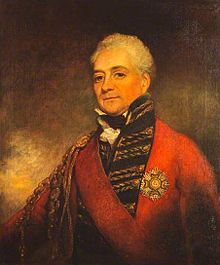
Ochterlony (shown here) was born on 12 Feb 1758, eldest son of a Scottish merchant captain with the same name. His mother was Katherine Tyler, a niece of the first Sir William Pepperrell. The family house from 1762 was a brick mansion on Back Street.

In 1766 David entered John Lovell’s South Latin School. The year before, however, his father had died on a voyage to the Caribbean. The estate was in debt, not paid off until well after the war.

What happened next to young David and his siblings isn’t easy to sort out. There’s evidence he spent some time studying under Samuel Moody at the Byfield school endowed by Lt. Gov. William Dummer, now the Governor’s Academy.

Katherine Ochterlony moved to Britain and in the early 1770s married Sir Isaac Heard, a Royal Navy veteran, merchant, and, of all things, heraldric official.

The Ochterlony children joined their mother in Britain, and Heard welcomed them into his family. It’s said that David developed a close relationship with his stepfather.

When the American War began, David Ochterlony showed his loyalty to the British Empire by joining the army, or pledging to. During this time in London, the teenager evidently met Charlotte Williams, and she fell in love with him.

Ochterlony shipped out to India as an army cadet. In 1778 he gained the rank of ensign, and in three years became quartermaster for the 71st Regiment. During the Second Anglo-Mysore War, connected with Britain and France’s fight on the other side of the world, Ochterlony was captured and spent two years as a prisoner. Then he returned to army staff positions.

The loss of the most populous North American colonies turned British attention to India, and Ochterlony’s career rose with the empire there. In 1812 he became a major general, and in 1816 a baronet and a Knight Grand Cross of the Order of the Bath. (Those are the sorts of honors his stepfather loved studying.) In the first quarter of the nineteenth century Ochterlony was among the British Empire’s most powerful administrators on the subcontinent.

Gen. Sir David Ochterlony was known for adopting the local aristocratic lifestyle rather than maintaining British, or Boston, ways. He had thirteen concubines or wives, who reportedly paraded around Delhi on elephants. A son by one of those women became the heir to his baronetcy after the general died in India in 1825.

Meanwhile, back in Europe, the teen-aged girl who had become Charlotte Biggs, author and intelligence source, was still carrying a torch for the aspiring officer she had met in the 1770s. When she wrote an autobiography late in life, she addressed it to Ochterlony, evidently still hoping to see him again. (That manuscript became the basis of Joanne Major and Sarah Murden’s biography, A Georgian Heroine.)

Sunday, May 10, 2020

Studying the Schoolmasters’ Salaries

Toward the end of their 8 May 1770 town meeting, Bostonians turned to approving salaries for the town’s schoolteachers.

There were five town schools—two grammar or Latin schools and three writing schools. However, not all the teachers were compensated equally. Here are the salaries for the masters at each school:
Obviously, the town valued John Lovell’s services significantly more than any other master. There were a number of factors, including his long tenure at the South Latin School and how that school was twice as large as the North Latin School. But the town always spent more on the grammar schools.

The disparity was even more pronounced when we add in the salaries that the meeting approved for each assistant master or usher:
  • James Lovell, usher, South Latin School: £60, plus £40 “as an encouragement for him to remain and exert himself in the Service of the Town the ensuing Year.”
  • James Carter, usher, Queen Street Writing School: £50, plus £25 for encouragement.
  • Assistant for the South Writing School, to be named later: £50.
  • Assistant for the North Writing School, to be paid through Tileston: £34.
Tileston’s assistant was William Dall, who turned seventeen years old in 1770. He was still an apprentice and thus worth only two-thirds of a regular usher’s salary.

At the South Writing School, Samuel Holbrook had become master partway through the school year after the death of his uncle Abiah, but he’d taught at the Queen Street School years before. His assistant might have been John Fenno, born in in 1751 and thus also still under age.

James Carter was an experienced teacher who would take over the Queen Street Writing School in a couple of years, which is probably why the town offered him “encouragement” to stay on the job.

But Boston really encouraged James Lovell at the South Latin School, paying him as an usher as much money as every master but his father. He was a Harvard graduate working under his father, and people might have felt he was turning away better prospects. Indeed, later that year, the congregation at Christ Church invited Lovell to preach during a dispute with their pastor, the Rev. Mather Byles, Jr.

That disparity in spending on the different schools becomes even more stark when we look at the number of children each of those schoolteachers served. Here’s how many scholars a town committee found at each school a couple of months later in 1770:
  • South Latin School, 137 boys.
  • North Latin School, 56 boys.
  • South Writing School, 231 boys.
  • Queen Street Writing School, 268 boys.
  • North Writing School, 250 boys.
Even without an usher at the North Latin School, the town was paying £320 to give 193 boys a grammar-school education (or, really, part of one since about two-thirds of each entering class dropped out without finishing). That’s per-pupil spending of £1.66.

Meanwhile, the town was spending £459 to educate the other 749 boys in the practical skills of handwriting and arithmetic. That was £0.61 per pupil.

Clearly the system favored the students at the Latin Schools, most of them coming from the town’s richer families. Though Boston prided itself on its public schools, the system wasn’t equitable. (And about half of the boys in town of school age weren’t in the public schools at all. Not to mention no girls or black children.)

There was one more piece of business for Boston’s 8 May 1770 town meeting: to vote £100 to David Jeffries “for his Services as Treasurer of the Town the Year past, and for all his Expences in that Office.” Someone had to pay the schoolmasters.

Monday, July 01, 2019

Schoolmasters with the Initials “J.L.”

As quoted yesterday, in the summer of 1775 London newspapers reported that letters found on the body of Dr. Joseph Warren after the Battle of Bunker Hill implicated some people in Boston as “spies.”

The newspapers disagreed on how many letters the royal authorities had found on Warren’s body—three or six. I don’t believe the text of any letter survives. But those documents prompted the arrest of schoolteachers James Lovell and John Leach on 29 June, twelve days after the battle.

This article from the Essex Institute Historical Collections shows James Lovell writing to friends outside the siege lines throughout May and June. In a 10 May letter, Lovell even told Oliver Wendell about the dangers of sharing sensitive information:
You must however give us no State Matters; for ’tis but “you are the General’s Prisoner,” and whip! away to the Man of War; as is the Case of poor John Peck. I carry’d him Breakfast to the main Guard yesterday, and again this Morning but he was carry’d off last Evening and put on Board Ship. Inquisitorial this!
The royal authorities released John Peck in a prisoner exchange on 6 June. However, the heavy losses at Bunker Hill made the royal authorities far less forgiving.

Lovell was a strong Patriot, known for orating on the memory of the Boston Massacre back in 1771. On 3 May he told Wendell that he was trying to get his wife and children out of Boston, but
I shall tarry if 10 Sieges take place. I have determined it to be a Duty which I owe the Cause & the Friends of it, and am perfectly fearless of the Consequences. An ill Turn, a most violent Diarhea, from being too long in a damp place, has confirm’d Doctr. [Joseph? Silvester?] Gardners advice to me not to go into the Trenches, where my whole Soul lodges nightly. How then can I be more actively serviceable to the Friends who think with me, than by keeping disagreeable post among a Set of Villains who would willingly destroy what those Friends leave behind them.
Lovell was probably writing in a similar vein to Dr. Warren and perhaps indeed sending out information useful to the provincial military. He took elementary precautions. As Sam Forman notes and the E.I.H.C. article shows, Lovell already often signed his letters with just his initials. In addition, he asked Wendell to be sure to seal all their correspondence. But there was no protection for the documents that Dr. Warren chose to carry onto the battlefield.

As for John Leach, he appears to have been dragged into this situation simply because he had the same initials as Lovell. It’s also possible that the letters mentioned teaching school. Boston had three schoolteachers with the initials “J.L.” One, John Lovell of the South Latin School, was a staunch Loyalist. The other two got hauled off to jail.

Then Leach’s specialty as a teacher of navigation became a liability. Lovell taught Latin and Greek—hardly sensitive subjects. But royal officers found “Drawings” in Leach’s home when they arrested him. Those probably included detailed nautical maps and sketches of the harbor.

On 19 July, after three weeks in jail, the schoolteachers and other prisoners were taken into a military court presided over by Maj. Thomas Moncrieffe. According to Leach, the proceeding confirmed how little evidence the authorities had on them:
Till this Time we did not know our Crimes, on what account we were committed, but now we found Mr. Lovell was charged with “being a Spy, and giving intelligence to the Rebels.” And my charge, “being a spy, and suspected of taking plans.” When Capt. [Richard] Symmes appeared, he knew so little of us, that he called me Mr. Lovell; he knew so little of us, that instead of being a just Evidence [i.e., witness], he appeared ashamed and confounded, and went off.
Nevertheless, Leach wasn’t released until 3 October.

In late August, Lovell told a friend “that he expects to be out soon, tryumphant over his Enemies,” and was ready to give up “idlely schooling the children of a pack of Villains” in Boston. Instead, the royal authorities kept him locked up through the end of the siege and then carried him off to Halifax. Eventually he was exchanged.

Lovell never did go back to teaching school. Instead, he became a delegate to the Continental Congress, where he managed the correspondence with America’s diplomats—this time using a code.

Saturday, October 21, 2017

“Colonial Boston’s Public Schools” at Old North, 1 Nov.

On Wednesday, 1 November, I’ll speak at the Old North Church on “Classes and Forms: The Landscape of Colonial Boston’s Public Schools.”

This talk is part of the Old North Foundation’s Speaker Series focusing on the ordinary people of Boston. The event description explains:
Colonial Boston took pride in its free public schools, which educated young Benjamin Franklin, Samuel Adams, John Hancock, Paul Revere, and thousands of other boys before the Revolution. But a close look at those five grammar and writing schools reveals that they provided only limited opportunities for middling-sort boys, not to mention no place for girls or non-white boys. Colonial Boston’s schools thus reflected and reinforced the town’s social and economic divisions. The creation of a new nation spurred major reforms in 1789, eventually leading toward today’s public education.
This talk is based on research I’ve presented at different scholarly conferences, most of which will appear in an upcoming volume from the Dublin Seminar on New England Folklife.

I started to look into Boston’s public schools to understand how the town’s pre-Revolutionary children spent their days. That effort soon forced me to give up a lot of assumptions I’d had about those schools, such as what they taught—they didn’t cover reading and writing, history, geography, science, or other standard modern topics.

Likewise, I had to discard idea about who went to those schools—only about half of the eligible white boys. And about how long those scholars lasted—two-thirds of more of the seven-year-olds entering the South Latin School taught by John Lovell (shown above) dropped out before finishing.

Thus, while Boston can pride itself on having the oldest public school system in the U.S. of A., legally open from the start to (white male) students from all classes, that pre-Revolutionary system didn’t provide equal opportunity as we might think. In 1789 the town had its first major debate on school reform since adding writing schools to the grammar or Latin school—reform explicitly driven by new republican ideas.

This talk is scheduled to start at 6:00 P.M. Register for the program here; the price is a “pay what you will” donation to the Old North Foundation.

Thursday, March 24, 2016

The Mystery of Poem XXIX

Yesterday I described the 1761 collection of poems titled Pietas et Gratulatio, designed to show off the learning of Harvard College in praise to King George III.

Although the college announced a competition for students and recent graduates, surviving copies of the book with handwritten notes indicate that many of the poems came from men well past their undergraduate days. That list included grammar-school master John Lovell, merchant and scholar James Bowdoin, the Rev. Samuel Cooper, and Dr. Benjamin Church. To be fair, those men all had received Harvard educations.

Several of the poems, particularly those in Latin and Greek, came from Stephen Sewall (1734-1804), who was a recent Harvard graduate. He was also on his way to becoming the college’s professor of Hebrew and other languages.

In 1809 the Monthly Anthology magazine of Boston used Prof. Sewall’s own copy of Pietas et Gratulatio to attribute the poem numbered XXIX to “Thomas Oliver, afterwards judge and lieutenant governour.” Thomas Oliver (1734-1815) would have qualified as a recent Harvard graduate, and he did become the last royal lieutenant governor.

However, Oliver was never a judge. In fact, no one matches that magazine’s description. The other candidates are:
  • Andrew Oliver, lieutenant governor but not judge.
  • His brother Peter Oliver, judge but not lieutenant governor (shown above).
  • Their brother-in-law Thomas Hutchinson, judge and lieutenant governor—and more prominent as governor.
I’ve seen different authors identify all four of those men as the author of poem XXIX.

But there’s more. Soon after publishing that article, the Monthly Anthology received letters from two people in Maine disputing and filling out its attributions. One was the Rev. Dr. Samuel Deane of Portland, the last surviving contributor to Pietas et Gratulatio. The other, left unnamed, said he (or she) had a copy of the book with poem XXIX attributed to Prof. Sewall.

The magazine’s editors accepted what that letter said, even though that reattribution created another question: If Sewall had composed that English poem, why didn’t his own copy of the book say so? Why did it evidently name some other man as author?

In an 1879 issue of the Harvard Library Bulletin, Justin Winsor tallied up the evidence from all the copies of and reports on Pietas et Gratulatio he could find. He wrote that copies owned by the Rev. Jeremy Belknap, Samuel A. Eliot, the Rev. John Lowell of Newbury, college president Edward Holyoke, and Prof. John Winthrop all named the author of poem XXIX as Stephen Sewall. However, five other copies named either Peter or Thomas Oliver.

Sewall definitely wrote poetry, though he was best known for work in Greek and Latin, not English. Peter Oliver wrote newspaper essays and a delightfully sarcastic account of the coming of the Revolution. In contrast, I’ve never come across Thomas Oliver writing anything but justifications for his actions on 2 Sept 1774 (the topic of my talk at Longfellow House–Washington’s Headquarters tonight).

Therefore, though I’m still unsure about who wrote that poem, Thomas Oliver is one of the least likely of the named candidates.

TOMORROW: Poem XXIX at last.

Sunday, May 17, 2015

How Hutchinson Learned Latin and French

This is Thomas Hutchinson writing in the third person about himself as a young man:
When he left College [1727] he went into his father's counting house, and became a Merchant Apprentice, from 17 years to 21. He saw how much he had neglected his studies at College, and applied to his schoolmaster, (…whose tuition he was under about five years), and desired he would allow him to spend two or three evenings in a week in going over some of the Latin Classicks, which he readily consented to. In a short time he acquired a relish for the Latin tongue, which he never lost.

Soon after he put himself under M. [Andrew] Le Mercier, the French Minister, and then began to learn the French tongue; but Monsieur [Louis] Langloiseier, arriving at Boston soon after, in Gov. [William] Burnet's family, & Mr [John Henry] Lidius of Albany, who had lived and married in Canada, and Mr [Peter] Chardon, a young gentleman of fortune from London, being also in Boston, a French Club was formed, of which the three gentlemen above named were members, and Mr [Jeremiah] Gridley, the Lawyer, Mr Jo[seph]. Greene, [John] Lovell, and two or three more New England young gentlemen were members, & the whole conversation was to be in French.

In these ways he acquired a competent knowledge of the Latin & French, accustoming himself to reading authors in both languages, and at length he found very little difficulty in either.
Le Mercier, a native of Caen educated in Geneva, was minister of the Huguenot church in Boston, which faded after his death. Eventually that building on School Street became the town’s first Catholic church.

As Hutchinson noted, Langloiserie arrived in Boston with the new governor in 1728, but left for London on the sudden death of his patron. He came back, opened a French school in 1730, and started tutoring Harvard students in the language in 1733.

Lydius was a Dutch-born dealer in western lands, not always equipped with legal titles.

Chardon was a merchant of Huguenot ancestry whose name remains in New Chardon Street.

Gridley, Green, and Lovell were all New England-born Englishmen like Hutchinson, learned and upper-class. Gridley became the province’s leading lawyer and leader of the Freemasons. Greene was a merchant also known for his satirical verse. Lovell was the master of the South Latin School for decades.

Of these men, all who survived until the Revolution became Loyalists. (Well, Lydius was already in Britain in 1776, either seeking to validate his land claims or hiding out from the many people who had bought deeds from him.)

Thursday, July 05, 2012

“The wretched blunder of the over sized balls”

In the summer of 1775, a letter from a British army officer in Boston circulated widely in London. Dated 5 July 1775 and stripped of a signature, it reported critically on the Battle of Bunker Hill. On the performance of the Royal Artillery, the officer wrote:
As they were marching up to attack, our artillery stopped firing, the General on enquiring the reason was told they had got twelve pound balls to six pounders, but that they had grape shot; on this he ordered them forward and to fire grape. . . .

The wretched blunder of the over sized balls sprung from the dotage of an officer of rank in that corps, who spends his whole time in dallying with the Schoolmaster’s daughters. God knows he is old enough—he is no Sampson—yet he must have his Dalilah.
By 1780 that letter was published in London in a pamphlet titled The Detail and Conduct of the American War. People interpreted the “officer of rank” to be Col. Samuel Cleaveland of the Royal Artillery. He was around age fifty-eight, perhaps “old enough,” according to the European Magazine’s report of his age when he died in August 1794 near Lymington, England.

Cleaveland had approved Benjamin Lovell, son of Master John Lovell of the South Latin School, as the artillery corps’s storekeeper. He later signed off on John Lovell, Jr.’s petition for support from the Crown. Was the artillery commander so close to the Lovell family because he was flirting with the schoolmaster’s daughters?

According to his biography in Sibley’s Harvard Graduates, John Lovell had three daughters: Priscilla and Elizabeth, baptized six weeks apart in 1749 [?!], and Mary, baptized in November 1752. So they were “old enough” for dallying, too.

Cleaveland’s own report on the battle doesn’t suggest any problem with the artillery supplies—but of course it wouldn’t. It might be more telling that the accusations in the letter don’t appear to have hurt his career. He remained in charge of the Royal Artillery in North America and became a brigadier in 1776. Interestingly, Cleaveland held those ranks under Gen. William Howe, who some later authors speculated (without apparently any evidence) was the officer who wrote this letter.

Regardless of the letter’s accuracy, because it was published so early, the colonel’s affair with the schoolmaster’s daughter has long been part of the historiography of the Battle of Bunker Hill. For example, in his address on the sixtieth anniversary of the Battle of Bunker Hill, Alexander H. Everett referred to Cleaveland’s “Fatal error!”; “delusion”; “superannuated gallantry”; and “slumbering in the lap of some beauteous Delilah.”

I won’t be able to drop such phrases into my talk at Anderson House in Washington, D.C., next Tuesday since that will focus on the American artillery in 1775. Which is a shame since (a) it’s a tidy story with a neat moral, whether or not it’s true; and (b) sex sells.

Thursday, May 03, 2012

Which Teacher Said, “War’s Begun”?

Last month Prof. Chris McDonough of the University of the South queried me about how Master John Lovell (shown here) of Boston’s South Latin School announced an end to the school day on 19 Apr 1775. Did he make the announcement in Latin or English or both? I’d noticed a discrepancy, but hadn’t tried to nail it down until then.

Our main (and perhaps only) source for that day in the South Latin School is the recollection that politician Harrison Gray Otis wrote down in 1844, quoted here:

As I entered School I heard the announcement of “deponite libros” and ran home for fear of the regulars.
Deponite libros [put down your books]” was the traditional way that Latin School masters signaled the end of every school day. It just came early that April morning.

Meanwhile, an alumnus of the Writing School on Queen Street, the newspaper publisher and politician Benjamin Russell, recalled how Master James Carter had closed that school. People recorded Russell’s anecdote in a couple of different ways.
  • “Master Carter then said: ‘Boys, war has begun; the school is broken up’,” quoted here.
  • “Master Carter said,—‘Boys, the war’s begun, and you may run’,” quoted here.
It makes sense for Carter to give his instructions in English.

In 1880, Henry F. Jenks wrote a history of Boston’s South Latin School that quoted Otis’s letter but added to it the line ”War’s begun and school’s done,” evidently inspired by Russell’s story. I haven’t found those words in any previous publication.

Jenks’s book was prestigious and widespread enough that his formulation went into a lot of reference books and histories over the next few decades. In fact, in 1887 a writer in The Nation responded to a recent article in The Magazine of History with this quibble:
And when Mr. Benjamin tells of “Master Carter,” in Boston, saying to his pupils, “Boys, the war’s begun, and you may run!” is he not thinking of Master John Lovell, of the Public Latin School, whose formula of dismissal was—“War’s begun and school’s done”?
Master Carter had been totally forgotten, and his best line assigned to someone else!

Monday, November 30, 2009

The End of Mary Lobb’s Marriage

When Capt. James Smithwick was lost at sea in early 1778, as I recounted last week, he left in Boston a widow named Mary and at least three children under the age of ten. Mary remarried the following spring to a man named George Lobb.

That match didn’t work out. By 1781 Mary Lobb was petitioning to end the marriage.

Divorce was unusual in eighteenth-century Massachusetts, but not unheard of. Among the divorced people I’ve read about are:

In addition, Thomas Paine’s separation papers were recently rediscovered. Thanks to PhiloBiblos for the tip.

In Massachusetts between 1692 (when the Crown established a new royal charter) and 1786, the governor and Council heard divorce cases. Nancy F. Cott’s article “Divorce and the Changing Status of Women in Eighteenth-Century Massachusetts” in the William and Mary Quarterly says:
Puritan divorce theory allowed divorce for incorrigible enmity between spouses or for dangerous abuse, but canon law prescribed only separate bed and board. . . .

Of the twenty-three Massachusetts petitions entered on grounds of cruelty,…Not a single one granted divorce.
“Separate bed and board” meant the spouses were legally separated, with husbands paying a sort of alimony, but no freedom to remarry. Wives usually asked for that status, perhaps because they knew it was the best they could realistically hope for.

Mary Lobb petitioned for a separation from her husband George on grounds of cruelty in 1780 or ’81. I haven’t seen the documents of her filing, so I don’t know what she said George had done. Gov. John Hancock and the Council dismissed Mary’s first petition, and she sued again the next year, offering more evidence. That time the body ruled that she deserved “separate bed and board.”

Mary Lobb also took steps to support herself and her children. The town licensed her to sell tea in 1781, then approved her “as a Retailer of Spirituous Liquors at her Shop in Fish Street” in January 1782. That August, town records say:
The Selectmen agree to allow Mrs. Lob, for a Building improved as a Watch house, Seven pounds ten p Annum to commence from the expiration of the last Quarter
The 1798 tax valuation listed Mary Lobb as the owner of three buildings: her home on Reas Court North and more valuable houses rented to “Mary Jenkins” on Fish Street and “Mrs. Doble” on Middle Street.

TOMORROW: What made Mary Lobb really stand out in eighteenth-century Boston.

Thursday, October 30, 2008

James Lovell’s Cambridge Secret

So here’s the scoop on James “Jemmy” Lovell (1737-1814) and “the CONJUGATION copulative.” When he graduated from Harvard College in 1756, he was already following his father John Lovell’s profession by teaching at the Cambridge Latin School. He boarded on the north side of the town’s common with Jonathan Hastings, whom different sources call a “substantial tanner” or the college steward. Hastings had a daughter Susanna, seven years Jemmy’s senior.

On 9 July 1758, Susanna Hastings died giving birth to a son. She was unmarried. The child was baptized on 6 August as James Hastings. Lovell apparently denied being the baby’s father for a while, but in April 1759 the Harvard faculty recorded his “penitential Confession” and ordered him to repeat it publicly in the college chapel.

In 1760 James Lovell went into Boston to become usher at the town’s South Latin School, working for his father. In November he married Mary Middleton, from a genteel Anglican family, and they started to have children together:

  • James Smith Lovell, born in 1762.
  • John Middleton Lovell (1763-1799?).
  • Joseph, died in 1784?
  • William, died in 1798 at sea.
  • Mary, born in 1769.
That information comes from Lovell’s entry in Sibley’s Harvard Graduates.

In 1766, when Samuel Waterhouse wrote of a “young grammarian” and “his very notable performance, on the feminine GENDER” in the Boston Evening-Press, he was bringing James Lovell’s illegitimate son, probably still living across the river in Cambridge, to public attention.

At some point, James Lovell agreed to take that young James into his household, allowing him to attend the prestigious South Latin School. This might have been in 1769 when the teachers’ notes list a “James Lobdell,” otherwise unidentified, as the last boy admitted that year. In later life young James definitely used the Lovell surname.

Master John Lovell (shown above) might not have appreciated his illegitimate grandson’s arrival at the school. The Rev. Dr. Jonathan Homer, who entered the school in 1766, later recalled: “James Lovell was so beaten by his grandfather John, that James the father rose and said, ‘Sir, you have flogged that boy enough.’” This was the only recorded example of anyone in Boston criticizing either Lovell for punishing a boy too harshly.

It’s possible that the boy in Homer’s anecdote was James Smith Lovell, who entered the South Latin School in 1771 along with his next younger brother. However, Homer was close in age to the James from Cambridge, and thus far more likely to notice him than a small lad in the first or second form.

Homer remembered: “The boy went off determined to leave school, and go to Master [John] Proctor’s” Writing School nearby. Such a transfer would not only repudiate the Lovell family heritage of learning Latin, but would also wipe out the boy’s chance of going on to Harvard.

TOMORROW: What happened next? Plus an extra dollop of gossip from South Carolina.

Thursday, September 20, 2007

The South Latin School Closes for War

Yesterday I quoted Harrison Gray Otis on his first day at the South Latin School in Boston. Today I quote his memory of his last day under Master John Lovell, which was the memorable morning of 19 Apr 1775.

In the morning about seven, Percy’s brigade [i.e., the British reinforcement column] was drawn up extending from Scollay’s building [underneath the J.F.K. Federal Building] thro’ Tremont Street nearly to the bottom of the Mall [on the Common], preparing to take up their march for Lexington.

A corporal came up to me as I was going to school, and turned me off to pass down Court St. which I did, and came up School St. to the School-house. It may well be imagined that great agitation prevailed, the British line being drawn up only a few yards from the School-house door.

As I entered School I heard the announcement of “deponite libros” and ran home for fear of the regulars.

Here ended my connection with Mr. Lovell’s administration of the School. Soon afterwards I left town and did not return until after the evacuation by the British in March, 1776.
“Deponite libros”—“Put down the books”—was the way the Latin School masters traditionally ended the school day.

By that evening, Boston was under siege by the provincial militia. On 24 April, Harry Otis’s classmate Joshua Green, Jr., wrote in his diary: “Bro’t my books home from Latin School”—by then it was clear that school would be closed for a while. (Joshua’s diary was published by a descendant in Facts Relating to the History of Groton, Massachusetts, volume 2, of all places.)

Two weeks later, the Greens left Boston to stay with relatives in Westfield. At the same time, the Otis family went to Barnstable, where Harry’s grandfather had a large estate. Most other wealthy families who adhered to the Patriot cause also departed, leaving the Loyalists.

Among those Loyalists were Master Lovell and most of his relations. But his son and assistant, James, was a Patriot. With his wife pregnant and himself suffering from diarrhea, he felt he couldn’t leave. Instead, he arranged for some of their older children to go out, and tried to make himself useful to the provincials. In August, Nathaniel Appleton quoted James Lovell as saying that a return to teaching would be “spending his time idlely schooling the children of a pack of Villains.”

But by that point James Lovell no longer had much choice about where he would spend his time. In late June, after the Battle of Bunker Hill, the military authorities had put him in jail on suspicion of spying for the rebels. Chroniclers say that in March 1776 the Lovell family sailed from Boston to Halifax on one ship, Master John as a passenger and James as a prisoner. The Latin School on School Street reopened later that year without them.

Wednesday, September 19, 2007

Latin School Entrance Exam

Master John Lovell (shown here, in an image from the 1886 Catalogue of the Boston Public Latin School) didn’t let just any child into Boston’s South Latin School in the decades before the Revolutionary War. No, a child had to be male and white. He had to be old enough—usually seven years old. He had to read English already. And it helped to be prompt.

Harrison Gray Otis (1765-1848) recalled the admission process in a letter he wrote to a Boston newspaper in 1844, which was quoted in the Catalogue:

I perfectly remember the day I entered the School, July, 1773, being then seven years and nine months old.

Immediately after the end of [Harvard] Commencement week, I repaired, according to the rule prescribed for candidates for admission to the lowest form [i.e., the youngest class], to old Master Lovell’s house, situate in School Street, nearly opposite the site of the old School House. I was early on the ground, anticipated only by Mr. John Hubbard, who lived near—it being understood that the boys were to take their places on the form in the same routine that they had presented themselves at the house.

The probationary exercise was reading a few verses of the Bible. Having passed muster in this, I was admitted as second boy in the lowest form.
Throughout their scholastic career, the boys were seated according to their class rank. That made it clear to them and everyone else how well they were performing. Thus, ambitious young Harry Otis kept careful track of his ranking, and might have resented John Hubbard for living close enough to Master Lovell’s house to get an early lead.

In fact, lists kept by Master Lovell and his son and by classmate Joshua Green, Jr., show that Harry was initially ranked third or fourth, behind an unidentified Lovell, Hubbard, and Samuel Taylor. But by the end of 1773 “H. G. Otis” was at the head of his form, and probably stayed there until the Revolution began.

Jonathan Homer (1759-1843) had a different reason to feel miffed about this admission process because the Lovells turned him away, probably for being too young:
At the age of six and a half years, I was sent to master John Lovell’s Latin School. The only requirement was reading well; but, though fully qualified, I was sent away to Master [John] Griffith, a private teacher, to learn to read, write and spell.
Homer returned to the South Latin School the next year, went on to Harvard, and became a minister in Newton, where Homer Street starts (or ends) at the site of his church.

Monday, September 10, 2007

Boston's Schools in 1770 by the Numbers

I’ve decided it’s “Back to School Week” at Boston 1775. Every posting (well, ’most every posting) for the next few days will be about schooling in Boston during the Revolutionary era.

In the summer of 1770, the annual committee to inspect Boston’s five public schools counted how many boys were studying at each.

  • South Latin School: 119
  • North Latin School: 56
  • South Writing School: 231
  • Queen Street Writing School: 268
  • North Writing School: 250
By my estimate, in 1765 a little over half of all white boys of school age in Boston were attending one of the town schools. The rest were presumably working, and perhaps taking private part-time lessons as well.

How many teachers were there? Typically, a school had one master and one “usher,” or assistant teacher. In practice, there were variations on this set-up.
You can do the math on student-teacher ratios. It’s not a pretty picture.

Finally, here’s the total of what the town voted to pay the schoolteachers at the town meeting in March of that year.
  • South Latin School: £220 (£120 to Master Lovell and £60 to James Lovell, plus a £40 grant to the younger man “as an encouragement for him to remain and exert himself in the Service of the Town”)
  • North Latin School: £100 (Master Hunt had asked for a salary equal to Master Lovell’s, but was denied. Even so, proportional to his student body he was the best paid teacher in town.)
  • South Writing School: £150 (£100 to Master Holbrook and £50 to the unnamed usher)
  • Queen Street Writing School: £175 (£100 to Master Proctor and £50 to Carter, plus a £25 grant)
  • North Writing School: £134 (£100 to Master Tileston and £34 for young William)
The town spent far more on each Latin School student than on each Writing School student.

Monday, January 15, 2007

Nightcaps in the Daytime

Yesterday I linked to some portraits of Boston merchants without their wigs. In those paintings they wore their banyans (dressing-gowns) and night-caps, signaling that they were interested in the life of the mind. Did they dress like that only in private, or did they ever go out in public in their gowns and caps?

According to Dr. Alexander Hamilton (no relation to the U.S. Treasurer), Philadelphia gentlemen did dress that casually in public in 1744. In that year the doctor took a journey for his health from Annapolis to York, Maine, and back, and he wrote a delightful travel narrative (reprinted in this Penguin Classics paperback). In Boston, Hamilton wrote:

I dined with Mr. Fletcher in the company of two Philadelphians, who could not be easy because forsooth they were in their night-caps seeing every body else in full dress with powdered wigs; it not being customary in Boston to go to dine or appear upon Change in caps as they do in other parts of America.
In the 1700s people "dined" in early afternoon, not at night, so these Philadelphians (and businessmen in "other parts of America") wore their "night-caps" at the height of day. To "appear upon Change" meant to meet with other businessmen in the town's central trading and deal-making area—the Royal Exchange in London, Exchange Lane in Boston, I-don't-know-where in Philadelphia.

Dr. Hamilton went on:
What strange creatures we are, and what triffles make us uneasy! It is no mean jest that such worthless things as caps and wigs should disturb our tranquility and disorder our thoughts when we imagine they are wore out of season.

I was my self much in the same state of uneasiness with these Philadelphians, for I had got such a hole in the lappet of my coat, to hide which employed so much of my thoughts in company that, for want of attention, I could not give a pertinent answer when I was spoke to.
That last paragraph shows why I love this account: Hamilton is able to spot the same vanity in himself as in the men from Philadelphia.

Perhaps twenty years after Dr. Hamilton's visit Bostonians had come to "walk upon Change" in their night-caps, but I suspect not. I've found only one group of men described as wearing their caps instead of their wigs in public, and that group was schoolmasters. According to the Rev. Dr. Jonathan Homer, "Masters [John] Lovell and [John] Proctor...wore a cap when not in full dress." Lovell, master at Boston's South Latin School, also had Nathaniel Smibert paint his portrait in a nightcap rather than a wig. (Proctor was master at the nearby Writing School on Queen Street.)

But of course teachers:
  • were scholars, and thus already interested in the life of the mind; and
  • dealt mainly with children, not other gentlemen, and therefore didn't have to keep up such appearances.

Sunday, October 01, 2006

So Afraid They Could Not Study

Looking back on Boston's South Latin School under Master John Lovell, the Rev. Jonathan Homer declared, “Lovell was a tyrant, and his system one of terror. . . . The boys were so afraid they could not study.” Homer's testimony was recorded by school reformer William B. Fowle in the 1800s.

Another student, Nathaniel Smibert, became a portrait painter, and an acquaintance recalled:

I remember that one of his first paintings was the picture of his old master, John Lovel, drawn while the terrific impressions of the pedagogue were yet vibrating upon his nerves. I found it so perfect a likeness, that I did not wonder when my young friend told me that a sudden undesigned glance at the head often made him shudder.
Similarly, the Rev. Dr. Samuel Cooper, one of Boston's most respected ministers in the 1770s, told a colleague “that he had had dreams of school [nearly] till he died.”

Isaac Davis, who first entered the South Latin School in 1772 and probably left after a couple of years, summed up Master Lovell this way:
passionate in his temper and tyrannical in his government; and his pupils perhaps improved less under his instructions than they w[oul]d. under some men of much inferior learning & abilities.

To be sure, other former Latin School boys did not criticize the Lovells' system of corporal punishment. Harrison Gray Otis, whose recollection of the teachers' beating styles I quoted yesterday, seemed also jovial about the experience—but then he probably avoided the worst. He was from a wealthy, influential family and was a consistently top student. (Otis did write to an alumni group about a disagreement with the Lovells' successor, Master Samuel Hunt, but kept quiet on the details: "He and I kept a most even account, error excepted in one case only on his part, and we parted on excellent terms. Any further explanation shall be promptly afforded, whenever you favor me with a call.")

Boys saw an economic element in the teachers' beatings. Homer recalled that the writing teacher his parents paid for lessons “was gentle, but his being a private teacher accounts for it.” A private tutor could not afford to anger individual customers. Even more blatantly, Samuel Breck recalled that Master Hunt
was a severe master, and flogged heartily. I went on, however, very well with him, mollifying his stern temper by occasional presents of money, which my indulgent father sent to him by me.
So the boys weren't convinced that the schoolmasters' punishments were part of a just system.

Did parents object to how the teachers treated their sons? In 1770 Boston’s selectmen recorded that “Mr. Thomas Parker entered a Complaint against Mr. Samuel Holbrook master of the South Writing School, for giving his Son as he says an unreasonable Correction.” No similar complaint was ever filed against the Lovells, who commanded more deference and more pay than other teachers because of their collegiate learning. (Parents did eventually complain that Master Hunt was unable to maintain discipline.)

Latin scholars recalled one father telling Master Lovell, "Sir, you have flogged that boy enough." However, that was a special case. The father in question was James Lovell, the schoolmaster's son and assistant, and the boy was James's own son—perhaps the one born illegitimately in 1758. (Gossip about that to come later.) So it's easy to imagine the old master being especially harsh on this boy, or the assistant being especially lenient. More likely the former since the scholar tried to find a more comfortable education:
The boy went off determined to leave school, and go to Master Proctor’s [i.e., the Writing School on Queen Street]; but he met one of Master Proctor’s boys, who asked him whither he was going, and when informed, warned him not to go, for he would fare worse.

Perhaps the most useful and broad-based measure of educational success is how well boys got through the South Latin School. And in this case the record is very clear. More than two-thirds of the boys who entered the Lovells' school in the decades before the Revolution left before finishing. Some then appear on the (very sparse) records of the town's Writing Schools. Others, such as Henry Knox and Henry Pelham, went to work. Only a handful each year—the survivors of a grim and limited course of study—went on to college. The Lovells' "system of terror" might have been acceptable in their society, but it did not serve most of their pupils well.

Saturday, September 30, 2006

Corporal Punishment in Colonial Schools

With corporal punishment in schools on the front page of today's New York Times, it seems timely to share more of Harrison Gray Otis's memories of going to the South Latin School on School Street just before and during the Revolution.

The practice of beating children in American schools goes back a long time, and has even been viewed as humorous, as in this Norman Rockwell illustration for Tom Sawyer. But today adults aren't allowed to beat unrelated children in schools in most of the U.S. of A., just as they aren't allowed to beat those children on the streets, in cinemas, or other places where they might be sorely tempted to.

Among the states that allow corporal punishment in schools, the Times reports, it's most common in Mississippi (over 9% of all students struck at some point in 2002), Arkansas, Alabama, Tennessee, Oklahoma, and Louisiana (fewer than one in forty students). Those six states also rank at #40 or below among American states on national test scores in elementary public education.

Corporal punishment was probably more common in colonial Boston's schools, based on memories of former scholars like Otis. For one thing, beating children was more common across society. Furthermore, with teacher-student ratios of up to 100:1 and lessons quite boring, physical punishment was probably the only way that teachers could keep the boys in order.

Harry Otis and his classmates started at the South Latin School under Master John Lovell (1710-1778) and his "usher," or assistant teacher, who was also his son: James Lovell (1737-1789). The boys called their teacher "Old Gaffer" (behind his back), and looked out for his "ferule"—a wooden stick like a thick ruler without any of those distracting measurements etched on it. Otis wrote:

Gaffer’s ferule was a short, stubbed, greasy-looking article, which, when not in use, served him as a stick of sugar candy. The lightest punishment was one clap, the severest four—the most usual, two, one on each hand. The inflictions of the old gentleman were not much dreaded; his ferule seemed to be a mere continuation of his arm, of which the centre of motion was the shoulder. It descended altogether with a whack, and there was the end of it, after blowing the fingers.

But Master James’s fashion of wielding his weapon was another affair. He had a gymnastic style of flourishing, altogether unique—a mode of administering out experimentum ferules that was absolutely terrific. He never punished in Gaffer’s presence, but whenever the old gentleman withdrew, all began to contemplate the "day’s disaster," and to tremble, not when he "frown’d," for he did not frown, nor was he an ill-tempered person, but rather smiled sardonically, as if preparing for a pugilistic effort, and the execution as nearly resembled the motion of a flail in the hands of an expert thrasher as could be acquired by long practice.
Otis also told his granddaughter about an "old Latin School ditty" that linked the punishments to the grammar lessons:
Hic haec hoc, strap him to the block;
Noun and pronoun, pull his breeches down,
Verb and participle, the rod begins to whistle.
Another Latin School alumnus recalled how another boy "pronounced the P in P-tolemy, and the younger Lovell rapped him over the head with a heavy ferule.” But the boys also told each other that the town's Writing School masters beat their pupils just as much.

TOMORROW: How effective was this pedagogical method?